Category: Apple

  • Edit : 1080p Full-HD Display On Smartphones – Game Changer Or Marketing Gimmick?

    Edit : 1080p Full-HD Display On Smartphones – Game Changer Or Marketing Gimmick?

    2013 (well 2012-end to be precise) ushered in a new era in the smartphone world. That of 1080p Full-HD  displays. The HTC One, HTC Butterfly, Samsung Galaxy S4 etc all come equipped with what many would call the next step to smartphone greatness. But is it so? Or is it all just a big marketing gimmick?

    This was a rather natural move, the one to Full-HD diplays, a move we all expected manufacturers to make. 

    When the Apple iPhone 4 was launched, with a new “high resolution display”, Steve Jobs decided that the best name for it would be the ‘Retina Display’, by dearth of the fact it was meant to be so high-res that it’s actually more than the eye can cope with. It had a PPI of 326, so high that individual pixels were indistinguishable to the human eye at normal viewing distances!

    PPI is an actual count of the number of pixels found in one inch of a display, which varies depending on the resolution of the display and the overall size of the display.

    Full-HD display
    The pixellation difference between the iPhone 3GS (left), and the Retina Display of the iPhone 4.

    The difference was there for all to see. Consumers were mesmerized by the clarity and sharpness of these displays. More text would show up on the screen at once, and higher-resolution images show in full on a 720p screen.

    [pullquote_left]  Life seemed perfect. [/pullquote_left]

    The focus of manufacturers shifted from WVGA (800*480) to 720p (720*1280) displays. Companies like Samsung, HTC, LG began churning out phone after phone equipped with what they all claimed were the best displays on the market!

    People rejoiced, gone were the days of pixelated displays and watering eyes. Everyone started enjoying browsing the web and reading content on their smartphones now. Life seemed perfect.

    Full-HD display
    Difference between zoomed in text on a WVGA display, and a 720p display.

    But as is the case with almost everything that us homo sapiens do, we wanted more. HTC duly obliged and up came the HTC Butterfly, 

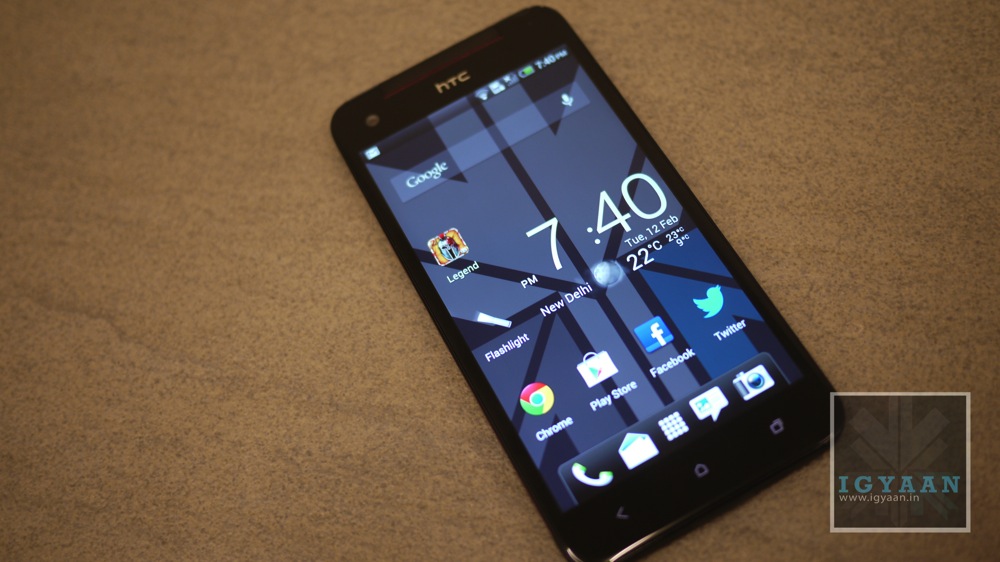
    In addition to an impressive spec sheet and super-sized proportions, the HTC Butterfly packed the world’s first smartphone-sized 1080p Full-HD display, a five-inch Super LCD 3 boasting an insane 440 pixels per inch. Boy were we all excited!

    Honestly though, once we got over all those amazing marketing lines that HTC threw at us, all that related to a Full-HD display and the massive ppi, we wondered about how useful these new displays truly were.
    Full-HD display

    I had a chance to test the Butterfly soon after and was  surprised at how unimpressed I was when I saw the screen. Don’t get me wrong, it’s beautiful. It’s ridiculously sharp, everything looks perfect on it, and the sample videos that come with it truly show off what a 5″ 1080p Full-HD display is capable of, video-wise.

    Despite all of that though, my reaction to it was more one of confirming what I was already expecting than it was one that blew me away. I still remember the first time I saw an iPhone 4; I was amazed at how good it looked. I didn’t get that with the Butterfly, because I fully expected it to look that way. 

    [pullquote_right]Back in February, Richard Yu, head of Huawei’s mobile division, claimed that a 1080p Full-HD display that is smaller than 5 inches didn’t make sense, as the human eye would be incapable of positively identifying the difference between that and a 720p panel.[/pullquote_right]

    Post the launch of the latest smartphones like the HTC One and the Galaxy S4, I realised, it’s more of a psychological effect than a physical one. If today someone was to go out and buy a smartphone with a 720p display, it would keep playing at the back of his/her head that there is another phone out there in the world which has an even better display, scientifically at least, than the one he/she is getting by paying a premium price for that smartphone. Even if that means lesser battery life and more GPU usage. 

    And we can’t really blame ourselves, for the way these Full-HD displays are advertised, we can’t help but feel we’re missing out on something.  

    All that aside, it’s tough to see why anything substantially over 300ppi, the limit Apple initially cited as the “Retina” threshold, is even necessary. If pixels are indistinguishable at 300ppi, are they going to be more indistinguishable at the latest smartphones’ 440+ ppi?

    It’s safe to assume now though that a  Full-HD display will be the saturation point as far as screen resolution is concerned, and we hope manufacturers would now shift their focus on improving other aspects of smartphones such as battery life, durability, audio, OS, performance etc.  

    In conclusion, it’s clear that you can’t really differentiate between a 1080p Full-HD display and a 720p one. Yet we may find ourselves shelling out a bit more money to get a Full-HD “revolutionary” device than what we would on an equally capable 720p one. It’s all good marketing and the need for us humans to have the best of everything (even if that is not the case) in the end. At this point, it feels more like a bragging right than a feature that can make our lives better.

    What do you think? Let us know below!

  • iOS 7 To See Major UI Overhaul, Running Behind Schedule

    iOS 7 To See Major UI Overhaul, Running Behind Schedule

    There have been some whispers floating around the web tonight that hint that Apple may be having trouble preparing for an iOS 7 launch down the road. Multiple rumors put the debut of iOS 7 some time this summer at Apple’s Worldwide Developer’s Conference with a launch a couple months later, but Apple could be struggling to meet that deadline.

    In a Branch chat, which at the time of this writing is still going on, Daring Fireball’s John Gruber says, according to what he’s heard, iOS 7 is running behind schedule and that it will bring a significant user interface (UI) refresh. 

    What I’ve heard: iOS 7 is running behind, and engineers have been pulled from OS X 10.9 to work on it. (Let me know if you’ve heard this song before.)

    Gruber went on to say that he’s heard that iOS 7 is a “significant system-wide UI overhaul” and the iOS engineers who are allowed to carry around devices with iOS 7 on them even have special privacy filters on their devices which reduces viewing angles. This is to prevent others from accidentally getting a glimpse of the new iOS design. 

    Back in 2007, Apple delayed the release of OS X Leopard to concentrate work on iPhone. Gruber claims that since iOS 7 development is “running behind,” it has promted OS X 10.9 engineers to be pulled from their work to lend a hand in getting the mobile OS ready in time for launch.

    Rene Ritchie of iMore adds, “Ive’s work is apparently making many people really happy, but will also apparently make rich-texture-loving designers sad.”

    As for what could be on the iPhone 5S, both Siegler and Panzarino say they’ve heard a lot about biometrics on the new device. The feature would apparently be used for payments and identification. Panzarino notes it wouldn’t be surprising to see AuthenTec’s biometric technology in Apple devices so soon after Apple purchased the company last July because of the urgency of the deal.

    [MacRumours]

  • Rumoured Apple Game Controller May Just Turn Out To Be Legit

    Rumoured Apple Game Controller May Just Turn Out To Be Legit

    Pocketgamer today says it has heard word from mobile game developers that Apple has been operating secret meetings at GDC discussing a game controller.

    Long rumoured – and hoped for – GDC 2013 has finally provided confirmation that Apple will release its own dedicated game controller. Of course, there’s no official word yet, but Apple has been active during the conference talking to developers about its plans and ensuring plenty of games will support the joypad at launch.It’s been operating a meeting room at the show, albeit booked under a pseudonym company name to avoid media attention.However, speaking anonymously, multiple developer sources have confirmed the news to PocketGamer.biz

    Should Apple’s rumored controller be unveiled alongside an updated Apple TV, such an event would largely confirm earlier rumors that Apple was preparing to make a push to turn its “hobby” into a much bigger pillar within the company. Those rumors had Apple revealing a standard development kit (SDK) and possibly opening the App Store for operation on its set-top box, two elements that would likely be necessary were Apple to release a controller for iOS/Apple TV gaming.

    Apple’s iOS devices have in short time become a major platform for game development, with games from previously unknown developers going on to sell in the millions of copies. The touchscreen form factor of the devices, though, has to some extent kept them from functioning as serious, dedicated gaming platforms. 

    Some major developers have introduced ports of successful titles for Apple’s devices, specially crafted to suit the touchscreen. These titles, though, tend to be from a limited range of game genres.

    In the site’s 2012 review of the 3rd generation iPad, AnandTech’s Anand Lal Shimpi and Vivek Gowri let slip a tantalizing tidbit when discussing the iPad’s faculty as a gaming machine: ”I know of an internal Apple project to bring a physical controller to market, but whether or not it will ever see the light of day remains to be seen,” the review reads.

    apple
    Apple has been filing patents related to gaming devices for quite some time now.

    What’s more Apple has been seen bulking itself up with patents that relate to a potential gaming push for at least a few years now.

    Update : 

    It wasn’t long before the unofficial oracle of Apple, Jim Dalrymple of loopinsight.com rained on everyone’s parade. At 1:19 PM today, he posted one of his terse responses in regards to the rumors of an Apple gamepad. The one word assassin “Nope.” Considering that he is well know to have reliable sources within Apple, and that he had an impeccable track record when it comes to rumors, that’s pretty much that.

    [Tech Crunch. Pocket Gamer]

  • Some iOS Developers Targeted With iMessage “Denial Of Service” Attack

    Some iOS Developers Targeted With iMessage “Denial Of Service” Attack

    The Next Web is reporting that a group of iOS developers has been targeted with a series of rapid-fire messages on iMessage, creating a sort of denial-of-service (DoS) attack that crashes the iMessage app.

    App developers iH8sn0w, well known for his jailbreak tool, and Grant Paul were among those targeted by the DoS attack that overwhelmed their respective Messages inboxes with a load of automatically-generated transmissions. 

    imessage

    The two devs believe the messages to have been sent one after another from the Messages app on OS X, with a simple AppleScript effecting the barrage that prompts a victim to constantly clear notifications and text.

    Grant Paul, one of the targeted iOS developers explains how the attack worked:

    “What’s happening is a simple flood: Apple doesn’t seem to limit how fast messages can be sent, so the attacker is able to send thousands of messages very quickly,” Paul says.

    The second part of that, he explains, is that if a user sends a ‘complex’ text message using unicode characters that force a browser to render ‘Zalgo’ text, or simply uses a message that is enormous in size, them the Messages app will eventually crash as it fails to display it properly. This will effectively ‘break’ the Messages app on iOS by forcing it to close and stop it from re-opening because it can’t render that text.”

    iH8sn0w mocked up a proof-of-concept AppleScript to demonstrate how such an attack may work. If Apple doesn’t limit the influx of messages, a user’s app will quickly become filled with what amounts to piles of spam.

    The attacks hit at least a half-dozen iOS developer and hacker community members, and appear to have originated with a Twitter account involved in selling UDIDs, provisioning profiles and more that facilitate in the installation of pirated App Store apps which are re-signed and distributed.

    Currently, there is no way to block particular senders in iMessage, though iH8sn0w said it should be possible for Apple to notice the bursts of messages and block them as repetitive spamming. Victims can also disable iMessage entirely.

    [The Next Web, Mac Rumors]

  • Apple Patents Wraparound Display For iPhone

    Apple Patents Wraparound Display For iPhone

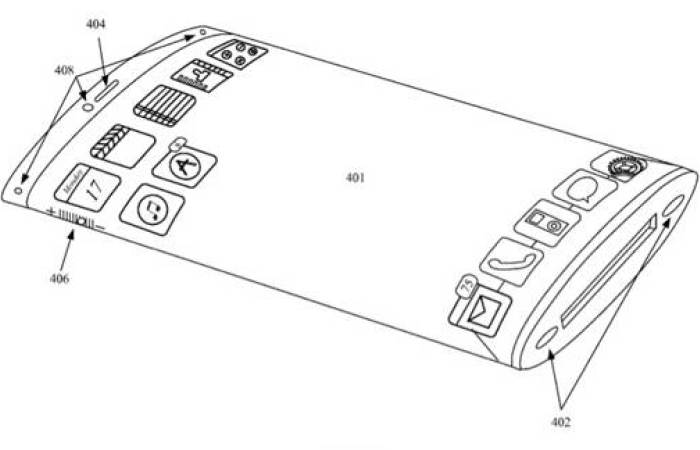
    A couple of days back the US  Patent and Trademarks Office published Apple’s application for a wrap-around form factor for electronic devices. It looks like a curvy, future iPhone.

    Well, not “wraps around,” per se, but rather “wraps within.” Patent application 20130076612, published Thursday morning in the US Patent and Trademark Office’s weekly filing-fest, describes a device in which a flexible AMOLED display is inserted into a hollow glass housing, and is pressed against the inside of that housing by “structural support elements.”

    In one of its examples, Apple describes a device with two flexible displays that work together.

    You can see from Apple’s illustration above what a flexible iPhone might look like. Note the volume controls on the side that are no longer physical buttons, but virtual ones.

    This certainly seems like a form factor that would be better suited to the palms of our hands, but it’s unclear how practical it would be in everyday use. A wraparound display may not be as comfortable to type on, and it may not be as suitable as a flat display for things like gaming and watching movies.

    apple

    The filing also describes a rather simple and permanent-looking connector that handles communications between the display and the device’s logic board, which resides in the center of the transparent housing.

    What do you think? Are you excited? Or could all this be used for the rumoured iWatch?

    [Forbes, Cult of Mac]

  • Report : Apple Hiring ‘Ground Truth’ Managers To Improve Maps

    Report : Apple Hiring ‘Ground Truth’ Managers To Improve Maps

    If job listings are any indication, Apple remains committed to improving its iOS Maps app.

    Apple’s woes regarding its Maps mobile app have been well documented, with the company taking a lot of flak from a lot of (lost) people, especially in the weeks following the app’s launch in September last year.

    Apple

    In the clearest sign yet that the Cupertino-based company is set on making the app something you’ll want to actually tap on and open. As the iDownload Blog spotted, Apple has posted job ads on its site for “Maps ground truth managers” at seven locations around the world.

    Here’s the job description for the U.S.-based “ground truth manager”:

    The Maps team is searching for a manager for the team responsible for regional map quality and ground truth in the U.S. Each of our regional teams is responsible for the quality of our maps in their region. This team’s responsibilities include:
    • Testing new releases of map code and data around the U.S.
    • Collecting ground truth data to allow for analysis of the impact of potential map code or data changes relative to known truth.
    • Utilizing local expertise to provide feedback about U.S.-specific mapping details.
    • Evaluating competing products in-region relative to our maps.
    As the manager of this team, you will be expected to drive all of this team’s work, determine where and how to allocate resources and clearly communicate test results and other feedback to teams in Cupertino. The U.S. regional team is also responsible for driving communication between engineering teams in Cupertino and our other regional teams as well as evaluating new regional testing initiatives in close coordination with the rest of the Maps quality team before those initiatives are rolled out to the other regional teams.

    The job listings not only reflect Apple Maps’ early problems, but also underscore how right Google’s Eric Schmidt was last year when he said that Apple is learning that “maps are really hard.”

    Google has been working on maps for years, and relies heavily today on “feet on the ground” products like Google Street View and Map Maker to improve its mapping accuracy. To give you an idea of how far ahead Google is, consider that those two products launched in 2007 and 2008, respectively. And 5-6 years is a long time in internet/tech development.

    We’re sure iOS 7 will feature “magical” and “revolutionary” new features in their Maps app.

    [Search Engine Land, iDownload Blog]

  • Apple Updates Find My Friends, Introduces Revamped Location Alerts

    Apple Updates Find My Friends, Introduces Revamped Location Alerts

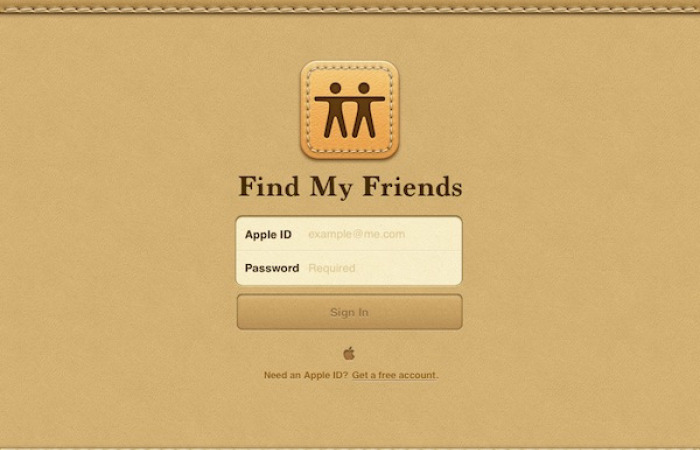
    Apple has updated its Find My Friends app. Version 2.1 now features a new UI to search and set location-based notifications. Probably the nicest part of the update is the ability to set a distance threshold from a certain location.

    While Find My Friends is a little harder to setup and tweak compared with the very simple Find My iPhone app, it is a nice way to share your location with friends and family who are using iOS devices.

    Find My Friends

    Find My Friends “Notify Me” page now features a customizable boundary, or geofencing, option that can be expanded or contracted around a located iOS device. Users can adjust the monitored area around a device by selecting the “Change Location” button, which resets the geofencing threshold to allow for more accurate location-based notifications.

    With the added functionality, users can select and manipulate the purple circle representing the geofencing around a tracked device, giving a bit more customization to the previous set threshold.

    The Next Web reports : 

    The new interface for setting up those alerts has been tweaked to let you set the exact distance threshold from a location. This lets you fine-tune the sensitivity of an alert for, say, two different buildings on a campus. If you just wanted to know when someone is ‘home’, the older process with a ‘fixed’ zone was fine, but if you were looking to get notices when someone gets into a neighborhood, it was pretty much impossible.

    [TNW, Apple Insider]

  • Apple Alleges $85 Million Error In Court Damages Order

    Apple Alleges $85 Million Error In Court Damages Order

    Samsung can’t seem to shake Apple off its back and although damages of $599 million were awarded to Apple, the tech giant still isn’t satisfied. In documents filed by Apple, they claim Judge Lucy Koh made an $85 million error in calculating damages. Supposedly, Koh thought the jury had granted $44,792,974 for the Infuse 4G and $40,494,356 for the Galaxy S II on AT&T, Florian Mueller reports for FOSS Patents. However, according to Apple, Samsung’s own statements prove that “disgorgement of profits for design patent infringement”, were permissible.

    “The number of products for which the damages award can stand would go up from 14 to 16, while the number of products for which a new determination is needed would go down from 14 to 12. The affirmed damages award would increase from $600 million to $685 million, almost two thirds of the $1.05 billion verdict”.

    Apple now seeks the court’s permission to bring a motion for reconsideration, though the request to bring such a motion is, for the time being, conditional.

    Apple’s conditional motion cites Civil Local Rule 7-9(b)(3). The related rule of the Northern District of California allows a motion for reconsideration in the event of “[a] manifest failure by the Court to consider material facts or dispositive legal arguments which were presented to the Court before such interlocutory order”.

    This is getting interesting! 

    [FOSS Patents]

  • Microsoft : Windows Phone Is Outselling iPhone In 7 Markets, Including India

    On Wednesday a blog post from Frank Shaw, head of PR at Microsoft, revealed that Windows Phone is outshipping the iPhone in seven countries.

    According to the IDC, who measures shipped numbers, more Windows Phones were shipped into 7 markets than iPhones and more than Blackberry in 26 markets.

    But before Apple fans explode with indignation, yes there is a catch.  Windows Phone outsold the iPhone in a smattering of emerging markets, where the high price of Apple’s trendy phone is probably a barrier to sales success.  In total Windows Phone led the iPhone in Argentina, India, Poland, Russia, South Africa, Ukraine, and “rest of central and eastern Europe”.

    In India, the arrival of low-end Windows Phone devices — namely Nokia Lumia 510/620/820 – has certainly boosted Windows Phone. Nokia’s also trying to market its Lumia 920 and Lumia 820 handsets via television and print campaigns. So it won’t come as a surprise if shipments are higher than that of the iPhone given that the iPhone commands a much higher retail price. 

    IDC’s numbers also reflect only the official number of cellphones imported into the countries. IDC said that in some countries, like Argentina and India high government taxes mean there is a very significant gray market in cellphones, which IDC doesn’t track. So it is hard to know actual market share in those places.

    While it’s certainly good news that Windows Phone is breaking into emerging markets, Windows Phone has had issues breaking in to the tough, and arguably more significant North American market as of late. Tackling the developed markets is no doubt a priority for Microsoft at the moment, and with Nokia continuing to release new devices, hopefully for Microsoft, progress will come.

    Do these facts diminish Microsoft’s announcement that Windows Phone outshipped the iPhone in seven countries — or not? Tell us in the comments, below.

    [Mashable]

  • “XCOM : Enemy Unknown” Coming To iOS

    “XCOM : Enemy Unknown” Coming To iOS

    Firaxis has announced that the full version of console and PC strategy title XCOM : Enemy Unknown will release on iOS.

    XCOM‘s developers spoke with Joystiq on Saturday after revealing the iOS port of the award-winning strategy game during a PAX East panel. The iOS version of XCOM : Enemy Unknown, they said, will arrive fully intact, with all the features available on its PC and console counterparts.

    “It is a straight port,” XCOM lead designer Jake Solomon said. “We have not made any gameplay exceptions. You play the exact same game… it’s just now fully playable on an iPhone or an iPad.”

    XCOM : Enemy Unknown is a re-imagined version of the 1994 game X-COM: UFO Defense. The game puts players at the head of a secretive agency charged with protecting Earth from extraterrestrials. Players must monitor alien activity throughout the globe and respond to it with force. They can scramble jets to shoot down UFO’s, or send teams of agents into battle against alien ground forces. Players will directly control their agents in turn-based battles. They’re also in charge of researching new technologies to ensure that their team is adequately equipped to stop the alien invasion.

    The game’s developers stressed that XCOM : Enemy Unknown on iOS will be a premium product and priced accordingly. 

    “It’s going to be priced appropriately for what it is,” Solomon said. “It’s going to be a premium price point. It is the game. It is the full game.”

    Some questions remain, however. Will multiplayer make the port? Will any kind of cross-platform saving or online matches be possible?

  • Apple Acquires WiFiSLAM Indoor Location Tech Startup

    Apple Acquires WiFiSLAM Indoor Location Tech Startup

    The Wall Street Journal is reporting that Apple has acquired indoor mobile location positioning firm WiFiSLAM, in a deal worth somewhere in the neighborhood of $20 million.

    The Wall Street Journal‘s Jessica Lessin reports:

    “Apple has acquired indoor-GPS company WifiSLAM, a sign that the war over indoor mobile location services is heating up. Apple paid around $20 million for the Silicon Valley-based company, according to a person familiar with the matter who said the deal closed recently.


    The two-year-old startup has developed ways for mobile apps to detect a phone user’s location in a building using Wi-Fi signals. It has been offering the technology to application developers for indoor mapping and new types of retail and social networking apps.”

    Founded in 2010 by former Google engineering intern Joseph Huang and Jessica Tsoong, WifiSlam develops technology that allows mobile apps to find a person’s exact location inside a building by using wi-fi signals. Such tech has been alluring to brick-and-mortar retail organizations that wish to gain more location-based data on customers as they browse a store, not to mention museums, theme parks, malls, and convention centers.

    Apple could implement the positioning assets into its much maligned iOS Maps app as an answer to Google’s Indoor Maps initiative, which leverages crowdsourcing to deliver indoor location information for a number of sites worldwide.

    [Wall Street Journal]

  • Apple Adds ‘In-App Purchase’ Warning In iTunes

    Apple Adds ‘In-App Purchase’ Warning In iTunes

    Apple has made a subtle change to the App Store to make consumers more aware of apps that offer in-app purchases. Apple recently added a new “Offers In-App Purchases” warning directly underneath the download button in iTunes following the settlement (as pictured below).

    apple

    Rather than continue to cash back to users, Apple has attempted to make perfectly clear which apps should be kept out of the reach of children if their folks aren’t savvy enough to password-protect purchases.

    Just last week the iPhone-maker refunded the parents of an 8-year-old British boy who had blown £980 (US$1,493, AU$1,429) of very real cash on virtual donuts in the ‘free’ Simpsons: Tapped Out game.

    It wasn’t the first time, either. Last month, the company agreed to pay out up to $100m (UK£66m, AUD$96m) in refunds to parents in the United States whose kids had also made unsanctioned in-app purchases.

    The new “Offers In-App Purchases” warning is currently only visible within the desktop version of the iTunes App Store; but we would expect that to be rolled out across the iPhone and iPad versions of the store very soon.

    The new warning will still not prevent careless parents from allowing their children access to their passwords and running up huge bills but it will give Apple a better legal argument. Also it may be a sign that Apple could offer the ability to filter apps from the App Store that contain in-app purchases; this could be a good option for parents that give their children access to their iTunes password to download free apps.

    Making it clearer which apps use IAP is a step in the right direction on the latter front. More may follow at Apple’s WWDC developer event this summer, when the company is expected to unveil its iOS 7 software.

  • New Loophole Lets Attacker Reset An Apple ID With Only Your Birthday And Email Address

    New Loophole Lets Attacker Reset An Apple ID With Only Your Birthday And Email Address

    A worrying new security hole allows for an Apple ID to be hacked, simply by knowing the user’s email address and date of birth. The Verge first reported the vulnerability after being tipped off to the hack.

    The Verge reports:

    [T]oday a new exploit has been discovered that affects all customers who haven’t yet enabled [two-step verification]. It allows anyone with your email address and date of birth to reset your password — using Apple’s own tools. We’ve been made aware of a step-by-step tutorial (which remains available as of this writing) that explains in detail how to take advantage of the vulnerability. The exploit involves pasting in a modified URL while answering the DOB security question on Apple’s iForgot page.

    The vulnerability affects all customers yet to upgrade to the two-step verification process, leaving those users’ accounts wide open to anyone who knows those not-exactly-hard-to-track down pieces of basic data. 

    apple

    The bad news is that two-step verification is not yet available in many countries. According to the Apple FAQ:

    Initially, two-step verification is being offered in the U.S., UK, Australia, Ireland, and New Zealand. Additional countries will be added over time. When your country is added, two-step verification will automatically appear in the Password and Security section of Manage My Apple ID when you sign in to My Apple ID.

    After the discovery, Apple subsequently took down the iForgot password reset page “for maintenance,” and updated the iCloud System Status webpage to inform users of the issue. 

    In a statement to The Verge the company said, “Apple takes customer privacy very seriously. We are aware of this issue, and working on a fix.”

    At the time of posting, Apple has taken down the iForgot page to avoid further hacks.

    Update : Several online sources report that the loophole has been fixed.

    [Via The Verge]

  • Apple’s Jonathan Ive Pushing For A More ‘Flat Design’ To iOS 7

    Apple’s Jonathan Ive Pushing For A More ‘Flat Design’ To iOS 7

    Back in October, iOS leader Scott Forstall was, along retail SVP John Browett, removed from Apple. It was a surprising decision, even after the nightmare iOS 6 Maps issue, but it quickly emerged that Forstall, in particular, had stepped on more than a few toes within the Cupertino executive ranks. Jony Ive, head of Industrial Design and credited with molding the vast majority of the company’s recent success stories, was said to strongly disagree with Forstall’s rampant skeuomorphism within the iOS UI, and since the Englishman has taken on the role as leader of Human Interface following Forstall’s departure, it now looks as though he plans to remove all remnants of the former iOS Senior Vice President.

    Jonathan Ive is pushing for a more ‘flat design’ to iOS 7, reports the WSJ.

    In the past, most of the iOS designers were cut out of the loop on specifics relating to the hardware of the devices they were designing for. On prototype projects, Ive used a stealth group of software developers. However, that is slowing starting to change, says the Journal.

    The Human Interface team led by Greg Christie is being briefed about industrial prototypes earlier. A source described the change as “a thawing”. Ive now sits in on the team’s review sessions to vet new designs and despite Christie being a blunt talker the sessions are described as “pleasant and cordial”.

    Some suggested that in Apple’s next mobile operating system, Ive is pushing a more “flat design” that is starker and simpler, according to developers who have spoken to Apple employees but didn’t have further details. Overall, they expect any changes to be pretty conservative. For the past few years, Apple has unveiled versions of its mobile operating system in the summer.

    While this report makes it sound as though there won’t be any earth-shattering changes made to the next version of iOS, a slight makeover could be in the cards. That obviously isn’t going to sit well with anyone that’s hoping for a major overhaul of iOS

    [Via WSJ]

  • Apple Patents iPhone Drop Protection Mechanisms That Are Built Into The Unit

    Apple Patents iPhone Drop Protection Mechanisms That Are Built Into The Unit

    Apple Inc. got a patent that could help protect iPhones from drops, including one that could help the smartphones change direction mid-air.

    Anyone with a pricey smartphone has likely felt that moment of panic when it slips from your fingers and tumbles to the floor. “Please be ok, please be ok,” you say to yourself, praying for a responsive gadget and a screen free of cracks.

    apple

    The patent is described as a “protective mechanism for an electronic device.” Apple Insider was the first to report on the new patent. The filing for it just appeared today, and it even mentions the Apple iPhone specifically as being a device that could be protected by the mechanism

    The patent describes a quantity of ways Apple may be capable to make a device that can change path mid-flight, which would let it to place its most effect-resistant surface forward to fulfill the floor. These incorporate an internal gadget for shifting mass to one stop of the Apple iPhone, an real “thrust mechanism” that could even consist of a “gas canister,” an air foil that activates in cost-free tumble, a way to agreement external bits like switches within the scenario for security, and a gripping system that can clamp down on charging and headphone cables to guarantee those capture the falling phone.

    We can’t help but be reminded of Amazon’s patent for a phone airbag. We won’t be seeing this in an iPhone anytime soon. Until then, we’ll have to stick with our conventional case.

    [Apple Insider, Tech Crunch]

iGyaan Network
Privacy Overview

This website uses cookies so that we can provide you with the best user experience possible. Cookie information is stored in your browser and performs functions such as recognising you when you return to our website and helping our team to understand which sections of the website you find most interesting and useful.