Category: Government, Law and Policy

  • How Social Media Helped Narendra Modi Win

    How Social Media Helped Narendra Modi Win

    Narendra Modi, leader of the Bhartiya Janata Party, won the 16th Lok Sabha elections on Friday. The stocks rose above the 25,000 mark for the first time, and the Rupee is finally getting stronger. As promised, the economic growth is moving forward in full force, but will this win deter and stunt us an independent inclusive state? Will the new ruling party ensure that the needs of the minorities are catered to? The nation is abuzz with questions about what Narendra Modi’s first big move as the Prime Minister of India may be.

    While the country debates about the pros and cons of Modi’s victory. We decided to take a step back and take a look at the party’s strategic online campaign which subsequently led to their smooth win.

    Futuristic Campaigning
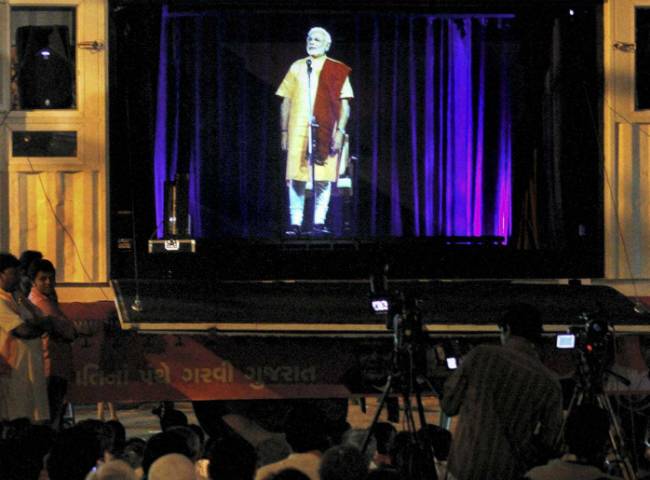
    Modi3D

    There is no debate about the fact that political campaigns can be no longer constrained to traditional rallying.  We’ve got something bigger and better connecting the voters and the potential leaders – the World Wide Web. The Bhartiya Janata Party ensured they had a strong online presence across each of the social media platforms – Facebook, Twitter, Google+ and YouTube.

    While the BJP party campaigned extensively across the country, conducting rally’s in every village, town and city; they did something clever. They went a step ahead and used various methods of technology to keep their voters feeling included. Many rural areas which were hard to reach and had no access to the internet, screens were staged and recorded speeches were played. Through Facebook, the 14 million followers could track Narendra Modi’s every move during the campaign. Meetings with dignitaries, selfies with celebrities, were shared. It was used as a mini blog, giving an impression that we are directly receiving messages from the Narendra Modi himself. His YouTube channel, has an extensive collection of speeches and interviews. The speeches were available is several regional languages.

    #ModifiedIndia

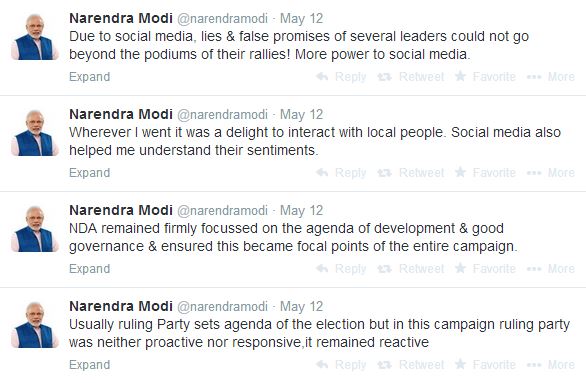
    On Twitter, @NarendraModi’s victory tweet, “India has won” created record history by becoming the most retweeted and favourited tweet from India. After Barack and Michelle Obama, he is now the most followed politician on Twitter. #Tsunamo, #Modiheadto2RCR, #Mission272 and #ModifiedIndia were some of the top trends on Twitter for days.
    Capture

    While Narendra Modi has more than 4million followers on Twitter, Rahul Gandhi doesn’t even have a verified Twitter account. The second most followed contestant on Twitter was Arvind Kejriwal, leader of the Aam Aadmi Party. It could be considered as an attempt to keep his following informed, however his tweets were mostly overconfident grumbling and blatant false promises. Much like most of Kejriwal’s campaign, his rants were ill-focused and misguided. On the other hand, Modi’s team used the platform what its meant for, connecting and building a sense of community through short eloquent messages.

    Brand Modi
    mugs

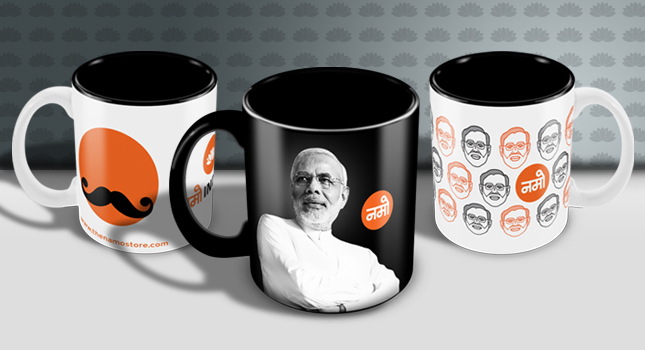
    Social Media Marketing works on one key concept – the appearance of underlying messages coming from a trusted source. The smartest move by BJP, was having a clear cut face for each of the platforms. More than promoting Bhartiya Janta Party, Narendra Modi’s name and face was everywhere.  It is a classic case of branding – they have a focus group (the entire population of India), a client brief (their election manifesto) and a product (Mr Modi).

    Overall, they used social media exactly like every major enterprise in the world is now using. Why shouldn’t they? A campaign is synonymous to a sales pitch. One that BJP mastered to the notch.

    While many attributes may have contributed to BJP’s win, one has to give the credit to the party’s attempt to plan ahead and use the strongest connectivity tool existent today. The outcome of the five years is yet to be seem, but the party needs to be given respect for smartly using social media to mobilize and include the masses. This also helped them promote an image of complete transparency.

    The slant and leaning of each of the political parties campaign’s were entirely reflected through their social media campaigns. Arvind Kejrival’s feeble attempt, Narendra Modi’s strong hold on the medium and Rahul Gandhi’s presence was entirely non-existent.

     

  • Net Neutrality vote: Our Internet is in Trouble

    Net Neutrality vote: Our Internet is in Trouble

    “Net Neutrality” – you might have heard this term in a passing reference on the internet or some news show. You may not know this yet, but this term directly has an effect on your life. We attempt to give you all the facts and tell you why you should care about net neutrality.

    Tim Wu Columbia Law Professor
    Tim Wu
    Columbia Law Professor

    The term, coined by Columbia media law professor Tim Wu in 2003, has been one of the major codes of conduct for the internet since its inception. It is the idea that internet service providers are not to discriminate between any content on the internet. The data packets which bring our services should all get equal access speed.

    This basic principle has allowed the internet to be an environment which encourages open competition and has encouraged some phenomenal innovation. It has helped even the smallest business models to grow to become international conglomerates, the most prominent examples of this a Google and Facebook.

    Open internet
    The Open Internet, Equal Access speed for all

    The fact that general public doesn’t realize is that internet is not just a service anymore, it has now become a necessary utility. It is literally impossible to live without a decent internet connection especially in urban areas where it is used for bill payments, shopping, and admissions in universities; in fact internet has intertwined itself with all facets of our daily life.

    The Federal Communication Commission (FCC) had codified the Net Neutrality principles into law in the 2010 Open Internet order. This order was unfortunately squashed by a federal court recently and can spell doom for the internet as we know it. This ruling can help create a precedent for internet companies to create a fast lanes for the highest bidder. This means wensites who agree to pay more will get a faster access while everyone else will end up getting sub par connectivity.

    Neutrality
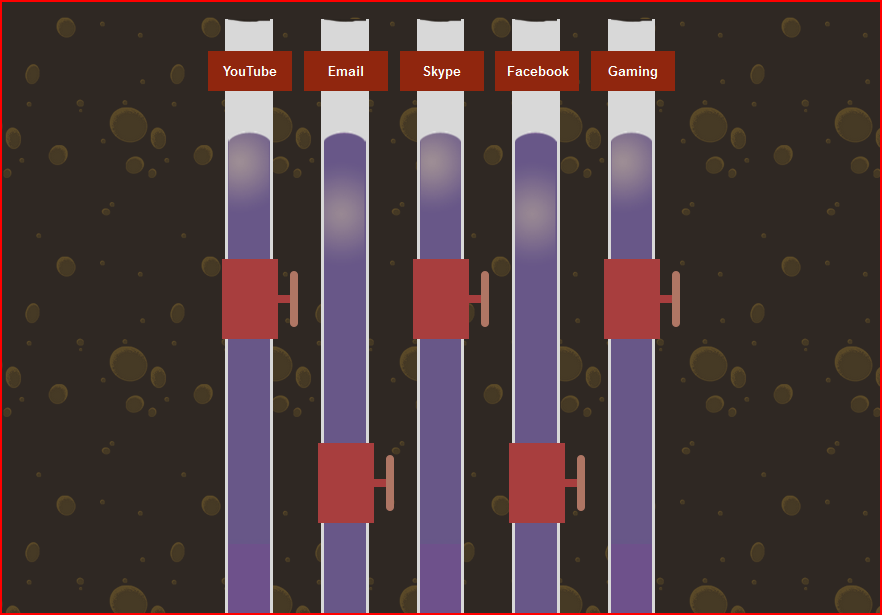
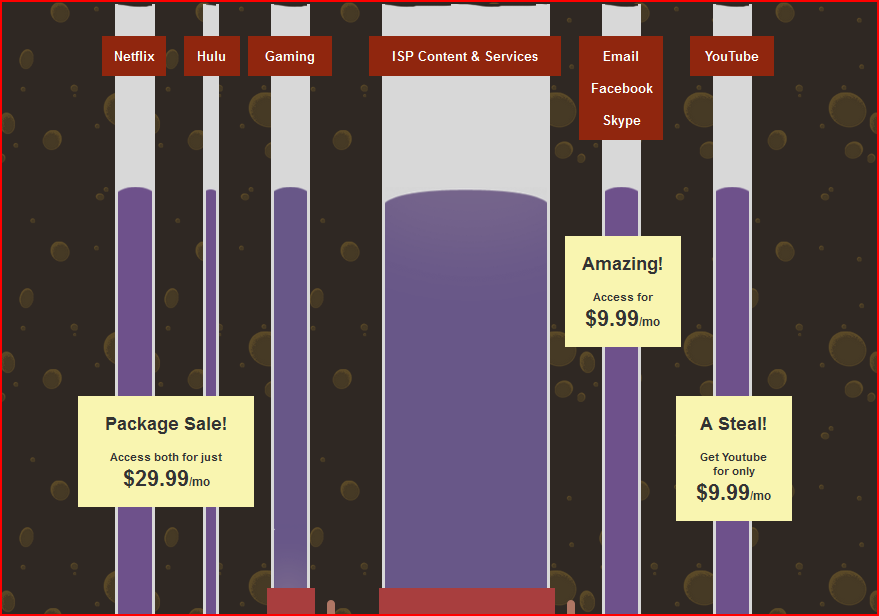
    Without Net Neutrality ISP’s can charge for individual websites.

    Imagine an internet where you have to pay to access individual websites. Like a Cable subscription where you have to pay more for bandwidth intensive websites such as YouTube or Vimeo. Most importantly it would kill smaller start-ups who  aspire to someday become the next Google.

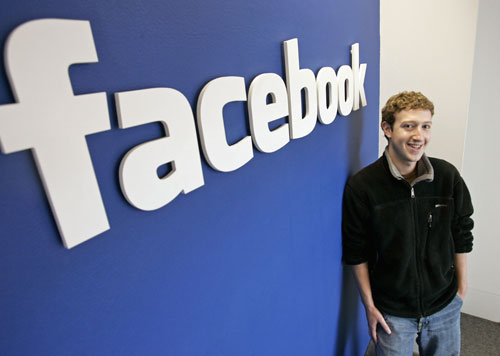
    Mark Zuckerberg could only succeed because of an open internet
    Mark Zuckerberg could only succeed because of an open internet

    The free and fair internet till now has given a level playing field for competition for all. So even a college freshman could create the Forbes listed, world’s biggest social medium called Facebook. It was also because of free internet that even iGyaan could reach its readers. But in a non net neutrality world, these guys will face the same obstacles which are faced by the real world business of finding resources.

    The opponents of net neutrality make a point that currently websites with higher bandwidth consumption pay the same price to reach the consumers like any other website. But when road traffic started getting congested, the government created wider roads and not special roads for rich people. They should consider the same. The Internet Service Providers (ISPs) which are opposing net neutrality earn billions in profits each year. Instead of disrupting a unique ecosystem that is still evolving, it is ISP’s prerogative to invest in making the services more innovative and sustainable for them as well as the internet. The companies will make more money by providing quality services to its consumers instead of trying to squeeze the last penny off them.

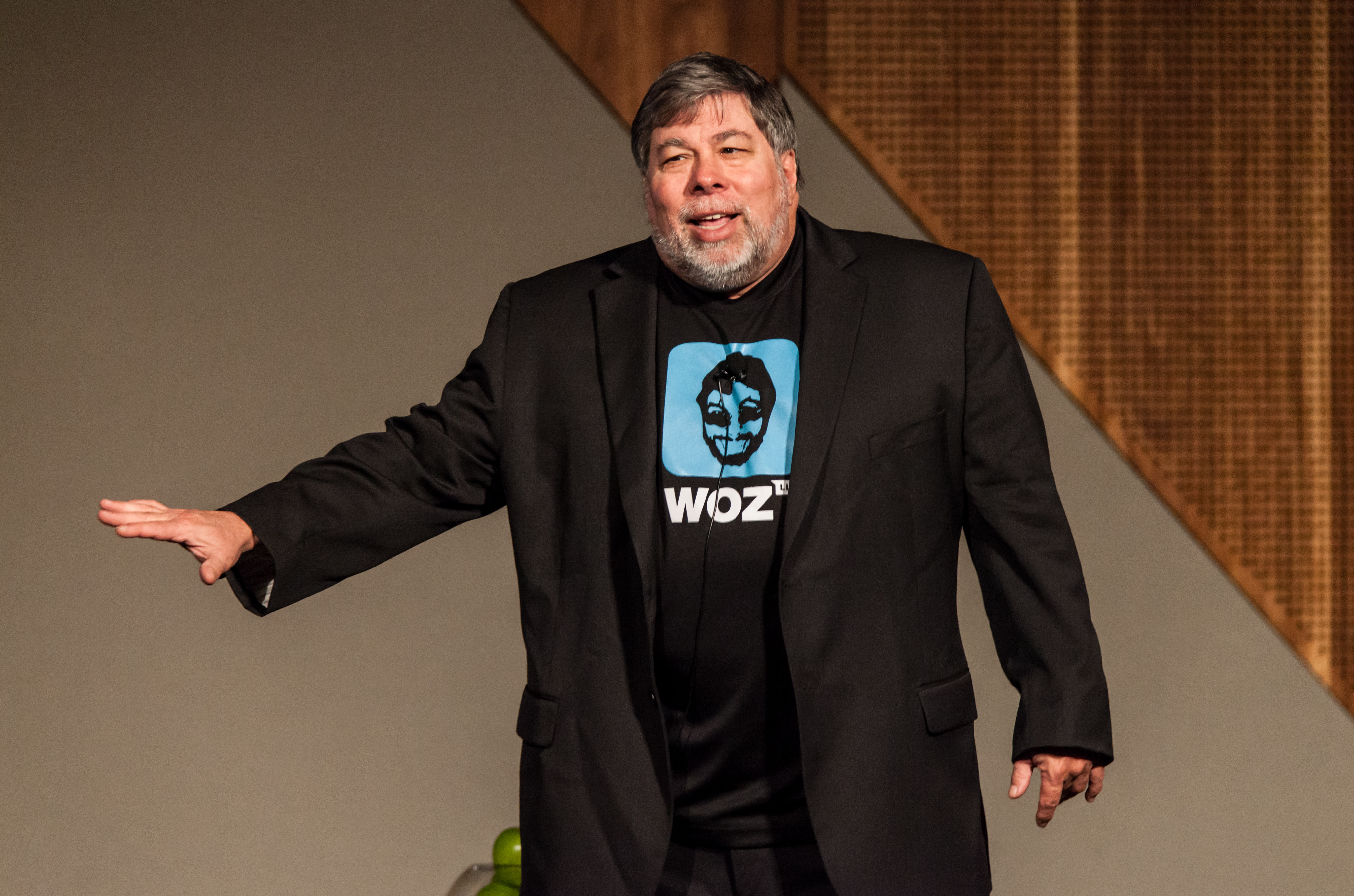
    Steve Wozniak is one of the major proponents of Net Neutrality
    Steve Wozniak is one of the major proponents of Net Neutrality. (Photo: Nichollas Harrison.)

    The great Steve Wozniak makes an excellent analogy when he says that nobody charges you for your per kilometer travel, then why charge for telecom routes. When the roads require maintenance, the government comes to do their part and this must be the responsibility of the ISPs itself.

    newguidelines
    TRAI needs to formulate regulations now

    In India though there are no specific laws safeguarding net neutrality. TRAI in its guidelines mentions non-discrimination, but it is not really enforced.  The high cost of spectrum licensing in India and the ever growing burden of massive mobile devices market  may lead companies to go for charging a premium on some websites. India’s BRICS companion Brazil recently enacted a brilliant piece of net neutrality legislation and we should ask our lawmakers for the same. All we as consumers can do is be vigilant and raise our voices when we see that happen.

    There is going to be a vote at FCC on Thursday the 15th which will decide the future of our internet. This vote can go both ways, the commission can create a precedent where companies can charge websites for priority access. Or the commission can create a legally safe law in which internet will be treated as a telecom service thereby giving FCC complete authority to regulate it. The great news right now is that most of the commissioners are siding with the open internet platform but what happens on Thursday still remain to be seen.

    There have been many times when  governments try to bring laws which discourage the free exchange of ideas. SOPA, PIPA were some of the laws targeted towards decreasing the efficacy of the internet dialogue. But some good sense prevailed and saved our internet. Net neutrality advocates from around the world are wishing for the same and hope to keep the future of a free and open internet secure.

  • Google Dodges Fine with EU Antitrust Deal

    Google Dodges Fine with EU Antitrust Deal

    As The Wall Street Journal reports, Google has clinched a settlement in its high-profile case with European Union antitrust regulators to address concerns that it is abusing its dominance in online search.

    EU Antitrust Commissioner Joaquin Almunia said that he’s “strongly convinced” the new proposals sufficiently address the competition concerns, marking a major milestone in the three-year-old case. “This is an important step forward,” he told reporters in Brussels.

    Google had been accused of giving favourable treatment to its own products in search results. The company said it looked forward to resolving the matter.

    As FT reports, on the European Commission’s side, there is still going to be a final approval process. The groups that filed the original complaint against Google will be consulted, but it will not be a formal “market test”. The commission will monitor whether Google sticks to its promises.

    The agreement means the world’s dominant search engine has avoided a process that could have lead to a fine of up to $5 billion, or 10 percent of its 2012 revenue. It must stick to the deal for the next five years. Google has a market share of about 90 percent of Internet searches in Europe, compared with around 70 percent in the U.S.

    However, Google may still face a second EU investigation, this time into its Android operating system for smartphones, with potentially bigger risks for the company.

  • Google To Face Hefty Fine For SimpleAir Push Notification Patent Infringement

    Google To Face Hefty Fine For SimpleAir Push Notification Patent Infringement

    SimpleAir is seeking $125M in damages from Google after a jury found that push notification services in Android infringe on a SimpleAir patent, the company said Tuesday.

    The accused services are the Google Cloud Messaging (GCM) and Android Cloud to Device Messaging (C2DM) services. The services are used by Google to process and send instant notifications for Android applications, such as Facebook, Twitter, and Gmail.

    It’s worth noting that Google isn’t the first company to run into trouble with SimpleAir. Microsoft, Apple and even Blackberry all have licensing agreements with the company, after all. 

    Because the jury did not agree on how much to award in damages, a limited second trial will be held to determine the amount. SimpleAir said in a press release that it will seek US$125 million, though it did not specify how it had calculated the amount.

    [modal heading=”Press Release” text=”Press Release” size=”btn-medium”]Federal Jury Finds Google Infringed SimpleAir Patent January 21, 2014 03:45 PM Eastern Standard Time MARSHALL, Texas–(BUSINESS WIRE)–SimpleAir announced today that a federal jury returned a verdict that SimpleAir’s U.S. Patent No. 7,035,914 is infringed by Google. The verdict was reached on Saturday, January 18, 2014, following a week-long trial presided over by the Honorable Rodney Gilstrap, U.S. District Judge for the Eastern District of Texas. “We are grateful for the jury’s hard work in this case and pleased with their verdict” SimpleAir had alleged that Google’s push notification services for the Android smartphones and tablets infringed five claims of the ‘914 patent. The jury agreed unanimously on all counts of infringement and also found unanimously that each claim was valid. The validity of the patent had previously been confirmed by the U.S. Patent and Trademark Office during a Reexamination proceeding that concluded in February 2013. The accused services are the Google Cloud Messaging (GCM) and Android Cloud to Device Messaging (C2DM) services. The services are used by Google to process and send instant notifications for Android applications, such as Facebook, Twitter, and Gmail. The jury was unable to reach a unanimous decision on the amount of damages to award for Google’s infringement. The damages issue will be decided by a separate jury in a limited second trial. SimpleAir will seek damages in excess of $125 million for Google’s infringement in the damages retrial. “We are grateful for the jury’s hard work in this case and pleased with their verdict,” said John Payne, who is the lead inventor and majority owner of SimpleAir. “There was a lot of information presented to the jury and they did an exceptional job figuring out what mattered and what didn’t. We look forward to addressing the issue of damages in the second trial and hope the jury in that trial will be as dedicated as this one was.” SimpleAir is an inventor-owned technology licensing company. The company holds eight issued U.S. Patents and several pending patent applications in the areas of wireless content delivery, mobile applications, and push notifications. SimpleAir has licensed its inventions to many leading technology companies. SimpleAir is represented by Greg Dovel, Jeff Eichmann, and Simon Franzini of Dovel & Luner LLP and by Calvin Capshaw, Elizabeth DeRieux, and Jeff Rambin of Capshaw DeRieux LLP.[/modal]

  • Microsoft : Syrian Hackers Hacked Into Employee Accounts

    Microsoft : Syrian Hackers Hacked Into Employee Accounts

    Microsoft yesterday confirmed that the Syrian Electronic Army accessed a “small number” of employee e-mail accounts.

    As The Verge notes, those published screenshots “mainly discuss[ed] the latest compromises of several Microsoft-owned Twitter accounts.” Included among the published screenshots was an email from Steve Clayton to Frank Shaw. 

    The Syrian Electronic Army — a political hacking group that supports Syrian President Bashar Assad — appears to be waging a war on Microsoft. Over the weekend, the group took control of the Twitter accounts of Xbox and Xbox Support, along with Xbox’s Instagram account.

    As the Verge reports, it’s not immediately clear how many email accounts were targeted during the recent attacks, or how much data the Syrian Electronic Army were able to obtain before the accounts were reset. A Syrian Electronic Army representative says that the latest attacks were designed to be a distraction, indicating there could be further compromises in future. “We are making some distraction for Microsoft employees so we can success in our main mission,” the SEA told The Verge by email.

  • HTC Executive Indicted For Leaking Secrets

    HTC Executive Indicted For Leaking Secrets

    Six employees of leading local smartphone maker HTC Corp, including vice president of product design Chien Chih-lin, were indicted by the Taipei District Prosecutors’ Office yesterday on charges of leaking trade secrets and breach of trust.

    According to the Wall Street Journal, Thomas Chien, formerly VP of product design at HTC, has been charged with leaking details of a future smartphone interface design, believed to be version 6.0 of the company’s Sense software for Android.

    In addition, prosecutors allege that Chien and his collaborators profited to the tune of 33.6 million New Taiwanese dollars ($1.12m) by accepting kickbacks from suppliers and charging fake expenses back to HTC.

    The Taipei Times named the 5 other HTC employees involved in the indictment as HTC senior manager of design and innovation Huang Kuo-ching, HTC research and development director Wu Chien-hung, senior manager of design and innovation Huang Hung-yi, manufacturing design department manager Hung Chung-yi, and employee Chen Shih-tsou.

    An HTC representative said that “The company expects employees to observe and practice the highest levels of integrity and ethics. Protecting the company’s proprietary and intellectual properties, privacy and security is a core fundamental responsibility of every employee. The company does not condone any violation.”

    Leaking company secrets could carry prison sentences of up to 10 years. The indictments top off a year of bad news for HTC, which has struggled with poor sales and executive management.

  • Apple Retains Multi-touch Patent

    Apple Retains Multi-touch Patent

    USPTO now once again recognizes patent No. 7,479,949 (for the multi-touch feature) in Apple’s favour after invalidating it in 2012. This happens to be one of the two patents that the ITC has determined was infringed on by Samsung, leading to a current import ban on some older Samsung models.

    Titled “Touch screen device, method, and graphical user interface for determining commands by applying heuristics,” the ‘949 patent is a broad, sweeping property covering functional aspects of multitouch screens like those found in many smart devices, like the iPhone and iPad. 

    Steve Jobs is listed as the first of over two dozen inventors on the patent, and it is considered perhaps the most famous of his over 300 credited patents. 

    As FOSS Patents notes :

    As we speak, the Steve Jobs patent is even stronger than it was before someone (presumably Samsung and Google) challenged it anonymously. On September 4, 2013, the USPTO issued a reexamination certificate confirming the patentability of all 20 claims because the prior art neither anticipated this invention nor renders it obvious.

    A number of Apple’s key patents have been challenged for reexamination as its competitors have sought to derail Apple’s claims against them in various court battles. 

    Apple has also filed an appeal to broaden the US import ban to cover additional Samsung products. The Cupertino company has asked the US International Trade Commission (ITC) to review three more patent cases, following the ITC finding Samsung guilty of two patent infringements already. 

  • Here’s Why The 0% Interest EMI Schemes Were Scrapped

    Here’s Why The 0% Interest EMI Schemes Were Scrapped

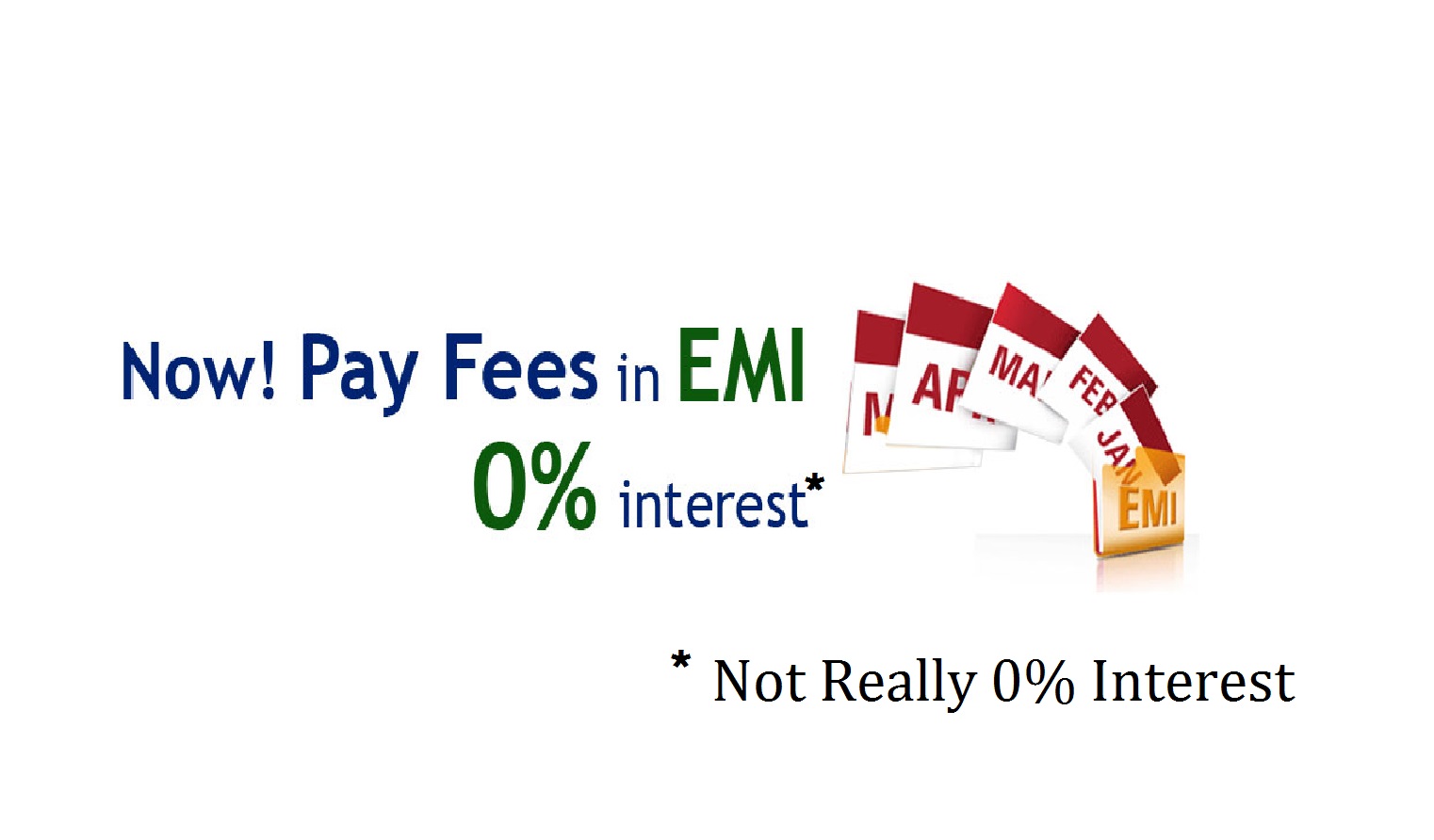
    Over the past 6 months, various companies including Apple, Samsung and Micromax went on an aggressive marketing drive that was based around the “0% EMI” tagline. Consumers, young and old alike, were attracted by the possibility of buying the device of their choice, by paying small amounts of money over a prolonged period of time. That too without any overhead costs. Who wouldn’t?

    So when the RBI on Wednesday banned zero per cent interest rate EMI schemes for purchase of consumer goods, it came as a shock for many people.

    What would possibly have been wrong? The companies were sacrificing their interest money just so we could get our dream products easily no? No.

    The very concept of zero per cent interest “is non-existent,” the RBI said. So how were the companies offering such schemes?

    The answer here lies in that “negligible” processing fee that the companies/showrooms charged when you opted for the EMI schemes. In the zero per cent EMI schemes offered on credit card outstandings, the interest element is often camouflaged and passed on to customer in the form of processing fee.

    Explaining the zero per cent EMI schemes on credit cards, Gaurav Mashruwala, a certified financial planner, said, “When a person buys a TV set for Rs 60,000 and makes full payment in cash, the dealer gives him a discount say of Rs 5,000. However, when the same TV is bought in instalments with a credit card, he is not entitled to any discount which is the earning for the bank.”

    As BankBazaar explains, these zero percent schemes have hidden costs inbuilt in them. Perhaps the biggest loss for you would be forfeiting the cash discount on a product that you could have otherwise got if you had bought it on full cash. This apart you will also be paying a transaction or processing fee under the zero percent scheme and consequently more money through advance EMIs.

    For example, you decide to buy an LCD colour television that costs around Rs. 48,000. You decide to buy it using the zero percent finance scheme. Under this arrangement you will pay the entire cost in six EMIs of Rs. 8,000 for six months. This works out to be Rs. 48,000 spread over 6 months. Now here’s how you end up paying more! To begin with you pay a processing fee of Rs. 1,000. And since you are buying the LCD on a zero percent finance scheme you are not entitled to the cash discount of Rs. 2,000!

    So here’s how it looks in the above example. The LCD costs Rs. 48,000! Add up the Rs. 1,000 processing fee that you pay initially and Rs. 2,000 that was lost out on cash discount. A total of Rs. 3, 000! This means you get a net finance of Rs. 45,000 only! Now you pay an EMI of Rs. 8,000 for 6 months which totals up to Rs. 48,000. So at the end of six months you pay Rs. 3,000 more for what you got.

    So ultimately, it all came down to false advertising and clever marketing. The consumer was led to believe that he/she was getting a fantastic deal whereas the company was earning way more than they would in case of a down payment. These schemes helped companies attain double digit growth as far sales were concerned.

    No wonder they are aggrieved by the RBI’s decision. Well done, we say.

  • Hacking Case Sentence Of Pirate Bay Founder Reduced

    Hacking Case Sentence Of Pirate Bay Founder Reduced

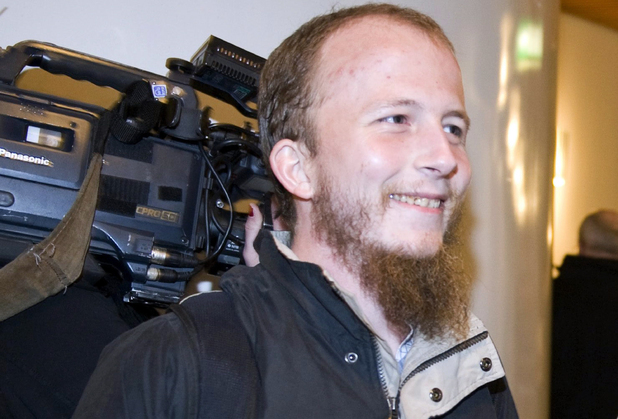
    The court however upheld Pirate Bay founder Svartholm Warg’s conviction for hacking into IT firm Logica, meaning he will still spend a year behind bars.

    The Svea Court of Appeal convicted Gottfrid Svartholm Warg of having illegally accessed the website of Logica, an international IT firm contracted to Swedish government agencies. Some of the information, including personal data, was made public. The scope of the hacking from 2010 to 2012 was sizeable, the court said.

    Svartholm Warg appealed that ruling, but left the country. He was arrested in Cambodia in 2012 and deported back to Sweden after an international arrest warrant was issued against him. He has served out his sentence for his first conviction while under detention over his hacking charges.

    Warg, a 28-year-old Swede, was extradited to Sweden last year from Cambodia to begin a separate one-year jail sentence, incurred when he was convicted in 2009 of Internet piracy along with other co-founders of Pirate Bay.

    “The important thing is to get the higher court to review the evidence in-depth, something that the lower court definitively didn’t do,” Kristina Svartholm, the Pirate Bay co-founder’s mother told website TorrentFreak prior to Wednesday’s ruling.

    Svartholm Warg and his fellow Pirate Bay co-founders Fredrik Neij and Peter Sunde, as well as financier Carl Lundström, were all convicted in 2009 of facilitating copyright infringement and ordered to pay 46 million kronor ($6.9 million) in damages to the music and movie industry.

    [Via]

  • 3D Realms Drops Duke Nukem Lawsuit Against Gearbox

    3D Realms Drops Duke Nukem Lawsuit Against Gearbox

    When Gearbox released Duke Nukem Forever back in 2011, the game studio hadn’t anticipated that it will be slammed with a massive lawsuit by the original creators of Duke Nukem, 3D Realms. The legendary studio sued Gearbox for skimping on paying royalties on Duke Nukem Forever. But after a long tug of money war, a new press release issued earlier today revealed that 3D Realms has officially dropped the lawsuit

    In its lawsuit 3D Realms argued that Gearbox had “refused and failed to make substantial royalty payments” related to the deal and that Gearbox had failed to take over responsibility for a $2.9 million loan – which was also allegedly part of that same agreement.

    It also included a statement from Scott Miller, the CEO of 3D Realms (also known as Apogee Software), who apologized for the damage it had done to its relationship with Gearbox.

    “After reviewing evidence regarding our business affairs, and without any money exchanging hands, we have satisfactorily resolved any and all differences that we perceived against Gearbox,” Miller wrote. “In all sincerity, we regret the misunderstanding that instigated our lawsuit. Now that we better understand–and appreciate–the actual nature of our business matters, we have voluntarily withdrawn our claims against Gearbox, with genuine apologies to Randy [Pitchford, president of Gearbox] for any damage that our lawsuit may have caused to the relationship.”

    [Via]

  • Yahoo Reports 29,000 Data Requests From Government

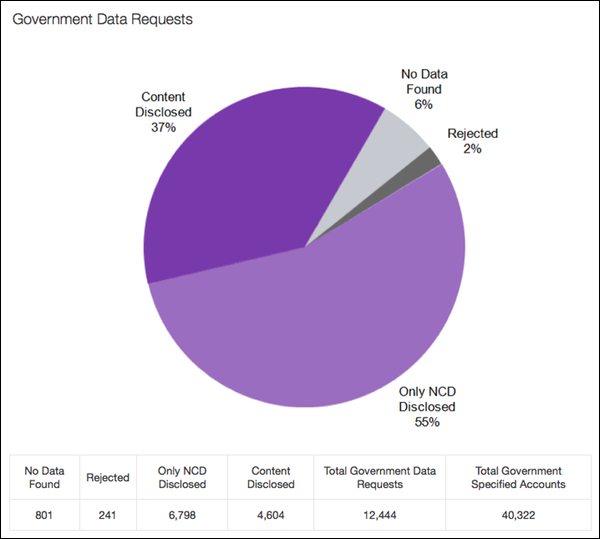
    Yahoo received 29,000 government data requests on its users this year, with almost half coming from the United States, according to the company’s global transparency report released Friday.

    Yahoo said in the report, covering the first six months of 2013, that 12,444 of the requests from worldwide governments came from the United States.

    At Yahoo, we take the privacy of our users seriously,” general counsel (Yahoo) Ron Bell said in a blog post. We also recognize our role as a global company in promoting freedom of expression wherever we do business. That’s why we’re issuing our first global law enforcement transparency report.”

    He added that the report includes US “national security requests” which have become a major issue in light of reports on secret government surveillance programs run by the United States. “Our legal department demands that government data requests be made through lawful means and for lawful purposes,” Bell said.

    “We regularly push back against improper requests for user data, including fighting requests that are unclear, improper, overbroad or unlawful. In addition, we mounted a two-year legal challenge to the 2008 amendments to the Foreign Intelligence Surveillance Act and recently won a motion requiring the US government to consider further declassifying court documents from that case.”

    The US data requests:

    Data requests

    Yahoo said the numbers reported “include all types of government data requests such as criminal law enforcement requests and those under US national security authorities, including the Foreign Intelligence Surveillance Act (FISA) and National Security Letters (NSLs), if any were received.”

    In addition to the United States, Yahoo listed requests from 16 other countries or territories including Australia, Hong Kong, India, New Zealand, Singapore, Taiwan, France, Germany, Ireland, Italy, Spain, Britain, Argentina, Brazil and Mexico.


  • Microsoft Awarded $14.5 Million In Patent Case Against Motorola

    Microsoft Awarded $14.5 Million In Patent Case Against Motorola

    A federal jury late Wednesday backed Microsoft Corp. in a dispute over Motorola Mobility’s licensing of so-called standard, essential patents used in Microsoft products.

    In the second of two trials in federal court in Seattle, the jury agreed with Microsoft’s claim that phone maker Motorola, owned by Google Inc,, broke agreements with standard-setting bodies to license certain patents at a fair and reasonable rate, according to Microsoft.

    The case revolves around patents owned by Motorola on the 802.11 wireless technology standard and the H.264 video compression. These technologies are used in numerous devices, including Microsoft’s Xbox game consoles. It is common business practice to pay patent owners a licensing fee in order to use the said patents, but it seems that the two tech giants couldn’t see eye to eye on just how much money is really involved.

    In 2010, Microsoft filed a lawsuit against Motorola, claiming that the now Google-owned company is charging excessive licensing fees that could reach up to $4 billion per year. While Microsoft has no qualms about paying royalty fees, it could not agree to Motorola’s demand to be paid 2.25 percent of profits from Microsoft’s products using the said patents.

    The jury awarded Microsoft about $14 million in damages, Microsoft said, about half what the company had asked for. That consisted of $11 million for the costs of relocating a warehouse in Germany due to an injunction on certain Microsoft products brought by Motorola in that country, and about $3 million in legal fees for fighting that injunction.

    “This is a landmark win for all who want products that are affordable and work well together,” Microsoft said in a statement.

  • Facebook To Pay $20M For Sponsored Stories Privacy Breaches

    Facebook To Pay $20M For Sponsored Stories Privacy Breaches

    A U.S. judge has put a stamp of approval on a US$20 million fund for Facebook to settle a class-action advertising suit, despite objections from groups representing minors on the site.

    The ruling was issued Monday in the U.S. District Court for the Northern District of California. The class-action suit, which was first filed in 2011, challenged Facebook’s “sponsored stories” advertising program. A sponsored story is a type of promoted post appearing in users’ feeds that may include the profile name and picture of Facebook members who have “liked” that advertiser’s products or services.

    As Wired reports, “Sponsored Stories” basically turns the act of pressing the Facebook “Like” button into a potential commercial endorsement. If a Facebook user clicks the “Like” button for a product or service with a Facebook page, that user’s profile picture and name may be automatically used in advertisements for that product or service that appear in the their friends’ Facebook pages. Facebook also reserves the right to show such ads on sites other than Facebook.

    U.S. District Judge Richard Seeborg in San Francisco approved the revised deal months after he said he had “serious concerns” because it originally provided a $10 million payout to attorneys suing Facebook and $10 million to activist and research groups in what is known as a cy pres award.

    Under the new plan Seeborg approved, the same $20 million pot is to be shared by charities, the class-action attorneys and the 125 million U.S. Facebook users who appeared in a “Sponsored Story” without consent.

    In a statement, a Facebook spokeswoman said the company was “pleased” that the settlement had received final approval.

  • Rapper Boasts Of Gun Sales On Instagram, Leads To Biggest Guns Bust In New York History

    Rapper Boasts Of Gun Sales On Instagram, Leads To Biggest Guns Bust In New York History

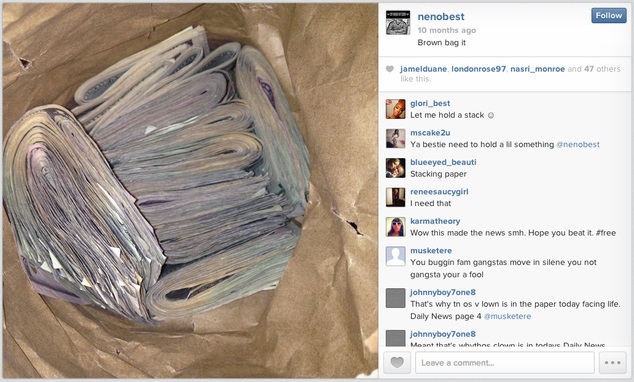
    Nineteen people have been indicted in a gun bust that began as a narcotics investigation after an aspiring rapper posted photos of weapons and cash on Instagram. 

    An undercover city police officer posing as a gun broker for criminal customers bought 254 weapons from the men in dozens of transactions since last year – the largest gun seizures in the city in recent memory. One of the guns was an assault rifle that was disassembled and transported in a girlfriend’s zebra-striped bag, authorities said.

    Aspiring rapper Neno Best is among a group of 19 people charged with selling nearly $160,000 of illegal weapons in New York.

    Best, 26, whose real first name is Matthew, was investigated by an undercover NYPD detective after the rapper posted images of large quantities of money on Instagram, captioning one photo ‘Brown bag it’.

    Other photos and videos, most of which have now been deleted, included shots of a variety of guns. One of the guns shared on Instagram was a Luger pistol, with Best commenting underneath ‘This old ass gun lol a hundred years old lol’. Neno also attached details to the images saying that he was selling weapons out of his Ocean Hill recording studio.

    According to CBS New York, Mayor Michael Bloomberg said “New York is the safest big city in the nation, but year after year, illegal guns flow into our city from states that don’t have common-sense laws that keep guns out of the hands of criminals. There is no doubt that the seizure of these guns has saved lives,” the Mayor said at the news conference.

    [youtube id=”ILJkByHQt2U” width=”100%” height=”300px”]

    [Via]

  • Micromax : Nothing like getting arrested?

    Micromax : Nothing like getting arrested?

    Two owners of the popular mobile phone company Micromax mobile have been arrested in a bribery case in New Delhi. The Central Bureau of Investigation (CBI) caught the company bosses amidst a Rs 30 lakh bribe to the engineers of North Delhi Municipal Corporation for clearance to a banquet hall construction. Incidentally the whole scenario has nothing to do with the Micromax Mobile division, but since the owners were involved the company has come into dark waters.

    The CBI on Wednesday arrested Rajesh Agrawal and Manish Tuli, both of Micromax Informatics, the officers also arrested two junior officials of the municipal corporation and carried out a total of 15 searches between MCD offices and Micromax owner residences and has recovered Rs 40 lakh in cash from the premises of one junior engineer  Kapil Dev. Vikas Jain, co-founder and business director of Micromax, declined immediate comment on the matter. The Gurgaon-based company is the 12th largest mobile handset maker in the world, according to its website.

    Micromax had recently launched the Micromax Canvas 4 and is ready to launch two new handsets in the next 45 days according to co-founder Vikas Jain. This will not affect the company’s operations in any form – said another spokesperson. 

iGyaan Network
Privacy Overview

This website uses cookies so that we can provide you with the best user experience possible. Cookie information is stored in your browser and performs functions such as recognising you when you return to our website and helping our team to understand which sections of the website you find most interesting and useful.