Tag: batteries

  • Silk May Be The Key to Longer Lasting Li-Ion Batteries

    Silk May Be The Key to Longer Lasting Li-Ion Batteries

    In today’s world, where almost everyone is dependant on battery-burning devices, research in the field of extending battery life has been on its peak.

    A new study has suggested that Silk can be used to make rechargeable Li-Ion batteries last longer. Li-Ion batteries have found a major place in today’s era of technology. The reasons for its acceptance stands in its above average battery life and small size. However, demand for these batteries to last longer on a single charge is increasing steadily, and the same is being researched upon. One such research has led to the creation of a new green material that is derived from silk and can be used to create Li-Ion batteries that last longer.

    Scientist, Chuanbao Cao, and his colleagues from Beijing found out a way to process natural silk to create carbon-based nanosheets that could potentially used to store energy in devices. This material can store five times more lithium than graphite, which is critical in improving battery performance. This worked perfectly, completing 10,000 cycles with only a 9% loss in stability.

    As of now, the team has been able to install silk-based materials effectively only in prototype batteries and super-capacitors. It could be the first step in yielding longer lasting batteries in thousands.

  • LG Chem Unveils Batteries For Next Generation: Curved Batteries in Production

    LG Chem Unveils Batteries For Next Generation: Curved Batteries in Production

    LG Display has confirmed production of a “bendable and unbreakable” smartphone display. Now, LG Chem unveiled what they have got for the future smartphones as the company unveiled the next generation of batteries.

    Through the exclusiveness of our unique technology, LG Chem has succeeded in launching future batteries that have not existed before. This shall be the fundamental grounds for LG Chem to become a pioneer in the market. As a leader of battery manufacturer, we will continue to strive for Global No.1 by developing more of optimized, safe and long-lasting batteries to make it the business of future generation”, said YS Kwon, the President of Energy Solution Company, LG Chem.

    The company announced that they have curved batteries in mass production, which will power the next generation smart phone from LG. The company calls it “Stack and Folding technology”, while the company claims that they can build batteries that will fit phones, or any wearable devices(watches, glass). The company has the patent of Stack & Folding technology and the mass production of Curved Battery has been started since this month and the products will power the next smart phone line up of LG Electronics.

    [toggle title=”Press Release “]LG Chem to unveil batteries of next generation
    SEOUL–(Korea Newswire) October 8, 2013 — LG Chem, a leading battery manufacturer, is ready to unveil batteries that have not existed before.

    The company announced on the 8th that it has succeeded in breaking the tradition of rectangular shaped batteries to lead the effort to a more sustainable future by mass producing batteries of different shapes.

    The types of LG Chem’s future batteries can be categorized as the following. ? Stepped Battery, ? Curved Battery and ? Cable Battery.

    At the moment, the chemical company is already mass producing stepped and curved batteries. Stepped Battery from Nanjing plant of LG Chem has been manufactured since July to power LG G2. However, the actual production of Cable Battery shall begin in upcoming years.

    First of all, Stepped Battery refers to an integral type of a battery in which two batteries are added on top of each other in the shape of “step design.” The battery takes greater advantage of available space within the device than other batteries as it perfectly suits the changing trend of modern IT gadgets of flexible designs.

    For example, recent mobile devices have been adopting round shapes and designs with rear buttons creating unnecessary “dead space” inside the gadget. With Stepped Batteries, the dead space can be filled up to fully power the handset and also increase the battery capacity.

    In fact, the battery density has increased the capacity by 16% and also the life span by more than 3 hours when applied to the newly launched LG G2, a premium smart phone by LG Electronics.

    The competitors in the market may succeed in stacking two batteries to make it into the step design but due to the increased cost of such technology, rivals will not achieve to do so, unless they can make it to an integral single type just like LG Chem.

    At the Nanjing plant, LG Chem plans to launch Stepped Battery that goes beyond 3 to 4 step designs, stacking up more batteries into one single type depending on customer needs.

    In addition, LG Chem’s Curved Battery refers to packs that can power IT devices with curved screen or flexible designs such as smart phones, watches and glasses. The company has the exclusive patent of Stack & Folding technology which reduces physical stress when realizing the curved design of battery packs. The mass production of Curved Battery has been started since this month and the products will power the next smart phone line up of LG Electronics.

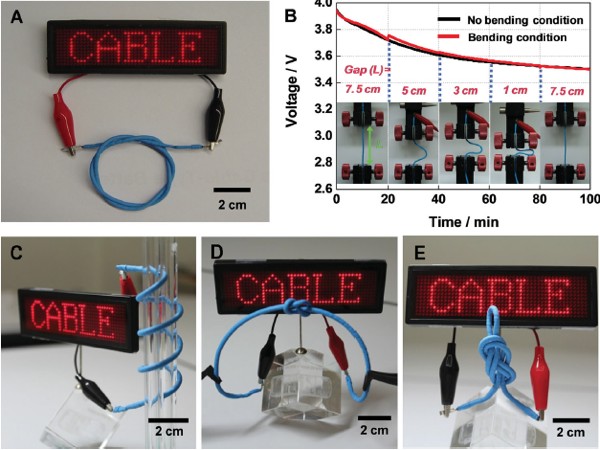
    Lastly, Cable Battery is applied to IT devices that are bendable, wearable and even be tied into a knot. Because it has been designed to use low electricity, the battery does not heat up although the user may operate the device for a long time. Moreover, the waterproof features of the battery allow itself to be used in wearable gadgets regardless of flexible figures, from necklace types to smart watches.

    “Through the exclusiveness of our unique technology, LG Chem has succeeded in launching future batteries that have not existed before. This shall be the fundamental grounds for LG Chem to become a pioneer in the market. As a leader of battery manufacturer, we will continue to strive for Global No.1 by developing more of optimized, safe and long-lasting batteries to make it the business of future generation”, said YS Kwon, the President of Energy Solution Company, LG Chem.

    LG Chem will be participating at the InterBattery 2013, which will be held in COEX from Oct 16th to display and demonstrate related products in a private zone.

    About LG Chem
    LG Chem, Ltd. is a globally diversified chemical company which operates three main business units: Petrochemicals, IT & Electronic Materials, and Energy Solution. The chemical business manufactures a wide range of products, from petrochemical goods to high-value added plastics. It also extends its chemical expertise into high-tech areas such as electronic materials and rechargeable batteries. LG Chem is one of the world’s largest lithium-ion battery manufacturers. For more information, please visit the LG Chem website at www.lgchem.com[/toggle]
  • Tech 101: How Batteries Work

    Tech 101: How Batteries Work

    The first “modern” battery consisted of an apparatus made with metal plates and brine soaked cardboard and was invented by an Italian physicist named Count Alessandro Volta in 1799. Since then, the materials used have changed tremendously, but the basic principle has remained the same. When a device is connected to a battery, a reaction takes place that generates electricity. This is called an electrochemical reaction.

    Mankind’s appetite for electricity has grown exponentially since the 1800s. Today, batteries are found in a vast variety of devices from wristwatches and alarm clocks to smartphones and laptops. Lets look at a few of the most common batteries that we find around us everyday.

    If you look at any battery today, be it a pencil cell or a car battery, the first thing you’ll notice is that it has two terminals marked + and – . On pencil cells and flashlight batteries like AA, AAA, C or a D cell battery, the terminals are at opposite ends of the battery. On higher capacity batteries like a 9V or a car battery the terminals are located together on top of the battery. If a wire is connected to both terminals, electricity will flow from the -‘ve terminal to the +’ve terminal as fast as possible. This will drain the battery very quickly and is dangerous when applied to larger batteries. 

    A battery consists of five main components. There is a cathode, which connects to the +’ve terminal, an anode, which connects to the -‘ve terminal, a seperator, which prevents the anode and cathode from touching each other, an electrolyte, which allows the charge to flow from the anode to the cathode and lastly a collector, which conducts the electricity out of the battery.

    When you put a battery in a device, it completes the load circuit. What happens next differs from battery to battery but the idea remains the same. The anode goes through an oxidation reaction in which two or more ions from the electrolyte react with the anode material and creates a new compound and two or more electrons. At the same time, the cathode goes through a reduction reaction in which the cathode material, ions and free electrons combine to form other compounds. While this sounds very complicated, its actually very easy. The anode reacts  with the electrolyte to create electrons and the cathode reacts with the electrolyte to absorb electrons. The end result is electricity. A battery will last as long as it has materials to continue the reaction at both electrodes.

    A few commonly found batteries include:

    • Zinc Carbon Battery: This type of battery chemistry is commonly found in many cheap AA, AAA, C and D cell batteries. The anode is Zinc, the cathode is Manganese Dioxide and the electrolyte is Ammonium Chloride or Zinc Chloride.
    • Alkaline Battery: This is also another commonly found battery chemistry. The cathode is composed of a manganese dioxide mixture, while the anode is a zinc powder. It gets its name from the potassium hydroxide electrolyte, which is an alkaline substance.
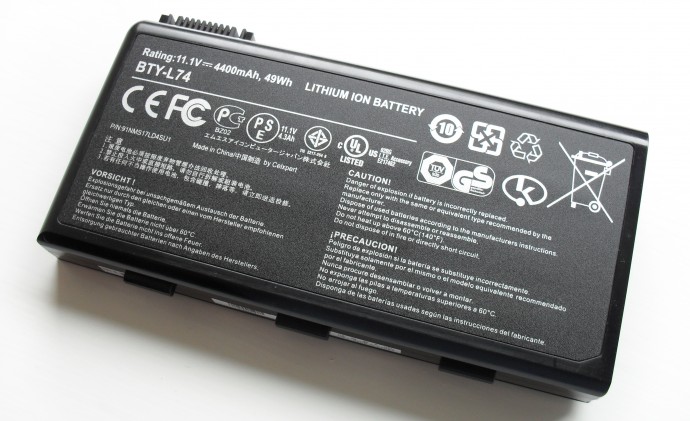
    • Lithium Ion: Lithium ion batteries are used in high performance devices that require frequent charging. These include phones, laptops, tablets and even electric cars. While the exact components of Lithium Ion batteries vary, the most common practice is to have a lithium cobalt oxide cathode and a carbon anode.
    • Lead Acid: This is the typical car battery. It consists of lead dioxide and metallic lead electrodes that are suspended in a Sulfuric Acid solution.

    The two main categories of batteries are Primary (one time use) batteries and Secondary (rechargeable) batteries. The only difference between the two is that when an external current is applied to a secondary battery, the electrochemical reaction happens in reverse, which restores the charge of the battery. There are three main types of rechargeable batteries, Lithium Ion (LiOn), Nickle Metal Hydride  (NiMH) and Nickle Cadmium (NiCd). NiCd batteries were the first widely available rechargeable batteries but they suffered from a problem known as the memory effect. These batteries, if not fully discharged during every use, would quickly start to loose power. 

    NiCd batteries were largely replaced by NiMH batteries which boasted a much larger capacity as well as a reduced memory effect. The only problem with NiMH batteries was their relatively short shelf life.  Like NiMH batteries, LiOn batteries have a long life, but they hold a charge better, operate at higher voltages, and come in a much smaller and lighter package.

    An offshoot of the LiOn technology is the Lithium Polymer (LiPo) battery. While LiOn batteries are the norm for most laptops, LiPo batteries offer significant advantages in space as well as weight savings. These types of batteries consist of an anode and cathode material that has been laminated onto a microperforated plastic sheet which, as the name implies, allows the passage of ions but seperates the anode from the cathode. This allows LiPo batteries to created in almost any shape from round to square and anywhere in the middle. Most mobile phones and tablets have these batteries as they boast the highest charge density of any battery available in the market today.

    Looking to the future, many people believe that the days of the battery are numbered and that they will soon be replaced by fuel cells. While we look forward to the day we have to start popping H2 cartridges into our phones once a month, it is still a while away.

  • Apple patent suggests fuel cell powered MacBooks

    Apple patent suggests fuel cell powered MacBooks


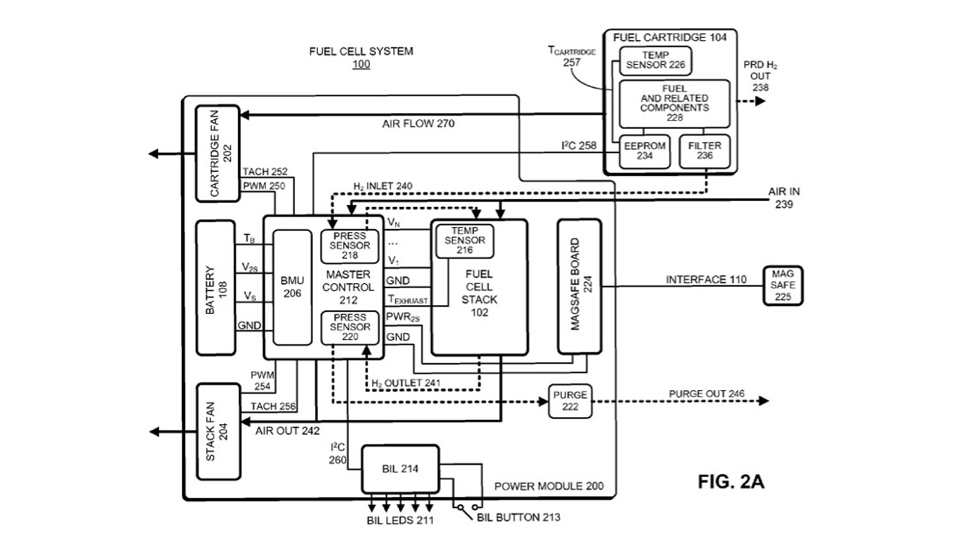
    Apple has filed for a new Patent that would allow for new MacBooks to go on for days and weeks without requiring a charge. This new technology would also allow for Cupertino’s new laptops to be slimmer and lighter. Apple has filed for a patent indicating that hydrogen fuel cells would be used to send and receive power from a battery to power a laptop computer. Apple also admits in this patent that the company is developing a product which is small enough and cheap enough to be placed in one of their laptops will be a challenge.

  • Apple Batteries Hacked

    Apple Batteries Hacked

    Did you know that the batteries in your Macbook can be hacked? You didn’t? Well now you do. Laptop batteries have evolved from being just batteries to a system that incorporates a microprocessor with a firmware to control it. This firmware performs various functions such as charging and discharging the battery, providing information on battery condition and charge rates, and telling the computer how much juice is left.

    Apple has, in the past, released hotfixes for malfunctioning batteries, and by analyzing these hotfixes, security researcher Charlie Miller has gained direct access to the embedded firmware. He has found some flaws in Apple’s firmware which allow malicious code to be embedded. So what can this malicious coded do? Well for starters it can brick your battery, which means that it will neither charge nor discharge itself. It could provide false information about the battery to the computer. This code can also execute software on your MacBook and no amount of anti-virus software and system formats can get rid of it, because its not on the system.

    The good news is that no amount of malicious code can make your battery overheat and explode. The bad news is that patching these vulnerabilities means that Apple will no longer be able to provide hotfixes for its batteries.


iGyaan Network
Privacy Overview

This website uses cookies so that we can provide you with the best user experience possible. Cookie information is stored in your browser and performs functions such as recognising you when you return to our website and helping our team to understand which sections of the website you find most interesting and useful.