Tag: Cellular Data

  • Tips to Reduce Data Usage on Android

    Tips to Reduce Data Usage on Android

    In this age of streaming and downloading, where our hunger for data is exponentially growing, most users often find themselves struggling with this ever losing battle of trying to not exceed or finish up their data allowances.

    Data plans have become so expensive that most of us live in constant fear of exceeding our monthly smartphone data allowance, forcing us  to run from one Wifi hotspot to another just to conserve as much data as possible.

    Today, iGyaan brings to you tips and tricks for Android users to conserve data, and help them keep more of their hard earned money away from the clutches of the evil ISPs.

    Chrome Webpage Compression
    screenshot_04


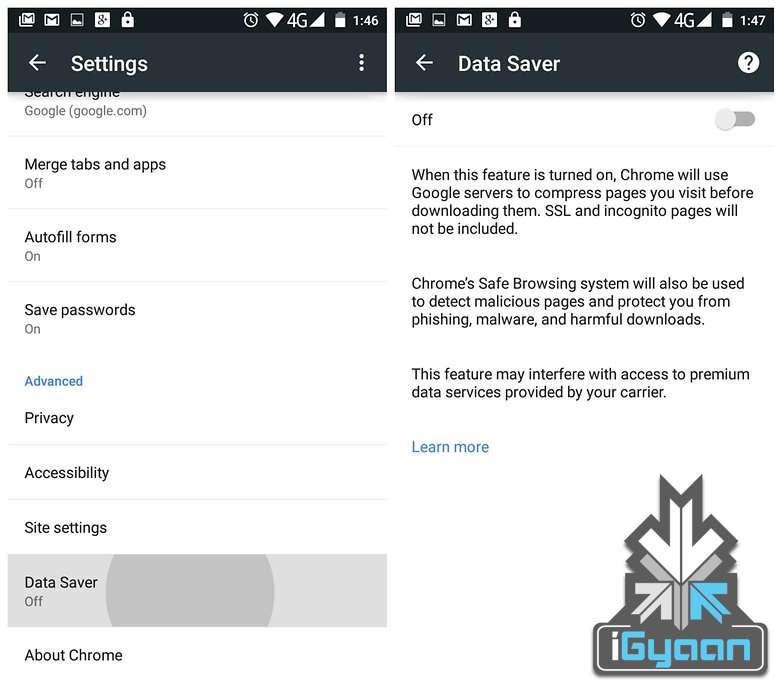
    For users who use Google Chrome for browsing the Internet this tip can help them cut down significantly on data used for browsing. Google claims you can save upwards of 35% of data while using Chrome’s Data Saver feature. When enabled, Google’s servers reduce the amount of data that is downloaded when you visit a web page.

    But such extreme data saving comes at a cost. When the data saver is enabled, certain websites might load slow, while ones with a lot of images displayed not at their best, but to us it seems like a fair trade for the major data savings that this feature provides.

    To activate this feature, the user needs to launch Chrome, tap the three dots in the top right-hand corner, scroll down to the settings button and then click om Data Saver. Just to see the results for yourself monitor Chrome’s data usage after switching the data saver feature on.

    Use Opera for Saving Data on Watching Videos
    screenshot_03

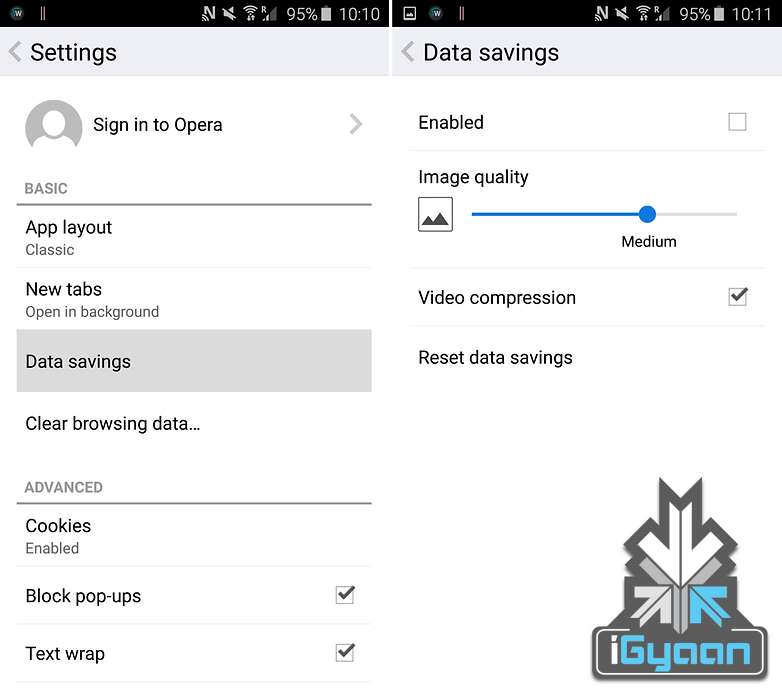
    Much like the Chrome browsers compression technology for web pages Opera for Android provides users with a very nifty trick that allows them to watch compressed videos, resulting in almost similar quality content, but greatly reduced size.

    The end result being reduced data usage for a very faster loading videos. Can’t say we don’t approve. the Opera browser, go to Settings > Data savings and tick the box that says Video compression.

    Restrict Background Data
    screenshot_02

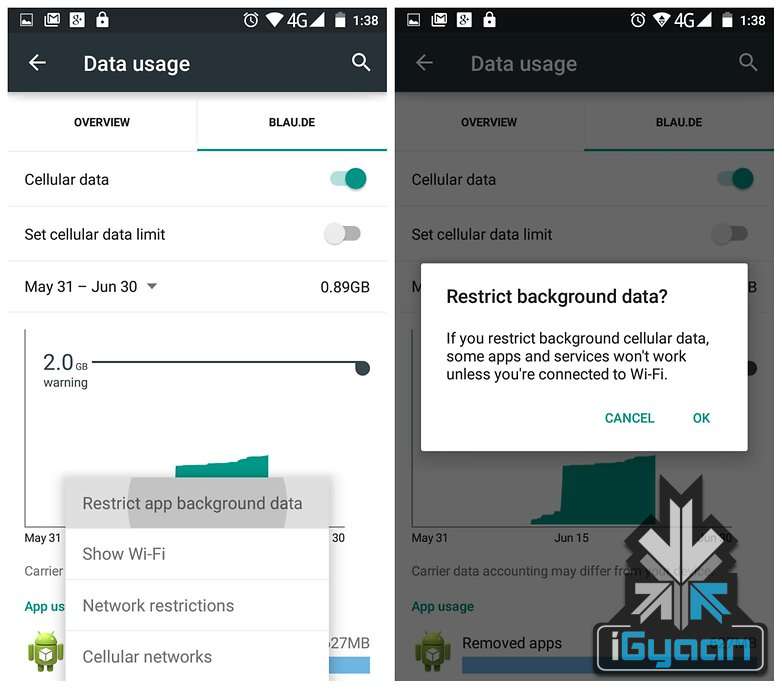
    One of the best ways to conserve data that Google provides Android users is with the option of restricting background data using the inbuilt data saving mechanism of the Android operating system.

    With this feature users can tell Android to restrict background data usage of specific apps, hence helping in greatly reduce data usage. Apps and tasks such as email syncing, feeds updating, weather widgets and so on can be stopped temporarily, and be taken care of when in a Wifi Hotspot area.

    Turn Auto Update Off for Apps
    screenshot_01

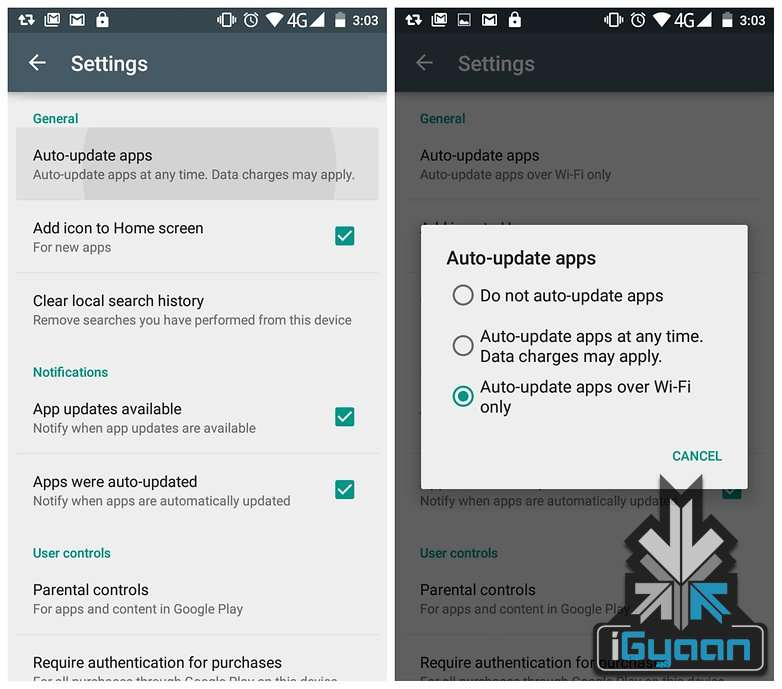
    Android by default sets the Play Store to download updates to apps the moment they are available. Depending on your internet speed, this particular feature if left unattended, can eat through your phone’s data pack very quickly. Switching this to Auto Update Apps Over Wifi Only is recommended.

    Head to the Play Store and head towards the Settings button. On the page you’ll see Auto-Update Apps. Tap this and make sure you either have it set to ‘Do not auto-update apps’ or ‘Auto-update apps over Wi-Fi only’.

    For users looking for more customization, and want to manage individual apps, they can make way to the My Apps page, select an app and then tap the overflow menu to un-check Auto-Update.

    Say Bye to the Facebook App
    Facebook-buys-WhatsApp-feature1

    The Facebook App is infamous for its habit of eating through mobile data for fun. Several reports have found that Facebook’s recommended app is a great drain on mobile data on the Android System along with being a dreaded enemy of your battery life. As such, uninstalling it in favour of the Facebook Lite App is highly recommended.

  • 2014 saw a 74% Increase in Mobile Data Traffic in India

    2014 saw a 74% Increase in Mobile Data Traffic in India

    A new report says that there has been a 74% increase in the mobile data traffic in India, generated by 2G and 3G mobile data connections till the end of 2014, as compared to the beginning of the same year. This rise is primarily driven by the 114% growth in 3G traffic and a 41% growth in 2G traffic.

    As per a Nokia Networks report on mobile broadband performance in India, 3G consumption was a 52% of the total data consumption in December 2014 as compared to 42% in January. 3G users surpassed 2G users in September of 2014 and their data usage increased to 688 MB per month on an average, indicating a 29% jump when compared to 2013. Also, a 3G data user uses approximately 3.2 times more data than a 2G user in 2014.

    [quote text_size=”small” author=”Sandeep Girotra” author_title=”Vice President and Head of India Region, Nokia Networks”]

    The 2014 study results clearly show the strong momentum of 3G in India, which has been the primary driver for the data traffic growth. A surge in 3G and 4G compatible Smartphone use underlines the greater need for operators to expand the 3G network coverage and selectively rollout 4G services for higher speeds across all the circles while modernising the existing 2G networks.

    [/quote]

    There are a very few circles where 4G connectivity is already live, but the numbers of cities with 4G access are growing. According to the reports, out of a total of 5.5 million LTE capable devices available, only around 85,000 are subscribed to LTE.

    All the aforementioned details are the part of the Nokia Networks’ Mbit Index study which is an annual report that measures the growth and performances of mobile broadband services throughout the year.

  • Government of India Schedules Spectrum Auctions

    Government of India Schedules Spectrum Auctions

    The Government of India (GOI) is going to auction 184MHz of spectrum in 900MHz band through the Department of Telecom(DOT). The auction will be done as 29 licences will be up for renewal in 18 telecom zones in 2015-16.

    The spectrum GOI intends to auction is mostly used for 3G services. The auction will be for the 900 MHz, 1800 MHz and 2100 MHz. Based on the memorandum of understanding between DOT and the Defense Ministry, the Defense Ministry will vacate about 25 MHz in the 2100MHz spectrum. Out of the agreed upon 25 MHz, the Defense ministry has already vacated 20 MHz.

    DoT is also planning to sell spectrum in the 2300 MHz and 2500 MHz bands to be used for LTE (4G) services. In 2010, the government had auctioned 2300 MHz spectrum to the operators such as Reliance Jio Infocomm, Bharti Airtel and Tikona for long-term evolution (LTE) services. But now they are at freedom to use the spectrum to their discretion as they are not bound to the technology.

    The government has 104 MHz of spectrum on it for auctioning. This will include the 26 MHz of spectrum freed after license renewals from Idea Cellular, Bharti Airtel and Vodafone India. Along with these the 78 MHz of spectrum which was left unsold in February will be up for auction.

    The spectrum base prices will be set by TRAI for the 900 and 1800 MHZ spectrum. In the previous auction, the Mumbai, Delhi and Kolkata circles were sold for double the base price, earning the government 610 billion Rupees.

    This auction will give the companies a chance to expand their spectrum thereby expanding services like better 3G and 4G connection. But the heavy cost of the auction will definitely percolate down to the consumers. We have to wait and see if more spectrums mean better services from the companies or just higher phone bills.

iGyaan Network
Privacy Overview

This website uses cookies so that we can provide you with the best user experience possible. Cookie information is stored in your browser and performs functions such as recognising you when you return to our website and helping our team to understand which sections of the website you find most interesting and useful.