Tag: cpu

  • HTC Sensation XE is Official with 1.5 GHz and Beats Audio, Comes in September

    HTC Sensation XE is Official with 1.5 GHz and Beats Audio, Comes in September

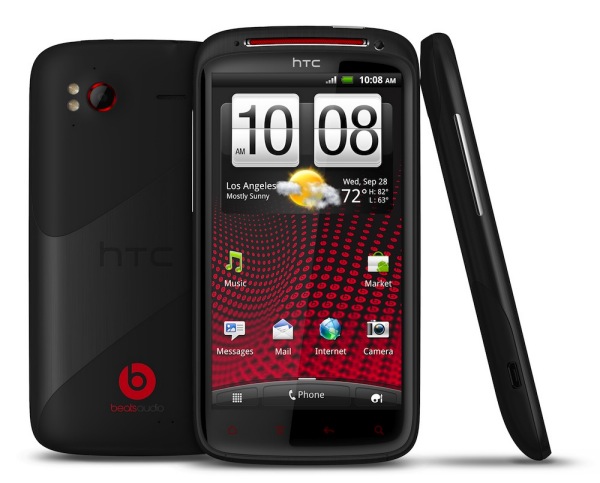
    HTC has finally intro’d the long rumored HTC Sensation XE, the new smartphone will have a revamped 1.5 GHz processor and beats audio. Now the unit itself essentially is the same with a qHD display (540 X 960) resolution and boasts a larger 1730mAh battery.

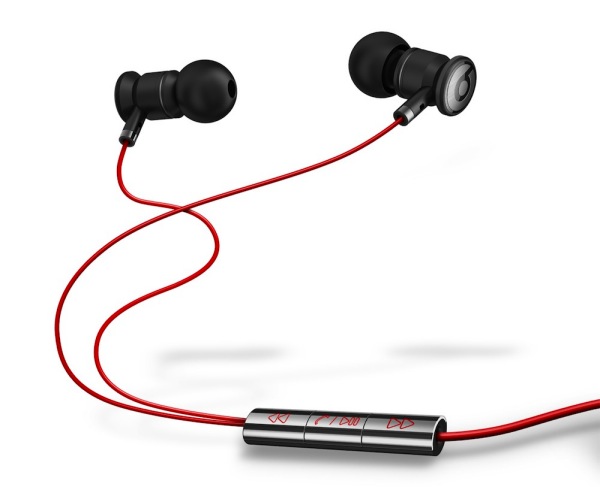
    This Special edition unit will come with a set of Beats by DRE Headphones and 8/16GB microSD cards and a remote control that allows audio track management. The Sensation XE is slated to launch in Europe, Asia, Africa and the Middle East sometime this month. So you can expect the device to hit our Review labs sooner than later.


    [toggle title_open=”PRESS RELEASE” title_closed=”PRESS RELEASE” hide=”no” border=”yes” style=”default” excerpt_length=”0″ read_more_text=”Read More” read_less_text=”Read Less” include_excerpt_html=”no”]HTC AND BEATS INTRODUCE NEW HTC SENSATION XE™, THE FIRST PHONE WITH INTEGRATED BEATS AUDIO™

    New 1.5 GHz dual core processor and longer battery life extend the HTC Sensation XE’s sophistication and overall experience.

    TAOYUAN, TAIWAN – September 14, 2011 – HTC Corporation, a global designer of mobile devices, today unveiled the new HTC Sensation XE – the first in a new line of HTC smartphones to feature Beats Audio technology to deliver studio quality audio. Taking HTC’s flagship handset to a new level of high fidelity audio, the HTC Sensation XE offers consumers the ultimate multimedia experience, setting a new standard for audio quality in the mobile market. In addition, the HTC Sensation XE boosts performance and battery life even further with the addition of a blazing fast 1.5GHz dual core processor and an extended battery that enables you to listen, watch, speak and browse for even longer.

    “Audio is a crucial part of any consumer’s mobile experience and we are continually pushing the audio boundaries to encompass not only improved voice but music, movies and games,” said Jason Mackenzie, president of global sales and marketing, HTC Corporation. “The HTC Sensation XE offers a truly incredible experience that demonstrates our commitment to place consumers at the center of their mobile worlds.”

    The ultimate audio experience

    The HTC Sensation XE is the first handset to offer a Beats Audio experience – a combination of software & hardware that allows you to hear music the way the artist intended. When used with the exclusive Beats by Dr. Dre in-ear headphones, the handset automatically switches to the bespoke Beats by Dr. Dre sound profile, delivering audio tracks tuned specifically for the headphones.

    Whether you are using any of the many music services available in the Android market you will notice fuller bass and crisper vocals and a new level of clarity and range offering audio the way the artist intended it to be heard.

    Beats Headphones

    The HTC Sensation XE also ships with a microSD card (8GB/16GB) allowing you to carry thousands of songs. The exclusive Beats by Dr. Dre in-ear headphones feature a remote control, allowing you to pause, play or skip through tracks and answer/end calls while the phone is in your pocket.

    Availability

    HTC Sensation XE will be available across EMEA and Asia Pacific from late September[/toggle]

  • The Razer Blade Laptop

    The Razer Blade Laptop

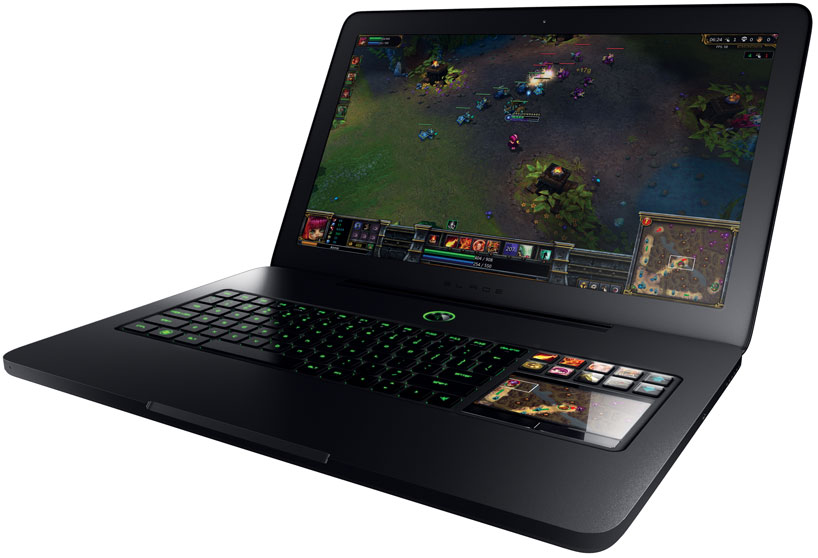
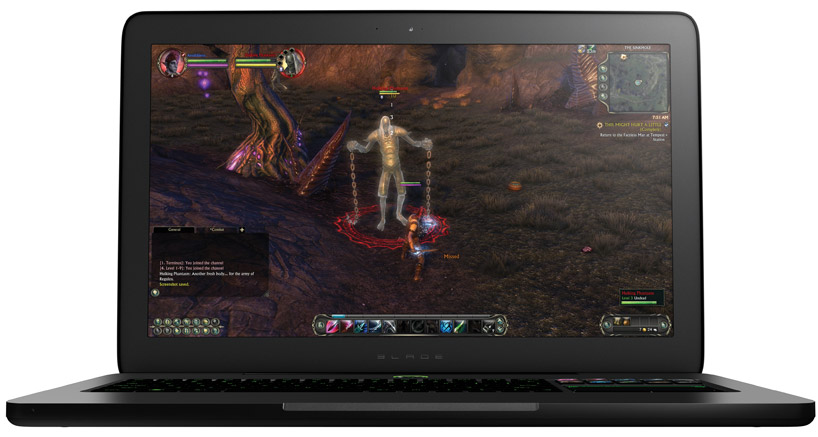
    Razer, nVidia and Intel have teamed up to create what they call the worlds first “True” gaming laptop.

    Dubbed the “Blade”, the laptop is made with an aluminium body that’s only .88″ thick, weighs 3.2 Kgs and houses some pretty mean hardware. It features a 17″ 1920 x 1080 px LED display which is powered by an nVidia GPU and the latest generation Intel Core i7 processor.

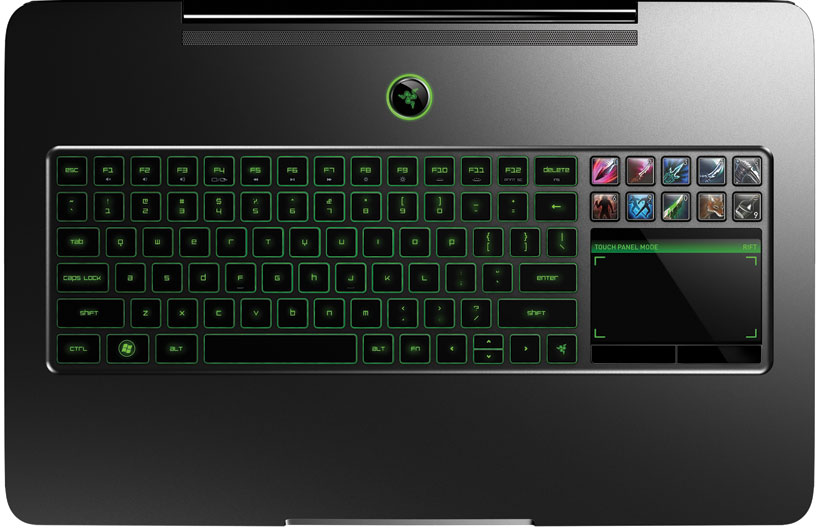
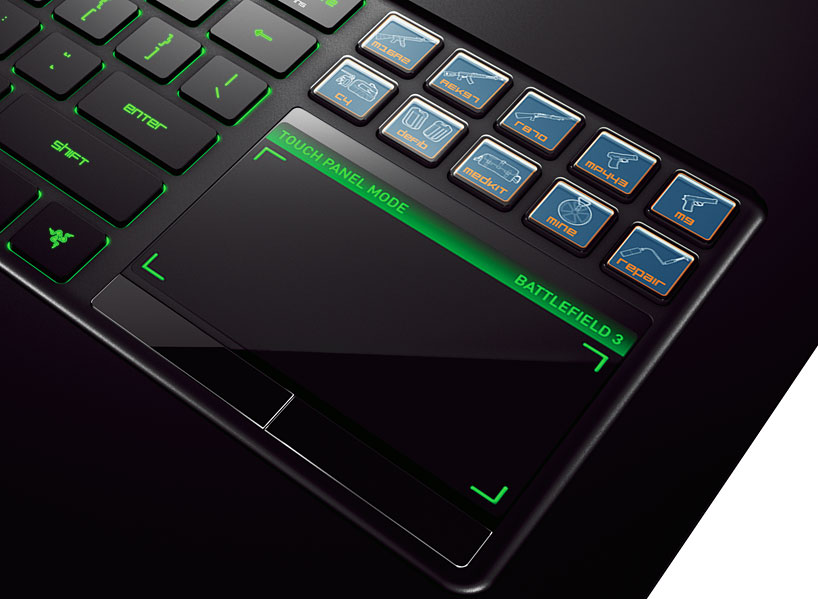
    The laptop also has a back-lit keyboard as well as Razer’s Switchblade interface which consists of ten programmable tactile keys and an LCD which doubles as a multi touch input and a display for in-game information when the system detects an external mouse being used. Each of the ten buttons can be programmed for in-game commands/actions and they can also be assigned an image which would be displayed on the in-built LCD.

    It also features a HD web-cam and is expected to retail for around USD 2800 later in the year.

  • A New Hybrid Heatsink Makes Your Computer Run Faster

    A New Hybrid Heatsink Makes Your Computer Run Faster

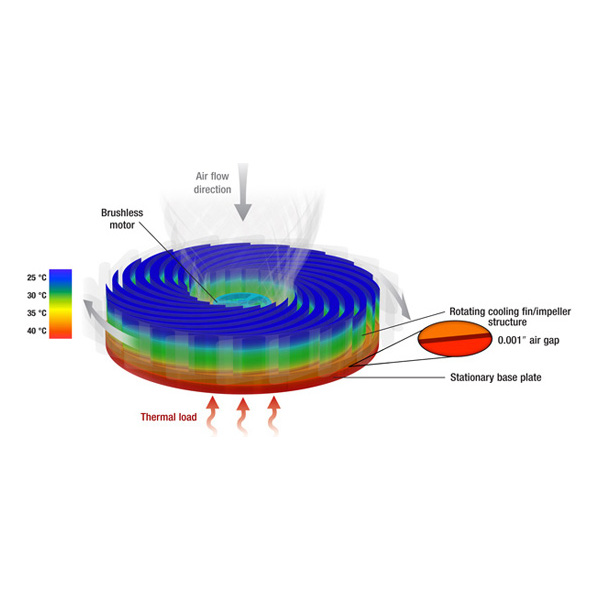
    The traditional way with which most computers deal with heat is a heat-sink and a fan assembly over the processor. Of course you have custom solutions like liquid cooling, but they’re out of the budget for most people. Unfortunately, this idea is quite dated and hails from the heydays of computing. New technology requires new solutions and that’s exactly what Jeff Koplow, a researcher at Sandia National Laboratories has developed.

     The problem with traditional heat-sinks is that, while the fins provide adequate surface area to cool the processor, a layer of air clings to the fins, which reduces efficiency, acting as an insulator. To compensate, the CPU fan can be cranked up to move more air, but that becomes noisy and uses more energy. As the heat-sink itself doesn’t move, it becomes a great place for dust to settle.

    Jeff has come up with an ‘air bearing heat exchanger’, which is just a fancy way of saying that he’s combined the heat-sink and fan into a spinning heat-sink. The heat exchanger is separated from the processor by just 1/1000th of an inch, and as it spins, it forces air out from the center of the exchanger, cooling the fins and eliminating the insulating layer of air. This turns out to be so efficient, that it can be run at much lower and quieter speeds. You can even overclock your CPU a few notches without it being any worse for the wear. As the heat-sink is spinning, it also becomes immune to dust.

    A prototype has been developed which doesn’t require any fancy metals or electronics, just good design. This hopefully means that the technology will be easily mass producible and will be available to the market soon.

  • Qualcomm Snapdragon roadmap leakead, Shows upcoming Krait

    Qualcomm Snapdragon roadmap leakead, Shows upcoming Krait

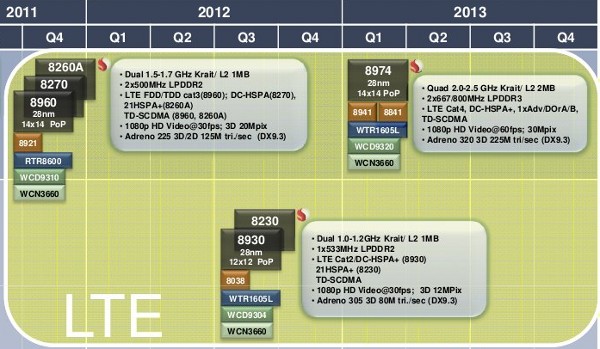
    [dropcap]A[/dropcap] full roadmap of Qualcomm’s  Snapdragon roadmap up till 2013 has been leaked, thanks to a PDF gotten by unknown sources.


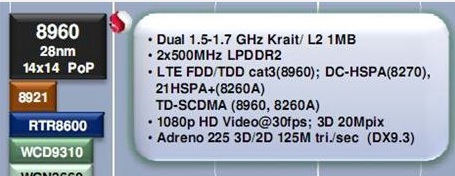
    The MSM8960, Qualcomm’s first Windows 8 certified SoC 

    • shipping in Q4 2011
    • Dual 1.5-1.7 GHz Krait/ L2 1MB
    • 2x500MHz LPDDR2
    • LTE FDD/TDD cat3(8960); DC-HSPA(8270)
    • 21HSPA+(8260A)
    • TD-SCDMA (8960, 8260A)
    • 1080p HD Video@30fps; 3D 20Mpix
    • Adreno 225 3D/2D 125M tri./sec (DX9.3)


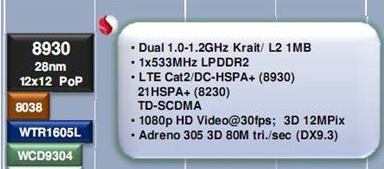
    Q3 2012  brings the MSM8930

    • one memory channel
    • lower CPU clocks 
    • less powerful GPU (Adreno 305) 

     The specifications are the following:

    • Dual 1.0-1.2GHz Krait/ L2 1MB
    • 1x533MHz LPDDR2 • 1x533MHz LPDDR2
    • LTE Cat2/DC-HSPA+ (8930)
    • 21HSPA+ (8230)
    • TD-SCDMA
    • 1080p HD Video@30fps; 3D 12MPix
    • Adreno 305 3D 80M tri./sec (DX9.3)

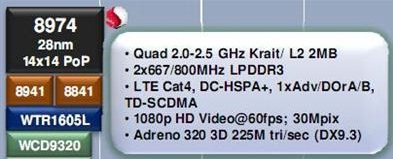
    The MSM8974 replaces the MSM8964/APQ8064 – launch in Q1 2013 w

    Specifications:

    • Quad 2.0-2.5 GHz Krait/ L2 2MB
    • 2×667/800MHz LPDDR3
    • LTE Cat4, DC-HSPA+, 1xAdv/DOrA/B
    • TD-SCDMA
    • 1080p HD Video@60fps; 30Mpix
    • Adreno 320 3D 225M tri/sec (DX9.3)


    Looks like the 2GHZ chips might just arrive in time for those 2 Ghz Smart phones.

  • AMD Launches A-Series APUs

    AMD Launches A-Series APUs

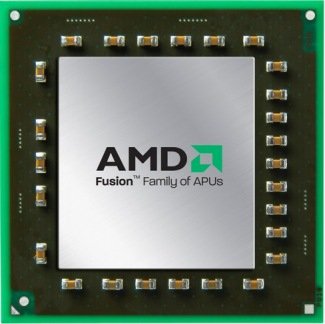
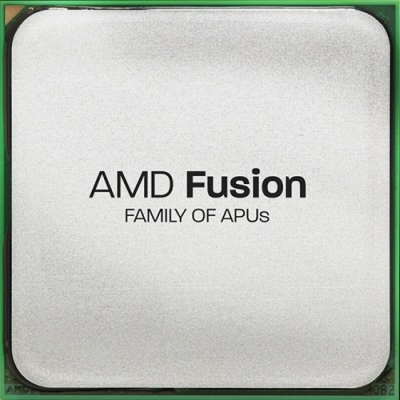
    AMD has launched its A-Series Chips. These Chips have a combination CPU + GPU chips in a single package that the company is dubbing APUs or Accelerated Processing Unit. The A-series was formerly known under the code name Llano. The company describes the new chips as follows:

    [quote]AMD A-Series APUs combine up to four x86 CPU cores with powerful DirectX 11-capable discrete-level graphics and up to 400 Radeon cores along with dedicated HD video processing on a single chip. [/quote]

    The processors will be available as the A4, A6, and A8 and are meant for mid to high-level laptops. The high-end quad-core A8 is targeted for “enthusiast HD and 3D entertainment,” with the quad-core A6 for “HD creation and Blu-ray entertainment,” and the lower-end dual-core A4 (comparable to Intel’s Core i3) for “Photo editing and HD movie playback.” Higher-end Laptops will also offer a separate discrete graphics card on top of the bundled GPU, in a setup called AMD Dual Graphics. The physically discrete GPU can be set to turn off while the system is not plugged into an outlet, in order to extend battery life.

    The first company to announce a line of A-Series Laptops is HP. It is not creating new models for these chips but is instead, adapting its existing models for these APUs. These processors should provide Intel’s second generation Sandy Bridge CPUs a run for their money.

  • AMD quad-core A8-3530MX processor for laptops- Rumor!

    AMD quad-core A8-3530MX processor for laptops- Rumor!

    Donanimhaber has leaked a new AMD Fusion chip that’s said to be a part of the  upcoming “Sabine” platform. 1.9GHz and boasts 4MB of Level 2 cache with boost upto 2.6Ghz plus has integrated Radeon HD 6620G graphics core and added support for 1,600MHz DDR3 RAM and low-power DDR3L memory.

    Seems AMD is planning serious competition for Sandy bridge Platform, but considering they are already late for the party, hopefully they can peg these right on the money.

    [via]

  • Samsung 2 Ghz Dual Core Phone coming next year

    Samsung 2 Ghz Dual Core Phone coming next year

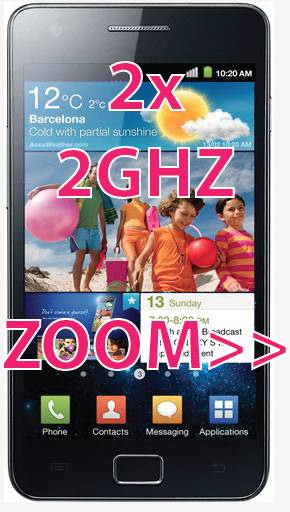
    Maeli Business Newspaper reports “a high-ranking” company official has disclosed that Samsung plans to release a 2 Ghz phone latest by next year. But, remember that 2 Ghz is a total of 2 x 2Ghz cores not 1Ghz cores. According to the report Samsung also plans to sell the chips to other manufacturers, so that you can enjoy boosted performance in your favorite brand.

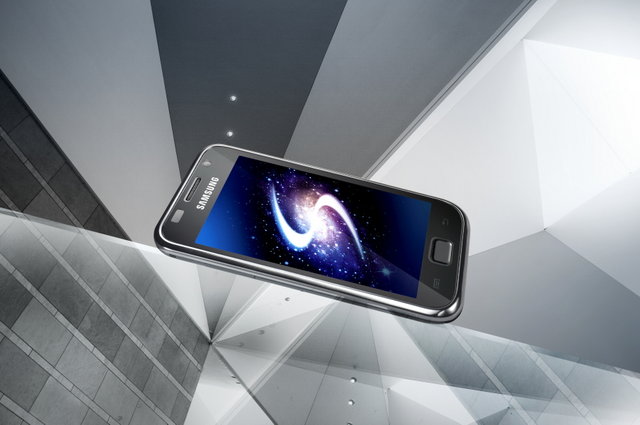
  • Samsung Galaxy S 2011 Version to have a 1.4 GHZ processor

    Samsung Galaxy S 2011 Version to have a 1.4 GHZ processor

    Samsung in Russia has informed that they will launch a new version of the popular Galaxy S Android smartphone next month.

    The Galaxy S 2011 edition will ship with Android 2.3 and  a new metal back cover.

    The phone packs

    • 1.4GHz Qualcomm MSM8255T Snapdragon processor
    • 14.4Mbps HSPA+ radio
    • 1,650mAh battery
    • 4-inch Super AMOLED display
    • 8GB of internal storage
    • Bluetooth 3.0
    • 5 megapixel camera
    • 720p HD video
    • 24,000 rubles ($846 USD) or INR 40,000 +

    No news on Launch in India or other countries.

    [Samsung Russia]

  • Rumor: Lg to release Optimus Big 4.3 inch Smartphone

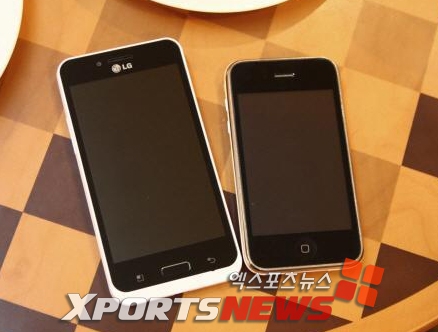
    Rumor: Lg to release Optimus Big 4.3 inch Smartphone

    According to some leaked images and specs, LG has a new phone in the works codenamed “Optimus Big”. This device is all set to take on the likes of HTC with their humongous displays. The Optimus Big sports

    • 4.3-inch screen
    • Single-core 1GHz processor
    • T-DMB TV tuner
    • LG’s NOVA display.
    • Forward-facing camera for video chats
    • Android (version unknown)

    [hankyung]

  • HTC Announces New HD7s, Coming in Summer

    HTC Announces New HD7s, Coming in Summer

    HTC has just announced the new HTC HD7s, A successor to the HD7 which has only a minor improvement in tow, which actually turns out to be a major improvement. The HD7s adds a Super LCD to the mix making the display even more eye-friendly and much better in drastic situations. Thic change will also improve the battery life of the unit and make using the device a better experience.

    Our Sources at HTC India say this device will hit as a quiet Update in June-July 2011 in India. Pricing Similar to the existing model is expected.

  • Your Desktop Supercomputer: Coming Soon

    Your Desktop Supercomputer: Coming Soon

    Scientists at the University of Massachusetts Lowell have managed to squeeze over a thousand processor cores onto a single chip. We’ve heard a lot about the potential for future desktop-sized supercomputers, but more than anything else this research proves that in the not-too-distant future it’s likely to be a reality. Interestingly enough, there’s also a green angle to this idea: FPGA chips can be more power efficient than their competitors, and if less computer time is needed to process complex tasks, then the overall power consumption of computers using the tech could be impressively low.


    The advance was made by Dr. Wim Vanderbauwhede’s team, who programmed an advanced chip called a Field Programmable Gate Array (FPGA). FPGA systems have been around for a while, and their strength is that they can be programmed “in the field” to best suit whatever task they’re needed for, unlike the hard-coded silicon ship designs you’re probably imagining. The UM team’s innovation was in working out how to program the FPGA to act as mini processor cores, since the tech is typically difficult to work with. This has traditionally been a barrier to their use in desktop PCs, although small FPGAs are often found inside devices like LCD TVs.


    Once the 1,000 individual CPU cores had been programmed onto the chip, the scientists took the necessary next step to prove how useful their innovation is: They ran an intensive algorithm through it to test how powerful it was, and they chose a tricky one too–at the core of motion MPEG video processing, used in many online video systems. The results speak for themselves. Using the kilo-core FPGA computer, the team was able to process 5 gigabytes per sec of movie files, which is about 20 times the rate that existing high-end computers can manage.

  • TI announces OMAP 5 – two high performance and two low power cores

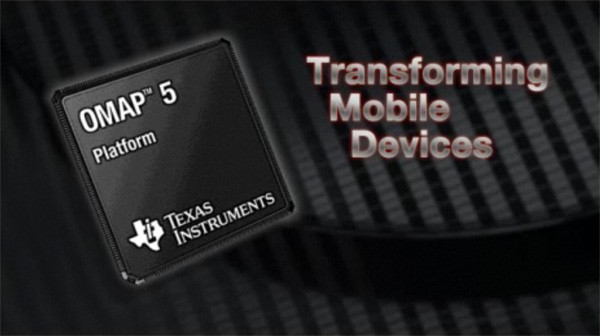
    TI announces OMAP 5 – two high performance and two low power cores

    Before we could get our hands dirty with the Ti-OMAP 4 devices, Texas Instruments has announced the Quad core – Ti-OMAP 5.  The 5 has two Cortex-A15 cores, each running at up to 2GHz (Cortex-A15 is the fastest architecture ARM has announced to date )there are another two Cortex-M4 processors along for the ride, ready to take over less intensive tasks at much lower power consumption to improve device responsiveness

    Moreover there is :

    • support up to four cameras operating at the same time
    • 3D playback
    • 3D recording
    • 2D upsampling to 3D at 1080p resolution
    • Upto 8GB of RAM support


    Full Press Release


    Not just a faster horse: TI’s OMAP™ 5 platform transforms the concept of ‘mobile’

    – New OMAP 5 platform creates disruptive mobile experiences akin to Henry Ford’s transformative automobile advancements

    – Mobile computing, stereoscopic 3D, gesture recognition and computational photography intensified by TI’s best-in-class applications platform

    – Sophisticated multi-core processing, including ARM® Cortex™-A15 MPCore™ processors

    DALLAS (Feb. 7, 2011) – Texas Instruments Incorporated (TI) (NYSE: TXN) announced today the next generation of its popular OMAP™ family: the OMAP 5 mobile applications platform, which is positioned to transform how mobile devices, such as Smartphones, tablets and other mobile form factors are used, making them even more valuable in our daily lives. More information on the OMAP 5 platform can be found here: www.ti.com/wbu_omap5_pr_lp.

    Imagine carrying only one productivity tool while in the office, on the road or at home – a single mobile device which provides PC-like computing performance with mobile power levels. Imagine using the same device to conduct a stereoscopic 3D (S3D) video conference for work. Imagine being in a meeting and projecting a document from this device, which you can edit by simply touching the projected image on a surface. Imagine going home and switching the device to your personal operating system to drive a next-generation game on your HDTV using wireless display technology. These capabilities are only highlights of what the TI OMAP 5 platform uniquely delivers. To see more experiences enabled by the OMAP 5 platform, view a video here: www.ti.com/wbu_omap5_pr_v.

    Highest performance, lowest power…yet again
    The 28 nanometer OMAP 5 applications processors carry on the OMAP family tradition of delivering significant increases in performance and functionality, while lowering power consumption compared to their predecessors. Specifically, they offer up to 3x processing performance and five-fold 3D graphics improvement, yet provide a nearly 60 percent average power reduction compared to a sample user experience on the OMAP 4 platform. Additionally, the OMAP 5 platform’s software is designed for maximum reuse to ease migration from the OMAP 4 platform.

    “The next decade will bring a revolution in mobile computing, as devices continue to converge, attempting to become one single device that meets all of our computing, entertainment, and complex day-to-day needs and interests. However, the bridge to true mobile computing enablement was missing until today. The OMAP 5 platform will be at the heart of driving the mobile computing revolution by delivering the highest computing, graphics and multimedia performance possible within the low power budget required by mobile form factors,” said Remi El-Ouazzane, vice president, OMAP platform business unit, TI.

    Sophisticated, multi-core processing: harmonized for the best possible user experience
    The OMAP 5 processor leverages two ARM® Cortex™-A15 MPCores™ – the most advanced ARM architecture to date – capable of speeds of up to 2 GHz per core in the OMAP 5 implementation. With a 50 percent boost in performance over the Cortex-A9 core (at the same clock frequency), combined with up to 8GB of dynamic memory access and hardware virtualization support, the Cortex-A15 core can enable true mobile computing experiences, such as the ones referenced above.

    The OMAP 5 architecture utilizes an intelligent combination of many different processing cores – each tailored and power-optimized for specific functions – and all harmonized to provide the best possible user experience. In addition to the two Cortex-A15 cores, the OMAP 5 processor includes individual, dedicated engines for: video, imaging and vision, DSP, 3D graphics, 2D graphics, display and security. The processor also includes two ARM Cortex-M4 processors for offloading real-time processing from the Cortex-A15 cores to improve low-level control and responsiveness of mobile devices.

    “We continue to see high performance mobile devices, such as advanced Smartphones and tablets, requiring increased processor performance while remaining within the restricted mobile power consumption boundaries,” said Mike Inglis, EVP and general manager of the ARM Processor Division. “The OMAP 5 processor highlights the advantage of the ARM business model. The relationship enables product differentiation through the integration of low power multi-core ARM processor cores with the partners’ own system-on-chip technologies, including power management, audio and video processing. ARM is proud to have contributed to the OMAP 5 platform, which enables OEM customers to leverage the extensive ARM software ecosystem to quickly deliver innovative new mobile solutions.”

    Next-generation natural user interfaces
    Natural user interfaces (NUI) – how we interact with the world around us in an intuitive, natural way – are taken to the next level with the OMAP 5 platform’s advanced support for S3D, gesturing (including proximity sensing), and interactive projection.

    The OMAP 5 processor can support up to four cameras in parallel, as well as record and play back S3D video in 1080p quality, and perform real-time conversion of 2D content to S3D at 1080p resolution. The new processor can also deliver advanced short- and long-range gesturing applications, as well as full-body and multi-body interactive gestures, utilizing either 2D or S3D cameras. The OMAP 5 processor, coupled with a TI DLP® Pico™ projector and a camera, can also enable interactive projection where the user can actually “touch and drag” projected images on both a table top or wall.

    Additionally, the OMAP 5 processor can interface with and leverage a wide variety of sensor technologies to enable touchless sensing, such as proximity sensing, capacitive sensing and ultrasonic sensing.

    Computational photography – the industry’s next frontier
    Today, most mobile devices are equipped with built-in cameras; however, due to the physical limitations of the device, picture and video quality is not on par with stand-alone consumer electronic products, such as digital SLR cameras. In order to close this quality gap, computational algorithms are used to compensate for these limitations. The OMAP 5 processor includes hardware and software resources that enable the development and deployment of such algorithms, such as camera stabilization, motion blur reduction, noise reduction, high dynamic range and face-based processing. The new processor also goes a step further by using the same OMAP 5 hardware resources with vision algorithms to extract features and data from the picture, in order to implement applications such as face recognition, object recognition and text recognition. These vision capabilities can also be used as the foundation for many different and exciting augmented reality applications.

    Industry’s best all-around applications processor platform
    The OMAP 5 platform sports an impressive list of features and benefits supporting everything from open source platforms to complementary TI technologies, including:

    Strengthening the OMAP 5 platform’s value, TI leverages its open source community involvement to benefit customer product development. Early extensive work in community projects translates to a significant quality and schedule advantage for device manufacturers, including power, memory and performance optimization. Additionally, TI’s pre-integrated software packages for popular Linux-based distributions help manufacturers achieve maximum system-level performance while driving a faster time-to-market.

    Availability
    TI’s OMAP 5 platform is expected to sample in the second half of 2011, with devices on the market in the second half of 2012. The OMAP5430 processor is offered in a 14x14mm Package-on-Package (PoP) with LPDDR2 memory support. The OMAP5432 processor is offered in a 17x17mm BGA package with DDR3/DDR3L memory support. 

    These products are intended for high-volume mobile OEMs and ODMs and are not available through distributors. TI also plans to develop compatible ARM Cortex-A15 processor-based solutions for broader market applications across TI’s product portfolio.
iGyaan Network
Privacy Overview

This website uses cookies so that we can provide you with the best user experience possible. Cookie information is stored in your browser and performs functions such as recognising you when you return to our website and helping our team to understand which sections of the website you find most interesting and useful.