Tag: google

  • Multiple Shots Of Upcoming Moto X Come Out Thanks To Eric Schmidt

    Multiple Shots Of Upcoming Moto X Come Out Thanks To Eric Schmidt

    Motorola’s new flagship device has been heavily leaked over the past number of weeks. This will reportedly have a half-billion dollar marketing budget behind it and bring customers various levels of customization – everything from the colour to engraving features. 

    moto X

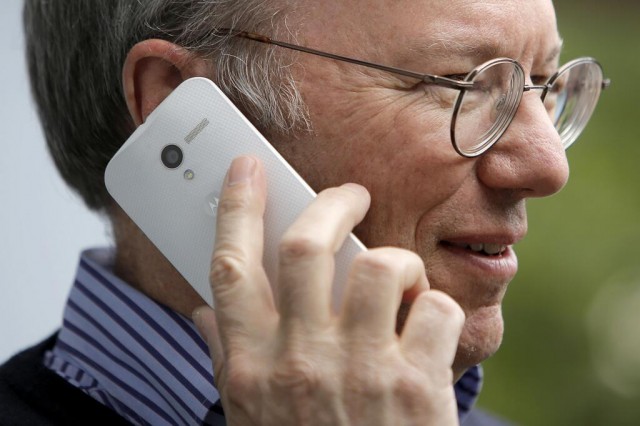
    Being Google’s executive chairman means being able to play with all the newest toys. Eric Schmidt, Google’s own Chairman, is in on the fun and went out in public using the Motorola Moto X.   

    Photographers at this year’s Allen and Co. conference snapped a few photos of the phone, which the Google chairman didn’t seem particularly shy about using.

    moto X

    The Moto X was teased last month by Dennis Woodside, and now it looks like Schmidt is following suit by being the first person to pull out the phone.

    What we know of the Moto X so far is mostly rumors, with a couple of leaked images of black phones with the Motorola M on them. Schmidt’s Moto X is the first white version of the phone we have seen, though it looks like the phone is only white on the back. We’ve seen this with previous Motorola phones, so it’s not a huge shock to see it here.

    moto x

    We didn’t get any confirmation of the previously leaked specs though. As you might recall the Motorola X is said to sport a 720p display and a 1.7 GHz dual-core Qualcomm Snapdragon S4 Pro chipset along with 2 GB of RAM, 10 megapixel rear camera and Android 4.2.2 Jelly Bean. 
    moto X

    Also a Google+ post by Robert Scoble shows the Moto X at the event, noting that “Tonight I was at a certain technology company (you might recognize it, except we weren’t supposed to share anything about what we were doing there) and someone handed +Daria Musk a really out-of-tune low-cost guitar. So I started shooting with Glass and this is what happened.”

    You can watch that video here.

    [Via]
  • Android Jelly Bean Now On 37.9% Devices, Passes Gingerbread

    Android Jelly Bean Now On 37.9% Devices, Passes Gingerbread

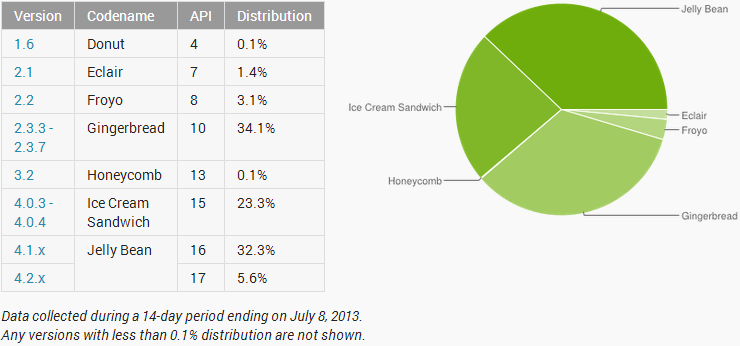
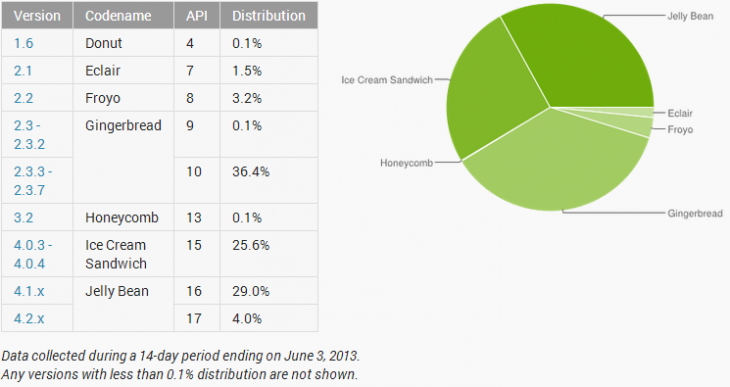
    Google has updated their Android platform distribution numbers for the month of June, 2013. It appears that Jelly Bean is currently running on 37.9% of active devices (of which only 5.6% accounts for Android 4.2.2) — up from last month’s 33%.

    Breaking down the numbers more specifically, 37.9 percent of Android users are using Jelly Bean, 23.3 percent have devices powered by ICS, 0.1 percent are on Honeycomb, 34.1 are stuck with Gingerbread, and 3.1 percent unfortunately still have Froyo.

    OS Donut and Eclair have are almost completely vanished, but there’s still 1.5% of users somewhere out there rocking the original version.

    android

    Remember, this isn’t really representative of Android as a whole — for all we know there are millions of Android devices in the world still running on Eclair.

     Google recently tweaked its algorithm in regards to how it counts users for these figures. In its own words, the company said:

    Note: Beginning in April, 2013, these charts are now built using data collected from each device when the user visits the Google Play Store. Previously, the data was collected when the device simply checked-in to Google servers. We believe the new data more accurately reflects those users who are most engaged in the Android and Google Play ecosystem.

    What OS are you at?

  • Bluebox Security Reveals That 99% Android Devices Have Major App Vulnerability

    Bluebox Security Reveals That 99% Android Devices Have Major App Vulnerability

    The company Bluebox security, has found a security hole in Android’s operating system. What’s even more scary about this news is the report states that this security hole has been around since Android 1.6 Donut. Apparently what can happen is malicious developers can change the APK of a legitimate company, without any breaks to its cryptographic signature. This basically means that if an app is hacked on Android, the user would not know and could be entering their information and sending it to the malicious hackers unknowingly.

    Android apps (packaged as an “APK”) are signed with an encryption key (just like iOS apps) to prevent a malicious party from changing the code. Signed apps are expressly designed to enable the system to detect any tampering or modification.

    Since verified apps are granted complete access to the Android system and all applications on a phone, the security weakness is potentially huge, although it remains theoretical since it is unclear how malicious apps and updates would be served to users.

    Apps listed on the Google Play store are immune from this tampering, so a hacker would need to lure a user into downloading a malicious version of an app in other ways, perhaps via a third-party app store or fake app links. A phishing email with a link to a fake update for a popular app, for example, might generate some downloads. 

    If Google has not done anything up to this point, it makes you wonder if they taking this security issue as seriously as they should. Smartphone malware is becoming a huge problem and in order to prevent threats, the security companies along with the OS developers must work together, to stop this ongoing threat. 

    As SlashGear reports, according to Bluebox, it informed Google of this Android vulnerability in February of this year. To take care of the issue, every device manufacturer will need to create a patch and roll it out to its users, who will then need to install it. The security firm says it will release “tools/material” and more info about this vulnerability during Blackhat USA 2013, which takes place later this month.

    [Via]

  • Google Begins New Program To Loan Out Street View Trekkers

    Google Begins New Program To Loan Out Street View Trekkers

    Google has announced that they are opening up their Street View Trekker program to third-party non-profits. Google is looking to expand Street View imagery off the beat path. To do this, they need to take their Trekker backpacks by foot into areas not accessible by cars or other imaging devices.

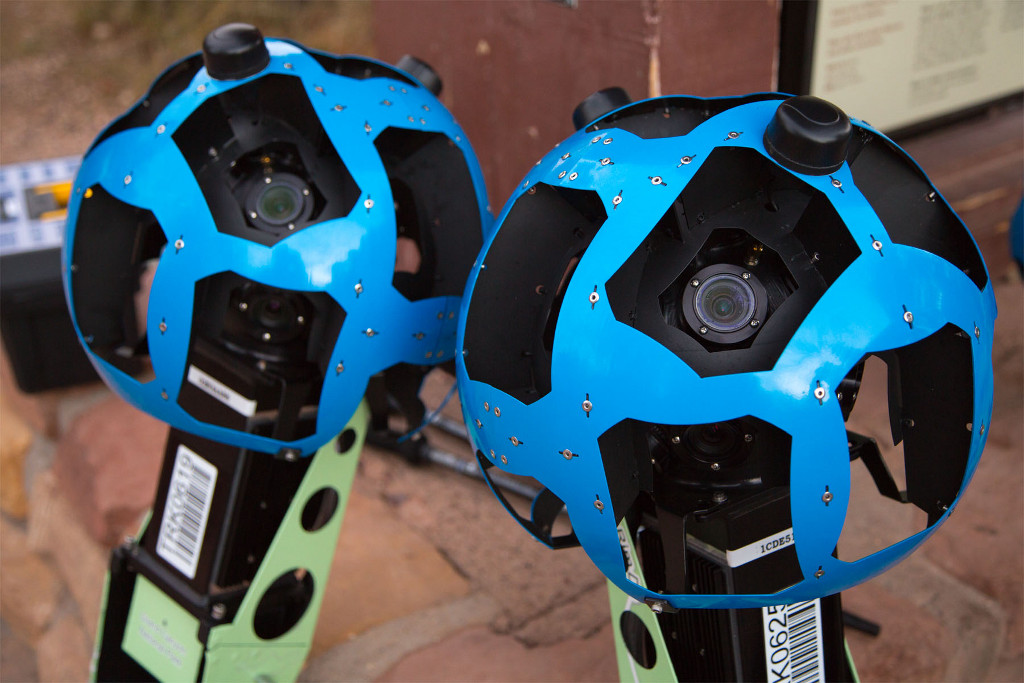
    The Street View Trekker is a compact version of the same tech used in Google’s Street View cars. The pièce de résistance is a 15-lens camera, mounted atop a spire-like appendage, that can capture 46MP images.

    “With 360-degree interactive imagery of the islands, people all over the world can see and explore the beautiful islands before they go, including some remote and hard-to-reach places they may never have discovered on their own,” Google Street View program manager Deanna Yick wrote in a blog post.

    Until recently, only Google and select third parties got the opportunity to strap on a Street View Trekker, but now interested organizations can fill out a form to line up for a chance at borrowing one. If you snap top-notch stuff, Google may add your work to its Street View collection, which includes the Galapagos and the Grand Canyon.

    As SlashGear reports, the loan scheme is open to tourism boards, non-profits, government agencies, universities, and research groups, with Google asking for details on proposed visits, expectations around what sort of photography might be captured, and why it’s thought that it could benefit Street View. There’s also the thorny matter of whether special permissions are required. “Even for public parks we often need to get written permission, legal releases and/or filming permits from the organization that manages the site” Google points out.

    In typical Google style, the company has a YouTube video for the new initiative:

    [youtube id=”SuiEmxDklKw” width=”100%” height=”300px”]

  • Leaked : Motorola X Phone Image, And Ad Campaign

    Leaked : Motorola X Phone Image, And Ad Campaign

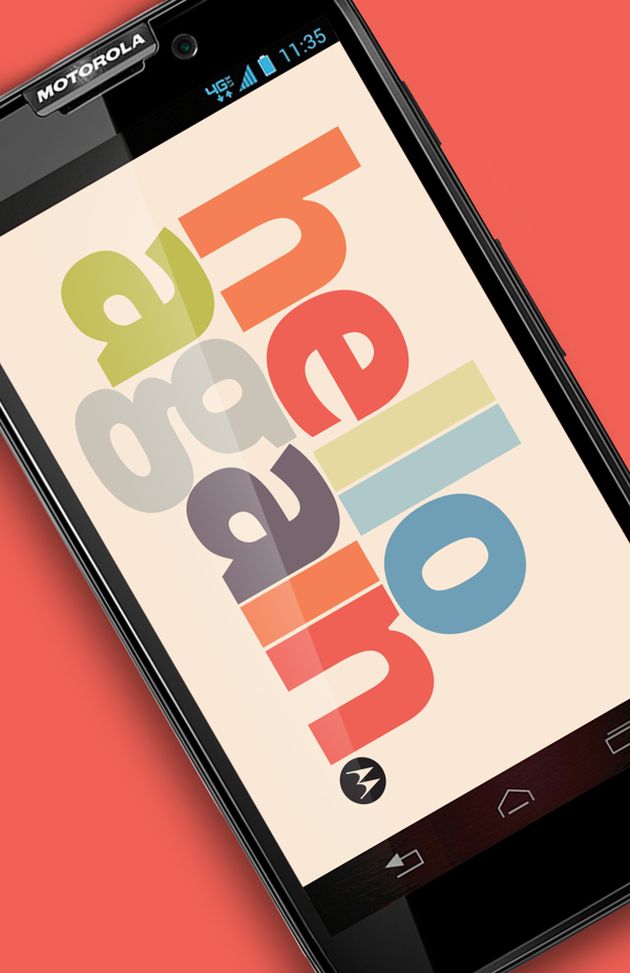
    After last night’s cryptic leak about a possible ad campaign for Motorola, the internet is back today with some more info. Once again posted on B.A. Bäkken’s Behance page, these pictures present a different story. A story of Motorola’s return; emphasized with the phrase “hello again”.

    motorola X Phone

    The company is understood to be undergoing some sort of rebranding, re-emerging with its new Motorola X Phone on August 1. 

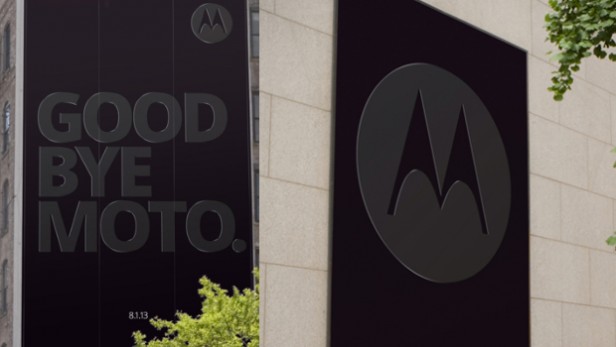
    “The Motorola that returns will not be the company you once knew. But we have some work to do”, reads one of the images. “So until we’re ready, we’re going away. No new ads or tweets. No site updates. Just silence until we begin the next chapter. Until we meet again, goodbye Moto.” 

    The most recent specs leak that we have seen came from an often-reliable source though, and these included a 1.7GHz MSM8960 Pro dual-core processor, 720p HD display, 2GB of RAM and 16GB of internal memory, a 10-megapixel rear camera and 2-megapixel front-facing shooter. Along with these specs we also heard that the Moto X phone would run the Android 4.2.2 Jelly Bean operating system, but we must remind you that all of this is not yet confirmed. If accurate though, then the specs are decent enough, but we feel that many potential customers are hoping for a lot more.

    Motorola X Phone

    PhoneArena also posted an image of the Motorola X Phone, which you can see above.

    Google and Motorola have also indicated that the Moto X phone will use the phone’s sensors in interesting new ways. We’ve heard Motorola talk about how the Moto X phone will be able to know when you’re driving and it will dynamically adjust the interface based on that information. 

    [Via, Via]

  • Google Working On A Plan To Eradicate Child Porn On The Web

    Google may have found the ultimate weapon in the fight against child porn on the Web. The company told The Daily Telegraph that it has built a new way for Web companies to share information about child abuse images.

    Photos and videos of child pornography on the Web have multiplied at an alarming rate over the past few years. In 2011, the National Center for Missing and Exploited Children said it received 17.3 million images and videos of suspected child abuse, which is four times more than 2007.

    “Behind these images are real, vulnerable kids who are sexually victimized and victimized further through the distribution of their images,” Google Giving director Jacquelline Fuller wrote in a blog post on Saturday. “It is critical that we take action as a community — as concerned parents, guardians, teachers and companies — to help combat this problem.”

    Google’s plan is to build a database of child porn images that can be shared with other tech companies, law enforcement, and charities around the world. The database will let these groups swap information, collaborate, and remove the images from the Web.

    Google will use a technique called “hashing” to build the particular data base. The “hashing” will help the firm tag images featuring sexual abuse of children with unique identification codes.

    Google has also announced that it is donating $5 million for the cause of fighting child pornography. Part of the aid will go to global child protection partners like NCMEC and Exploited Children and the Internet Watch Foundation

    The fight to remove these images from the internet is a global one, and we hope these measures will help in that important battle

  • Google Announces ‘Project Loon’, Giant Balloons For Affordable Internet

    Google has a truly sky-high idea for connecting billions of people to the internet – 19 kilometres in the air to be exact – through giant helium balloons circling the globe that are equipped to beam Wi-Fi signals down below.

    According to Google, two of every three individuals on Earth either do not have access to the Internet, or don’t have access to a connection that is both fast and within their financial means – in some areas, individuals are faced with prices equal to more than a month’s paycheck. This issue isn’t going to resolve itself without thinking outside of the box, according to the company, and that is where the balloons come in. It was the culmination of 18 months’ work on what Google calls Project Loon.

    Project Loon

    In addition to providing access to the two out of every three people on earth Google says don’t have access to affordable broadband, another goal of the Google[x] team behind Project Loon is to help with maintaining communications following natural disasters.

    The solar-powered, remote-controlled balloons would navigate stratospheric winds 20 kilometers above the surface of the earth, well above the altitude where most planes travel. Similar to the way satellite internet works, the balloons would communicate with special antennas and receiver stations on the ground.

    project loon

    The balloons also represent another of Google’s forays into the telecommunications business. The company has been setting up Google Fibre internet connections in Kansas City, Austin, Texas and elsewhere that offer speeds 100 times faster than what most consumers have today.

    [youtube id=”m96tYpEk1Ao” width=”100%” height=”300px”]

  • About Time! Google Glass Cracked Open In Teardown

    About Time! Google Glass Cracked Open In Teardown

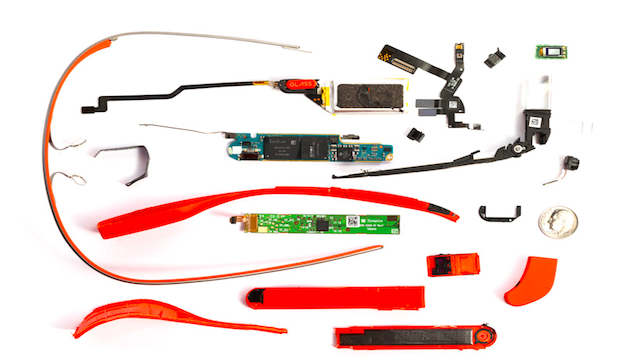
    It was bound to happen at some point, and condolences to whomever sacrificed their frames for the greater good aside, we’ve got our first look at the components from Google Glass and how they’re fitted together.

    The internet owes a deep thanks to Scott Torborg and Star Simpson who did a detailed tear-down post on the Google Glass.

    Some of the motivation for the tear down was purely technological while some of it was driven by the growing concerns about privacy and personal security in the US.

    “Growing up on a rich diet of dystopian tech fiction, we were filled with both intrigue and concern about Glass and decided to take our model apart to bring you a detailed view into the electronics guts of the device.

    It is not surprising that the camera is similar in quality and resolution to cameras found in your everyday smartphone:

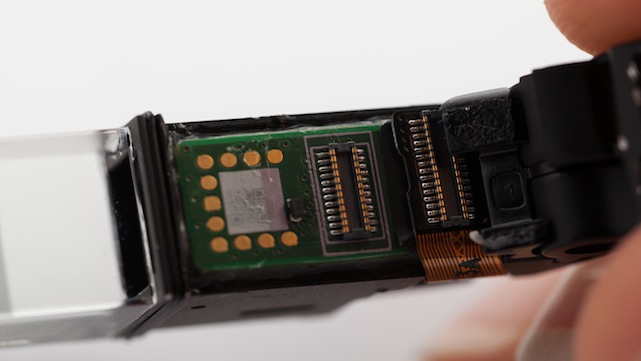
    “The Glass camera seems to be of typical smartphone-level size and format. It is not coaxially aligned with the wearer’s eye. The camera and display appear to talk to the CPU independently, with no direct connection between each other.

    The main board, which is held in place with “lots of paste.” Removing said paste revealed a TI OMAP4430 chip and a 16GB SanDisk flash chip. Next was the battery, which also required tearing the plastic in order to get to it. Obviously, this means users cannot replace the battery on their own. The rest of the teardown is detailed in extensive pictures, which you can check out at the link at the bottom.

    Google Glass

    According to the Google Glass Tech specs page, Glass has a 5-megapixel camera that can shoot video in 720p. It supports 802.11 b/g Wi-Fi and Bluetooth. Audio is provided by a bone conduction transducer, and the display is “the equivalent of a 25-inch high definition screen from eight feet away.” As for buttons and connectors, Glass has a Listen button, on/off button, capture button, touch sensitive area, and Micro USB port for charging. There’s also a status LED and rear-facing sensor array.

    [Catwig]

  • Rumour: Google Set To Ink US$1.3 Billion Deal For Waze Traffic App

    Popular mapping-app Waze has been a hot commodity in the tech world recently, fetching offers from Facebook and Apple along the $1 billion range. But it appears Google won the bidding war, for a cool $1.3 billion, according to a report from Israeli media.

    Haaretz newspaper said on its website that the two companies had agreed terms and were about to sign for a price “exceeding $1 billion”.

    waze

    Business daily Globes said the purchase price was $1.3 billion. Neither report identified its sources. “We don’t comment on rumour and speculation,” a Google spokesman told AFP about the Israeli media reports.

    Waze, whose mobile app solicits input from more than 40 million users to improve directions and display traffic and road-hazard details, would help Google add social features to its mapping tool, said Greg Sterling, an analyst at Opus Research.

    Interestingly, Microsoft was reportedly an early investor in Waze back in 2009, helping the fledgling start-up with building capital. Microsoft (or Nokia and their HERE services) were not part of the latest round of negotiations, which means either they did not see the value in the company, had alternatives or were simply caught off guard.

    Last year, Apple CEO Tim Cook issued a public apology for Apple Mapssoftware, which was followed by the announcement of an iOS version from Google of Google Maps.

    In an interview with “AllThingsD” at D11 in May, Cook announced that Apple had not bid for Waze.

    [T3, Haaretz]

  • Android Jelly Bean Now On 33 Percent Of Android Devices According To June Figures

    Android Jelly Bean Now On 33 Percent Of Android Devices According To June Figures

    The latest Android distribution stats are in as of June 3rd, and things are looking up for Jelly Bean.

    Jelly Bean, including Android 4.1 and 4.2, now makes up 33% of all users. Coupled with Ice Cream Sandwich at 25.6%, nearly 60% of users run Android 4.0 and above.

    android

    Changes from last month are minor, Android 4.2 finally got a bit boost, almost doubling from 2.3% to 4% in less than a month, on the strength of the Samsung Galaxy S4. Android 4.1 also jumped 2.9% from last month as more customers upgraded from older devices; 2.1, 2.2 and 2.3 saw slight drops this month.

    It also appears that manufacturers are making good on their word to upgrade ICS users to Jelly Bean, as much of the Android 4.1 gain came at the expense of 4.0 — the former gaining 2.9% and the latter losing 1.9%.

    There are some unfortunate conclusions to be made here: while it’s gratifying to see Android 4.0+ rising to 60% of all users, Gingerbread’s demise is taking far larger than it should and it is hampering the rollout of apps that take advantage of newer platform features only possible on ICS and above.

    It’s important to remember that Google recently tweaked its algorithm in regards to how it counts users for these figures. In its own words, the company explains:

    Note: Beginning in April, 2013, these charts are now built using data collected from each device when the user visits the Google Play Store. Previously, the data was collected when the device simply checked-in to Google servers. We believe the new data more accurately reflects those users who are most engaged in the Android and Google Play ecosystem.

    Also, according to a tweet from the well-connected and accurate @LlabTooFeR Twitter account, Android 4.3 Jelly Bean could be rolling out a few weeks after the HTC One Nexus hits the Google Play Store.

    @LlabTooFeR is best known as a source of HTC-related rumors, and has proven to be very accurate in most cases.

    Exciting times for all Android fans!

  • Gmail Version 4.5 For Android Now Rolling Out

    Gmail Version 4.5 For Android Now Rolling Out

    Google has started rolling out its new version of Gmail for Android today.

    Like the desktop version, Gmail for Android gets the organizational luxury of “categories”. Those tabs are meant to filter email messages into a type of sub-folder system, rather than clutter your inbox. 

    Also, now there is the option to refresh the feed by pulling down on the feed.

    The left-side navigation bar is also present, making it much easier to navigate between Labels.

    The update is rolling out slowly to the hundreds of millions of Android Gmail users, so head to Android Police for the APK download. No word on when the iOS version will be released. The tablet UI is the same, though the left menu remains on the screen.

    Have you tried the new Gmail layout on your desktop or laptop? What do you think of the new design for Android? Let us know your thoughts.

    If you’re the impatient kind, and cannot find the update on the Play Store, you might like to try one of the following download links to grab the updated APK today:

    All mirrors courtesy of Android Police

    [Android Police]

  • HTC One with Stock Android Announced, Available June 26th $599

    HTC One with Stock Android Announced, Available June 26th $599

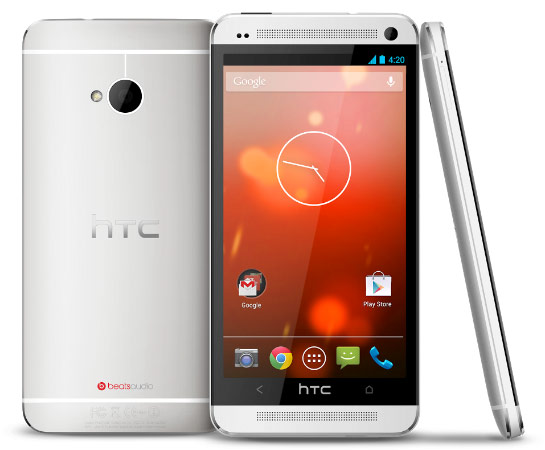
    Google’s Sundar Pichai while at D11 has made it clear that there indeed will be an HTC One running stock android 4.2.2 which will be launched and made available on June 26th via the Google Play store. For the US market this phone will come unlocked to GSM networks and will cost US $ 599 (approximately Rs. 34,000) vs the Samsung Galaxy S4 which is priced at US $ 649.

    For global connectivity the Stock Android HTC One will offer quadband LTE (700/850/AWS/1900), triband HSPA+ (850/1900/2100) and the usual quadband GSM / EDGE. The Hardware will still be integrated with Beats audio and will retain the “two button on either side of the HTC logo” layout. The app list black bar will also be there along with the button press schemes.  For the main buttons short press of Home for Home, long press for Google Now and double tap for Recent Apps.


    [VIA]


  • Google Calendar for Android updated with more color options and tweaks

    Google Calendar for Android updated with more color options and tweaks

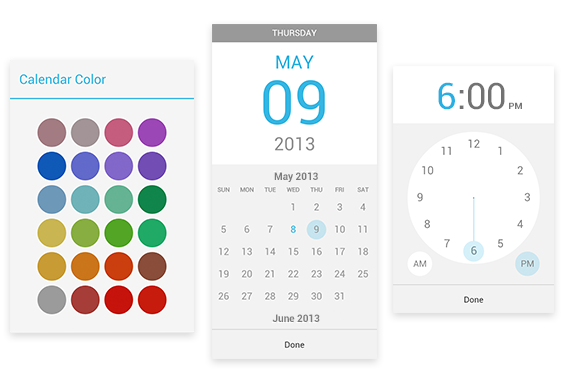
    If you use Google Calendar a lot on your Android phones, you will love the new changes that Google has made to the app. Starting with a new color tool, which lets you highlight specific appointments and change the color of your entire calendar.

    So now all your meetings can be set in blue and all the Home chores in Red ! This feature will let you identify and group up your tasks making the calendar a lot more efficient to do tool. The newly designed date and time function lets you pick out time and dates in the analogue style and as Google says “well before the vacation”.

    Time zones are now set automatically by entering the name of the city and the app is available for Android ICS 4.1 and above. Check it out in the link below.


    [toggle title=”Press Release”]

    One of the most requested features we’ve seen so far for Google Calendar on Android is the ability to customize event and calendar colors directly from your device. Today’s update allows you to do just that. Now you can highlight those super-urgent meetings and important birthdays, or just switch up the color of your calendar whenever your heart desires.

    Adding events is now easier and more fun with our redesigned date and time pickers, which let you schedule your special dinner date or the start of your well-deserved vacation in a snap.

    For all of you world travelers, our redesigned timezone picker makes it simpler to find the region that you’re looking for, whether you’re in San Francisco, Tokyo or Zurich.

    Finally, it’s easier to schedule repeating events. You can now set events to repeat every Tuesday and Thursday, every month, or every 7 weeks, it’s completely up to you.

    The latest version of Google Calendar is built for devices running Android 4.0.3 and above (Android 4.1 or higher for custom event colors). Get it on Google Play, rolling out over the course of the day, and let us know what you think.

    [/toggle]

    [Download]

    [Source]


  • Leaked Image Shows Nexus 4 Running Android 4.3, New Camera Camera UI

    Leaked Image Shows Nexus 4 Running Android 4.3, New Camera Camera UI

    Leading up to Google’s I/O event, there were a lot of rumors indicating that we would see the unveiling of Android version 4.3 rather than 5.0. However, during the keynote, Google ended up not addressing a new version of Android at all. Instead, they chose to focus on updating individual apps and APIs separate from the operating system.

    android 4.3

    Today we get a first-hand look at the software in action, with a number of images appearing to show Android 4.3 running on a Nexus 4. The image was taken at the Thailand Mobile Expo and posted on the XDA Developers forum.

    We clearly see Android 4.3 Jelly Bean as the OS, with a build date being May 14th, so it’s a pretty new updated version. Then the build number is listed as JWR45B.

    android 4.3

    The other pictures show the camera in action – with a slightly modified interface – and a screen of just the Jelly Bean Easter Egg that can be found in the About section too.

    The camera interface seems to include a new see-through action area, complete with a new activation ring and fresh icons for HDR, contrast, and rotation. 

    android 4.3

    The images don’t seem to show any significant changes, so the possibility remains that Google didn’t show their latest version of Android perhaps because there isn’t much to show in the first place. They could be saving the bigger changes for a major 5.0 update rather than another incremental version update.

    Is what we heard about a June launch, alongside the white Nexus 4 accurate?

    [XDA, Droid-Life, VR-Zone]

  • Google Maps get redesigned; Improve the Search and Tablet Interface

    Google Maps get redesigned; Improve the Search and Tablet Interface

    Although the information was already leaked ahead of the time, the final announcement has been made. Talking at the Google I/O conference the company has taken wraps off the next major release of Google Maps for Android and iOS. The new design targeted at a personalized approach to the maps use, sports a rating system and offers experience from various retail merchants. 

    Like a friend drawing you a map to her favorite restaurant, with only the roads and landmarks you need to get there, the new Google Maps instantly changes to highlight information that matters most.

    And the more you interact with the map, the better it gets. When you set your Home and Work locations, star favorite places, write reviews and share with friends, Google Maps will build even more useful maps with recommendations for places you might enjoy.

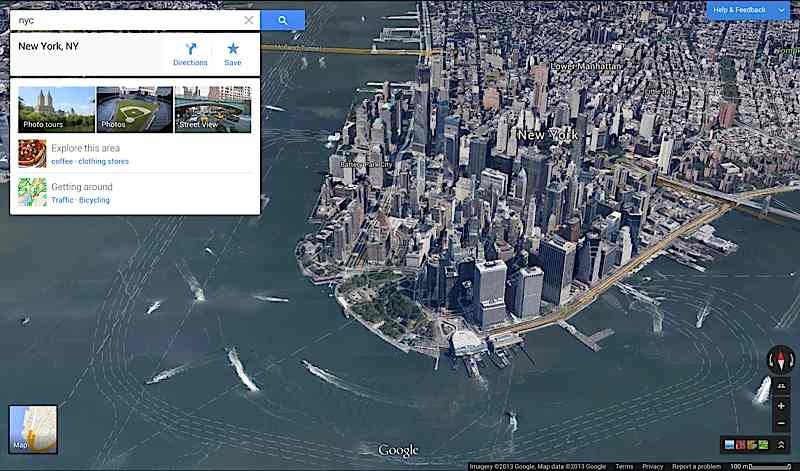
    Calling the desktop version a treasure chest of  “immersive imagery”, Google says the redesigned map itself is now the user interface.

    Easier to find the best local places 
    In addition to a customized map, we’ve also made it easier to uncover the best local gems. Search results are labeled directly on the map with brief place descriptions and icons that highlight business categories and other useful information – like restaurants that are recommended by your Google+ friends. Info cards provide helpful information such as business hours, and ratings and reviews so you can quickly decide where to eat, drink and play. 


    Of course, no map would be complete without amazing images for exploring the world. The new carousel gathers all Google Maps imagery in one spot enabling you to fly through cities, walk canyon trails, climb mountains, and even swim the oceans. And on a WebGL-enabled browser, like Google Chrome, the carousel is also where you’ll find the Earth view which directly integrates the beautiful 3D experience from Google Earth into the new maps. 

    Check out the Google Maps Blog below for more details, and if you are already on board, click the maps preview link to signup for an invite.

    [Google Maps Blog]

    [Signup page]


iGyaan Network
Privacy Overview

This website uses cookies so that we can provide you with the best user experience possible. Cookie information is stored in your browser and performs functions such as recognising you when you return to our website and helping our team to understand which sections of the website you find most interesting and useful.