Tag: Microsoft Windows 8

  • Windows 8 Crosses 100,000 Apps Milestone

    Windows 8 Crosses 100,000 Apps Milestone

    Microsoft has hit a pretty big milestone for Windows 8, with the Windows Store passing the 100,000 apps mark. It’s taken just over seven months for Microsoft to hit the big 100K after Windows 8 launched in late October last year, although the milestone didn’t quite happen quickly enough as it managed to miss Microsoft’s BUILD 2013 developer conference by roughly a week.

    At the same time, Microsoft has also confirmed the development of some new exciting Metro apps, including a Facebook client that would allow users to access their profiles from the Modern UI. Flipboard and Rhapsody will also develop Windows 8 apps.

    Even when compared against the iPad the feat is impressive.  That device took 14 months to reach the mark, while the Mac app store still languishes on only 15,000 apps 30 months after its own launch.

    Windows 8 has just passed the 5.1% share of the 1.3 billion PCs in use world-wide, according to NetApplications, which translates into more than 66 million PCs running Windows 8 at present, with at least 40% running a Metro app once per day.  This is likely double the number of Windows Phones in use.

    While Microsoft has hit the 100,000 app milestone, they still have a way to go to not only improve the quality of app offerings in the Windows Store, but also convince customers that Modern apps are worth downloading. Various analysts have been very critical of the app offerings in the Store, and consumers haven’t been convinced by Windows RT – which largely runs Windows Store apps – instead choosing to buy full Windows 8 tablets with desktop compatibility.

  • Microsoft Q2 2013 Earnings Indicate $21.56b Revenue, $6.38b Profit

    Microsoft Q2 2013 Earnings Indicate $21.56b Revenue, $6.38b Profit

    microsoft

    Microsoft says its fourth-quarter earnings slipped 4 percent, despite a lift from its latest version of Windows.

    The Redmond, Washington-based software giant posted revenue of $21.46 billion and net income of $6.38 billion, with earnings per share of 77 cents. That’s largely in line with what Wall Street had been expecting, though a bit lower on the revenue side and higher on the earnings side — ahead of today’s financial report, the analyst consensus was that Microsoft would post earnings of 75 cents a share on $21.53 billion in revenue.

    The results announced Thursday are the first to include Windows 8. The program is a dramatic overhaul of the Microsoft Corp operating system that powers most PCs. Windows 8 came out  26  October with slightly more than two months left in Microsoft’s fiscal second quarter.

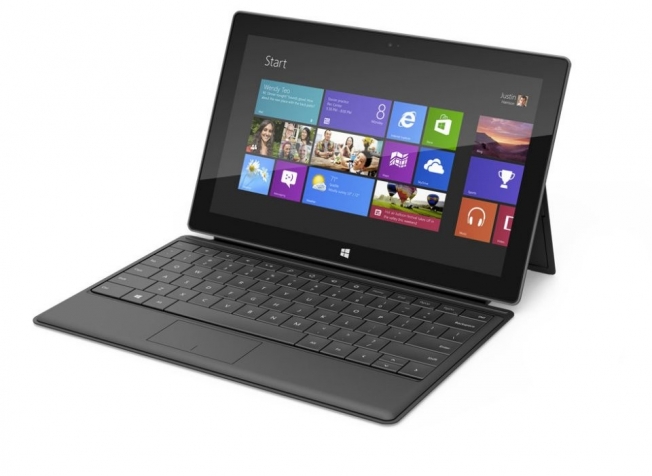
    When Windows 8 finally hit the market, Microsoft also unveiled its own tablet computer, Surface, as a showcase for the operating system. Microsoft didn’t disclose Thursday how many Surface devices were sold in the October-December period.

    Microsoft’s Entertainment & Devices division, which is responsible for the Xbox and Surface, saw an 11% decline from last year, with only $3.77 billion of revenue. This comes after Microsoft announced that the Xbox 360 was the top-selling gaming console for two years straight. It looks like holiday sales weren’t as great as the company expected.

    Microsoft’s Online Services division saw more growth, however, with $869 million in revenue, which is an 11% increase year-over-year. Thanks to the upcoming Office 365 suite and SkyDrive, Microsoft’s online services don’t seem to be slowing down anytime soon, especially with the deal that Microsoft made with the city of Chicago to bring Office 365 services to city employees.

  • Steve Ballmer : Windows Phone Sales Have Quadrupled

    Steve Ballmer : Windows Phone Sales Have Quadrupled

    windows phone

    Speaking at the company’s annual shareholders meeting on Wednesday, Microsoft CEO Steve Ballmer waxed enthusiastic about Windows Phone 8, claiming sales were off to “a great start.”

    Without citing any exact numbers, Ballmer said Redmond is selling four times as many Windows Phone devices than at this time last year.

    In addition, he said the Windows Phone Store now offers more than 120,000 apps, and that it will soon have “46 of the top 50 apps that people use.”

    Those aren’t bad results for a product that launched only a month ago, and Ballmer’s comments must surely have sounded encouraging to Microsoft shareholders, for whom the poor performance of the Windows Phone division has been a longstanding gripe.

    Competing with Android and iOS is no simple task. Apple is a pioneer in the smartphone space that has demonstrated a blend of persistent innovation, and recently, price flexibility in its smartphone line to reach several socioeconomic demographics. At the same time, Android has taken on the position in the smartphone market that Windows has long enjoyed in PCs: the low-cost, volume leader that also has the ability to sell high-end devices to enthusiasts.

    According to Microsoft, demand for Windows 8 PCs and tablets is enormous; the data, however, shows a 21% decline for Windows PCs over last year (including tablets, which were practically non-existent), and according to analysts the Windows 8 tablet market is “virtually non-existent.” Again, until we hear from OEMs reporting actual sales data we won’t know for sure. We’ll also likely hear how many Surfaces were sold when Microsoft issues its next quarterly results. Either way, it will be spun into a web of success: Ballmer is good at that, and we love an underdog.

  • Microsoft Windows Phone 8 Reboot Bug Fix Coming In December

    Microsoft Windows Phone 8 Reboot Bug Fix Coming In December

    microsoft

    Microsoft has found the issue that’s causing some Windows Phone 8 users devices to randomly reboot. It’s certainly frustrating and it’s happen to other platforms in the past.

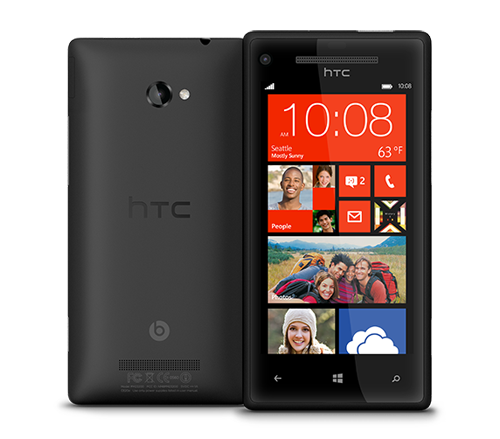
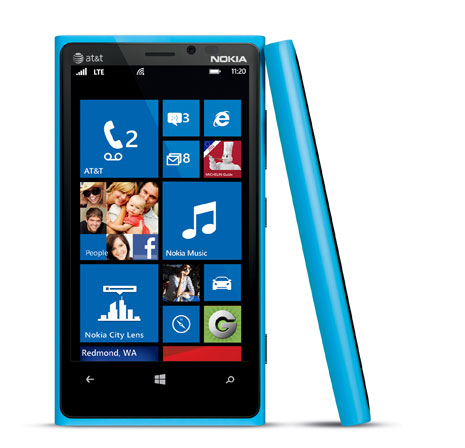
    Hundreds of users of the Nokia Lumia 920 and HTC 8X smartphones have reported on Internet forums that their phones were repeatedly and spontaneously rebooting. The reports identified several different mobile operators in the U.S. and Europe. The forums didn’t identify a consistent culprit for the problem.

    Initially, it was speculated that the patch to fix the rebooting issue will be part of a larger software update for the platform, known as Apollo Plus, that would bring added features. However, it looks like as the problem has been identified, Microsoft may not want to wait and is rolling out the patch ahead of Apollo Plus.

    Unfortunately Microsoft isn’t specifically saying what’s causing this, only stating that it’s not them but “with our partners.” No indication if it’s a manufacturer, carrier or app developer. However, according to AllThingsD a fix is en route OTA in December.

  • Steven Sinofsky, Microsoft’s Windows Chief, Set To Leave

    Steven Sinofsky, Microsoft’s Windows Chief, Set To Leave

    windows

    Microsoft Corp said the head of its flagship Windows division and the driving force behind Windows 8, Steven Sinofsky, will be leaving the company with immediate effect, days after the software giant launched the Surface tablet.

    Just weeks earlier, Microsoft released Windows 8, the company’s biggest overhaul to its flagship software product in years. The departure raises questions about how Microsoft, one of the giants in the technology business, will prepare itself for a new generation of leadership.

    In an e-mail sent to all employees Monday evening, Mr. Ballmer said that Mr. Sinofsky’s decision to leave Microsoft comes at the start of a “new era” for the company, with the release of a wave of new products like Windows 8.

    “I am grateful for the work that Steven has delivered in his time at our company,” Mr. Ballmer said in the e-mail. Frank Shaw, a Microsoft spokesman, said Mr. Sinofsky was not available for an interview.

    [quote]In a statement announcing his departure, Mr. Sinofsky, 47, said, “I am humbled by the professionalism and generosity of everyone I have had the good fortune to work with at this awesome company.”[/quote]

    Mr. Sinofsky was viewed as one of the most competent managers within Microsoft, and he earned high marks for helping to improve the quality of its software after the company released Windows Vista, a widely criticized version of the operating system. A former technical assistant to Bill Gates, Microsoft’s co-founder, he was known to be a big admirer of Apple’s attention to detail in its products.

    His name was often floated by people speculating about a possible successor to Mr. Ballmer, who has not announced any plans to retire from the company.

  • “Notification Center” For WP8 : We Ran Out Of Time Says Microsoft, May Come In Next Update

    “Notification Center” For WP8 : We Ran Out Of Time Says Microsoft, May Come In Next Update

    windows

    There is no doubt that Windows Phone 8 is beautiful, fast and, most importantly, a huge upgrade over its predecessor.

    But one thing that Microsoft didn’t change, to the chagrin of almost every WP7 user, was the way the OS deals with notifications. When WP7 debuted in late 2010, neither iOS nor Android had what could be called great notification systems. Yes, Android has, from the beginning, had its drop-down shade, but one couldn’t dismiss individual notifications until Android 4.0. iOS, until its fifth iteration, had arguably the worst and most disruptive way of dealing with notifications in the industry.

    Windows Phone, on the other hand, used toast notifications that were immediately intriguing. Combined with live tiles, they provided a simple way to view what was happening — emails, tweets, messages — without disrupting the overall user experience. Very soon, however, it became obvious that without a live tile consolidating these notices, it was possible to miss a notification and have no idea where it came from. Users were understandable frustrated by this, and expected something a little more robust in Windows Phone 8.

    Alas, when WP8 was revealed in its entirety, not a mention was made to the notification system. Microsoft, however, is sensitive to the matter, and commented on it during BUILD. Microsoft’s Michael Fennel told an audience during a session on notifications, “We ran out of time. It’s very, very important to m. We get tons of feedback from developers that they want something like that as well. I promise we’re thinking very, very hard on that one.” While the statement is nothing more than a, “we’ll see,” and may not be implemented until WP8.5 or its equivalent, it’s good news to hear that Microsoft is giving it some serious thought.

  • Microsoft Officially Unveils Windows 8 and the Surface RT tablet

    Microsoft Officially Unveils Windows 8 and the Surface RT tablet

    Windows

    Microsoft has brought thousands of people to New York to celebrate the launch of its Windows 8 operating system and its Surface RT tablet, available October 26th. Touting 670 million users of Windows 7 and over 15 petabytes of data stored in its Skydrive cloud, Microsoft is confident that Windows 8 will become even more successful than its predecessor.

    windows

    One major aspect of the announcement is bringing more attention to Windows RT, a version of Windows 8 optimized to run on ARM-based processors such as Nvidia’s Tegra 3 and Qualcomm’s Snapdragon S4 family. This is the version of Windows that will first become available on Microsoft’s Surface tablet — the Intel-powered Pro version will be available in the coming months — and will be limited to running apps downloaded from the Windows Store. While this severely limits the potential audience of Windows RT, Microsoft has promised that the Windows Store will contain more apps upon its launch than any other ecosystem did when it launched.

    Microsoft claims that there have been over 1,000 PCs, in varying styles and sizes, certified to use Windows 8. The ARM-based PCs and tablets will have extensive peripheral support, supporting the majority of mice, keyboards and printers. As for apps, Microsoft promises that top brands will feature in the Store, as well as first-party apps such as Xbox Music, Games and Movies.

  • Windows Store Reaches 1000 Apps Milestone

    Windows Store Reaches 1000 Apps Milestone

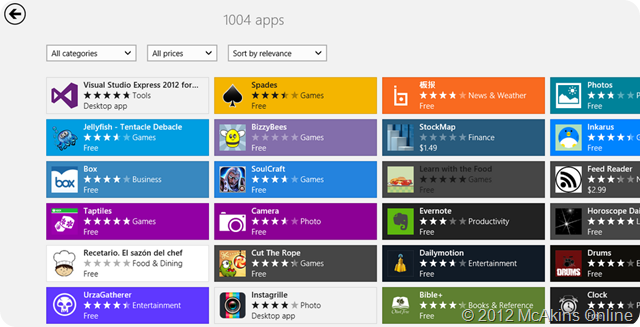
    We have seen a large rise in the number of Windows 8 apps that users of the RTM version can see from the Windows Store. Today, a third party site that has been tracking the numbers of those apps stated that it has now passed the 1,000 milestone.

    McAtkins Online says that in its latest app count shows there are now 1,004 apps that are visable for Windows Store users. This number includes both desktop apps (which cannot be directly downloaded from the Windows Store) and the “Modern” Windows 8 apps. Just a few days ago, the same website said there were 839 apps available on the Windows Store.

    Apparently, the rate at which new applications are being pushed to the Store has increased, and chances are that Microsoft will go near the 3,000 apps mark or beyond it by the time the platform reaches general availability. 

    It seems that more and more developers are flocking to Windows 8, which suggests that more new software will appear in the Store soon, thus making the platform even more appealing than before.

    It’s also possible that Microsoft could be holding back until just a few days before October 26th before it decides to open the flood gates for new Windows 8 apps to be released.


  • Microsoft Debuts New Logo Before Windows 8

    Microsoft Debuts New Logo Before Windows 8

    In advance of the Windows 8 launch on Oct. 26, Microsoft today unveiled a new logo that’s 25 years in the making.

    The world’s largest software company is introducing a dash of color in its first logo redesign since 1987, using a new multi-colored square next to a plain rendering of its name, replacing its well-worn italic style logo.

    Microsoft is rolling out its new Windows 8 operating system along with new Office and phone software this autumn, and is hoping the new logo unifies customers’ experience of the company, much like rival Apple Inc’s distinctive logo has for its consumers.

    The logo uses the so-called Segoe font, which is used in Microsoft products and marketing materials, and four colored squares that are “intended to express the company’s diverse portfolio of products,” the Redmond, Washington-based company said on its blog.

    “It’s been 25 years since we’ve updated the Microsoft logo and now is the perfect time for a change,” said Jeff Hansen, general manager of Microsoft’s brand strategy, in a blog on Microsoft’s website. “This wave of new releases is not only a reimagining of our most popular products, but also represents a new era for Microsoft, so our logo should evolve to visually accentuate this new beginning.”

    The new design, which resembles the existing logo for Windows, its most important product, is already in use on Microsoft’s website and is being unveiled at its latest store opening in Boston on Thursday.

  • Windows 8 to be launched on 26 October

    Windows 8 to be launched on 26 October

    Microsoft on Wednesday announced that its next-generation operating system tailored for a world shifting from personal computers to smartphones and tablets will be available on 26 October.

    Windows unit boss Steven Sinofsky revealed the Windows 8 debut date at a sales meeting, Microsoft communications manager Brandon LeBlanc said in a blog post.

    Windows 8 will be available in 109 languages across 231 markets worldwide, according to LeBlanc.

    Microsoft has promised to make the new operating system available in August for computer, tablet or smartphone makers to build into hardware.

    The Redmond, Washington-based firm has gone on record stating that Surface tablets would hit the market when the Windows 8 operating system became publicly available.

  • Microsoft will replace NTFS with ReFS in Windows Server 8

    Microsoft will replace NTFS with ReFS in Windows Server 8

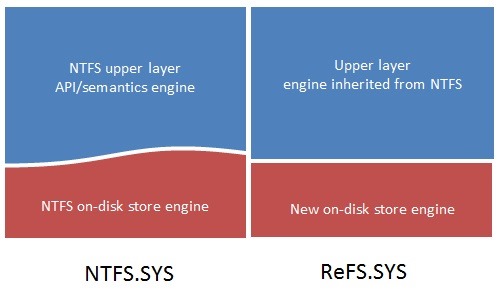
    Windows server 8 will introduce the Resilient File System, or ReFS, as a “next generation file system” built on the foundations of the NTFS. The new gen file system is designed by reusing NTFS’ API / semantics engine to retain a high level of compatibility with NTFS features. The new file system design is aimed to protect against latent disk errors, resist data corruption, uphold metadata integrity, grant large volume, file and directory size. The whole concept is to reduce the massive file corruption and fragmentation users face with NTFS and Windows in general.

    The key goals of ReFS are:

    • Maintain a high degree of compatibility with a subset of NTFS features that are widely adopted while deprecating others that provide limited value at the cost of system complexity and footprint.
    • Verify and auto-correct data. Data can get corrupted due to a number of reasons and therefore must be verified and, when possible, corrected automatically. Metadata must not be written in place to avoid the possibility of “torn writes,” which we will talk about in more detail below.
    • Optimize for extreme scale. Use scalable structures for everything. Don’t assume that disk-checking algorithms, in particular, can scale to the size of the entire file system.
    • Never take the file system offline. Assume that in the event of corruptions, it is advantageous to isolate the fault while allowing access to the rest of the volume. This is done while salvaging the maximum amount of data possible, all done live.
    • Provide a full end-to-end resiliency architecture when used in conjunction with the Storage Spaces feature, which was co-designed and built in conjunction with ReFS.

    The key features of ReFS are as follows (note that some of these features are provided in conjunction with Storage Spaces).

    • Metadata integrity with checksums
    • Integrity streams providing optional user data integrity
    • Allocate on write transactional model for robust disk updates (also known as copy on write)
    • Large volume, file and directory sizes
    • Storage pooling and virtualization makes file system creation and management easy
    • Data striping for performance (bandwidth can be managed) and redundancy for fault tolerance
    • Disk scrubbing for protection against latent disk errors
    • Resiliency to corruptions with “salvage” for maximum volume availability in all cases
    • Shared storage pools across machines for additional failure tolerance and load balancing

    What are the capacity limits of ReFS?

    The table below shows the capacity limits of the on-disk format. Other concerns may determine some practical limits, such as the system configuration (for example, the amount of memory), limits set by various system components, as well as time taken to populate data sets, backup times, etc.

    Attribute

    Limit based on the on-disk format

    Maximum size of a single file

    2^64-1 bytes

    Maximum size of a single volume

    Format supports 2^78 bytes with 16KB cluster size (2^64 * 16 * 2^10). Windows stack addressing allows 2^64 bytes

    Maximum number of files in a directory

    2^64

    Maximum number of directories in a volume

    2^64

    Maximum file name length

    32K unicode characters

    Maximum path length

    32K

    Maximum size of any storage pool

    4 PB

    Maximum number of storage pools in a system

    No limit

    Maximum number of spaces in a storage pool

    No limit

    [Building Windows 8]

  • Windows 8 Developer Preview Launched, Downloads Commenced(PR)

    Windows 8 Developer Preview Launched, Downloads Commenced(PR)

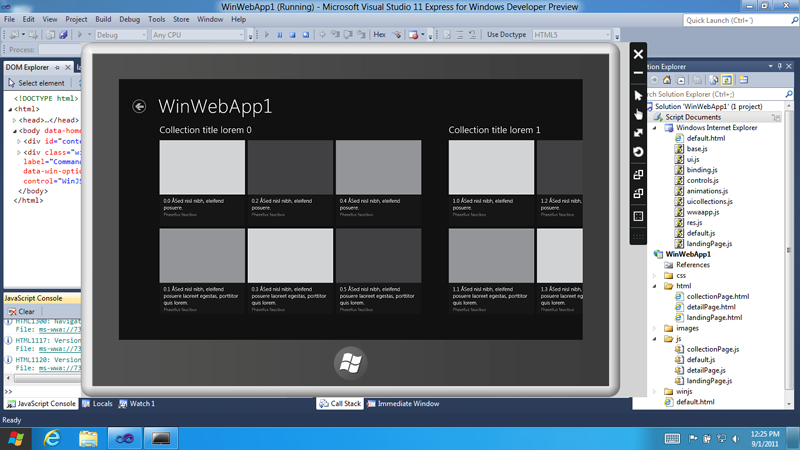
    With the commencement of the Microsoft Build conference, the company has also launched the Developer version of Windows 8.

    Widows 8 is a remained version of Windows, that offers a practically new way to interact with the personal computer. The new platform also bring a new range of capabilities that can let developers bring the easy and graphics of the Windows Phone 7 Metro UI .

    Steven Sinofsky- President Windows.


    Get Your version of the Dev Preview Here : Link – Microsoft Dev Downloads


    [toggle title_open=”Press Release” title_closed=”Press Release” hide=”no” border=”yes” style=”default” excerpt_length=”0″ read_more_text=”Read More” read_less_text=”Read Less” include_excerpt_html=”no”]Microsoft Reimagines Windows, Presents Windows 8 Developer Preview

    BUILD Conference attendees and developers get first access to new operating system.

    LOS ANGELES – Sept. 13, 2011 – Today at its developer-focused BUILD conference, Microsoft Corp. showcased a detailed preview of the next major release of Windows, code-named “Windows 8.” The company also detailed new tools for developers to help write applications for more than 1 billion people around the world who use Windows every day.
    “We reimagined Windows,” said Steven Sinofsky, president of the Windows and Windows Live Division at Microsoft, in his keynote address to the thousands of developers in attendance. “From the chipset to the user experience, Windows 8 brings a new range of capabilities without compromise.”

    The company also highlighted a variety of new features in Windows 8, including the following:

    Touch-First User Interface
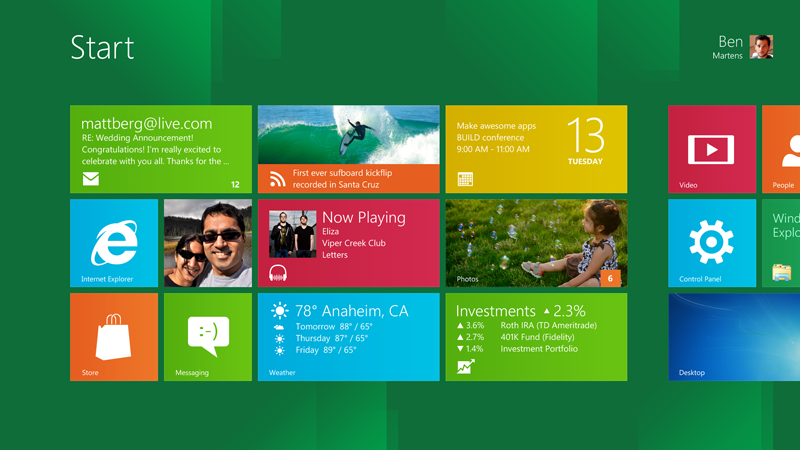
    • Metro style. Windows 8 introduces a new Metro style interface built for touch, which shows information important to you, embodies simplicity and gives you control.
    • Touch-first browsing, not just browsing on a touch device. Providing a fast and fluid touch-browsing experience, Internet Explorer 10 puts sites at the center on new Windows 8 devices.
    More Ways to Engage With Powerful, Connected Apps
    • Powered by apps. Metro style apps built for Windows 8 are the focal point of your experience, filling your entire screen so there are no distractions.
    • Apps can work together. Apps communicate with each other in Windows 8. For example, you can easily select and email photos from different places, such as Facebook, Flickr or on your hard drive.
    • The content you create syncs across your devices. Live roams all the content from the cloud services you use most – photos, email, calendar and contacts – keeping them up-to-date on your devices. With Windows SkyDrive, you can access content anywhere with your Microsoft account.
    Enhanced Fundamentals
    • The best of Windows 7, only better. Windows 8 is built on the rock-solid foundation of Windows 7, delivering improvements in performance, security, privacy and system reliability.
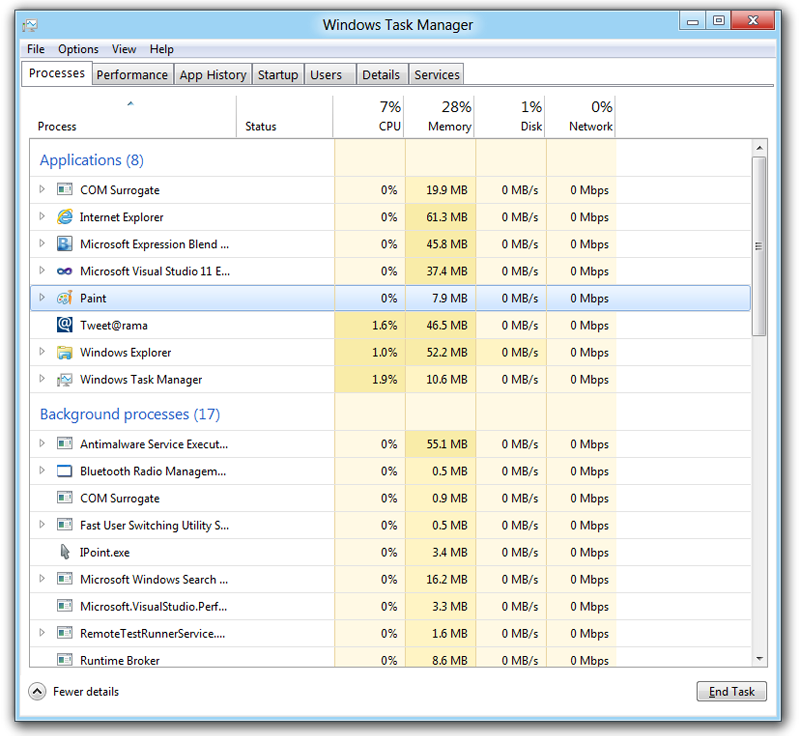
    • Preserving power-user favorites and making them better. For those who push the limits of their PC, Windows 8 features an enhanced Task Manager and Windows Explorer and new, flexible options for multimonitor setups.
    New Developer Opportunities
    • Windows Store. The Windows Store will allow developers to sell their apps anywhere Windows is sold worldwide, whether they’re creating new games or familiar productivity tools.
    • Build using more languages. Windows 8 lets you leverage your existing skills and code assets to create great experiences using the programming language you prefer.
    • Rich hardware integration leads to richer experiences – particularly for games. DirectX 11 gaming power underlies Windows 8, allowing the easy creation of full-screen games with smooth, flicker-free action.
    New Generation of Hardware
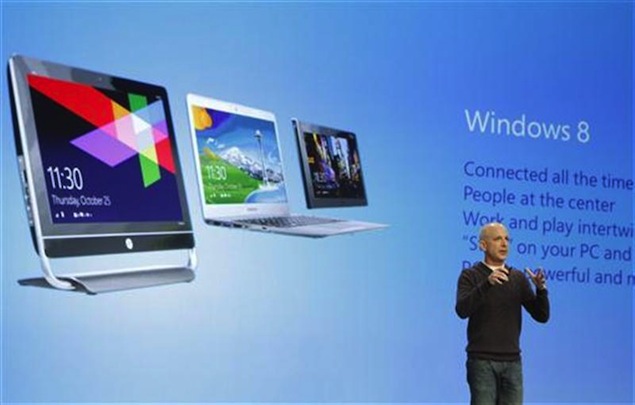
    • One Windows – many shapes and sizes. Support for ARM-based chipsets, x86 devices, touch and sensors means Windows 8 works beautifully across a spectrum of devices, from 10-inch tablets and laptops to all-in-ones with 27-inch high-definition screens.
    • Always connected. With Windows 8, new ultrathin PCs and tablets turn on instantly, run all day on a single charge and stay connected to the Internet so your PC is ready when you are.
    • Tap the full power of your PC. Windows 8 runs on PCs and is compatible with the devices and programs you use today on Windows 7, without compromise, to deliver the performance you expect of a PC.

    Developers will be able to download the Windows Developer Preview via the new Windows Dev Center later this week. Webcasts of sessions will be posted on the BUILD site as well.
    Founded in 1975, Microsoft (Nasdaq “MSFT”) is the worldwide leader in software, services and solutions that help people and businesses realize their full potential.
    Some information relates to a prerelease product, which may be substantially modified before it’s commercially released. Microsoft makes no warranties, express or implied, with respect to the information provided here.[/toggle]
  • Microsoft Patent Applications Reveal a possible Dual Screen Tablet Future

    Microsoft Patent Applications Reveal a possible Dual Screen Tablet Future

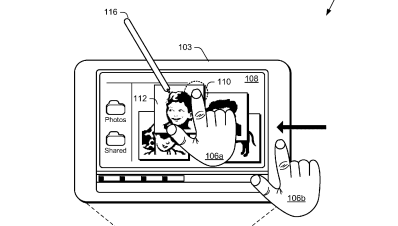
    Microsoft has been playing with the idea of a dual screen tablet for quite some time, remember the courier tablet? This time around MS is teasing the world of tech itself with the Tablet patent that promises a dual screen experience. Microsoft has been talking a lot about Windows 8 and a tablet specific OS.

    MS has filed for multiple patents including, Muti-screen dual tap, on-off gesture, Muti Screen Pinch and expand, Muti-screen – Hold – Expand- page flip and radial gestures. Microsoft has not yet been awarded with these patents. But looks like the whole Tablet frenzy has been fueled by the Apple Patent Lawsuits.

iGyaan Network
Privacy Overview

This website uses cookies so that we can provide you with the best user experience possible. Cookie information is stored in your browser and performs functions such as recognising you when you return to our website and helping our team to understand which sections of the website you find most interesting and useful.