Category: Hardware News

Latest news from the World of Hardware

  • Foxconn to Make Amazon Tablet

    Foxconn to Make Amazon Tablet

    Apple’s largest manufacturer of their devices like The iPhone and The iPad – Foxconn (they also the worlds largest contract manufacturer of electronics) will now produce the Android gutted tablet from the stables of Amazon. A report released yesterday claims that a 10.1 inch display is in the manufactory, and Quanta Computer, another contract manufacturer from Asia, is already shipping a 7 inch device to Amazon.

    Foxconn Electronics (Hon Hai Precision Industry) has reportedly landed orders for 10.1-inch tablet PCs from Amazon with shipments to begin in 2012, while Quanta Computer has begun shipping a 7-inch model to Amazon. Foxconn declined to comment on market speculation.

    The smaller version dubbed “coyote”  packs a dual-core NVIDIA Tegra processor and will be available in Aug-Sept timeframe. While the larger 10 inch version will ship later this year and is dubbed ” Hollywood”, has a quad-core Kal-El chip.

    Foxconn already manufacturers the Kindle for Amazon, about 12 million a year, compare that to the 40 Million iPad for Apple this year and it seems like even Foxconn has a lot to loose if they loose Apple as a client.

    Looks like Apple lost on securing their manufacturer by signing an exclusive deal of tablet manufacture with them. It is highly unlikely of Apple to allow such a thing to happen, hopefully no high level exec gets fired from cupertino – because he didn’t read his memo!


  • MSI To Launch World’s First PCI Express Gen 3 Motherboard (PR)

    MSI To Launch World’s First PCI Express Gen 3 Motherboard (PR)

    MSI has announced that it will be releasing the world’s first PCI Express Gen 3 motherboard and exclusive Click BIOS II with unified interface. This motherboard will bring together may new technologies to boost performance. Read the Press Release for more information.


    [toggle title_open=”Collapse Press Release” title_closed=”Expand Press Release” hide=”yes” border=”yes” style=”default” excerpt_length=”0″ read_more_text=”Read More” read_less_text=”Read Less” include_excerpt_html=”no”]

    New Delhi, India: MSI, the world-renowned mainboard and graphics card manufacturer, officially launches the Z68A-GD80 (G3), featuring world’s first large bandwidth PCI Express Gen 3 mainboard, and the latest UEFI technology: Click BIOS II which features a homogenous interface both under Windows and the UEFI interface. Conforming to Intel’s latest design standard, the MSI Z68A-GD80 (G3) with PCI Express Gen 3 provides a data transfer rate that is 200% faster than PCI Express Gen 2, enhancing the performance of graphics cards without bandwidth limitations. Click BIOS II, allows simple and intuitive system adjustments in both Windows and the UEFI interface! In addition, Z68A-GD80 (G3) utilizes MIL-810STD Certified Military Class II components and are equipped with OC Genie II technology which increases the performance of hard drive up to 457%. The MSI Z68A-GD80 (G3) enables next generation superior performance with PCI Express Gen 3 and OC Genie II, ultimate stability with certified Military Class II components and an extreme user-friendly Click BIOS II interface both in Windows and in the UEFI BIOS. 

    If you want to own the highest specification, components and the most superior performance and technology, the best choice is MSI Z68A-GD80 (G3).  The product is expected to hit the market in the very early Q3 2011 as the first PCIe Gen 3 mainboard available in the global market. 

    The world’s 1st PCI Express Gen 3 Mainboard – unparalleled performance

    With the Z68A-GD80 (G3), MSI introduced the world’s first PCI Express Gen 3 mainboard in Computex 2011. With ultra-high 32GB/s transfer bandwidth, PCI Express Gen 3 is 200% faster than PCI Express Gen 2. This allows the MSI Z68A-GD80 (G3) to process huge amounts of data and information, maximizing the performance of AMD CrossFireX and NVIDIA SLI multi-GPU solutions. 
    MSI Z68A-GD80 (G3) is backwards compatible with all the devices with PCI Express 2.0 or older devices already available on the market and enhances their performance considerably. For example, PCI Express 2.0 SSD devices on MSI Z68-GD80 (G3) mainboards perform 14% faster than on competitor’s mainboards. 

    Click BIOS II with unified interface – provides the best experience 

    As an industry leader of UEFI technology, MSI revolutionizes the industry again with the world’s first UEFI BIOS which utilizes a unified graphical interface in both Windows and in the UEFI BIOS, Click BIOS II. Click BIOS II brings the ease of a clear, unified interface with all the benefits of MSI’s UEFI interface. This allows both die-hard overclockers and first-time system users to get the maximum out of their system through an easy-to-use Graphical User Interface. This interface supports all traditional input devices like a Keyboard, Mouse or new touch-screen interfaces for the most flexibility. 

    OC Genie II unleashes total system power 

    MSI’s exclusive OC Genie II provides stunning system performance within a single push of a button and unleash the true performance of CPU, memory and integrated graphics all at once. By maximizing system performance and guaranteeing the most stable condition, it gives users the best benefits in the shortest time. When measuring with industry standard benchmarking software such as 3DMark Vantage and PCMark Vantage, the results show that OC Genie II boosts 3D game performance up to 145% and hard drive reading speed up to 457% along with Intel Smart Response Technology. 

    Military Class II brings top quality and stability 

    MSI has equipped all its Z68 mainboards with the leading-edge Military Class II components. In addition to Hi-c CAPs made out of the rare element Tantalum and the Solid CAPs with a lifespan longer than 10 years, Military Class II includes Super Ferrite Choke (SFC) that provides 30% more power and is 10% more efficient. Military Class II components ensure ultimate stability and performance under any circumstance.

    [/toggle]

  • A New Hybrid Heatsink Makes Your Computer Run Faster

    A New Hybrid Heatsink Makes Your Computer Run Faster

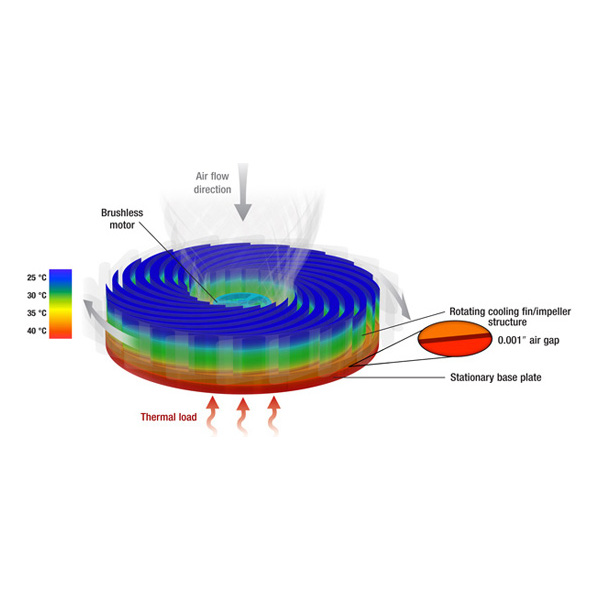
    The traditional way with which most computers deal with heat is a heat-sink and a fan assembly over the processor. Of course you have custom solutions like liquid cooling, but they’re out of the budget for most people. Unfortunately, this idea is quite dated and hails from the heydays of computing. New technology requires new solutions and that’s exactly what Jeff Koplow, a researcher at Sandia National Laboratories has developed.

     The problem with traditional heat-sinks is that, while the fins provide adequate surface area to cool the processor, a layer of air clings to the fins, which reduces efficiency, acting as an insulator. To compensate, the CPU fan can be cranked up to move more air, but that becomes noisy and uses more energy. As the heat-sink itself doesn’t move, it becomes a great place for dust to settle.

    Jeff has come up with an ‘air bearing heat exchanger’, which is just a fancy way of saying that he’s combined the heat-sink and fan into a spinning heat-sink. The heat exchanger is separated from the processor by just 1/1000th of an inch, and as it spins, it forces air out from the center of the exchanger, cooling the fins and eliminating the insulating layer of air. This turns out to be so efficient, that it can be run at much lower and quieter speeds. You can even overclock your CPU a few notches without it being any worse for the wear. As the heat-sink is spinning, it also becomes immune to dust.

    A prototype has been developed which doesn’t require any fancy metals or electronics, just good design. This hopefully means that the technology will be easily mass producible and will be available to the market soon.

  • LG’s Launches 20-inch D2000 / DX2000 glasses – free 3D monitor

    LG’s Launches 20-inch D2000 / DX2000 glasses – free 3D monitor


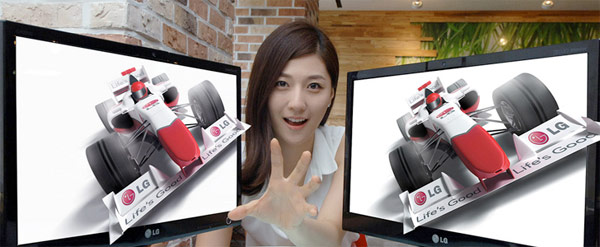
    The LG D2000 has been officially launched and It features a glasses free 3D experience. 


    “With a full line-up of 3D TVs, laptops, projectors and smartphones, LG Electronics is by far and away the industry leader in all things 3D.” said Si-hwan Park, Vice President of the Monitor Division at LG’s Home Entertainment Company. “LG’s position has always been that 3D will and must eventually function without glasses. The D2000 is a look at what the future has in store.”

    The monitors are already shipping in Korea with the DX2000 label and will soon hit India somewhat south of September 2011.

    Read the press release below


    [toggle title_open=”Collapse” title_closed=”Read the Press Release” hide=”yes” border=”yes” style=”default” excerpt_length=”0″ read_more_text=”Read More” read_less_text=”Read Less” include_excerpt_html=”no”]

    SEOUL, July, 13, 2011 – LG Electronics (LG) today unveiled the world’s first glasses-free monitor utilizing eye-tracking technology to maintain an optimal 3D image from a range of viewing angles. The 20-inch D2000 (Korean model: DX2000) monitor was developed as a fully functional entertainment display capable of reproducing games, movies and images in all their realistic glory. “With a full line-up of 3D TVs, laptops, projectors and smartphones, LG Electronics is by far and away the industry leader in all things 3D.” said Si-hwan Park, Vice President of the Monitor Division at LG’s Home Entertainment Company. “LG’s position has always been that 3D will and must eventually function without glasses. The D2000 is a look at what the future has in store.”

    The D2000’s 3D effect comes courtesy of glasses-free parallax barrier 3D technology, and the application of the world’s first eye-tracking feature to the monitor. The combination of parallax barrier and eye-tracking in a single unit promises to open up new horizons for glasses-free 3D products.

    Existing glasses-free 3D technologies generally require viewers to stay within a tightly restricted angle and distance to perceive the 3D images. However, the D2000 has done much to resolve this issue, allowing viewer much freer movement and more comfortable viewing. Eye tracking in the D2000 works via a special camera sensor attached to the monitor which detects changes in the user’s eye position in real-time. With this information, the monitor calculates the angle and position of the viewer and adjusts the displayed image for the optimal 3D effect.

    In addition to playing back existing 3D content, the D2000 has a highly refined 2D to 3D conversion feature which adds a new dimension to existing movies and game playing.

    The D2000, available in Korea this month, will be introduced in other markets around the world in the latter part of 2011.
    [/toggle]

  • The Machine That Prints Gadgets

    The Machine That Prints Gadgets

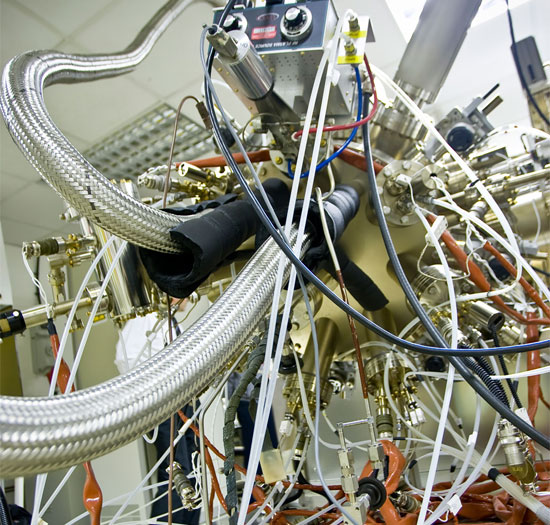
    This monstrous machine has been dubbed the MBE and its named after the process that it uses to assemble objects at the molecular level. The process, called molecular beam epitaxy, is the method by which tiny crystalline structures are layered together to form objects. The process is similar to 3D printing, but works on a molecular level.

    With this particular MBE, Sharp researchers at the company’s Oxford Labs in England use a plethora of sensors and magnetic arrays to piece together molecular sized Lego blocks to assemble electronics. The machine works in an environment that is similar to the vacuum of outer space.

    As crazy as it sounds, these machines have been around since the 1960s and this particular MBE is one of the smallest to date. Check out the researchers detailing the machine in the video below.

  • 3-in-1 Computer – Gigabyte’s Booktop

    3-in-1 Computer – Gigabyte’s Booktop

    With the earliest models debuted last fall, Gigabyte has just officially announced at Computex 2011 the  Booktop T1125P 3-in-1 computer: a laptop whose rotating screen can convert the machine into a tablet-like device, and which when docked into a special station can be used in a desktop configuration.

    On the T1125P, is a 11.6-inch capacitive multi-touch display that is fixed to a 180-degree hinge, which lets the laptop be closed with the screen facing outward for use as a tablet. The device itself contains a USB 3.0 and HDMI ports, as well as two dual-channel stereo speakers and two woofers. an ultra low voltage intel core i5/i3 processor plus Nvidia GPU with 1GB dedicated visual RAM translates to a responsive, high-quality multimedia experience. a built/in 3.5G modem facilitates mobile internet connectivity, while the docking station features a DVD drive. when docked (which is necessarily in the vertical position), the device in addition to charging can be used for processing power and as a second screen to an external monitor.

    Gigabyte also announced the Booktop M2432 which features a 14 inch backlit LCD and has a Core i3/i5 sandy-bridge processor. This allows the device to function as a laptop or a desktop when docked, but not as a tablet. The dock contains an in-built Nvidia GPU.

  • The Samsung NC215s – The Solar Powered Netbook

    The Samsung NC215s – The Solar Powered Netbook

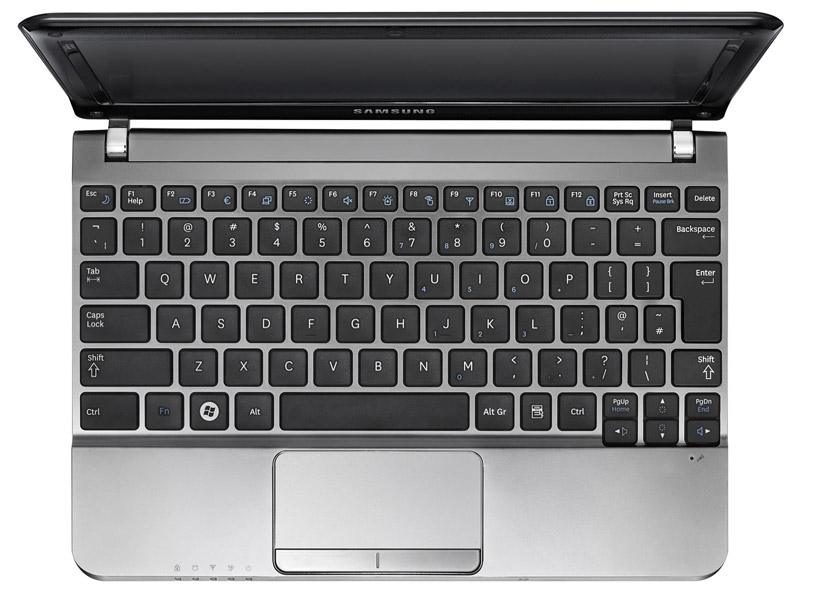
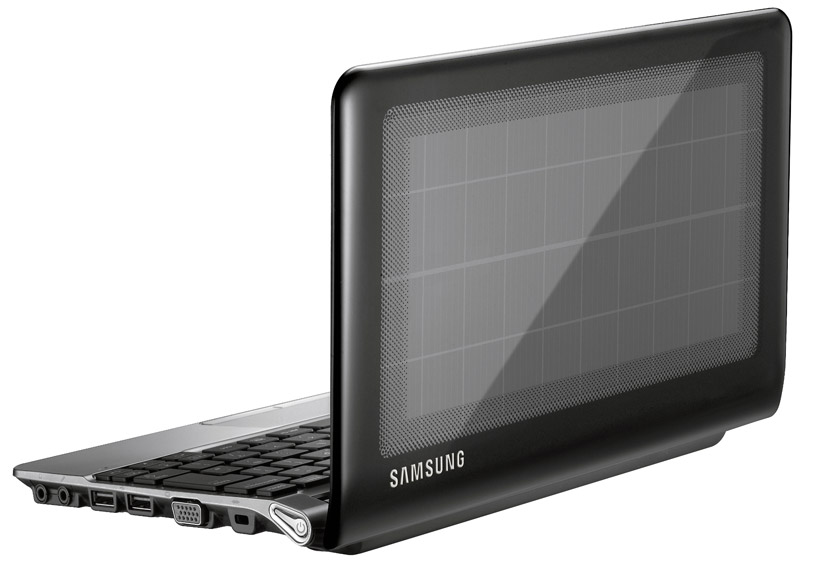
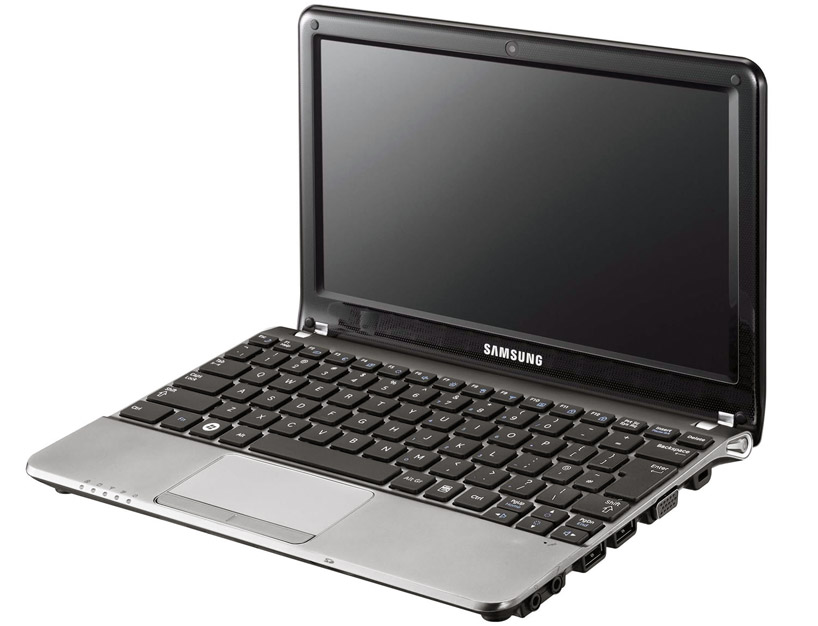
    Samsung has released a Solar powered netbook that will be available in the US and Russia. The rear side of the display houses a solar panel that can generate an hours worth of power for every two hours of exposure to direct sunlight.

    The netbook’s 10.1 inch 1024x600px display is specially designed for extra brightness and is also layered with an anti reflective coating  for use outdoors. The netbook features either a dual-core N570 or single-core N455 Intel Atom processor, with a choice of a 250 or 320 GB harddrive. A sleep mode called ‘Samsung Fast Start’ combines the stability of hibernation with the fast reloading of sleep, while ‘sleep-and-charge’ enables the charging of external USB devices even when the computer is off. A full charge of the six-cell battery is reported to provide up to 14 hours of use. The Samsung NC215S is expected to be released in the United States in early July at a cost of 400 USD, and in Russia in early august, for 13,999 rubles (500 USD).

  • Toshiba Unveils a New CMOS Sensor

    Toshiba Unveils a New CMOS Sensor

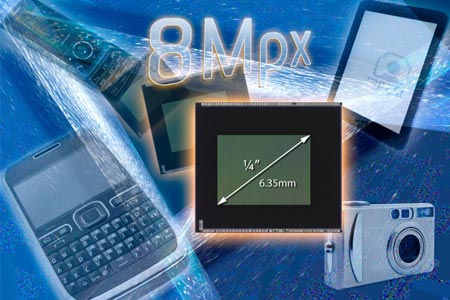
    Toshiba has released a new CMOS image sensor with a 0.25 inch optical format. This new sensor has the smallest pixel size to date of 1.12 micrometers and delivers cutting edge peformance with its built in back-side illumination technology.

    The sensor has been designed to accomodate tight form factors and still capture high definition images. Due to this feature, the company expects it to be embedded into mobile devices such as cameras, smartphones, tablets and even laptops in the near future. The 8.08 MP sensor can capture video at 60 frames per second at both 720p and 1080p resolutions.

    Andrew Burt, vice president, Analog and Imaging Business Unit, System LSI Group, TAEC had this to say,

    As smartphones and other portable digital devices move to smaller form factors, image sensors must also shrink in size. This presents imaging subsystem designers with a challenge: how do you get smaller and smaller image sensors to support higher image resolutions when miniaturization can cause a fall off in performance? Our BSI technology overcomes this problem by deploying the lens on the rear of the sensor, on its silicon substrate, not on the front, where wiring limits light absorption. This positioning boosts light sensitivity and absorption, and allows Toshiba to make finer quality image pixels in smaller-sized CMOS image sensors. This increased sensitivity also makes our BSI CMOS image sensors more suitable for video applications, such as video capture or video chat.

  • New Macbook air to come July 13th, Even Mac OS X Lion , After Store Update

    New Macbook air to come July 13th, Even Mac OS X Lion , After Store Update

    The inter-webs are abuzz with news of Apple Sale Item refresh on the 13th of July. This news comes as many have confirmed that Apple has started to ask Apple Store employees to prepare for an “overnight” shift on July 13th.

    Many claim that the Macbook air and Lion OS X will be available from the 14th of July in Apple Stores. and the Macbook Air refresh will bring a lot of new things, including SandyBridge processors and Thunderbolt I/O.

    A black Macbook Air (premium) is also in the “AIR”, but seems highly unlikely.

  • Lens Free Camera Developed at Cornell

    Lens Free Camera Developed at Cornell

    Patrick Gill, a postdoctoral associate, led a team that invented the camera in the laboratory of Alyosha Molnar, assistant professor of computing and electrical engineering at Cornell. Their working prototype, resolves images 20 pixels across, which is not studio quality but is quite impressive from a camera that’s only a hundredth of a millimeter thick. The camera was developed to shed light onto objects that were previously hard to see.

    Gill’s camera looks like a tiny compact disc and is made of a flat piece of doped silicone, which makes its manufacturing costs amount to just a few cents. The camera is incredibly small and light and is much cheaper than traditional small cameras which cost a dollar or more to manufacture and require bulky focusing optics.

    The scientists call the camera a Planar Fourier Capture Array (PFCA) since it uses the principles of the Fourier transformation, which is a mathematical tool that allows multiple ways of capturing the same information. The scientists would continue to refine the camera’s resolution and efficiency as they believe that such a device can have a multitude of applications. It could be used in devices that need to measure the angle of the sun or in a simple robot that requires a vision system to navigate.

  • Apple – Stylus Patents Approved

    Apple – Stylus Patents Approved

    Apple had applied for two patents for styluses for capacitive touchscreens and other surfaces last year, but the US Patent office has approved them only yesterday. The first patent is for a stylus with a heated conductive tip which would be charged when it is inserted back into the phone to be used with touchscreen devices.

    The second patent is for a stylus which could be used to write on any surface, with the results appearing on a computing device; a phone, tablet or computer, which is programmed to receive the input. This would be similar to the already existing Livescribe pen. These patents leave us wondering just what kind of devices does Apple have is store for release.

  • Qualcomm Snapdragon roadmap leakead, Shows upcoming Krait

    Qualcomm Snapdragon roadmap leakead, Shows upcoming Krait

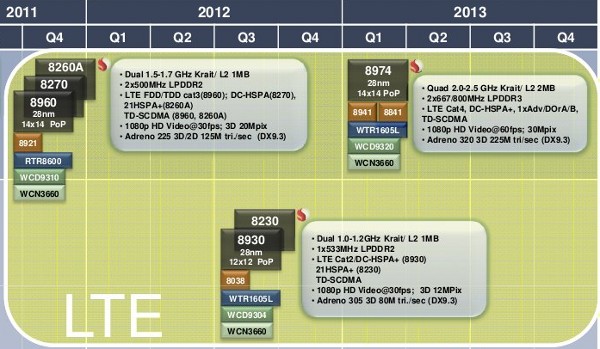
    [dropcap]A[/dropcap] full roadmap of Qualcomm’s  Snapdragon roadmap up till 2013 has been leaked, thanks to a PDF gotten by unknown sources.


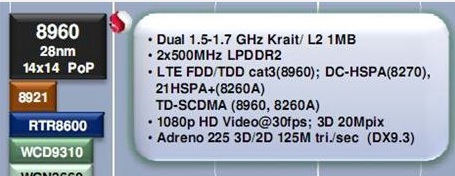
    The MSM8960, Qualcomm’s first Windows 8 certified SoC 

    • shipping in Q4 2011
    • Dual 1.5-1.7 GHz Krait/ L2 1MB
    • 2x500MHz LPDDR2
    • LTE FDD/TDD cat3(8960); DC-HSPA(8270)
    • 21HSPA+(8260A)
    • TD-SCDMA (8960, 8260A)
    • 1080p HD Video@30fps; 3D 20Mpix
    • Adreno 225 3D/2D 125M tri./sec (DX9.3)


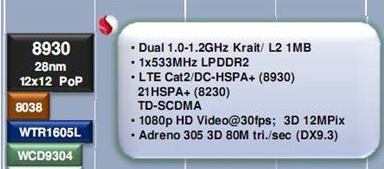
    Q3 2012  brings the MSM8930

    • one memory channel
    • lower CPU clocks 
    • less powerful GPU (Adreno 305) 

     The specifications are the following:

    • Dual 1.0-1.2GHz Krait/ L2 1MB
    • 1x533MHz LPDDR2 • 1x533MHz LPDDR2
    • LTE Cat2/DC-HSPA+ (8930)
    • 21HSPA+ (8230)
    • TD-SCDMA
    • 1080p HD Video@30fps; 3D 12MPix
    • Adreno 305 3D 80M tri./sec (DX9.3)

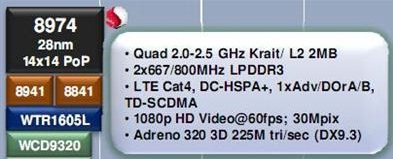
    The MSM8974 replaces the MSM8964/APQ8064 – launch in Q1 2013 w

    Specifications:

    • Quad 2.0-2.5 GHz Krait/ L2 2MB
    • 2×667/800MHz LPDDR3
    • LTE Cat4, DC-HSPA+, 1xAdv/DOrA/B
    • TD-SCDMA
    • 1080p HD Video@60fps; 30Mpix
    • Adreno 320 3D 225M tri/sec (DX9.3)


    Looks like the 2GHZ chips might just arrive in time for those 2 Ghz Smart phones.

  • MSI Launches A75MA-G55 Worlds Fastest Motherboard with Integrated Graphics in India (PR)

    MSI Launches A75MA-G55 Worlds Fastest Motherboard with Integrated Graphics in India (PR)

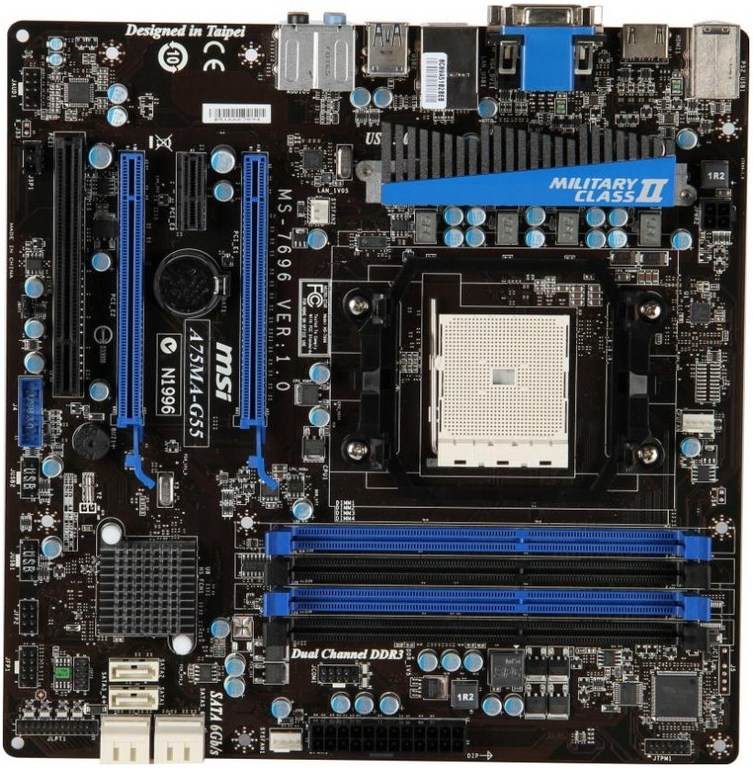
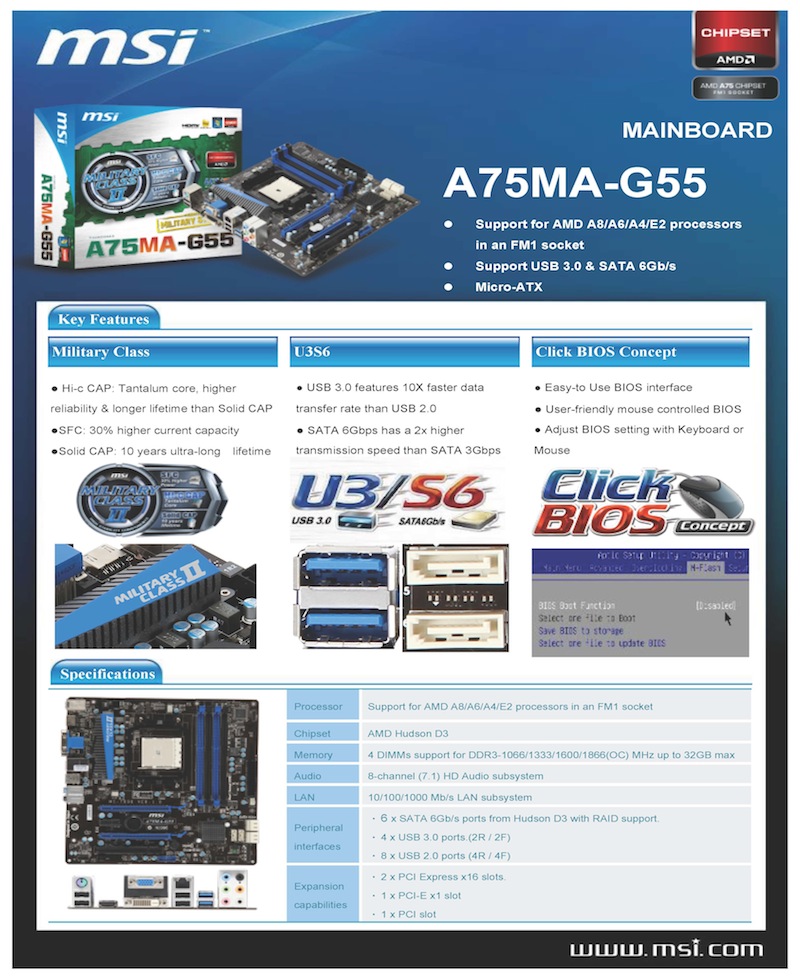
    MSI has launched the A75MA-G55 Motherboard with Integrated GPU in India.

    The A75MA-G55 board is a micro-ATX part based on AMD’s Hudson D3 chipset. It features MSI’s Military Class II components. four DIMM slots with support for up to 32GB of memory, four USB 3.0, eight USB 2.0 ports, six SATA 6Gbps, 8-channel audio, GbE LAN, HDMI, DVI, D-Sub, and MSI’s Click BIOS concept based on UEFI.

    There is no word on pricing or availability.


    [toggle title_open=”Collapse” title_closed=”Expand Press Release” hide=”yes” border=”yes” style=”default” excerpt_length=”0″ read_more_text=”Read More” read_less_text=”Read Less” include_excerpt_html=”no”]

    2011/6/29

    MSI A75MA-G55: World’s Fastest Mainboard With Integrated Graphics

    MSI A75MA-G55 was officially announced on June 27 as the world’s fastest mainboard with integrated graphics. MSI, the world’s leading graphics card and mainboard manufacturer has incorporated over 25 years of overclocking experience in their latest motherboard. Hardware enthusiasts and and overclockers were eagerly waiting for the MSI A75MA-G55 with FM1 sockets. The mainboard is the perfect tool to enjoy the superpower of A series APUS by AMD. The mainboard has scores P1646 points on 3DMark 11. With Military Class II components, A75MA-G55 was found to be perfectly stable under highest workloads.

    MSI A75MA-G55

    Those who are technically challenged when it comes to overclocking, but still want to enjoy extra power can use MSI’s OC Genie II technology. It allows single click overclocking without need of any technical knowledge. OC Genie II is available on all MSI A75-Series mainboards. MSI claims that the mainboard has broken records on 3D Mark 06 which has been made possible only by versatile Click BIOS UEFI interface and improvements in mainboard design.

    Certified Military Class

    MSI’s Military Class II components have been certified by the United States Department of Defense 810G Standard. Only Military Class II components have the lifetime and stability required by today’s most demanding situations of extreme overclocking but at the same time provide great levels of power saving. The MSI A75MA-G55 has proven to be stable under the highest workloads and stress conceivable, overclocking, clearly displaying the top quality and stability demanded by professional overclockers.

    OC Genie II – Easy one click overclocking

    MSI’s OC Genie II technology allows everyone to enjoy the benefits of extra performance without having any technical knowledge.

    Applauded by media worldwide for its simple operation and great benefits, OC Genie II set the new standard for mainboard performance and that technology powers todays 3DMark 11 and 3DMark 06 world records. OC Genie II is available on all MSI A75-Series mainboards.

    Not only is the MSI A75MA-G55 fastest in the latest world standard benchmark 3DMark 11, but it also broke the world records for 3DMark 06. The MSI A75MA-G55  thanks its recordbreaking performance to the use of the most stable components found in Military Class II, versatile Click BIOS UEFI interface and excellent mainboard design

    [/toggle]


  • Samsung will not make the Apple A6 Processor

    Samsung will not make the Apple A6 Processor

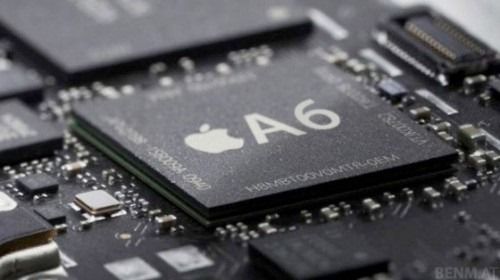
    TSMC or Taiwanese Semiconductor Manufacturing Corp will be the next company to manufacture the Apple A6 Chips that will go in the upcoming iPhone 5 / iPad 3. According to rumors Apple is looking for a high performance chip with a much more smaller topography than Samsung can manufacture. Samsung already had difficulties in the A5’s 45nm process. While it is suggested that TSMC will manufacture the processor on low power 28nm ARM chips.


  • Bluetooth Specialist Interest Group adds Apple and Nordic to its Board (PR)

    Bluetooth Specialist Interest Group adds Apple and Nordic to its Board (PR)

    The Bluetooth SIG group announced yesterday that it’s added both Apple and Nordic Semiconductor to its board of directors.

    Companies that it says will help it :

    “drive Bluetooth technology’s expansion into platform and sensor markets.”

    [Bluetooth SIG]

    [toggle title_open=”COLLAPSE” title_closed=”READ THE PRESS RELEASE” hide=”yes” border=”yes” style=”default” excerpt_length=”0″ read_more_text=”Read More” read_less_text=”Read Less” include_excerpt_html=”no”]Bluetooth SIG Adds Apple and Nordic Semiconductor to Board of Directors

    Industry Leaders Support Expansion of Bluetooth Technology into New Markets

    KIRKLAND, Wash.–(BUSINESS WIRE)–The Bluetooth Special Interest Group (SIG) today announced two new members to its board of directors from Apple and Nordic Semiconductor. Leaders in their perspective markets, Apple and Nordic join household names Intel, Motorola, Lenovo, Nokia, Microsoft, Ericsson AB, and Toshiba on the Bluetooth SIG board. These companies, plus the more than 14,500 additional Bluetooth SIG member companies, will drive Bluetooth technology’s expansion into platform and sensor markets.

    “We see the importance of platform development and ultra-low power sensor silicon for Bluetooth technology and believe guidance and board participation from Apple and Nordic, industry leaders in these perspective fields, is essential,” said Michael Foley, Ph.D., executive director of the Bluetooth SIG. “We have set the ambitious goal of shipping five billion devices in 2015 – to get there we must continue to build a technology that will offer a simple and secure solution that can be found everywhere, in every type of device. These additions to our board will ensure we succeed in new markets we have targeted for growth.”

    The way consumers utilize digital devices is undergoing a fundamental shift – mobile phones, laptops and tablets, TVs and even cars now stand to serve as hub devices that capture data from small sensors monitoring everything from footsteps, heart rate activity, blood pressure and sugar levels to house temperature. Hub devices turn that data into useful information at the application layer, then may push that information to the cloud. Apple and Nordic understand this shift; insight from Apple on platform development and Nordic for sensor silicon demands will ensure a smooth growth trajectory of Bluetooth v4.0 into these new areas.

    Nordic Semiconductor’s Svein-Egil Nielsen brings extensive experience in R&D as well as his entrepreneurial spirit to the Bluetooth SIG. Nielsen’s vast understanding of the ultra-low power space and its demands will help guide continued development of the Bluetooth v4.0 specification.

    “Bluetooth technology has been the main R&D focus at Nordic for the last six years and we are now in a position to enable new and exciting products for consumers,” said Svenn-Tore Larsen, CEO Nordic Semiconductor. “With our success in ultra-low power wireless technology, we know the market, applications and the customers. Nordic is proud to have the opportunity to extend this knowledge to the Bluetooth community.”

    Apple and Nordic’s two-year appointments were agreed upon by unanimous vote of the current board of directors and will officially begin on July 1, 2011.

    About Bluetooth® Wireless Technology

    Bluetooth wireless technology is the global wireless standard enabling simple connectivity for a broad range of electronic devices. Version 4.0 featuring Bluetooth low energy technology creates new application opportunities for products within the mobile phone, consumer electronics, PC, automotive, health & wellness, sports & fitness and smart home industries. With nearly two billion devices shipping annually, Bluetooth technology is the only proven wireless solution for developers, product manufacturers, and consumers worldwide. Backed by industry leading companies, the Bluetooth SIG empowers more than 14,500 member companies to collaborate, innovate and guide Bluetooth wireless technology. For more information please visit www.bluetooth.com. Bluetooth wireless technology: Simple. Secure. Everywhere.[/toggle]

iGyaan Network
Privacy Overview

This website uses cookies so that we can provide you with the best user experience possible. Cookie information is stored in your browser and performs functions such as recognising you when you return to our website and helping our team to understand which sections of the website you find most interesting and useful.