Category: Apps and Software

Games, Apps, Softwares, Operating Systems and Software Hacks

  • Samsung requests Source Code to ban iPhone 4S sales in Australia

    Samsung requests Source Code to ban iPhone 4S sales in Australia

    Samsung and Apple wars rage on as this time around the South Korean Giant is looking to get revenge in Aussie-Land. Samsung has requested the source code for iOS 5 firmware including Siri, and has also asked for details on Apple’s subsidy agreements with Australian carriers Vodafone, Optus and Telstra. This is a part of the ongoing Apple Vs Samsung Lawsuit that caused a denial of sales of the Galaxy Tab in Australia. Apple believes Samsung has no need to access the information, but the lawyers from Samsung argued that there are fewer subsidies available for Samsung’s products if subsidies are given for the iPhone 4S, and hence the information was critically important. The South Korean also said that the source code is important to ensure that Apple ins not infringing on patents.

    “Based on the accompanying firmware, [an expert] can tell how the chips are working in the phones, To form a final view on whether patent 621 is infringed, [an expert] needs to see the documents that set out the source code for that firmware.” 

    -Samsung counsel Cynthia Cochrane

    Apple had sued Samsung earlier this year in several parts of the world claiming that Samsung had produces copycat devices that infringed a multiple of Apple device design and software patents. Due to which Apple was successful in lowering and banning sales of various Samsung devices in countries like Netharlands, Germany and Australia.

  • GarageBand comes to iPod Touch and iPhone (PR)

    GarageBand comes to iPod Touch and iPhone (PR)

    This is one of those moments where some of you go like “whatever” and some are like “awesome”. The popular Apple official GarageBand app for the iPad has been converted to fit the iPhone and iPod Touch.  The app enables users to record and mix up to eight tracks and then share the finished product with friends or send it to your Mac to keep working on it in GarageBand for Mac or other softwares like Logic Pro.

    The App costs $4.99 and costs nothing if you already bought it for the iPad.

    Get it Here

    US Store:

    GarageBand - Apple

    India Store:

    GarageBand - Apple


    [toggle title_open=”Press Release” title_closed=”Press Release” hide=”yes” border=”yes” style=”default” excerpt_length=”0″ read_more_text=”Read More” read_less_text=”Read Less” include_excerpt_html=”no”]


    GarageBand Now Available for iPhone and iPod touch Users

    CUPERTINO, California-November 1, 2011-Apple® today announced that GarageBand®, its breakthrough music creation app, is now available for iPhone® and iPod touch® users. Introduced earlier this year on iPad®, GarageBand uses Apple’s revolutionary Multi-Touch™ interface to make it easy for anyone to create and record their own songs, even if they’ve never played an instrument before.

    “GarageBand on iPad has been a big hit and we think customers will love using it on their iPhone or iPod touch,” said Philip Schiller, Apple’s senior vice president of Worldwide Product Marketing. “The innovative Multi-Touch interface combined with Smart Instruments makes it easy to create great sounding music, even if you’ve never studied music or played an instrument before.”

    GarageBand features a collection of fun Touch Instruments that sound great and make it easy for beginners or experienced musicians to play and record keyboards, guitars, drums and basses in a wide variety of styles. Smart Instruments now allow you to choose from an extensive new library of custom chords so you can play and strum along with your favorite songs.

    You can plug your electric guitar into iPad, iPhone or iPod touch to play and record through classic amps and stompbox effects, or record your voice or any acoustic sound using the built-in microphone. GarageBand allows you to record and mix up to eight tracks and then share your finished song with friends or send it to your Mac® to keep working on it in GarageBand or Logic® Pro.

    Pricing & Availability
    GarageBand 1.1 for iPad, iPhone and iPod touch is available on the App Store™ for $4.99 (US) to new users, or as a free update for existing GarageBand for iPad customers. GarageBand is a universal app that runs on iPad, iPad 2, iPhone 3GS, iPhone 4, iPhone 4S and iPod touch (3rd & 4th generation).

    [/toggle]


  • Google starts up new Gmail for users.

    Google starts up new Gmail for users.

    Google’s new Gmail got us previewed earlier this year, and now its finally ready to roll out. In the coming few days you should see a “switch to the new look” link in the bottom right corner of Gmail which, if clicked, will open up a range of new features and design changes.  Easiest way to learn more is to watch the generously provided Video below.

    [Official Google Blog]

  • Duke Nukem 3D now on Android : Retro Game Gasm

    Duke Nukem 3D now on Android : Retro Game Gasm

    Thats right you are reading  this story straight up, no you are not hung over or estranged, Duke Nukem 3D is now available in the Android Marketplace. The mobile version of this classic FPS has hit the Android OS and you can rock this game for Android 1.6 and up. The cost is a mere 0.99 $ and you cant put a price on a game of legends.


    Android Market

  • WhatsApp Users send over 1 Billion messages daily

    WhatsApp Users send over 1 Billion messages daily

    Do you use a popular messaging service? services like WhatsApp have taken inter device connectivity by storm. The company is reporting that their users send and receive over 1 billion messages over a number of platforms including Android, iOS and Blackberry.


    The mobile messaging market is moving, choices around platforms and their pricing and how they provide an amazing customer experience are the hot topics at hand. As a leader in the messaging space and with our network now handling over one billion messages a day, we see that the power is with the consumer.

    -Whatsapp

    WhatsApp is currently available for iOS, Android, Windows Phone, BlackBerry and Symbian devices.

    [VIA]

  • Dropbox for multiple Users/Teams start at US$795 a year

    Dropbox for multiple Users/Teams start at US$795 a year

    Dropbox has just announced its plans for Dropbox for Team users. Starting at US$ 795 / Year for up to 5 users sharing a mere 1 TB of data (200GB x 5). We would rather off get our own server, But hey not everyone is capable of maintaining their own server. The price seems quite reasonable for enterprise applications, where there is more bulk to spend than required.T he business offering also includes special tools for administrators to add or delete users and dedicated phone support Check out the Full PR 

    [toggle title_open=”Press Release” title_closed=”Press Release” hide=”yes” border=”yes” style=”default” excerpt_length=”0″ read_more_text=”Read More” read_less_text=”Read Less” include_excerpt_html=”no”]Dropbox Now Open for Business

    Dropbox Launches “Dropbox for Teams” With Administrative Controls and Plenty of Space

    People Are Using Dropbox in Over One Million Businesses Globally

    SAN FRANCISCO, Calif. – October 27, 2011 – Dropbox, a free service that lets people bring their documents, photos and videos everywhere and share them easily, today introduced Dropbox for Teams. More than 45 million people already depend on Dropbox, and with Dropbox for Teams, businesses can now experience the same ease-of-use along with new administrative controls, centralized billing, phone support, and plenty of space for everyone on the team.

    “People in over a million businesses around the world trust Dropbox for its simplicity and reliability,” said Sujay Jaswa, vice president of business development and sales at Dropbox. “Now, Dropbox for Teams will give businesses the control and freedom to rethink how they work.”

    How Dropbox for Teams Works

    Dropbox for Teams delivers the same user experience as the free Dropbox service. Adding and updating files is as easy as saving any document, photo or video to the Dropbox folder. Changes sync immediately across all devices which have Dropbox installed. Dropbox is compatible with nearly every computer and smartphone operating system, including Windows, Mac, Linux, iOS, Android, and BlackBerry.

    With Dropbox for Teams, administrators get new features including centralized billing, phone support, and controls allowing them to add or delete users. Dropbox for Teams is priced at $795 annually for five
    users, with additional seats available for $125 each. The base plan includes 1,000 GB of storage, and each additional seat comes with 200 GB.

    Like Dropbox, Dropbox for Teams is a secure solution. Files are stored encrypted on Amazon S3 in secure data centers and also remain on users’ Dropbox-synced computers for added backup.

    Visit www.dropbox.com/teams for more information.

    About Dropbox

    The mission of Dropbox is to simplify life for people around the world. Dropbox lets people bring their documents, photos and videos everywhere and share them easily. The service has more than 45 million
    users in 175 countries saving one billion files every three days. Dropbox was founded in San Francisco in 2007 by Drew Houston and Arash Ferdowsi and has received a total of $257.2 million in funding.[/toggle]

  • HP will Shut Down WebOS , HP Wont Shut Down WebOS : Who Cares

    HP will Shut Down WebOS , HP Wont Shut Down WebOS : Who Cares

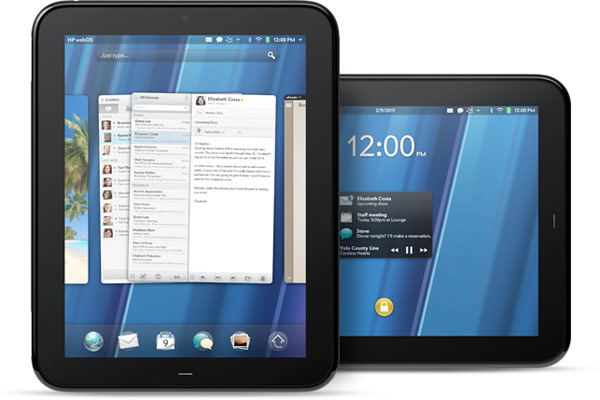
    After successfully acquiring and killing an operating system(WebOS) and a company (Palm), in less than six months, HP continues to wonder what it can do with the remains. HP earlier this week issued a statement that it will shut down all remaining operations of the division. This news didn’t come as much of a shocker to us as HP had already clarified its plans to shut down the operations on WebOS devices.

    Yesterday HP’s Todd Bradley, went on Bloomberg to clear the air, and called the report about the shut down an “unfounded rumor.” He said

    “Accolades for the operating system are broadly known and that the company is focusing on how to effectively utilize that phenomenal software.HP will weigh all the data and information before making the right decision.”


  • Microsoft shows of the Future in a Video : We watch in amazement

    Microsoft like every other company sees a future for themselves and a world around it, their vision and what they wish to achieve. In the Company’s Productivity Future Vision concept video they make it clear that they would like seamless interconnectivity. From translating eyeglasses, to active Car window displays and transparent fridge displays. Phone to Tablet to TV transfers, it just seems so smooth and seamless. Check it out.


  • RIM releases BBM SDK for WebWorks, Allows integration with Apps

    RIM releases BBM SDK for WebWorks, Allows integration with Apps

    RIM at their DEVcon forgot to mention that they will be releasing the SDK for their social instant messenger to the developer world, for integration within apps and notifications. The service will allow apps to initiate chats and incorporate BBM statuses, avatars and personal messages. The SDK will also allow “application-to-application background communication,” file transfers over the protocol and sharing apps between users.

    This may change the outlook of blackberry devices, even though their future now looks bleek to us.

  • Research in Motion announces BBX the future of Blackberry OS (PR)

    Research in Motion announces BBX the future of Blackberry OS (PR)

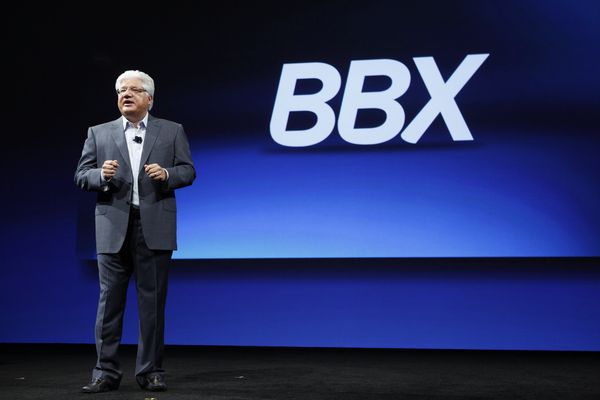
    The war on speculation is over already, RIM acquisition of QNX is finally paid off as the company announces their new Mobile operating system the BBX. BBX will be based on QNX, the current operating system found on the BlackBerry PlayBook tablet. But, like Apple’s iOS and Google’s Android Ice Cream Sandwich operating systems, BBX will be one operating system across devices.

    BBX will also bring along the long-promised ability to run Android apps on BlackBerry devices. It will also run native BBX apps, apps developed using Adobe’s AIR software and HTML5 apps.

    But while RIM made the next BlackBerry operating system official, the company offered up few details on the new software outside of how developers will be able to build for it. RIM hasn’t yet said when the first BBX smartphones will arrive.


    [toggle title_open=”Press Release” title_closed=”Press Release” hide=”yes” border=”yes” style=”default” excerpt_length=”0″ read_more_text=”Read More” read_less_text=”Read Less” include_excerpt_html=”no”]

    RIM Unveils BlackBerry BBX-Combines the Best of BlackBerry and QNX to Provide a Next Generation Platform for BlackBerry Smartphones and Tablets


    Additional announcements and highlights from BlackBerry DevCon Americas 2011 include: – BlackBerry WebWorks and HTML5 apps compatible with current BlackBerry smartphones and tablets will run on future BBX-based devices – Native SDK for BlackBerry PlayBook goes gold; released for general availability – SDK for Adobe AIR Now Supports Adobe AIR 3.0 – BlackBerry PlayBook OS 2.0 Developer Beta now available, includes BlackBerry Runtime for Android Apps


    SAN FRANCISCO, CALIFORNIA, Oct 18, 2011 (MARKETWIRE via COMTEX) — BlackBerry DevCon Americas 2011 – At BlackBerry DevCon Americas 2011, Research In Motion today unveiled BlackBerry BBX, its next generation mobile platform that takes the best of the BlackBerry platform and the best of the QNX platform to connect people, devices, content and services.


    In addition, RIM announced a series of developer tool updates, including WebWorks for BlackBerry smartphones and tablets, the Native SDK for the BlackBerry PlayBook and a developer beta of BlackBerry PlayBook OS 2.0 with support for running Android applications. RIM also provided direction for developers on how to best develop and monetize their BlackBerry applications for today and for the future.


    “With nearly 5 million BlackBerry apps downloaded daily, our customers have made BlackBerry one of the most profitable platforms for developers,” said Mike Lazaridis, President and Co-CEO at RIM. “At DevCon today, we’re giving developers the tools they need to build richer applications and we’re providing direction on how to best develop their smartphone and tablet apps as the BlackBerry and QNX platforms converge into our next generation BBX platform.”


    BlackBerry BBX


    BBX is the next generation platform for BlackBerry smartphones and tablets. It combines the best of BlackBerry and the best of QNX and is designed from the ground up to enable the powerful real-time mobile experiences that distinguish BlackBerry products and services.


    The BBX platform will include BBX-OS, and will support BlackBerry cloud services and development environments for both HTML5 and native developers. BBX will also support applications developed using any of the tools available today for the BlackBerry PlayBook – including Native SDK, Adobe AIR/Flash and WebWorks/HTML5, as well as the BlackBerry Runtime for Android Apps – on future BBX-based tablets and smartphones.


    BBX will also include the new BlackBerry Cascades UI Framework for advanced graphics (shown for the first time today), and bring “Super App” capabilities to enable many advanced capabilities including deep integration between apps, always-on Push services, the BBM(TM) Social Platform, and much more.


    BlackBerry WebWorks


    Developers who want to support both existing smartphones (running BlackBerry 6 and BlackBerry 7 OS) and BlackBerry PlayBook tablets can monetize apps on both platforms today with BlackBerry WebWorks, which supports apps built on HTML5, CSS and JavaScript. The latest release, BlackBerry WebWorks SDK 2.2 (supporting both smartphones and tablets), is now available and includes updates for the new PlayBook OS SDK, PlayBook Simulator and more.


    The BlackBerry WebWorks APIs are supported by the Ripple Emulator, a standalone, high-fidelity browser-like emulation tool that allows developers to test and debug their applications on multiple platforms and devices without having to compile or launch simulators. Starting today the Ripple Emulator is available in beta and can also be downloaded from RIM’s WebWorks Developer site at: http://developer.blackberry.com/html5 .


    Native SDK – Content Rich, Fast and Smooth Running Applications


    RIM also announced today the immediate availability of the Native SDK for the BlackBerry PlayBook (1.0 gold release). The Native SDK allows developers to build high-performance, multi-threaded, native C/C++ applications and enables developers to create advanced 2D and 3D games and other apps with access to OpenGL ES 2.0 and Open AL, as well as device specific APIs. Applications developed with the Native SDK will run today on the BlackBerry PlayBook and will be forwardly compatible on BBX-based tablets and smartphones.


    The Native SDK includes support for C/C++ POSIX library and compliance, device events like gesture swipes and touch screen inputs, access to code management systems using industry standard Eclipse CDT (C/C++ Development Tools) and advanced debug and analysis tools. QNX Momentics Tool Suite, an Eclipse-based integrated development environment, is included. It provides memory profiling, application debugging, and memory usage statistics to help developers debug sophisticated programs, including hardware accelerated OpenGL applications.


    The Native SDK makes the development and porting of game applications to the BlackBerry PlayBook an extremely attractive proposition for developers. Well known game publishers, developers and major game engine companies have already started to bring their game titles and applications to the platform.


    Scoreloop, the largest and fastest growing cross-platform social gaming ecosystem on mobile, is now available in beta for the Native SDK through BlackBerry(R) Beta Zone. The Scoreloop SDK provides everything a developer needs to easily integrate social capabilities into their native PlayBook applications and includes support for Leaderboards, Game Challenges, Awards & Achievements, and Player Profiles. Scoreloop’s fully customizable and cross-platform technology empowers developers to add as many or as few features as they want, from a simple leader-board to more extensive player achievements. It makes mobile games more social and profitable.


    BlackBerry Cascades – Create Visually Stunning Interfaces


    RIM today showcased BlackBerry Cascades, a rich user interface framework coming to a future release of the Native SDK. Cascades unleashes a new breed of design centric mobile applications and provides developers with an exceptional feature set for creating visually stunning interfaces with custom layouts, animations, effects and 3D graphics. These features, combined with a strong set of built-in core user interface components, will make it easy to build beautiful native applications with innovative user interfaces for the current BlackBerry PlayBook and future BBX-based tablets and smartphones. Cascades is scheduled to be made available in beta later this fall.


    Adobe AIR 3.0 Support


    Adobe Flash enables developers to produce visually stunning, highly functional applications for the BlackBerry PlayBook that can integrate with the underlying OS and will be supported on future BBX-based tablets and smartphones.


    The BlackBerry PlayBook now supports the recently announced Adobe AIR 3.0 runtime. Among the supported features are Encrypted Local Store that gives developers the ability to use the Advanced Encryption Standard (AES) to encrypt and securely store sensitive information on the device, as well as store passwords, keys or credit card information safely within the app; StageText that allows developers to take advantage of native text controls and the native interaction behaviors of those controls; Multitouch and Gestures built into applications to provide great usability; and more.


    PlayBook OS 2.0 – Developer Beta


    RIM introduced today the Developer Beta version of the BlackBerry PlayBook OS 2.0. The Developer Beta includes the BlackBerry Runtime for Android Apps and the BlackBerry Plug-In for Android Development Tools (ADT), allowing developers to quickly and easily bring Android applications to BlackBerry PlayBook tablets.


    The BlackBerry Plug-In for ADT (an Eclipse plug-in) extends a developer’s existing Eclipse Android development environment to support the PlayBook, and includes the BlackBerry PlayBook Simulator for developers to test and debug their apps before submitting them to BlackBerry App World(TM). Developers can also test and debug their apps on a PlayBook running the BlackBerry PlayBook OS 2.0 – Developer Beta.


    Android developers can also repackage Android apps for the BlackBerry PlayBook online by using the BlackBerry Packager for Android Apps. The web tool guides developers through a step-by-step process, allowing them to test their apps for compatibility with the PlayBook, and repackage and sign their apps for submission to BlackBerry App World, all without downloading any tools.


    BlackBerry Runtime for Android Apps and the associated tools allow Android developers to easily expand their market to include BlackBerry PlayBook users, and hence increase their apps’ market potential.


    The BlackBerry PlayBook OS 2.0 – Developer Beta also supports Adobe Air 3.0 and Adobe Flash 11, as well as WebGL, a new web technology that brings hardware-accelerated 3D graphics to the browser without installing additional software. Developers will be able to generate rich, interactive 3D graphics within their BlackBerry WebWorks application.


    For more information about the BlackBerry PlayBook OS 2.0 – Developer Beta and BlackBerry Runtime for Android Apps and associated tools, visit For more information about the BlackBerry PlayBook OS 2.0 – Developer Beta and BlackBerry Runtime for Android Apps and associated tools, visit: https://bdsc.webapps.blackberry.com/android/bpaa/ .


    Increased Developer Productivity with Open Source Libraries on the BlackBerry PlayBook OS


    RIM also announced the BlackBerry Open Source Initiative to port popular Open Source libraries to the BlackBerry PlayBook platform. Libraries already available include physics engines like Bullet Physics and Box2DX, scripting languages like Lua, multimedia libraries like OpenAL and SDL, gaming frameworks like Cocos2DX and general-purpose libraries like Boost and Qt. Also available under an Open Source license are a range of code samples that developers can use to get started quickly, as well as GamePlay, a new 3D native gaming framework.


    RIM will continue to expand its involvement in the Open Source community to help increase developer productivity on the BlackBerry platforms. For more details on RIM’s Open Source activities, visit http://blackberry.github.com .

    [/toggle]


  • Google Confirms Ice Cream Sandwich will run on Nexus S and other Gingerbread Devices

    Google Confirms Ice Cream Sandwich will run on Nexus S and other Gingerbread Devices

    Google has officially confirmed that all Gingerbread devices should be able to get some Ice Cream Sandwich love. Starting with the Nexus S devices will soon get their upgrades as they go along. 

    Currently in the process for releasing Ice Cream Sandwich for Nexus S. Theoretically should work for any 2.3 device.”

    -Gabe Cohen, Google Android Team

    Glad you bough that Nexus S huh?

  • Google Officially calls Android Ice Cream Sandwich, Shouts Android 4.0

    Google Officially calls Android Ice Cream Sandwich, Shouts Android 4.0

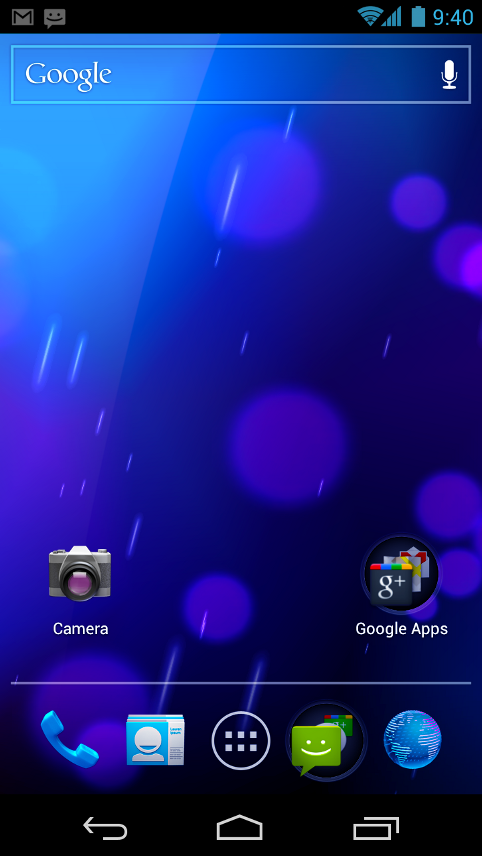
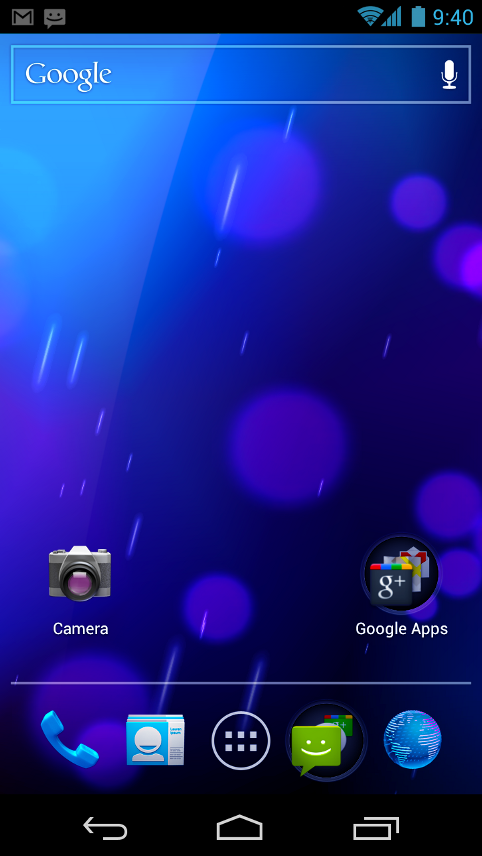
    The number is finally FInal, Google has announced Ice Cream Sandwich as the next Revision of Android, and has called it Android 4.0. This update will bring a major overhaul to the UI that we know and love, and bring along a whole bucketful of features.

    Here’s some of the things in Ice Cream Sandwich:

    • Virtual buttons in the UI(like Honeycomb)
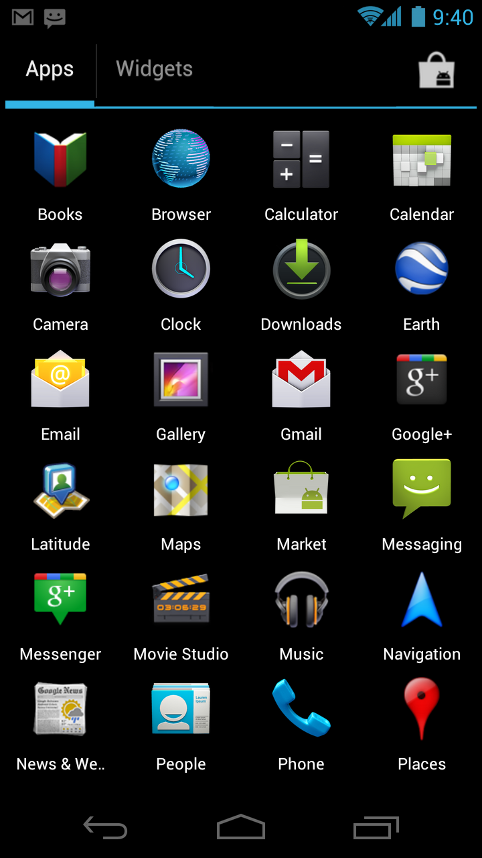
    • Widgets are in a new tab, listed in a similar list to apps
    • Folders are much easier to create, with a drag-and-drop style similar to iOS
    • A customizable launcher
    • New phone app with visual voicemail functionality that lets you speed up or slow down voicemail messages
    • Pinch-to-zoom functionality in the calendar
    • Gmail has offline search, a two-line preview, and new action bar at the bottom
    • Swipe left or right to switch between Gmail conversations
    • Integrated screenshot capture by holding power and volume down buttons
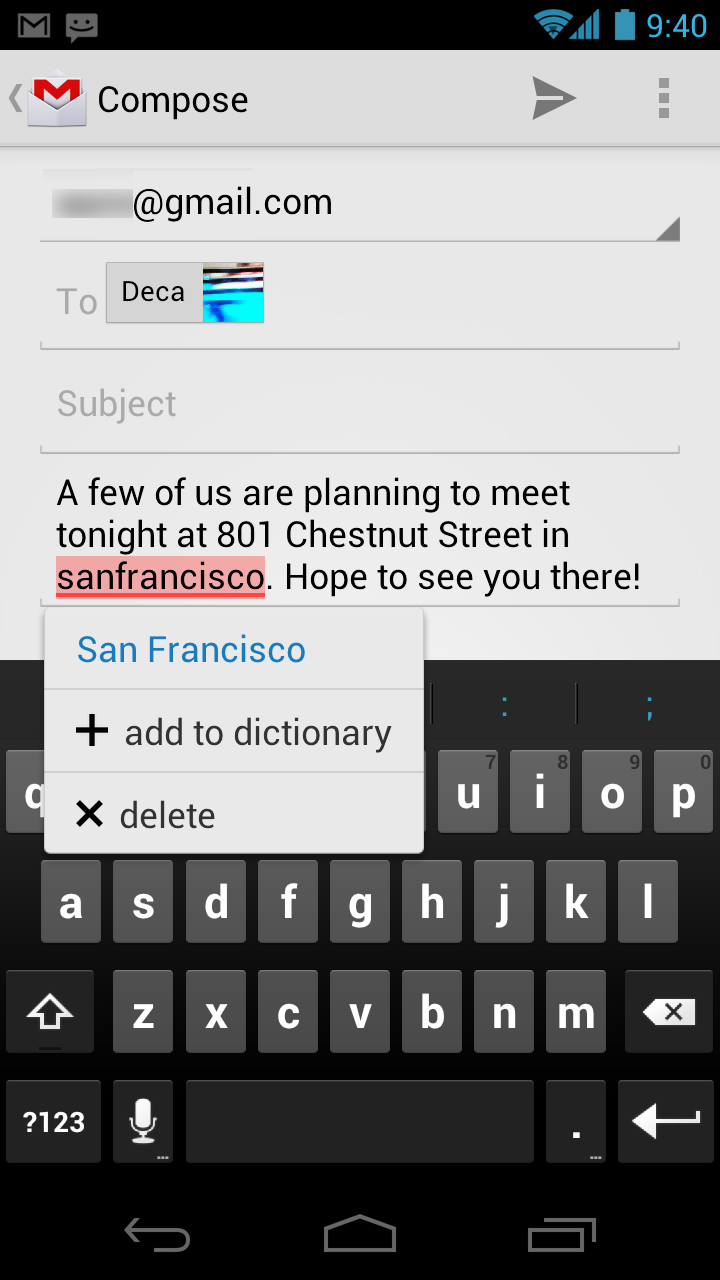
    • Improved error correction on the keyboard
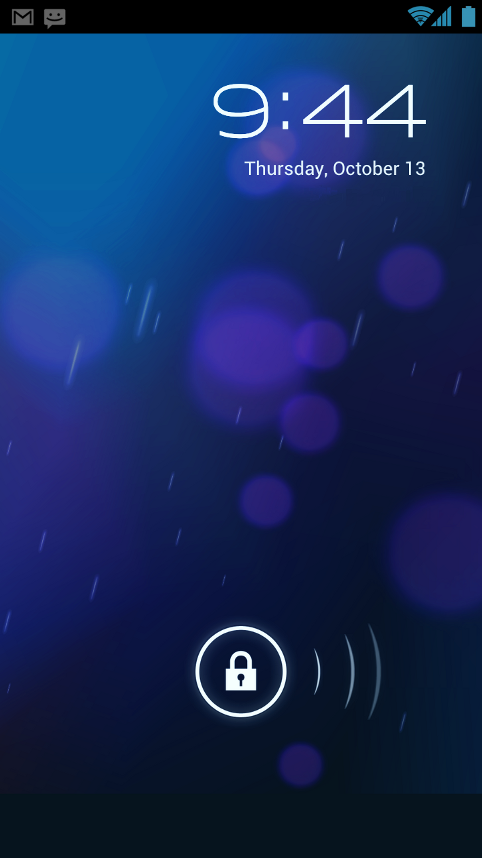
    • Ability to access apps directly from lock screen (similar to HTC Sense 3.x)
    • Improved copy and paste
    • Better voice integration
    • Face Unlock, a facial recognition service
    • New tabbed web browser, allowing up to 16 tabs
    • Browser now automatically syncs your Chrome bookmarks
    • Modern “Roboto” font
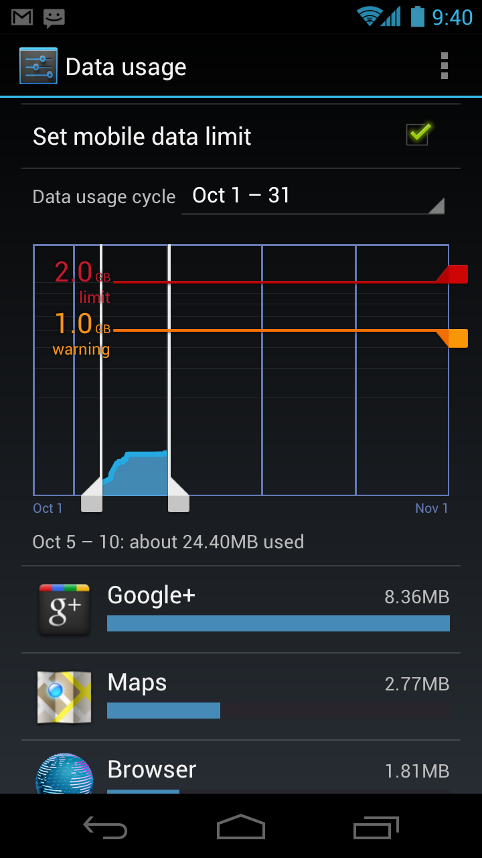
    • Data Usage section in settings lets you monitor and disable data when you go over your limit
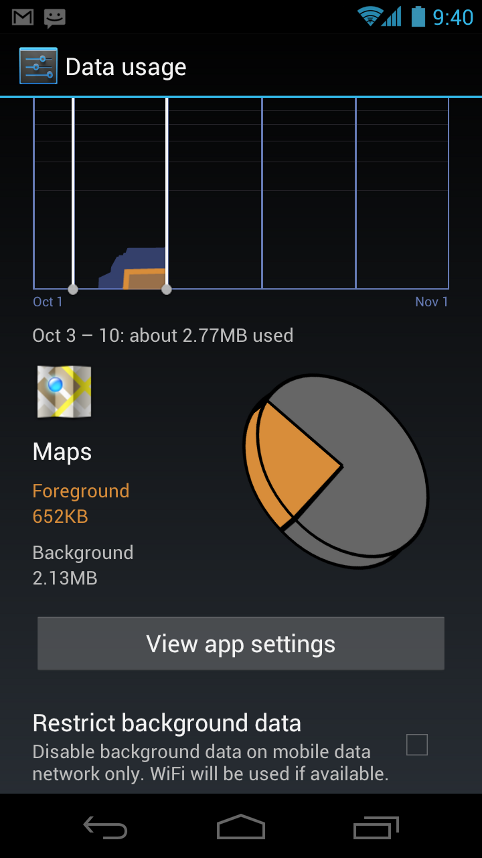
    • Ability to kill off apps that are using data in the background
    • Camera app: zero shutter lag, time lapse settings, zoom while recording
    • Built-in photo editor
    • New gallery layout, organized by location and person
    • Refreshed people app with social network integration, status updates and hi-res images
    • Android Beam, a NFC feature that lets you exchange websites, contact info, directions, YouTube, etc.

    Android 4.0 for Users

    Simple, beautiful, beyond smart

    Android 4.0 builds on the things people love most about Android — easy multitasking, rich notifications, customizable home screens, resizable widgets, and deep interactivity — and adds powerful new ways of communicating and sharing.

    Refined, evolved UI

    Focused on bringing the power of Android to the surface, Android 4.0 makes common actions more visibleand lets users navigate with simple, intuitive gestures. Refined animations and feedback throughout the system make interactions engaging and interesting. An entirely new typeface optimized for high-resolution screens improves readability and brings a polished, modern feel to the user interface.

    Virtual buttons in the System Bar let users navigate instantly to Back, Home, and Recent Apps. The System Bar and virtual buttons are present across all apps, but can be dimmed by applications for full-screen viewing. Users can access each application’s contextual options in the Action Bar, displayed at the top (and sometimes also at the bottom) of the screen.

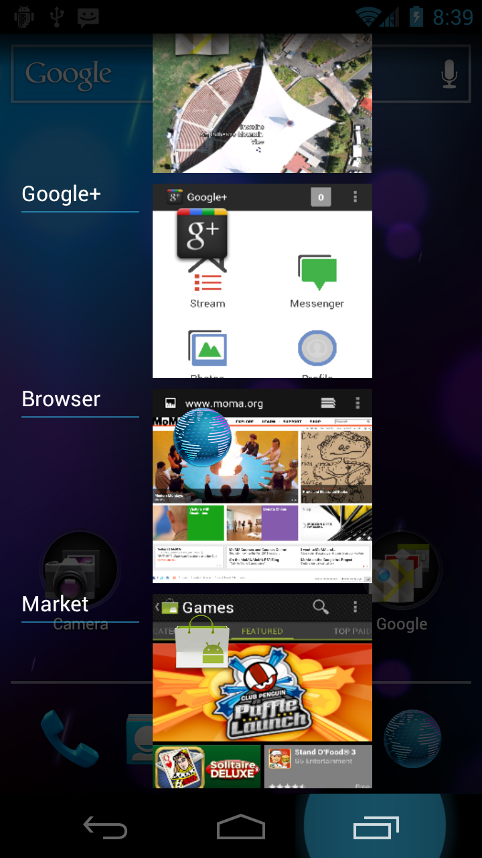
    Multitasking is a key strength of Android and it’s made even easier and more visual on Android 4.0. The Recent Apps button lets users jump instantly from one task to another using the list in the System Bar. The list pops up to show thumbnail images of apps used recently — tapping a thumbnail switches to the app.

    Rich and interactive notifications let users keep in constant touch with incoming messages, play music tracks, see real-time updates from apps, and much more. On smaller-screen devices, notifications appear at the top of the screen, while on larger-screen devices they appear in the System Bar.

    Home screen folders and favorites tray

    New home screen folders offer a new way for users to group their apps and shortcuts logically, just by dragging one onto another. From the All Apps launcher, users can now simply drag an app to get information about it or immediately uninstall it, or disable a pre-installed app.

    On smaller-screen devices, the home screen now includes a customizablefavorites tray visible from all home screens. Users can drag apps, shortcuts, folders, and other priority items in or out of the favorites tray for instant access from any home screen.

    Resizable widgets

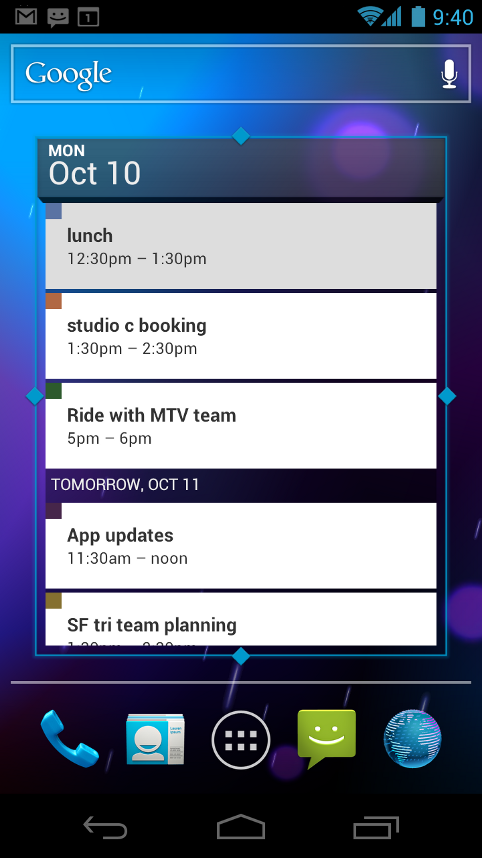
    Home screens in Android 4.0 are designed to be content-rich and customizable. Users can do much more than add shortcuts — they can embed live application content directly through interactive widgets. Widgets let users check email, flip through a calendar, play music, check social streams, and more — right from the home screen, without having to launch apps. Widgets are resizable, so users can expand them to show more content or shrink them to save space.

    New lock screen actions

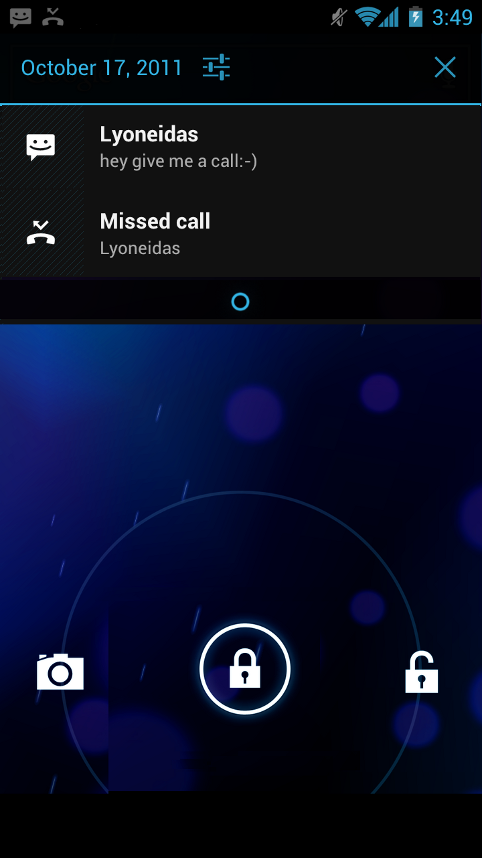
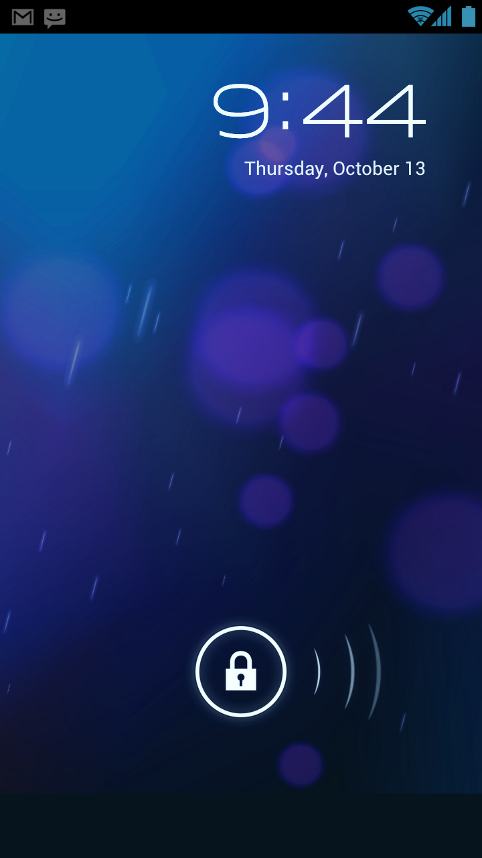
    The lock screens now let users do more without unlocking. From the slide lock screen, users can jump directly to the camera for a picture orpull down the notifications window to check for messages. When listening to music, users can even manage music tracks and see album art.

    Quick responses for incoming calls

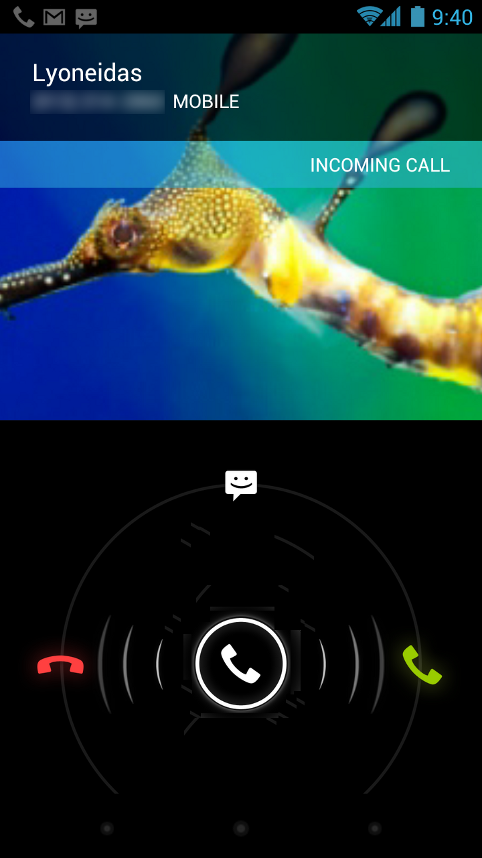
    When an incoming call arrives, users can now quickly respond by text message, without needing to pick up the call or unlock the device. On the incoming call screen, users simply slide a control to see a list of text responses and then tap to send and end the call. Users can add their own responses and manage the list from the Settings app.

    Swipe to dismiss notifications, tasks, and browser tabs

    Android 4.0 makes managing notifications, recent apps, and brwoser tabs even easier. Users can now dismiss individual notifications, apps from the Recent Apps list, and browser tabs with a simple swipe of a finger.

    Improved text input and spell-checking

    The soft keyboard in Android 4.0 makes text input even faster and more accurate. Error correction and word suggestion are improved through a new set of default dictionaries and more accurate heuristics for handling cases such as double-typed characters, skipped letters, and omitted spaces. Word suggestion is also improved and the suggestion strip is simplified to show only three words at a time.

    To fix misspelled words more easily, Android 4.0 adds a spell-checker that locates and underlines errors and suggests replacement words. With one tap, users can choose from multiple spelling suggestions, delete a word, or add it to the dictionary. Users can even tap to see replacement suggestions for words that are spelled correctly. For specialized features or additional languages, users can now download and install third-party dictionaries, spell-checkers, and other text services.

    Powerful voice input engine

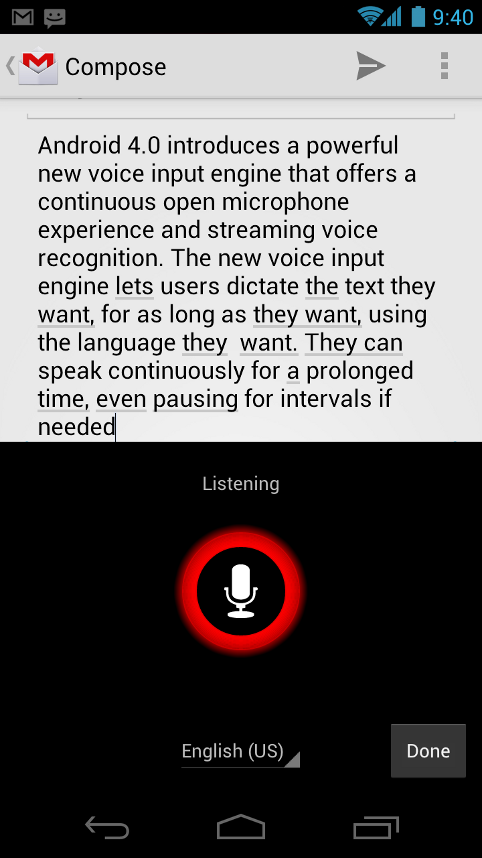
    Android 4.0 introduces a powerful new voice input engine that offers a continuous “open microphone” experience and streaming voice recognition. The new voice input engine lets users dictate the text they want, for as long as they want, using the language they want. Users can speak continously for a prolonged time, even pausing for intervals if needed, and dictate punctuation to create correct sentences. As the voice input engine enters text, it underlines possible dictation errors in gray. After dictating, users can tap the underlined words to quickly replace them from a list of suggestions.

    Control over network data

    Mobile devices can make extensive use of network data for streaming content, synchronizing data, downloading apps, and more. To meet the needs of users with tiered or metered data plans, Android 4.0 adds new controls for managing network data usage.

    In the Settings app, colorful charts show the total data usage on each network type (mobile or Wi-Fi), as well as amount of data used by each running application. Based on their data plans, users can optionally set warning levels or hard limits on data usage or disable mobile data altogether. Users can also manage the background data used by individual applications as needed.

    Designed for accessibility

    A variety of new features greatly enhance the accessibility of Android 4.0 for blind or visually impaired users. Most important is a new explore-by-touch mode that lets users navigate without having to see the screen. Touching the screen once triggers audible feedback that identifies the UI component below; a second touch in the same component activates it with a full touch event. The new mode is especially important to support users on new devices that use virtual buttons in the System Bar, rather than dedicated hardware buttons or trackballs. Also, standard apps are updated to offer an improved accessibility experience. The Browser supports a script-based screen reader for reading favorite web content and navigating sites. For improved readability, users can also increase the default font size used across the system.

    The accessibility experience begins at first setup — a simple touch gesture during setup (clockwise square from upper left) activates all accessibility features and loads a setup tutorial. Once accessibility features are active, everything visible on the screen can be spoken aloud by the standard screen reader.

    Communication and sharing

    Contacts and profiles are integrated across apps and social networks, for a consistent, personal experience everywhere — from incoming calls to emails.

    Designed for the way people live, Android 4.0 integrates rich social communication and sharing touchpoints across the system, making it easy to talk, email, text, and share.

    People and profiles

    Throughout the system, a user’s social groups, profiles, and contacts are linked together and integrated for easy accessibility. At the center is a new People app that offers richer profile information, including a large profile picture, phone numbers, addresses and accounts, status updates, events, and a new button for connecting on integrated social networks.

    The user’s own contact information is stored in a new “Me” profile, allowing easier sharing with apps and people. All of the user’s integrated contacts are displayed in an easy to manage list, including controls over which contacts are shown from any integrated account or social network. Wherever the user navigates across the system, tapping a profile photo displays Quick Contacts, with large provile pictures, shortcuts to phone numbers, text messaging, and more.

    Unified calendar, visual voicemail

    To help organize appointments and events, an updated Calendar app brings together personal, work, school, and social agendas. With user permission, other applications can contribute events to the calendar and manage reminders, for an integrated view across multiple calendar providers. The app is redesigned to let users manage events more easily. Calendars are color-coded and users can swipe left or right to change dates and pinch to zoom in or out agendas.

    In the phone app, a new visual voicemail features integrates incoming messages, voice transcriptions, and audio files from one or more providers. Third-party applications can integrate with the Phone app to add their own voice messages, transcriptions, and more to the visual voicemail inbox.

    Rich and versatile camera capabilities

    The Camera app includes many new features that let users capture special moments with great photos and videos. After capturing images, they can edit and share them easily with friemds.

    When taking pictures, continuous focuszero shutter lag exposure, and decreased shot-to-shot speed help capture clear, precise images. Stabilized image zoom lets users compose photos and video in the way they want, including while video is recording. For new flexibility and convenience while shooting video, users can now take snapshots at full video resolutionjust by tapping the screen as video continues to record.

    To make it easier to take great pictures of people, built-in face detection locates faces in the frame and automatically sets focus. For more control, users can tap to focus anywhere in the preview image.

    For capturing larger scenes, the Camera introduces a single-motion panorama mode. In this mode, the user starts an exposure and then slowly turns the Camera to encompass as wide a perspective as needed. The Camera assembles the full range of continuous imagery into a single panoramic photo.

    After taking a picture or video, users can quickly share it by email, text message, bluetooth, social networks, and more, just by tapping the thumbnail in the camera controls.

    Redesigned Gallery app with photo editor

    The Gallery app now makes it easier to manage, show, and share photos and videos. For managing collections, a redesigned album layout shows many more albums and offers larger thumbnails. There are many ways to sort albums, including by time, location, people, and tags. To help pictures look their best, the Gallery now includes a powerful photo editor. Users can crop and rotate pictures, set levels, remove red eyes, add effects, and much more. After retouching, users can select one or multiple pictures or videos to share instantly over email, text messaging, bluetooth, social networks, or other apps.

    An improved Picture Gallery widget lets users look at pictures directly on their home screen. The widget can display pictures from a selected album, shuffle pictures from all albums, or show a single image. After adding the widget to the home screen, users can flick through the photo stacks to locate the image they want, then tap to load it in Gallery.

    Live Effects for transforming video

    Live Effects is a collection of graphical transformations that add interest and fun to videos captured in the Camera app. For example, users can change the background behind them to any stock or custom image, for just the right setting when shooting video or using Google Talk video chat. Also available is Silly Faces, a set of morphing effects that use state-of-the-art face recognition and GPU filters to add great effects to facial features during video capture. For example, you can use effects such as small eyes, big mouth, big nose, face squeeze, and more. Outside of the Camera app, Live Effects is available during video chat in the Google Talk app.

    Sharing with screenshots

    Users can now share what’s on their screens more easily by taking screenshots. Hardware buttons let them snap a screenshot and store it locally. Afterward, they can view, edit, and share the screen shot in Gallery or a similar app.

    Cloud-connected experience


    The Browser tabs menu (left) lets you quickly switch browser tabs. The options menu (right) gives you new ways to manage your browsing experience.


    Benchmark comparisons of Android Browser.

    Android has always been cloud-connected, letting users browse the web and sync photos, apps, games, email, and contacts — wherever they are and across all of their devices. Android 4.0 adds new browsing and email capabilities to let users take even more with them and keep communication organized.

    Powerful web browsing

    The Android Browser offers an experience that’s as rich and convenient as a desktop browser. It lets users instantly sync and manage Google Chrome bookmarks from all of their accounts, jump to their favorite content faster, and even save it for reading later in case there’s no network available.

    To get the most out of web content, users can now request full desktop versions of web sites, rather than their mobile versions. Users can set their preference for web sites separately for each browser tab. For longer content, users can save a copy for offline reading. To find and open saved pages, users can browse a visual list that’s included with browser bookmarks and history. For better readability and accessibility, users can increase the browser’s zoom levels and override the system default text sizes.

    Across all types of content, the Android Browser offers dramatically improved page rendering performancethrough updated versions of the WebKit core and the V8 Crankshaft compilation engine for JavaScript. In benchmarks run on a Nexus S device, the Android 4.0 browser showed an improvement of nearly 220% over the Android 2.3 browser in the V8 Benchmark Suite and more than 35% in the SunSpider 9.1 JavaScript Benchmark. When run on a Galaxy Nexus device, the Android 4.0 browser showed improvement of nearly 550% in the V8 benchmark and nearly 70% in the SunSpider benchmark.

    Improved email

    In Android 4.0, email is easier to send, read, and manage. For composing email, improved auto-completion of recipients helps with finding and adding frequent contacts more quickly. For easier input of frequent text, users can now create quick responses and store them in the app, then enter them from a convenient menu when composing. When replying to a message, users can now toggle the message to Reply All and Forward without changing screens.

    For easier browsing across accounts and labels, the app adds an integrated menu of accounts and recent labels. To help users locate and organize IMAP and Exchange email, the Email app now supports nested mail subfolders, each with synchronization rules. Users can also search across folders on the server, for faster results.

    For enterprises, the Email app supports EAS v14. It supports EAS certificate authentication, provides ABQ strings for device type and mode, and allows automatic sync to be disabled while roaming. Administrators can also limit attachment size or disable attachments.

    For keeping track of incoming email more easily, a resizable Email widget lets users flick through recent email right from the home screen, then jump into the Email app to compose or reply.

    Android Beam lets users share what they are using with a single tap.

    Innovation

    Android is continously driving innovation forward, pushing the boundaries of communication and sharing with new capabilities and interactions.

    Android Beam for NFC-based sharing

    Android Beam is an innovative, convenient feature for sharing across two NFC-enabled devices, It lets people instantly exchange favorite apps, contacts, music, videos — almost anything. It’s incredibly simple and convenient to use — there’s no menu to open, application to launch, or pairing needed. Just touch one Android-powered phone to another, then tap to send.

    For sharing apps, Android Beam pushes a link to the app’s details page in Android Market. On the other device, the Market app launches and loads the details page, for easy downloading of the app. Individual apps can build on Android Beam to add other types of interactions, such as passing game scores, initiating a multiplayer game or chat, and more.

    Face recognition lets you unlock your phone with your face.

    Face Unlock

    Android 4.0 introduces a completely new approach to securing a device, making it even more personal — Face Unlock is a new screen-lock option that lets users unlock their devices with their faces. It takes advantage of state-of-the-art facial recognition technology to register a face and to recognize it later when unlocking the device. Users just hold their devices in front of their faces to unlock, or use a backup PIN or pattern.

    Wi-Fi Direct and Bluetooth HDP

    Support for Wi-Fi Direct lets users connect directly to nearby peer devices over Wi-Fi, for more reliable, higher-speed communication. No internet connection or tethering is needed. Through third-party apps, users can connect to compatible devices to take advantage of new features such as instant sharing of files, photos, or other media; streaming video or audio from another device; or connecting to compatible printers or other devices.

    Android 4.0 also introduces built-in support for connecting to Bluetooth Health Device Profile (HDP) devices. With support from third-party apps, users can connect to wireless medical devices and sensors in hospitals, fitness centers, homes, and elsewhere. In addition, for connecting to higher quality Bluetooth audio devices, Android 4.0 adds support for Bluetooth Hands Free Profile (HFP) 1.6.

  • Did you suffer from the Blackberry Outage? RIM will give you 12 free Paid Apps! (PR)

    Did you suffer from the Blackberry Outage? RIM will give you 12 free Paid Apps! (PR)

    Following the major outages for Blackberry services in the past week, RIM will offer free premium apps to its consumer. These apps include 

    • SIMS 3 – Electronic Arts
    • Bejeweled – Electronic Arts
    • N.O.V.A. – Gameloft
    • Texas Hold’em Poker 2 – Gameloft
    • Bubble Bash 2 – Gameloft
    • Photo Editor Ultimate – Ice Cold Apps
    • DriveSafe.ly Pro – iSpeech.org
    • iSpeech Translator Pro – iSpeech.org
    • Drive Safe.ly Enterprise – iSpeech.org
    • Nobex Radio™ Premium – Nobex
    • Shazam Encore – Shazam
    • Vlingo Plus: Virtual Assistant – Vlingo (Almost SIRI)

    Good move from CEO Lazaridis, to prevent users from jumping the boat for iOS or Android.


    [toggle title_open=”Press Release” title_closed=”Press Release” hide=”yes” border=”yes” style=”default” excerpt_length=”0″ read_more_text=”Read More” read_less_text=”Read Less” include_excerpt_html=”no”]Research In Motion Offers Free Premium Apps to Customers Following Service Interruptions

    Waterloo, ON – Research In Motion (RIM) (NASDAQ: RIMM; TSX: RIM) announced today that a selection of premium apps worth a total value of more than US $100 will be offered free of charge to subscribers as an expression of appreciation for their patience during the recent service disruptions. The apps will be made available to customers over the coming weeks on BlackBerry® App World™ and will continue to be available until December 31, 2011.*

    “Our global network supports the communications needs of more than 70 million customers,” said RIM Co-CEO Mike Lazaridis. “We truly appreciate and value our relationship with our customers. We’ve worked hard to earn their trust over the past 12 years, and we’re committed to providing the high standard of reliability they expect, today and in the future.”

    The complete selection of premium apps will become available to download at BlackBerry App World over a period of four weeks beginning Wednesday, October 19th. The selections over this period will include the following (with more to come):

    SIMS 3 – Electronic Arts
    Bejeweled – Electronic Arts
    N.O.V.A. – Gameloft
    Texas Hold’em Poker 2 – Gameloft
    Bubble Bash 2 – Gameloft
    Photo Editor Ultimate – Ice Cold Apps
    DriveSafe.ly Pro – iSpeech.org
    iSpeech Translator Pro – iSpeech.org
    Drive Safe.ly Enterprise – iSpeech.org
    Nobex Radio™ Premium – Nobex
    Shazam Encore – Shazam
    Vlingo Plus: Virtual Assistant – Vlingo

    RIM’s enterprise customers will also be offered one month of free Technical Support. Current customers will be offered a complimentary one month extension of their existing Technical Support contract, and customers who do not currently have a Technical Support contract will be offered a one month trial of RIM’s BlackBerry Technical Support Services – Enhanced Support, free of charge. Additional details about the program and information about how to register will be available at www.blackberry.com/enterpriseoffer.

    “We are grateful to our loyal BlackBerry customers for their patience,” added Lazaridis. “We have apologized to our customers and we will work tirelessly to restore their confidence. We are taking immediate and aggressive steps to help prevent something like this from happening again.

    * Please note that the availability of this offer will depend on the type of device, operating system version, access to BlackBerry App World and local conditions and/or restrictions.[/toggle]

  • Google starts up @ Android Twitter account to bring on the Ice Cream Sandwich

    Google starts up @ Android Twitter account to bring on the Ice Cream Sandwich

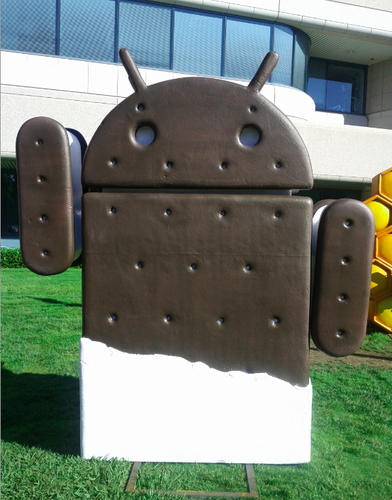
    Google is finally putting the @Android account to use, and seems to be calling all Android lovers to follow. They have opened the floodgates of information as ICS approaches and added a new statue at their campus !

    [@Android (Twitter)]

  • Google Translate for Android Update adds more Speech to Speech Language support

    Google Translate for Android Update adds more Speech to Speech Language support

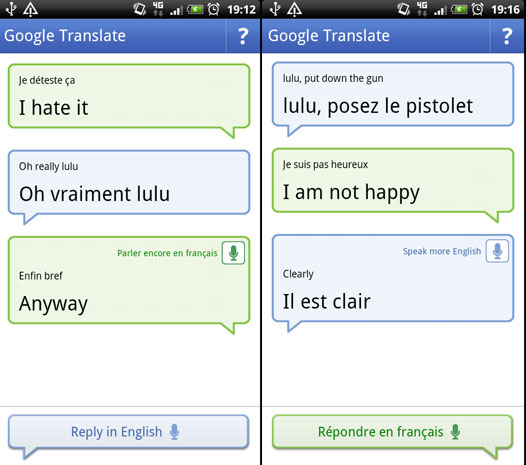
    Google Translate on Android gets update version 2.2, with support for over 14 languages in terms of speech to speech translations. The new interface will allow you to save any translations before they are said out loud. A demo video shows of how simple it can be. Personally till we get our Hands on Siri, we wont comment on any direct blows to it.

    [Android Market]

iGyaan Network
Privacy Overview

This website uses cookies so that we can provide you with the best user experience possible. Cookie information is stored in your browser and performs functions such as recognising you when you return to our website and helping our team to understand which sections of the website you find most interesting and useful.