Airtel has taken some more steps towards its goal of its complete network transformation. The telecom provider, which is one of the leading in India and was at one point of time, amongst the largest int he world, plans to get back on track. Airtel’s 4G network already covers 100% of Karnataka. It is the only telecom provider in the region to offer 4G, 3G and 2G services. to give a recap of its journey in the state, here are some numbers:
4G services on 2300 MHz launched in 2012
4G services on 1800 MHz launched in 2015
VoLTE services launched in November 2017
Towns and villages covered by network – 39,000
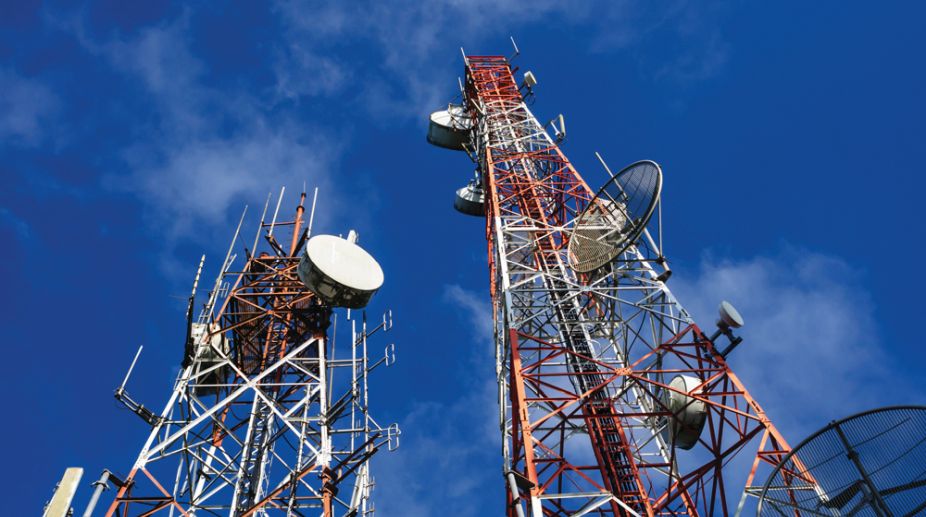
Now, in an effort to maintain their lead in this territory, the company will rollout 13,000 new mobile tower sites and also spread a 4500 km long optical fibre network that will enable them to boost high speed data network capacity.
This rollout will also include deployment of Pre-5G Massive MIMO (Multiple Input, Multiple Output) technology in vital residential and commercial hubs. However, the success in Karnataka is just a demonstration of the ongoing Project LEAP.
Project LEAP:
Airtel started working on project LEAP back in 2015 and planned a massive investment of Rs 60,000 crore. Some of that has already been used up and the remaining will be spent in the upcoming future.
The key points of project LEAP are:
Create India’s first Open Network – An open network will allow users to see the mobile network coverage in their area with the help of simple colour schemes. These colour schemes will define whether the network quality in their location is excellent, good, moderate or has no-coverage.
Users will also be able to locate company outlets and service centers with the help of a graphical map an easy to read colour schemes.
Under project LEAP, Airtel also plans to strengthen their network of mobile towers throughout the nation. The company will upgrade current towers and will also increase the number of towers.
A New Telecom Leader?
Airtel might be taking these steps as a counter-attack towards Jio. Airtel posted it first loss in 15 years, months after the arrival of Jio. Furthermore, Jio is continuously gaining traction since its launch. Jio scaled quickly because it adapted 4G technology faster than Airtel and now Airtel is trying to use the same trick to get back its lost marketshare. Airtel wants to be prepared when the 5G devices come out in 2019. It will allow Airtel to fight hard against big telecom players like Jio and the recently announced merger of Aditya Birla’s Idea and Vodafone group.
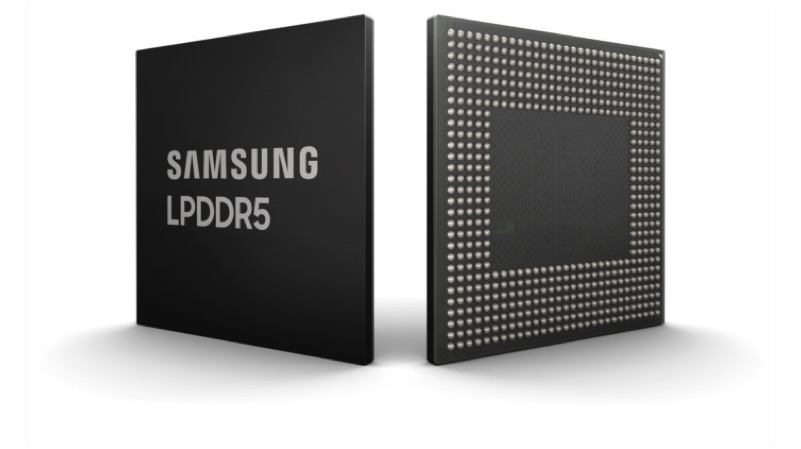
Samsung has set a benchmark when it comes to all things computing related. From manufacturing displays to home appliances, Samsung has done it all. The latest innovation in their line up is 8GB DRAM which is essentially a Low Power type (LPDDR5). Made for smartphones, Samsung has focussed on integrating AI capabilities and 5G compatibility with this 8GB DRAM. Samsung also claims high data-rates for the LPDDR5 DRAMs. The announcement was made on Samsung’s news blog.
Samsung 8GB DRAM
The senior vice president of Memory Product Planning & Application Engineering at Samsung Electronics, Jinman Han, quoted:
“This development of 8Gb LPDDR5 represents a major step forward for low-power mobile memory solutions.We will continue to expand our next-generation 10nm-class DRAM lineup as we accelerate the move toward greater use of premium memory across the global landscape”
This is exciting news because a faster and better-optimized RAM module will allow smartphone manufacturers to integrate AI into their devices. And then we have 5G which Samsung claims will be compatible with the LDDPR5 8GB DRAM. Prior to this DRAM, Samsung had started mass producing the 8GB LPDDR4 DRAM back in 2014.
According to claims by Samsung, the LPDDR5 will have data-rates of up to 6,400 megabits per second (Mb/s). This, compared to the current DRAM in flagship devices, is almost 1.5 times faster. Samsung further claims that you can send close to 14 full HD video files (with a total size of approximately 3.7GB each), in a mere second.
The 8GB DRAM is also optimized to be less power hungry and work synchronously with the application processor. The LPDDR5 will achieve this optimization by lowering its voltage. Ultimately, Samsung wants to make the chip AI-friendly and better optimization will allow the DRAM to deliver better performance. The DRAM will also offer what Samsung is calling a ‘deep sleep mode’, which will essentially allow the DRAM to run on half of its usual power.
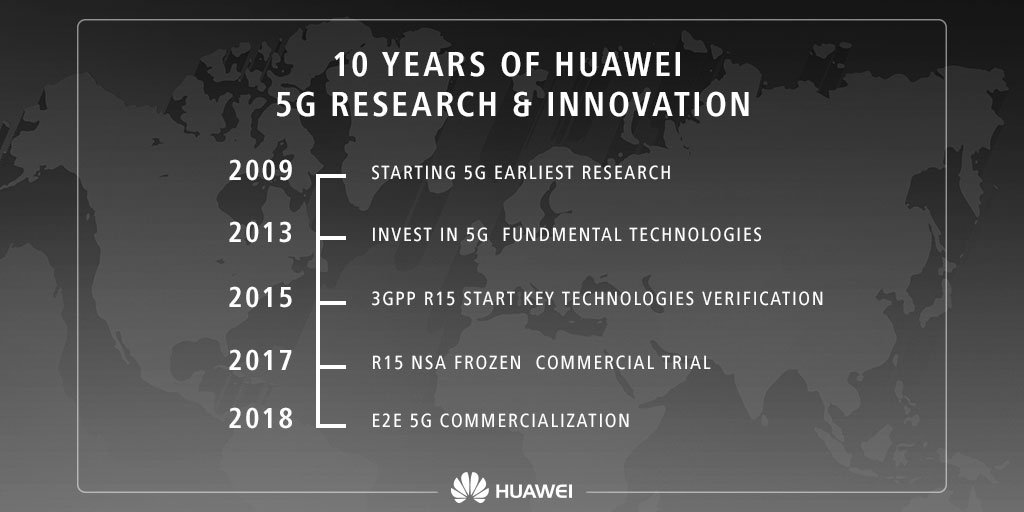
Huawei has launched the worlds first 5G CPE at MWC 2018. However, the availability of the CPE will be limited to North America. The CPE stands for Customer Premise Equipment, which enables the company to test the true potential of the 5G network before the official rollout.
Huawei has partnered with the Canadian telecom company TELUS to implement this technology in Canada. Initially, this technology will be tested with the TELUS employees based on the successful 5G 3GPP mmWave tests that were conducted by the Huawei and TELUS in June 2017.
H Ibrahim Gedeon, CTO at TELUS said:
This trial represents continued progress toward the launch of 5G, as we start to replicate both the in-home experience and network footprint we will see when 5G becomes commercially available in the near future. Wireless 5G services will generate tremendous benefits for consumers, operators, governments and more through the use of advanced IoT devices, big data applications, smart city systems and other technologies of the future.
Dr Wen Tong, Huawei Fellow, and CTO Huawei Wireless said:
mmWave technology will be an important tool in ensuring widespread deployment of 5G technology in Canada. Huawei’s 5G solutions and terminals will enable 5G coverage over a neighbourhood or small community cost effectively. While providing more convenient and high-speed home broadband Internet access services. This friendly user trial will drive the global 3GPP unified 5G standard and build a solid foundation for the 5G early commercialization.
The Huawei 5G CPE utilises 5G gNodeB related elements built by Huawei?TELUS 5G lab. The trail system is based on the 28GHz mmwave band with 800 MHz of bandwidth. In fact, the 5G CPE from Huawei uses the existing technologies like MIMO, F-OFDM, and Polar Code.
With the 5G technology, the company will be able to replace the fibre to home solutions. Huawei calls this as “Last-Mile” solution for the consumers and business. The deployment of wireless 5G solutions will help the brands to reduce the cost of operations. The 5G equipment has smaller footprints compared to the traditional towers. In fact, it helps the requirement of government’s permission to set up new towers.
Everyone wants faster and better internet connection. While 4G has slowly but surely entered the Indian market on a mass level, the world has already moved on to 5G internet. The first true move towards launching 5G wireless networks and smartphones received a huge impetus. The members of the 3rd Generation Partnership Project (3GPP) have officially approved the hardware specifications for the Non-Standalone (NSA) 5G New Radio (NR) standards. The specifications were confirmed during a meeting of the 3GPP group in Lisbon, Portugal. The actual specifications will be posted sometime later this week on the group’s official website.
NSA 5G NR specs were approved today at RAN#78. Balazs Bertenyi , RAN Chair called it “an Impressive achievement in a remarkably short time, with credit due particularly to the Working Groups”. News article to follow on the 3GPP site and from 3GPP Member announcements. pic.twitter.com/b10fTV5V5n
This development means that smartphone hardware companies such as Qualcomm, Intel, Huawei and others can begin making 5G wireless products and components based on these official standards. The industry has already moved towards 5G and only recently in November, Qualcomm, ZTE, and China Mobile announced a successful test of the world’s first end-to-end 5G NR interoperable system based on the standards that were developed by the 3GPP group.
As reported earlier, the Indian government has recognised the importance of the fast-speed internet and has already taken steps to ensure that India is not left behind in the 5G race. India is planning to roll out 5G internet services by the year 2020. In order to complete this task successfully, the government has set up a high-level forum which will evaluate all possible roadmaps to make sure that 5G internet becomes prominent in the country. For the said objective, the ministries of telecom, information and technology, and science and technology have been included in the forum. A budget of Rs 500 crore is set aside for research and development of 5G technology by the government.
Apart from the government, Indian telcos such as Airtel are also actively taking initiatives toward the 5G technology. Airtel on 26th September launched a mimo, a pre-5G technology, producing internet browsing speeds three times higher than the current levels. State-run Bharat Sanchar Nigam Ltd. along with Airtel have also signed initial pacts with smartphone makers such as Nokia for the development of 5G and its applications which are relevant to India.
Major telcos in India are future proofing their networks by working on the next big thing in the telecom industry, 5G. We had earlier reported that the government of India wants to be a big player in the 5G industry and take adequate steps earlier on in order to not fall behind in the 5G race. Now, major telcos like Airtel, Relieance Jio and more are preparing to introduce massive MIMO technology into their respective networks. The 5G technology is expected to be rolled out by 2020 and the massive MIMO technology is considered to be a key component in enabling 5G.
Massive MIMO, or massive multiple input multiple output, increases capacity of a base station by five to seven times and reduces interference substantially, in turn boosting the transmission signal to the devices. This means that a consumer using voice and data, will get data speed which can be between 30 MBPS and 35 MBPS on average. These speeds can go up to 50MBPS during peak time. Comparatively, depending on one’s 4G data provider and plan, the mobile internet speed varies from 4 MBPS to 16 MBPS on paper.
It is fair to say that 5G data is still a few years away as India has barely adopted 4G in its full capacity. Director of Technology at Vodafone India says:
While 5G is still may be a few years away, we are bringing some of 5G technologies like massive MIMO into 4G and applying them. We are conducting trials of this technology. It is very futuristic in 5G, but we are using it in 4G.
Airtel has already begun the first round of deployment of the technology in Bangalore and Kolkata and will expand to other cities like Pune, Hyderabad and Chandigarh. Reliance Jio on the other hand, is currently running trials of massive MIMO technology with Chinese gear maker ZTE. Idea as well, which now has a pan India 4G network is working on bring massive MIMO technology on 4G in India.
The Indian government has also acknowledged that bringing 5G to India is a priority. For this objective, the ministries of telecom, information and technology, and science and technology have been included in the forum. A budget of Rs 500 crore is set aside for research and development of 5G technology by the government.
India is planning to roll out 5G internet services by the year 2020. In order to complete this task successfully, the government has set up a high-level forum which will evaluate all possible roadmaps to make sure that 5G internet becomes prominent in the country. For the said objective, the ministries of telecom, information and technology, and science and technology have been included in the forum. A budget of Rs 500 crore is set aside for research and development of 5G technology by the government.
The minister of State for Communications Manoj Sinha said:
We missed the opportunity to participate when the standards were being set for 3G and 4G, but don’t want to miss the 5G opportunity. Now when the standards are being set for 5G across the world, India will also participate in the process. As per the OECD Committee on Digital Economic Policy, it has been stated that 5G technologies rollout will help in increasing GDP, creating employment, and digitising the economy.
Apart from the government, Indian telcos such as Airtel are also actively taking initiatives toward the 5G technology. Airtel on 26th September launched a mimo, a pre-5G technology, producing internet browsing speeds three times higher than the current levels. State-run Bharat Sanchar Nigam Ltd. along with Airtel have also signed initial pacts with smartphone makers such as Nokia for the development of 5G and its applications which are relevant to India.
India was slow to jump aboard the 3G and 4G train. Even currently, the 4G technology adoption is at a nascent stage whereas a lot of countries have adopted 4G and even 3G has become a secondary internet technology. In order not to lose out on the 5G hype, India is planning to hold auction for 5G spectrums. While a part of the government back an early sale of 5G airwaves, the telecom industry wants it to be sold only post 2018, citing the lack advanced ecosystem around the technology as the main reason. The industry also believes that India will get 5G only around 2021-2022.
The International Telecommunication Union (ITU), which will finalise the standards for 5G mobile technology proposed the downlink peak rate for 5G at 20 gigabits (or 20,000 megabits) per second. These speeds however, cannot be ascertained yet since the technology is yet to be deployed.
A country where even 4G speeds at the moment are underwhelming and network speed throttling is a major issue, 5G technology becoming a regular for consumers seem like an overkill or a distant dream. But, the forum setup by the government includes all the important bodies necessary to make 5G technology a relevant dream in the future. The high-level forum will work towards accelerated deployment of 5G for specific use cases in India, and these will include development of roadmap related to emerging technologies, testing, and trials.
Manoj Sinha has said that India is “We are open to collaboration” with countries who have set up a similar forum. This early resilience shown by the government is definitely a positive sign and a step in the right direction.
Even though 4G networks in India have not been a real success, thanks to poor deployment and connectivity and also due to high charges, Nokia is in talks with various telecom companies to provide 5G networks in India.
While major telecos are still investing into 4G technology trying to get it up to speed with other countries, with respect to network and infrastructure.
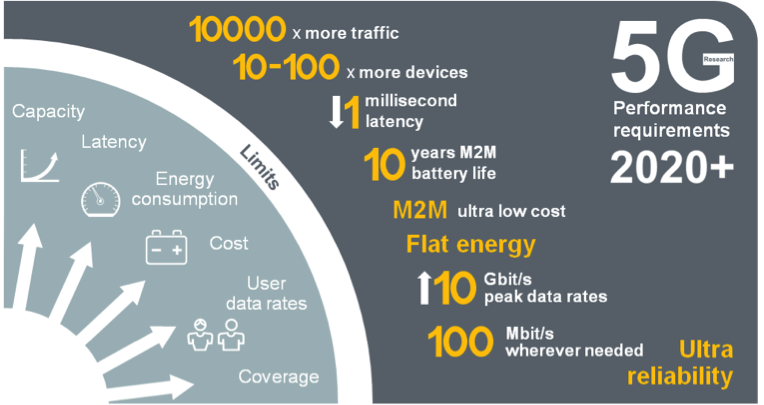
5G technology is leaps and bounds ahead of current gen networks and, many countries are already investing heavily in the technology. With 5G users can attain 100 megabit per second speed and the infrastructure can handle 1000 times more data traffic.
India is expected to initiate 5G by 2020 and Nokia equipment will play a major role in providing this technology across the country.
It will be used for purposes beyond voice and data communications carried by people today. It will has less than 1 millisecond latency that will be used by machines for quick action like for to stop in case it identifies any obstacle, surgery from remote location etc.Discussion about spectrum (at global level) in which 5G will operate will finish by 2019. Commercial 5G deployment will start in 2020. Then you will see 100 mbps guaranteed speed everywhere : Nokia Networks Head of Mobile Broadband Milivoj Vela
For India 700 Mhz and 2.6 Ghz are currently employed for Mobile Telephony, Wi-fi generally uses between 2.4 Ghz to 5.9 Ghz. With 5G networks telepresence ill get a huge boost. Although with the poor state of network in the country many users are waiting for options like Reliance JIO that promise to offer up better connectivity and cheaper pricing.
We all know that 5G is the next big thing. We are also aware that the speeds 5G promises will be massive. While many countries still try to have an established 4G network, including India, Australia is one country which wants to stay ahead of the pack. According to Vodafone, Australia will likely have 5G mobile network by 2020.
The development of the fifth-generation mobile network has invited a number of eager investors. After all, the next-gen network promises supremely fast speeds and will be the guiding factor for everything from ‘Internet of Things’ to driverless cars.
Vodafone’s Australian chief Benoit Hanssen believes Australia will be among the first countries to have 5G network by 2020. “Australia adopted the smartphone enthusiastically — smartphone penetration is one of the highest in the world,” he said. “There is a readiness to adopt new things, and you have a population that can largely afford to adopt new things. We do think that as 5G comes out, Australia will be there.”
Indeed, Australia has embraced 4G greatly with almost 70% of Vodafone customers on 4G phones. Hanssen expects the figure to cross 90% this year. 5G is all set to break speed records if the tests have anything to show for it. In 2015, British scientists claimed they broke speed records during tests of 5G data connections, reaching one terabit per second. According to the BBC, with such a speed, it “would be theoretically possible to download a file 100 times the size of a feature film in about three seconds.”
Spectrums have and continue to be the main reason behind the delay of not only 5G but 4G as well. In fact, many countries still face a lack of 3G connectivity. The release of spectrum is being negotiated globally. We wonder how long it takes before we can even begin talking about 5G in India, which is still being introduced to 4G network slowly.
Trust our species to think ahead. 4G has yet to establish itself firmly around the world and now news has reached our ears that plans on 5G mobile network is very much on. The UN said on Thursday that member countries have approved the roadmap for the development of the next generation of mobile networking – 5G.
Needless to say, 5G mobile networks will promise lightening-fast downloads and will also help bring driverless cars closer to reality. The future 5G technology will supposedly deliver data speeds up to 1,000 times faster than the current 4G network. Just when you thought such speeds were too farfetched for the present. But a lot can happen in 4 years.
UN’s 193 member countries have approved the plan and are now working on how to harmonise the development of the next-gen networks. Sanjay Acarya, spokesman for the International Telecommunication Union (ITU) told AFP that the UN agency is “looking at a 2020 timeframe” for rolling out 5G networks.
Interestingly, many countries have yet to harness the potential of 4G networks. India, too, is far behind in the 4G game. The need is to build infrastructure that can carry mobile signals quickly, consistently, and reliably so as to support split-second activities. Spectrum allocation is the biggest concern and the UN member countries will have to decide how much spectrum can be allocated for this at next month’s World Radiocommunication Conference.
It has been estimated by Boston Consulting Group earlier this year that mobile companies will need to spend $4.0 trillion on research and investments by 2020 to develop 5G.
With 4G gaining speed slowly here in India, we’re already looking at the possibility of 5G coming sooner than expected. There is no doubt that the next step to fast, wireless network is 5G. The question is how quickly that may happen. Though it is highly unlikely that 5G would be introduced by next year, it will not, however, it has not stopped smartphone makers to prepare for it.
The whole idea behind 5G comes as a ‘what can we add’ when looking at 4G. 4G connections tend to drain battery life in a flash and 5G would look to solve this by making it more energy efficient.
So far Bharati Airtel is the only operator to have launched 4G in a broad scale since it initially launched it on 10 April 2012 in Kolkata. Since then, Airtel’s 4G services have spread across the entire country.
Bharati Airtel revealed it has faced problems in Delhi due to the spectrum cap. The problem currently is the need for more spectrum. The operators in India need more spectrum to improve quality of not only internet services but to also reduce ‘call drops’. This is a deficiency which can only be fixed by the Indian Government and TRAI.
The recent spectrum auction held in March saw Bharti Airtel, Vodafone India, Idea Cellular, Reliance Communications and Reliance Jio Infocomm as the big winners, with Bharati Airtel and Reliance Jio already planning big launches of LTE using 1800 MHz as the primary band. However, limited spectrum is slowing the growth of 4G. This will also delay 5G services in India, whenever it does begin to roll out.
Faster 5G network, that will boost internet speed exceptionally, is going to be a reality much sooner than expected. Well, the 5G internet network speed that was anticipated to launch until 2020 will now arrive two years before, in 2018.
The International Telecommunication Union (ITU), United Nations agency for Information and Communications Technologies, made public the speed to be offered with 5G. They also announced that the first demo of its blazing fast internet speed will be done at the 2018 Winter Olympics in Pyeongchang, South Korea.
As reported by online daily The Korean Times, the transmit speed of 5G will be up to 20 GB per second, while is presently 150MB per second maximum with 4G speed. The purposed 5G enables users to download 20HD movies within seconds.
The report reads –
The 5G network will also have capacity to provide more than 100 megabits-per-second average data transmission to over one million Internet of Things devices within 1 square kilometer.
The United Nations agency will start accepting technologies suitable for the 5G standard before its commercialization plan in 2020. There is still a lot of time for 5G network to become a reality, and to become a standard all around the world, it will take another couple of years.
India has been stuck in the internet revolution for many a years. And while the country is progressing at a rapid speed, infrastructure is not growing fast enough. With new businesses sprouting each day, the need for a connected economy has increased considerably.
India’s Massive Market
India is one of the largest consumers of mobile phones in the world. Enough so, that many manufacturers have put India in the first list of launch countries. According to the TRAI Performance Indicator Report, India has 414.18 million wireless GSM connected users as of March 2015. But this is just in the rural sector, the all India number is at 705.21 928 Million according to the COAI report of May 2015 and Others report of Dec 2014. This number also receives staggering growth of 2.5% month on month in the Rural sector and a growth of 0.90% month on month nationwide.
What appears to be a small growth percentage, 2.5% growth means that the industry is adding approximately 10.2 million rural subscribers a month at the current trend. This additional user base earns the industry approximately Rs. 1200 crore each quarter. This large number is only a dip in an industry that moved around Rs. 26781 crore in revenue in Q4 2014.
The large revenue for the telecom operators is driven largely by the large number of users and large user base additions each month. But how much has the industry progressed since the begining of the internet age.
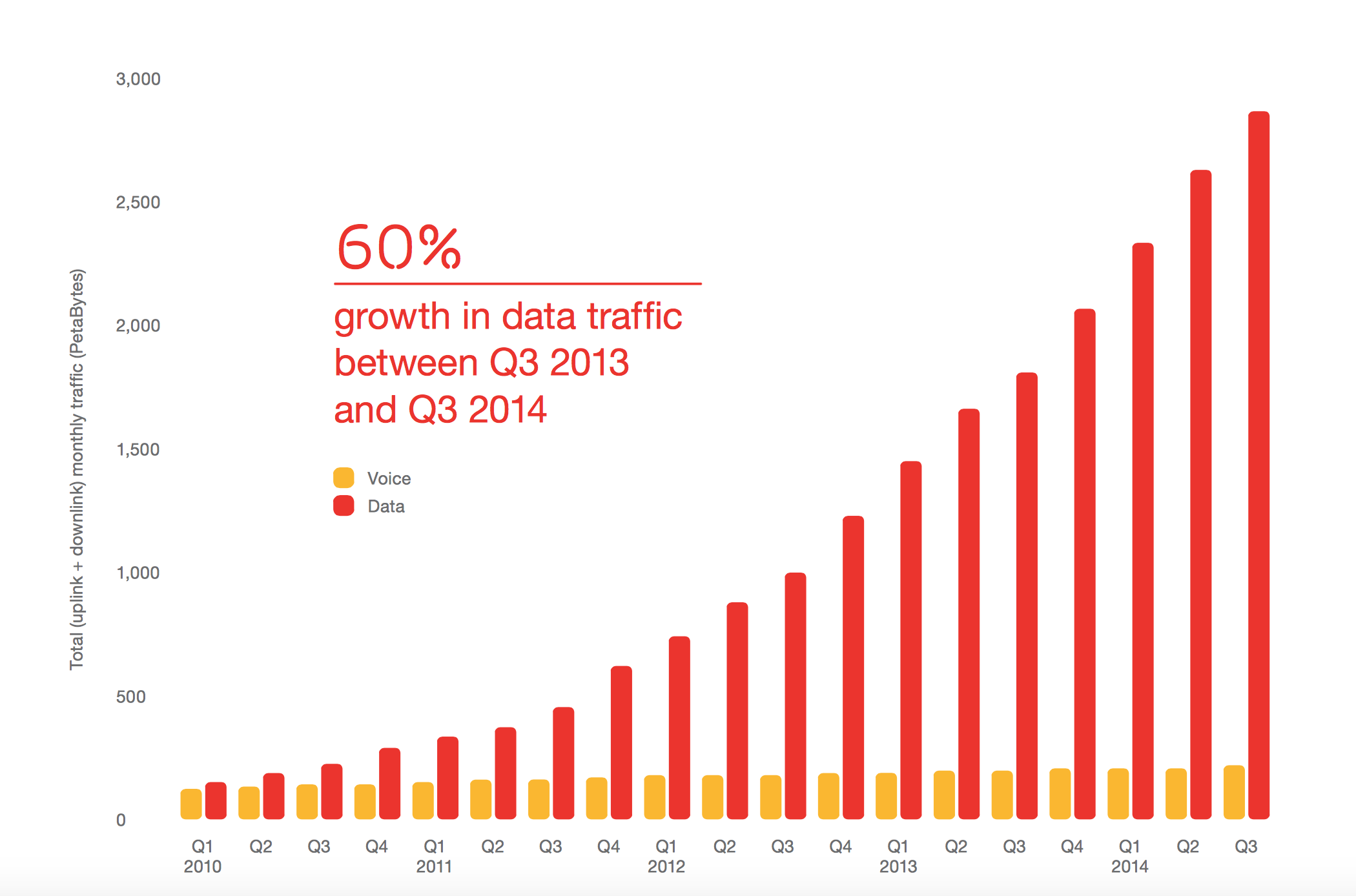
[pullquote_left] By the End of 2014 the World was Consuming 3000 PetaBytes of Data [/pullquote_left]
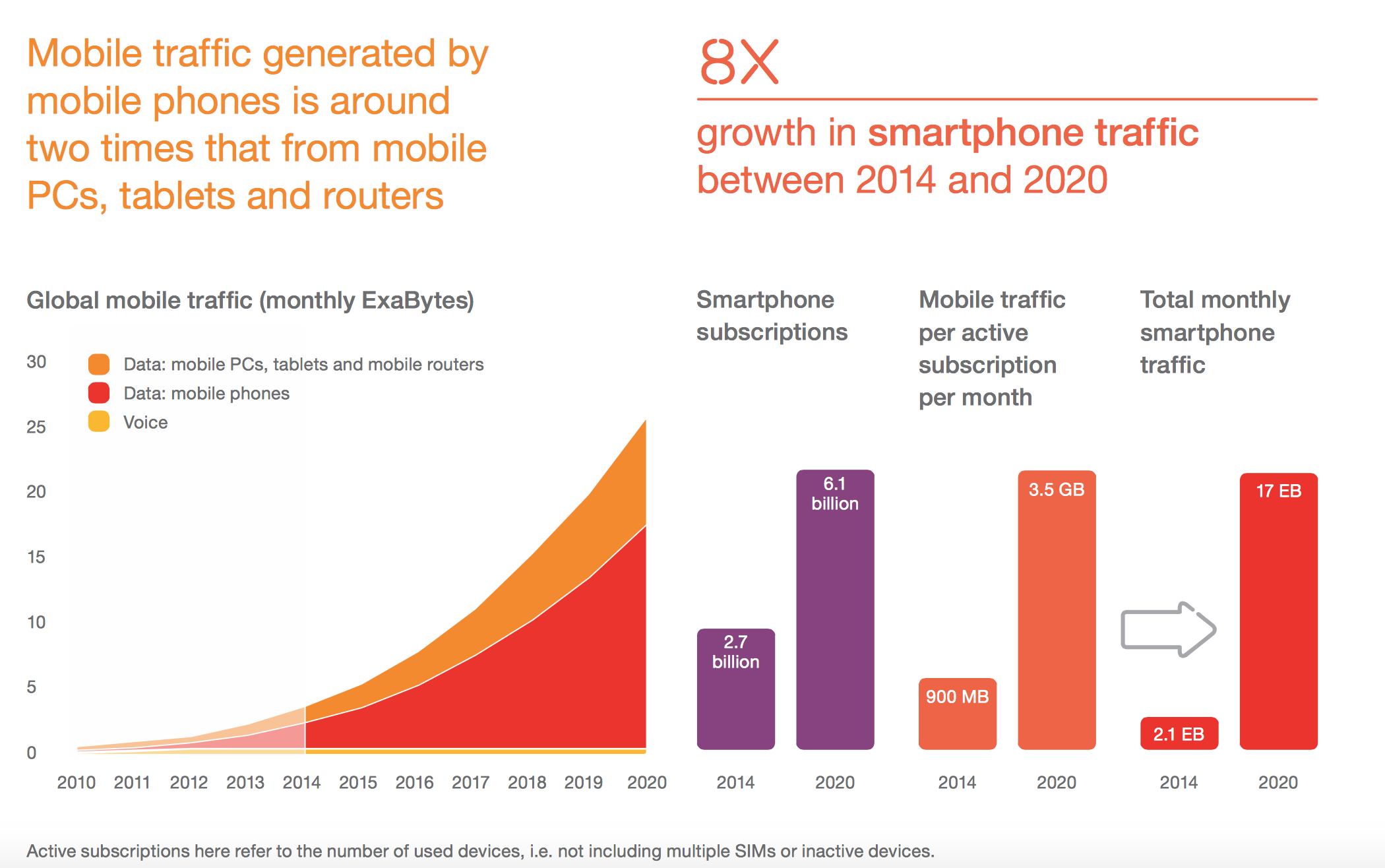
Global consumption of mobile data is through the roof. By Q4 2010 the world was only getting acquainted to mobile data and consumption of data on a portable phone was at 400 PetaBytes (mobile data traffic Up+Down). However, by the end of 2014 the world was consuming 3000 PetaBytes of Data. The industry estimates that the growth with continue by 60-70% each month.
Global Launch Trends
HSPA 42 Mbps networks have been commercially launched in 86 countries, while LTE networks have been commercially launched in 112 countries. So far, 40 LTE TDD networks have been made commercially available in 27 countries, with 27 operators launching LTE services using only the TDD mode, and 13 deploying both TDD and FDD modes together. 6 In a mixed LTE FDD/TDD network, the use of FDD for the uplink can improve the effective coverage area of the TDD band, and can also make TDD more efficient on the downlink.
On the other side mobile operators in 75 countries have now launched HD voice commercially. VoLTE or “voice on LTE” provides users with telecom-grade HD voice, video calling and other new, richer communication services on LTE smartphones.
State of Indian Networks
Despite all the launches mentioned above, India remains as a part of none of them. While India contributes to a large percentage of global mobile data usage, it all somehow comes from poor data connections.
It is estimated that if connection quality and speeds were to improve in India, the present data consumption would increase by 400%. A number that the industry should play close attention to. Over 60% of the data consumption in India was mobile data by the end of 2014.
Mobile Data Drivers
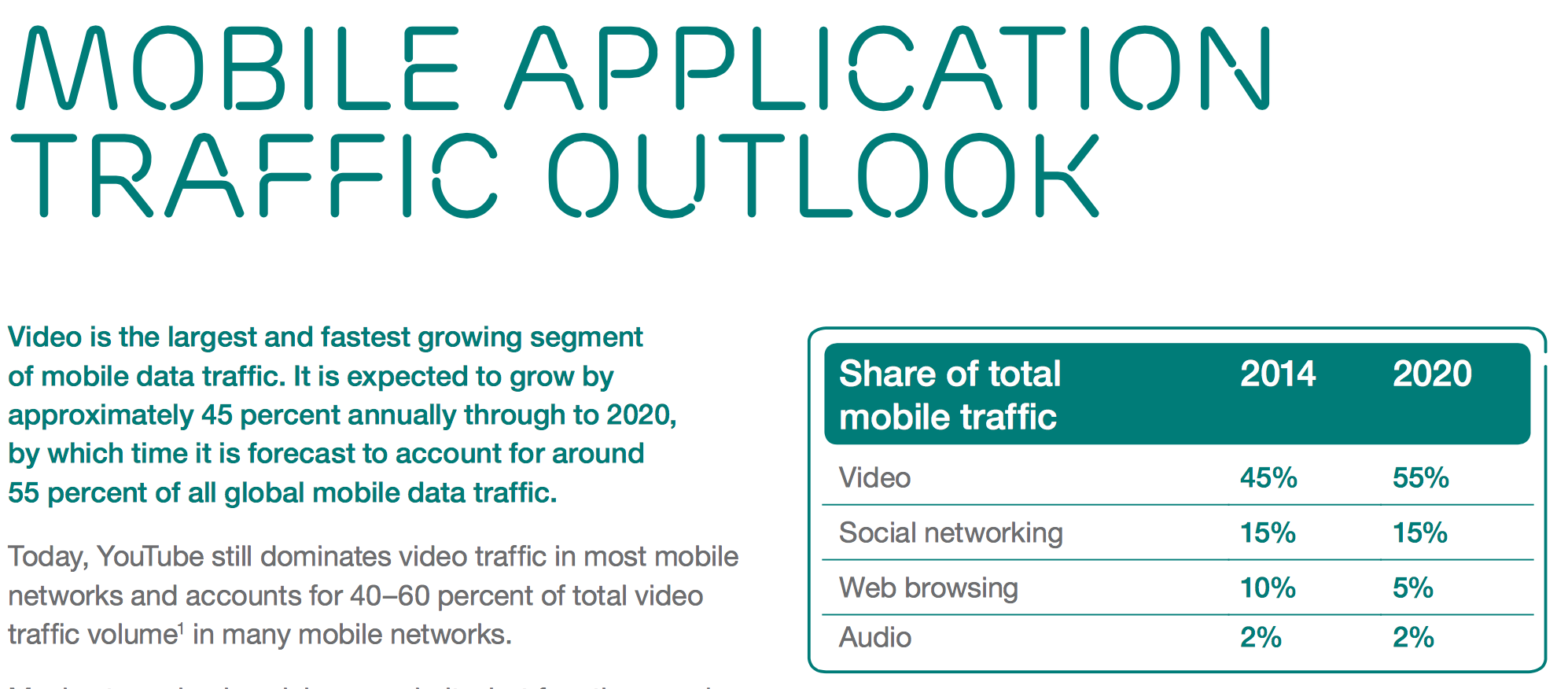
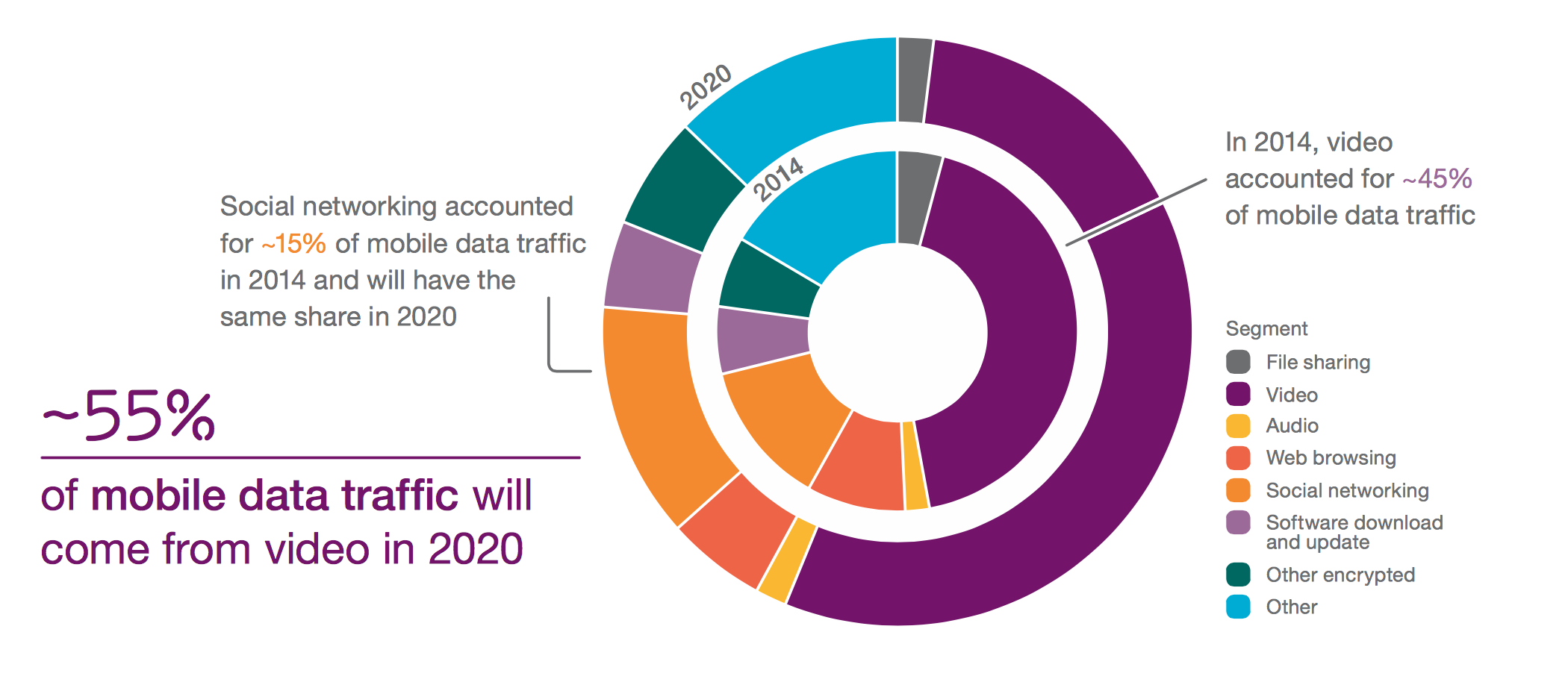
Out of the total mobile data consumed in India, 45% comes from video playback from websites like YouTube. A large chunk of music streaming services are also responsible for driving mobile data in the country.
Mobile Data Usage
[pullquote_left]55% of mobile data will be consumed for Video services[/pullquote_left]
Globally, YouTube is responsible for consumption of 40-60% of mobile data, a number which is relatively lower at 17% in India due to mobile data connectivity and speed limitations.
It is estimated that by the year 2020, 55% of mobile data will be consumed for Video services. Reaching this percentage will be possible by the implementation of 5G mobile data globally. 5G services are being tested in over 8 countries as we read this, while implementation for global markets is kept at 2019. India (and some other markets) are not a part of this implementation list.
India is about 5 years behind the 4G rollout targets (Dec 2010) and 2 years behind LTE 2.0. HD Voice and Video are not being talked about by the Indian industry leaders, despite the fact that India is one of the largest contributors to the overall revenue for the mobile industry.
Data and Future
India needs fast internet access, as a developing nation, its metropolitan cities need to be connected to the world. With a boom in startup culture and high paying jobs with international markets, most suffer due to lack of internet access. Video consumption and video calling with services like Skype, Google Hangouts and even FaceTime are at an all time high and consumers end up paying large sums of money just to say connected.
[pullquote_right]FUP has slowed down growth[/pullquote_right]
The biggest limiting factor in the whole telecom industry is the limited usage policies implemented by the companies. The limited usage policy or fair usage policy (FUP) was first implemented by Airtel and Tata Teleservices to prevent users for exploiting their internet connection speeds and downloading illegal materials from the internet.
The FUP has since not been removed and with no pressure from TRAI (Telecom Regulatory Authority of India) this antiquated method continues to haunt each user.
Airtel is one of the biggest users of this aged method of policing the usage of high speed data and is also one who exploits its use the most to benefit in the long run. Airtel has annoying auto redirects (Smart Bytes) that transfer you to a buy page insisting that you buy additional data packs to continue on the fast speed. These packs are usually 4-5 times the cost of the bundled data and tend to really hurt consumers financially.
The world is getting connected, using a highway of data which is not only fast but also super efficient and budget friendly.
However, we are no where near that future. Most operators globally offer the ability to choose a plan that suits the customers needs. The United States and countries like United Kingdom, Australia, South Korea, Japan, New Zealand, Spain, Canada and many others are not familiar with the term FUP. In fact, any form of throttling is against the law in many of these countries. Terming the so called limiting plans as “marketing gimmicks” countries have ensured that the consumer gets what he pays for, no more and especially no less.
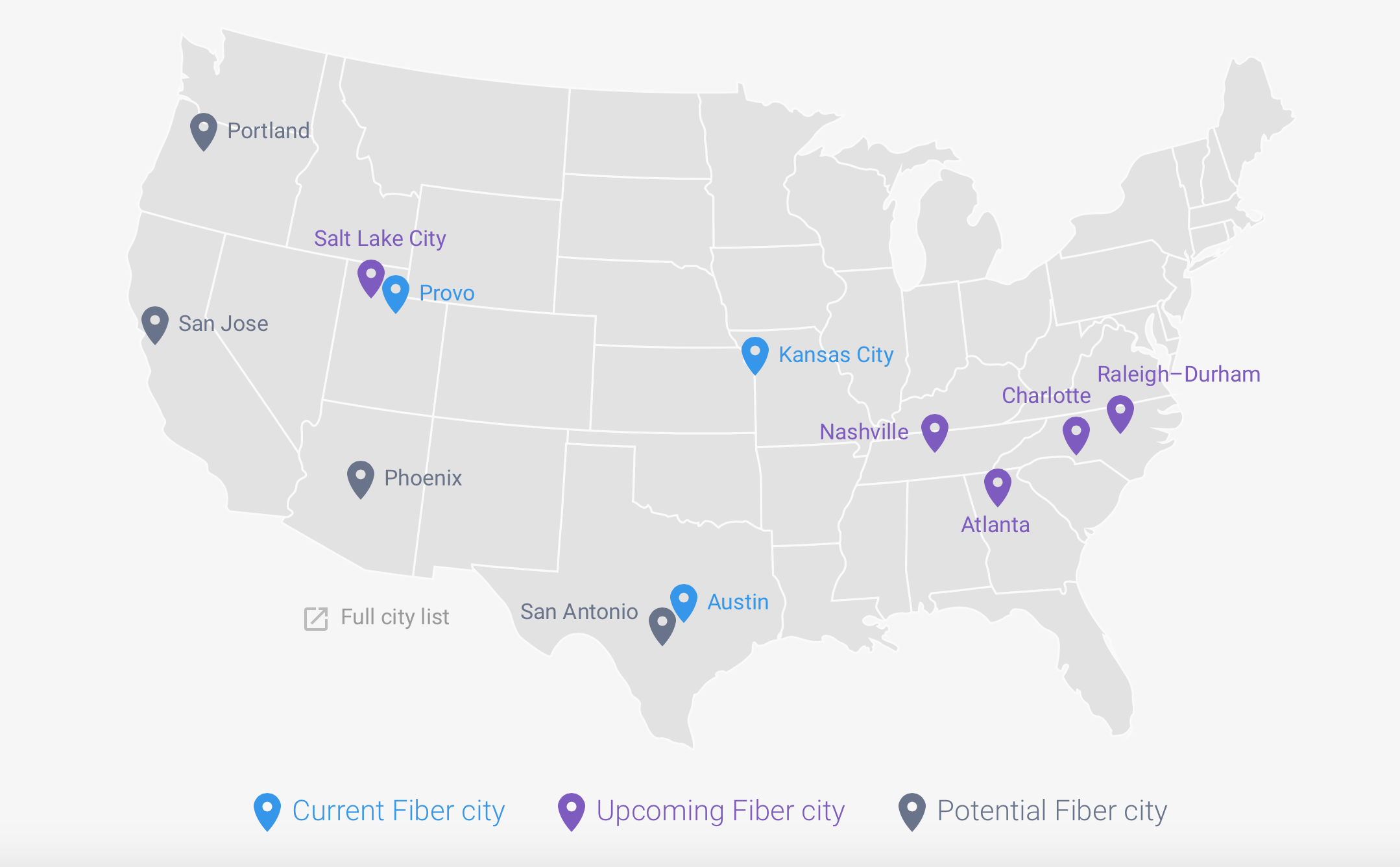
Google Fibre Deployment Map
Then there are packages from the likes of Google Fibre limited in reach and availability, Google has made possible speeds of upto 1000 Mbps for as little as US $ 70/month (chump change compared to what iGyaan spends for Internet) available at residences across the United States. They also offer a “Basic Plan” which is at 5 Mbps downloads and 1 Mbps uploads (unlimited) for a price of US $0 if you pay the installation fee. Free Internet! If that does not help the startup economy, then what else will?
Something needs to change
India and Indians deserve the ability to get unlimited internet, the users seem to be paying for it, but nobody seems to be getting it. Riddled by hidden corporate talk and contracts that fool the customers into believing that they are getting the best possible deal. Everybody has the right to stay connected, and a fast internet connection is more like a lifeline today.
Many sectors in the country do offer high speed data connections for a higher price. However, these too are controlled by limits, and speed drops are often too high. A 100 Mbps connection from Airtel Fibrenet drops to a mere 512 Kbps post a 100GB download. A simple math calculation will tell you that it takes just 2 Hours, 23 Minutes and 9.93 Seconds to download 100 GB on such a connection. Post the download you either have to pay heavy sums of money to get data packs or live with a devastatingly slow 512 Kbps which would take 19 Days, 10 Hours, 2 Minutes and 1.6 Seconds to download the same 100 GB. Airtel charges INR 5,999 + tax for this plan , making it well over US $100. Now compare this to Google’s 1000 Mbps line with no limits whatsoever, which costs US $ 70 /month.
Something needs to change and fast! Sign our petition below and be part of the voice of change. #StopFUP #EndFUP