Tag: device

  • MapmyIndia introduces 3G, Android enabled CarPad 5

    MapmyIndia introduces 3G, Android enabled CarPad 5


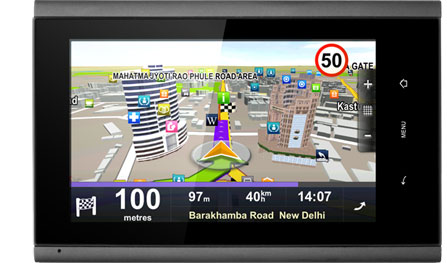
    MapmyIndia, provider of digital maps, navigation and location-based services, has launched CarPad 5, a connected car product. Built on Android OS, CarPad 5 is an all-In-One GPS Navigator, Smart Phone and 3G Tablet. It 5 runs on a 1GHz Samsung processor (Cortex A8, S5PV210) and features a 5 inch capacitive touch screen. It is priced at Rs 19,990 and contains the CarPad windshield mount and Car charger.

    The navigation device has built-in 3G & Wi-Fi and comes preloaded with Aura, MapmyIndia’s fully 3D and connected GPS navigation interface.

    Rakesh Verma, managing director at MapmyIndia said that the CarPad 5 is one of the many in-car productivity gadgets they plan to launch in the near future.

    The company claims Aura maps offers real-time traffic updates, house level search, security (track and trace) and discount offers in the vicinity. It covers over 6.3 million places, 5,79,000 towns and villages, 4000 cities at street-level, house-level data for 36 cities and 3D landmarks and building footprints for 34 major cities. 

    The navigation device is 3G enabled and allows users to call, message, mail and chat, search and browse the web at high speed, and access social networks.

  • Samsung Launches GALAXY Beam Projector Phone For Rs 30,000

    Samsung Launches GALAXY Beam Projector Phone For Rs 30,000

    Whoops! Something went wrong!
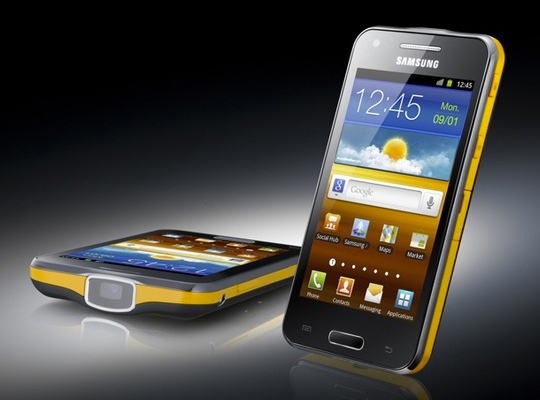
    Samsung Electronics today announced the launch of Samsung Galaxy Beam projector smartphone in India, priced at INR 30,000. The smartphone will enable the users to display and share multimedia content anywhere on a large luminous projector screen or on a clear wall or surface.

    The Beam is said to house a 15 lumen bright lamp that is capable of projecting a high definition 50″ wide image at a distance of 2 meters. It comes with a 4″ WVGA multi-touch capacitive LCD screen, and is powered by a 1 GHz dual-core CPU. Weighing in at 145 grammes, this phone is just 12.5 mm (0.5″) thick, with the rest of the dimensions being 123.9 mm (l) x 64.2 mm (w).

    Other specs include a 5 MP snapper capable of 720p video capture, a front 1.3 mp camera for video chat, and 8 GB of internal storage that’s expandable up to 32 GB via microSD. According to the spec sheet, a pair of 2000 mAh battery packs offer up to 20 hours of talktime. However, it’s wise to take this claim with a pinch of salt, as the figure seems a little too far-fetched to be true. In addition to a wide range of apps available through Google Play, the smartphone comes bundled with a drawing tool for presentations, which is touted to aid in drawing viewers’ attention without the need for a laser pointer.

    However, we feel that the phone might not be able to outshine its competitors based on its Projector feature alone. 

  • Windows Phone 7.5 SMS bug found, requires a Hard Reset to fix

    Windows Phone 7.5 SMS bug found, requires a Hard Reset to fix

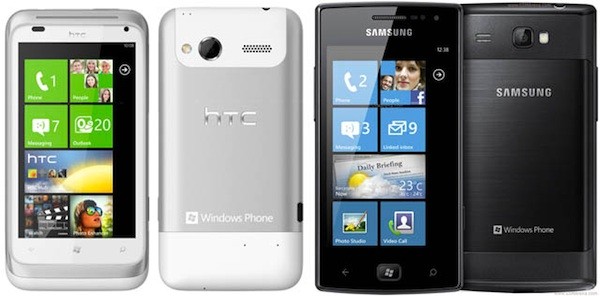
    A new SMS bug has been found in the Windows Phone 7.5 devices, WP devices that receive a text containing a certain string of characters will reboot and return with a non-functional messaging client which can only be restored via a hard reset. The bug does not affect any particular device, but the OS. The funny bit is that the same bug message could be received via Facebook messenger or MSN messenger.

    Android and iOS have had their fair list of SMS bugs, But never one that disables the messaging interface all-together.

  • Solar Powered Smartphones Without Solar Panels – Coming Soon

    Solar Powered Smartphones Without Solar Panels – Coming Soon

    In a very interesting development, researchers from the UCLA Henry Samueli School of Engineering and Applied Sciences, have created an LCD screen which can charge its own batteries from any ambient light source such as the sun, an incandescent bulb and even its own backlight!

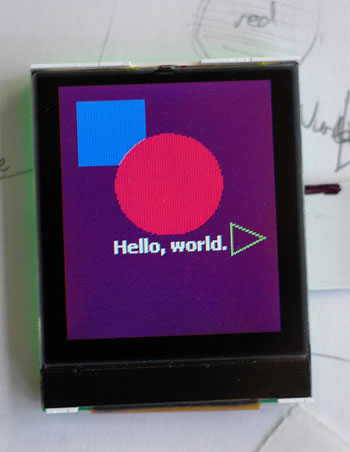
    We took a look a little while ago at How Modern LCDs Work. As you might remember, each LCD has a polarizing sheet that controls the amount of light that passes through any given pixel. These polarizers are very inefficient, and waste most of the absorbed energy. With this new development however, the standard polarizers have been replaced by a polarized sheet made with organic photovoltaics. These photovoltaics convert any absorbed energy, into electricity, thereby increasing the battery life of any device that it is used in.

    The researchers say that they are speaking to manufacturers so that this technology may be incorporated into future products.

  • 3-in-1 Computer – Gigabyte’s Booktop

    3-in-1 Computer – Gigabyte’s Booktop

    With the earliest models debuted last fall, Gigabyte has just officially announced at Computex 2011 the  Booktop T1125P 3-in-1 computer: a laptop whose rotating screen can convert the machine into a tablet-like device, and which when docked into a special station can be used in a desktop configuration.

    On the T1125P, is a 11.6-inch capacitive multi-touch display that is fixed to a 180-degree hinge, which lets the laptop be closed with the screen facing outward for use as a tablet. The device itself contains a USB 3.0 and HDMI ports, as well as two dual-channel stereo speakers and two woofers. an ultra low voltage intel core i5/i3 processor plus Nvidia GPU with 1GB dedicated visual RAM translates to a responsive, high-quality multimedia experience. a built/in 3.5G modem facilitates mobile internet connectivity, while the docking station features a DVD drive. when docked (which is necessarily in the vertical position), the device in addition to charging can be used for processing power and as a second screen to an external monitor.

    Gigabyte also announced the Booktop M2432 which features a 14 inch backlit LCD and has a Core i3/i5 sandy-bridge processor. This allows the device to function as a laptop or a desktop when docked, but not as a tablet. The dock contains an in-built Nvidia GPU.

  • Liquid Robotics to Launch Wave Gliders to collect Oceanographic Data

    Liquid Robotics to Launch Wave Gliders to collect Oceanographic Data

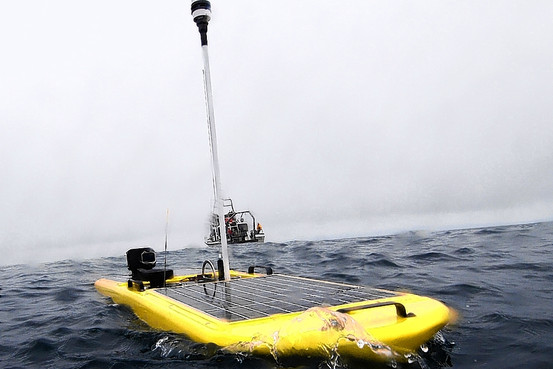
    Liquid Robotics, a Silicon Valley startup, makes remote controlled robots that cruise the open ocean and gather data. The company plans to collect this data and offer it up to consumers on the web. The machines, called Wave Gliders, can keep track of all sorts of data including whale songs, wave heights and the presence of nearby ships. The company plans to sell these robots to governments, research institutions and energy companies for between $1,50,000 and $5,00,000 a piece depending on the included components.

    The wave glider features a 6-foot, 10-inch-long floating section equipped with solar panels, a battery and sensors. Tethered 23 feet below the float in the water is a similarly sized glider with metal wings and a rudder that propel and steer the device.

    The inventor of the device, Robert Hine, originally made the device for a friend who wished to study whale songs off the coast of Hawaii. He started designing and fabricating the machines in 2005, taking every other week off from his job as a semiconductor engineer. He experimented with different Electric Engine designs, but they all failed. After much research, he came up with a design that harnesses the natural energy in waves, like a sailboat harnesses the wind.

    The gliders ‘wings’ use the up and down motion of the waves to propel the device forward at a pace of around 1.5 miles per hour. Operators are able to map out a route and have waypoints transmitted to the robot via satellite. It then uses GPS signals to follow the programmed route. The robot is unable to remain still but can criss-cross the same area.

    Because the gliders are essentially floating platforms that can be programmed to go anywhere, there are many possible uses. They can measure ocean and air temperature to help predict storms and water currents and wave height for shippers trying to determine the safest route for their vessels. They also can help oceanographers monitor whales and other aquatic life. In crowded areas like the Gulf of Mexico, gliders could collect location, speed and destination information for ships—information that now is sent through radio signals—and display the information on a map. There are less obvious uses as well. Mr. Vass imagines equipping gliders with cellular towers to provide coverage in the middle of oceans. Also, gliders could be programmed to dispense fish food, creating fish farms that move around at sea.

    Liquid Robotics isn’t the only company that makes unmanned sea vehicles for data collection. iRobot Corp., creator of the Roomba vacuum cleaner, makes a glider that collects information up to 3,000 feet under water, surfacing from time to time to transmit its findings and collect new instructions. The Slocum glider from Teledyne Technologies Inc. works in a similar way. Both gliders can collect information from far deeper in the ocean than the one from Liquid Robotics, but aren’t able to transmit data continuously.
  • Video Chat Coming to Android 2.3.4

    Video Chat Coming to Android 2.3.4

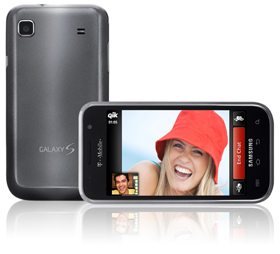
    Looks like a bunch of Rumors floating around the web including a tweet which talks about the Nexus S – Video Chat on Gingerbread 2.3.4.

    What this means is that all Android Devices with front facing cameras and the latest version of Gingerbread will be Able to use it to Video Chat amongst other with similar availabilities.

iGyaan Network
Privacy Overview

This website uses cookies so that we can provide you with the best user experience possible. Cookie information is stored in your browser and performs functions such as recognising you when you return to our website and helping our team to understand which sections of the website you find most interesting and useful.