Tag: power

  • Apple Wants to Sell its Surplus Clean Energy

    Apple Wants to Sell its Surplus Clean Energy

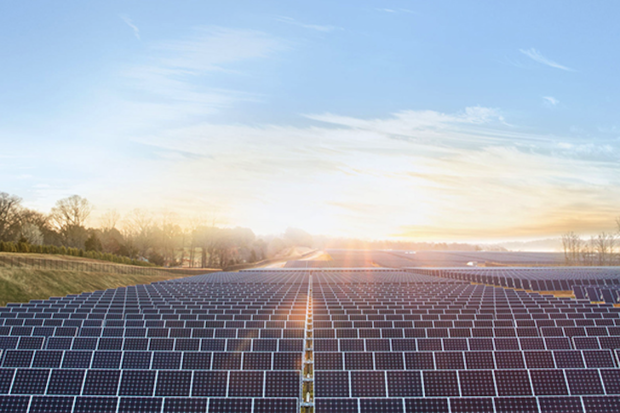
    Apple’s investments in the hundreds of megawatts of solar projects for powering its server farms and offices is apparently generating more electricity than the company can use. Apple has set up a new business called Apple Energy with the Federal Energy Regulatory Commission to sell power on wholesale markets.

    Apple has announced its plans for significant investments in solar projects throughout the US, and this will only help generate more electricity for the energy company.

    apple solar

    Apple claims that they generate enough electricity to recover 93% of its usage worldwide. The company also has investments in hydroelectric, biogas, and geothermal power, will buy green energy from the grid when and if needed.

    Apple may not be looking to convert this into its main business and call it iPower, however, it seems that they can sell back to the grid and get rid of any surplus they may not need. Apple had earlier this year shown $ 1.5 Billion in green investments, and major initiatives to improve recycling and impact on the planet.

  • Micromax launches X259, powered by Solar Energy

    Micromax launches X259, powered by Solar Energy


    Micromax has announced the launch of X259 handset, which comes with a built-in solar panel. Priced at Rs. 2,499, it is the first solar phone from the company.

    The built-in solar panel allows the phone to get automatically charged when exposed to sunlight. It is targeted to rural consumers, who constantly grapple with power cuts over long durations. According to the company, three hours of solar charge provides 1.5 hours of talk time on the phone.

    It features a 2.4-inch QVGA screen with a resolution of 240x320p, a VGA camera, a 1000mAh Li-ion battery and dual-SIM dual-standby feature. The handset also supports Bluetooth and GPRS connectivity.

    [quote]”We have been at the forefront of innovation. We have introduced many categories into this competitive Industry be it long battery life phones or dual SIM phones. With the introduction of this our intent is to get rid of the mobile phone charger by including a solar panel on the device itself,” stated Rahul Sharma, co-founder, Micromax.[/quote]

    [toggle_box title=”Press Release” width=”Width of toggle box”]

    Go Green with the Micromax X259 SOLAR PHONE 
     
    ?     Micromax X259 comes with solar cells which can be charged through solar energy
    ?     3 hours of solar charge provides 1.5 hours of talk time
     
     
    Text Box: Key features of X259</p><br />
<p>ü	Solar Panel technology<br /><br />
ü	2.4” QVGA screen<br /><br />
ü	VGA Camera<br /><br />
ü	240X320 screen resolution<br /><br />
ü	1000mAh battery<br /><br />
ü	Dual SIM Dual Standby<br /><br />
ü	Mi-Zone<br /><br />
ü	M- Store<br /><br />
ü	GPRS & Bluetooth connectivity<br /><br />
New Delhi, July 12th, 2012: Micromax Informatics Limited (“Micromax”)the 12th largest handset manufacturer in the World (According to Global Handset Vendor Market share report from Strategy Analytics) today announced the launch of X259, with a built-in solar panel.

    Micromax has always been recognized for its innovation in its device portfolio and has created categories such as marathon battery life phones, dual SIM Phones, Life Style phone and many more. Micromax adds yet another category to its offering of unique devices. The Micromax X259 Solar Phone priced at Rs. 2499/-, it is the company’s first solar phone which enables the users to charge their phone using solar energy.

    Micromax X259 comes with a solar panel technology through which the phone automatically gets charged through solar power on exposure to sunlight. With unpredictable power cuts specifically in the rural areas this handset will be the perfect solution to address the issue of recharging the phone through electricity.

    Commenting on the device launch, Mr. Rahul Sharma, Co – Founder, Micromax said, “We have been at the forefront of innovation. We have introduced many categories into this competitive Industry be it long battery life phones or dual SIM phones. With the introduction of this our intent is to get rid of the mobile phone charger by including a solar panel on the device itself”.

    Micromax X259 features a 2.4” QVGA screen with a resolution of 240X320. The phone is powered with a 1000mAh Li-ion battery and facilitates dual SIM dual standby feature. The users can share images, videos, music with friends through the phone’s Bluetooth connectivity.

    Micromax X259 is available at Rs. 2499/- This model will be available across all leading retail outlets across India.  
     
    For more information, please visit www.micromaxinfo.com
     
    About Micromax:
    Micromax is the 12th largest handset manufacturer in the World (According to Global Handset Vendor Market share report from Strategy Analytics). The Indian brand is reaching out to the global frontier with innovative products that challenge the status quo that Innovation comes with a priceMicromax has sales presence across India and global presence in Hong Kong, Bangladesh, Nepal, Sri-Lanka, Maldives, UAE, Kingdom of Saudi Arabia, Kuwait, Qatar, Oman, Afghanistan and Brazil.
     
    * Micromax holds the 3rd position amongst the handset manufacturers in India as pre revenue with a market share of 6.9% for the FY 2011. (Source: V&D report)
     

    [/toggle_box]

  • Researchers use Virus’s traits to create electricity from motion

    Researchers at Berkeley Labs have now coated electrodes with modified M13 bacteriophage, a harmless bacteria-eating virus, to create the first ever organic piezoelectric material which can convert force to electricity.

    The researchers also said that the option is a lot environment friendly as the material is non-toxic, organizes naturally into thin layers and self-regenerates, giving it a possible advantage over chemical options.

    By attaching thin layers to, for example, shoes one would be able to charge devices on the go, by sending cables up to pockets. Lets hope there isn’t an electrical leak, else some privates may get electrocuted.

  • The Wind Cube – A Modular Green Power System

    The Wind Cube – A Modular Green Power System

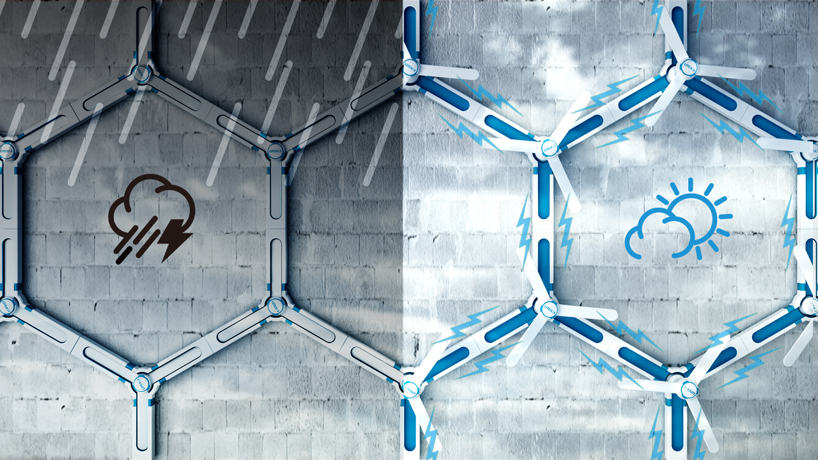
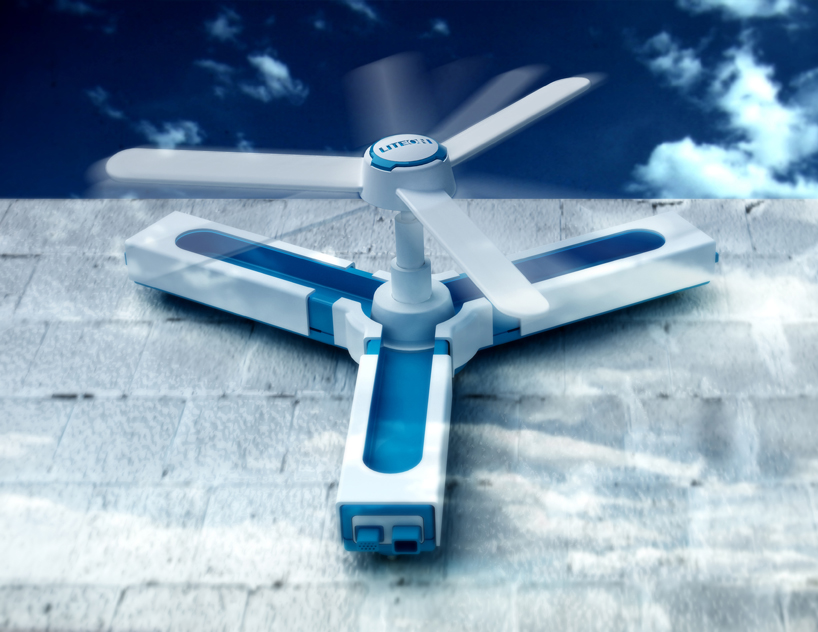
    The Wind Cube is a modular green energy power system that has been designed by Chen Liao Hsun for urban household use. “The concept,”he says, “is to use three-dimensional wind fields to make up for the insufficiency of two-dimensional ones.” Each individual unit can produce around 100 W of electricity which translates into an estimated 21.6 KWh a month. For an average family of 4 members, a total of 15 Wind Cube units would be enough to take them off the grid.


    This concept provides many advantages over traditional windmills. Each unit is designed to fit into adjacent units to form a hexagonal honey-comb structure which is very sturdy. Each unit is also designed with telescopic blades which can be pulled out when a gentle breeze is blowing and can be retracted during rough and stormy weather. In terms of installation, the units have been designed so that they plug into each other to automatically form a circuit and they have a three step installation process.


    While the real life efficiency of these devices is yet to be tested, it just might turn out that the honey-comb structure would be strong enough to set these up as a fence. This would perhaps increase the efficiency of these devices by providing them with an advantage in terms of wind speeds as compared to units that are installed against a wall.


  • Solar Powered Smartphones Without Solar Panels – Coming Soon

    Solar Powered Smartphones Without Solar Panels – Coming Soon

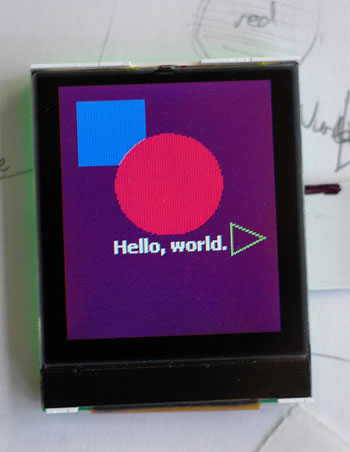
    In a very interesting development, researchers from the UCLA Henry Samueli School of Engineering and Applied Sciences, have created an LCD screen which can charge its own batteries from any ambient light source such as the sun, an incandescent bulb and even its own backlight!

    We took a look a little while ago at How Modern LCDs Work. As you might remember, each LCD has a polarizing sheet that controls the amount of light that passes through any given pixel. These polarizers are very inefficient, and waste most of the absorbed energy. With this new development however, the standard polarizers have been replaced by a polarized sheet made with organic photovoltaics. These photovoltaics convert any absorbed energy, into electricity, thereby increasing the battery life of any device that it is used in.

    The researchers say that they are speaking to manufacturers so that this technology may be incorporated into future products.

  • Traveling Wave Reactors – The New Nuclear Power Source

    Traveling Wave Reactors – The New Nuclear Power Source

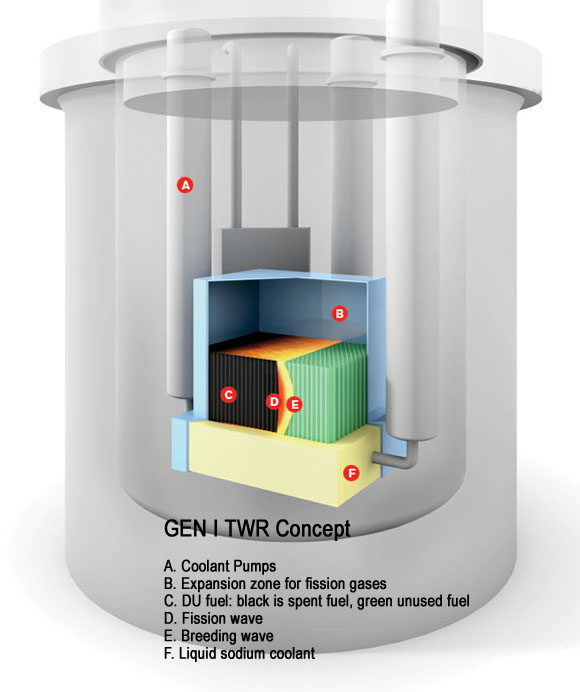
    Conventional nuclear reactors use Uranium 235 as their power source. However, out of all the Uranium that we dig up, only about 1% is U-235 while the rest is composed of, its not so reactive cousin, U-238. So what can we do with this U-238? Well according to some new research, we can now use U-238 as a fuel to power a new generation of nuclear reactors.

    Bill Gates has funded a new startup called Terrapower which is attempting to build the first prototype of a new type of nuclear reactor called a traveling wave reactor. this reactor will be using uranium 238 as a fuel source. How this will work is that a bunch of uranium 238 rods will be placed around a rod of uranium 235. This rod of U235 will kickstart the entire process. The uranium 238 gets converted into plutonium 239. This will generate heat and keep the entire reaction going, and as it propagates outwards from the center in a kind of wave, more rods of U-238 can be added to keep it going. Once the fuel gets used up, it can be used to kickstart a new reaction.

    What this basically means is that you can burn the expensive fuel, you can burn the cheap fuel, you can burn the waste from other nuclear reactors and generate electricity from the whole thing. If we start extracting Uranium from sea water, which is apparently easy to do, we can provide enough electricity to power the entire human race without any problems for thousands of years.

  • Printable Antenna Generates Electricity from Out of the Blue

    Printable Antenna Generates Electricity from Out of the Blue

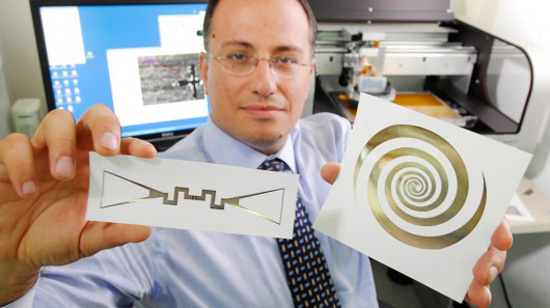
    WiFi networks, Cellphone and Radio Signals. These are just a few of the waves that are spamming the Electro Magnetic Spectrum around you most of the time. You can harvest this energy for more than its intended use. With printable antennas, you can power battery free electronics in most urban environments.

    Since this technology is still in its infancy and generates only a few milliwatts, so don’t expect it to power your cellphone or laptop anytime soon. What this technology is good for is powering networks of sensors in locations that don’t have electrical outlets, batteries or access to solar power. This could be a temperature sensor placed in the wall of your home, or a sensor built into the body of your car to check for structural damage. These sensors could also be teamed up with capacitors to collect power and send short bursts of wireless data to a receiver nearby.

    Theoretically, the amount of electricity generated could be increased in two ways. The first way would involve stacking these antennas one on top of the other and the second way would be to increase the surface area of each antenna. Combined, perhaps we could have a self charging battery or phone in the near future. We can only hope…

  • How to Shut Down a Nuclear Reactor

    How to Shut Down a Nuclear Reactor

    At the Torness nuclear power station in East Lothian, UK, seawater is taken in and filtered before it is used to cool down the reactor cores. It is not unusual for these inlets to be clogged with debris from the ocean, mainly seaweed and jellyfish. But on the 28th of June, the power plant faced a highly unusual situation.

    Clouds of jellyfish seemed to be pulled towards the plant and clogged its intake filters. This reduced the flow of cool seawater to the reactor cores. At first the plant engineers tried to reduce the load on the cores to reduce the amount of water required to cool them, but that was not sufficient and the cores had to eventually be shut down. Local fishermen were employed by the plant in the effort to clear up the jellyfish. They also used spotter planes to identify the large swarms or blooms of the sea creatures out in the open ocean. Large industrial vacuum cleaners (mounted on trucks) were also used to clear the water of any jellyfish that made it past the intake filters.

    The incident has been picked up by environmentalists to prove the unreliability of nuclear power, however the plant bosses claim that the public was never in any danger. The plant is regularly taken offline to ensure that its in good working order and this incident was no different. One of the plants cores was brought back online today while the other core is still being serviced.

    Why the jellyfish decided to make the sudden migration to the plant’s intake filters remains a mystery to experts and has stumped locals. So how many jellyfish did they end up catching? Over 600 tons!

  • Bio-Energy Plants to be setup in Himachal

    The Himachal Pradesh Government is ready to setup Bio Energy Power Plants ranging from 100 KW to 1 MW in capacity. The plants would be using a variety of grass called the Congress Grass and Pine Needles as fuel. These plants are causing trouble for farmers in the state but can now be put to good use generating electricity. The state has the potential to generate upto 418 MW of electricity from a number of these Power Plants.

  • Flywheel Batteries to replace Chemical Ones

    Flywheel Batteries to replace Chemical Ones


    A flywheel battery is a system that stores electricity in the form of kinetic energy, in a mechanism that has a wheel that spins at tens of thousands of RPM. The batteries are made of carbon fiber and levitated in a vacuum using magnetic bearings. Carbon fibre is perfect for this application as it’s very strong and lightweight; it doesn’t take a lot of energy to keep it spinning.

    Flywheels are better than batteries in many applications. They can absorb and release power very very quickly, they don’t need much in the way of maintenance, and, most importantly, the amount of storage that they provide doesn’t degrade over time like chemical batteries do. They tend to be bulky, and the gyroscopic effect of a big spinning thingy means that they can be tricky to integrate into anything that moves, but for stationary power storage applications, flywheels could be the way to go for the future.

    It’s pretty easy to understand the basic method of operation of a flywheel. It’s really just a big wheel hooked up to a generator, and you can either put electricity into the generator to speed up the wheel and store energy, or you can suck electricity out of the generator by slowing the wheel down, just like the regenerative braking system in a hybrid car. The system isn’t perfect, and it does cost you something to keep the wheel spinning, but thanks to magnetic levitation and a sealed vacuum, modern flywheel batteries can be up to 97% efficient.

iGyaan Network
Privacy Overview

This website uses cookies so that we can provide you with the best user experience possible. Cookie information is stored in your browser and performs functions such as recognising you when you return to our website and helping our team to understand which sections of the website you find most interesting and useful.