Few months back, a Japanese robot successfully removed a wisdom tooth of a 55 year old man in a local clinic in Tokyo. The robot, who is rightly nicknamed “Al Dente”, removed the tooth without any inconvenience to the patient.
The robot is part of a Japanese program that is looking to substitute 30% of Japan’s dentists with robots by the year 2030. “We knew the software is perfect, we knew Al Dente has all the capabilities to maintain such a delicate mission but from this, to completing a successful wisdom tooth removal… I mean, there were moments I felt pity for that man on the dentist chair. It’s good to know that our experiment had a happy end, knowing from previous tests that much more blood could have been spilled there,” said Ishaki Morakuni, one of the developers in the program.
This program is finding strong reactions from certain parts of the world who are concerned that the idea of robots such as “Al Dente” substituting humans could lead to the disappearance of the profession itself. “This is our job of which we’re very proud,” said a spokesman of a small group in France. “We don’t like the idea of them (robots – O.N.) coming and taking our place. People must understand that even if robots can pull put an aching tooth, they will not be there to tell us jokes or calm us down when blood is pouring down like a river.”
This is the real deal for those who always wanted to see a duel between gigantic robots. It may become a reality within a year, it seems. And no, it is not for a new movie. This challenge has been put up by USA to Japan, which has already been accepted.
MegaBots founders Gui Cavalcanti and Matt Oehrlein, have issued the challenge to Suidobashi Heavy Industries from Japan through a video on YouTube. In true American style, the video is done teeming with full patriotism as the whole message borders on parody, in a hilarious way, of course.
Suidobashi, we have a giant robot, you have a giant robot. You know what needs to happen. We challenge you to a duel.
Suidobashi’s response to them is also clever and witty where the video stars the creator and founder, Kogoro Kurata wrapping a Japanese flag as a cape.
However in a more serious fashion, the Japanese were apparently calm and collected in their response, stating,
We cannot let another country win this. Giant robots are all about Japanese culture.
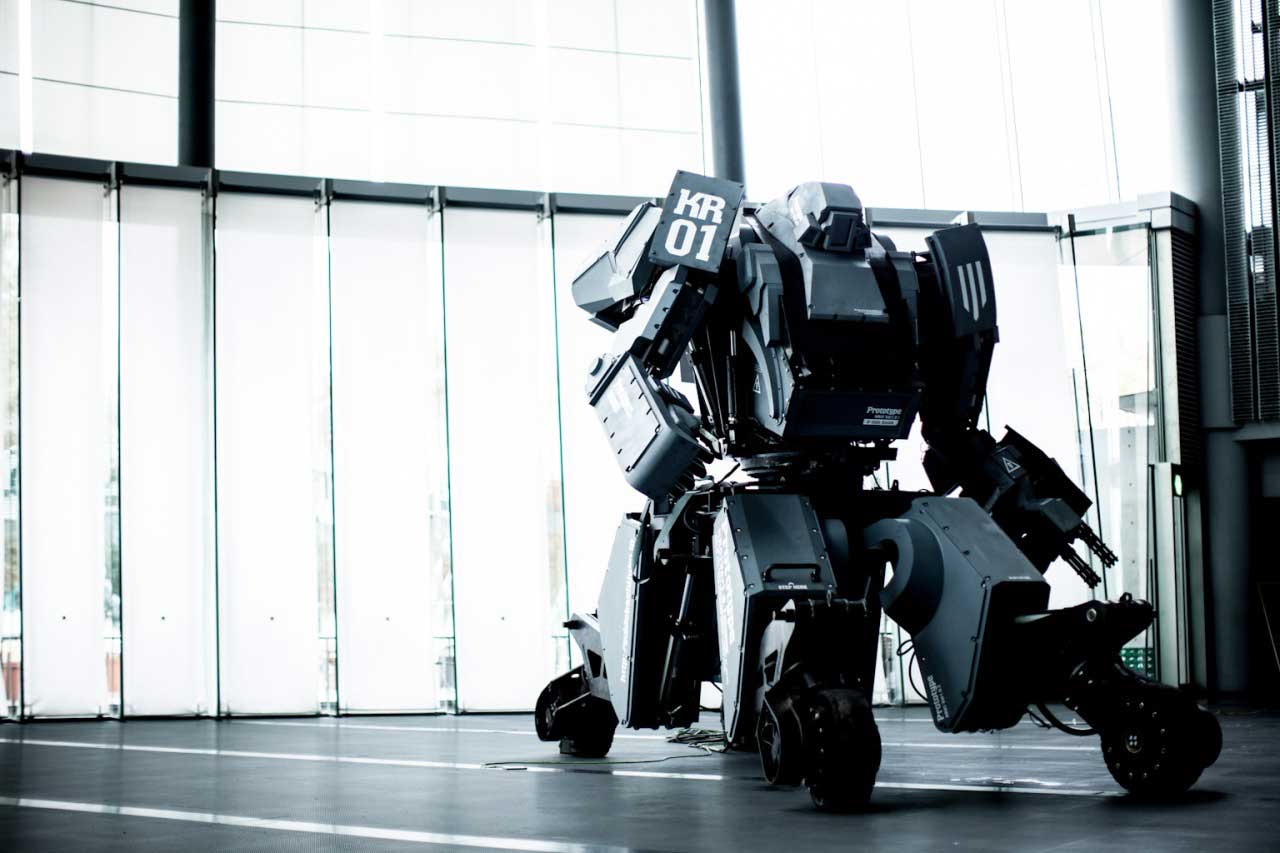
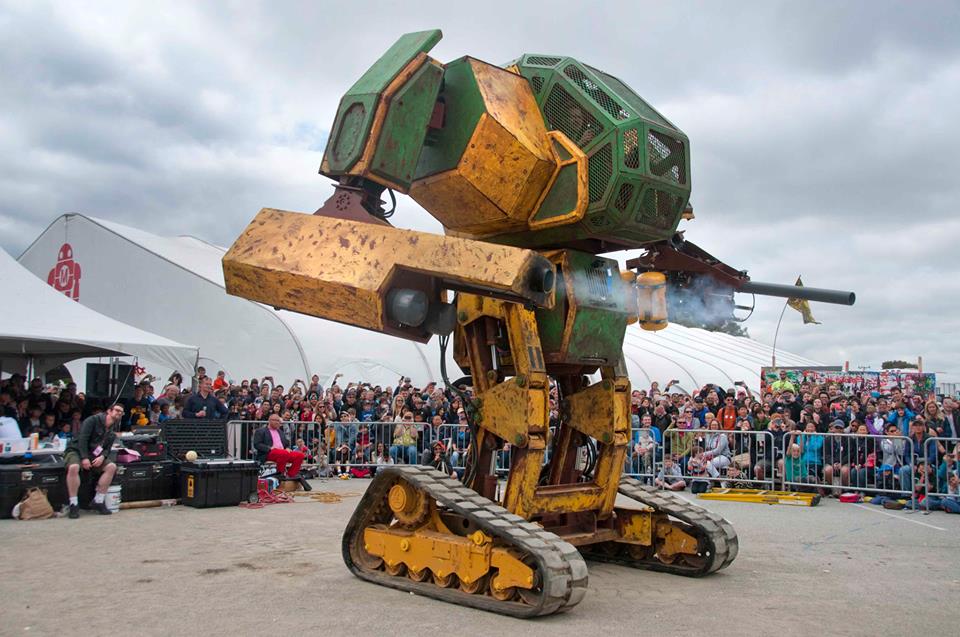
The MegaBots Mark II robot is 15 feet tall, weighs 5.4 tons and carries enormous paintball guns that can shoot projectiles at speeds exceeding 100 mph. Meanwhile, the Kuratas is a 13-foot-tall robot that weighs 4 tons and is decked with diverse weapon systems, including a “smile-activated” BB Gatling gun. Kuratas is guided by one person while the Mark II needs a two-man crew.
MegaBots’ primary challenge demanded that the battle should happen in one year’s time, and Kuratas replied by recommending that they even forego the cannons and punch it out in an old-fashioned brawl. Although additional specifics for time and location have not been released, let’s all pause for a moment and consider that the world we have been expecting is finally here.
Let us compare the bots:
Name: Mk. II
Designers: Location: San Francisco, California Debut: 2015, Bay Area Maker Faire Height: 15? (standing) Weight: 12,000 lbs Cockpit: Dual pilot Locomotion: Two tracks, from a CAT 289c skidsteer, one of the largest made. Legs are A36 plate steel, lasercut and welded at the seams. 13 degrees of freedom across 20 hydraulic actuators Power: 24HP honda gas engine spinning a hydraulic gear pump Armaments: Arm cannons. The right arm can fire 3lb, 6? paint cannonballs at 130mph. The left arm has a 20x shot missile launcher, firing 2.5? circumference paint missiles 150mph.
Name: Kuratas
Creator: Kogoro Kuratas, Suidobashi Industries Location: Tokyo, Japan Debut: 2012 Height: 13.1? (standing) Weight: 9,900 lbs Cockpit: Single pilot Locomotion: Four wheels, each mounted to individual legs. 30 hydraulic actuators Power: Diesel engine Armaments: BB mini-gun shooting 6000 rounds per minute, water bottles Note: You can order your own Kurata mech suit from Amazon.jp for just $1 million.
You may have seen Robots in movies and wondered about how awesome it might be to have a mechanised friend of your own. In the real world you’ve seen Asimo, which has some really awesome features but is still in the prototype stage. There are many companies who are working towards making a good personal assistant endowed with Artificial Intelligence(AI). Well, it seems like the wait for a personal robot is about to come to an end thanks to the efforts of a New York-based company.
Robotbase is made up of a team of engineers based in New York who unveiled an AI robot at CES 2015 to kick-off its Kickstarter campaign. They call it the ‘Personal Robot’ and are keen on putting a robot in every home. The company touts its Personal Robot to be a multi-talented personal assistant. She’s a hands-free helper, an awesome photographer, a reliable security guard, a wonderful storyteller, and much more.
It’s apparently the world’s first Artificial Intelligence based Personal Robot with the ability to detect faces, recognise emotions and everyday objects. According to the company, this PERSONAL ROBOT does everything for you from understanding what’re you’re saying and then replying back to you. She can even navigate around the house by herself with navigation and mapping algorithms. In addition, the device comes equipped with sensors to detect the outside environment and can communicate via your connected devices.
On the design front, the Personal Robot looks like the Mobile Virtual Presence Device that Sheldon Cooper created on the popular sitcom Big Bang Theory. A giant oval display is attached to a movable platform. The avatar on the display looks like one of the characters from a Japanese anime show. It might feel a bit creepy at first to interact with a cartoon who knows everything about you before you even ask.
Barring all that, she’s got a few special talents too, she can place food orders, act as a personal assistant and can even be a storyteller for your kids. It’s also an emotionally responsive personal assistant and can remind you about appointments. As of now, the company’s primary focus is the consumer version of the Personal Robot, however they are also getting keen interest from businesses as well, especially department stores.
The campaign seems quite promising, the company has already scooped up around $25,000 and promises that early takers can get the device for $995, delivery for which will begin by late 2015. You can head over to the Kickstarter campaign for more information. Check out the video below to find what this innovative device can do for you.
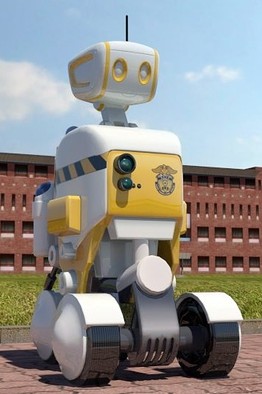
South Korea is aiming hard and fast to become the leader in Robotics. The country is also the first to test out robot prototypes for use in security installations. Nothing close to the terminator movies and more like Wall-E these robots will be used for basic security details and will be equipped with tactical advantages against prisoners.
Unlike CCTV that just monitors cells through screens, the robots are programmed to analyze various activities of those in prison and identify abnormal behavior
-Prof. Lee Baik-chul of Kyonggi University
The robots can also work as a communication channel when inmates want to contact guards in an emergency. According to Mr. Lee, prison officers have welcomed the idea because the robots can potentially reduce their workload, particularly at night.
But the robots are not terminators. Their job is not cracking down on violent prisoners. They are helpers. When an inmate is in a life-threatening situation or seriously ill, he or she can reach out for help quickly.
Taiwanese based original equipment manufacturer, Foxconn has announced that it is going to supplant its workforce with close to a million robots. The two things that Foxconn is most famous for are the spate of suicides that plagued the factory or for the fact that it manufactures most of the gizmo’s around you (including the iPad and iPhone).
At the moment the company currently employs 1.2 million workers and has around 10,000 robots as well. The number of robots will be increased to 300,000 by the end of 2012 and by 2014, it will be increased even further to 1 million. The number of workers that will be displaced by the robots is uncertain at this time. However, it would be very unlikely that Foxconn would be looking to hire over the next three years.
The Foxconn chairman Terry Gou informed workers of the plan at the company Dance Party. Not the occasion we’d have picked…
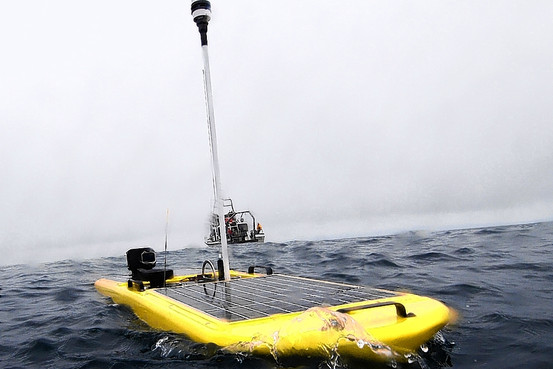
Liquid Robotics, a Silicon Valley startup, makes remote controlled robots that cruise the open ocean and gather data. The company plans to collect this data and offer it up to consumers on the web. The machines, called Wave Gliders, can keep track of all sorts of data including whale songs, wave heights and the presence of nearby ships. The company plans to sell these robots to governments, research institutions and energy companies for between $1,50,000 and $5,00,000 a piece depending on the included components.
The wave glider features a 6-foot, 10-inch-long floating section equipped with solar panels, a battery and sensors. Tethered 23 feet below the float in the water is a similarly sized glider with metal wings and a rudder that propel and steer the device.
The inventor of the device, Robert Hine, originally made the device for a friend who wished to study whale songs off the coast of Hawaii. He started designing and fabricating the machines in 2005, taking every other week off from his job as a semiconductor engineer. He experimented with different Electric Engine designs, but they all failed. After much research, he came up with a design that harnesses the natural energy in waves, like a sailboat harnesses the wind.
The gliders ‘wings’ use the up and down motion of the waves to propel the device forward at a pace of around 1.5 miles per hour. Operators are able to map out a route and have waypoints transmitted to the robot via satellite. It then uses GPS signals to follow the programmed route. The robot is unable to remain still but can criss-cross the same area.
Because the gliders are essentially floating platforms that can be programmed to go anywhere, there are many possible uses. They can measure ocean and air temperature to help predict storms and water currents and wave height for shippers trying to determine the safest route for their vessels. They also can help oceanographers monitor whales and other aquatic life. In crowded areas like the Gulf of Mexico, gliders could collect location, speed and destination information for ships—information that now is sent through radio signals—and display the information on a map. There are less obvious uses as well. Mr. Vass imagines equipping gliders with cellular towers to provide coverage in the middle of oceans. Also, gliders could be programmed to dispense fish food, creating fish farms that move around at sea.
Liquid Robotics isn’t the only company that makes unmanned sea vehicles for data collection. iRobot Corp., creator of the Roomba vacuum cleaner, makes a glider that collects information up to 3,000 feet under water, surfacing from time to time to transmit its findings and collect new instructions. The Slocum glider from Teledyne Technologies Inc. works in a similar way. Both gliders can collect information from far deeper in the ocean than the one from Liquid Robotics, but aren’t able to transmit data continuously.
The human skin is a magnificent sensory organ. It can detect the minutest gust of wind to a single touch. Robots however, are unable to sense the world around them in this fashion. Scientists at the Technical University of Munich (TUM), Germany, are developing an artificial skin for robots with a similar quality.
The skin will provide important tactile feedback for the robot and augment its existing camera “eyes”, its infrared sensors and gripping tools. As with human skin, the way the artificial skin is touched could trigger different reactions from the robot. It could for example, run away when hit, or use its eyes to see what has touched it.
The centrepiece of the new robotic skin is a five square cm hexagonal plate or circuit board. Each small circuit board contains four infrared sensors that detect anything closer than one cm. There are also six temperature sensors and an accelerometer, which allow the robot to accurately measure the movement of its limbs. The circuit board was designed keeping future expandability in mind, hence it can have more sensors attached as needed.
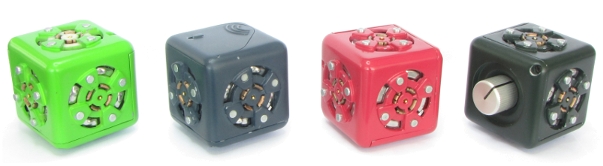
A cool new toy that we’ve discovered for the hobbyist and robot aficionado, Cubelets from Modular Robotics. For a price of 300 USD you get 20 cubelets, which you can basically snap together in various configurations to make your robot do almost anything. The modular nature of these devices makes it very easy to make new creations. Watch the video for more info.