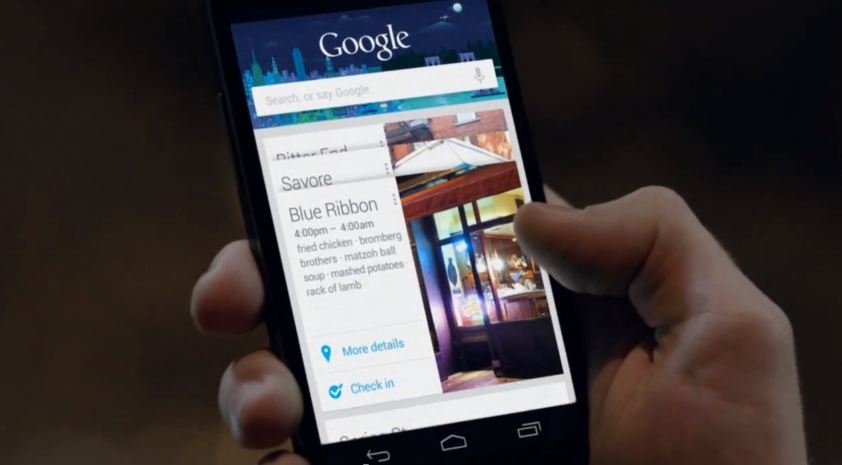
During the Grammys award show on Sunday night, Google aired a new commercial highlighting the Nexus 4 and its Google Now service found within Jelly Bean.
The first dedicated Nexus 4 ad was a Christmas-themed effort that went down rather quietly last month, showcasing the device’s camera. However, this new advert — details of which were revealed on Google+ by Vic Gundotra, who heads up development of Google’s social network — is its first big-time US ad spot for the (Android 4.2) Jelly Bean-powered device and the focus is interesting.
Rather than going into detail on the handset itself, which is built by LG, the advertisement highlights the features of Google Now, showcasing a number of ways it can be used via examples from across the world. In the extended 60-second version of the video, below, Google Now is used to check the weather, plan and carry out a trip, locate a restaurant, perform a translation on the go, and video chat through a Hangout.
Indeed, Google Now aims to make your life a little less challenging while you pursue your goals. It is a good thing that Google Now works on multiple devices, otherwise you would still be facing the supreme challenge of finding a Nexus 4.
Apart from its aggressive web campaign for the Nexus 4 and Google Now, the company hasn’t exactly highlighted the features to the masses via television campaigns. Now that Google’s Nexus 4 stock looks to be steadying, it’s ramping up that arena.
Still nothing for the Indian market yet! Disappointing!
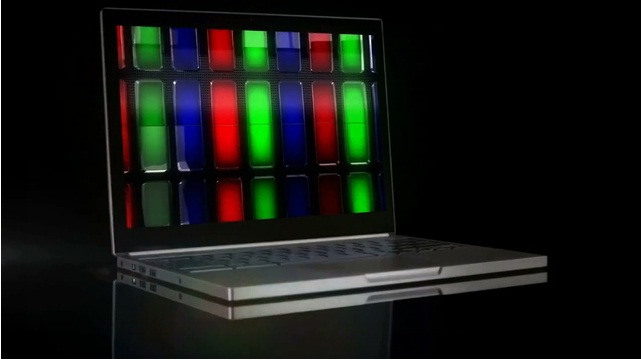
We’re still not sure whether the high-resolution Chromebook Pixel purportedly leaked in a video last week is real, but developer François Beaufort — who’s leaked Chome OS information before — has unearthed a piece of potential evidence. Beaufort has posted a link to a piece of documentation for a multi-colored “lightbar scheme.” Here’s part of the description:
[quote]
Yet another set of tweaks to the lightbar patterns:
At Startup or wake from sleep, Google colors cycle in.
While running, > 25% power level in the battery: All blue, in a breathing effect (cycle up and down 30%).
While running,
Shutting down, or going into sleep: Cycle out the Google colors
[/quote]
Based on the above, the feature certainly isn’t in existing Chromebooks, and it’s consistent with a shot of the Pixel in the earlier leaked video.
The world took to the idea of the Chromebook Pixel as it was tipped to support a massive quantity of pixels, perhaps more than four million, allowing the laptop to have a 2560 x 1700 display. That, as part of a machine that the video intoned again and again was ‘designed by Google’ snapped the world to attention.
In an odd world in which software and service companies are becoming OEMs to compete, having Google enter this space with a machine under its own flag would be no small market event.
Even more, the Chromebook Pixel could sport a touchscreen display. The video itself shows off a user touching the screen, pinching to zoom in on a jellyfish.
If Chrome OS is ever going to be a mainstream success, it needs to make a move now, because its best chance is ticking away.
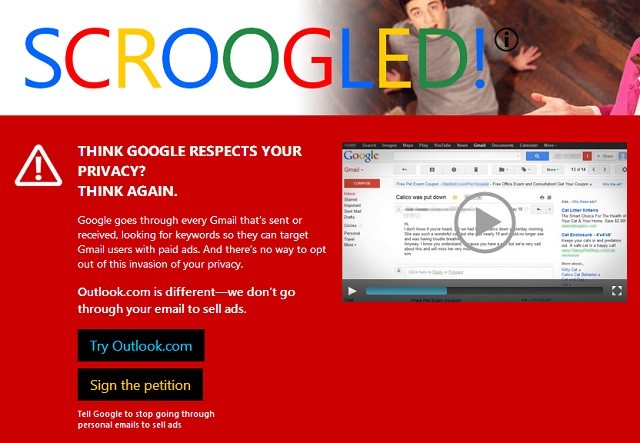
Microsoft has taken aim at Google before with its ‘Scroogled’ advertising campaign, and now it’s revived the attack tactics, slating Gmail’s policy of reading your emails to target ads.
“Think Google respects your privacy? Think again,” says Microsoft’s advert. It says that nasty Google goes through your every email, reading every word, so it can target ads to you based on what you’re writing about.
[quote]”Emails are personal — and people feel that reading through their emails to sell ads is out of bounds,” said Stefan Weitz, senior director of Online Services at Microsoft in a statement. “We honor the privacy of our Outlook.com users, and we are concerned that Google violates that privacy every time an Outlook.com user exchanges messages with someone on Gmail. This campaign is as much about protecting Outlook.com users from Gmail as it is about making sure Gmail users know what Google’s doing.”[/quote]
To illustrate this, Microsoft has a pair of shifty-looking eyes reading an email. Outlook.com, however, “prioritises privacy”, according to the ad.
In a press release pushed out today, Microsoft said the Scroogled campaign is also an attempt to educate Americans on some of the bad practices used by email providers. A study commissioned by Microsoft reveals that 70% of consumers “don’t know that major email providers routinely engage in the practice of reading through their personal email to sell ads”, while a larger 88% disapprove of the practice.
Previously Microsoft has used the “Scroogled” catch-phrase to warn users against Google Shopping’s practices, but today sees the campaign expanded into a much wider attack on Google and their advertising methods. Gmail has been targeted this time around, but it’s likely more services will be highlighted in future campaigns.
As we wait for the next big version of Android to appear — Key Lime Pie is rumoured to debut at Google I/O in May — Google hasn’t slowed down its sprucing and pruning of the current version.
According to a recent article on ibtimes.com, Google might be set to make the new platform version available by mid-February, after concluding internal testing for it.
The story goes that Google has been having employees test the 4.2.2 update on all of the Nexus devices – Galaxy, 4, 7, and 10 – and that the update is close to being released. There isn’t a lot to the update, which is expected to be very minimal. The only major issue that is expected to be fixed is the “stuttering” audio issue when using a Bluetooth headset with the Nexus 7.
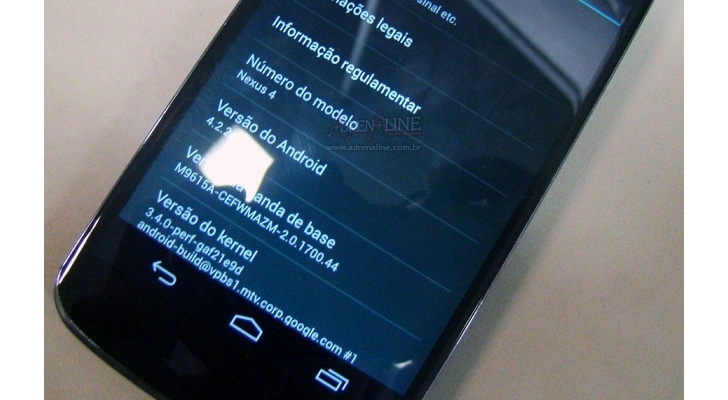
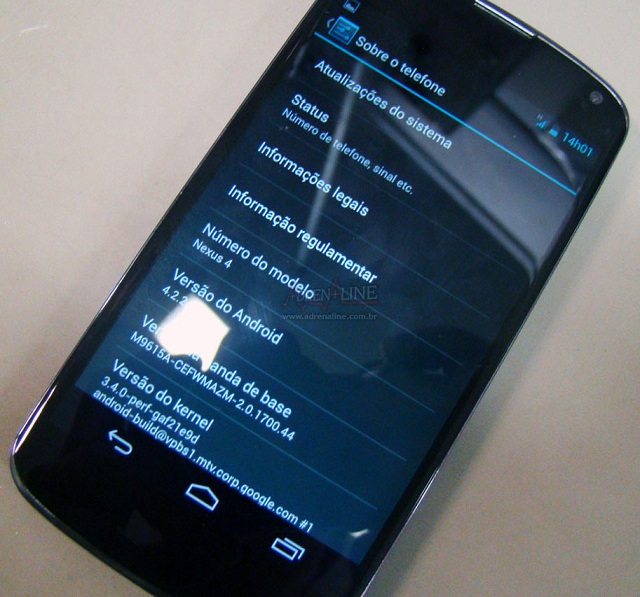
Multiple reports and videos have surfaced showing at least the latest LG Nexus 4 running 4.2.2 Jelly Bean for a select few. Google hasn’t pushed 4.2.2 to AOSP and it hasn’t been confirmed, but either way it’s coming soon.
News of this forthcoming version of Jelly Bean comes not long after Google updated the Android version share page. According to the data, Jelly Bean–both versions 4.1 and 4.2–has grown by 3.2 per cent since last month. This new update will probably see more Jelly Bean devices being activated, giving a firm foothold to Jelly Bean before the next version of Android is released.
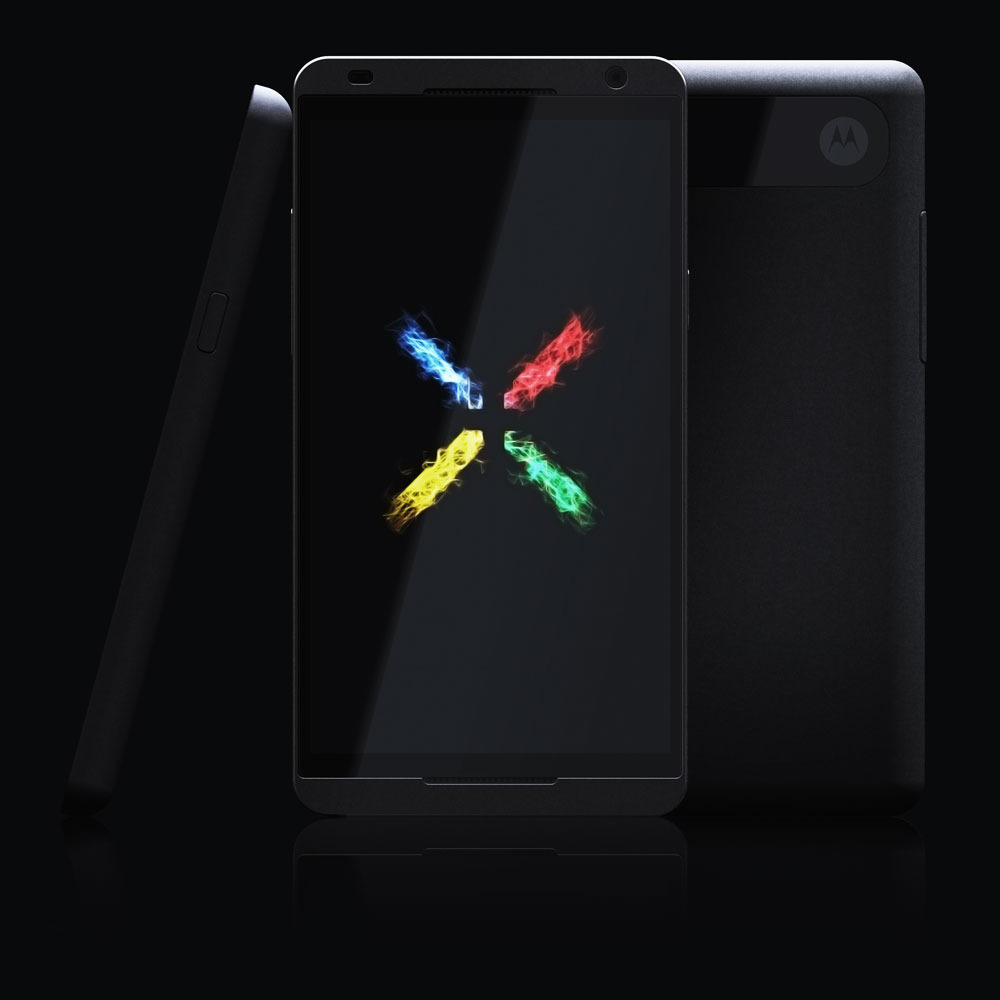
Motorola posted a job opening on LinkedIn this week searching for a product manager for an upcoming smartphone called the X Phone.
There was a pervasive rumour going around last year that Google and its newly-acquired Motorola Mobile division were working on a phone that would rival the iPhone, both in terms of sales and quality. While Motorola hasn’t had the best 12 months, repeatedly losing money quarter over quarter, the company is poised for a comeback in 2013.
The job posting on LinkedIn was for a “Senior Director of Product Management” to work on the X-Phone project and this is the first time Motorola directly referenced the X-Phone. The listing did not reveal anything about the phone itself, but at least it seems to prove its existence. It also indicates that development is still at an early stage, so don’t expect to see it anytime soon.
Motorola is trying to regain its strength in the smartphone market, and Google is attempting to get its $12.5 billion money’s worth. During Google’s earnings call last week, they deflected blame that they haven’t yet been able to turn around Motorola’s mobile business, stating that all the devices the company released since the acquisition were planned and executed without Google’s intervention.
We’re excited about the potential for Motorola’s success this year; the company is in better hands with Google than it was before.
Google on Wednesday released updates to two of its Android apps, Google+ and Google Play Music. You can download the latest versions now directly from the Google Play Store: here and here.
The former now displays notifications in the top right corner, much like its web-based counterpart. This makes more sense when scrolling through the app, as Google+ relies so heavily on them. Google+ users can now also insert links into their posts, and Community Moderators have more options when administrating a page.
The Google Play Music update is more significant. This makes sense given that the service is even newer than Google+, if you can believe it.
Instant mixes finally go beyond 25 songs (an arbitrary limit that should never have been there in the first place) and the app now features new album art. As for new features, the homescreen widget has gained a previous button and you can now shuffle an album, artist, or playlist.
There’s a new widget design and, thankfully, freezing fixes for the Galaxy S III.
Changelog for version 4.5.910I:
Instant mixes continue playing beyond 25 songs.
Added ability to shuffle an album, artist or playlist.
New default album art.
Previous button added to widget.
Pinning progress now shown on album and playlist pages.
Fix for the Galaxy S3 freezing issue.
Again, neither of these updates are particularly breathtaking but they are part of what makes using Google’s apps so enjoyable. Everyone likes regular updates that bring in more functionality for free. In both the social networking and music streaming spaces, Google has to keep iterating to fight the competition.
A curious Nexus 7 user (Smackel from Reddit) accidentally found out we can turn this hidden feature, Chrome running full screen on an Android device, on by pulling some strings and making a few tricks.
Full screen browsing is top of many an Android fans wish list for Google’s mobile version of the Chrome browser. On smartphone screens in particular, display space is important. It seems it might not be all that far away.
As we know, the latest beta build brought about support for WebGL in the mobile browser, and the first thing we need to do is go ahead and enable it. Type the magic line — “chrome://flags/ — into the address bar, and scroll down the list presented before you until you find WebGL. Tap on enable, then follow the prompt to restart the browser.
When Chrome has restarted, you want to head on over to the Chrome Experiment Boids and Buildings. Tap on the “launch experiment” button, then the “run” button when the main screen pops up. Then it’s simply a case of sitting back and watching. You don’t need to let it run right through, but it is pretty cool to watch this city get drawn out and constructed in front of you. At this point it’s also worth noting that it seems to run pretty well in the mobile browser.
When you come back out of the experiment though, you’ll notice the status bar at the top of the screen has vanished, and the address bar in Chrome has gone a little translucent. After a couple of seconds of doing nothing it just disappears completely. And there we have it, full screen browsing.
It is buggy, but it does work, and expands your web pages to take up the full display — on screen buttons not included. To get the address bar back takes just a swipe down from the top, although said swipe doesn’t bring the status bar back with it. Full screen mode seems to stay in place until you exit the app completely.
The highly-acclaimed Temple Run for Android has just its deserved sequel. Keith Sheperd, co-founder of Imangi Studios, creators of the game, has just announced Temple Run 2 has been published on Google Play Store.
The sequel to the popular endless runner game promises “beautiful new graphics, gorgeous new environments and new obstacles”. And as well as running, sliding and jumping, you can now also swing on a rope and ride in a mine cart.
Initially launched on iOS, Temple Run 2 shot to the top of the free-app chart last week within eight hours of its release. Within 24 hours it had clocked up an astonishing six million downloads and on Monday, just four days after it first landed in the iOS app store, maker Imangi Studios announced it had been downloaded over 20 million times. Expect the Android version to follow suit.
Thanks to in-app purchases, Temple Run 2 has also landed in third spot in the iOS top-grossing-apps chart.
[quote]”The response from fans has been overwhelming. We are thrilled players want more of the Temple Run universe, and we hope to grow and expand the game over the coming months,” says Keith Shepherd, co-founder of Imangi.[/quote]
In June last year, Imangi Studios had teamed up with Disney for a special edition of the game and brought Temple Run Brave for iOS and Android, with the the locale and character based on the Disney – Pixar movie, Brave. You are in control of Merida, the main protagonist – helping her run, slide, jump and turn and shoot your way across the wilds of Scotland.
Google eked out slightly higher earnings in the fourth quarter, despite a financial drag caused by the Internet search leader’s expansion into device manufacturing and a decline in digital ad prices as more people gaze into the smaller screens of smartphones.
The results announced Tuesday pleased investors, helping to lift Google’s stock by nearly 5 percent in extended trading. The performance lifted Google’s stock by $34.14, or 4.9 percent, to $737.01 in Tuesday’s extended trading.
The company earned $2.89 billion in profit on revenue of $14.42 billion, a staggering number that was up 36% over the previous year and 8% from the prior quarter.
Motorola Mobile, the newly-acquired handset division, earned $1.51 billion in revenue but lost $353 million overall. In comparison to last quarter, Motorola Mobility lost less money but earned significantly less revenue, so we’re hoping that Google stops the bleeding somehow. A Motorola X Phone may help the situation immensely.
2012 was the company’s first $50 billion year, which is pretty incredible, and Google now has 37,544 employees, though it’s set to lose 5204 as it sells Motorola’s Home division in the coming months. The company’s market cap is roughly $231 billion based on the last share price, though it should spike on the good news.
Google Chrome beta for Android was released just five days ago, but it has already received its first update in what looks to be a coming trend. The desktop beta and developer channels receive weekly updates and Google is unlikely to slow down its improvement schedule for mobile, especially since both versions share a significant proportion of code.
These bug fixes are mainly about interaction with specific websites, but there are some overarching performance improvements on some devices. These are also a number of outstanding bugs to contend with, including poor performance on the Galaxy Nexus and Nexus S. And while the beta version did decrease the propensity for crashing on the Nexus 10, it didn’t eliminate it altogether. Hopefully this will be addressed in the coming weeks.
If you’ve already downloaded the Chrome beta via the non-searchable Play Store link, you’ll see an update available for you today. If not, head to this link and get downloading. Chrome beta, like its sibling, is available for Android 4.0+ devices only.
This update contains a number of fixes, including:
While most of the world is seeing Android 4.2.1 as the latest version of Jelly Bean, it looks like Google has quietly begun rolling out something a bit newer. According to new reports, Google has begun rolling out Android 4.2.2 in select countries. So far the reports are pinpointing just two countries — Brazil and Malaysia.
According to a recent report, LG Mobile’s production facility situated in Taubaté, Brazil has already started churning out Nexus 4 smartphones today in hopes of catching up with the overwhelming demands, an interesting twist to this story is that at least a thousand of these quad-core packing monsters have — purportedly — been loaded with Google’s latest version of the Android Jelly Bean platform so don’t be surprised if the Nexus 4 you have ordered via the Play Store portal will come running the Android 4.2.2 operating system.
Also, a new leak reveals the LG Nexus 4 in Malaysia running the new, unannounced software from Google.
True or not, we suggest taking this news with a grain of salt since it’s still unknown if the leaked image is legitimate — but, like we’ve previously mentioned, the fact that Google has stopped letting users download the Android 4.1.2 may give us a vague clue as to what Google is really hiding up its sleeves and the Android 4.2.2 may just be the answer we’ve been waiting for.
Google has finally launched a beta channel for its own Android web browser, Google Chrome. The beta, now available in the Google Play Store, will be updated more frequently with the latest work-in-progress features for users to try out before they’re ready to go stable. You’ll have to note that betas are not promised to be perfect, so while this is a great way to test new features you might also encounter some bugs and rough edges.
The company posted a blog post citing massive increases to Javascript performance, better HTML5 integration and, hopefully, smoother scrolling on tablets like the Nexus 10.
[quote]Chrome for Android now benefits from all the speed, security and other improvements that have been landing on Chrome’s other platforms. For example, in today’s Beta update we have improved the Octane performance benchmark on average by 25-30%. In addition, this update includes interesting HTML5 features for developers such as CSS Filters. This is just one step of many towards bringing beautiful experiences to the mobile web.[/quote]
It looks like this beta version is running the same source code as the current desktop beta: 25.0.1364.8.
You can grab the new version from the Google Play store now. You will need to use the link as the app can’t be found by simply searching for it.
Big news for small developers: regardless of size, presence or popularity, all devs can now respond to comments in the Play Store.
Way back in June of 2012, Google began letting developers reply directly to user comments in the Play Store. The one catch with that, this was made available only for a select group of developers, those sporting a “Top Developer Badge.” And well, flash forward back to the present day and it looks like this is now rolling-out to all developers.
Not only will this help establish better relationships between app developers and their customers, but it will also allow developers to provide feedback and answer questions to critical comments or concerns. Trevor Johns, developer programs engineer at Google, previously said that “conversations are meant to be two-sided, and facilitating discussion between developers and users will ultimately yield better apps, to the benefit of everyone.”
The feature doesn’t seem to have rolled out in full, though it should only be a matter of time before your complaints can be heard, and dealt with, in one fell swoop.
Google+ integration was also recently added to the Play Store, forcing members of the social network to post comments under a real name, opening up richer commentary and preventing troll culture from taking over.
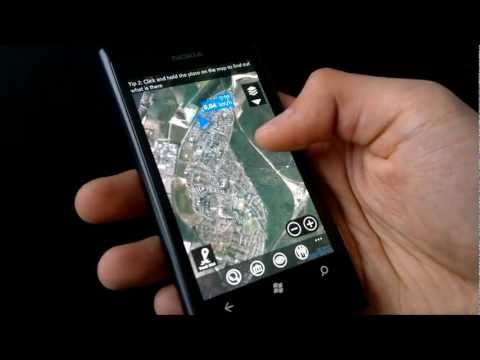
Microsoft’s complaint that Google is hoarding its YouTube metadata has fueled a new conspiracy theory: The search giant has pulled levers to prevent Windows Phones from accessing Google Maps. In reality, this phenomenon likely has little if anything to do with chicanery on Google’s part and everything to do with Microsoft’s reluctance to support the WebKit browser framework.
While Google Maps was never officially built for or supported by the Windows Phone platform, prior to this complaint, the service was accessible to a certain degree. Users of Windows Phone 7 and 8 both seem to be facing this issue.
Google released an explanation for the issue, saying that Google Maps rely on WebKit on mobile devices and Internet Explorer for Windows Phone does not utilise the rendering engine.
Microsoft, over the past few months, has publicly sparred with Google over its shutting down of Exchange Activesync support at the end of January. Microsoft expressed “disappointment” in the action and implored any affected users to transition to Outlook.com, its new (and excellent) mail offering. By turning off Activesync access (which applies to all platforms, not just Microsoft’s), Windows Phone users will not be able to sync Google contacts or calendars. Because Microsoft has yet to implement CalDAV and CardDAV support in its mobile OS, users will be out of luck by the end of the month.
Apple, on the other hand, will be unaffected by the change as it implemented the new calendar and contact sync standards in its latest version and has push support for mail via a native app. Android users, of course, will suffer no such issues with sync as their phones tie directly into Google’s activation servers.
While it’s currently assumed that the redirect is a bug and not the status quo going forward, we’ve yet to hear from Google on the issue.
When you look at the tech world this year, there have been plenty of innovations, but of course where there are successes, there are certainly going to be failures. Coming up with a list of the top 10 tech fails of 2012 was a bit of a challenge however, not because there weren’t enough, but because there are so many. And most of the entries on this list are debatable to some extent.
1. Aakash Tablet!
In October 2012, Indian politician Kapil Sibal called a press conference. Indian politicians call press conferences all the time, even those with a last name that is not Gandhi. And with two portfolios–he is both India’s minister of human-resource development and its minister of communications and information technology–Sibal typically has a lot he wants to talk about.
But this time he actually had news that would be noticed beyond New Delhi. With a phalanx of reporters and photographers gathered in a government auditorium, Sibal, a Harvard Law grad with a halo of white hair, held up a device he called the Aakash, which is Hindi for “sky.” It looked like an iPad.
The most remarkable Aakash data point was its price: $35. Meant for the millions of students who can’t even afford textbooks, the Aakash is supposed to be India’s iPad knockoff. “There are some moments in history,” Sibal said, taking a long pause, “that will be milestones recognized by future generations. This is one such moment.”
Indians take a certain pride in making things cheaper. The Hindi word to describe this is jugaad, roughly translated as “frugal innovation.” However, the Aakash, never made it to market.
I’ve yet to come across any college student who bought the tablet, either at the subsidized rate or the normal cost. So it tops our list as the biggest fail for 2012!
2. Apple Maps
Along with the rollout of the much anticipated iPhone 5 in September 2012, Apple overhauled iOS, the operating system that runs the phone, its iPad and other mobile devices. A much-hyped feature of the change was Apple’s first effort at its own mapping app — after dumping rival Google’s map software.
The result was so bad that a few days later Apple’s CEO was essentially telling customers to use Google Maps.
Entire cities appeared in the wrong place. Landmarks such as the Washington Monument showed up submerged in bodies of water, and big chunks of the globe appeared as roadless wastelands.
It was a little more than a month later when Scott Forstall, vice president in charge of iOS, was ousted from the company, reportedly, in part, for not wanting to apologize for Maps.
Apple fails are few and far between, but Apple Maps were a definite fail!
3. Motorola India
Motorola Mobility, which is totally independent from Motorola Solutions, had incurred heavy loss last year. Google took over the company for $12.5 billion in May this year. Google had earlier said in a filing to the US Securities and Exchange Commission.
Motorola Mobility shut down its India-specific product website as part of its global streamlining process.
“We are streamlining our business and support systems, and unfortunately, we’ll no longer have a dedicated website for India,” a message on Motorola Mobility India’s website said.
“Your local support site will remain open well into the future, and we’ll continue to provide support for our existing products,” it added.
This move seems to be a part of the company’s global downsizing process. In August, it had confirmed its decision to cut off 20 percent of work force and shut down operations in many countries.
So after capturing the Indian customer’s imagination with devices like the MotoRazr and the MotoRokr, Motorola finally bid adieu to the country, leaving many disappointed.
4. HTC One X Wi-Fi Issue
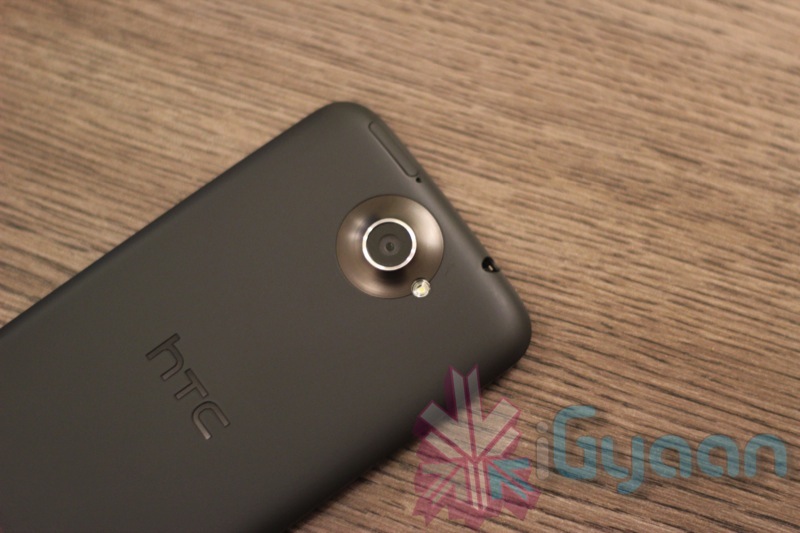
HTC did extremely well for themselves with their new line of Smartphones, the One Series. In June, several reports of WiFi issues on the HTC One X came to light, issues that led to difficulty connecting to Wi-Fi networks and annoying lag when playing games. The issues, which can also negatively affect the handset’s battery life, may have been related to a flaw in manufacturing, was actually confirmed.
Taiwanese manufacturer, HTC, officially confirmed that the device was infact suffering said issues. But having finally come clean on the issue, the Taiwanese Smartphone Giant also claimed to have found its fix, and had changed its production process for the One X to tackle the problem.
It replaced many handsets in the process, earning itself a place in our top 10 fails.
5. Stop Online Piracy Act ( SOPA )
The new law was supposed to be about fighting online piracy. Who’s going to be against that, right?
Answer: Pretty much the whole Internet.
Members of Congress sponsored the Stop Online Piracy Act, or SOPA, and related bills to make it easier to shut down websites that illegally share music, movies and other content.
But opponents argued it went too far and could end up shutting down legitimate sites while stifling free expression in the process.
Unfortunately for backers of SOPA, Web heavyweights such as Google, Facebook, Reddit and Wikipedia joined the fight against the bill. Sites went black on January 18 to raise awareness. Members of communities such as Reddit put intense pressure on lawmakers (including soon-to-be GOP vice presidential nominee Paul Ryan) until they dropped their support or went on record opposing the bill.
The unprecedented backlash eventually caused supporters to shelve SOPA, and quite possibly ushered in a new age of Web activism.
6. Blackberry Outage
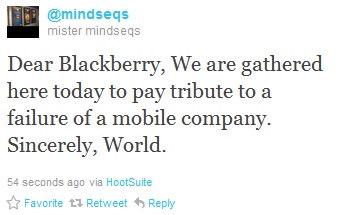
This tweet just about sums it up!
It was a case of worst possible timing as BlackBerry maker Research In Motion (RIM) confirmed it had suffered a significant outage across Europe and Asia, just as the iPhone 5 was launching to the now familiar queues in Apple stores around the world.
An October outage at a data center caused users to lose messaging ability in parts of Europe, the Middle East, India, Africa, Latin America and North America. (To their credit, RIM ultimately gave away a pile of free apps to the folks affected).
The outage lasted for several days and was the final straw for some users, who abandoned ship for other phones. Add that to a list of Blackberry fails.
7. Zynga
Zynga was riding high. Love them or hate them, its games like “Mafia Wars” and “FarmVille” were everywhere, clogging up Facebook pages and spurring millions of bored casual gamers to pay real cash for virtual cows. Then, it all came crumbling down.”
OK, maybe “crumbling down” is an overstatement. But things in The ‘Ville definitely didn’t go Zynga’s way in 2012.
In October, Zynga announced it was laying off 5% of its employees, Facebook, which gets a cut when people spend money on games such as “FarmVille,” said that income from Zynga was down 20% over last year.
And yesterday, the company announced that it was closing down 20 of its game titles in order to cut costs. FAIL!
8. Windows 8
Many eyebrows were raised on November 12, 2012 when Microsoft announced that Stephen Sinofsky—the president of the Windows division, a driving force behind Windows 8, and a long-time leader at Microsoft—was leaving his post, effective immediately. The odd timing and abrupt announcement led to a rash of speculation. Was Sinofsky fired or did he quit? Was it planned? Are Windows 8 sales that bad? The answer is yes!
Aside from the app selection, many early criticisms targeted the modern UI itself, which throws everything you know about navigating Windows, well, out the window. Early adopters—especially nontechie types—have reported running into issues with the overhauled interface, which is made worse by Windows 8’s near-complete lack of instructions when you boot it up for the first time.
Microsoft hasn’t been forthcoming with sales numbers, and the company declined to comment when asked by various journalists. That institutional reticence makes it hard to divine just how well Windows 8 is actually selling on the streets.
All that said, sporadic leaks, whispers, and data from third-party channels help us paint a partial picture of Windows 8’s sales success—and what we’ve learned suggests that the OS is stumbling out of the gate.
A fail so far, we’re afraid.
9. Facebook IPO
Maybe the dumb money wasn’t so dumb this time.
From the point of view of the company, Facebook itself, of course it was a roaring success. They were able to raise a good chunk of capital to develop and expand the business. That’s what an IPO is, at heart, about. Early investors in the company did well too: they were able to cash out some portion of their earlier investment at good prices. But things went horribly wrong!
If the market were to judge Facebook not a a potential promise but as actual worth today, the stock should be trading around $4.50. It could lose over 85% of its current value (90% from the IPO price, which started at $38) and still have room to fall further. That’s how big a fail the IPO has turned out to be!
10. IPC Sec 66A Of The IT App
The Section 66 (A) of the Indian IT Act continues to haunt the cyber population of India. At a time when a public interest litigation has been filed in the Supreme court questioning the constitutional validity of the section, questions are also being raised about the need for such “draconian” section.
Section 66A of the IT Act criminalises any person who electronically sends any information that is deemed grossly offensive, has a menacing character, which he\she knows to be false but still transmits to cause annoyance, inconvenience, danger, obstruction, insult, injury, criminal intimidation, enmity, hatred, or ill will, persistently by making use of the electronic communication medium. It also includes emails or text messages that have been sent with the deliberate purpose of causing annoyance or inconvenience or to deceive or mislead the recipient. The punishment can be a fine or imprisonment for up to 3 years.
The act has been in the eye of the storm after it caused the arrest two Palghar girls for allegedly posting Facebook comments against a political party. Earlier, the police had used the same law to arrest Aseem Trivedi for allegedly mocking the Indian Constitution through cartoons that had been put up as banners during Anna Hazare’s rally in Mumbai.
It definitely earns its place in the top fails!
Epic Fail
But the biggest fail of 2012 has to be the inability of our nation to respect women. The recent gang-rape and eventual death of the girl, named by the press as “Nirbhaya” (or fearless) is a BIG black dot on our society. Change is needed, not only in our laws and government, but within ourselves.
So many Big Statements coming in. Where are the big actions?
Have we missed any? Let us know in the comments section below!