Tag: exynos

  • Samsung Exynos 9610 Chipset Officially Announced

    Samsung Exynos 9610 Chipset Officially Announced

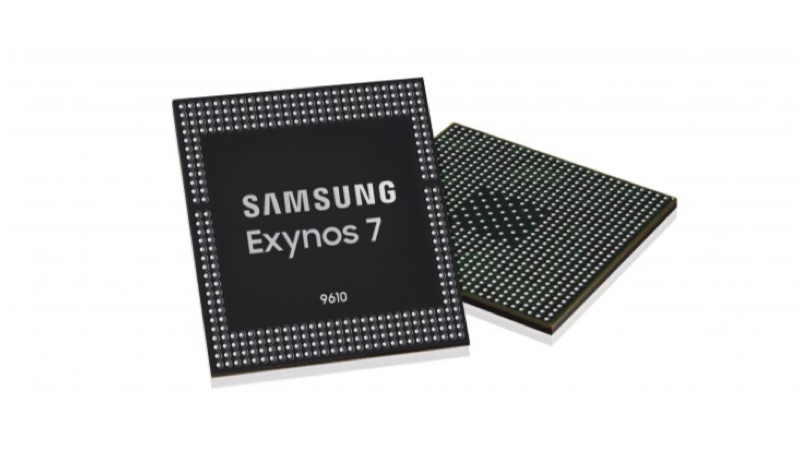
    Samsung has officially announced the Exynos 9610 Octa-core chipset. The Exynos 9610 is a series 7 processor which uses ARM’s big.LITTLE architecture, which will power Samsung mid-tier devices. The processor is based on 10nm FinFET architecture and the mass production will start by the end of Q2 2o18.

    Ben Hur, vice president of System LSI marketing at Samsung Electronics said:

    The Exynos 7 Series 9610 is our latest mobile processor that delivers on added power and speed. But more importantly, it sets a new performance standard for high-end devices with its deep learning vision-image processing solution and slow-motion video capabilities that change the way we engage with our mobile devices.

    Exynos 9610
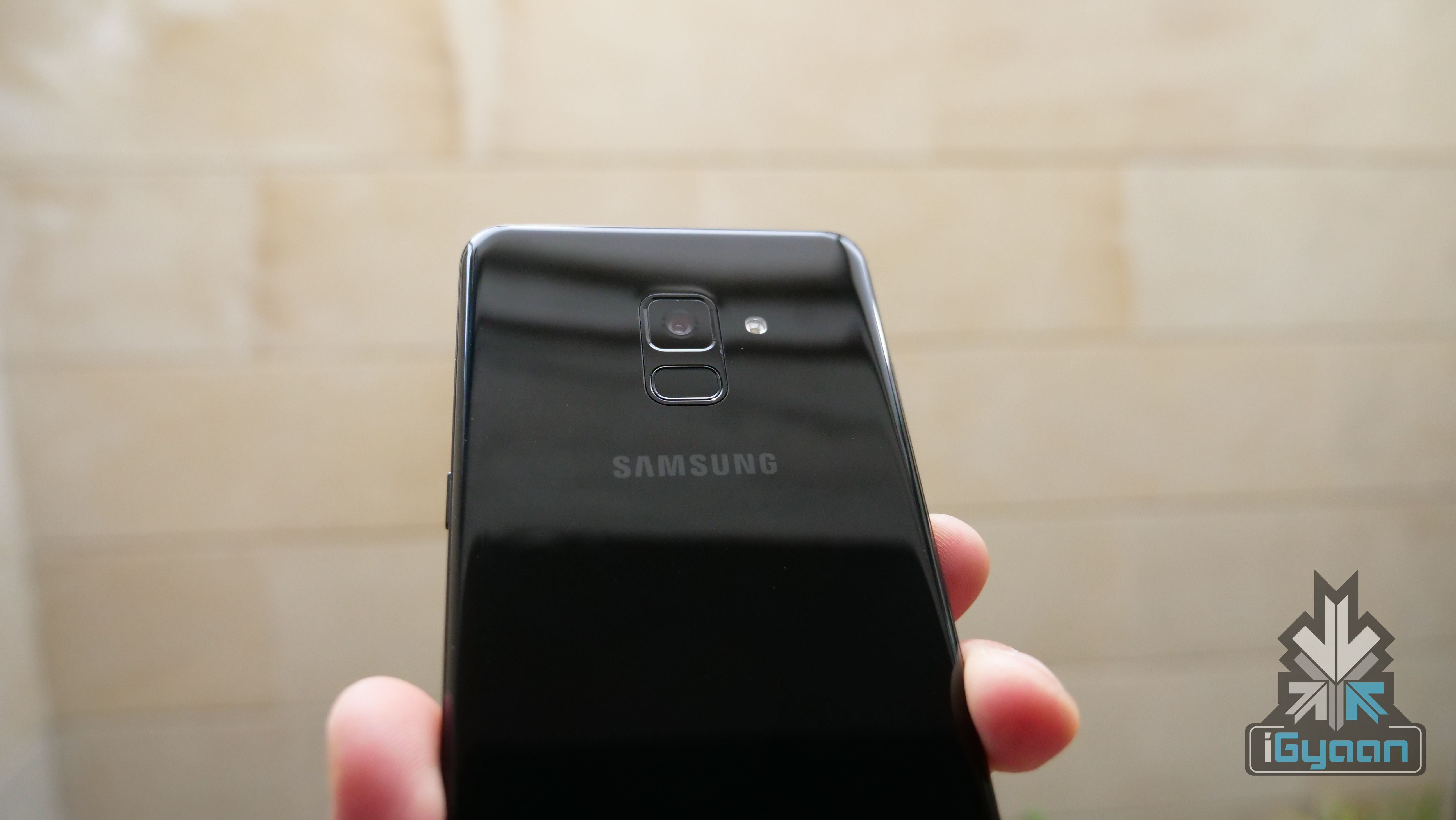
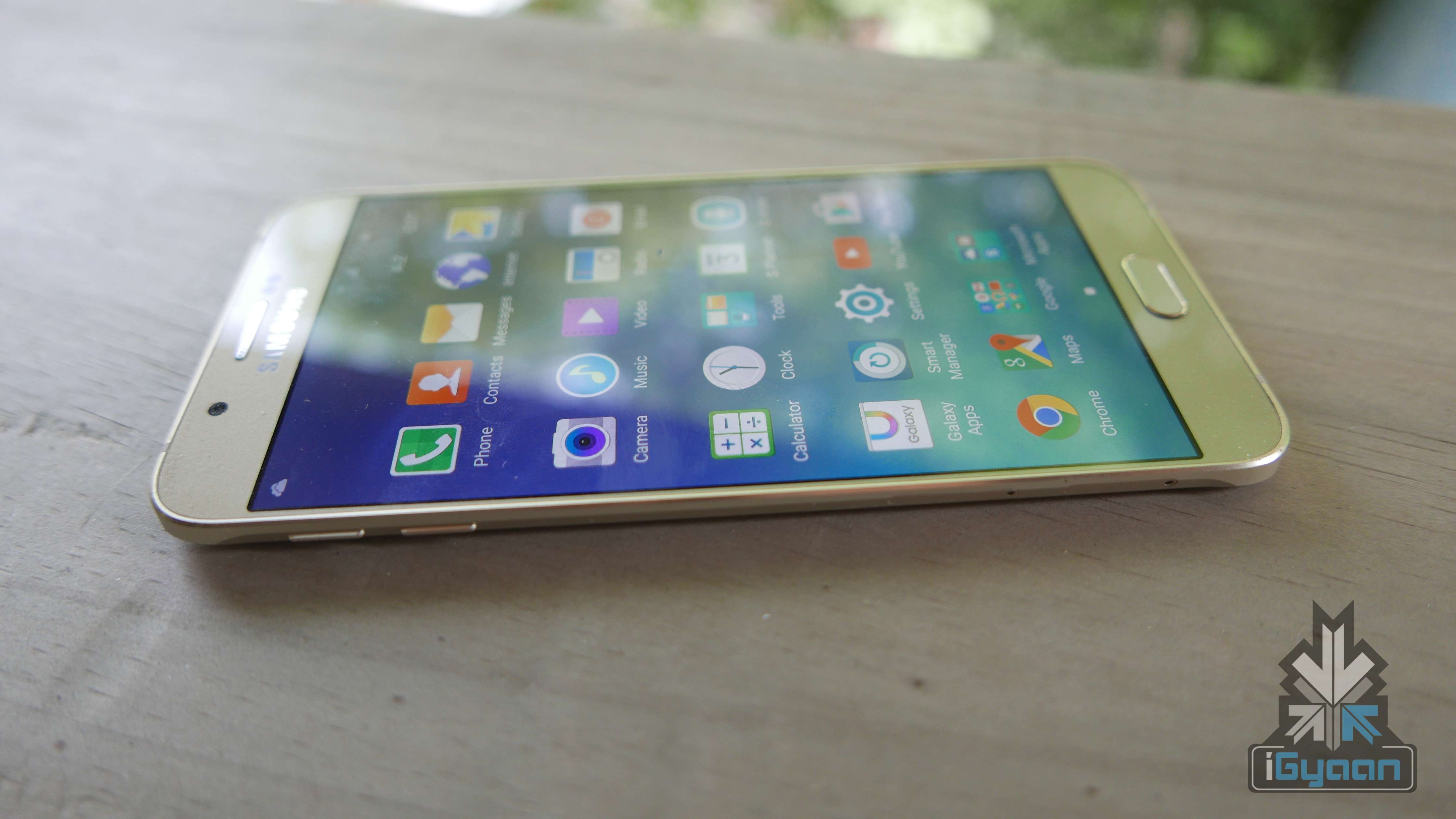
    Samsung Galaxy A8+ based on the Exynos 7885 chipset
    Specs

    The chipset has 4 high-performance A-73 cores, which handles CPU intensive tasks and applications. Similarly, the other 4 cores are based on A-53.  The four high-performance cores are clocked at 2.45GHz and the four efficient cores are clocked at 1.65GHz. The graphics are handled by Mali-G72MP3 GPU.

    The chipset has a new image sensing processor (ISP) that supports native 4K video recording up to 120fps. Similarly, at 1080p the chipset can record up to 480fps slow-motion video footages. Samsung claims that the chipset can reduce the noise in low light shots. Similarly, the chipset also has a dedicated AI neural engine, which can detect various objects with the ability to produce real-time bokeh.

    The Exynos 9610 offers greater LTE upload and download speeds using 3-carrier aggregation. In fact, the device which possesses this processor can offer a maximum download speed of 600Mbps and upload speed of 150Mbps. Additionally, the chipset has latest Bluetooth 5.0, FM Radio, GPS, A-GPS, and BeiDou.

  • Samsung Galaxy J6 2018 Leaked On GeekBench

    Samsung Galaxy J6 2018 Leaked On GeekBench

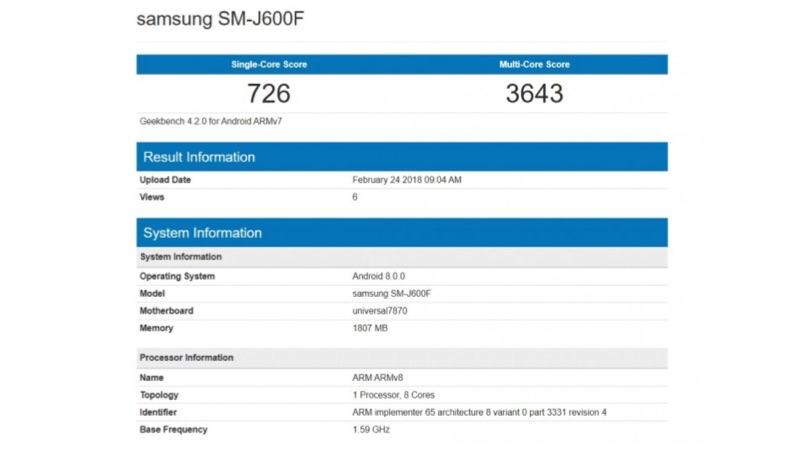
    The 2018 iteration of the Samsung Galaxy J6 was spotted on Geekbench, which provided information on the insights of the smartphone. The smartphone comes with the model number SM-J600F. Under the hood, the smartphone is powered by Exynos 7870 Octa-core chipset, which is also used in the Samsung Galaxy J5 2017.  The smartphone scores 726 points on single core performance and 3643 points on the multi-core performance.

    The maximum display resolution supported by the chipset is limited to 1980 x 1200px. So, we might see a 720p or 1080p display panel. The listing does not reveal any information on the aspect ratio of the smartphone. Going by the Samsung’s track record, the phone might feature an older 16:9 aspect ratio.Samsung Galaxy J6 2018

    Benchmark details:

    As mentioned earlier, the Exynos 7870 chipset is based on a 14nm architecture with Octa-core CPU configuration. The Samsung Galaxy J6 2018 is powered by Exynos 7870 chipset with 2GB RAM. Similarly, the smartphone is expected to have at least 16GB storage with a dedicated micro SD card slot.

    The smartphone also runs on the latest Android 8 Oreo OS with custom Experience UI on the top. Which means, the smartphone will launch with the Google’s latest operating system.

    The device is expected to have a single primary camera and a single front-facing camera with no fancy portrait mode or X2 optical zoom. The Samsung Galaxy J6 2018 will have dual SIM card slots with 4G LTE and VoLte support on both the SIM slots. However, the 4G standby will be limited to one active SIM card at a time.

  • Samsung Announces Exynos 9810 Chipset Which Will Power The Galaxy S9

    Samsung Announces Exynos 9810 Chipset Which Will Power The Galaxy S9

    Samsung has announced its new flagship chipset, the Exynos 9810 SoC (System on Chip) in a press release. The chipset will power the upcoming the flagship smartphones, the Samsung Galaxy S9 and Galaxy S9+ and even the Galaxy Note9 which is expected to be launched in the third quarter of 2018.

    Unlike the Qualcomm Snapdragon 845, which is manufactured on the 7nm process, the Exynos 9810 chipset has been manufactured on the 10nm process. This is the same as the Exynos 8895 chipset which powered the 2017 Samsung flagship smartphone lineup.

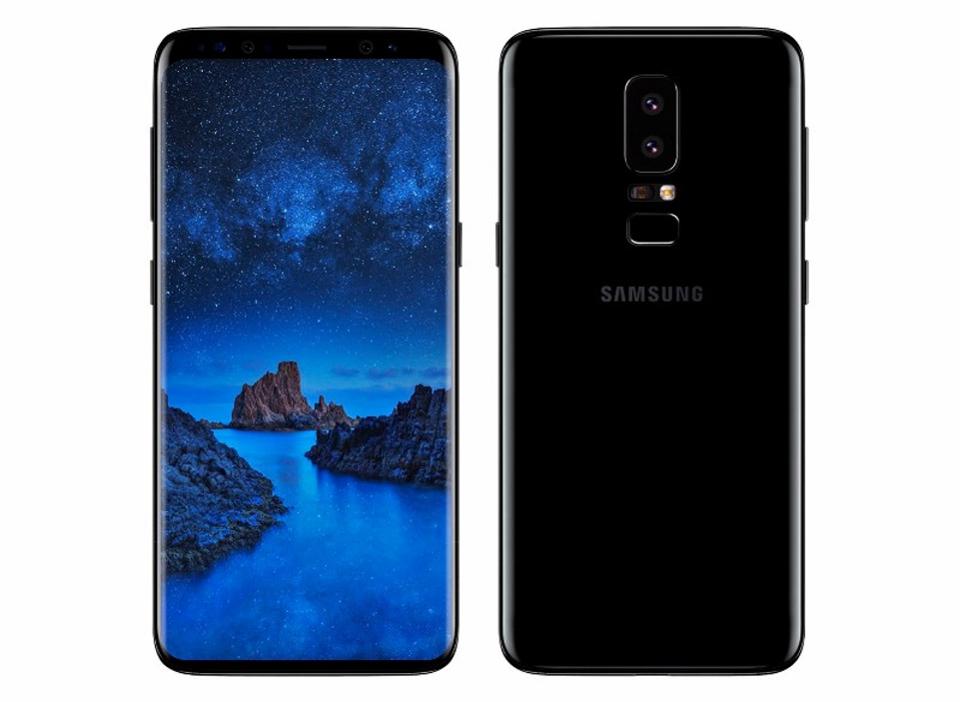
    Samsung Galaxy S9 Render

    Samsung says that the Exynos 9810 processor has “3rd-generation custom CPU cores, upgraded GPU, and gigabit LTE modem with industry-first 6CA support.” Earlier this year, Samsung had introduced the 6CA modem and had promised that the 6CA modem would be included into its next generation mobile processing unit. Hence, as it promised the Exynos 9810 features the new and improved 6CA modem.

    At the time of unveiling of the 6CA modem, Samsung had said:

    Mobile processor adopting the new Cat.18 6CA-supported LTE modem technology is expected to be in mass production by the end of this year.

    The announcement of the Exynos 9810 chipset falls perfectly inline with the above statement.

  • Samsung Galaxy S7 Antutu Leak Confirms Hardware

    Samsung Galaxy S7 Antutu Leak Confirms Hardware

    Samsung is being tipped to launch the Galaxy S7 during the Mobile World Congress next month, and as expected the internet has gone into overdrive with rumours and leaks of this upcoming phone. Latest set of leaks about the phone confirm to us the underhood specs of the Galaxy S7.

    Galaxy S7 rENDER 02

    As it had been reported for some time now, the S7 would come in two variants, the S7 Edge, and the flat screen S7. The curved screen Edge is expected to sport a Snapdragon processor with a 5.1-inch QHD screen along with 4 GB of RAM. The other model, the Galaxy S7 will come equipped with a Exynos processor.

    All this news comes from Antutu’s Weibo page. The Galaxy S7 (SM-G930F), apart from sporting the new Exynos 8890,  will also come with a 5.1″ 1440 x 2560 pixels screen, 12 MP rear camera, 5 MP front camera, 4 GB of RAM, and 64 GB of internal storage.

    As it is visible, the only difference between the S7 and the S7 Edge is the choice of the SoC. Sporting two different processor is not a new strategy for Samsung. The Galaxy flagships have done so in the past, except for last year’s lineup which dropped Snapdragon altogether from the show.


  • Samsung Exynos 8870 Will be Sold to Meizu and Other Companies

    Samsung Exynos 8870 Will be Sold to Meizu and Other Companies

    If rumours are to be believed, Samsung is working on releasing a Exynos 8870 chipset. This chipset would be mainly for Samsung’s external clients like Meizu. Additionally, rumours further suggest that Meizu Pro 6 and Pro 6 Mini are expected to come equipped with this chipset next year. The performance of the chipset is expected to be as good as that of Qualcomm Snapdragon 820.Exynos Samsung

    The rumour which has emerged out of China expects the chipset to be official sometime in 2016. Samsung, however, is expected to make use of Exynos 8890 as the chipset of its own high-end devices instead of this rumoured Exynos 8870. Speculations will continue making the rounds for a while until something gets confirmed by Meizu or Samsung.

  • Report : Samsung Galaxy S7 to Come With a Qualcomm Snapdragon 820 Chipset

    Report : Samsung Galaxy S7 to Come With a Qualcomm Snapdragon 820 Chipset

    Samsung has not even released its Galaxy Note 5and S6 edge+, and there are already leaks and rumours about the Galaxy S7.

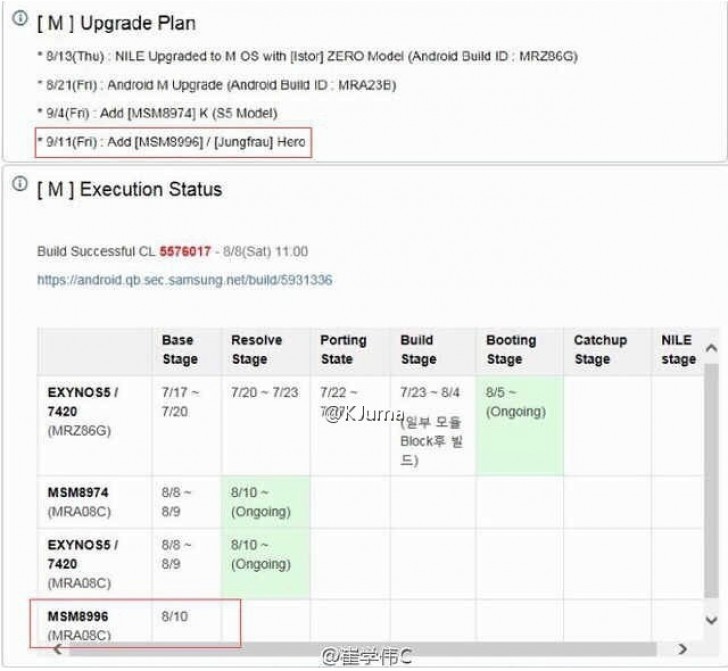
    According to reports, today in China, a document depicting an internal Samsung communication suggested that “Jungfrau”, which is rumoured to be the code name for the Galaxy S7, is being added to the company and along with it the “MSM8996” , which is the model number for the Qualcomm Snapdragom 820, as part of its software development plan for Android M.

    S7 leak 1

    This suggests that Samsung may be beginning to test the Qualcomm Snapdragon 820 inside its next flagship. This also means that after the company’s usage of an Exynos silicon chipset throughout 2015, it is again planning on using Qualcomm chipsets for its devices.

    Reports also say that Qualcomm’s new chip should be out in devices by the end of 2015.

  • Samsung Launches Galaxy S5 in India with True Octa Core Processor

    Samsung Launches Galaxy S5 in India with True Octa Core Processor

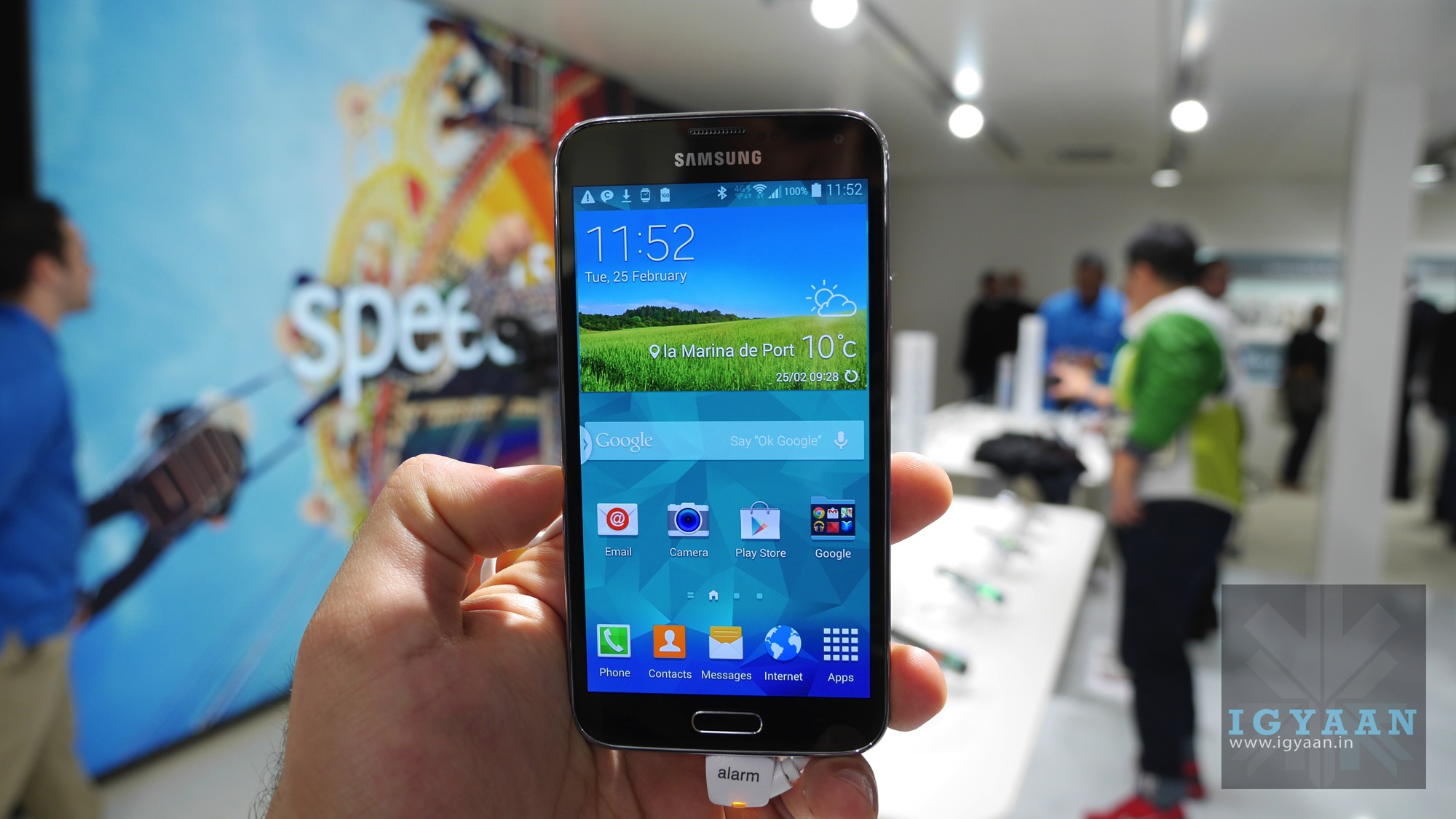
    Samsung today launched its first flagship product for this year, the Samsung Galaxy S5. However, the company has not revealed any pricing of the product. Alongside, the Samsung Galaxy S5, the company has also launched three of its newly launched wearable devices; the Gear 2, Gear 2 Neo and the Gear Fit.

    The Galaxy S5 is IP67 Dust and water Resistant, which means; it can be used in rain, and wet condition, but keeping in mind it is not water proof. The Galaxy S5 also features a heart rate sensor, located just below the back camera and next to the new layout led flash. It also offers a Fingerprint Scanner, providing a secure, biometric screen locking feature and a seamless and safe mobile payment experience to the users. 

    The Samsung Galaxy S5 sports a 5.1 Full HD Super AMOLED display with a resolution of 1920 x 1080 pixels. The Galaxy S5 is powered by a true Octa-Core chipset which Samsung India failed to elaborate more on, but we believe it to be the Exynos 5422 (Octa-core application processor Quad 1.9 GHz + Quad 1.3 GHz) processor with Heterogeneous Multi-Processing and has XMM6360 for HSPA+ connectivity. 

    This new Galaxy is packed with a 2 GB of RAM and 16/32 GB of storage which is expandable to 128 GB via MicroSD card. Just like the global variant it has a 16 MP camera with an enhanced menu and user interface that allows users to take, edit and share photos. The Galaxy S5 offers the world’s fastest autofocus speed of 0.3 seconds. The new Selective Focus feature allows users to focus on a specific area of an object while blurring out the background. Most importantly, the Galaxy S5 also is capable of shootin 4K videos.

    The device is packed with a 2800 mAh battery which is removable if required. Samsung has introduced a Ultra Power Saving Mode which turns the display to black and white, and shuts down all unnecessary features to minimize the battery consumption. During the keynote, the company said if the S5 is at 10% battery level and if you switch on the Ultra Power Saving Mode, the device will further be active on standby for 24 hours.

    Stay tuned, as we will share more details as soon as we get them. Moreover, going through the leaks, the device is expected to launch around the price tag of Rs. 51,000. Even though our earlier reports pegged the price down to Rs. 41,000 it seems the company will be selling it much higher.


  • Samsung Details Exynos 5422, 5260 Chipsets

    Samsung Details Exynos 5422, 5260 Chipsets

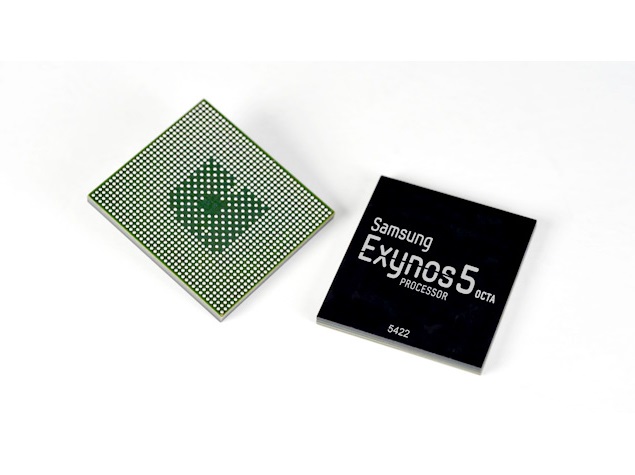
    Samsung is adding two new processors to its Exynos family. The Samsung Exynos 5422 is an updated, faster version of the Exynos 5420 octa-core processor, while the new Exynos 5260 is the company’s first hexa-core chip.

    The line struggles to compete with Qualcomm when it comes to LTE radio capabilities, so like previous releases we’ll see the Exynos version of the phone in markets where LTE isn’t an option yet. In the US and in parts of Europe where LTE has been steadily growing, we’ll see the Qualcomm variant so users can take advantage of the special bonded download feature Samsung has implemented for the Galaxy S5.

    The 5422 has four Cortex-A15 cores clocked at 2.1GHz and four Cortex-A7 cores @ 1.5GHz. This is a good 200MHz upgrade over the previous Exynos 5420 SoC. The 5422, naturally, uses the big.LITTLE ARM architecture, but comes with Samsung’s own tweak – HMP (Heterogeneous Multi Processing) technology. The HMP allows the device to utilize any combination of cores, even all eight, at once.

    Another addition to the Samsung’s Exynos family is the 5 Hexa or the Exynos 5260, is seen in the Galaxy Note 3 Neo, which features six CPU cores: two 1.7GHz ARM Cortex A15 cores and four 1.3GHz ARM Cortex A7 cores.

    As per Samsung, the Exynos 5 Hexa supports WQXGA (2560 x 1600) display resolution and also supports full-HD (1080p) playback at up to 60 frames-per-second (fps).

    Samsung further revealed that the samples of the processor are scheduled for mass production in the first quarter of 2014, while the Exynos 5260 is currently in mass production.

  • Samsung announces 1.4GHz Exynos 4 Quad as basis for Galaxy S3

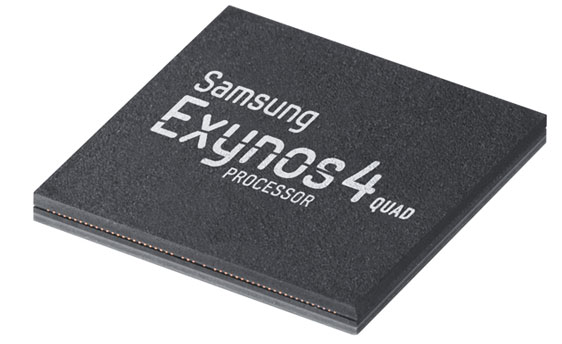
    Samsung has announced that it will launch the next Galaxy phone based on its new Exynos  4 Quad 1.4GHz Chipset. With its High-K Metal Gate (HKMG) low-power technology, it boasts twice the performance of its predecessor, and about 20-percent battery savings.

    The application processor is a crucial element in providing our customers with a PC-like experience on mobile devices, Samsung’s next Galaxy device, which will be officially announced soon, offers uncompromised performance and ground breaking multitasking features, thanks to Exynos 4 Quad’s powerful performance and efficient energy management technology.”

    Hankil Yoon, Senior VP of Product Strategy Team at Samsung
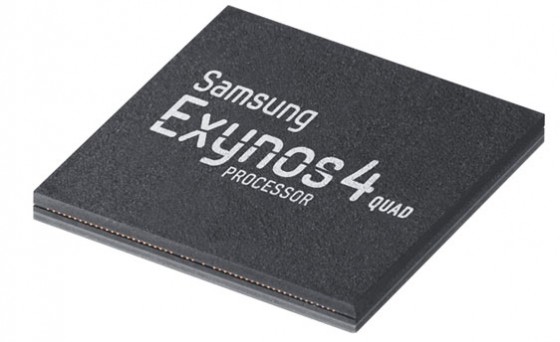
    Samsung is also shipping the chipset to other manufacturers like Meizu for their new handset, and the Exynos 4 Quad is pin-to-pin compatible with the Exynos 4 Dual (used in S2 and Note). Allowing previous adaptors to update the specs without many hardware changes.

    [toggle_box title=”Press Release” width=”550″]

    Samsung’s New Quad-Core Application Processor Drives Advanced Feature Sets in Smartphones and Tablets


    Designed on 32nm HKMG process, new energy-efficient chip exceeds 1.4GHz per core


    SEOUL, Korea–(BUSINESS WIRE)–Samsung Electronics Co. Ltd., a world leader in advanced semiconductor solutions, today introduced the industry’s first quad-core application processor built on the High-k Metal Gate (HKMG) low-power process technology. With unprecedented performance capabilities exceeding 1.4GHz based on the ARM® CORTEXTM A9 quad-core, the powerful, yet energy-efficient Exynos 4 Quad, allows system-level architects to integrate maximized power efficiencies into smartphones and tablets which enables double the processing power at a 20 percent lower power bill over its predecessor, the 45nm process-based Exynos 4 Dual.


    “The quad-core processor offers phenomenal multitasking abilities surpassing any single or dual application processor. Since all the cores must share a single battery, the power management and efficiency in the limited battery capacity are indispensable for mobile computing devices,” said Taehoon Kim, vice president of System LSI marketing, Device Solutions, Samsung Electronics. “Given the diverse functionalities consumers are demanding from their mobile devices today, the Exynos 4 Quad meets those high-performance needs while keeping power consumption very low.”


    Multi-core processing delivers enhanced performance, enabling users to accomplish more tasks in a shorter period of time. For example, a task such as streaming video can run on one core while the other cores update applications in the background, connecting to the web and scanning virus-check simultaneously.


    Benefitting from a use case where the parallel processing and workload sharing among the four cores is necessary, the Exynos 4 Quad is particularly well-suited for heavy-load applications such as 3D games, video editing, and calculation-intensive simulation.


    Due to its 32nm HKMG low-power process and power-saving design, the Exynos 4 Quad has two times the processing capability over the 45nm process based Exynos 4 Dual while consuming 20-percent less power. To improve power efficiency, Samsung adopted hot-plug functionality to support on-off switching for each core as well as the per-core dynamic voltage and frequency scaling (DVFS), which offers a dramatic reduction in power consumption by adapting different levels of voltage and frequency when changing workloads.


    Having identical form factor measurements (12mm X 12mm X 1.37 mm), the Exynos 4 Quad is pin-to-pin compatible with the 32nm process based Exynos 4 Dual, allowing mobile device designers to immediately adopt the new solution without additional cost, engineering or design efforts.


    In addition, the new processor incorporates a full HD 30 frame per second video hardware codec engine for high resolution 1080p video recording and play-back, an embedded image signal processor interface for high-quality camera functionality and an HDMI 1.4 interface for sharp and crisp multimedia content transmission.


    Samsung developed a power management IC (PMIC), the S5M8767, as a companion chip to power the Exynos 4 Quad processor. By integrating various circuitry such as nine highly efficient and programmable buck converters and 28 low-dropout regulators (LDOs) into the small package of 5.0 mm x 5.0mm x 0.4mm, the S5M8767 is designed to scale up or down the dynamic voltage depending on the clock speed in 6.25mV step for managing power delivery and maximizing battery life at the system level.


    Already in production, the Exynos 4 Quad is scheduled to be adopted first into Samsung’s next Galaxy smartphone that will officially be announced in May. Samsung’s Exynos 4 Quad is also sampling to other major handset makers.


    “The application processor is a crucial element in providing our customers with a PC-like experience on mobile devices. Samsung’s next Galaxy device, which will be officially announced soon, offers uncompromised performance and ground breaking multi-tasking features, thanks to Exynos 4 Quad’s powerful performance and efficient energy management technology,” said Hankil Yoon, Senior Vice President of Product Strategy Team, Samsung’s Mobile Communications Business.


    Last year, Samsung introduced a new online hub dedicated to its Exynos processor. Designed to facilitate easy communication with industry partners and end users, the new micro-site takes you a step closer to the ultimate experience Exynos delivers; product information, user experience and information on promotion events. More information can be found at http://www.samsung.com/exynos.

    [/toggle_box]
  • Meizu MX Quad-core with Android 4.0 ICS coming in June (PR)

    Meizu MX Quad-core with Android 4.0 ICS coming in June (PR)

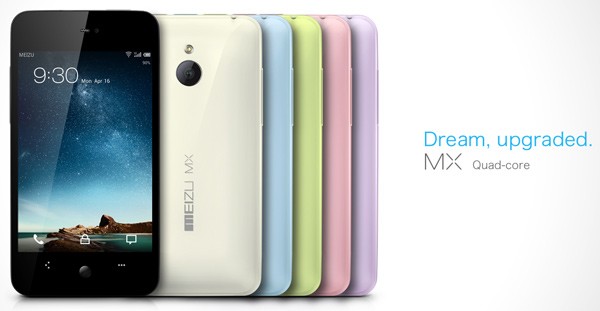
    Meizu is one company that kept its hype going since the beginning. With the launch of their new Meizu MX Quad Core the company is yet again trying to prove that it is not behind when it comes to staying up to date. Called the MX Quad-core, this new device will be powered by a Cortex-A9-based, 32nm HKMG (High-K Metal Gate) quad-core Samsung Exynos chip, which supposedly clocks in at 1.5 GHz. 

    Meizu claims the battery life is 20% better compared to the dual core MX, also the upgraded 1700 mAh battery probably plays a major role in that aspect. Other specs include a 4-inch 960 x 640 ASV display, an 8 MP BSI camera. 32GB  for ¥2,999 (US$480, INR 25,000) in China and HK$3,099 (US$400, INR 20,000) in Hong Kong;  64GB version priced at ¥3,999 (US$635, INR 32,000) and HK$4,099 (US$530, INR 26,500)), respectively. 

    The price of the Original Meizu MX has been reduced starting today.

    [toggle title_open=”Press Release” title_closed=”Press Release” hide=”yes” border=”yes” style=”default” excerpt_length=”0″ read_more_text=”Read More” read_less_text=”Read Less” include_excerpt_html=”no”]


    MEIZU officially announces the new MEIZU MX Quad-core

    MEIZU announces the world’s first smartphone with the quad-core Exynos A9 CPU

    HONG KONG – April 16, 2012 – MEIZU today announces the brand new MEIZU MX Quad-core smartphone to be available in June this year. Among many surprises, the MEIZU MX Quad-core is the first smartphone in the world to use the brand new and powerful Exynos A9 quad-core processor.

    The MX Quad-core uses a power efficient quad-core Exynos A9 CPU with industry-leading 32 nm HKMG technology which has been optimized to reduce CPU power consumption by up to 20%. In addition, it will last even longer with a new 1700mAh battery.

    With its state-of-the art hardware, the MEIZU MX Quad-core is better in every way than its predecessor. The MEIZU MX Quad-core CPU is 60% faster, and GPU 50% faster compared to the previous MX. Whether it is browsing through menus, playing the latest games, or watching 1080p video, the MX Quad-core easily beats dual-core devices.

    MX Quad-core comes with a vivid 292 PPI high definition ASV display. With no visible pixels on the screen, it provides the user with the ideal smartphone viewing experience. On the back side, the MX Quad-core has an 8 megapixel BSI camera with an f/2.2 lens aperture, capable of taking great photos even in low light conditions. The MX Quad-core will come with MEIZU’s unique Flyme OS based on Android 4.0, providing users with beauty, simplicity and buttery smooth performance at every interaction.

    The MEIZU MX Quad-core will be available in MEIZU’s 400 retail stores during June at ¥2999/3999 CNY and $3099/4099 HKD for capacities 32GB and 64GB in Mainland China and Hong Kong, respectively. With MX Quad-core, the company also releases MX back covers in five colors in addition to the original white, allowing users to experience the MX on their own terms. Coinciding with the announcement of MEIZU MX Quad-core, the MEIZU MX will have its price adjusted to ¥2399 CNY and $2599 HKD in Mainland China and Hong Kong respectively. The reduced price for the MEIZU MX is effective as of April 16, 2012.

    [/toggle]

  • The New iPad goes through Benchmarks, iPad 3 vs iPad 2 vs Transformer Prime vs Galaxy Tab 10.1

    The New iPad goes through Benchmarks, iPad 3 vs iPad 2 vs Transformer Prime vs Galaxy Tab 10.1

    During the launch of Apple’s third-gen iPad, the company made huge claims about the performance of the new A5x chip, claiming that the A5X processor with quad-core graphics provided up to 4x the graphics performance of NVIDIA’s Tegra 3 chip and  2x the graphics performance of the iPad 2?s A5 chip.

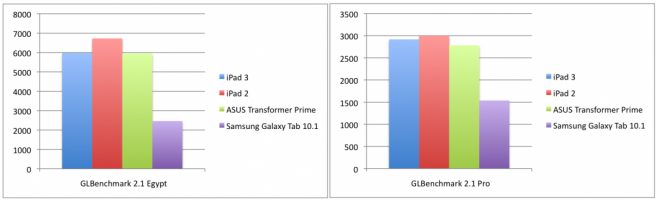
    Benchmark data shows the iPad 2?s A5 chip bettering both the A5X and Tegra 3 with the A5X’s improved graphics being used mostly to power the new iPad’s high-resolution Retina display of 3.1 million pixels.

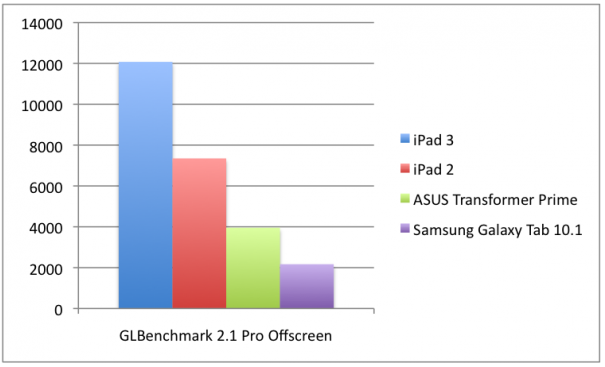
    However when the Screen is in off mode and benchmarks are run, the results of the A5x significantly prove to outperform all remaining devices. 

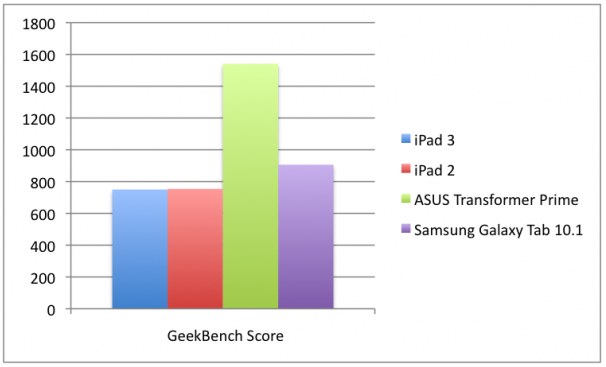
    For CPU Tegra 3-powered ASUS Transformer Prime and Galaxy Tab 10.1 scored higher in GeekBench than both the iPads:

    Tegra 3?s quad-core configuration blazes past the dual-core A5X, garnering GeekBench scores of 1540 and 750, respectively. Interestingly, the A5X’s average score fell a few points short of the iPad 2?s standard A5 chip, 753. Both the A5X and the A5 also fell shy of the Samsung Galaxy Tab 10.1?s Tegra 2, which received an overall score 905. The gains made by the Tegra 3 are easily chalked up to its two extra cores, but it is also boasts the highest clocking speed of the group at 1.6GHz, compared to the 1GHz clock of the A5X, A5 and Tegra 2.

    IGN

    For graphics tests with GLBenchmark, iPad 2 scored higher than the third-gen iPad in both tests. 

    For the Egypt test, the iPad 2 (1024×768) produced 6,709 frames at a framerate of 59 frames-per-second, while the new iPad (2048×1536) ran 5,974 frames at 53 FPS and the Transformer Prime (1280×800) generated 5,955 at a rate of 52 FPS. The Galaxy Tab 10.1 (1280×800), on the other hand, produced only 2,465 frames at a surprisingly low 21 FPS.

    -IGN

    The results of the off-screen tests show the A5X producing 15,412 frames at a rate of 138 FPS compared to the iPad 2 that has 10,143 frames at 90 FPS.

  • Supposed Samsung S II Plus Leaks ahead of MWC launch

    Supposed Samsung S II Plus Leaks ahead of MWC launch

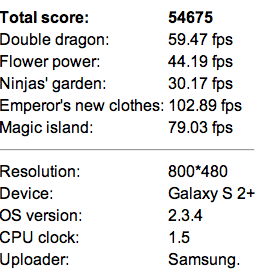
    A supposed leak of the upcoming Samsung Galaxy S II + running Android 4.0 with TouchWiz UI has appeared on the inter webs. Industry insider Eldar Murtazin is responsible for the above image of the suspicious looking phone. A close look reveals that the buttons below have been updated to host the new flavor of the Android platform, Ice Cream Sandwich.  The device is being considered as the Samsung Galaxy S2 plus purely because of its resemblance to the S2 and the fact that a benchmark score has also popped up on an3dbenchxl website. The device is running a 1.5 GHz processor on a Android 2.3.4 platform, but that could have changed by now.

    [Source]

  • iPhone 4S vs Galaxy Nexus Vs Galaxy S2 Vs HTC Sensation XE : Spec Wars

    iPhone 4S vs Galaxy Nexus Vs Galaxy S2 Vs HTC Sensation XE : Spec Wars

    Before the journey, Here are the major and upcoming smartphones of India in a spec by spec battle.

    Sure there are others and we will continue to add them.


     Price  TBD  TBD INR : 28500   TBD  
     Processor  Dual-core Apple A5   1.2GHz dual-core  1.2GHz dual-core Samsung Exyno  Dual core, Qualcomm 8260, 1500 MHz  
     Display  3.5 inches, 960 x 640
    IPS LCD 
    4.65-inch curved glass
    HD Super AMOLED
    1280 x 720
      4.3 inch , 800 x 480 Super AMOLED Plus  4.3 Inch, 540 x 960 SLCD  
     Primary Camera  8 megapixel AF, f2.4 lens, BSI sensor, LED flash  5 megapixel with zero
    shutter lag
     8 megapixel AF, LED flash  8 megapixel AF, LED flash  
     Front Camera VGA 1.3 megapixel 2 megapixel VGA  
     Cellular  Quadband GSM, quadband HSPA+ 14.4, CDMA / EDVO Rev. A  LTE or HSPA+, GSM  Quadband GSM, quadband HSPA+ 21 / 42    Quadband GSM, quadband HSPA+ 21 / 42   
     Wifi  802.11b/g/n  802.11 a/b/g/n  802.11a/b/g/n   802.11a/b/g/n  
     NFC  N/A Yes  NO   NO  
     Memory   Unknown (likely 512MB)  1GB RAM  1GB RAM  768 MB  
     Storage 16GB / 32GB / 64GB internal  16GB / 32GB
    internal storage
     16GB / 32GB internal, microSDHC expansion  1GB inbulit, microSDHC expansion  
     OS  iOS 5  Android 4.0
    Ice Cream Sandwich
     Android 2.3.4 with TouchWiz 4.0  Android 2.3.4 with Sense  
     Battery  1420+mAh, embedded  1,750mAh  1650mAh, removable  1730 mAh, Removable  
     Quoted Batt life Talk 8 hours on 3G, 14 hours on 2G
    40 hours audio, 10 hours video 
    TBD  7-8.7 hours on 3G, 5 hours video  7.16 hours on 3g, 6 Hours video  
     Weight  140 grams / 4.9 oz.  135g / 4.76oz  116 grams / 4.1 oz  151 grams / 5.33 oz   
     Dimensions  115.2 x 58.6 x 9.3mm  135.5 x 67.94 x 8.94 mm  125.3 mm x 66.1 mm x 8.49 mm   126.1 x 65.4 x 11.3 mm  


  • Samsung 2 Ghz Dual Core Phone coming next year

    Samsung 2 Ghz Dual Core Phone coming next year

    Maeli Business Newspaper reports “a high-ranking” company official has disclosed that Samsung plans to release a 2 Ghz phone latest by next year. But, remember that 2 Ghz is a total of 2 x 2Ghz cores not 1Ghz cores. According to the report Samsung also plans to sell the chips to other manufacturers, so that you can enjoy boosted performance in your favorite brand.

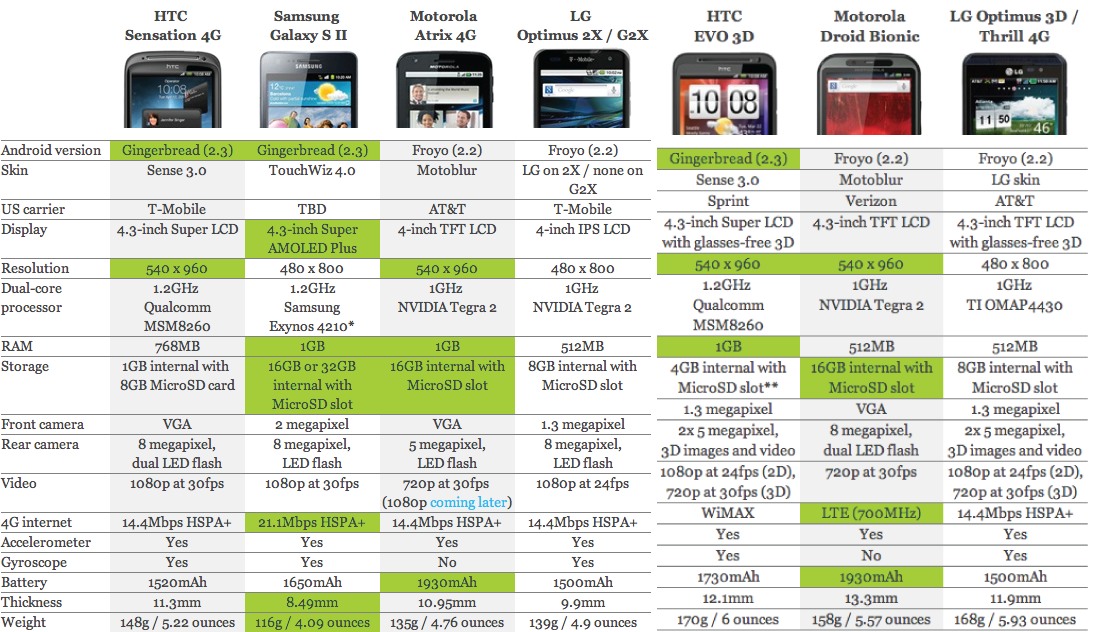
  • Clash OF the Titans : HTC Sensation vs Galaxy S II vs Motorola Atrix vs LG Optimus 2X vs HTC Evo 3D vs LG Optimus 3D Vs Droid Bionic

    Clash OF the Titans : HTC Sensation vs Galaxy S II vs Motorola Atrix vs LG Optimus 2X vs HTC Evo 3D vs LG Optimus 3D Vs Droid Bionic

    Single Core cpu on a mobile phone is so passe’, its the break of the new world of technology and we are hitting it with the new dual core processors. Folks over at Engadget assembled the specs to all the dual core goodness available yet. We have it here for you in a tabulated form comparing spec for spec and detail for detail. Which one will you choose?
    Click to Enlarge
iGyaan Network
Privacy Overview

This website uses cookies so that we can provide you with the best user experience possible. Cookie information is stored in your browser and performs functions such as recognising you when you return to our website and helping our team to understand which sections of the website you find most interesting and useful.