Tag: lawsuit

  • Apple Exec Eddy Cue Goes Defensive At E-Books Trial

    Apple Exec Eddy Cue Goes Defensive At E-Books Trial

    Eddy Cue, the Apple Inc. executive in charge of negotiating the company’s controversial e-book deals, defended how the tech giant started its online bookstore as he made his highly anticipated appearance on the witness stand in a federal antitrust trial.

    Cue testified that he didn’t know about any of the e-mails and more than 100 phone calls involving the CEOs of five of the biggest U.S. book publishers in late 2009 and early 2010.

    Apple

    Cue said he “struggled and fought” with the publishers, in individual talks before the introduction of the iPad, to get them to sign contracts to sell e-books on Apple’s iBookstore. Cue testified it’s his opinion the CEOs weren’t coordinating over their negotiations with Apple.

    “If they were talking to one another, I would assume I would have had a much easier time getting those deals done,” Cue testified.

    Steve Jobs closely monitored the negotiations but was “indifferent” about the outcome for Amazon, Cue testified. However, when asked if Jobs knew that there was a chance that once the iBookstore launched, publishers would withhold best sellers and new releases from Amazon, he responded, “I believe so, sure. Smart guy.”

    When Tim Cook was asked about the trial during his recent appearance at the All Things D conference, he called the trial “bizarre,” noting that Apple wasn’t going to settle and effectively admit to something it didn’t do.

    Cue’s testimony on Thursday marked the end of this week’s proceedings. The trial will resume next Monday and scheduled to wrap up late next week.

  • YouTube Defeats Viacom In Lawsuit Again

    YouTube Defeats Viacom In Lawsuit Again

    A federal judge handed a major victory to YouTube on Thursday, one year after a federal appeals court breathed new life into Viacom’s $1 billion lawsuit. Viacom had accused YouTube of illegally hosting videos that infringe on the company’s intellectual property, including popular content like MTV videos and TV shows like Comedy Central’s “South Park.”

    The case has flip-flopped in federal courts, with YouTube winning the first round in 2010 when U.S. District Judge Louis L. Stanton dismissed Viacom’s allegations that YouTube had violated copyrights by displaying videos of Viacom shows uploaded to the site by users. Stanton ruled that YouTube was shielded by the safe harbor provisions of the Digital Millennium Copyright Act by removing such videos when asked to and granted Google’s request for a summary judgment.

    YouTube submitted 63,060 video clips that were later identified as infringing copyrights and challenged Viacom to prove adequate notice of infringement was given to YouTube. Viacom admitted in January that “neither side possesses the kind of evidence that would allow a clip-by-clip assessment of actual knowledge. Defendants apparently are unable to say which clips-in-suit they knew about and which they did not.”

    In a decision filed Thursday in U.S. District Court of Southern New York, Stanton reaffirmed his original stance. “The burden of showing that YouTube knew or was aware of the specific infringements of the works in suit cannot be shifted to YouTube to disprove,” Stance said. “Congress has determined that the burden of identifying what must be taken down is to be on the copyright owner.”

    Google, which purchased YouTube in 2006 for $1.8 billion, hailed the outcome.

    “The court correctly rejected Viacom’s lawsuit against YouTube, reaffirming that Congress got it right when it comes to copyright on the Internet,” Kent Walker, Google’s Senior Vice President & General Counsel, said in a statement. “This is a win not just for YouTube, but for people everywhere who depend on the Internet to exchange ideas and information.”

    [BillBoard]

  • Apple Alleges $85 Million Error In Court Damages Order

    Apple Alleges $85 Million Error In Court Damages Order

    Samsung can’t seem to shake Apple off its back and although damages of $599 million were awarded to Apple, the tech giant still isn’t satisfied. In documents filed by Apple, they claim Judge Lucy Koh made an $85 million error in calculating damages. Supposedly, Koh thought the jury had granted $44,792,974 for the Infuse 4G and $40,494,356 for the Galaxy S II on AT&T, Florian Mueller reports for FOSS Patents. However, according to Apple, Samsung’s own statements prove that “disgorgement of profits for design patent infringement”, were permissible.

    “The number of products for which the damages award can stand would go up from 14 to 16, while the number of products for which a new determination is needed would go down from 14 to 12. The affirmed damages award would increase from $600 million to $685 million, almost two thirds of the $1.05 billion verdict”.

    Apple now seeks the court’s permission to bring a motion for reconsideration, though the request to bring such a motion is, for the time being, conditional.

    Apple’s conditional motion cites Civil Local Rule 7-9(b)(3). The related rule of the Northern District of California allows a motion for reconsideration in the event of “[a] manifest failure by the Court to consider material facts or dispositive legal arguments which were presented to the Court before such interlocutory order”.

    This is getting interesting! 

    [FOSS Patents]

  • Apple Hit With ‘Planned Obsolescence’ Lawsuit Over Fourth-Generation iPad

    Apple Hit With ‘Planned Obsolescence’ Lawsuit Over Fourth-Generation iPad

    Apple’s legal troubles in Brazil grew on Thursday, as news emerged that the company has been hit with a class-action suit alleging that the quick release of the fourth-generation iPad constitutes “planned obsolescence” with regard to its predecessor. 

    Brazil’s Jornal do Comérciao reports that the Brazilian Institute of Politics and Law Software (IBDI) has filed suit against the iPad maker, claiming that the company could have, when launching the third-generation “New iPad,” implemented all of the technological upgrades it introduced in the fourth-generation model. Apple’s failure to do so, the suit alleges, amounts to planned obsolescence and unfair business practices.

    “Consumers thought [they were] buying high-end equipment not knowing [it] was already an obsolete version,” says IBDI attorney Sergio Palomares.

    The New iPad and iPad with Retina display are different in three ways.

    For one, the current generation tablet includes an A6X processor versus the A5X processor that came with the discontinued iPad 3. It also includes a FaceTime HD camera. The previous model included a VGA front-facing videophone camera. Finally, the iPad 4 includes Apple’s new Lightning connector. The iPad 3 included a 30-pin connector.

    It should also be noted that iPad 3 buyers who had purchased their tablet within 30 days of the iPad 4 announcement were able to make a return. In addition, some retailers extended this policy even further.

    Apple also faces a struggle over rights to the iPhone brand in the country, having lost the right to the trademark after a court found in favor of Gradiente Electronica, a company that first registered the iPhone trademark in 2000.

  • FTC’s $22.5 Million Fine Of Google Approved

    FTC’s $22.5 Million Fine Of Google Approved

    Google

    A federal judge on Friday approved a legal settlement in which Google agreed to pay a record fine of $22.5 million to resolve federal allegations of privacy violations, despite objections from a consumer group that argues the penalty is too weak.

    Hours after holding a brief hearing in San Francisco’s federal court, U.S. District Judge Susan Illston ruled that the negotiated agreement is “fair, adequate and reasonable.”

    The Federal Trade Commission had touted the penalty, negotiated last summer, as the largest fine it has ever assessed in a case of this kind. The settlement stems from an FTC investigation which found that Google’s advertising service used software “cookies” to track the Web pages visited by people who used Apple’s Safari Web browser, after promising that it would not do so.

    Google, which has maintained that the tracking was inadvertent, did not admit to any legal violation but agreed to disable the cookies. Attorneys for both Google and the FTC spoke in favor of the settlement in court, while an attorney for the nonprofit Consumer Watchdog group opposed the agreement as ineffective.

    The fine, although large by the federal government’s standards, is a drop in the bucket for Google, which made nearly $38 billion in revenue last year.

    “We were disappointed, but think we made important points that will have an impact on how similar cases are dealt with in the future,” said John Simpson, director of the Consumer Watchdog Privacy Project.

  • Lawyer To Sue Microsoft Over Storage Capacity Of Surface

    Lawyer To Sue Microsoft Over Storage Capacity Of Surface

    microsoft

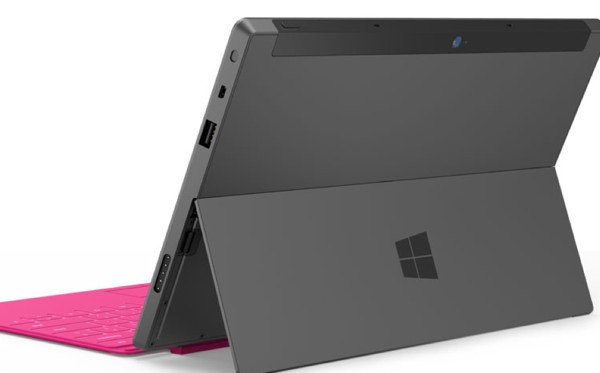
    A lawyer in California is suing Microsoft over his 32GB Surface, which he realized only had 16GB of free space. Andrew Sokolowski, the lawyer, is suing Microsoft for false advertising and unfair business practices, claiming that Microsoft should have told consumers that the 32GB Surface doesn’t actually have 32GB of free space.

    The suit aims to change how Microsoft advertises its device and hopes to force the company to give back revenue and profits that resulted from its alleged wrongful conduct.

    Microsoft said in a statement that it believes the suit is without merit.

    “Customers understand the operating system and pre-installed applications reside on the device’s internal storage thereby reducing the total free space,” the company said. It noted that people can add storage via the microSD slot and USB port.

    Microsoft confirmed on November 5 exactly how much usable storage space its Surface tablets come with out of the box. It says on its website that the 32GB Surface has 16GB of free space while the 64GB version has 45GB free. The Surface started selling October 26 and Sokolowski bought his device on November 7.

    Sokolowski’s lawyer, Rhett Francisco, said on Wednesday that his client never saw Microsoft’s responses and said the details on its website are “buried.”

    “They make you search and dig for it specifically, or you would never find it,” he said.

    It’s common for mobile devices to have less usable storage space than advertised.

  • HTC Could Pay Up To $8 Per Handset Sold To Apple in New Agreement

    HTC Could Pay Up To $8 Per Handset Sold To Apple in New Agreement

    htc

    Over the weekend, HTC announced that it has licensed several Apple patents for 10 years, and will pay the company an undisclosed amount per phone sold to use several features in its Android devices. The agreement came after a several year patent battle between the two companies, in which Apple accused HTC of patent infringement and even managed to delay the release of its One series devices in the U.S. through an import ban. While the statement also referred to “cross-licensing” of a select number of HTC patents, likely pertaining to LTE technologies, Apple is expected to be the ultimate winner in this deal.

    With the licensing settlement announced, it could set the bar for other Android OEMs, many of whom do not have the deep pockets of Samsung. So just how high is that bar? HTC is likely paying Apple between $6 and $8 per phone sold, which could account for nearly $200 million in revenue for Cupertino if HTC’s projection of 30 million devices sold next year is accurate. The Taiwanese company is already paying Microsoft some $5 per handset sold, but HTC says neither deal will have a material impact on its finances. HTC’s revenue for 2012 is expected to be roughly $10 billion CDN, though its last few quarters have seen a precipitous drop in net profit.

    Whether other companies will follow suit remains to be seen, but this is unlikely to be the last time we hear about Apple’s renewed, albeit less frantic, war on Android.

  • US FTC Pushes Antitrust Suit Against Google

    US FTC Pushes Antitrust Suit Against Google

    The Federal Trade Commission of the United States is raising the ante in its antitrust confrontation with Google with the commission staff preparing a recommendation that the government sue the search giant.

    Jon Leibowitz, chairman of the F.T.C., said the agency would decide whether to sue Google by the end of the year while Joaquín Almunia, competition commissioner for the European Union, said he was troubled by Google’s dominance.

    The government’s escalating pursuit of Google is the most far-reaching antitrust investigation of a corporation since the landmark federal case against Microsoft in the late 1990s. The agency’s central focus is whether Google manipulates search results to favor its own products, and makes it harder for competitors and their products to appear prominently on a results page.

    The staff recommendation is in a detailed draft memo of more than 100 pages that is being shared with the five F.T.C. commissioners, said two people briefed on the inquiry.

    The memo is still being edited and changes could be made, but these are mostly fine-tuning and will not alter the broad conclusions reached after an inquiry that began more than a year ago, said these people, who spoke on the condition that they not be identified.

    Google rivals specializing in travel, shopping and entertainment have accused Google, the world’s No. 1 search engine, of unfairly giving their web sites low quality rankings in search results to steer Internet users away from their websites and toward Google products that provide similar services.

    Computer users are overwhelmingly more likely to click on the top results in any search. The low ranking often forces companies to buy more ads on Google to improve their visibility, one source said.

    The agency also is examining whether the company is using its control of the Android mobile operating system to discourage smartphone and device makers from using rivals’ applications, two of the people said.

    The FTC began making calls to high-tech companies to gather information for its probe in April 2011 and Google disclosed in June of that year that the FTC had begun a review of its business practices.

    On the patent investigation, the agency is scrutinizing whether a strategy of seeking court orders to ban Apple Inc. and Microsoft from using mobile and video compression technology is anticompetitive, said the people.

    Meanwhile, Google has repeatedly denied any wrongdoing.

  • South Korean court bans some Apple, Samsung products

    South Korean court bans some Apple, Samsung products

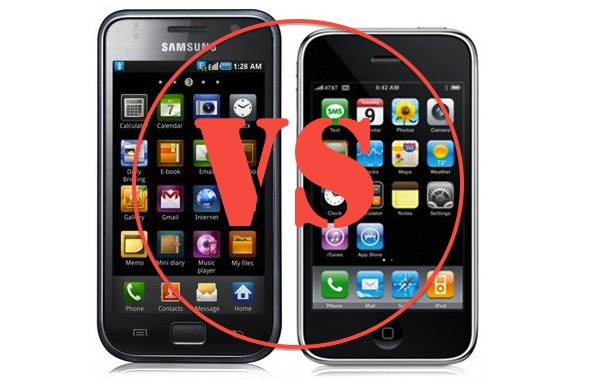
    Apple and Samsung have been ordered to stop selling some smartphones and tablet computers in South Korea and pay damages after a court ruled they each infringed the other’s patents.

    The South Korean court said that Apple had infringed two of Samsung’s wireless patents, while Samsung had infringed on a fruity firm patent related to a “bounce-back” touchscreen feature, Bloomberg, the Financial Times and others reported.

    The court also awarded damages to both sides, but only enough to cause a momentary fumble in their pockets. Apple only needs to pay 40m won ($35,000, £22,000) and Samsung just has to hand over 25m won ($22,000, £14,000).

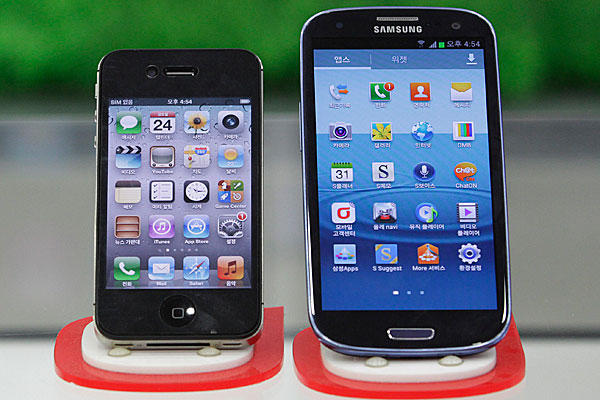
    The Seoul Central District Court ruling called for a partial ban on sales of products including iPads and smartphones from both companies, though the verdict did not affect the latest-generation phones — Apple’s iPhone 4S or Samsung’s Galaxy S3.

    The ruling affects only the South Korean market, and is part of a larger, epic struggle over patents and innovation unfolding in nine countries. The biggest stakes are in the U.S., where Apple is suing Samsung for $2.5 billion over allegations it has created illegal knockoffs of iPhones and iPads.

  • Apple seeks more than $2.5 billion in Samsung patent case

    Apple seeks more than $2.5 billion in Samsung patent case

    According to a partially redacted filing on Tuesday with a federal court in San Jose, California, Apple believes Samsung owes “substantial monetary damages” because the Korean company illegally “chose to compete by copying Apple.”

    Apple said this allowed Samsung to overtake it as the world’s largest maker of smartphones, and reap “billions of dollars in profits” while costing Apple $500 million of profit.

    It said damages, including reasonable royalty damages, reach “a combined total of $2.525 billion.” Apple said it also plans to seek a permanent injunction to stop future violations.

    Samsung countered Apple’s allegations in a filing 13 minutes later, accusing the Cupertino, California-based company of trying “to stifle legitimate competition and limit consumer choice to maintain its historically exorbitant profits.”

    It said Apple, in fact, should pay for the use of Samsung’s patented technology, “without which Apple could not have become a successful participant in the mobile telecommunications industry.”

    Their dispute is part of a worldwide legal battle over the alleged theft of technology used in smartphones and tablets, including those powered by Google Inc’s Android, which Samsung uses in its most popular devices.

    Apple Chief Executive Tim Cook and top Samsung executives last week participated in court-supervised mediation to try to resolve the case but a resolution appeared to be unlikely, people familiar with the matter said.

  • US Court lifts Galaxy Nexus smartphone ban, tablet still blocked

    US Court lifts Galaxy Nexus smartphone ban, tablet still blocked

    Whoops! Something went wrong!

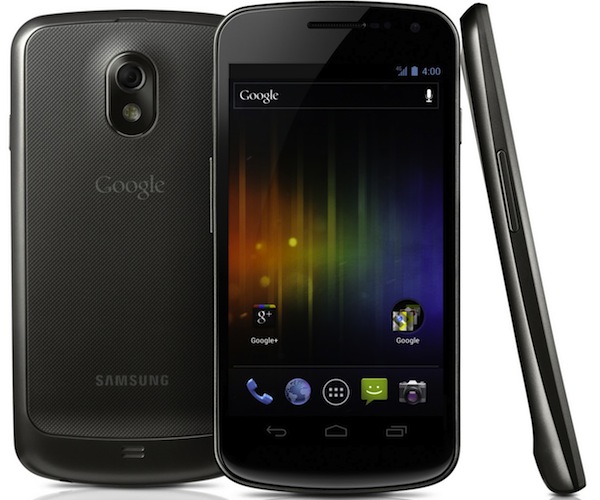
    A US appeals court gave Samsung a temporary reprieve Friday on the sale of its Galaxy Nexus 7 smartphones while leaving intact a court ban on US sales of its tablet computers in a patent battle with Apple.

    In two rulings in the bitter patent dispute, the US Court of Appeals in the capital Washington gave one to Apple and one to Samsung, but only temporarily.

    But the “stay” was just temporary until the panel receives arguments from Apple, which argues the phone infringes on patents in its iPhone.

    In a separate decision, the appellate judges refused to lift Koh’s injunction on the 10-inch Galaxy Tab computer, which Apple claimed was copied from the iPad.

    The court panel in Washington ordered Apple to respond by July 12, while denying a Samsung request to stay, or halt the injunction.

    Both Galaxy devices are powered by Android operating software that Google makes available for free to gadget makers. Nexus is the Mountain View, California-based technology company’s own branded line.

  • Apple loses patent war with HTC

    Apple loses patent war with HTC

    Taiwan’s HTC on Wednesday won a London court ruling against US tech giant Apple over a series of patent infringement claims linked to technology used in its mobile devices.

    London’s High Court said in a ruling carried on its website that HTC’s devices did not infringe four Apple technology patents.

    Along with the slide-to-unlock mechanism, HTC challenged Apple’s patents on the iPhone’s “multi-touch” system. Both are prize features in the American company’s portfolio, according to intellectual property experts. The other patents in the case related to the way the iPhone manages photographs, and the use of different character sets in text messaging.

    A HTC spokesman welcomed the London court’s ruling, which said parts of the slide-to-unlock patented were too “obvious” or foreshadowed by earlier patents.

  • Apple vs Samsung settles down as parties drop several claims

    Apple vs Samsung settles down as parties drop several claims

    Both Apple and Samsung have dropped several claims from the case against one another, after Judge Lucy Koh informed them to do so. Apple has reduced its case to one claim from each of its asserted utility patents, its four iPhone and one iPad design patents, and its trade dress claims for those two devices. While Samsung has dropped their cases to 15 altogether from a a total of 75 and completely deleted two claims.

    Both parties can later re-assert the removed claims in another lawsuit if they choose to do so.

    The case date for the hearing is on July 30th, after which a real outcome may finally be achieved.

    [Apple filing]

    [Samsung filing]

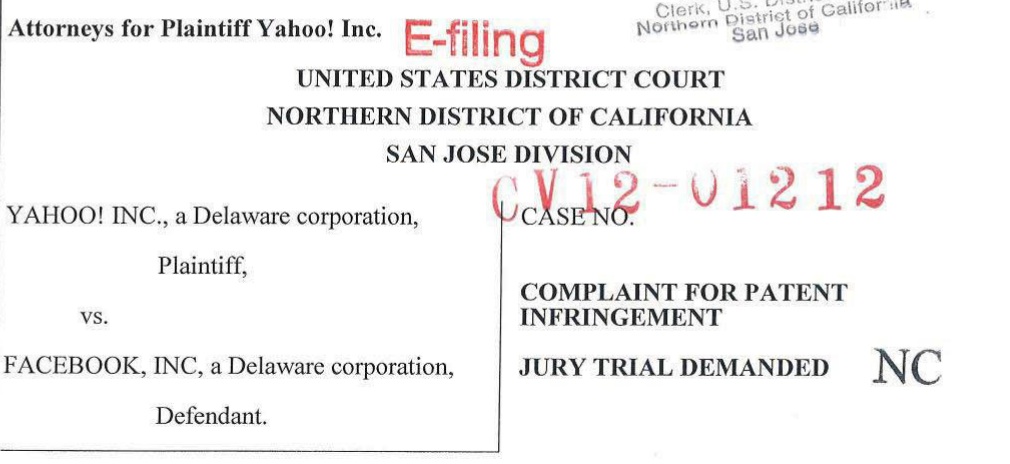
  • Yahoo sues Facebook for infringing on the social networking patent !

    Yahoo sues Facebook for infringing on the social networking patent !

    This is possibly going to be the biggest battle since the Apple vs Samsung saga began, Yahoo has allegedly filed a lawsuit to sue social networking giant Facebook for infringing on several patents that are owned by Yahoo. These patents include a series of things Facebook is famous for, ten patents in all, which cover everything from advertising and privacy measures to messaging and social networking itself.

    Yahoo claims that the company licenses its patents to several other companies but the matter of Facebook remains unresolved.

    Yahoo! has invested substantial resources in research and development through the years, which has resulted in numerous patented inventions of technology that other companies have licensed. These technologies are the foundation of our business that engages over 700 million monthly unique visitors and represent the spirit of innovation upon which Yahoo! is built. Unfortunately, the matter with Facebook remains unresolved and we are compelled to seek redress in federal court. We are confident that we will prevail.”

    – Yahoo Spokesperson

    Facebook on the other hand claims that there has been no real discussion when it comes to the matter of Facebook infringing Yahoo Patents. 

    We’re disappointed that Yahoo, a longtime business partner of Facebook and a company that has substantially benefited from its association with Facebook, has decided to resort to litigation. Once again, we learned of Yahoo’s decision simultaneously with the media. We will defend ourselves vigorously against these puzzling actions.”

    -Facebook


    [AllThingsD]

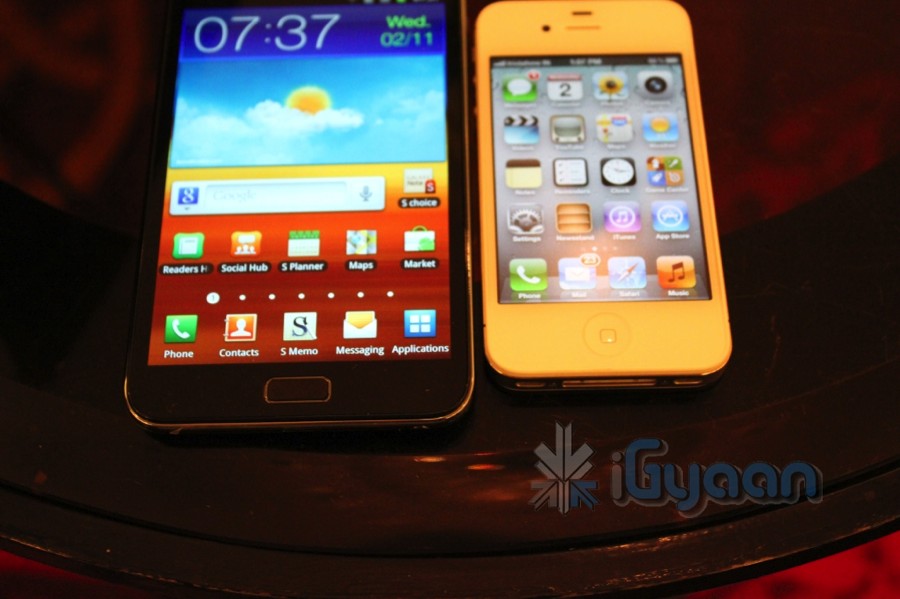
  • Apple vs Samsung Heats up : new complaint : 17 devices infringe 8 patents.

    Apple vs Samsung Heats up : new complaint : 17 devices infringe 8 patents.

    With the old lawsuit not yet over, Apple has filed a new complaint that attack 18 new Samsung devices. According to Apple the devices infringe 8 patents that are currently owned by Apple.  Four of the patents in question having been granted since the last time Apple filed suit against the Korean firm including missed call management, slide-to-unlock and data-syncing technology. 

    The devices infringing the patent include the new Galaxy Nexus along with all variants of the Galaxy SII, Galaxy Player 4.0 and 5.0, the Galaxy Tab 7.0 Plus and Galaxy Tab 8.9.

    Looks like this battle is going to be a never ending one, or at least till cupertino gets some korean slaves in its undertone.

    [Complaint (PDF)]

iGyaan Network
Privacy Overview

This website uses cookies so that we can provide you with the best user experience possible. Cookie information is stored in your browser and performs functions such as recognising you when you return to our website and helping our team to understand which sections of the website you find most interesting and useful.