
Earlier this week, Huawei unveiled a variety of new products at a Chinese event which includes the Nova 5 lineup and MediaPad M6 tablet duo. One significant offering that the company unveiled at the event is the Kirin 810 SoC which is featured in the Nova 5. The newly released chipset is intended towards devices that fall in the mid range and premium segment.
In terms of competition, the chipset that contends against Huawei’s offering is the Snapdragon 730 which is developed by Qualcomm. Antutu, a popular benchmarking platform has shared a comparison table that details the difference between the Kirin 810 and Snapdragon 730 across various aspects including CPU and GPU.
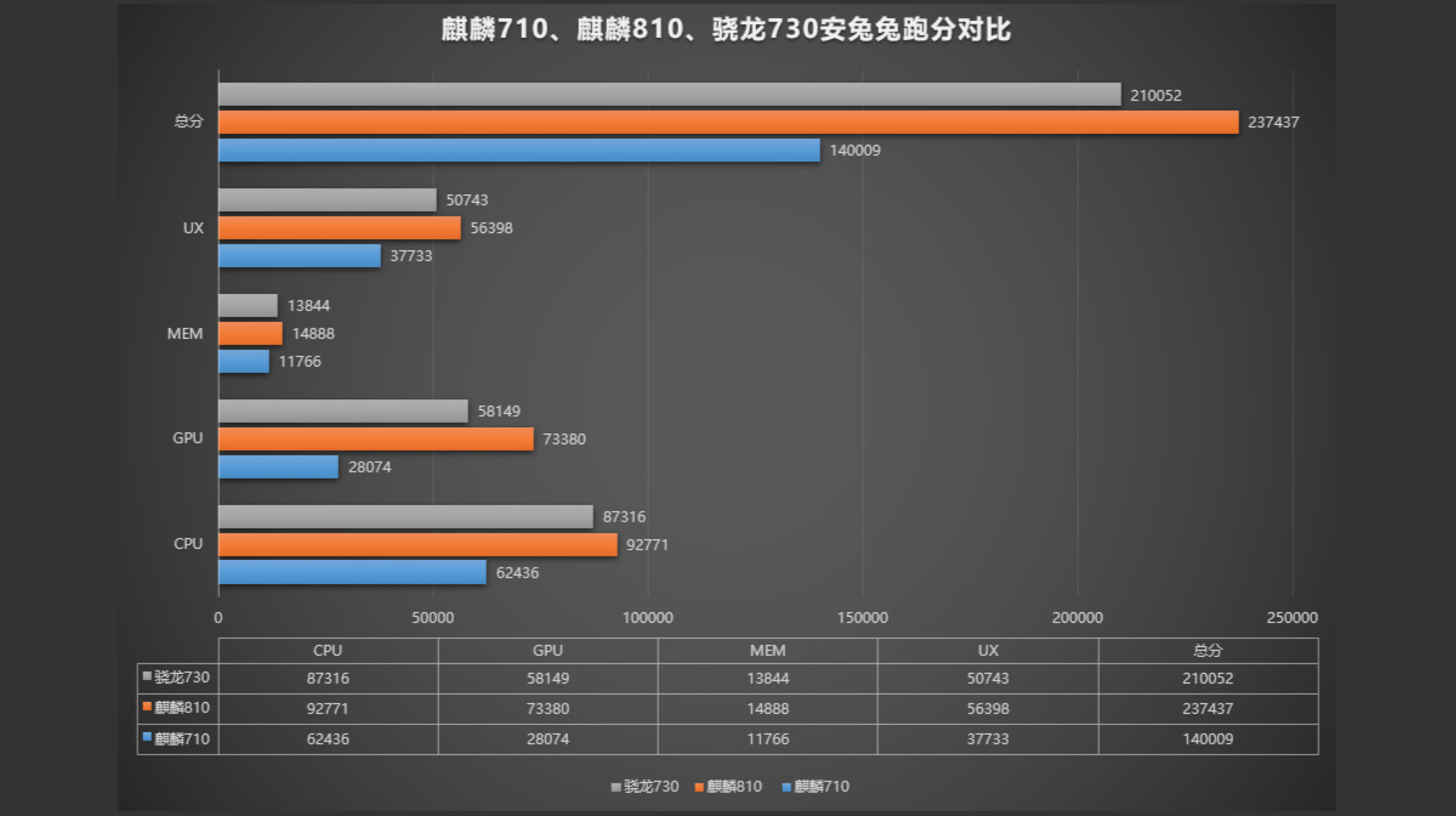 Noteworthy, in the GPU department, the Kirin 810 races far ahead of the Snapdragon 730. The former records a score of 73380 points while the latter only manages 58149. In no regards is the Qualcomm chipset underpowered, but the Kirin 810 trumps it in all departments.

To recap, the Kirin 810 SoC is fabricated using 7 nm process and is manufactured by TSMC (Taiwan Semi-Conductor Manufacturing Company). It consists of an Octa Core CPU along with the Mali G52 GPU. The eight core CPU setup is comprised of two different clusters which include 2x Cortex-A76 cores which are clocked at 2.27 GHz and 6x Cortex A55 cores which are clocked at 1.88 GHz. This combination of two different CPU architecture and clock speed clusters allow devices employing the chipset to provide the optimised equilibrium of performance and battery life.
Also Read: Samsung Is Launching Three New Galaxy Tabs Next Week
To sum it all, Huawei has done a fantastic job with its latest chipset which will definitely give Qualcomm’s Snapdragon 730 a run for its money. As of now, the Nova 5 is the only device equipped with the SoC but Huawei is expected to unveil a whole array of handsets with this chipset in the coming future.

 The Snapdragon 665 chipset is the base model in the lineup unveiled on April 9, however, it has significant improvements over the Snapdragon 660. The new 11nm chipset comprises of an octa-core Kryo 260 CPU. Four cores of the aforementioned 8 cores are dedicated to performance, while the other cores enhance the efficiency of the device, the company claims. For graphics, the chipset packs an Adreno 610 GPU with the Vulkan 1.1 graphics driver. Furthermore, the chipset features Qualcomm aptX Adaptive Audio and Aqstic to improve the gaming experience of the user.
 The company has included the Spectra 165 ISP, which integrates support for triple cameras and AI while capturing images. Also, the chipset enables features such as Hybrid autofocus, zero shutter lag and optical zoom, in addition to 48-megapixel image support. The SoC has the third-generation Qualcomm AI Engine, providing support for features such as 3D Face Unlock. Qualcomm claims that the chipset will deliver almost 2x faster AI device processing than the Snapdragon 660. Moreover, the SoC is enabled with Quick Charge 3.0 Fast Charge technology.
 Qualcomm made it quite clear that the Snapdragon 665 will be targeted towards smartphones lying in the entry-level segment. For mid-range segment devices, the San-Diego company unveiled the Qualcomm Snapdragon 730, which is built on an 8nm process. Some features that were previously only present on Snapdragon’s 8xx series have been carried over to the Snapdragon 730. The SoC comprises of Kryo 470 octa-core CPU, which have a maximum clock speed of 2.2 GHz. Six cores are dedicated to regulating the power and efficiency of the smartphone, whereas the other two cores are dedicated solely to performance. The chipset has the Adreno 618 GPU, which is claimed by the company to provide a 25% performance boost over its predecessor.