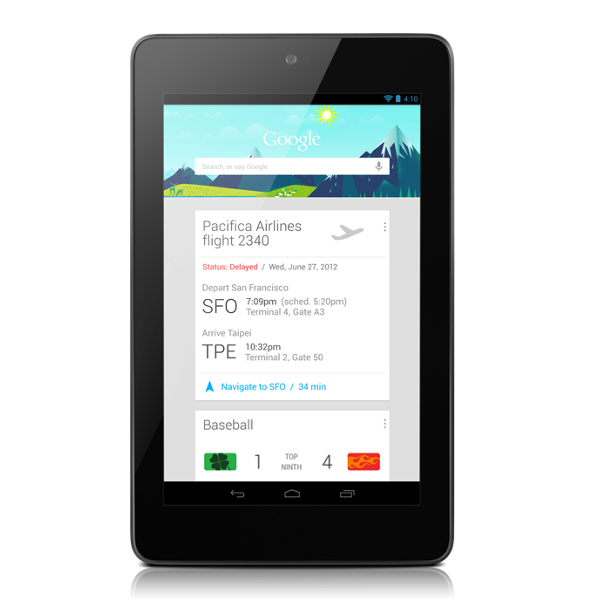
The Nexus 7 sequel has been on the docket for a long time, and rumoured specifications have been floating around for months — a 7-inch 1280×800 display, a quad-core Snapdragon 600 SoC, 2GB RAM, a 1.2MP front-facing camera, 5MP rear camera, Android 4.3 — but nothing has been confirmed.
Today Google started sending out invites to a “breakfast” conference being held next week with Android head, Sundar Pichai, but Engadget got their hands on an internal OfficeMax document stating that the “new Google Nexus 7″ is also launching next week. Coincidence? Probably not.
The device is expected to launch at $229 USD for the 16GB model, increasing to $269 for the 32GB version. Not the $199 we saw the original debut at, but this is a much more powerful machine.
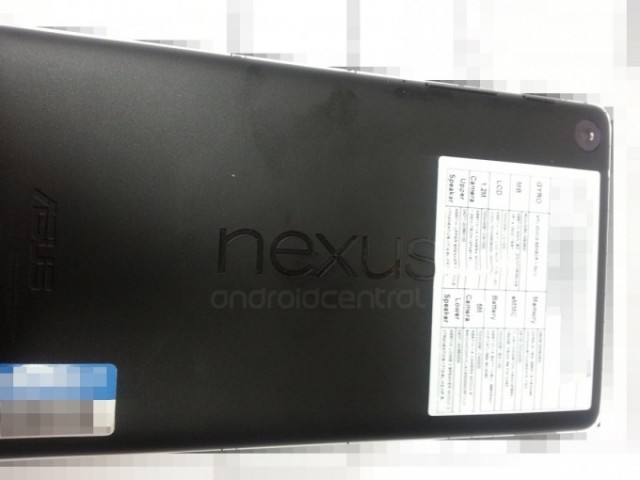
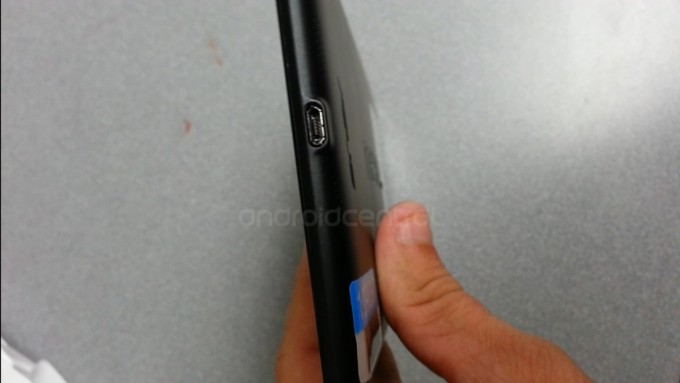
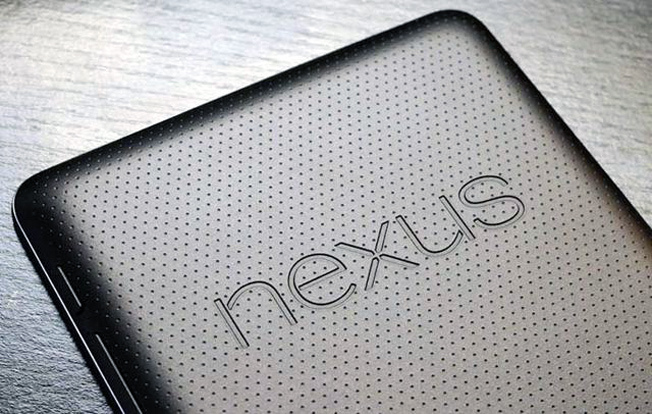
The more interesting info comes from Android Central, who got their hands on the device itself. “we have no idea if what we see here is a finished product, or prototype,” cautions the site, but the pics certainly look legitimate.
The only change from previously rumoured specs according to Android Central being the inclusion of 4GB of RAM (unlikely) and a slower Snapdragon S4 Pro SoC. And, of course, it will be manufactured once again by Asustek.
The new design appears to mimic its predecessor. The Nexus insignia on the rear is similarly placed as before, as are the various buttons, rockers and ports. There are two speakers on the device, which will provide stereo sound playback and hopefully be an improvement over the original.
The design is also slightly more squared-off than last year’s model, but we can’t be sure if what we’re seeing is a prototype or a finished product.
Google is also expected to launch Android 4.3 next week, a small but important update to the current software. The existing Nexus 7, as well as the Galaxy Nexus, Nexus 4 and Nexus 10 should receive the new version in the weeks following the announcement.
For its part, Apple is also expected to refresh its 8-inch tablet in the not-so-distant future.Recent rumors suggest that a new version of the iPad mini will launch alongside a redesigned iPad 5 this fall, though it doesn’t sound like it’ll get the Retina treatment.
What do you think of the next-gen Nexus 7 thus far?
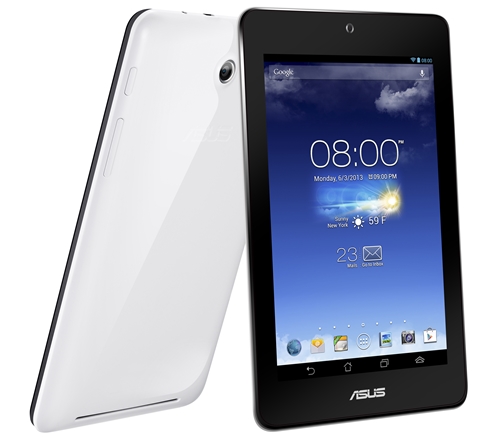
Asus is on a roll here. After announcing an entire lineup of new products, it has now unveiled the Asus MeMO Pad HD7 and the Asus MeMO Pad FHD 10.
While the Asus MeMO Pad HD7 retains much of the same design (and most of the same name) as that of its predecessor, it is tweaked a bit to make it both thinner and lighter than it’s predecessor — down to 10.8mm thick and 302g in weight. On the display side ASUS bumps things to “HD” with a 1280×800 IPS display, up from the original 1024×600 panel.
On the inside, the Asus MeMO Pad HD7 is running an ARM Cortex A7 quad-core CPU, but didn’t specify a clock speed or manufacturer. It did specify that the tablet will have both Bluetooth 4.0 and GPS, however, along with the addition of stereo speakers and a 5MP rear camera (keeping a 1.2MP shooter up front). Pinning this device at the low-end are some appealing prices too: 16GB for $149, 8GB for $129. The MeMO Pad HD7 will be released in a few different bright color options, with no specific sales dates given at this point.
The Asus MeMO Pad FHD 10, meanwhile, runs on the Intel Atom Z2560 processor, also known as Clovertrail+, with a dual-core 1.2GHz Saltwell CPU and PowerVR SGX 544 MP2 GPU. It also has a 10.1-inch 1920 x 1200 resolution display, 2GB RAM, 16/32GB internal storage, 5 megapixel rear camera with auto-focus, 1.2 megapixel front camera, Wi-Fi 802.11a/b/g/n, Bluetooth 3.0, Android 4.2 Jelly Bean and a 10-hour battery life.
No word on Indian pricing and availability yet! Stay tuned for more!
During its press conference, held at Computex , ASUS announced the Tegra 4 based Transformer Pad Infinity and Fonepad Note.
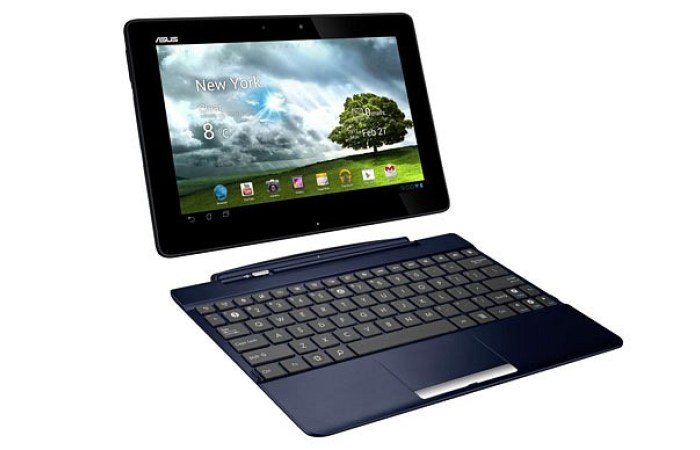
The latest addition to the Transformer line will come with Nvidia’s 72-core GeForce graphics card in addition to the Tegra 4 Cortex A15 CPU clocked at 1.9GHz with 2GB of RAM. It runs on Android 4.2.2. This means it can handle the most demanding mobile games you’ll find in the Google Play store.
It boasts a 2560 x 1600 IPS display and also comes with a mobile dock that includes a touchpad and keyboard. It also features the hallmark metallic finish you’ll find on other Asus flagship products such as its line of Zenbook ultrabooks. There’s 32GB of internal storage.
It also has a USB 3.0 port, 32GB of storage, a 5-megapixel camera, and a 1.2-megapixel front-facing camera. It sports a HDMI 1.4 output with support for 4K / Ultra HD and Wi-Fi 802.11n dual band.
Asus has yet to reveal pricing or availability for the Transformer Pad Infinity.
Image Credit : The Verge
Asus then announced the Fonepad Note, a tablet that also serves as a smartphone. It sports a Super IPS + “(1920 x 1080 pixels) display with a stylus and is powered by a 1.6GHz Z2560 “Clover Trail” Atom processor (the Z2560) with 2GB of RAM, and a typical 8-megapixel rear-facing camera round out the spec list.
Connectivity is based on the 802.11n Wi-Fi, Bluetooth as well as 3G + up to 42 Mb / s.
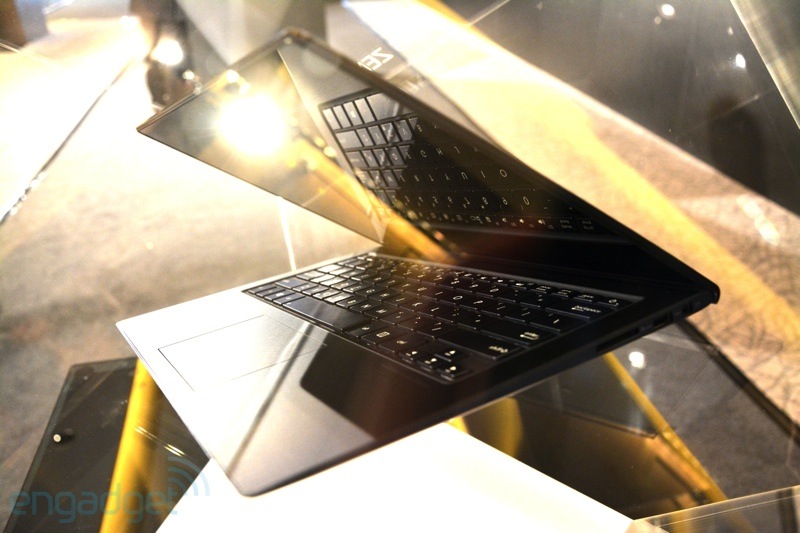
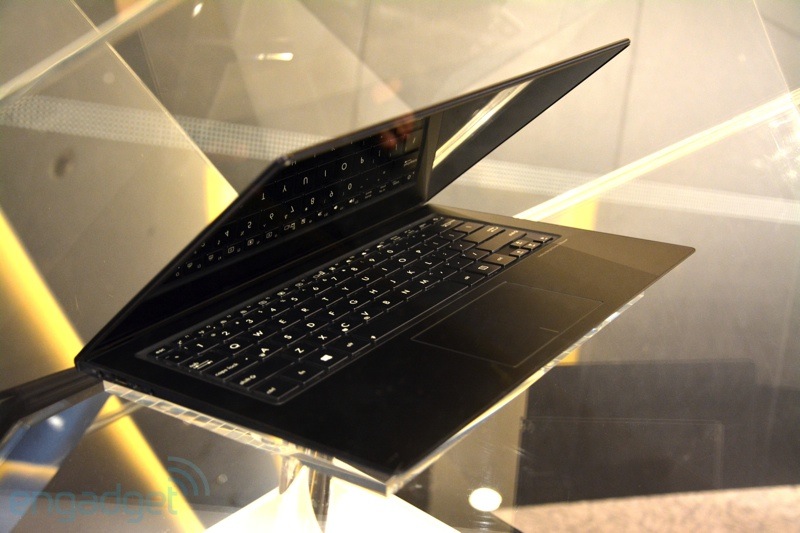
Asus has unveiled its new Zenbook Infinity Ultrabook during Computex 2013 today, the world’s first Ultrabook to sport a lid comprised entirely from Corning’s Gorilla Glass 3.
The Gorilla Glass has been fused directly to the aluminum frame, allowing for a thickness of just 15.5-mm thin (about 0.61 inches). That’s 14-percent thinner than the previous generation Zenbook, the company said.
Image Credit : Engadget
New Corning Gorilla Glass 3 has the same durability and thinness as Gorilla Glass 2, but uses Corning’s proprietary NDR glass composition for superior scratch resistance, reduced scratch visibility and improved toughness. Corning Gorilla Glass 3 with NDR has three times the scratch resistance of Gorilla Glass 2, and gives a 40% reduction in the number of highly visible scratches with a 40% improvement in retained strength if a deep scratch does occur.
The Asus Zenbook Infinity has a built-in touchscreen as well as a backlit keyboard. Inside, there is a 28W dual-core Haswell part with GT3 graphics, otherwise known as Iris 5100. It will come in at a similar 13.3-inches like the Asus Zenbook Prime.
It also has a USB 3.0 port on each side, along with an SD card slot, micro-HDMI port and a Mini DisplayPort.
The new Zenbook Infinity isn’t slated to hit the market until Q4, and hence further specifications have not been revealed yet! Stay tuned!
Asus India today launched the world’s first dual OS, Windows 8 and Android 4.1, All-in-One PC, the ASUS Transformer AiO.
It has an 18.4-inch LED-backlit display, featuring 1080p HD resolution with 10-point multi-touch and IPS technology, docked onto a stand. When docked, the AiO is a Windows 8 PC, with a dual-core / quad-core Intel Ivy Bridge CPU, but once removed you get an Android Jelly Bean running tablet PC.
“With the introduction of new product, we are creating a new segment or in other words all-in-one product. Our efforts are to grow this new segment by coming out with innovative products and which gel with the consumers’ demand,” ASUS (India) Country Head (Component Business) Vinay Shetty said.
The Transformer AiO comes with an Nvidia GeForce GT 730M GPU paired with 2GB of RAM taking care of the graphics, while the tablet of the device is powered by the quad core Nvidia Tegra 3 processor coupled with 2GB of RAM along with 32GB of on board storage.
The device comes with plenty of connection options as well with 4 USB 3.0 ports, 1 USB 2.0 port, and the tablet has a microUSB socket. Both devices also support Bluetooth 4.0 and HDMI outputs.
The Asus Transformer AiO is available with Core i3, i5, and i7 processor options with 4 to 8 GB of RAM. The India pricing for the device ranges between Rs. 87,000 to Rs. 1,07,000 depending on the choice of processor and RAM. It is currently available only through ASUS-exclusive stores and comes with a 3-year warranty.
Internet giant Google is reportedly gearing up for the launch of a successor for last year’s Nexus 7 tablet PC, and might release it on shelves as soon as July, a new report from Reuters on the matter suggests.
We have already reported on a possible new 7-inch Nexus tablet coming from Google and ASUS, with no official confirmation on the matter available as of now, but it seems that we might indeed be nearing a formal unveiling of the device.
The latest version will have a higher screen resolution, a thinner bezel design and adopt Qualcomm’s chip in place of Nvidia Corp’s Tegra 3, which was used in the first Nexus 7s released last year, the sources said, declining to be identified because they are not authorised to speak to the media.
In a blow to Nvidia, Google weighed both U.S. chipmakers’ processors but finally decided on Qualcomm’s for power reasons, one of the sources added.
Qualcomm and Nvidia are competing aggressively in the tablet market as they seek to expand from their traditional strongholds of cellphones and PCs respectively.
Google will maintain an aggressive pricing strategy, however the two sources are split on exactly how that will be achieved: the new Nexus could come in at $199, with the older model seeing a discount, or $149, obviating the elder Nexus 7 entirely.
The tablet would likely be equipped with Google’s next Android version, Key Lime Pie, so there’s plenty to look forward to.
The Asus Transformer AiO is an all-in-one that is really more-than-one.
Asus lays claim to the world’s first device that runs Windows 8 and Android 4.1 Jelly Bean, depending on your need at that point in time. The Asus Transformer AiO (All in One) would make for an interesting addition into any home or office, and it does its name justice too, as the Asus Transformer AiO can switch from Windows 8 to Android 4.1 Jelly Bean with a simple button click.
The design of the transfer AIO PC is such that when being used in the desktop mode, it runs on Windows 8 while if you decide to use it as a tablet, it will give you all the goodness of Android 4.1 Jelly bean.
The Asus Transformer AIO hybrid PC comes with a 18.4-inch IPS display that has a resolution of 1920 x 1280 pixels and also supports a 10-point multi-touch.
When being used in the desktop mode, the device gets powered by Intel Core processors (ranging from i3 to i7) while in the tablet mode, it is powered by an Nvidia Tegra 3 processor. How? Well, just via the press of a button! When the screen is docked in to it’s holder it runs on Windows 8 being powered by Intel Core processors and discrete Nvidia graphics whereas by just pressing a button located on the side, it can start running on Android powered by Nvidia Tegra 3 processor.
To ensure easy portability of the device, Asus has added an integrated handle on the device so that it can be carried easily when being used as a tablet. As far as storage is concerned, you’ll get 1TB of storage space while running windows 8 while just 16GB of storage space on Android.
It has now been confirmed that the Asus Transformer AIO PC would go on sale in Q2 (about April) 2013 for a price of $1,299 for the Core i3 variant, while the Core i5 and i7 variants would follow soon but their pricing hasn’t been revealed yet.
Asus has started rolling out an update to Android 4.2 Jelly Bean for its Transformer Pad TF300 tablet.
The software update means that the Transformer Pad 300 is the first tablet to get Android 4.2 Jelly Bean aside from Google’s Nexus 7 and Nexus 10. Asus is rolling the firmware out in the US from today and other regions during March.
In a time where Android 4.2 is still a rarity for those who don’t own a Nexus device, ASUS has come along and, once again, put a lot of OEM to shame with swift action on the latest version of Android.
Along with all of the goods Jelly Bean 4.2 brings, including widgets on the lock-screen and user profiles for multiple users, ASUS will also have significant updates in tow for its App Locker, its virtual keyboard, the lock-screen and setup wizards. Users can grab the upgrade over-the-air so be sure to take a quick trip to the Settings > About Tablet menu where you’ll be able to pull this one down.
In related news, ASUS has confirmed several other tablets in its lineup that will get Android 4.1 in the second quarter of this year. These tablets include the Transformer Pad Infinity, the ASUS MeMO Pad Smart 10, and the MeMO Pad.
Good going Asus!
[toggle_box title=”Press Release” width=”Width of toggle box”]
Android 4.2 released for the ASUS Transformer Pad TF300
Improvements include enhanced performance, stability and multiple user account logins
Fremont, CA (March 4, 2013) — ASUS is excited to announce Android 4.2 is now available in the US region for the ASUS Transformer Pad TF300T. Android 4.2 will be released to Transformer Pad owners via a free over the air update starting today in the United States and will be available in other regions during March. This new version of Android enhances performance and stability, improves the user experience with new features as well as providing multiple user account logins.
The ASUS Transformer Pad TF300 is one of the most successful ASUS tablets to date and offers a full notebook PC experience when attached to the innovative mobile dock. ASUS is committed to providing the best customer experience, and is the first manufacturer to receive Android 4.2 for partnered tablets. The ASUS Transformer Pad Infinity, ASUS MeMO Pad Smart 10”, and ASUS MeMO Pad will receive Android 4.2 in Q2.
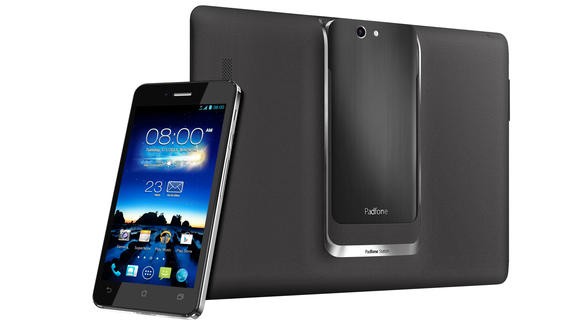
Asus has announced a new version of their Padfone, the Asus Padfone Infinity, which is a 5 inch smartphone and 10 inch tablet device that can be docked together to form one device.
The successor to the company’s hybrid tablet/smartphone has a redesign with an aluminum back and edge-to-edge glass display, a 5-inch display with 1920 x 1080 resolution and 441 PPI.
The PadFone Infinity runs Android 4.2, the latest version of the OS, and is powered by a 1.7GHz Qualcomm Snapdragon 600 quad-core processor, and an Adreno 320 Graphics processor. It has 2GB RAM and offers 32GB/64GB of internal storage. The PadFone also supports LTE connectivity and NFC.
The Padfone Infinity packs a 13MP F/2.0 main camera which has a dedicated image signal-processor to enhance low-light image quality and to enable PadFone Infinity to capture up to 100 sequential photos at 8 frames-per-second, while simultaneously recording 1080p full-HD video.The PadFone Infinity can also record 1080p full-HD video via its micro-USB-compatible MyDP interface. There’s also a front-facing camera – 2MP, F/2.0.
The phone itself has a unibody design and is made of aero-space grade aluminum alloy, with brushed finish.
The Asus Padfone Infinity also features a 2,400 mAh battery with up to 19 hours of talk time over 3G and up to 40 hours when it is docked with the tablet, it will launch in Europe in April.
It sounds as though Asus is looking to ship the latest PadFone for around £875 (around Rs 72,000, $1325, €999 or AU$1287) so if you like the sound of it, you’d better get saving. The PadFone Infinity release date has been set for April.
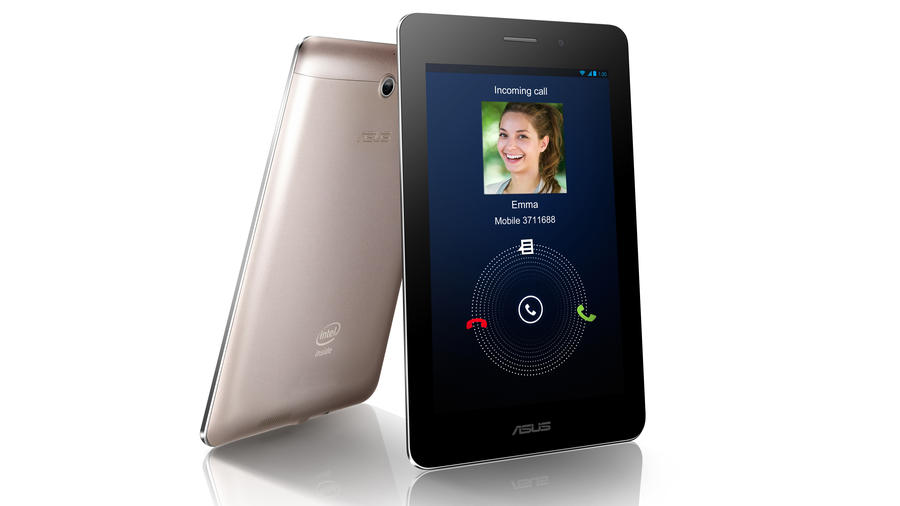
Asus has unveiled its latest handset at MWC 2013 – the Asus FonePad, which it describes as ‘a phone that’s also a tablet’.
The company has obviously seen that, hey, that Samsung Galaxy Note’s doing quite well, and decided it wants a piece of the ‘phablet’ action.
It’s a 7” tablet with an IPS screen of 1280 x 800 resolution and sports full phone functionality with 3G HSPA+ connectivity. Of course there’s also WiFi (B/G/N) and Bluetooth 3.0.
Hardware-wise, the ASUS FonePad is one if the slowly rising number of Android devices with an Intel processor. It is powered by an Intel Atom Z2420 at 1.2GHz which has an integrated PowerVR SGX540 graphics processor (GPU). There is 1GB of RAM and 16GB of internal storage (+32GB microSD max).
There are two versions of the Asus Fonepad. In Europe, the tablet will come with 16GB of built-in storage and a 1.2MP front-facing camera. It will launch in April for €220.
For the APAC region, the Fonepad will have only 8GB of built-in storage but it grows a 3MP camera on the back. This one will launch in March for $250. Both have microSD card slots and 5GB of lifetime Asus WebStorage.
The rear camera will capture only 720p video, but there’s enough power on tap to playback 1080p video you might have imported to the device.
In the near future, people will wear head-mounted computers and control them by moving hands through the air. They’ll learn guitar using programs that track the placement of each finger on each string. And in online combat games, they’ll smite an enemy with their fists.
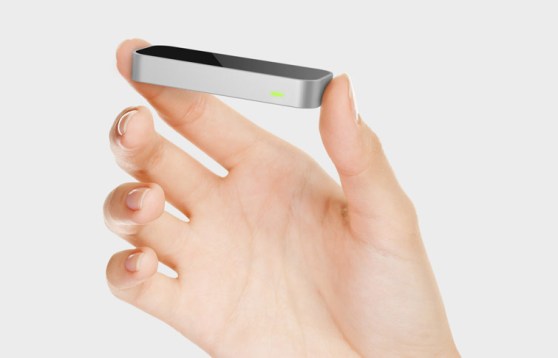
Those are some of the applications that founders of Leap Motion foresee for motion sensing, as precision improves and pricing declines. And as the company prepares to launch its first product in Q1 – a $70 motion-sensing device that works with a computer – VCs are buying into the vision.
Leap Motion announced that it has raised $30 million in Series B funding. Co-founder and CEO Michael Buckwaldsaid that the company is still planning to ship its gesture-based controller sometime during the first quarter of this year, and he’s also announcing a partnership with Asus that should help get Leap Motion into the hands of consumers.
In this case, Asus is supposed to bundle the Leap Motion controller with its All-In-One PCs and high-end notebooks.
[quote]
“Leap Motion is poised to fundamentally change human/computer interaction, and this new funding will help us bring our technology to the mass global market,” said Leap Motion CEO Michael Buckwald. “With this influx of capital, coupled with the major OEM partnership we also announced today, we’re ready to make 2013 the year of the new interface.”
[/quote]
The new funding round will be used to scale manufacturing in preparation for the retail launch of the Leap Motion controller in early 2013. Leap Motion’s technology can track movements to 1/100th millimeter — smaller than the tip of a pin — with no visible lag time. The Leap Motion controller has a 150-degree field of view, and tracks individual hands and all 10 fingers at 290 frames per second.
David Chang, ASUS’ CFO, stated last month that shipments of the Nexus 7 were initially slow, popping in around “500K units a month, then maybe 600, 700K.” He then declared October was a breakout month with shipments getting “close to one million.”
With the recent release of the 32GB Nexus 7 and 32GB 3G version you can expect interest to peak, especially at their low-cost price points. News today from an overseas report in DigiTimes claims that their supply chain sources believe that Nexus 7 shipments – all models – will reach 5 million units by year end. That’s not to hard to imagine as the above numbers total 2.8 million, so another 2.2 million in the next couple months is certainly possible.
It’s no secret that a lot of the tablet’s success is down to it’s brilliant pricing. For what you get with the Nexus 7, it’s incredible value for money and a price that no other Android tablet has yet matched. At it’s current pricing, you can get the Nexus 7 with 16GB of storage for $199 and the 32GB model for $249. As of last week there’s the addition of the 32GB Nexus 7 with 3G connectivity for $299, which is pretty cheap for a tablet of its specs with 3G, often the premium for 3G is a lot higher on tablets.
The tablet comes with 7-inch IPS display screen with a 1280×800 resolution and is powered by 1.3GHz Nvidia Tegra 3 processor. Other features of the tablet include 1GB RAM, 1.2-megapixel front camera and 4325mAh battery.
Apparently, an Asus Google Nexus 7 spontaneously combusted as a result of being plugged in to a standard wall charger.
The owner, who posted the set of images in a Chinese forum, claims she left the device to charge for a total of 3 hours using the factory OEM charger before the tablet went up in flames. As we’ve seen before, these types of incidents leave plenty of room for controversy, though it seems as though this particular case is legitimate. In fact, ASUS has already acknowledged the problem and has sent out a fresh replacement free of charge.
According to CNET, the owner will also be getting a free pair of Google Glass upon release, but it seems pretty unlike that Asus is going around promising people Google hardware, and there’s no evidence that Google itself has addressed the incident. Google Glass or no, it looks like Asus is fairly willing to bet this is going to be a one time event by providing a free replacement.
Until we hear something official from ASUS, you may want to make sure your device isn’t sitting next to anything valuable or flammable.
The Google Nexus 7 Tablet will go on sale today in India. Tablet maker Asus confirmed that sale of the tablet would begin today, with an entry level Nexus 7 with 16GB storage priced at Rs 19,990. The Nexus 7 available in India is not the new Android 4.2 variant recently announced but the original Jelly Bean version launched early this year.
The Nexus 7 has a 7-inch screen with IPS (in-plane switching) screen with a resolution of 1,280×800 pixels. The Nexus 7 has a 1.3GHz Nvidia Tegra 3 quad-core CPU, which includes a 12-core GPU. It also has a Micro-USB port, 1GB of RAM, and a 1.2-megapixel front camera . The Nexus 7 has been touted as one of the best 7 inch tablets and only stand in competition to Kindle Fire HD and the likes.
The Nexus 7 also has a more enhanced display according to display tech expert display mate. The Rs 19,999 price is for the Nexus 7 with 16GB storage. The same model sells in the US for $199. Until a few weeks ago, this model used to cost $249 while the one with 8GB storage was sold for $199. But on October 29, Google discontinued the 8GB version of Nexus 7. It reduced the price on 16GB model and introduced a new model with 32GB storage. It also launched the 3G version of Nexus 7 with 32GB storage.
Google today announced the Google Nexus 4 Smartphone, the Google Nexus 10 Tablet and the 32 GB version of the Google Nexus 7 tablet.
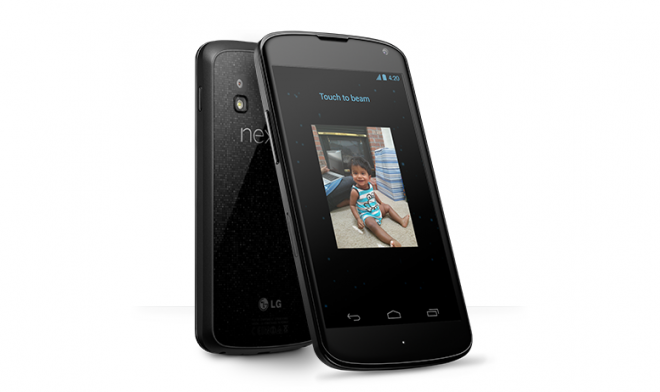
The Google Nexus 4, the newest smartphone in the Nexus line-up from Google, was announced today for availability starting next month in select markets.
[quote]“LG is proud and excited to play this role in helping build the latest Nexus smart-phone,” said Dr. Jong-seok Park, President and CEO of LG Electronics Mobile Com-munications Company. “Users will be delighted by the perfectly balanced combination of form and function with the latest generation of Android.”[/quote]
The specs of the Google Nexus 4 include a 4.7-inch True HD IPS Plus display (1,280 x 768), an 8 megapixel rear camera, Gorilla Glass 2, a Qualcomm Snapdragon S4 Pro processor, 2GB of RAM and the latest rendition of Google Now. Turn-by-turn navigation via Google Maps is included, as are 3D Maps, Street View and Indoor Maps. The Nexus 4 will be sold unlocked, supporting some 200 carriers that play by the GSM / HSPA+ rules. It’ll be made available in both 8GB and 16GB versions starting November 13 in the US, UK, Canada, Germany, France, Spain and Australia, with pricing set for $299 (8GB) / $349 (16GB).
[quote]“This is the first time we collaborated with LG to build a Nexus device,” said Andy Ru-bin, Senior Vice President of Mobile and Digital Content at Google. “They brought an extraordinary amount of talent to the project, and the result is a feature-packed device that feels great in your hand, and blazingly fast under the hood.”[/quote]
[toggle_box title=”Press Release” width=”Width of toggle box”]
LG AND GOOGLE ANNOUNCE NEXUS 4
Sleek, New Smartphone Combines LG’s Best-in-Class Hardware with the Best of Google
SEOUL, Oct. 30, 2012 – Designed collaboratively by LG and Google, Nexus 4, the newest smartphone in the Nexus line-up from Google, was announced today for avail-ability starting next month in select markets. With a sophisticated hardware design from LG, your favorite Google Apps, and the latest version of Android™, Nexus 4 puts the best of Google in the palm of your hand.
“LG is proud and excited to play this role in helping build the latest Nexus smart-phone,” said Dr. Jong-seok Park, President and CEO of LG Electronics Mobile Com-munications Company. “Users will be delighted by the perfectly balanced combination of form and function with the latest generation of Android.”
“This is the first time we collaborated with LG to build a Nexus device,” said Andy Ru-bin, Senior Vice President of Mobile and Digital Content at Google. “They brought an extraordinary amount of talent to the project, and the result is a feature-packed device that feels great in your hand, and blazingly fast under the hood.”
Capture and share your world Nexus 4 comes with a high-performance 8MP camera and takes stunning Photo Sphere images, letting you capture every detail of the world around you. Up, down and all around you, it’s like no camera you’ve ever seen; with Nexus 4, you can snap pictures in every direction that come together into incredible, immersive Photo Spheres that put you right inside the scene. Plus, photos upload themselves with Instant Upload so you’ll never lose a shot.
All of this comes to life with stunning clarity and crisp, natural color on the vibrant 1280-by-768 4.7-inch True HD IPS Plus display supported by Zerogap Touch technol-ogy. Gently curved glass edges allow your finger to slide smoothly on and off the 320ppi screen, while cutting edge display technology means you feel like you’re touch-ing every pixel, protected by scratch resistant Corning? Gorilla? Glass 2.
Built for speed Nexus 4 comes with a cutting-edge Qualcomm Snapdragon™ S4 Pro processor, so you’ve got speed and power to spare. Zip around the web, experience rich 3D graphics and gameplay, and effortlessly switch between multiple apps without ever missing a beat. With 2GB of RAM and the fastest version of Android ever, Nexus 4 is the snappi-est Nexus smartphone yet.
Information at your fingertips Nexus 4 comes with the latest Google apps, putting the best of Google in the palm of your hand. The latest version of Google Now is built-in, which keeps you even more organized – get reminders about upcoming flights, restaurant reservations, hotel confir-mations and even nearby photo opportunities – when and where you need them.
Get to the places you care about quickly and easily with Google Maps™ for Android. With turn-by-turn GPS navigation, live traffic info, and integrated driving, walking and public transit directions, getting from A to B has never been easier. 3D Maps and rich satellite imagery give you a more realistic sense of what’s around you while features like Street View and Indoor Maps make sure you always know what’s in front of you.
Nexus 4 is sold unlocked and is GSM/HSPA+ compatible so it will operate on more than 200 network providers worldwide. Just pop in a supported SIM card and be up and running in no time. It will be available to purchase in both an 8GB version and a 16GB version on Google Play™ starting November 13 in the US, UK, Canada, Germany, France, Spain and Australia. Offline availability in Europe, Central/South Americas, Asia, CIS and the Middle East will begin from the end of November.
[/toggle_box]
Also, Google released the 32GB version of the Nexus 7 tablet, signalling an end to the 8GB version. The 16GB Google Nexus 7 has now taken center stage in Google’s Play Store, with $199 netting you a slate that’s currently boasting a “now shipping” status. Those willing to fork out $249 can get a 32GB model (also listed as “In Stock”), while $299 provides access to a GSM-enabled 32GB model that’ll hop onto cellular networks — unfortunately, that one’s listed as “coming soon.”
And last but not least, out comes the iPad rival from Google’s stable, the Google Nexus 10. The new tablet, built in collaboration with Samsung, has one big bragging point — the highest resolution display of any tablet on the market — a 2560 x 1600, 300ppi, 10-inch touchscreen. Google promises about 9 hours of continuous video playback and about 500 hours of standby time. Despite being a Nexus device, the new tablet picks up on the design language of the Galaxy Tab 10.1 and Galaxy Note 10.1. It features a pair of front-facing stereo speakers on either side of the display (when it’s held in a landscape orientation) plus an 8-megapixel rear camera and a 1.9-megapixel front camera for video chats. Under the hood, there’s a dual-core processor, 2GB of RAM and built-in NFC. It also gets a built-in micro-HDMI port.
Like the Nexus 4, the Google Nexus 10 will ship with Android 4.2 Jelly Bean. One new 4.2 feature Nexus 10 users may enjoy is the ability to have multiple user profiles on a single device. The Nexus 10 will ship on Nov. 13 at a price of $400 for 16GB of storage and $500 for 32GB.