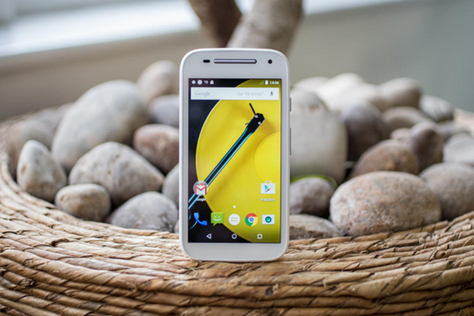
Launched a few weeks back with Android 5.0 Lollipop on-board, Motorola’s Moto E second-gen is now receiving the software update. Google is rolling out the latest version of its Android OS, Android 5.1 Lollipop for its newest budget contender worldwide. The update will appear on your screen via an OTA update and may take some time to hit your device.
The new Android 5.1 will occupy 259MB of space on your new Moto E. Although it’s a minor upgrade, but will bring a lot of bug fixes and performance updates that the earlier version was missing out on. The new OS version includes features like multiple SIM slot, Device Protection, HD Voice calling, Quick Settings and few more. Everything about Android 5.1 can be read here.
At a time when more than 75% of the Android devices still don’t have the first version of Android Lollipop 5.0, it is a big announcement for a low-end device like Moto E (Gen 2). A few Motorola devices have already received the update; more handsets are likely to get the notification soon.
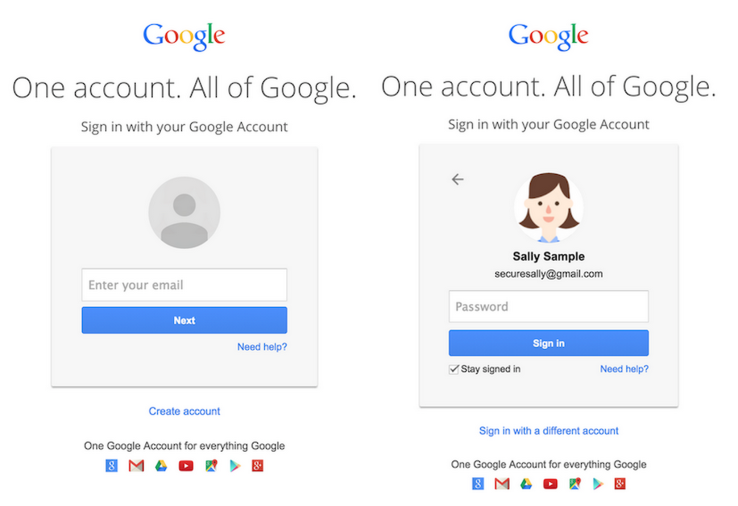
Gmail was the only Google subsidiary that had not undergone many updates for a long time. But, Google has quietly rolled out a new update that may change the phase of web logins. According to TechCrunch, Gmail has rolled out a new login screen that would require you to go through two different pages, one asking for your Email ID and the other for your password.
Before, to log into your Gmail account, you were required to enter your Email ID and password on the same page, which would later be directed to your inbox. With the new login screen, you will first have to enter your user id. The next page will ask you for your password, and then you will be directed to your inbox.
Google’s official product forum reads that the new login screen will prepare for ‘future authentication solutions that complement passwords.’ It also claims that the new login screen will reduce confusion among people having multiple Gmail accounts. It also reads that a better experience is promised for SAML SSO users, like university users or corporate that sign in with a different identity other than Google.
Google has not made clear what the above points meant. But the thread saw many users complaining about the change being unnecessary. Users have complained that the two-screen login process wastes time. Some users who have more than two accounts say the new screen have broken their ability to login using various password managers.
TechCrunch also pointed out that the method is somewhat similar to the ‘Trusted Device’ option in Android devices that lets users unlock their devices when they come in vicinity of their smartphone or tablet while they have a chosen trusted device on their person.
After being the first Indian city to get the Street View (a technological feature by Google Maps and Google Earth that provides paranomia views along many streets), Hyderabad may have yet another surprise announcement up its sleeves. Google has decided to set up its first Asian campus here in India’s largest IT corridor, Hyderabad. It is touted to be its biggest campus outside the USA.
Excited to announce that Google & Govt of Telangana has inked an MoU to build their largest campus (outside US) 1/3 pic.twitter.com/iMiPFa3hf7
IT Minister of Telangana, KT Rama Rao, who is on a visit right now to the US, has signed a MoU with Google Inc, under which Hyderabad will allot 7.2 acres in the Gachibowli area. KT Rama Rao said an investment of Rs 1,000 crore would be used for the same and they will increase its employee size from 6,500 to 13,000. Google also expects the facility would be developed and be fully operational by 2019.
The minister also spoke with Google about supporting the intended Telangana programme that is aimed to promote digital literacy among school children.
With powerhouses of tech like Google, forging its way to Indian soil, it could very well mean that we could be heading to a very bright technological future along with a rise in employment.
Google’s upcoming Android OS is the next big thing everybody is looking forward to. There are speculations of the tech giant gearing to unveil the mysterious ‘Android M‘ in the Google I/O conference 2015. Bloomberg has surfaced another vital fact about the forthcoming Android version that would bring data apps control in the hands of users.
According to a report by the global business and financial information portal, Google is planning to provide users with privacy controls that would allow users grant permissions to a particular app. This way, users themselves can decide what apps can penetrate more into the content and which can’t. These may include photos, contacts or location. The privacy controls would bring Android OS closer to Apple’s iOS that furnish users with the freedom to apps permission.
For now, Android users cannot decide permissions for the app. Whenever a user wishes to download a new application, he/she is directed to the setting page to provide the app with required permissions. Refusing to the permissions leads to cancellation of the app download. Presently, the customization option is available on Cyanogen and Xiaomi’s MIUI 6.
The demand for privacy on Android devices is being made for quite a while. Paying a little attention to the rising voices, Google has lost 3 percent share in Europe’s five largest countries, coming down to 69 percent. On the other hand, the share of iOS has increased from 18.6 percent to 20.3 percent in those five countries.
However, there is no confirmation from the company, but the mounting pressure may force Google to come up with the advanced Android version this time. Google’s annual I/O developers’ conference is scheduled for 28th of this month.
When browsing through mobile, it is quite a task to open a website, copying the link, switching between the apps and pasting it on your Facebook status bar. For many users, this is quite a cumbersome job. According to TechCrunch, to change the experiences for its mobile users, Facebook is working on an internal test search engine for its mobile app.
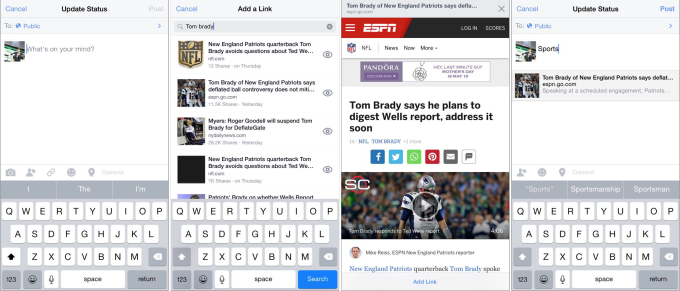
TechCrunch spotted that a few iOS users saw a new ‘Add a Link’ button next to buttons that we use to add photos, location and feelings. Upon writing down a word in the search engine, a list of related and matching links shows up that can be shared to your wall along with a caption. Using this feature, users will be able to bypass search engine while searching for content and give the social media giant a rich data of analytics of the type of content being explored and shared in a series of detailed statistics.
This move by Facebook may throw a hard brick on Google. On the other hand, Google has also allowed users to order food from its search results and add tweets. Apple, too, mentioned about the AppleBot on its support page, indicating an all-new Apple Search on Safari and other search related apps on iOS and OSX environment. This may set up an entirely new bar for search engines.
There are no words when this feature will roll out for the rest of its mobile users. For now, only a handful of iOS users has access to this new tool.
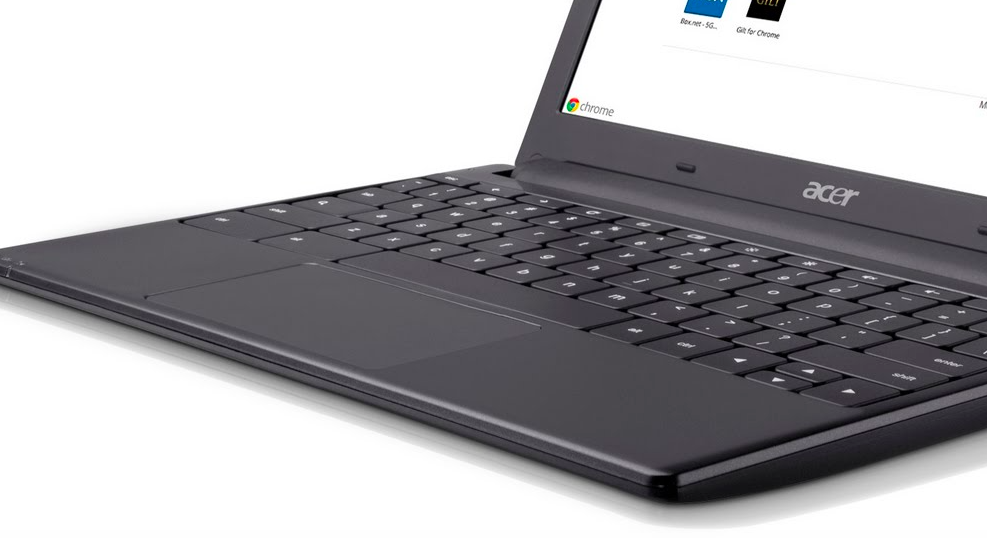
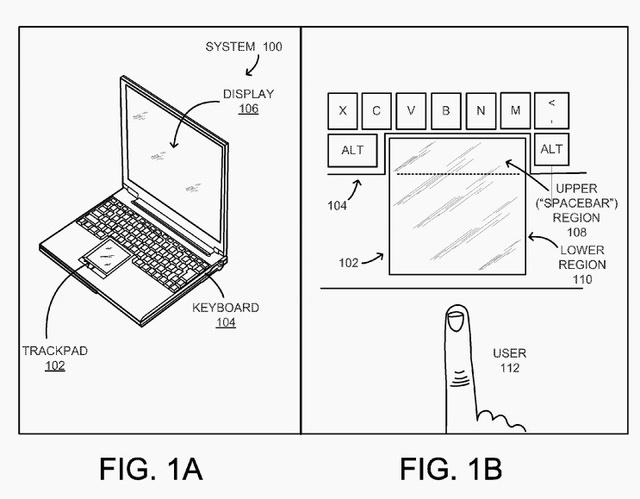
In an attempt to making laptops more compact, Google has recently signed a patent that may make your future laptop smaller by getting rid of the space bar. In a patent signed by the search giant, the design of the laptop replaced the space bar with an extended mouse trackpad. The trackpad and the rest of the keyboard are separated by a ridge, or a line, which might work as a spacebar button. Sensors beneath the trackpad will determine whether the space is used as a trackpad or a space bar. While typing, a touch to this region will result in a space, while a tap while using the trackpad will result in a mouse click.
Google’s reason for removing the space bar is that by pushing the trackpad up to the area of the space bar would be the first step to creating a smaller laptop. Although, the patent is still presented as ‘questionable’ since Lenovo’s current line of laptops already have trackpads pushed closer to the space bar.
Meanwhile, Google’s space bar patent was rejected four times in the past, according to Patent Office’s digital paper trail system. Will we soon see a smaller keyboard in Google’s Chromebook? We will have to wait to find that out.
Google aims to get a hold of your exclusive set of rights. The search internet giant announced the same on Monday by stating its plan to establish an online marketplace. The common place will offer talented minds sell their patents to them.
The online meeting spot for Google and patent holders is known as Patent Purchase Promotion and it is an “experimental marketplace for patents that’s simple, easy to use, and fast.”
Allen Lo, the Patent Deputy Counsel of Google mentioned in a blog post –
We invite you to sell us your patents. Today we’re announcing the Patent Purchase Promotion as an experiment to remove friction from the patent market.
The blog post adds that a streamlined portal will be open for patent holders from May 8, 2015 through May 22, 2015, where willing sellers can set a price of their product. On the last date, the submission will close and submitters with valuable patents will be contacted by June 26, 2015. The deal is anticipated to close by late August.
The move will help improve their patent landscape. Also, it will provide better benefits to the original patent owner.
Get more information on Patent Purchase Promotion here.
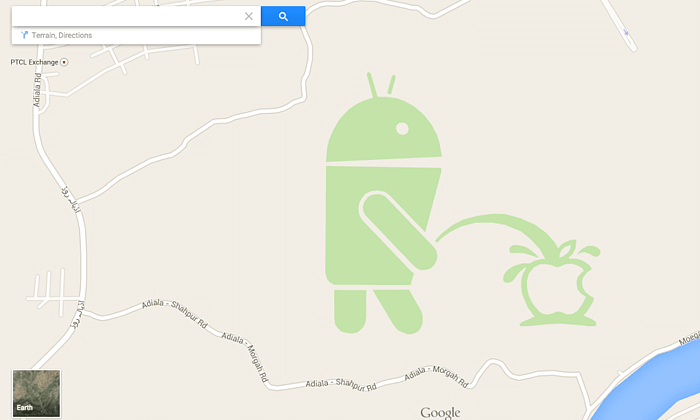
In a bizarre yet funny incident a Google map render image contains a cartoon of an Android robot taking a piss on the Apple logo. The image is in a small patch just south of the Pakistani city of Rawalpindi, which was possibly put by an End- user.
Someone at Google definitely is getting the boot as the image, which apparently was by an end-user helpfully “suggesting” an edit, has now been removed, Google says. “We’ve terminated the Android figure involved in this incident, and he’ll be disappearing from Google Maps shortly.”
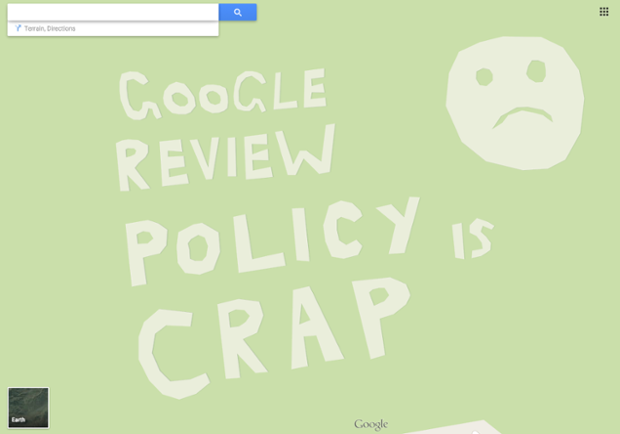
Another picture accompanies the Urinating Android Figurine, a few miles to the east, reads : “Google review policy is crap.”
The Google Map Maker allows for users to suggest changes on the Google Maps, which are then duly moderated. These two however were not identified and managed to get on the public domain. This is not the fist incident of lack of moderation on Google Maps, and considering the massive scale of the project it may not be the last.
However people always tend to leave stuff for a few chuckles here and there.
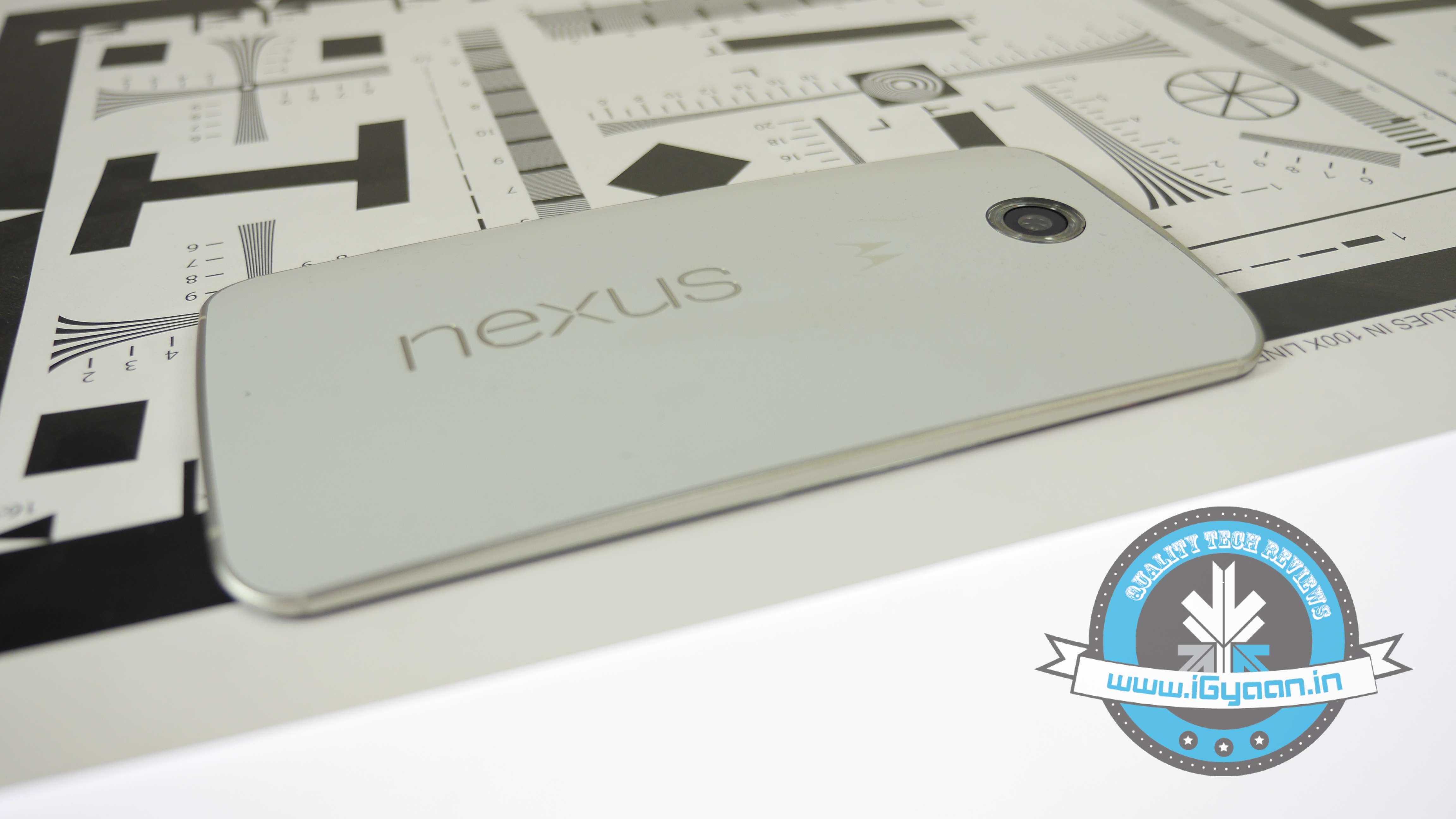
The Nexus 5 has been touted as one of the best products to roll out from the Google lineup. The handset, featuring a Full HD Display and 2.3 GHz processor, came with an affordable price tag and sold like hot cakes. Now there are reports stating that the internet giant is working on a refreshed version of the flagship. The next device has tentatively been titled as Nexus 5 2015.
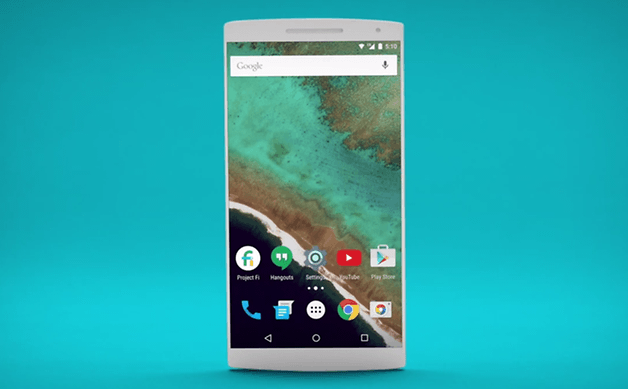
A technology portal called Android Origins states that a new version of Google Nexus 5 might release in two variants. The video released last week by Google on Project Fi also displayed a new device, which resembles the Nexus 5 from the front. The device render stayed for almost 16 seconds on the video with Project Fi support on it.
Google’s recent mobile carrier plan that allows users to switch between Wi-Fi and cellular networks is limited to Nexus 6 only. The company announced that its upcoming devices will come with support to Project Fi. It’s quite possible that Google was talking about the next-gen Nexus 5. Since it is called Nexus 5 2015, the device is expected to release sometime this year.
According to the source, both Huawei and LG will be working on the Nexus devices. LG will be responsible for the Nexus tablet or the Nexus phone, while Huawei can bring out inexpensive versions of the two.
Have a look at the Project Fi video below from timeframe 0.16 to 0.32 to check out the phone renders:
A destructive earthquake shocked Nepal for two days and left nearly 2,200 people dead, and many more were left injured or missing. It was one of the most dangerous earthquakes whose epicenter originated 17km south of Kodari, Nepal and measured 7.9 on the Richter scale. At this hour of crisis, many technological powerhouses have made it easier for rescue workers and family members to reach out to missing people.
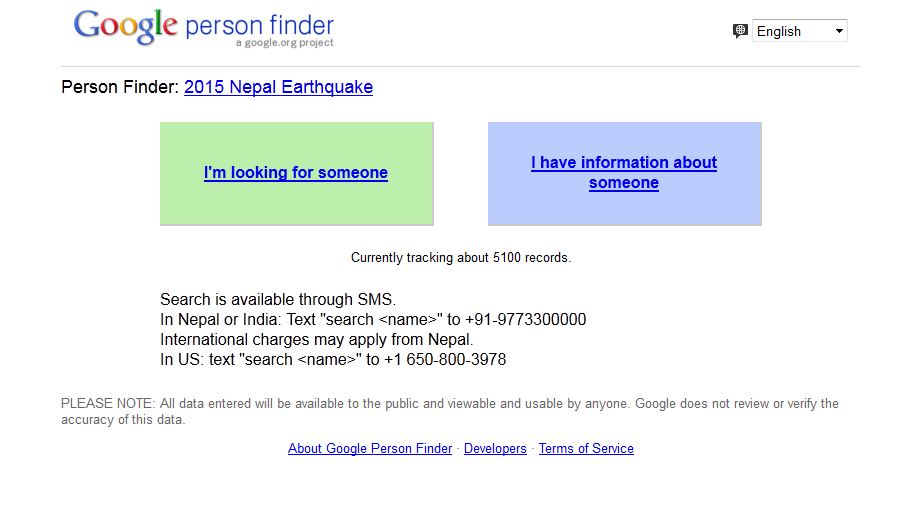
Google’s Person Finder is a free tool that doubles up as a registry or a message board for survivors. This app was developed first during the 2010 Haiti earthquake, and its aggregated data include registries run by CNN, the Miami Herald and the New York Times. This tool can be used by family or friends to locate missing people or loved ones.
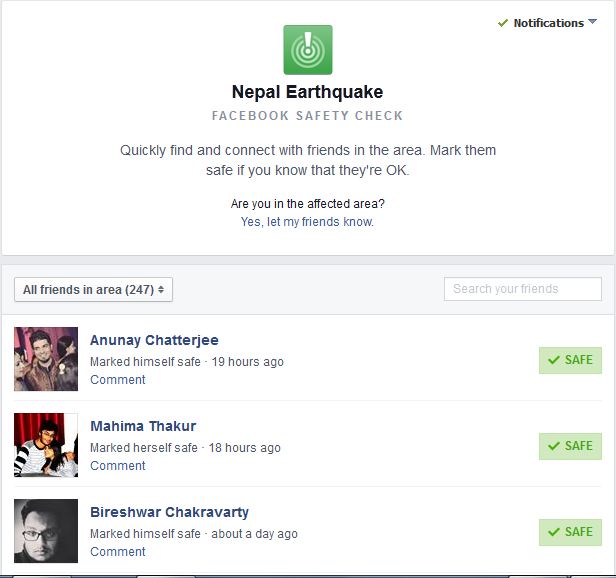
Facebook’s Safety Check is a tool that allows people to inform their family members or friends about their safety status. This feature works by accessing the user’s profile information and check-in updates and tracks people near the area of impact.
This feature was first initiated by Facebook on 16th October 2014.
For the current disaster in Nepal, Facebook has mapped every person in Nepal and nearby Indian states within the reach.
Viber cancelled the Viber Out bill system so that users can make calls for free to any mobile or landline number during the stretch of the disaster. Similar steps were taken by BSNL, MTNL, IDEA,Airtel and Vodafone. BSNL, Vodafone, MTNL and Idea have lowered down the call rates to Re 1 for the next three days while Airtel offered free Airtel India to Nepal calls for the next three days.
The earthquake jolted Nepal yesterday whose tremors were felt in Delhi and places of Uttar Pradesh and Bihar. The quake flattened down many houses and buildings, including the famous Dharhara tower.
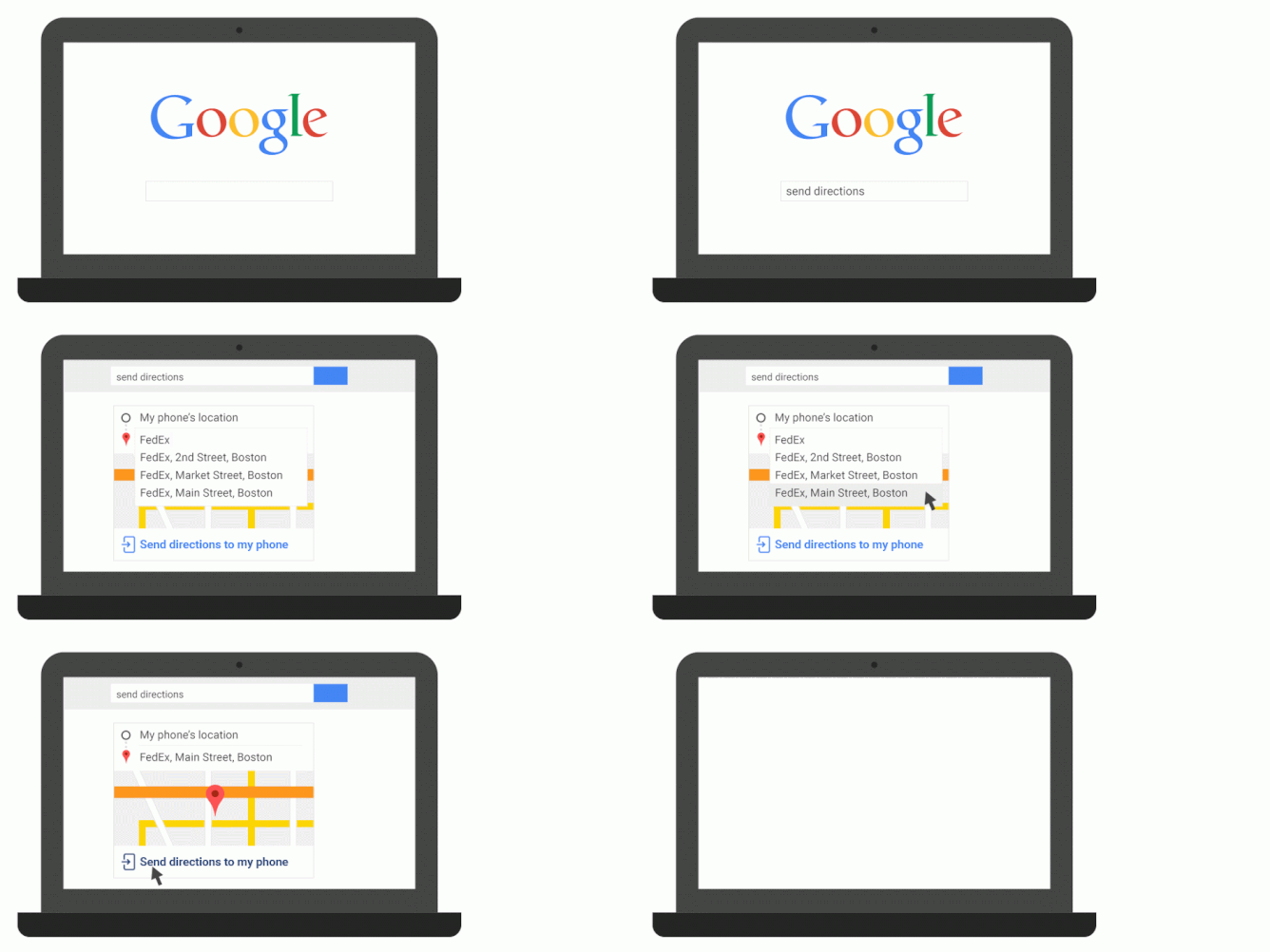
The Maps app by Google is a must-have tool while commuting from one place to another. Users need to type in the address or speak it to Google to get directions to the location, but what if you can avoid all that hassle. The search engine biggie has launched a new feature that allows sending directions from Chrome browser to your handheld device. Now users can search commute routes before leaving for the destination.
The announcement was made public by the company itself through its Google+ page. The process is as simple as searching on Google. Just type in send directions in the Chrome omnibox and add the final point. Tap on the ‘Send directions to my phone’ option and it will send the directions to your device. The Google Maps will load automatically with the specified location and will navigate to your destination.
It looks like the feature is not accessible in India as of now, but is expected to arrive soon. The hardware and software company launched ‘Find my Phone’ feature a week back that helps locate your missing Android device. It also revised its search algorithm to boost mobile-friendly websites and slipped a list of relevant apps within search results for you to download. All the moves are in favour of its users.
A couple of days back, there had been reports that Google was planning to launch its own US mobile wireless service. Now, the company has made its plan to bring wireless services public. Google’s new venture gives users an alternate way to curb data usage and keep their phone bills low.
Dubbed as ‘Project Fi’, the new Google-run network service is a customizable package that switches between Wi-Fi and cellular networks. It eradicates boundaries and gives customers freedom to use the network in their hometown and during international travels at the same rate. The service is only available for Nexus 6 smartphones as of now, and will work with newer models soon.
The blog post of Google reads –
Similar to our Nexus hardware program, Project Fi enables us to work in close partnership with leading carriers, hardware makers, and all of you to push the boundaries of what’s possible. By designing across hardware, software and connectivity, we can more fully explore new ways for people to connect and communicate.
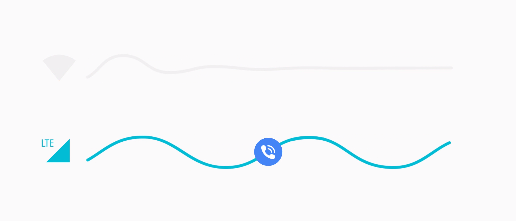
Project Fi makes use of Wi-Fi hotspot or specific 4G LTE networks, together with the US mobile networks of Sprint and T-Mobile, the venture partners. Here’s how it works: if you are connected to a Wi-Fi hotspot and leave the Wi-Fi coverage area, your call will seamlessly transmit to cell networks. The service requires a special SIM and is supported in over 120 countries without roaming charges.
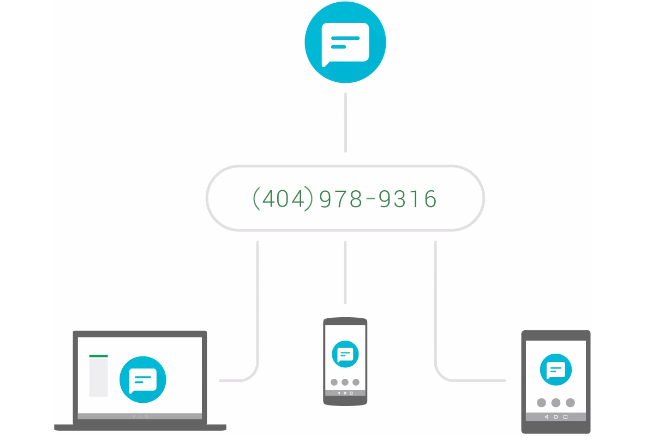
Another revolutionary development that comes with Project Fi is that phone numbers adopt “a multi-screen world”. This means your number works with all your devices like a phone, tablet or laptop. You can connect any device that supports Google Hangouts, whether it works on Android, iOS, Windows, and start a chat. It cuts down the dependency on your smartphone and makes every device a ready-to-use handset.
Google’s new project is unconventional in the sense that it charges customers only for the data consumed. It breaks the standard procedure of dispatching a bill for the unused data as well, which is practiced till date. Google says, “Project Fi takes a fresh approach to how you pay for wireless, manage your service, and get in touch when you need help.” There is one plan for all, and in case a user doesn’t utilize the pack called, Google will simply refund the variance.
Here’s how Project Fi works:
For $20 a month you get all the basics (talk, text, Wi-Fi tethering, and international coverage in 120+ countries), and then it’s a flat $10 per GB for cellular data while in the U.S. and abroad. 1GB is $10/month, 2GB is $20/month, 3GB is $30/month, and so on. Since it’s hard to predict your data usage, you’ll get credit for the full value of your unused data. Let’s say you go with 3GB for $30 and only use 1.4GB one month. You’ll get $16 back, so you only pay for what you use.
For now, Project Fi is invite-based, and customers need to request an invite on their site to get the service. Meanwhile it’s available only in the US, but India can expect to receive it sometime later. Check the video below to understand it better:
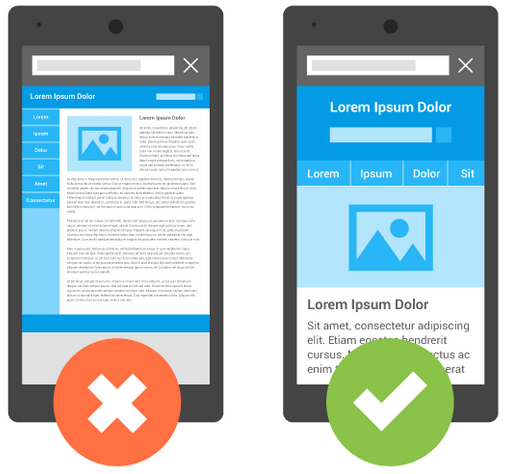
Google is making a pre-determined move that will affect website search on mobile devices. The search giant has revised its search algorithm to rank sites at the top that are tailored for mobile screens. Termed as Mobile-Friendly update, the new changes have been implemented from yesterday.
The new upgrade will push up the content fitting the small screen of your smartphones and force the desktop-optimised searches down to the bottom of the list. It will give a boost to mobile-adaptive websites, given that over 60 percent of the search is done through smartphones. The update is limited to just handsets only and doesn’t extend to bigger devices like tablets. This suggests that from now on, search results on mobile will be different from the results googled on the desktop.
Google stated in its blog post –
We’re boosting the ranking of mobile-friendly pages on mobile search results. Now searchers can more easily find high-quality and relevant results where text is readable without tapping or zooming, tap targets are spaced appropriately, and the page avoids unplayable content or horizontal scrolling.
However Google is not favouring anyone in the internet business, it will give advantage to the sites designed for mobile. The search would work on Mobile-Friendly Test and would scan different factors of each page to give it a thumps up. It’s important to note that the update applies to individual pages, not entire websites. It will affect search results in all languages globally.
The California-based giant recently did another major alteration for smartphones; it slipped a list of relevant apps within search results for you to download. Both these moves are useful for users and developers alike.
The search engine major is geared to update its smartwatch operating system that would bring Android-run watches a step closer to Apple Watch. Lately, Google announced to update Android Wear to bring a slew of new features that are simple, fast and would make Android watches convenient to use.
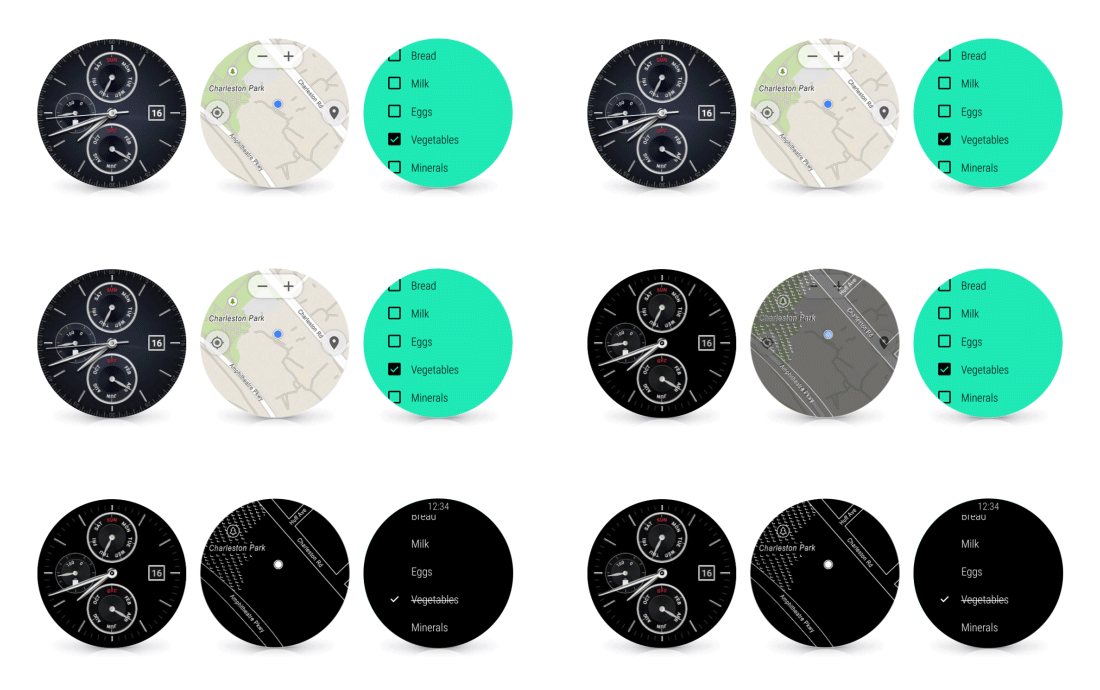
The foremost significant feature of the new update is the always-on mode that is now extended to the apps. With the update, Android Wear will support a low-power, always-on mode that would allow apps to stay in the background in black and white. The screen will remain on, showing just a minimal amount of data and will save the battery life as well. The feature is helpful especially with shopping lists, map directions, music controls and fitness apps. The screen turns back to full colour when the user is actively looking at it.
Google has reduced the dependability on your smartphone with the latest Android Wear update. The Android smartwatches can now operate independently “as long as your watch is connected to a Wi-Fi network, and your phone has a data connection.” Yes, the Android Wear now supports Wi-Fi. Users can move the smartwatch beyond the Bluetooth range of their handset, which was the only connecting medium until now. The Android Wear device will now receive notifications, send messages, and use all your favorite apps.
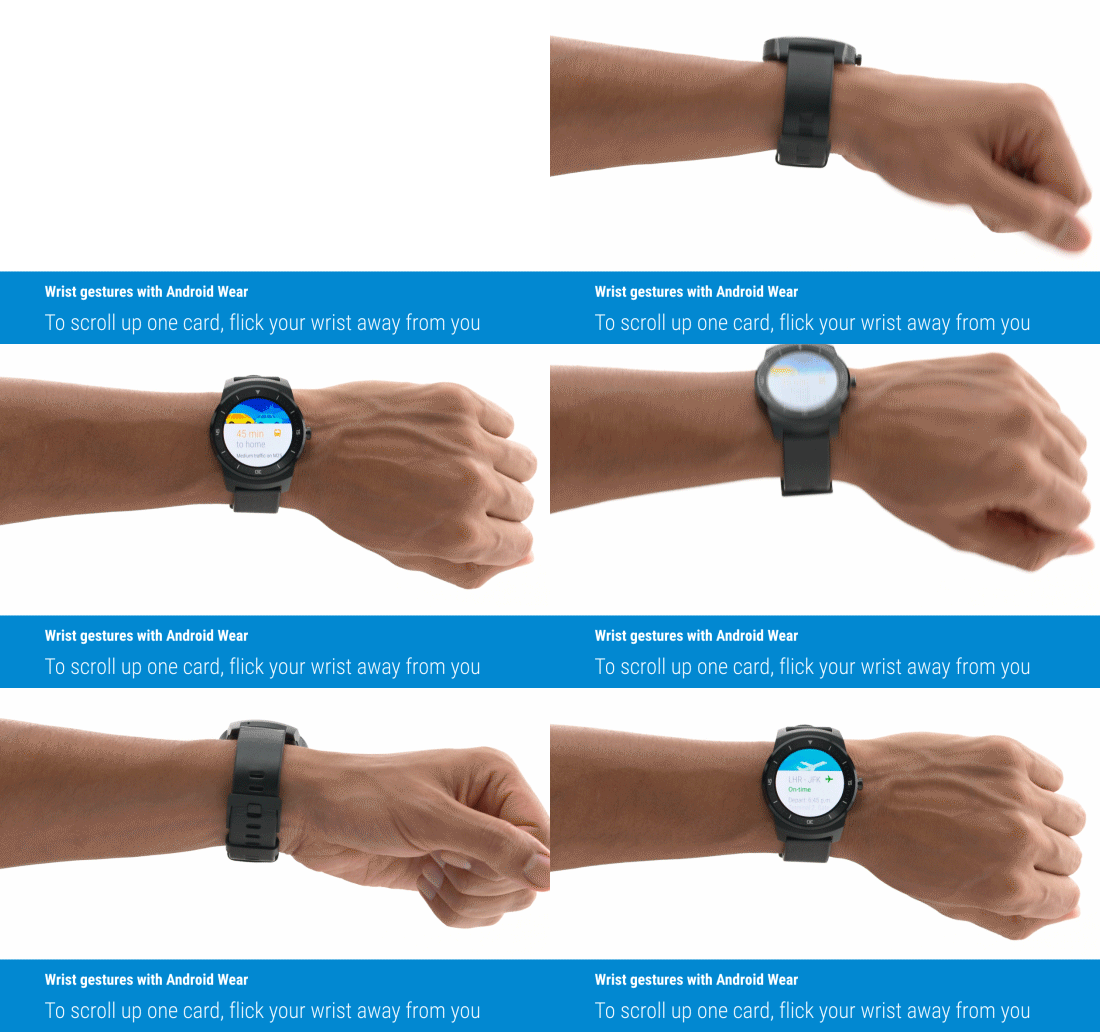
The fresh update will sort of change the way users interact with their smartwatch. Google has added a few gestures to improve usability. Now, one can scroll the screen up just by a flick of the wrist and don’t need to empty your hands to operate the watch.
The basic functionality of the watch has been simplified by bringing ahead the apps and contacts. Just touch the watch face and users can start send messages immediately and start apps.
Also, Google has added hand-drawn emoji support as a mode to communicate with your friends. Android Wear will understand the hundreds of different emojis drawn by you and send it via message or text.
The update will be coming over the next few weeks, starting with the new LG Watch Urbane. All the other Android watches will soon follow.
Google, as we all know, is a powerful search engine which has given us the power of endless knowledge on our fingertips. Yesterday, it introduced a super useful new tool called ‘Find My Phone’ which helps locate missing Android smartphones and today, it revealed a feature that suggests apps based on your search.
Through the newly developed feature called App Indexing, users will come across more relevant content on the web, along with applications notification on your Search page. That means, besides other results that usually pop up on your screen, applications suggestion relevant to your search will also be made available on your handset.
For example, if you type ‘Give me instructions to make perfect tea’ then a list of standard search results together with applications recommendations will appear before you. The application suggestions will come with an Install button that will take the users to the App Store for installation. Once installed, the app will take you straight on to the required content within it. The service will start for Android users sometime next week.
The App Indexing program is beneficial to developers and users alike. Users can get app suggestions without browsing through millions of apps on Play Store and for developers, it will make their apps more discoverable. The app makers just need to implement the App Indexing API onto their applications.
Developers can get more information on the App Indexing API here.