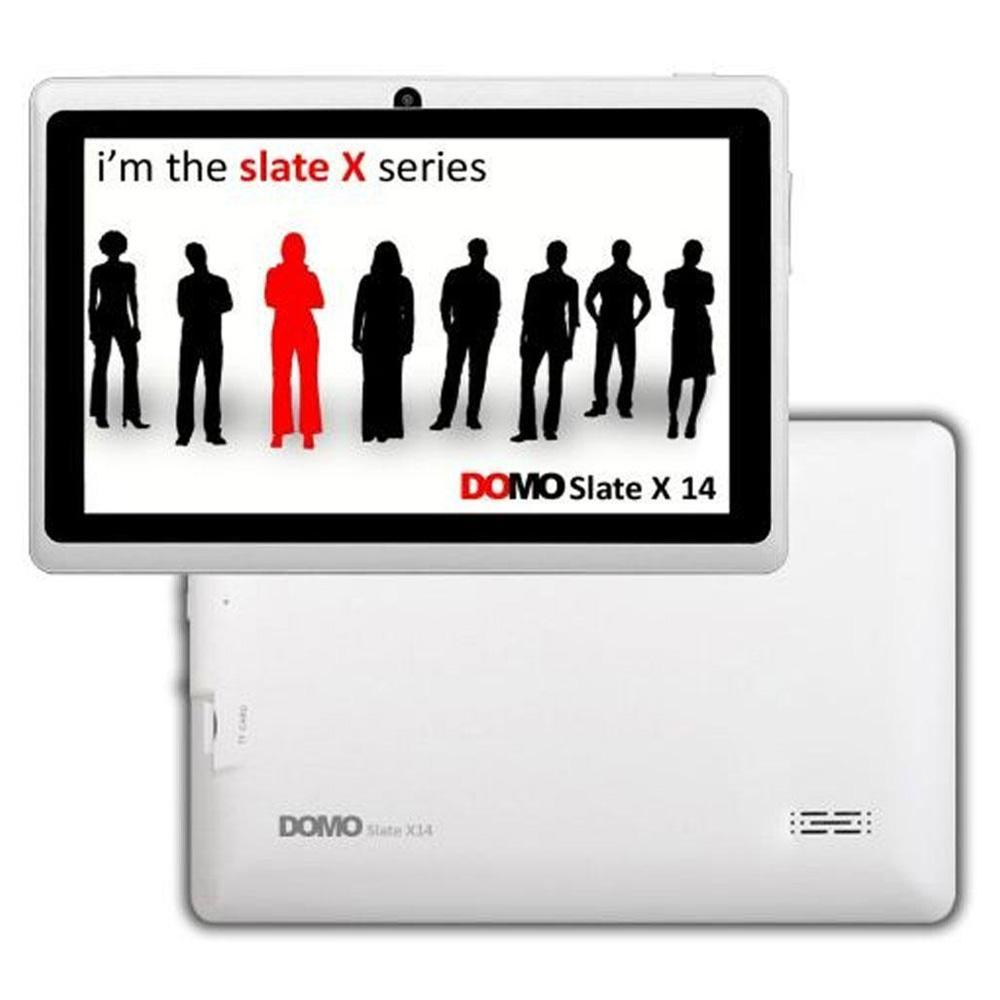
DOMO has launched the Slate X14 tablet for Rs. 4,990, targeting students. The DOMO Slate X14 comes with 7-inch LCD display with a resolution of 800 x 480 pixels. It is powered by a 1GHz Cortex A8 processor, and has a Mali 400 GPU with 512 MB of RAM. The dimensions of the Slate X14 121 x 182 x 10 (mm) and weighs in at 270 grams. It features 4GB of built-in storage which can be expanded up to 32GB with the help of a micro SD card. The tablet runs Android 4.2.2 Jelly Bean with Flash support.
Commenting on the launch, Mazher Shaikh, Business Development Manager at DOMO said, “DOMO Slate X14 has been designed especially for student offering value for money features. With support for most 3G dongles, users can stay connected to internet on the go.”
The Slate X14 include a 2-megapixel front camera and the connectivity options as Wi-Fi, Micro-USB and 3G via external USB dongle. The tablet does not come with SIM support. The DOMO Slate X14 can playback 1080p videos, and runs on a 3000 mAh battery.
The tablet comes up with a warranty of 3 months for the box accessories which includes Device Charger, USB Cable and OTG Cable and the device itself comes up with a limited warranty of 6 months, which can be a problem for some. The repairs are done through onsite pick up and deliveries, that mean if you buy this tablet you don’t have to run around to find a service center.
After the announcement of much hyped Moto-X smartphone, the Google-owned Illinois based company has hinted the making of Motorola tablets.
“That’s something we are working on, but [there’s] nothing specific to talk about right now,” Dennis Woodside, CEO of Motorola told Engadget when asked about plans to manufacture the Motorola tablets.
The tablet will probably be available to customize through Moto Maker, just like the Motorola Moto X smartphone. There are no details on what hardware it will come with as yet.
Under the guidance of new owners Google, Motorola Mobility has decided that personalization is the way forward when it comes to mobile devices and that being able to choose wallpapers, colors, cases and finishes is just as important as processing speeds or screen resolution. For proof, look no further than its current Moto X handset which, through a dedicated mini site, can be customized and tweaked by prospective owners before it’s shipped to their doors.
Woodside also mentioned that the expected phablet-sized Moto device would be inspired by few Moto-X features such as “design cues, as well as technologies..”
The device will not be a continuation to Motorola’s “Xoom” line of tablets, the recent shutting down of which has been reported as a result of the company settling down on a lawsuit filed by the online payment processing firm in 2011.
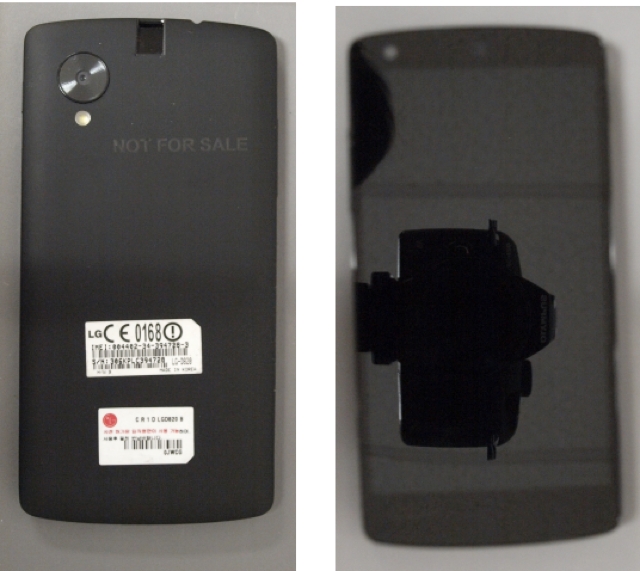
We’ve seen glimpses of a device that resembles a next-generation Nexus — it even has the eponymous logo on the back — in a Google promo video, and today we see a similar product added to the FCC documents of the Verizon LG G2. Strange, we know.
As seen in screen captures from the promo vid, the Nexus 5 looks to have a much larger camera lens than the previous version, but retains the rounded corners of the Nexus 4. One of the biggest changes is a move away from a glass back, as pretty as it was, in favour of a rubbery polycarbonate that should be a lot more durable.
It’s unclear from the photo what size the screen is, but we’ve been lead to believe Google has opted for a 5-inch 1080p display, slightly smaller than the upcoming LG G2.
LG Nexus 5 should become available sometime in November with the new Android 4.4 KitKat operating system flavor loaded on top. LG did a great job on the Nexus 4 and with newer hardware — think a Snapdragon 800 chip and full HD screen — the Nexus 5 is already looking good.
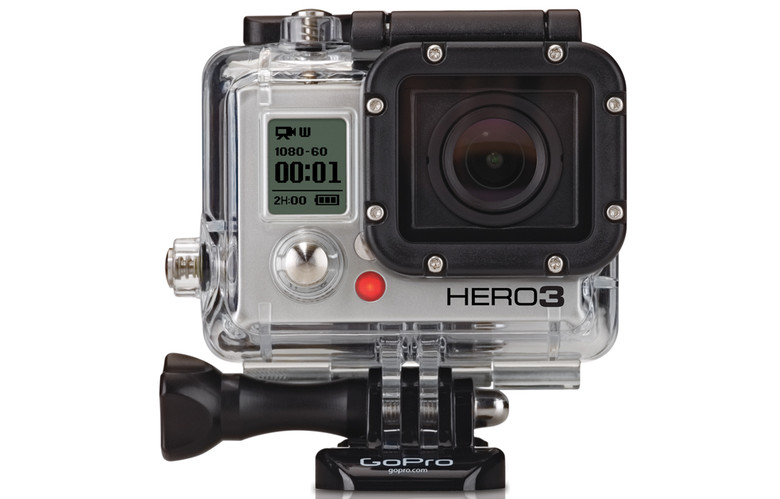
GoPro is a brand of high-definition personal cameras, often used in extreme action video photography. They are known for being lightweight, rugged or mountable in unusual places such as outside planes, cars, or boats.
In an interview with Nicholas Woodman(CEO for GoPro), he was asked whether GoPro is working on a Google Glass style product, he suggested that while the company is looking at the space it’s more with a view to thinking about how to interoperate with those type of devices, rather than making a dedicated pair of GoPro Glasses itself.
I think what’s going to be exciting is you’re going to see more of these products working together,” said Woodman. “You already see it with GoPro and smartphones and people often ask me are you afraid of the smartphone? And the answer is no — the smartphone is helping our business because it’s killing traditional cameras… which is opening up retail shelf space for GoPro and opening up consumer dollars for GoPro.”
”GoPro is used in a totally different way to a traditional camera, and then beyond that the smartphone makes for an incredible video remote control for a GoPro right?” said Woodman. “Now I can preview and control my GoPro with my smartphone, playback my videos and share them directly from the smartphone. Never needing to hook my GoPro to a computer.
“And then you think of things like Glass and what not — a Glass-like product become terrific heads-up hands-free remote control devices for the GoPros and I think it’s just going to become more and more enabling and you’re going to be able to use your GoPro in even more versatile ways thanks to these complementary products.”
Woodman said the company is not feeling complacent about potentially having a Mountain View sized competitor, in the not too distance future. ”We’ve very careful to be very appreciative for the success that we have right now but also we still wake up sacred every morning. You know we’re smart but we’re not that smart. Fear drives you a lot harder than success does,” he added.
Nicholas does not seem to take Glass as its competitor, instead he sees Glass (or other wearables) as an excellent way for folks to interact with GoPro cameras.
During the interview he was asked which is the best video he has ever seen recorded by the GoPro, he said there are many but the one that come first in mind is :
Michael Dell clinched shareholder approval on Thursday for his $25-billion offer to buy and take Dell Inc. private, ending months of conflict with the company’s largest investors and removing the uncertainty surrounding the world’s No. 3 PC maker.
The results of a shareholder vote were just announced moments ago at a special meeting of shareholders in Round Rock, Texas. The final vote tallies haven’t been released yet, but CNBC, citing sources familiar with the result, have pegged the vote in favor at 65 percent to 35 percent. A final tally will be read out a little later, as the meeting is still under way.
As AllThingsD reports, the final buyout price is $13.75 per share, and includes a 13 cent per share special dividend, for a total price of $13.88, or $24.9 billion. The deal also guarantees an eight cent per share quarterly dividend when Dell next reports earnings, in November.
The path to victory was practically guaranteed today because Dell’s chief competitor, Carl Icahn, had backed out of his bid to take the company in another direction. Earlier this week, Icahn announced that he has abandoned plans to offer an alternative option to shareholders, saying that it would be “impossible” for him to win.
In a statement on the vote, Michael Dell said that he was “pleased” with the shareholder vote, adding that the vote will now allow his company to move forward to “serve our customers.”
Post Apple’s September 10th announcement of the two new iPhones, with the iPhone 5s running a 64 bit chipset, Samsung head JK Shin has said that the next Samsung smartphone will run a 64 bit processor too, reports Korea Times.
JK Shin added that Samsung is aware of the Apple’s plans in China and will be affected by them. The upcoming 64 bit smartphones will come “not in the shortest time,” but that “our next smartphones will have 64-bit processing capability.”
ARM has been promoting their 64 bit architecture for some time and this would be any easy in-house production for Samsung for their next Exynos 6 and Galaxy S5 combination expected to be announced at CES January 2014.
Is this a knee-jerk move by Samsung, or is it a planned announcement? Only the folks at Samsung know.
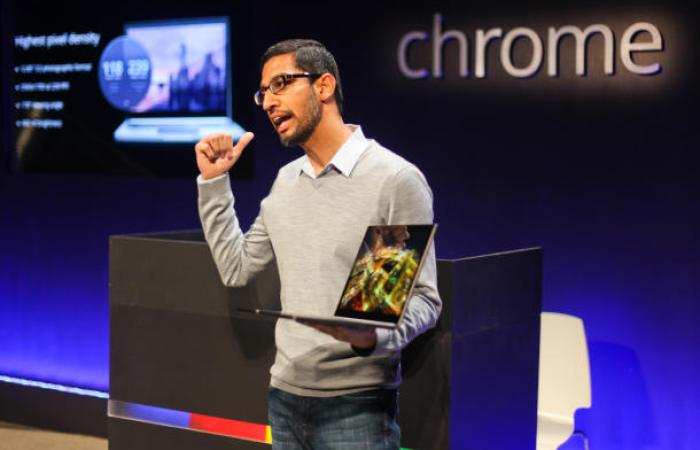
Google and Intel introduced three new Chromebooks and a Chromebox, each of them running Intel’s Haswell processors. This was announced on Wednesday at Intel Developer Forum keynote in San Francisco, as Intel VP Doug Fisher and Sundar Pichai, the head of Google’s Android and Chrome divisions, showed off the new hardware.
They revealed two new laptops from existing partners HP and Acer, a Chromebook from Toshiba and a Chromebox from Asus. These devices makes Asus and Toshiba’s first devices into Chrome OS hardware. Doug Fisher promised battery life improvements of up to 50 percent and performance jumps as high as 15 percent for Haswell Chrome devices over their previous generation chipsets.
There are customers telling us they are interested in new operating systems and in particular Chromebooks,” said Ron Coughlin, senior vice president and general manager, Consumer PCs, Services and Solutions, HP. “We built the HP Chromebook to offer a great experience, choice and affordability, with a design that is truly unique.”
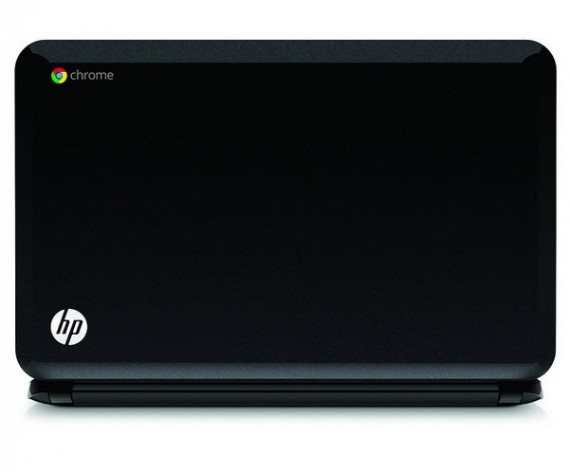
The HP Chromebook 14 offers a fast and easy way for customers to connect to favorite websites in seconds. It also offers a gateway to the Google experience, including Google Chrome apps like Gmail, YouTube, Google Drive and Google+ Hangouts for users daily routine.
Some time back Chrome was just a browser and nothing else. But if Chrome OS is going to grow up and truly take on Microsoft and Apple, it will need both better applications and good hardware.
The HP Chromebook14 is expected to be available in the US by end of the year, starting at $299.99.
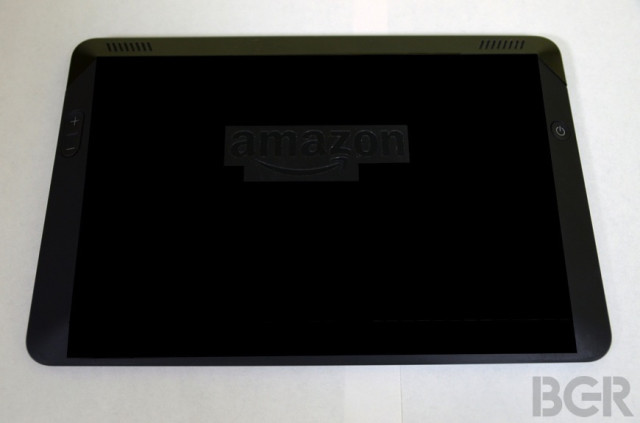
A day after Apple unveiled a new iPhone lineup that had effectively been revealed weeks earlier by anonymous people in the hardware supply chain, a new set of leaked photos purports to show Amazon’s next Kindle Fire HD, as reported by BGR.
It’s thought that Amazon may release the 7-inch version ahead of the 8.9-inch version.
The 2013 Kindle Fire HD models feature an extensive design overhaul. The rounded shape on the back of the current models has been replaced with a more angular design that gives the device a much harder look. Also as we described, the buttons have been completely redesigned since the current layout was a big pain point for many users. The stereo speakers on the back of the Kindle Fire HD have now been moved to the top of the device, as seen in several of our exclusive photos. The band across the bottom on the back of the current HD tablets has been removed, leaving a smooth back surface interrupted only by Amazon’s logo.
It’s believed that the 7-inch tablet will have a 1920×1200 display, a quad-core Qualcomm Snapdragon 800 chipset clocked at more than 2GHz, 2GB of RAM, Wi-Fi, optional cellular data, Android 4.2.2 Jelly Bean and either 16GB, 32GB or 64GB of internal storage. The 8.9-inch version will have a 2560×1600 display and 8MP camera.
Intel launched two Atom Z3000 series system on chip (SoC) processors at IDF today, which are aimed at doubling the performance of Android and upcoming Windows 8.1 tablets.
The Bay Trail chipset brings improved power management compared to the current lot of Clover Trail and Clover Trail+ devices, which essentially means longer usage times for the users. Intel refrained from giving out specifics about these devices, but we should know in due time.
Supporting the Windows and Android operating systems, the Atom Z3700 series chips are powered by four cores up to a clock speed of 2.4GHz, with 2MB L2 cache and HD graphics. Depending on the configurations chosen, the chips offer dual or single channel DDR3 memory, supporting memory capacity up to 4GB.
The Atom Z3600 series chips are the less powerful of the two and most probably aimed more at smartphone devices. Supporting only Google’s Android mobile operating system, the Atom Z3600 series chips offer dual core process technology, 1MB L2 cache, HD graphics and, depending on the configuration, supporting up to 2GB memory capacity.
Both Bay Trail Atom processor series support Intel’s new Silvermont Core microarchitecture, which offers a wider dynamic operating range for better power efficiency. They will also support up to 2560×1600 display resolution.
Intel mentioned that over 20 Android tablets running on the Bay Trail chip will be launched before the end of the holiday shopping season, so we might have some interesting devices to look forward to. This list also includes a few super cheap sub $100 tablets. Of the 20 Bay Trail tablets that will launch this year, only 12 will be running on Android apparently with the remaining featuring Windows 8.
Popular PC benchmarking suite and former Android convert, 3DMark, has come to iOS.
The company promises to make 3D gaming benchmarks accurate and truthful between platforms and chipsets, doing away with the notion that an app on Android can’t run the same way as one on iOS.
The benchmark comes with three tests: Ice Storm, Ice Storm Extreme, and Ice Storm Unlimited. The first delivers mid-range testing with OpenGL 2.0, perfect for older devices and aging GPUs. Extreme ups the ante, “raising the offscreen resolution to 1080p” to ensure that Android and iOS devices crunch the same polygons and make the same calculations without using screen resolution as a base.
Lastly, “3DMark Ice Storm Unlimited [uses] chip-to-chip comparisons of the hardware inside your device without vertical sync, display resolution scaling and other operating system factors affecting the result. In Unlimited mode the rendering engine uses a fixed time step between frames and renders exactly the same frames in every run on every device. The frames are rendered in 720p resolution “offscreen” while the display is updated with small frame thumbnails every 100 frames to show progress.” This is the grunt test, as it’s not frame-limited, so it can push GPUs to their maximum potential. It also serves as a good torture test for system stability.
3DMark will run on any iOS device that can run iOS 6 or above — excluding the fourth-generation iPod touch. It requires 512 MB of RAM and 174 MB of free space. 3DMark is a free download.
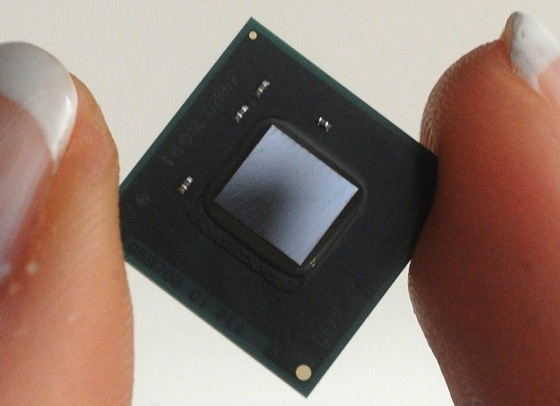
Intel is working on a new line of ultra-small and ultra-low-power microchips for wearable devices like smart-watches and bracelets, it seems like an effort from the company to fit into the next generation technology, which is the wearable devices.
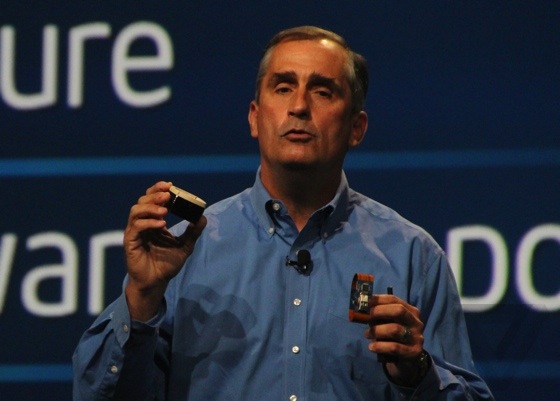
Intel CEO Bryan Krzanich just pulled out the tiny Quark X1000 chip at the 2013 Intel Developer Forum (IDF) in San Francisco. Intel will provide equally miniature reference boards and software to help developers put tiny communicating computers in just about everything, which includes smart-watches, if developers are interested.
“Our strategy is actually very simple,” Krzanich explained earlier in the keynote. “Our plan is to lead in every segment of computing.” That includes servers, laptops, tablets, and phones, but also other devices yet to be designed.
In other words, the actual CPU core inside a Quark chip is one-fifth the size and consumes one-tenth the power of an Atom CPU core. Quark is aimed at markets where power consumption and form factor take priority, according to an Intel representative.
After the launch of the Samsung Galaxy Gear and Qualcomm Toq, the wearable devices is supposedly the next technology to rule the world, keeping that in mind ‘Quark’ seems a smart move from Intel.
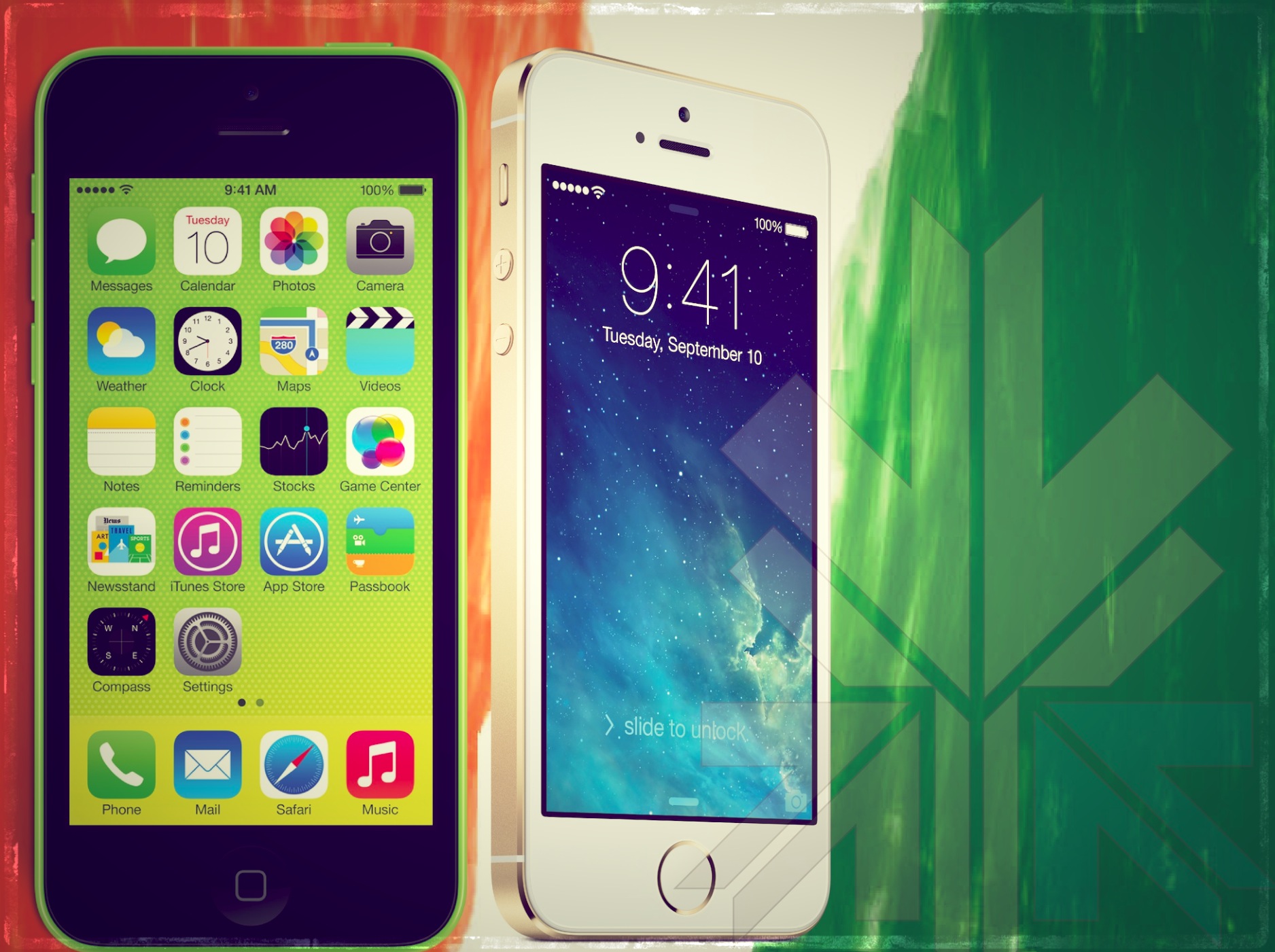
Apple yesterday announced the iPhone 5S and iPhone 5C, two new iPhones that are set to replace and enhance the experience you get from the current generation iPhone 5.
In the US and several other countries the Apple iPhone 5S and 5C will go on sale starting September 20th 2013, however no concrete information was available on their launch dates in India.
Apple sources close to iGyaan have let us know that Apple India is planning to bring the new iPhone 5C and the 5S to India as early as Oct 20th. The iPhone 5C which will be a replacement of the iPhone 5 will actually cost as much as the iPhone 5 does today, Rs. 44500 for 16GB. This is thanks to the inflated costs of Dollar vs Indian Rupee. The iPhone 5s however will launch for upwards of Rs. 50,000 for the 16GB variant making the 64 GB iPhone 5s the most expensive smartphone till date in India, since it will cross the Rs. 65,000 barrier.
Apple saw a 400% growth in the past year in India, and it thanks quick availability and easy payment schemes for it. Last year Apple was able to sell out its initial stock of 20,000 iPhone 5 units in one day, this year the company plans to bring in over 100,000 units at the time of launch, this number will include a variation of iPhone 5C and iPhone 5S in all colors.
India as a market has shown some real potential, and Apple wishes to remain at the forefront of technology. We have been planning the launch for over a month prior to the announcement yesterday, and it should happen in Oct, if the Cupertino office is in line with our Ideas.
Many claim that Apple may not have the same impact in the market with the iPhone 5C or iPhone 5S as they did with the iPhone 5, because of the lack of innovation in these new products.
Apple is hoping that the new Touch ID security features will enable a lot of business folks, who prefer Samsung phones/ Blackberry devices, to easily pick the iPhone 5S thanks to the rock solid security.
Despite many expectations, every bit of information from the past leaks came true as Apple took stage on Tuesday 10th September to launch two new iPhones the iPhone 5S and the iPhone 5C. One handset which is replaces the existing iPhone 5 and one which supersedes it.
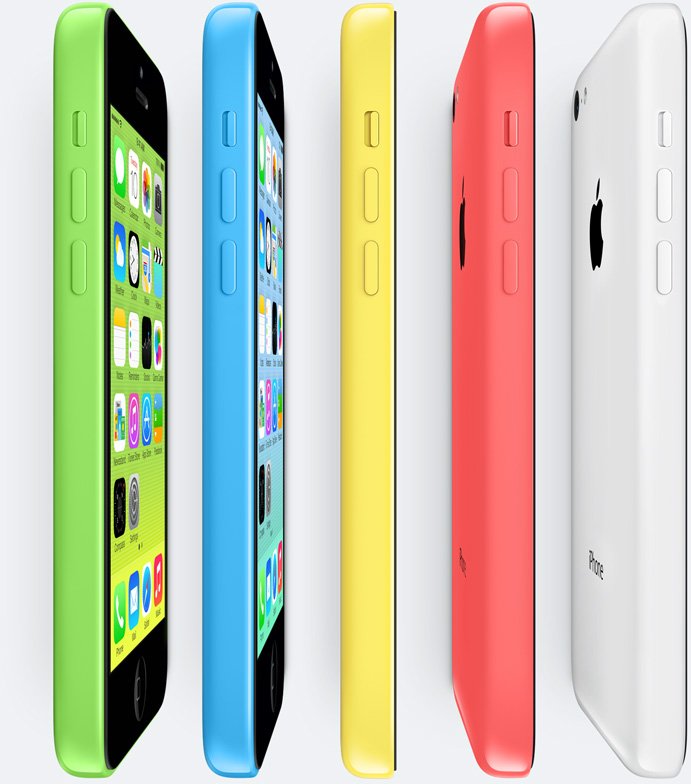
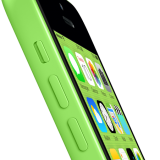
The iPhone 5c which was expected to be a cheap iPhone, never really made it to that mark, basically its a complete change of play by Apple. It definitely looks cheap, thats thanks to the extended use of shiny/glossy plastic polycarbonate composite. But it also is a phone intended to replace the iPhone 5, a phone which was made out of premium aluminum and glass has been replaced by a phone made of plastic with the exact same specs and the exact same price. Sure it was intended to be cheap, a cheap move by Apple.
iPhone 5c
One thing it does do however, is play with the colors, opening the market to a frenzy of color options which have been limited to the two from the origin of the iPhone. The iPhone 5c retains the retina display and A6 chipset, along with the same 8 MP camera and lightning connector. It does add an upgraded FaceTime HD front camera for High definition FaceTime and VOIP calls.
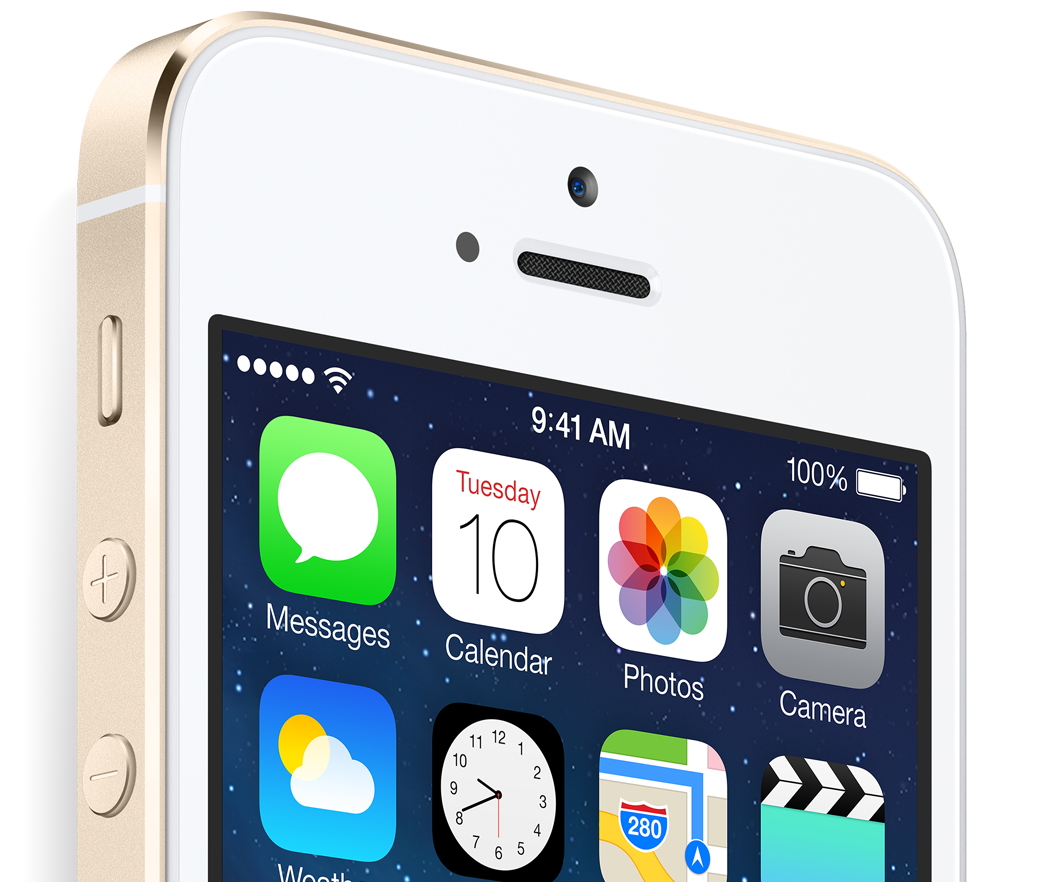
The iPhone 5s however, is a whole new story. The existing shell of the iPhone 5 has been upgraded with a few new exciting enhancements in hardware, Apple calls the iPhone 5 “the most forward thinking phone ever”.
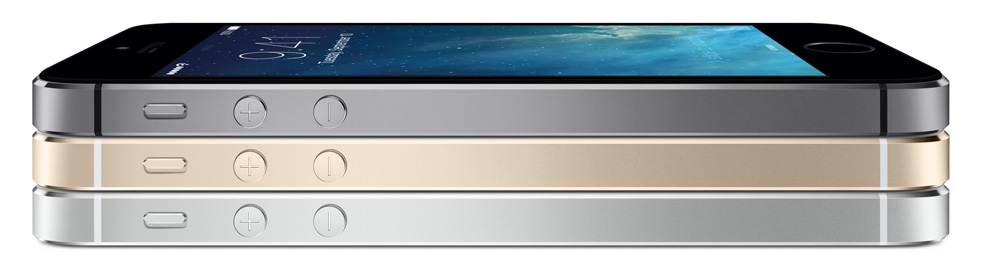
The iPhone 5s adds a new A7 architecture which adds new capabilities to the device. In retrospect, the iPhone 5 is half as fast and has half as powerful graphics in comparison to the new iPhone 5s. You also get a new camera system, that increases the size of pixels and has a new element lens, for brighter and more accurate images. The new iPhone 5s will also feature a champagne gold color, which seems to have created a buzz on the twitter feeds despite it leaking out almost 6 months ago. The new iPhone 5s also has the worlds first desktop level 64 bit architecture, making life for developers difficult initially, but opening them up to a whole new world or options for future apps.
[pullquote_left]The Touch ID may as well be the new revolution for the mobile industry[/pullquote_left]
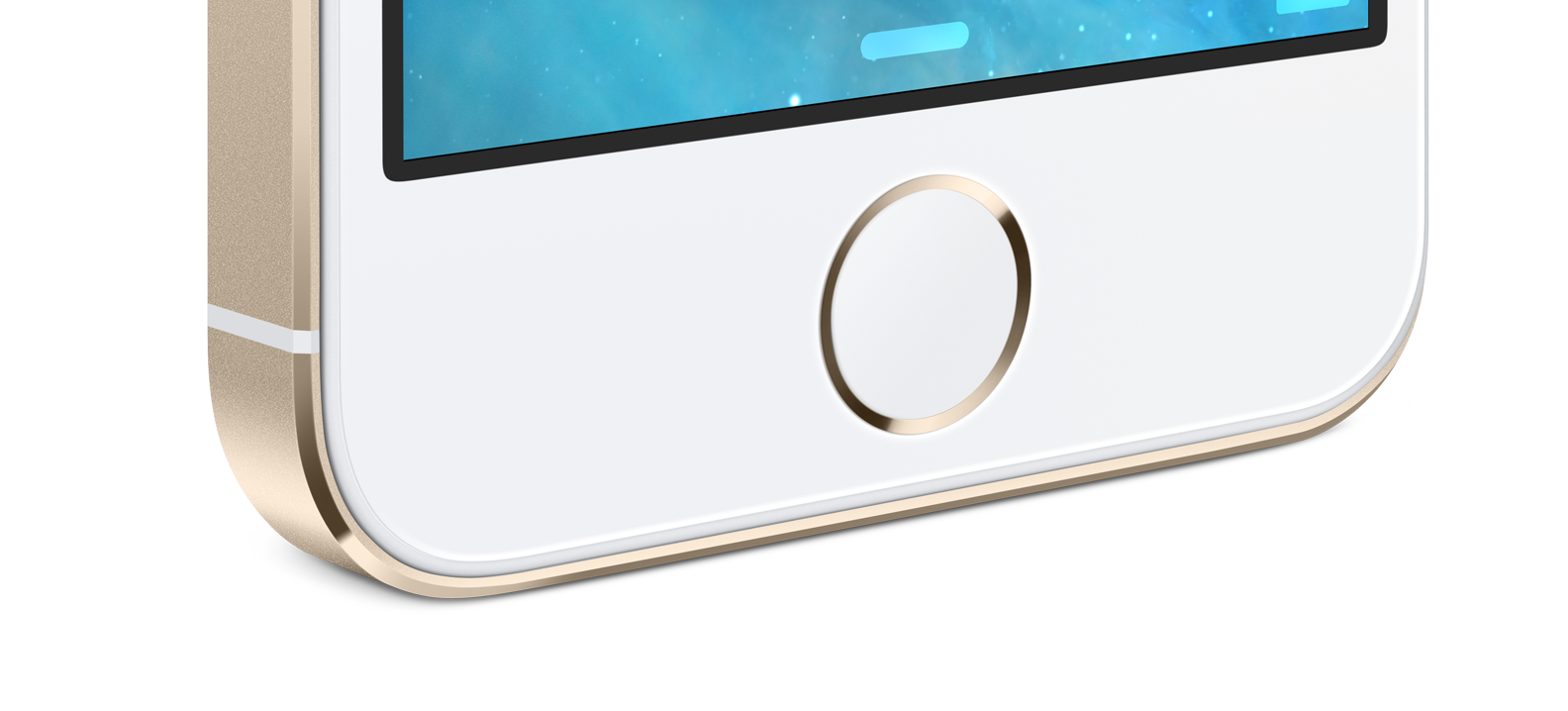
What is a mobile industry first is the new Touch ID sensor, a fingerprint sensor on a smartphone is a new one alright. It opens up a whole new array of possibilities, even though Apple has not yet opened it up to developers.
The Touch ID replaces the lock code requirements and also password requirements for you iPhone, hopefully you can also use it to access the iPhone keychain to auto-magically enter passwords.
Apple also announced that iOS 7 will be officially available post September 18th 2013 for all those supported devices.
The iPhone 5C will be available fro Pre Order on September 13th whereas the iPhone 5S will go on Preorder September 20th 2013. starting $549 and $649 for the 16 GB unlocked variants.
Apple just brought all the rumors to an end by launching two new iPhones, the iPhone 5s and the iPhone 5c. The iPhone 5c is a poly-carbonate build phone with various color options like white, pink, yellow, blue and green, the phone has all the same features as the previous iPhone 5 which has now been discontinued. On the other hand the iPhone 5s has a typical iPhone 5 build that uses aluminium and glass, the 5s is available in three colors: silver, space gray and gold, this phone comes up with some upgraded features.
So lets simply compare both the iPhones:
Specifications
iPhone 5s
iPhone 5c
Dimensions
123.8 x 58.6 x 7.6 mm
124.4 x 59.2 x 8.97 mm
Weight
112 grams
132 grams
Processors
A7 chip with 64 bit architecture
and a M7 motion compressor
A6 chip
Display
4 inch retina display with a resolution of 1136 x 640 (326ppi)
4 inch retina display with a resolution of 1136 x 640 (326ppi)
Rear Camera
8 megapixels with 1.5µ pixels, f/2.2 aperture, Sapphire crystal lens cover, True tone flash, backside illumination sensor, five element lens and hybrid IR filter
8 megapixels with 1.5µ pixels, f/2.2 aperture, Sapphire crystal lens cover, LED flash, backside illumination sensor, five element lens and hybrid IR filter
Video Recording
Full HD @ 30fps, true tone flash, Slo – mo Video, improved video stabilization
Full HD @ 30fps, LED flash, video stabilization
Front Camera
1.2 MP, 720p video with a resolution of 1280 x 960
1.2 MP, 720p video with a resolution of 1280 x 960
Siri
Yes
Yes
Touch ID
Fingerprint Identity Sensor (Yes)
No
Colors
Silver, Space Gray & Gold
White, Pink, Yellow, Blue, Green
Price
16/32/64 GB – 649/749/849 USD
16/32 GB – 549/649 USD
The pricing and availability of these phones in Indian market is still not confirmed, we will have to wait and see as factors like prices are of great importance in the Indian market. Meanwhile, which phone would you like to go for, do let us know below.
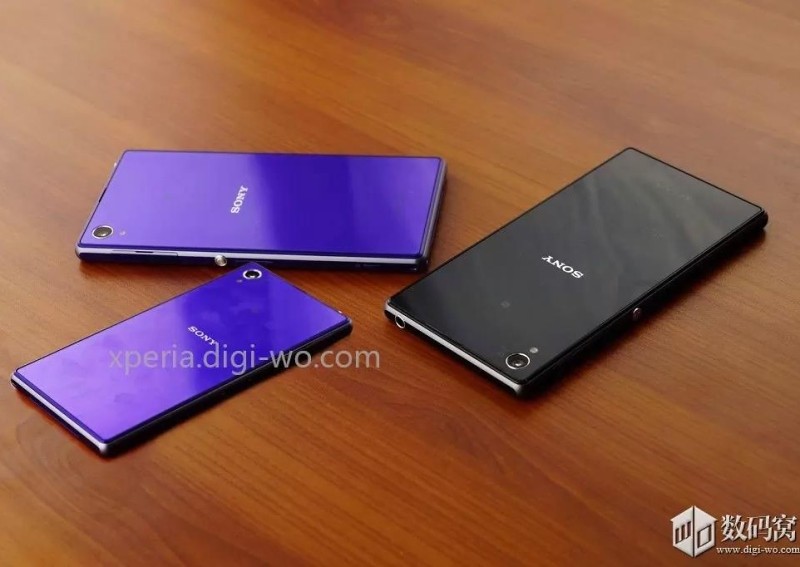
After the launch of the Sony Xperia Z1 at IFA 2013, its time to get back to the rumors. The mini version of the water resistant smartphone by Sony showed up along with the Z1 itself.
With the leaked images we get to look at some of the specs as well. The Xperia Z1 mini is rumored to come up with a 720p 4.3 inch screen, boast 2 GB of RAM, 8 GB of internal memory, powered by quad-core Snapdragon 800 processor, Android Jelly Bean 4.3 and sport the same 20.7 MP camera as on the Xperia Z1. The Z1 mini is rumored to make its official appearance at CES 2014 in Las Vegas this January.
These are leaked configurations, as there is no word from Sony about this device. The above configurations seem a bit too much as it shows that the Z1 mini will be powered with the snapdragon 800 processor and will sport a 20.7 MP camera, but if this rumor comes up true just like the rumors of a plastic iphone 5c which came up to be true, the Z1 mini seems to be a nightmare for its competitors.
However, the Japanese major has not yet revealed its plan for the smaller-sized version of its flagship smartphone. If we look at the previously launched mini versions of the phones like HTC One and the Galaxy S4 it shows that all smartphone minis have opted for lower grade processors than their bigger ones, we believe something like a Snapdragon 600 processor might be the choice of Sony for the Z1 mini.
Will Sony follow what is been the trend for mini phones, or will it completely change the segment of “mini” phones with its rumored Xperia Z1 mini, we will have to wait and see what Sony brings to the table.