A security firm has found a bug in Android that can result in the death of your phone – you won’t be able to access it as the bug will make your phone unresponsive to the extent that you won’t be able to receive any notifications or calls. According to Trend Micro, the security firm behind the discovery, the bug is present in phones running on Android 4.3 Jelly Bean and above, meaning that even your newly purchased Moto G (Gen 3) is vulnerable.
The new bug causes your phone to crash through Android’s mediaserver service, which indexes all the media files located on your Android device. The service crashes when it processes a distorted Matroska video file (.mkv), thus effectively shutting down the phone. The company notes that the bug can be exploited in two ways – by embedding the corrupted .mkv file in an app or a web page/website.
The glitch was reported by Trend Micro to Google in May this year, which was labelled as low-priority. According to a Google spokesperson (via Engadget), a security flaw will be made available in a “future version of Android.”
Last year the Google Nexus 7 became the best 7 inch tablet on Android, only because the best 10 inch tablet turned out to be the Nexus 10. This year the Nexus 7 is back in a sleeker and more refined format, only to tackle the title yet again. This is iGyaan’s review of the new Nexus 7.
Build Quality and Hardware
[pullquote_left]Slimmer, Taller, and Thinner[/pullquote_left]
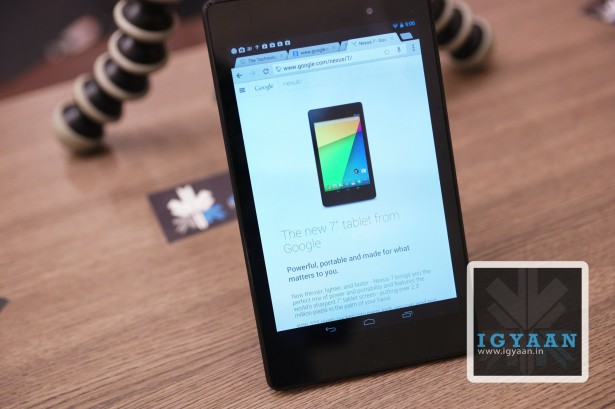
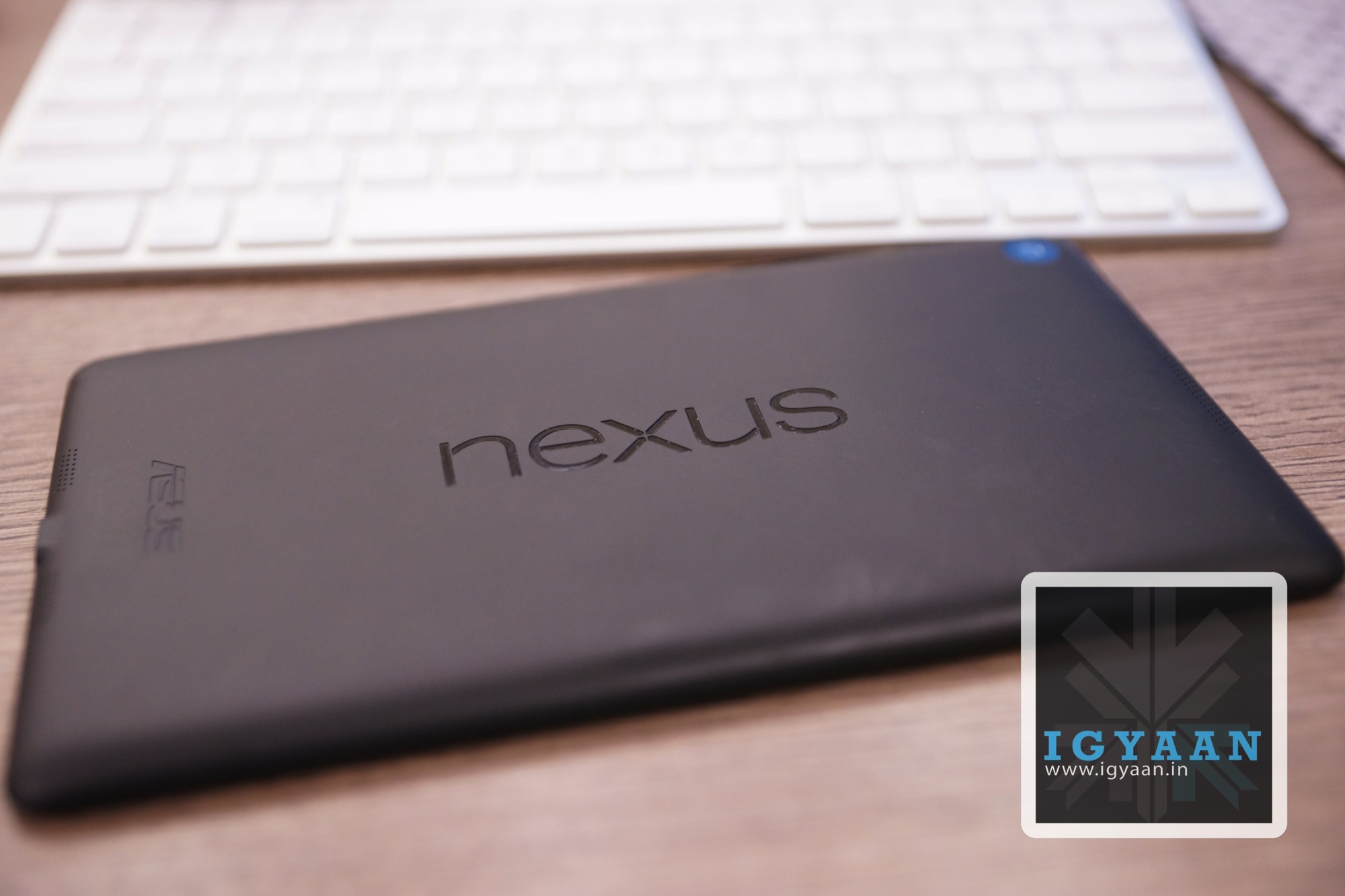
Setting the standards yet again the new Nexus 7 from Google offers the perfect mix of the right build and design you would expect from a tablet today. The back of the Nexus 7 loses the ribbed texture, only to be replaced with a plain soft touch back panel which not only is more comfortable to hold but also adds to the aesthetic. The new Nexus 7 2013 is slimmer, taller, and thinner than the first edition of the market breaking Android tablet.
The front of the new Nexus 7 2013 is laden with a Gorilla Glass display that stretches out to 7.02 inches and features a high resolution of 1920 x 1200 px, simply dwarfing any and every tablet in the market today when it comes to the display resolution. The overall pixel density of the display rests at 323 ppi and the Touchscreen will accept a 10 point touch input.
The Innards are comprised of a Quad core Qualcomm Snapdragon S4 Pro chipset with a 1.5 GHz Krait CPU and an impressive Adreno 320 GPU which is clocked at 400 MHz. The 3950 mAh battery provides the juice and the optics are defined by a 5 MP main shooter and a docile 1.2 MP forward facing peephole. All this is supported by fixed internal storage options of 16 GB and 32 GB along with 2 GB of RAM.
Display and Multimedia
Who says extra pixels are not good? On a larger screen the more pixels you can get the less they seem. The New Nexus 7 2013 finds this balance in the display size and pixel density nearing the retina stature for small handhelds. The display is gorgeous no matter what you do with it, movies, browsing and even gaming. The display delivers with vivid colors and excellent viewing angles.
The new Nexus 7 is a great content consumption device you will almost always enjoy picking up the tablet. The interface is instant in terms of response and the overall multimedia experience is just shy of what you could expect from a flagship tablet. The only real downside is the lack of enhanced audio, the inbuilt speakers, although stereo and well placed, simply are not enough.
Cameras
The new Nexus 7 2013 is US $ 20 more expensive than last years edition, most of which can be blamed on the additional 5 MP camera at the back of the tablet. The new camera may be an addition in price, but a lot of owners will accept is as a welcome addition and a valid additional expense.
The camera is no design and engineering marvel, with flat pictures and no real points of emphasis, it is just a camera on a tablet which may as well not have been there. Pictures from the main camera are prone to loss of focus and sometimes exposed inaccurately causing a severe problem in the overall feel when using the new Nexus 7.
Video capture is also average, with a lot of shake getting carried through to the 1080p footage.
Nexus Performance and Gaming
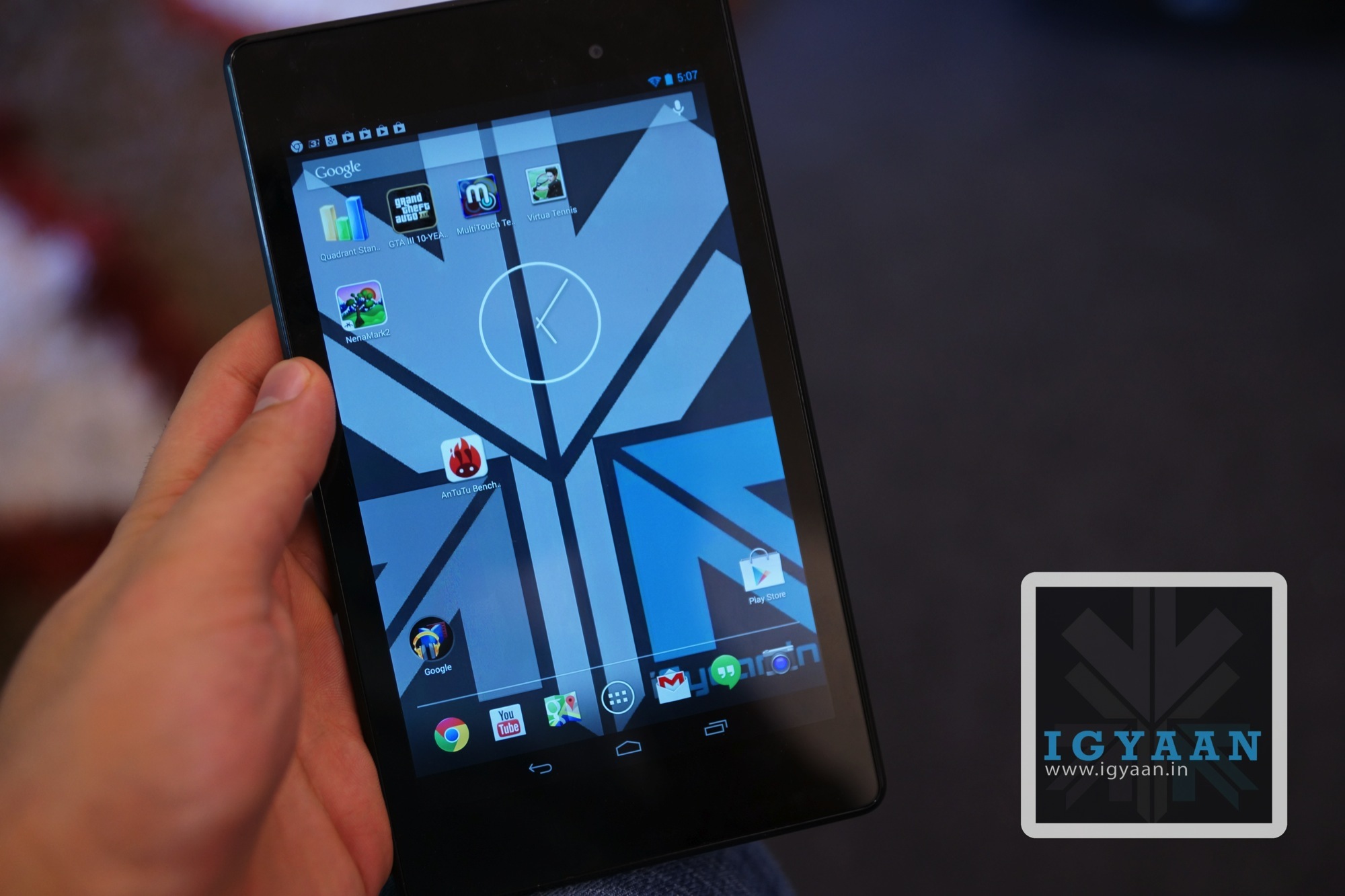
One of the biggest reasons the Nexus 7 came out on top last year was the fact that the tablet ran a completely vanilla Nexus rom with no customizations. Same is the case with newer edition Nexus 7 2013, the experience of pure Android makes performance of the device a notch better, the tablet a notch more responsive than any other custom Tablet UI including those from Samsung and Sony.
Gaming has been best defined in our video below. But, to elaborate a little more, the perfect size of the tablet, the light weigh and the hardware on the inside promises an unmatched gaming experience. You really will appreciate the Adreno 320 Graphics and the S4 chipset in action along with the ample 2 Gigs of RAM which make for an exciting gaming experience.
The new Nexus 7 2013 is more a tablet than its predecessor. Since a modern day tablet has to be portable, powerful, thin and light yet capable of long hours of use, the new Nexus 7 fits those criterion like a glove. The new Nexus 7 is a perfect balance, where on one hand it give you the portability you will need, on the other it offers up the performance you will demand. The tablet choses to look good while doing it as well.
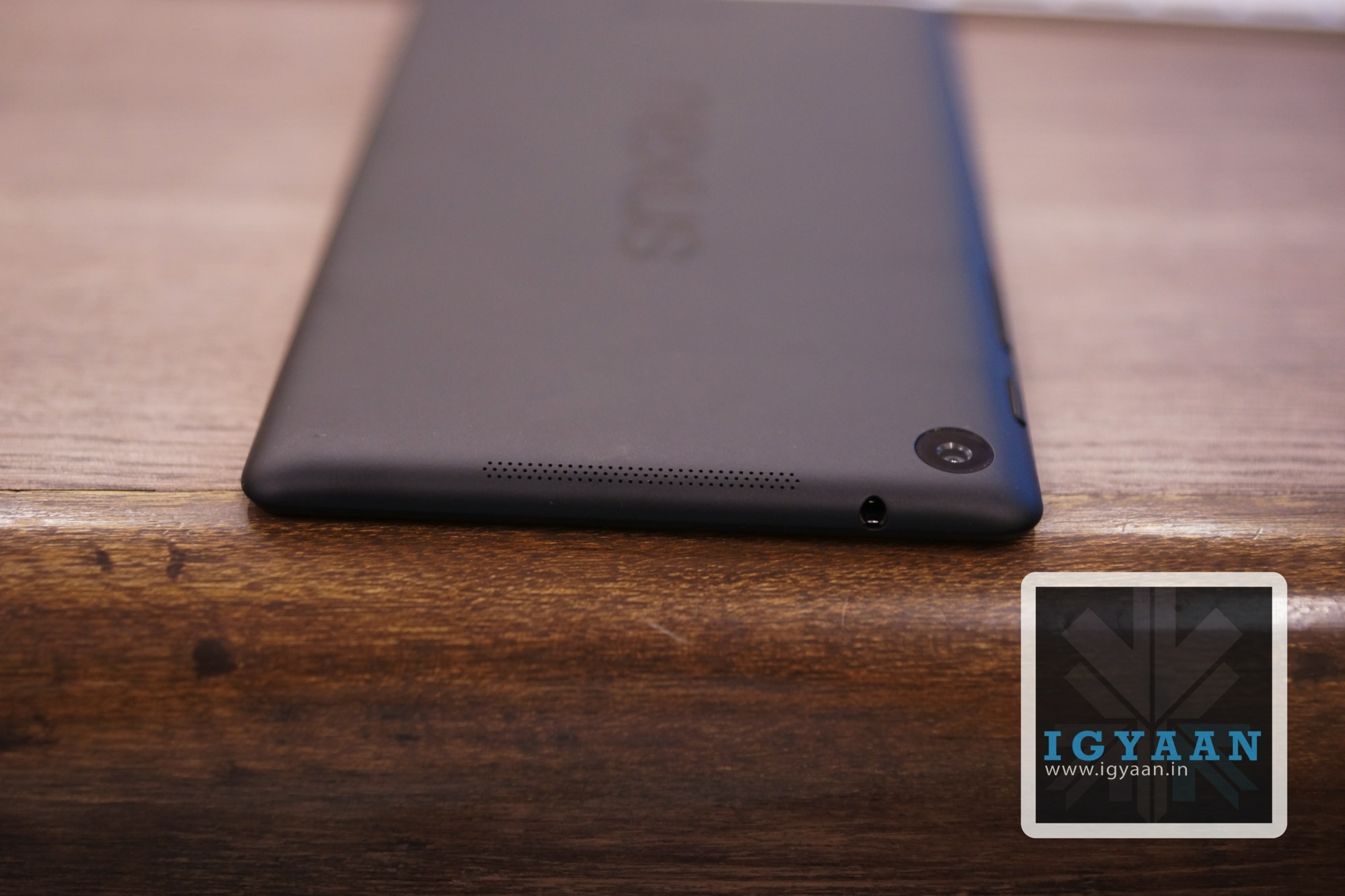
Charging port and Speaker
Buttons Layout
Analogue TV OUT
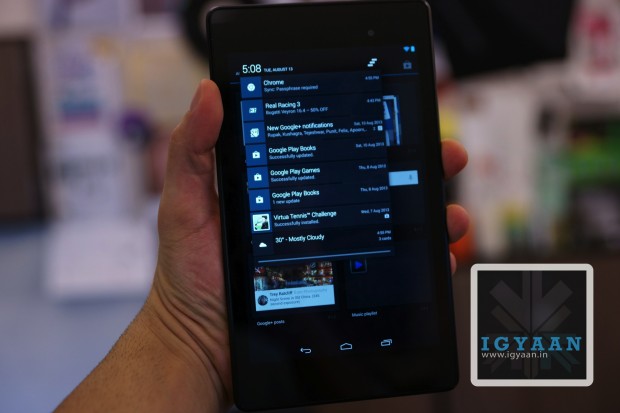
smooth UI
still pocketable
Conclusion
Since the lower strata of the market is crowded by tablets of the third edition, the slightly expensive Nexus 7 provides the ultimate satisfaction. But since no one is ever fully satisfied, the Nexus 7, just like the iPad, will never be a phone. Honestly, we don’t want it to be a phone, the 4G variant will offer up data on the go for those who need it. The new Nexus 7 has the highest resolution display, the best gaming performance, good looks and portable yet solid construction. Need we say more?
The new Nexus 7 gets tablet of the year 2013 (till September) from iGyaan.We expect the new Nexus 7 to launch in India soon, for pricing and more details click here.
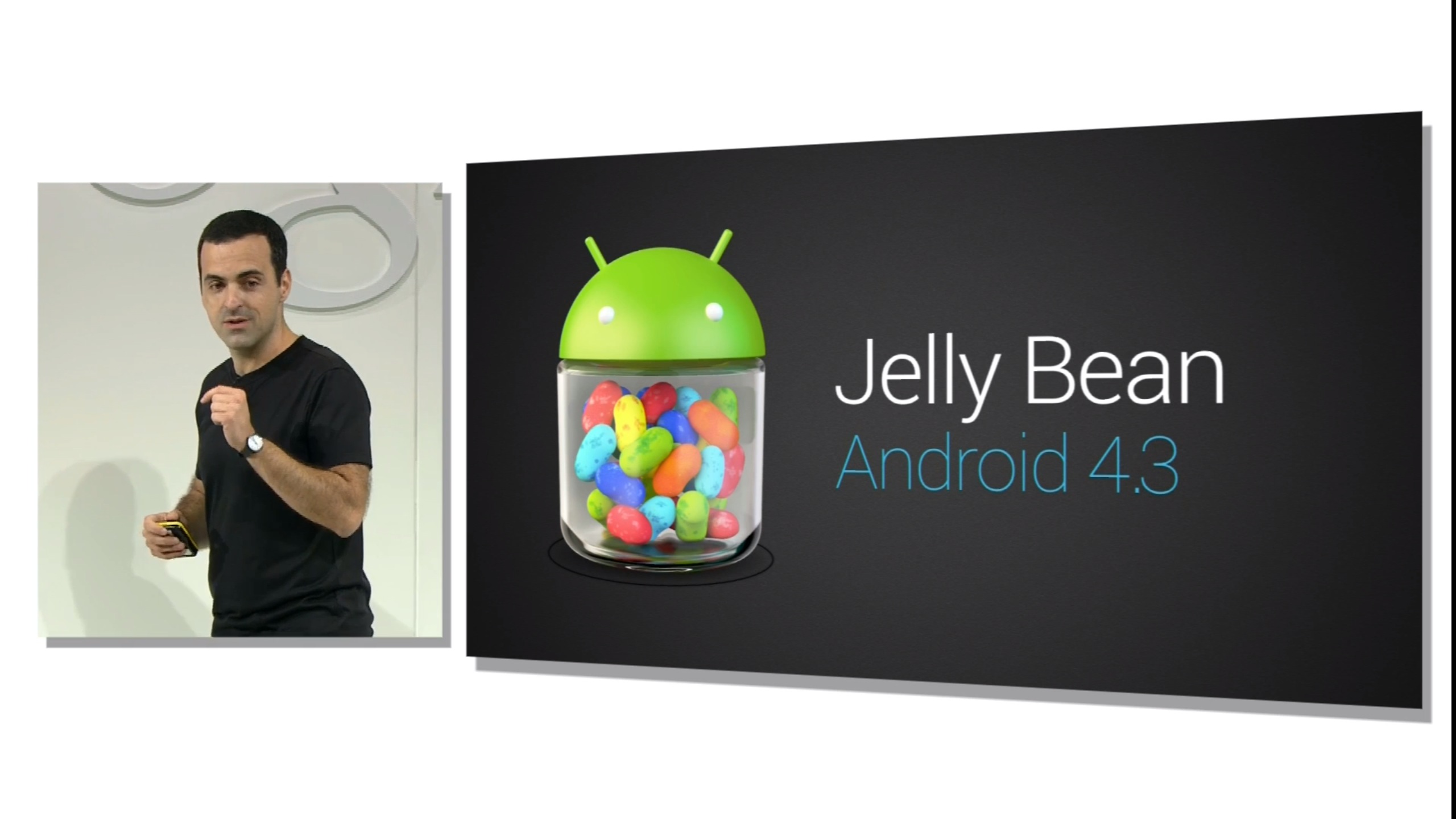
Google today announced the latest iteration of Android – Android 4.3 Jelly Bean during a press breakfast in San Francisco.
The long-awaited OS update will be coming to Android device users based on their devices. The Android 4.3 Jelly Bean update will start rolling out today to the Nexus 4, Nexus 7 and Nexus 10. The “Google Play Edition” versions of the HTC One and Samsung Galaxy S4 can expect it soon, most likely August or September.
As ArsTechnica reports, the new operating system will feature multi-user restricted profiles. This will let users control access to contents and apps per user—so parents, for example, can control which applications their kids can access. When accessed from restricted profiles, applications behave differently. On stage, Hugo Barra demonstrated this by showing a puzzle game whose in-app purchase functionality was automatically disabled when it was accessed on the kid’s restricted profile.
Other features include built-in OpenGL ES 3.0 support, DRM APIs for providing hardware-based encryption for protecting content, which will allow it to provide 1080p video to its tablets. The first partner is Netflix, which supports 1080p HD streaming. The Nexus 7 is the first device to support it.
Android 4.3 also introduces many other features, including support for Bluetooth Smart devices, background Wi-Fi location, more language support and “easier text input.”
We’ll bring you more on the new release as it comes. In the meantime, share your thoughts down in the comments.
Android 4.3, Jelly Bean will be the next major software build released from Google.
Android 5.0, Key Lime Pie was originally expected to debut at this year’s Google I/O, however, a newer build of JellyBean seems to be the stronger candidate to be introduced this year, according to a report from Android Community.
Much of the proof has been found in IP logs that are available to many web administrators. They point to a new version of Jelly Bean, Android 4.3, with a build number of JWR23B. Android Police posted examples of this from their server logs coming from both the Nexus 4 and Nexus 7, all of which emerged from IP addresses in Google’s range.
There are also several examples of developers citing this build in various bug trackers around Google products, suggesting that its launch is imminent. Because the build starts with “J,” it’s easy to assume that it’s part of the same family of code as the previous two major Jelly Bean releases; Google assigns the first letter of the name to each corresponding build.
Google has also never launched a major version of Android at Google I/O. Android 4.1 was announced last summer, and Android 2.2 was launched at Google I/O in 2010. While Android 3.1 Honeycomb was exposed at Google I/O 2011, its significance would go on to be undermined as merely “aesthetic” in future releases.
That being said, even though Jelly Bean has been around for over a year now, there still seem to be a few major bugs to squash. Android 4.2 has not been a smooth upgrade for many users, especially those running the Galaxy Nexus and Nexus 7, as it introduced significant slowdown, animation glitches, camera instability and more. Overall, while Android 4.2 seemed to be a fairly minor upgrade to end user, it actually made a number of significant modifications to the Android case base, and Google may believe it has another minor upgrade to fix any remaining bugs.
Google I/O is coming on May 15th, and we’ll be there to cover all the announcements, major or otherwise. You can certainly expect a faster, Qualcomm-powered Nexus 7, as well as a rumoured 32GB LTE-powered Nexus 4. There will be a much higher prevalence of Glass users at this year’s jaunt, too, and you can bet on a few more surprises as well.