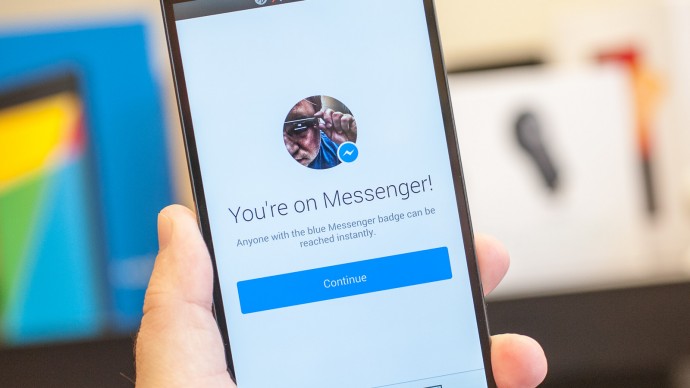
Voice-Calling within the app is a recent trend every established and emerging messaging software company is following. Recently, Facebook joined the drift and updated its Messenger service to enable voice-calling in the app. Now users can talk face-to-face with their friends anywhere through Facebook.
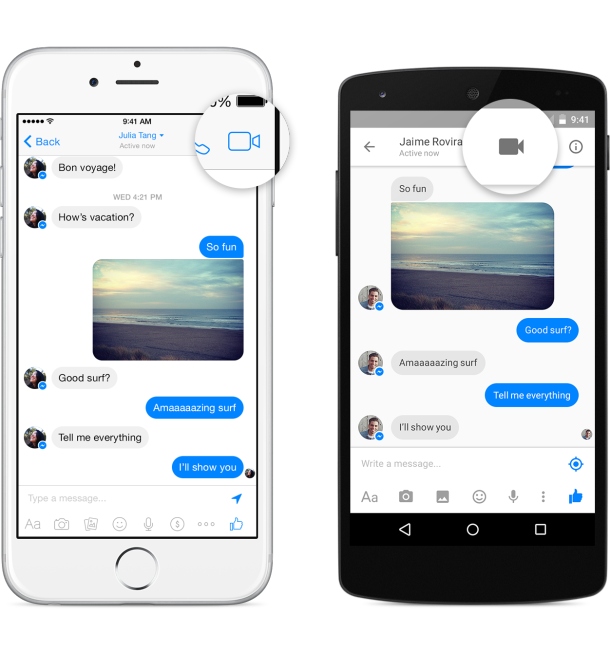
Initiating the voice chat service is a child’s play, and users just have to tap on the video icon in the top right corner of the screen to pop up a voice call. The service is available for iOS and Android users as of now. Countries that will be able to access this feature are Belgium, Canada, Croatia, Denmark, France, Greece, Ireland, Laos, Lithuania, Mexico, Nigeria, Norway, Oman, Poland, Portugal, the UK, the US and Uruguay. The tool will soon arrive in other countries “over the coming months.”
The standard messaging service on Messenger still exists. Users can anytime stop a voice call and get back to the customary messaging platform and vice-versa. The company claims that there are over 600 million active users of its Messenger app, and the voice-calling tool will help them with real-time video communication.
Facebook’s Messenger platform is on a development spree. Previously, it added the ability to send money to friends via Messenger, which was followed by the release of Messenger platform for Developers to help people connectwith businesses.
Check out the video below for a detailed description of voice-calling on Messenger:
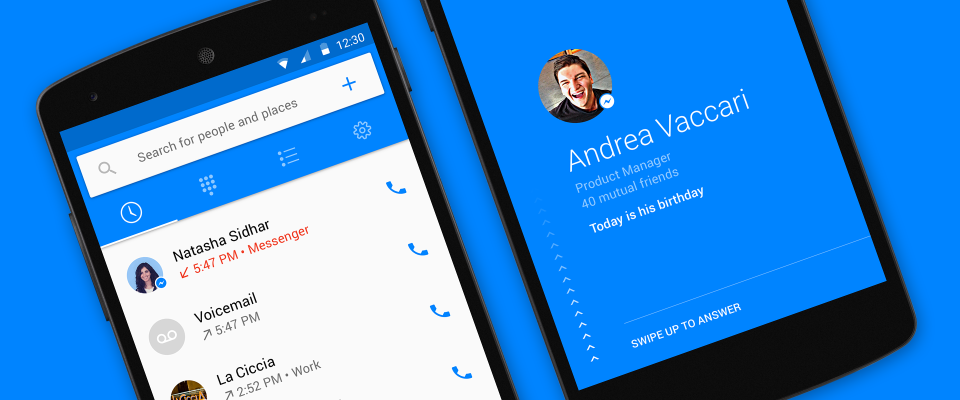
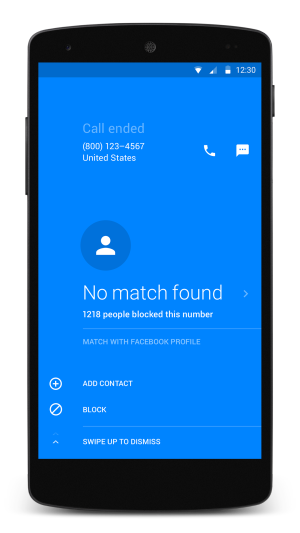
We have to admit that the Phone app on our smartphones is really basic. It just performs limited number of functions like keeping call log and allowing users to make a call. However, Facebook aims to change our call making experience. The social networking service has brought out a smart app that is a blend of TrueCaller, Google Search, Google Maps, and WhatsApp. Hailed as ‘Hello’, it’s an Android-only dialler that works in conjunction with your Facebook account.
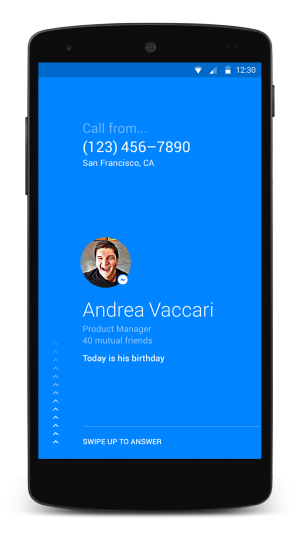
The Hello application is a product of Facebook’s Messenger team. It connects the Facebook data with the contact info on your device, and pops up relevant details of the incoming and outgoing calls. No worries if your phone book is narrow, you’ll still get to know the name and other available details of the caller via Hello. Users have the choice to block possibly spam numbers and avoid unwanted calls. Meanwhile, TrueCaller is best known for this feature.
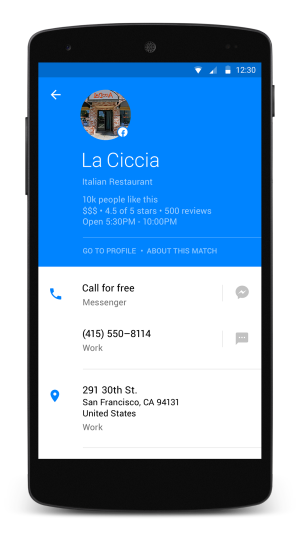
Users can also find businesses with the Hello tool. Meaning you can start a search for a restaurant right in the Hello app and can call for a reservation. The tool comes with direction support, subtracting the need to start off Google Maps to get directions.
Its features don’t end here. With Hello installed on the device, one can text and make calls for free. Hello links with the Messenger app and allows users perform both the functions using cellular data.
Hello is available for free on Google Play Store for the US, Brazil and Nigeria. The tool is likely to arrive in more countries soon. Check out the video below to know how it works:
Facebook announced today that they will be changing and reconfiguring their website’s News Feed section. The social networking site has applied three changes and aims to supply information about the people ‘you care about’.
One of the main changes to the Facebook layout will be that your News Feed will first prioritise your closer friends. Photo or a Status put up by them will be placed higher in the News Feed so that it won’t be missed out.
The second change is that the rules for seeing multiple posts from the same source has been toned down. This modification has been done for people who do not have much content to view. Now, you will never reach the ‘end’ of a News Feed easily.
Finally, the last change would be that you will see lesser posts of your friends liking or commenting on other friend’s posts. These stories will be pushed further down the News Feed so that you first see the posts or photos of the people you care about more.
The only downfall would be that Facebook Pages may get compromised. Facebook states in its blog:
[quote text_size=”small” author=”Facebook Official Blog”]
The impact of these changes on your page’s distribution will vary considerably depending on the composition of your audience and your posting activity. In some cases, post reach and referral traffic could potentially decline. Overall, pages should continue to post things that your audience finds meaningful and continue using our Page’s best practices.
[/quote]
Facebook has asked Web Publishers and Page Managers to visit their blog to know more about page feeds and posts under the new circumstances. Click here to visit the blog.
It’s barely been a few days since Facebook gave an adrenaline boost to its Messenger platform by opening it for third-party developers. The independent platform gave users freedom to interact with businesses and made it an all-around service. The social networking giant is now making one more modification to the messaging tool that will incorporate WhatsApp to Facebook.
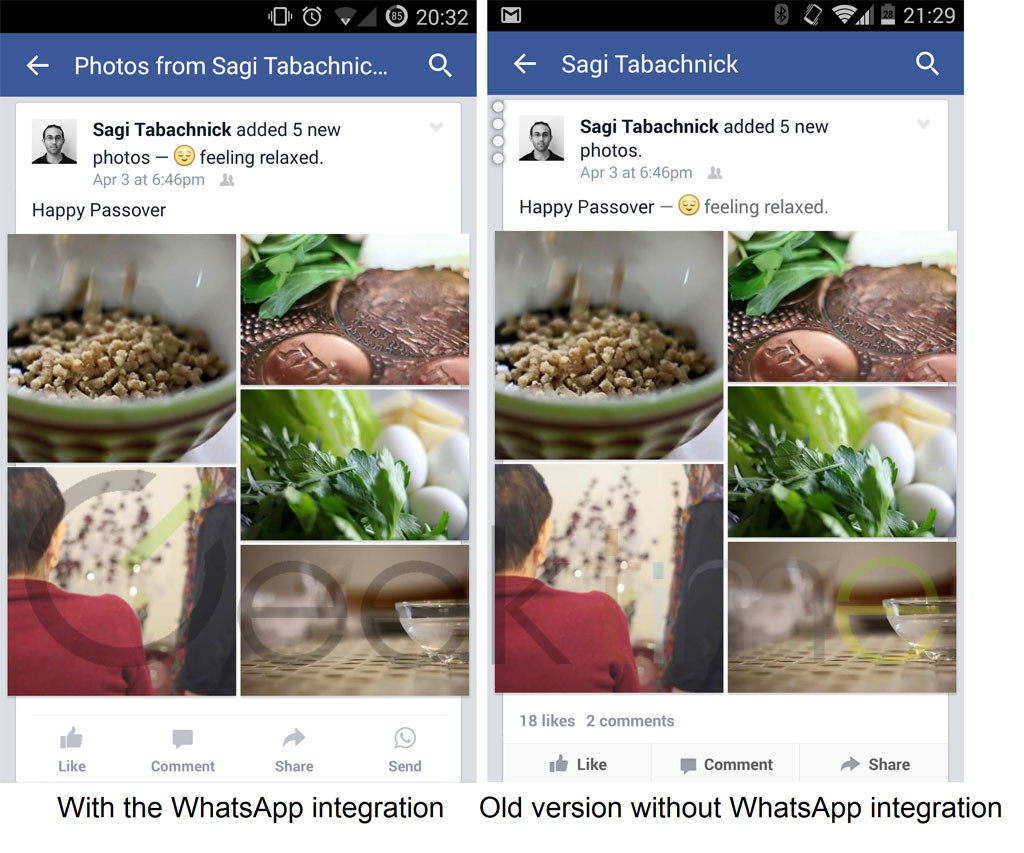
According to a report by Geek Time, Facebook is testing a new feature on its app for Android operating system that will mark the first major integration of WhatsApp to it parent company Facebook. The company has reportedly added a ‘Send’ button to Facebook’s latest version 31.0.0.7.13. The new feature is a part of the status actions buttons that appear beneath every status update, and it looks exactly like the WhatsApp icon.
As per the source, the button is spotted at the right side of the window for some users (for left-to-right languages) in the recent update. The pictures depicting the new feature inclusion is provided below:
It’s just the first glimpse at how Facebook is planning to play its WhatsApp acquisition. The same report also confirms of a deeper integration between the two that would allow users to send messages directly from Facebook Messenger to WhatsApp. It took Facebook more than a year to merge its buyout with its central tool, but it seems like the parent firm was mulling over on how to use it wisely. The social networking tool seems to be making slow but steady moves, towards becoming the ruler of the messaging market.
Without leaving its ground, Facebook is firming its grasp into several other domains as well. Recently, we reported that Facebook is also developing a new caller ID and call blocking tool ‘Phone‘ and has built a solar-powered drone to beam down internet to the earth.
At the two-day F8 Developer Conference at Fort Mason in San Francisco, Facebook shared with the world its plans for year 2015. Yesterday we surfaced the news of Facebook extending Messenger support to third-party apps allowing users to interact with businesses. Now, the social networking giant announced that it will be building drones to help accomplish its Internet.org project.
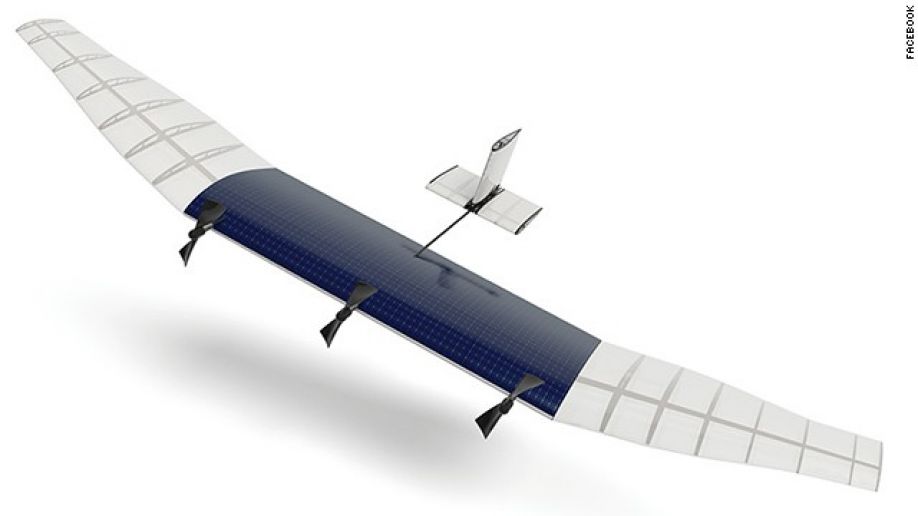
According to The New York Times, the unmanned aerial vehicle will be V-shaped and are codenamed as Aquila. The drones have got their name from an eagle in Greek mythology. The wingspan of Aquila would be as wide as a Boeing 767 jet airliner, but will weigh as much as a compact car; thanks to the lightweight material to be used for its construction.
The unmanned aerial vehicle will reportedly stay in the atmosphere for almost three months and will use solar power for its operations. Staying in the air, the drones will push internet access to 60,000 and 90,000 feet via lasers. During their suspension in the sky, the aerial vehicles will communicate with each other so that they cover the maximum area on the earth. According to the source, the first flights will begin in summer this year, however, the commercial deployment of these drones fleet may take time.
Facebook’s drone initiatives are powered by its buyout of Ascenta, a drone maker in 2014. But it needs external support to build its fleet of drones. Facebook is seeking partners to fund its Aquila project to take off, and in turn the company will offer the data and technology to the supporters.
Until now, Facebook was recognised as a social media entity, but looks like it wants to be the leading powers of the technology busines. Facebook inaugurated the limited free internet service across the world in August 2013 and today, it’s shaping itself to give maximum benefits to the people. It recently brought the internet.org initiative to India in a tie-up with Rcom. There are several initiative underway to offer low cost, high speed access to the entire population of the planet. Apart from Facebook’s drone initiative, Google is making headway in the arena with its Project Loon. SpaceX founder Elon Musk, in cooperation with Google also plans to cover the planet under a constellation of internet beaming satellites. The human population will soon become a connected civilization.
At Facebook’s F8 Developer conference yesterday, the CEO of the company Mark Zuckerberg took the stage to announce the future of its Messenger Platform. The company recently spun off Messenger into its own independent app. Messenger will now become a superpowered messaging app that can become the most formidable competitor in the market.
Mark Zuckerberg spoke about the new service at the conference –
It’s a new platform that developers can use to build apps that help people connect.
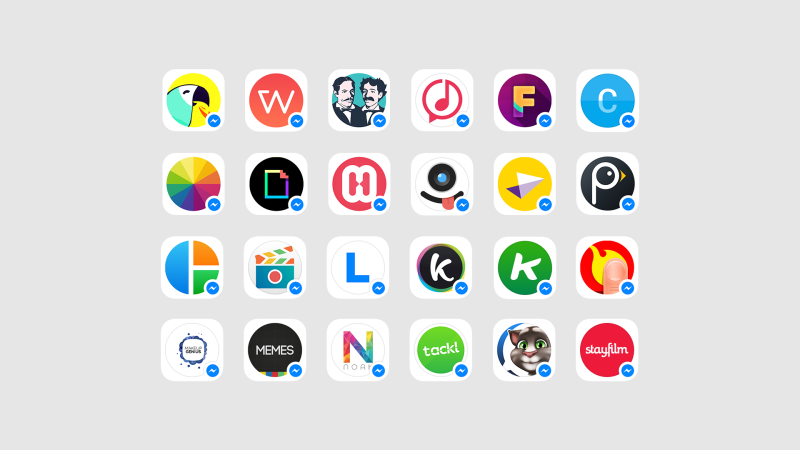
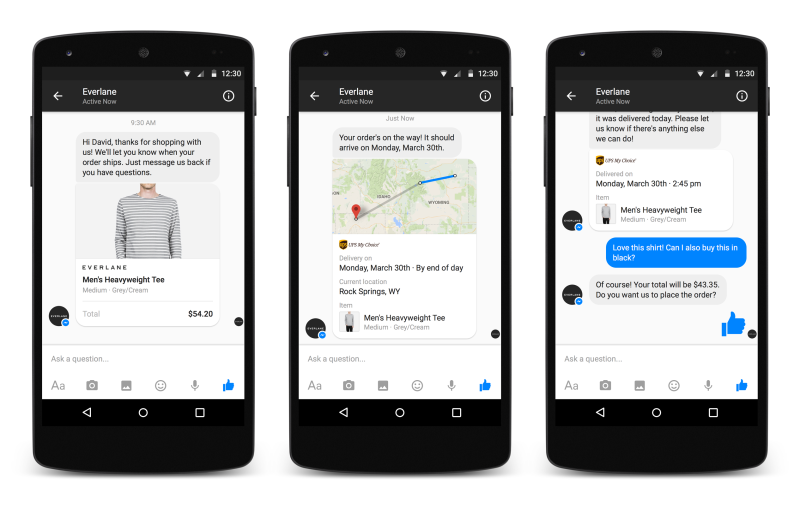
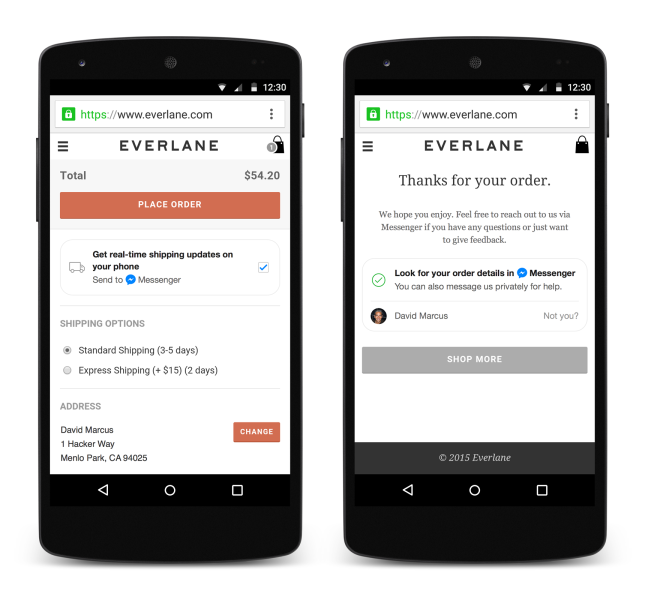
Facebook introduced 40 new apps for the Messenger Platform. These apps come within the Messenger service and adds up to the vast ecosystem of apps on Android and iOS. The newly developed tools allow users to interact with businesses like online retail brands, where they can place their order directly and get details about the order through chat. Also, you would be able to send messages to the Messenger app store to download an application. Facebook can use its reach and introduce a Messenger tab on major websites to speak directly with businesses or content creators. By opening up Facebook Messenger platform, the social networking platform has given the third-party apps access to the millions of Facebook users. Besides, it has made Facebook Messenger a strong contender among other messaging platforms like WeChat and Line, who are all-round services that offer for gaming, e-commerce, and of course, communication. The new platform is said to be open for all the developers, but the company has already finalised 40 launch partners. Some of them includes ESPN, Imgur, The Weather Channel, and Giphy.
A while back, Facebook detached Messenger from its smartphone app and asked the users to install the new independent app. The decision by the social networking giant led to mass disapproval at that time, but it has now begun to make sense. Facebook was preparing its user-base to explore the new developments of the Messenger store and its scope for business communication.
Th company has been continuously building up its Messenger platform. Few days back, Facebook announced a new payment feature that allows you to send money via instant message. Messaging app will soon become the center of future communication and might replace tools like e-mails and become our primary mode of communication. Facebook also said that Messengers new features can act as a model for WhatsApp in the future. The future of messaging apps looks great.
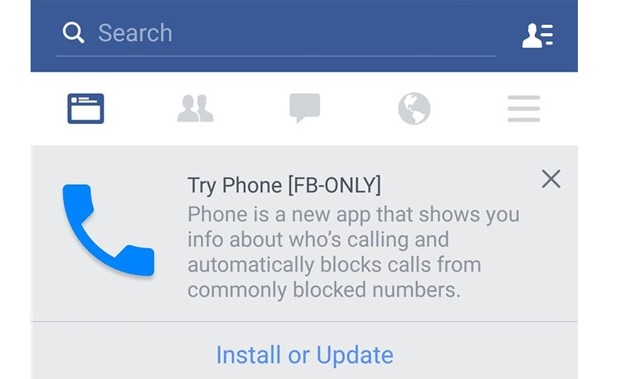
Facebook might have accidentally popped a small glance at the next major app coming from its stable. A message popped up on the Android app of some Facebook users which gave an indication that the social media giant is working on a new app called “Phone.”
The feature popped out with a FB-only tag and showed a dialer icon. However, on tapping the icon, it led to a ‘no page found’ error. It is said that the feature is still in works and the link might have accidentally showed up in the users feed. A report from Android Police stated that the Phone button seems like a replacement for a dialer and will automatically block spam calls and show detailed information about the incoming calls.
Whatsapp, which was acquired by Facebook last year, has also rolled out their version of the calling feature that allows you to make voice calls to one another using data connection or WiFi data. As of now, the only problem Whatsapp may be facing regarding the calling feature is the lag-time in between a call.
Facebook has already rolled out voice calling feature on Messenger. Android and iOS users in can call anyone through this app, consuming only cellular or WiFi data. The feature came to India last year. Now we hope Facebook doesn’t force us to download a whole new app to clutter our devices again. Instead they can include the feature in their existing app like Whatsapp did with their latest update.
The world’s largest social network Facebook is a powerful tool to connect with billions of people across the globe at any given time. With an active user base of 1.39 billion users, the responsibility for establishing the proper code of conduct for the website gets really tough for Facebook. This is why the biggest social network in the world has to constantly update its community policies. Facebook has now clearly spelt out what kind of actions are likely to get a user suspended from using their service.
The social networking giant has set a standard to make sure no nuisance befalls on the website and today the company has updated its community standards section to make clear what all is prohibited on the site. The company didn’t change the policy and instead provided details ‘on what is and is not allowed’.
Gratuitous nudity and violence will definitely get you banned from the website
Without seizing the freedom to share and freedom of free expression from the users, Facebook gave a detailed policy description for nudity and hate speech; “We remove photographs of people displaying genitals or focusing in on fully exposed buttocks.” It said that “images of female breasts if they include the nipple” is unacceptable “but we always allow photos of women actively engaged in breast-feeding or showing breasts with post-mastectomy scarring.”
Facebook banned the terrorist organisations like ISIS a while back, and they also made clear that encouraging groups that show violent, criminal or hateful behaviour is also prohibited on their platform.
These measures have been taken to put an end to online bullying. Posting tailored images to degrade a person, and threatening someone for financial or physical harm is illegal and banned. The company has also opted strict rules for revenge porn videos where intimate images or videos of women are shared online without their consent to degrade them in public.
Meanwhile, it should also be taken into account that there is no set method to scan the image automatically and remove the offensive content once posted on Facebook. The previous method of reporting abuse still follows, and once a user reports about an abusive post, it will take about 48 hours to eradicate the content from the website. Monika Bickert from Facebook talked about the rules saying:
Sometimes the best way to share information about atrocities in the world is Facebook. We recognize that is a very challenging issue.
Along with updating its rule book, the company also released its ‘transparency report’, which had requests by governments of each country for user data. The overall governmental applications were 34,946 in the first half of 2014 and 35,051 in the second half. The government of India, Turkey and Russia made most of the request, while the western countries including UK and the US, showed a decline in applications.
Overall, the new announcement shows the kind intentions of Facebook. With a medium like Facebook where videos go viral in a matter of minutes, 48 hours is too long skip a prohibited content from eyes of the 1.4 billion users. Facebook wouldn’t be able to stop the content from being posted as its a matter of freedom of speech. Also as it has a massive varied user-base raging from different regions of the world, it would be difficult to have a one size fits all policy. So as of now, the user complaint based feedback model seems like the best way let Facebook know of your discomfort with the content on their website.
Facebook’s non-profit initiative to connect the world, Internet.org, is successfully running in six countries. The company’s CEO Mark Zuckerberg is quite happy with providing limited free internet to remote areas and is planning to expand the service to 100 more countries by the end of this year.
Chris Daniels, VP of Internet.org at Facebook said in a statement –
The ambitious goal this year is to roll it out to 100 [countries]. We don’t want to focus so much on the number, but we want this to spread to additional countries, operator groups and… see more people coming online, buying data and voice and SMS bundles. The number is indicative of our ambitious goal.
Internet.org is a Facebook-led free internet program that works with data suppliers to provide free internet to people who can’t get online. It allows users to access basic sites like Wikipedia, job and health sites, and Facebook, of course. The service was launched back in 2013 and now it connects 7 million people of six nations across the globe – Zambia, Ghana, Kenya, Tanzania, Colombia and India.
Zuckerberg thought ahead and his idea really worked. Countries provided with free internet have seen a sudden jump of 40% in the internet data demand. People are willing to get associated with the world around seeing the power of internet via little demo, that is Internet.org.
Facebook’s step will draw more nations closer to each other and is a way to transform the developing nations into developed ones. Meanwhile, Facebook has teamed up with Google for Project Loon in establishing high-altitude balloons, a satellite-based network, to connect to connect people in rural and remote areas.
Gender rights and equality issues is one of the major conversational topics today. There has been more interest than ever to give equal representations to all members of society. Facebook has been one of the most prominent tech companies that has tried to engage on this issue. The company last year unveiled a huge list of new sexual identities for users to choose from but now the company has gone further. It now allows users to specify it for themselves.
The new feature lets user define their gender and select how they choose to be referred to on Facebook.
Facebook had unveiled another feature where users could select from options like cisgender, transgender or intersex. But some users found the move not inclusive enough. So now the social media superpower has gone ahead to let the users themselves choose how they want to be addressed by the service. Users can select how they define their gender and can select from options like her/him/them, as to how they want to be referred to as on Facebook. It will also let users select who they want to share their gender information with through privacy settings.
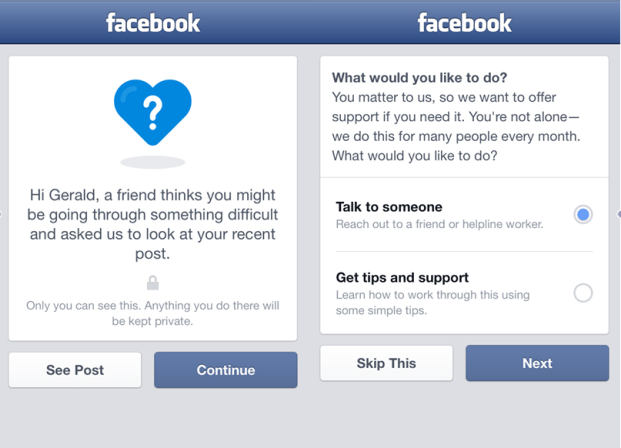
Suicide prevention features from Facebook.
Facebook’s use of its platform for socially responsible causes doesn’t end here, the company also unveiled a new suicide prevention feature. This is an applaudable move because we are getting limited to social networking for human interaction, and this will help troubled individuals to get support from concerned friends. The feature lets users report to Facebook if they see troubling content that would define suicidal thoughts in an individual. Facebook’s professionals will go through the reports and decide on providing help to the individual. Facebook has worked with various agencies who specialize in suicide prevention to come up with this new feature.
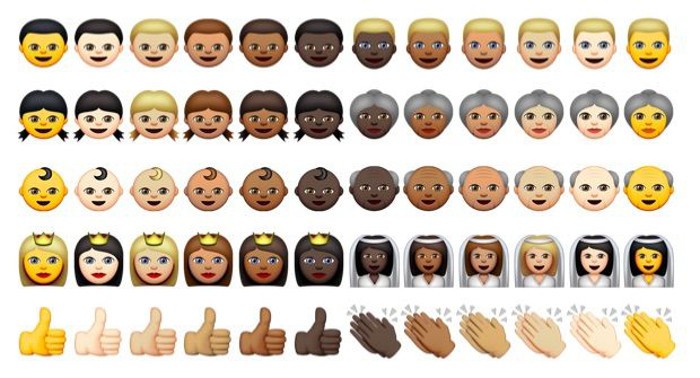
Apple’s new all inclusive emoji’s.
Another Silicon Valley powerhouse, Apple announced new emoji’s in order to address diversity issues. The makers of iPhone have unveiled new emoji line up that will represent people of all races. This feature is added in the iOS 8.3 beta and will probably arrive later this year.
It’s encouraging to see the tech industry standing up for the values of equality. Social media and messaging apps are the most important communication tools and it’s good to see them have more utility than just telling us what our random high school acquaintance had for lunch.
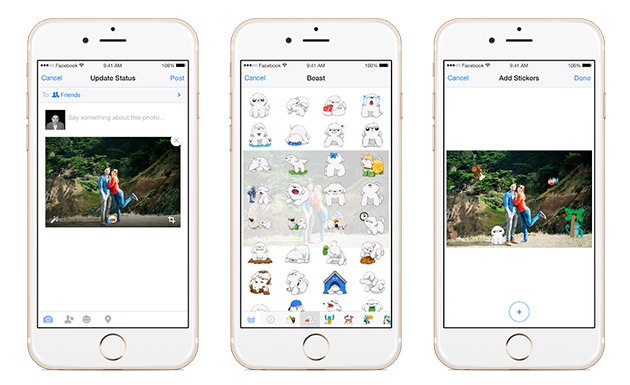
From Thursday onwards, Facebook will be introducing updates that would allow you to add stickers to your photos from Facebook’s mobile app on iOS and Android devices.
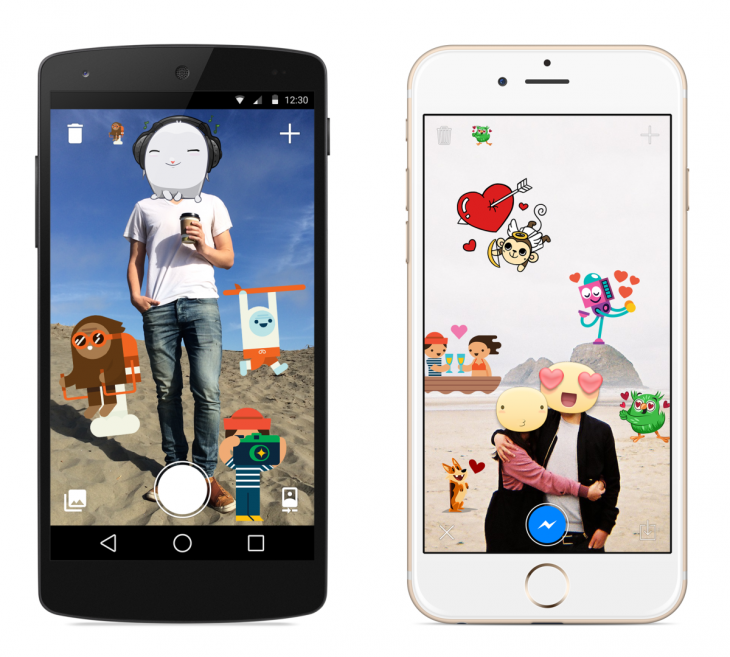
While uploading a new photo, you will be able to access the new sticker icon with the updated Facebook app. This icon will offer a huge variety of stickers. Once the sticker (or multiple stickers) is added, you are free to choose as to where to position the sticker, resize it or rotate it. You of course have the option to delete the stickers before the photo is finally uploaded.
You can also add captions, and even apply the stickers before the shot is taken with the app’s built-in camera access feature. Images already present in your image gallery can be decorated as well, and there is no limit to how many stickers can be applied to one image.
Facebook had launched the sticker app called ‘Stickers for Messenger’ in December for Android and iOS devices. However, this app required the Facebook Messenger app to send images to Facebook friends.
This new feature may suggest that Facebook is now targeting mobile users more than desktop users. 85% of its users access the website via mobile, and one-third of its total users access the site exclusively on mobiles. Facebook’s revenue rose to $2.5 billion last quarter, thanks, in part, to mobile advertising. Stickers for photos look like an enjoyable feature and will be really appreciated by the users.
Last March, Facebook acquired virtual reality (VR) headset maker Oculus with a vision of introducing the world to futuristic social media experience. The social media giant hasn’t taken a break since then and is coming up with one or the other breakthrough. Lately, Facebook has confirmed that it is working on virtual reality apps that will assist users in creating and viewing VR content.
In a conference today, Chris Cox, Chief Product Officer of Facebook, stamped the news saying that they’re working on apps for VR.
You realize, when you’re in it, that you’re looking at the future, and it’s going to be awesome. When you’re in Facebook, you’re just sending around these bits of experience — a photo, a video, a thought, whereas with VR, you could be sending a fuller picture.
According to Cox, the users will be able to create VR content of their own and share the surrounding environment with other app users. Though, he didn’t elaborate what all apps are in the progression and how are they going to work.
Facebook exhibited a small demo of the boundless platform at Sundance Film Festival this year. The company stepped forward and premiered its first short piece titled ‘Lost‘. It also confirmed to release five more flicks this year.
This step by Facebook is commendable. It would be exciting to see the apps that would give users freedom to create VR content of their choice and share it. This will give social media whole new space to grow.
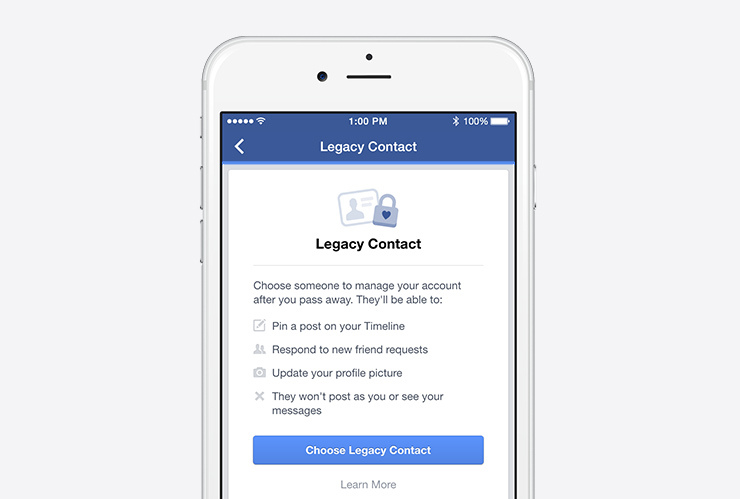
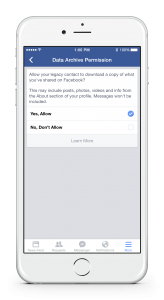
Facebook has announced a ‘Legacy Contact’ feature for its social network, signifying a person can be entitled full control to the user’s account after his death. The addition of this new feature allows a user to take control of his legacy contact, who will be able to mange their account when he/she dies.
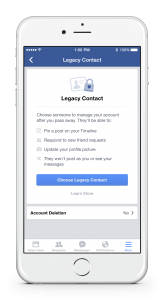
The Legacy Contact can post on your Timeline, update your profile picture, respond to friend requests, though won’t be allowed to access your messages. They can also choose to delete the account permanently from Facebook. In addition, the Legacy Contact will be allowed to take control of someone’s account, only after they inform Facebook about the concerned user’s death.
Earlier, Facebook had offered something similar with the memorialized account feature, though did not allow family or friends of the deceased user to manage their account.
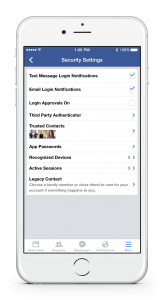
Here’s how you can activate the Legacy Contact feature on Facebook – Go to Settings, then Security and click on Legacy Contact.
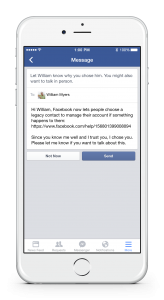
You’ll be allowed to further customise the kind of access you want to give your legacy contact, and even contact them to let them know you chose them. In an event that an account remains active, a “Remembering” mention will be added above the deceased person’s name on Facebook.
Social media has taken over our daily lives; we all now live a second life as a digital creature. We control this side of our lives with regular updates, images and interests. With the proliferation of these accounts, employers are finding it a lot easier to screen their potential employees. But a research paper claims that using computer assessment models, employers can find exactly who they are looking for and they claim it is better than human judgement.
The paper is published in Proceedings of the National Academy of Sciences and is presented by Wu Youyou, Michal Kosinski and David Stillwell. They used a computer model to judge a person’s personality based on their Facebook likes. They claim that the results are even better than a human assessment of personalities.
Many companies have taken the social media route to find the suitable candidate for the job. Some have even shown the audacity to ask for social media passwords. The researchers claim that their ‘likes’ based model can be used as a recruitment tool that will be almost like a dating website. Here the employers can immediately be given options of potential employees based on the job requirement and personality models.
There are, of course, severe privacy concerns. The model uses the activities of the users who don’t put a lot of thought before hitting the like button. It is true that our service providers and companies alike store information of the websites visited by you, but it doesn’t effect your chances at a new job, at present. Who is to say that your various online activities won’t be used against you during a future job interview.
All of these leads to the question, how do I prevent my innocent ‘Like’ on Facebook from influencing my next job search? Well, the answer cannot be to ‘think before liking something on social media’, because that will take all the fun out of your life. That will turn us into a paranoid bunch who’ll be scared to voice our opinion. The control in your hands is to keep your images and posts in a private setting. Also only add ‘friends’ on social networks whom you know in real life, it’s not a race to see who can get more people to click a button on their profile. If you share your innermost thoughts and pictures on social media, it’s a good idea to keep them away from random ‘friends’.
As our dependence on the internet increases, our digital footprint is bound to get more visible. Marketing companies, search engines and government institutions will store more of the personal data. And it will stay there till eternity. So in the end, one way, to react to this issue, is being extremely paranoid and monitor each and all your online activity. While the easier thing to do, is just to make your peace with it and live on doing whatever you do. You may actually be better off than working at a company that judges you based on random online likes before meeting you.
Facebook founder has been working on an audacious initiative to provide free internet to people who haven’t yet received the benefits of the information superhighway. Internet.org was launched on August 20, 2013 and has till now provided services more than 150 million people total across Africa and Latin America. Now the biggest social network has introduced the service in India.
Internet.org is in partnership with Facebook and six mobile phone companies, namely Samsung, Ericsson, MediaTek, Microsoft, Opera Software, and Qualcomm. It is one of the initiatives along with Google’s Project Loon and Space-Internet plans by Tesla founder Elon Musk. They intend to reach the last 3 Billion people untouched by the internet.
Mark Zuckerberg in a post on Facebook has announced the introduction of the initiative in India. The initiative will begin offering services on the Reliance network in the states of Tamil Nadu, Maharashtra, Andhra Pradesh, Gujarat, Kerala and Telangana. The users will now have free data access to more than three dozen services.
Mr. Zuckerberg also hoped to one day connect everyone, and the power of the internet will serve every community across India and the world. He added that the day is coming soon. This initiative from Facebook is surely appreciable and will help empower the vulnerable communities in the world.