Tag: patent

  • Google Patents Touch Sensitive Wristband For Smartwatch

    Engadget has posted an image of a new watch-based device, patented by Google, which would perform many of the same functions.

    While the drawing does not necessarily mean such a product is in the works for commercial release, it does hint at an intriguing new direction for the company’s move into wearable computing.
    smartwatch

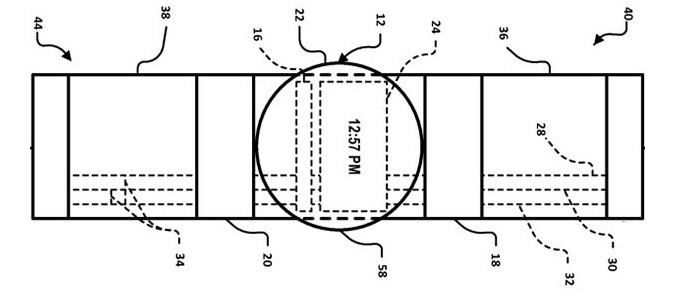
    The device itself is explicitly titled “Smart-watch with user interface features” by the USPTO patent so there’s no beating around the bush, but it’s the extra little bits we’re interested in.

    For example, the watch, displayed in the accompanying illustration, also has two touchpads on either side of the display face. The patent says that you’ll be able to use these to “pinch, stretch and scroll on a platform with limited space available for user input.”

    Given what we’ve previously heard about Google’s foray into the smartwatch domain, it sounded like Mountain View was separating its smartwatch and Google Glass development teams. But this new discovery makes a crossover seem more likely than ever.

    This actually isn’t the first time we stumble upon a smartwatch patent application granted to Google. Last year, the company received a patent for such a device with augmented reality features.

    It’s all pretty vague at the moment – understandably. But with Google I/O coming up you might just be able to get into the wearable tech game before too long.

    [Engadget, TechRadar]
  • Apple Patents Wraparound Display For iPhone

    Apple Patents Wraparound Display For iPhone

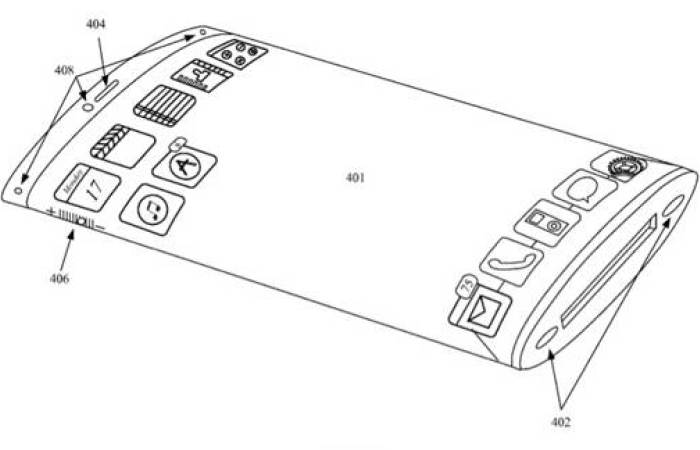
    A couple of days back the US  Patent and Trademarks Office published Apple’s application for a wrap-around form factor for electronic devices. It looks like a curvy, future iPhone.

    Well, not “wraps around,” per se, but rather “wraps within.” Patent application 20130076612, published Thursday morning in the US Patent and Trademark Office’s weekly filing-fest, describes a device in which a flexible AMOLED display is inserted into a hollow glass housing, and is pressed against the inside of that housing by “structural support elements.”

    In one of its examples, Apple describes a device with two flexible displays that work together.

    You can see from Apple’s illustration above what a flexible iPhone might look like. Note the volume controls on the side that are no longer physical buttons, but virtual ones.

    This certainly seems like a form factor that would be better suited to the palms of our hands, but it’s unclear how practical it would be in everyday use. A wraparound display may not be as comfortable to type on, and it may not be as suitable as a flat display for things like gaming and watching movies.

    apple

    The filing also describes a rather simple and permanent-looking connector that handles communications between the display and the device’s logic board, which resides in the center of the transparent housing.

    What do you think? Are you excited? Or could all this be used for the rumoured iWatch?

    [Forbes, Cult of Mac]

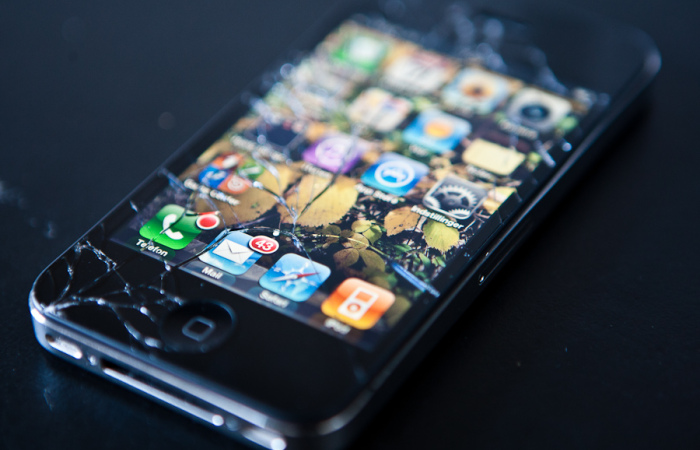
  • Apple Patents iPhone Drop Protection Mechanisms That Are Built Into The Unit

    Apple Patents iPhone Drop Protection Mechanisms That Are Built Into The Unit

    Apple Inc. got a patent that could help protect iPhones from drops, including one that could help the smartphones change direction mid-air.

    Anyone with a pricey smartphone has likely felt that moment of panic when it slips from your fingers and tumbles to the floor. “Please be ok, please be ok,” you say to yourself, praying for a responsive gadget and a screen free of cracks.

    apple

    The patent is described as a “protective mechanism for an electronic device.” Apple Insider was the first to report on the new patent. The filing for it just appeared today, and it even mentions the Apple iPhone specifically as being a device that could be protected by the mechanism

    The patent describes a quantity of ways Apple may be capable to make a device that can change path mid-flight, which would let it to place its most effect-resistant surface forward to fulfill the floor. These incorporate an internal gadget for shifting mass to one stop of the Apple iPhone, an real “thrust mechanism” that could even consist of a “gas canister,” an air foil that activates in cost-free tumble, a way to agreement external bits like switches within the scenario for security, and a gripping system that can clamp down on charging and headphone cables to guarantee those capture the falling phone.

    We can’t help but be reminded of Amazon’s patent for a phone airbag. We won’t be seeing this in an iPhone anytime soon. Until then, we’ll have to stick with our conventional case.

    [Apple Insider, Tech Crunch]

  • Apple New Patent Reveals Interactive Augmented Reality System

    Apple New Patent Reveals Interactive Augmented Reality System

    Apple has been granted a patent today for their invention relating to synchronized, interactive augmented reality displays for multifunctional devices or iDevices.

    apple
    Image Courtesy : Apple Insider

    Published by the U.S. Patent and Trademark Office, Apple’s U.S. Patent No. 8,400,548 for “Synchronized, interactive augmented reality displays for multifunction devices” describes an advanced AR system that uses various iOS device features like a multitouch screen, camera and internet connectivity, among others, to facilitate advanced AR functionality.

    Patently Apple reports : 

    According to Apple, the granted patent is about a device that can receive live video of a real-world, physical environment on a touch sensitive surface. One or more objects can be identified in the live video. An information layer can be generated related to the objects. In some implementations, the information layer can include annotations made by a user through the touch sensitive surface. The information layer and live video can be combined in a display of the device. Data can be received from one or more onboard sensors indicating that the device is in motion. The sensor data can be used to synchronize the live video and the information layer as the perspective of video camera view changes due to the motion. The live video and information layer can be shared with other devices over a communication link.

    apple
    Image Courtesy : Patently Apple

    According to Apple Insider, The patent describes an AR system for iOS devices, which can be used in a variety of different ways. At its most basic, it works by labeling elements of an image in a live video feed, as when it names the parts of a circuit board being shot with the rear-facing camera on an iPad-like device in Apple’s patent.

    The iOS device employing the AR tech is also described as being able to show both the straight image itself, and the version with overlaid information at once in windows side-by-side, allowing both an unobstructed view and one with all the contextual information.

    Interesting!

    [Patently Apple, Apple Insider, Tech Crunch]

  • THX Sues Apple Over Speaker Patent

    THX Sues Apple Over Speaker Patent

    Apple Inc. has been accused by THX Ltd., a company founded by “Star Wars” producer George Lucas, of stealing speaker technology used in iPhones, iPads and iMac products.

    According to the complaint, Apple knowingly infringed and continues to infringe upon THX’s U.S. Patent No. 7,433,483 for “Narrow profile speaker configurations and systems,” a property granted in 2008 describing methods to effectively enhance sound quality in compact speaker arrangements integrated into consumer electronics like computers and televisions. 

    As noted by Bloomberg, THX claims Apple’s violation caused monetary damages and irreparable harm, and seeks royalties or damages to make up for lost profit. 

    Given the products Apple allegedly uses the technology in, it is reasonable to assume that monetary damages could be a substantial sum.

    THX originated as a way to make sure that the audio in Lucas’s Star Wars movies could be properly produced outside of the theater. The company did this by establishing standards, as well as a certification for sound systems, reports Bloomberg.

    This year, San Rafael, California-based THX announced its first mobile application, THX tune-up, available in Apple’s iTunes App Store, according to a Jan. 29 statement from THX. The app allows consumers to use an Apple device with the iOS operating system to adjust the performance of televisions, projectors and speakers, according to the statement.

    Neither company would comment outside of THX which simply said that this was a “pending legal matter”.

    [Via Bloomberg]

  • HTC and Apple Settle Patent issues with 10 year licensing deal

    HTC and Apple Settle Patent issues with 10 year licensing deal

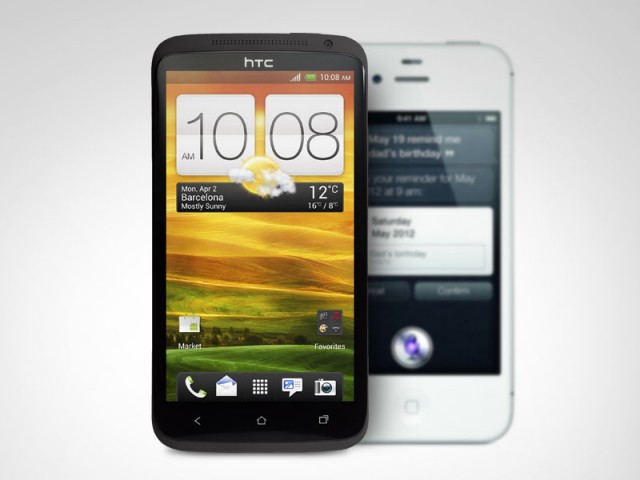
    So at least one patent dispute is coming to an end, HTC and Apple have entered a 10 year patent licensing deal to end all issues with their disputes.

    [quote]HTC is pleased to have resolved its dispute with Apple, so HTC can focus on innovation instead of litigation,” said Peter Chou, CEO of HTC. [/quote]

    [quote]We are glad to have reached a settlement with HTC,” said Tim Cook, CEO of Apple. “We will continue to stay laser focused on product innovation.[/quote]

    The license extends to current and future patents held by both parties. The terms of the settlement are confidential.


    [toggle_box title=”Press Release” width=”Width of toggle box”]


    Posted Nov 11, 2012
    HTC AND APPLE SETTLE PATENT DISPUTE. All Patent Litigation Between The Companies Dismissed


    1.Date of occurrence of the event:2012/11/11


    2.Company name:HTC Corporation


    3.Relationship to the Company (please enter “head office” or
    “affiliate company”):Head Office


    4.Reciprocal shareholding ratios:N/A


    5.Cause of occurrence:HTC and Apple have reached a global settlement
    that includes the dismissal of all current lawsuits and a ten-year
    license agreement. The license extends to current and future patents
    held by both parties. The terms of the settlement are confidential.


    6.Countermeasures:None


    7.Any other matters that need to be specified:There is no material
    adverse impact on the financials of the Company.


    HTC AND APPLE SETTLE PATENT DISPUTE


    All Patent Litigation Between The Companies Dismissed


    TAIPEI and CUPERTINO, California – November 11, 2012 – HTC and Apple have reached a global settlement that includes the dismissal of all current lawsuits and a ten-year license agreement. The license extends to current and future patents held by both parties. The terms of the settlement are confidential.


    “HTC is pleased to have resolved its dispute with Apple, so HTC can focus on innovation instead of litigation,” said Peter Chou, CEO of HTC.


    “We are glad to have reached a settlement with HTC,” said Tim Cook, CEO of Apple. “We will continue to stay laser focused on product innovation.”


    -end-

    [/toggle_box]


  • Sony’s New Cloud Service To Be Called “MyXperia”?

    Sony’s New Cloud Service To Be Called “MyXperia”?

    sony

    Sony’s $1,47 billion acquisition of the remaining 50% stake in their Sony Ericsson joint venture closed in January of this year. The mobile division is called “Sony Mobile Communications” and they are focussed bringing the latest smartphones to market. The other key areas for Sony – that fall under the “One Sony” umbrella – are laptops, tablets and televisions.

    It seems, just like so many other manufacturers, Sony is heading into the cloud and might possibly launch a storage service. According to a recent European trademark filing Sony has coined the term “MyXperia,” hinting at a future, but unconfirmed, cloud service or app. The description says:

    “Computer application software and downloadable software in the nature of mobile applications for use in connection with virtual computer systems and virtual computing environments for upload, storage, retrieval, download, transmission and delivery of digital content and media to and from the following: mobile phones; smart phones; digital or electronic tablets for the recording, transmission, processing and reproduction of sound, images or data; personal digital assistants (PDAs); and/or portable and handheld digital electronic devices for the recording, transmission, processing and reproduction of sound, images or data.”

    The domain for MyXperia.com has already been secured by Sony and the basic website is already up and running. We’ll see soon enough whether something (big or small) will come out of the “MyXperia” filing.

  • Apple wins $1 billion in Samsung patent case

    Apple wins $1 billion in Samsung patent case

    Apple Inc scored a sweeping legal victory over Samsung on Friday as a U.S. jury found the Korean company had copied critical features of the hugely popular iPhone and iPad and awarded the U.S. company $1.05 billion in damages.

    The verdict — which came after less than three days of jury deliberations — could lead to an outright ban on sales of key Samsung products and will likely solidify Apple’s dominance of the exploding mobile computing market.

    The US lawsuit was one of several cases around the world between California-based Apple and South Korean Samsung over technology rights and innovation in the fast-growing mobile computing sector.

    Apple sued Samsung in April 2011, and Samsung countersued. The companies have also sued each other in Britain, Australia and South Korea. The California case was the first to go to a US jury.

    Apple sought $2.75 billion for its claims that Samsung infringed four design patents and three software patents. Samsung demanded as much as $421.8 million in royalties for claims that Apple infringed five patents.

    For the ’381 patent, which covers the “bounce-back” feature in document scrolling, all applicable Samsung products were found to be infringing for Samsung Electronics Ltd, Samsung Electronics America, and Samsung Telecommunications America, with the exception of the Galaxy Tab under Samsung Telecommunications America. This is a total of 21 smartphones and tablets including the Samsung Nexus S 4G, Galaxy s II (AT&T and i9100), Galaxy Tab, and Galaxy Tab 10.1.

    One bit of good news for Samsung: The jurors found that the Galaxy Tab 10.1 tablet did not infringe on any physical iPad design patents, as Apple had claimed.

  • Apple seeks more than $2.5 billion in Samsung patent case

    Apple seeks more than $2.5 billion in Samsung patent case

    According to a partially redacted filing on Tuesday with a federal court in San Jose, California, Apple believes Samsung owes “substantial monetary damages” because the Korean company illegally “chose to compete by copying Apple.”

    Apple said this allowed Samsung to overtake it as the world’s largest maker of smartphones, and reap “billions of dollars in profits” while costing Apple $500 million of profit.

    It said damages, including reasonable royalty damages, reach “a combined total of $2.525 billion.” Apple said it also plans to seek a permanent injunction to stop future violations.

    Samsung countered Apple’s allegations in a filing 13 minutes later, accusing the Cupertino, California-based company of trying “to stifle legitimate competition and limit consumer choice to maintain its historically exorbitant profits.”

    It said Apple, in fact, should pay for the use of Samsung’s patented technology, “without which Apple could not have become a successful participant in the mobile telecommunications industry.”

    Their dispute is part of a worldwide legal battle over the alleged theft of technology used in smartphones and tablets, including those powered by Google Inc’s Android, which Samsung uses in its most popular devices.

    Apple Chief Executive Tim Cook and top Samsung executives last week participated in court-supervised mediation to try to resolve the case but a resolution appeared to be unlikely, people familiar with the matter said.

  • Apple ordered to publish Notice that Samsung didn’t copy iPad In U.K.

    Apple ordered to publish Notice that Samsung didn’t copy iPad In U.K.

    Apple Inc.  was ordered by a judge to publish a notice on its U.K. website and in British newspapers alerting people to a ruling that Samsung Electronics Co. didn’t copy designs for the iPad.

    The notice should outline the July 9 London court decision that Samsung’s Galaxy tablets don’t infringe Apple’s registered designs, Judge Colin Birss said yesterday. It should be posted on Apple’s U.K. home page for six months and published in several newspapers and magazines to correct any impression the South Korea-based company was copying Apple’s product, Birss said.

    This order means that Apple will, in a way, advertise Samsung’s tablets, that too on its own website. However, Judge Briss shot down Samsung’s request to bar Apple from further claiming that its tablet copied the iPad’s design. On this, he said, “They are entitled to their opinion.”

    As well as Apple’s website, the company must pay for notices in the Financial Times, the Daily Mail, Guardian Mobile magazine, and T3, according to a draft copy of the order provided by Samsung’s lawyers.

    Apple’s lawyer said the company would appeal the July 9 decision and Judge Birss granted the company permission to take its case to the court of appeal.

  • RIM hit with $147.2 million verdict in wireless patent lawsuit

    RIM hit with $147.2 million verdict in wireless patent lawsuit

    Whoops! Something went wrong!

    Research in Motion Ltd has been directed by a northern California jury directed to pay $147.2 million in patent litigation over a remote management system for wireless devices.

    Mformation, a maker of mobile-device management software, sued RIM in 2008, alleging infringement of two patents. The company claimed it disclosed details of the technology to RIM during licensing discussions. After refusing to take a license, the BlackBerry maker modified its software to include the patented systems, Mformation said in its complaint.

    Amar Thakur, an attorney for Mformation, said the jury directed RIM to pay an $8 royalty for every BlackBerry device connected to RIM’s enterprise server software, which brings the total award to $147.2 million. The verdict only covers U.S. sales through trial, Thakur said, and not future or foreign damages.

    RIM’s stock has tumbled more than 70 percent in the past year as its customers abandoned the BlackBerry following the increasing popularity of its rivals Apple’s iPhone and other devices using Google Inc’s Android software. RIM last month posted its first and unexpected operating loss in eight years.

  • US Court lifts Galaxy Nexus smartphone ban, tablet still blocked

    US Court lifts Galaxy Nexus smartphone ban, tablet still blocked

    Whoops! Something went wrong!

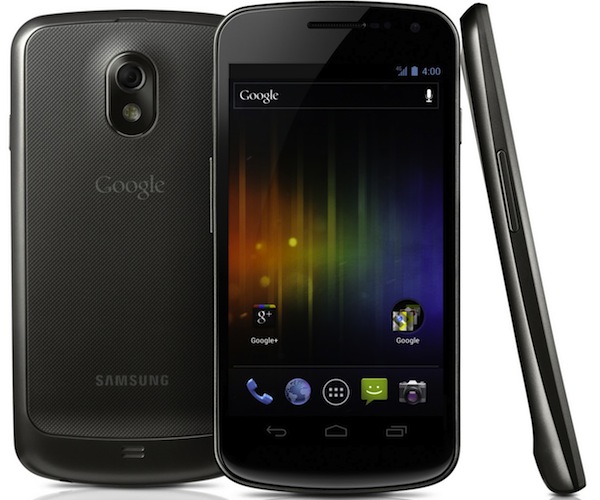
    A US appeals court gave Samsung a temporary reprieve Friday on the sale of its Galaxy Nexus 7 smartphones while leaving intact a court ban on US sales of its tablet computers in a patent battle with Apple.

    In two rulings in the bitter patent dispute, the US Court of Appeals in the capital Washington gave one to Apple and one to Samsung, but only temporarily.

    But the “stay” was just temporary until the panel receives arguments from Apple, which argues the phone infringes on patents in its iPhone.

    In a separate decision, the appellate judges refused to lift Koh’s injunction on the 10-inch Galaxy Tab computer, which Apple claimed was copied from the iPad.

    The court panel in Washington ordered Apple to respond by July 12, while denying a Samsung request to stay, or halt the injunction.

    Both Galaxy devices are powered by Android operating software that Google makes available for free to gadget makers. Nexus is the Mountain View, California-based technology company’s own branded line.

  • Microsoft applies for a High Performance Touchscreen Patent

    Microsoft applies for a High Performance Touchscreen Patent

    Microsoft Recently demonstrated a high performance touchscreen prototype, that would reduce the touch lag of a device from 100ms to 1ms. Microsoft has filed a patent protecting its endless research on the subject. 

    The Effect of touch response lag once reduced will bring the experience of touchscreen devices to a brilliant level. Instead of a laying line , users if drawing on a touch screen tablet, will experience almost no lag as if the ink was coming from the finger. 

    Micrososft may throw these screens into future Microsoft Tablets, if they do, expect them to be superiorly responsive. 

    [USPTO]

  • Apple loses patent war with HTC

    Apple loses patent war with HTC

    Taiwan’s HTC on Wednesday won a London court ruling against US tech giant Apple over a series of patent infringement claims linked to technology used in its mobile devices.

    London’s High Court said in a ruling carried on its website that HTC’s devices did not infringe four Apple technology patents.

    Along with the slide-to-unlock mechanism, HTC challenged Apple’s patents on the iPhone’s “multi-touch” system. Both are prize features in the American company’s portfolio, according to intellectual property experts. The other patents in the case related to the way the iPhone manages photographs, and the use of different character sets in text messaging.

    A HTC spokesman welcomed the London court’s ruling, which said parts of the slide-to-unlock patented were too “obvious” or foreshadowed by earlier patents.

  • U.S judge dismisses Apple vs Motorola patent suit

    U.S judge dismisses Apple vs Motorola patent suit

    Whoops! Something went wrong!

    A U.S. judge on Friday ruled that Apple Inc. cannot pursue an injunction against Google’s Motorola Mobility unit, effectively ending a key case for the iPhone maker in the smartphone patent wars.

    Judge Richard Posner, of the U.S. District Court for Northern Illinois in Chicago, has also dismissed a counterclaim that Apple was infringing on Motorola’s patent in iPhones. Posner ruled out any damages for either company and said, that neither party is entitled to an injunction as the parties have failed to present enough evidence to create triable issues. In the ruling filed, Posner also said neither side could refile their claims.

    [quote]During the legal proceedings, the judge also pointed to serious problems with the U.S. patent system and questioned the worth of many software patents, saying, Reuters reported, You can’t just assume that because someone has a patent, he has some deep moral right to exclude everyone else[/quote].


iGyaan Network
Privacy Overview

This website uses cookies so that we can provide you with the best user experience possible. Cookie information is stored in your browser and performs functions such as recognising you when you return to our website and helping our team to understand which sections of the website you find most interesting and useful.