Tag: Qualcomm Snapdragon

  • Qualcomm Snapdragon 710 Launched

    Qualcomm Snapdragon 710 Launched

    Qualcomm has announced a new mid-range chipset, the Snapdragon 710 SoC. This will be the first chipset in its recently announced Snapdragon 700 series for the mobile platform. As budget smartphones become more popular, we expect premium features to trickle down to mid-range and budget devices as well. The new Snapdragon 710 chipset has a lot of optimisations which should help make premium smartphone features more accessible to mid-rangers.

    The Snapdragon 710 sits somewhere between the Snapdragon 660 and Snapdragon 845. It is not as powerful or efficient as the Snapdragon 845 but, has enough improvements to be superior to the Snapdragon 660. Qualcomm concedes that Snapdragon 710 has improvements in most of the popular consumer use cases. For example, 4K HDR video recording will consume 40% less power compared to 4K SDR capture on the 660.
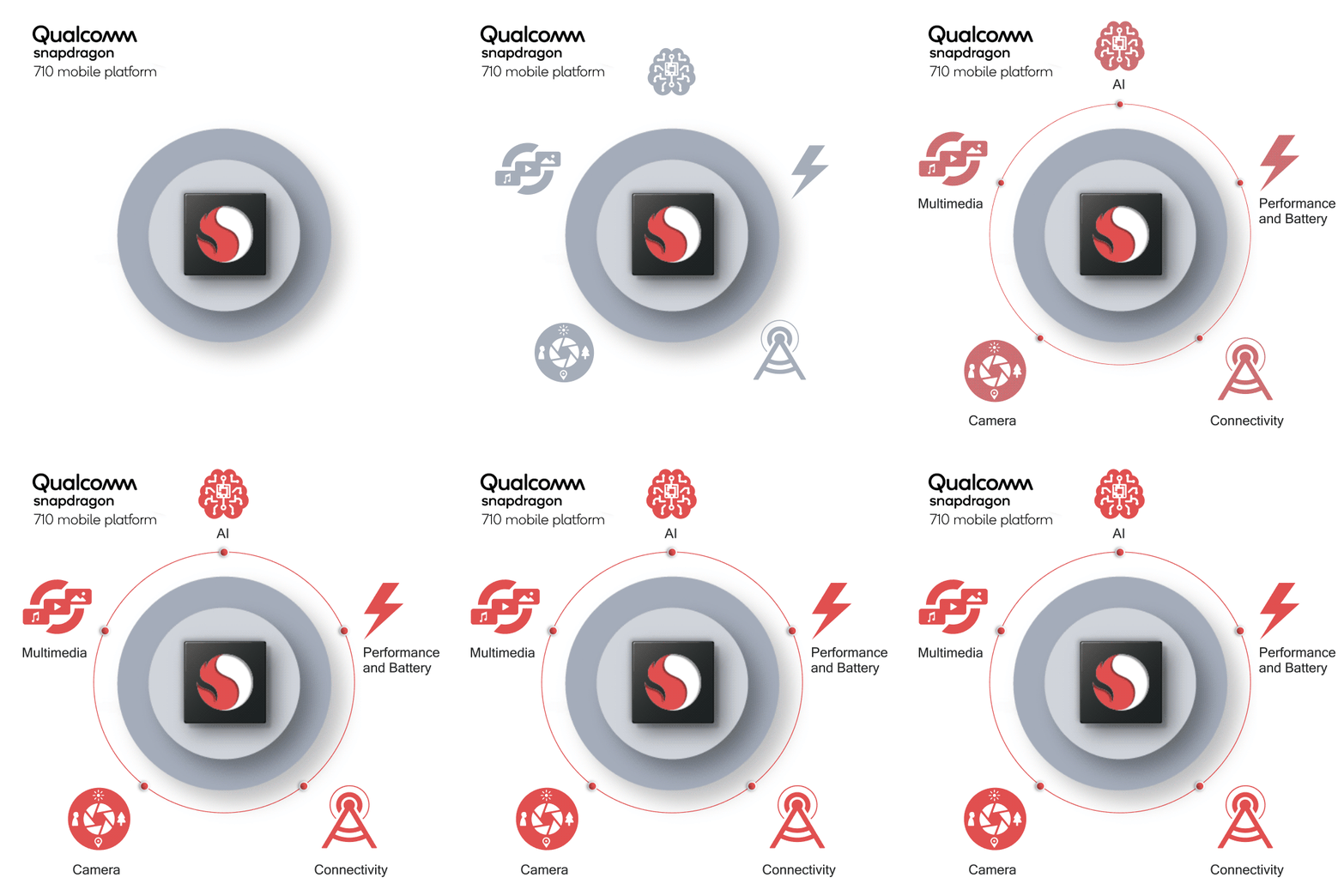
    The Snapdragon 710’s processors also have a different composition. Qualcomm has designed the octa-core chip with two 2.2GHz ARM Cortex-A75 cores for performance and six 1.7GHz ARM Cortex-A55 cores for efficiency. According to Snapdragon, users can expect 25% faster web browsing, 20% overall increase in performance, and 15% faster app loading compared to the Snapdragon 660. The battery life will also improve, thanks to the composition of the cores of the SoC.

    Must Read: BlackBerry KEYone Successor Spotted On GeekBench

    The new chipset is also the first for Snapdragon to feature 600-series GPU. According to Qualcomm, the 616 GPU  will allow for up to 35% faster graphics rendering while consuming up to 40% less power. This is a great news for people who like gaming on budget smartphones.

    Specifications
    Specifications Qualcomm Snapdragon 660 Qualcomm Snapdragon 710
    CPU Kyro 260
    4x 2.2GHz (Cortex-A73)
    4x 1.8GHz (Cortex-A53)
    Kyro 360
    2x 2.2GHz (Cortex-A75)
    6x 1.7GHz (Cortex-A55)
    GPU Adreno 512 Adreno 616
    DSP Hexagon 680 3.0
    ISP Spectra 160 ISP
    24MP
    Spectra 250 ISP
    32MP single / 20MP dual
    Memory 2x 32-bit @ 1866MHz
    LPDDR4
    29.9GB/s
    2x 32-bit @ 1866MHz
    LPDDR4
    29.9GB/s
    1MB system cache
    Integrated Modem Snapdragon X12 LTE
    (Category 12/13)
    DL = 600Mbps
    3x20MHz CA, 256-QAM
    UL = 150Mbps
    2x20MHz CA, 64-QAM
    Snapdragon X15 LTE
    (Category 15/7)
    DL = 800Mbps
    4x20MHz CA, 256-QAM
    UL = 300Mbps
    2x20MHz CA, 256-QAM
    Encode/
    Decode
    2160p30, 1080p120
    H.264 & H.265
    2160p30, 1080p120
    H.264 & H.265
    10-bit HDR pipelines
    Manufacturing Process 14 nm 10 nm


  • Xiaomi Berlin Leaked Running On Unannounced Snapdragon 632

    Xiaomi Berlin Leaked Running On Unannounced Snapdragon 632

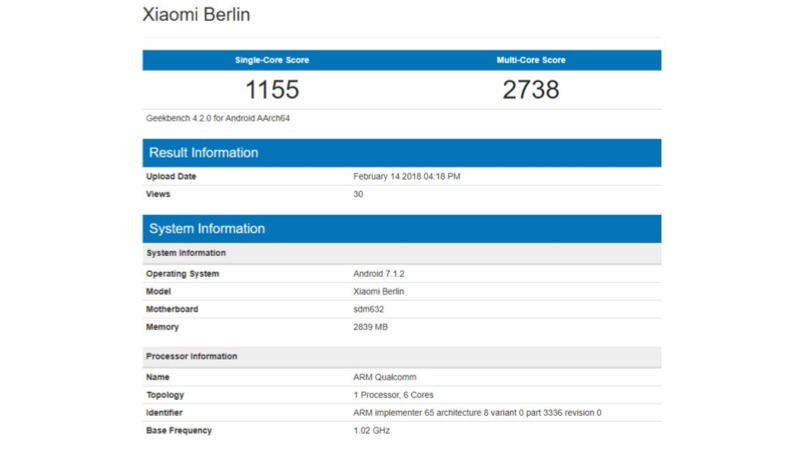
    Xiaomi is getting ready to launch its premium Xiaomi Mi MIX 2s in China. Similarly, the company is silently testing out a new smartphone with the codename Berlin. The Xiaomi Berlin is powered by Snapdragon 632 Hex-core chipset. However, this is an unannounced chipset from Qualcomm.

    Xiaomi is known for launching the smartphones with the newest chipsets in the past. In fact, the Xiaomi Redmi Note 5 Pro is the first smartphone to feature Qualcomm Snapdragon 636 chipset. This could be a wrong report, as the Geekbench clearly mentions that, the chipset has 6 cores with a base frequency of 1.02 GHz. In fact, the chipset is expected to have octa-core CPU.

    Xiaomi Berlin

    Specifications of Xioami Berlin

    The smartphone has been spotted on the latest Geekbench 4.2.0, which does not say anything about the display size or resolution. Under the hood, the device will be powered by the Qualcomm Snapdragon 632 Hexa-core chipset with 3GB RAM. Similarly, looking at the benchmark,  the device scores 1155 points on the single-core and 2738 points on the multi-core performance. This means the chipset might be based on the custom Kryo 280 CPU.

    The smartphone runs on Android 7 Nougat. Similarly, the device is expected to feature MIUI skin on the top. However, looking at the specifications we can consider that, the Xiaomi Berlin will be Redmi series smartphone.

    Summary:
    • Qualcomm Snapdragon 632 chipset
    • 3GB RAM
    • Android 7 Nougat
  • Specifications Of Qualcomm Snapdragon 670, 640 And 460 Leaked

    Specifications Of Qualcomm Snapdragon 670, 640 And 460 Leaked

    2018 will be a huge year for smartphones, irrespective of the price category they’ll be in. This year saw a lot of mid-range smartphones having flagship features like bezel-less designs and dual-camera setups. While we already know all about the flagship chipset from Qualcomm, the Snapdragon 845, there isn’t clarity as to what the mid-range smartphones will be powered by.

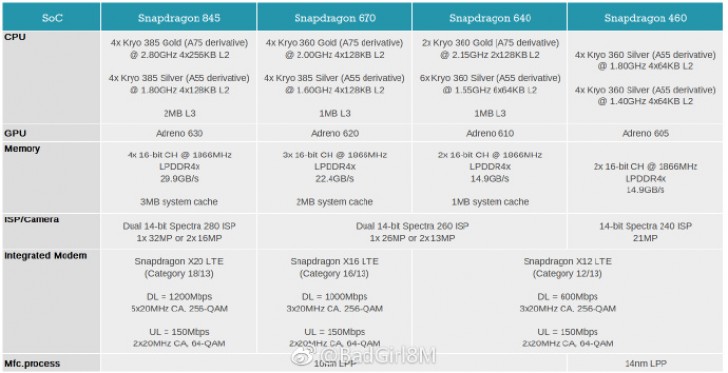
    A new, however, has revealed the possible specifications of three new upcoming chipsets from Qualcomm, the Snapdragon 670, 640 and 460. Three chipsets which possibly power a lot of mid-range phones in 2018.

    The Qualcomm Snapdragon 670 will succeed the Snapdragon 660 as the most powerful mid-tier chipset that Snapdragon will have to offer. While the Snapdragon 660 was built on a 14nm process, the Snapdragon 670 will move to a 10nm process similar to the Snapdragon 845. The chipset will have an octa-core processor with four Kryo 360 cores clocked at 2 GHz and four Kryo 385 cores clocked at 1.6 GHz. It’ll also feature an Adreno 620 GPU.

    The Qualcomm Snapdragon 640 will offer something different than every other chipset, a 6+2 core combination CPU. It will have two Kryo 360 cores clocked at 2.15 GHz and six Kryo 360 cores clocked at 1.55 GHz. This is possible thanks to ARM’s DynamIQ, which allows for mixing and matching for Cortex-A75 and A55 CPU cores. With DynamIQ, there can be a total of eight cores in a cluster which is exactly what we’re seeing in the Snapdragon 640. Similar to the Snapdragon 670, the 640 will also be made on the 10nm process.

    The Snapdragon 460 will likely power smartphones under the Rs. 15000 price bracket. According to the leak, it will have four Kryo 360 cores clocked at 1.8 GHz and four Kryo 360 cores clocked at 1.4 GHz. It will be built on the 14nm process, unlike the other two chipsets.

    Whether early-2018 entrants adopt any of the chipsets is yet to be seen as not a lot of mid-tier smartphones of 2017 even used the Snapdragon 660 chipset.

  • Qualcomm To Launch Snapdragon 670 Chipset In Q1 Of 2018

    Qualcomm To Launch Snapdragon 670 Chipset In Q1 Of 2018

    Every year, it is not just the flagship lineup of chipsets from Qualcomm gets a refresh. The mid-range segment of smartphones has even tougher competition between Qualcomm and MediaTek, and Qualcomm will soon launch the Snapdragon 670 chipset in 2018.

    The Snapdragon 670 chipset will be based on Samsung’s 10-nanometer (nm) LPP process technology which was also used in Qualcomm’s 2017 flagship chip, the Snapdragon 835. Samsung used the same process for its 2017 flagship chipset, the Exynos 8895.

    A famous leakster tweeted a few details about the upcoming Snapdragon 670 chipset:

    According to the report, the Snapdragon 670 will go into mass production in early-2018 and will be subsequently available for OEMs.

    Qualcomm recently unveiled its 2018 flagship chipset, the Snapdragon 845 which was also manufactured by Samsung. Recent reports have claimed that the South Korean tech giant will lose its business from Qualcomm as the Snapdragon 855 is expected to be manufactured by TSMC.

    The report also claims that an industry executive believes that Samsung is losing Qualcomm orders to TSMC because the company will not be fabricating 7nm chips in 2018. The report went on to state that “Qualcomm is still likely to transfer orders back to Samsung in 2019 if its 7nm chip facility becomes ready.”

    As much as the Snapdragon 845 is important, markets like India sell mid-range smartphones much more than their flagship counterparts, hence the Snapdragon 670 and its adequacy will be important for upcoming mid-range smartphones in 2018.

  • Snapdragon 845: Everything You Need To Know

    Snapdragon 845: Everything You Need To Know

    A majority of Android phones are powered by the chipsets made by Qualcomm. From phones priced at Rs 6999 running Snapdragon 212 to the Galaxy Note8 priced at Rs 67900 powered by the Snapdragon 835, smartphones in all price range run on a Qualcomm chipset, with some exceptions running MediaTek chipsets.

    For 2018, the flagship phones will be powered by the new chip from Qualcomm, the Snapdragon 845 which was announced two days ago during the Qualcomm Tech Summit.

    The Snapdragon 845 has the new Kryo 385 CPU architecture and an upgraded Adreno 630 GPU. The chip is built on Samsung’s 10nm LPP FinFET, its second generation 10nm node that offers “10-percent higher performance or 15-percent lower power consumption compared to its first generation”.  Similar to the previous generation, the Kryo 385 is built on Arm Cortex technology. Qualcomm claims that thanks to its customised off-the-shelf design from Arm, the chip promises up to a 25% performance upgrade compared with the last generation Snapdragon 835. The four performance cores clock up to 2.8 GHz and are paired with four energy efficient cores that can reach up to 1.7 GHz.

    A lot of experts claim that what bezel-less design was to 2017 smartphones, AI and machine learning will be to 2018 smartphones. With Apple and Huawei already claiming a stake in the AI space with their new chipsets, a lot will be expected from the Snapdragon 845. In terms of performance, the Snapdragon 845 gets a 3X upgrade in AI tasks over the Snapdragon 835. This comes down to upgraded CPU and GPU performance but, the Snapdragon 845 also includes a third generation Vector DSP with HVX, called the Hexagon 685, which is optimised for AI and imaging workloads.

    Specifications Snapdragon 845 Snapdragon 835
    CPU Core Semi-custom ARM Cortex – Kryo 385 Semi-custom ARM Cortex – Kryo 280
    CPU Configuration 4x 2.8GHz (Cortex-A75)
    4x 1.7GHz (Cortex-A55)
    4x 2.45GHz (Cortex-A73)
    4x 1.9GHz (Cortex-A53)
    GPU Adreno 630 Adreno 540
    Manufacturing Process 10nm LPP FinFET 10nm LPE FinFET
    DSP Hexagon 685 with HVX Hexagon 682 with HVX

    For multimedia, Qualcomm’s latest Spectra image signal processor has been rebuilt from scratch. The new Spectra 280 ISP introduces new video capture options, such as 720P at 480fps, 60 fps video recording at up to 16MP of resolution, and the ability to capture 64x more high-dynamic range colour information than before.

    Qualcomm has also introduced a new security feature. It has added Security Processing Unit (SPU), a hardware isolated security subsystem inside the Snapdragon 845. This dedicated chip acts as a storage unit for any saved biometric information, such as fingerprint, face, or iris scans, and builds on Qualcomm’s existing security software.

    The Samsung Galaxy S9 and S9+ are expected to be the first of the many phones which will be powered by the Qualcomm Snapdragon 845 chipset. Xiaomi also announced that its new flagship, presumably Xiaomi Mi 7 will have the Qualcomm Snapdragon 845 chipset as well.

  • Qualcomm Announces Snapdragon 845 Chipset

    Qualcomm Announces Snapdragon 845 Chipset

    Qualcomm has announced the new flagship chipset, the Snapdragon 845 at it Qualcomm Tech Summit.

    The Snapdragon 845 will be the successor to the popular Snapdragon 835 chipset which powered the majority of 2017 flagship phones, barring the likes from Huawei and some Samsung phones (that ship outside the US and South Korea). The Snapdragon 845 will likely be found in many high-end Android phones in 2018, though it is also expected to make its way to Windows 10 laptops as well.

    Just like the Snapdragon 835, the Snapdragon 845 is also based on a 10nm manufacturing process albeit upgrades to performance and power efficiency. Qualcomm will pair the 845 with its latest X20 LTE modem, which provides gigabit connectivity on supported networks.

    The Snapdragon 845 will definitely aim to compete with Apple’s A11 Bionic chipset since the Snapdragon 835 fell short against it in benchmark scores.

    Similar to the partnership that led to Samsung having early access to Snapdragon 835 chipsets, the Snapdragon 845 chipset might be found in the Galaxy S9 and S9+ before any other phone. Even though, the LG G7 is expected to be launched at a similar time. Also, Xiaomi has announced its plan to use the Snapdragon 845 chipset in its next flagship, which could be the Mi 7.

    The American chipmaker is hosting its tech summit right now where we will get to know more about the Snapdragon 845 chipset.

  • Qualcomm Snapdragon 845 Could Be Announced In December

    Qualcomm Snapdragon 845 Could Be Announced In December

    2018 will see most of the flagship smartphones being powered by the Snapdragon 845 SoC, which will succeed the Snapdragon 835 from 2017. Qualcomm is likely to announce the new flagship chipset, the Snapdragon 845 in December at the Snapdragon Technology Summit that will be held in Maui, Hawaii between 4th of December and the 8th of December.

    The Snapdragon 835 was announced during CES 2017 in January of 2017 so, Qualcomm’s announcement might come a month prior to what is the norm. The Snapdragon 845 could be manufactured through 10nm Low Power Early (LPE) FinFET process. It is expected to have four ARM Cortex-A75 cores and four ARM Cortex-A53 cores. It is also reported that the new SoC will be paired with the Adreno 630 GPU, which is expected to deliver a significant graphical performance bump over the Adreno 540 that comes with the Snapdragon 835. The upcoming chipset will also be optimised for augmented reality (AR) and virtual reality (VR). Updated Kyro cores and X20 connectivity modem means upgraded downlink speeds of 1.2Gbps.

    iGyaan reported that the Samsung Galaxy S9 could be the first device to feature the Qualcomm Snapdragon 845 chipset as per an agreement between Qualcomm and Snapdragon. In 2017,  Samsung manufactured Qualcomm’s Snapdragon 835 chipset and got to keep the initial batch for itself. That’s why early in 2017 there was no other Snapdragon 835-powered handset on the market other than the Galaxy S8. This could be the case in 2018 as well.


  • New Snapdragon 636 Chipset Unveiled By Qualcomm

    New Snapdragon 636 Chipset Unveiled By Qualcomm

    Qualcomm has unveiled a new mid-range chipset, the Qualcomm Snapdragon 636. The standout point with this chipset is the introduction of Qualcomm’s Kirin 260 CPU cores into the Snapdragon 63X range, bringing additional CPU power to a lower cost chipset.

    Qualcomm says that the Kyro 260 arrangement in the Snapdragon 636 chipset will deliver a 40 percent performance improvement over the Snapdragon 630’s 2.2 GHz octa-core Cortex-A53 CPU arrangement. This change means that the 636 will also give users a little more CPU push than the 653 too, all at a lower price. In addition to the CPU changes, Qualcomm has also bumped up the GPU performance a tad with the introduction of an Adreno 509, up from the 508. This GPU provides about a 10 percent performance boost, however the Snapdragon 660 retains a performance advantage that gamers may be after.

    There’s a 14-bit Spectra 160 ISP with support for up to 24MP cameras, smooth zoom, and fast auto-focusing. The platform also comes with Qualcomm’s Aqustic audio codec, which supports 24-bit, 192 kHz audio playback.

    The chipset will be available in November of 2017.

    Specs Snapdragon 636
    CPU 4x Kryo 260 @ 2.2 GHz
    4x Kryo 260 @ 1.8 GHz
    GPU Adreno 509
    Co-Processors Hexagon, All-Ways Aware, Spectra 160
    LTE X12 LTE
    600 Mbps down,
    150 Mbps up,
    3x20MHz CA, up to 256-QAM
    Process  14 nm
  • Samsung May Have Early Access To Snapdragon 845

    Samsung May Have Early Access To Snapdragon 845

    It looks like the Samsung Galaxy S9 and Galaxy S9+ will have an early access pass to Qualcomm’s next flagship chipset, Snapdragon 845. If Qualcomm decides to go for a similar deal with Samsung like last year’s Snapdragon 835, then Galaxy S9 could b the first device to have the next flagship processor. Samsung manufactured Qualcomm’s Snapdragon 835 chipset and got to keep the initial batch for itself. That’s why early in 2017 there was no other Snapdragon 835-powered handset on the market other than the Galaxy S8.

    There isn’t a lot known about the Snapdragon 845 but, as the launch of the chipset comes near, there will be a lot more known about it. It is however, rumoured that it is expected to get manufactured through 10nm Low Power Early (LPE) FinFET process. The processor is also said to incorporate a combination of Cortex A75 cores, Adreno 630 graphics and X20 LTE modem. A report suggested that Qualcomm Snapdragon 845 SoC will be clocked at 2.5GHz, suggesting that the upcoming chip may not offer a significant improvement over the Snapdragon 835 as it clocks at 2.45GHz. A recent GeekBench listing of the Snapdragon 845 revealed a single core score of 2600+. In comparison, the Apple A9 scored around 2500 while the new A11 Bionic chipset on iPhone 8+ scored 4200+.

    As far as availability is concerned, the Samsung Galaxy S9 and Galaxy S9+ will likely be the first smartphones to have the Qualcomm’s latest chip. This means that rivals like LG would have to go through yet another flagship cycle without access to Qualcomm’s latest chip, just like last year. There were rumours that Xiaomi’s Mi7 will also have the Snapdragon 845 chipset and that the smartphone and chipset manufactures were working together to optimise the chipset for the Mi7 called ‘Snapdragon 845 V2’.


  • Touch ID vs Sense ID : Here’s the Real Difference

    Touch ID vs Sense ID : Here’s the Real Difference

    Along with customization, security is another area drawing the attention of software developers. Apple was the first to introduce the breakthrough Touch ID technology that took over manual methods of entering text and numeric combinations to unlock the screen. And following the Cupertino-based giant, Qualcomm brought forward its revolutionary Sense ID at the Mobile World Congress that’s much more secure and authentic than the Touch ID. Let’s find out what separates the two modern day technologies.

    The Touch ID is the simplest way to wake up your lock screen. Just put your finger on the physical button and device will recognise the provided input and let you access the phone. Once the user puts his/her finger on the Home button, the stainless steel ring on the button comes into action and activates the capacitive touch sensor. The finger impression gets imprinted on the button’s sapphire crystal surface, which is sent to the sensor lying beneath. The software then reads the input and unlocks the device for you. The mechanism seems complex, but the whole process takes a fraction of a second.

    touch id 1

    The Touch ID is capable of reading impressions with a 360-degree orientation. Users can place their finger the way they want and it will still work. One can enrol multiple fingerprints on a device. Its usage is not just limited to unlocking the screen and you can also make purchases on iTunes and the Apple App Store by making mobile payments through your fingerprint. It can also be infused into third-party apps through developers’ support.

    On the other hand, Sense ID is one step ahead of Touch ID. It’s the mobile industry’s first biometric platform based on ultrasonic technology. Instead of just analysing the ridges of your fingers, it makes a 3D map of the minute details including ridge flow and sweat pores. The sound waves penetrate the outer layer of the skin and create a matchless password that is hard to reproduce. According to Qualcomm, the technology “incorporates a Qualcomm biometric integrated circuit (QBIC), custom sensor technology and algorithms managed by the company’s hardware-based SecureMSM technology.”

    Here’s the video showing how Sense ID works:

    It can work with moist fingers and with other contaminants like dust and dirt. Its ability to scan doesn’t get blocked by the display type and allows fingerprint detection through glass, plastic, steel, aluminium and sapphire. Snapdragon Sense ID permits manufacturers to experiment with designs, enabling them to develop sleeker smartphones in the future.

    Along with the added benefits of scanning through multiple surfaces and damp fingers, Sense ID embraces features from FIDO (Fast IDentity Online). It is an Alliance biometric protocol that keeps the fingerprint data on the device, instead of securing it on cloud; allowing people to visit websites, more securely. Online accounts and apps can also be accessed without the need of repeatedly providing a password for authentication.

    sense id

    Fingerprints are unique and make matchless passwords. Their unique characteristics compel smartphone manufacturers to deploy the newest innovations. Qualcomm will install the technology to its Snapdragon processors and soon, fingerprints will replace the traditional character-based passwords, giving faster access to a plethora of features. Since Qualcomm penetration in the Android market is high, more smartphones will have this standout feature on board.

    Till date, Apple’s recent handsets, iPhone 6 and 6 Plus have Touch ID, and Samsung implanted its own fingerprint technology on Samsung Galaxy S6. It is learnt that Microsoft and Google have also tied up with FIDO Alliance, which means future Android and Windows devices may pack identical authentication features. Fingerprint scanning is a doorway to enormous features for which we presently need passwords. Akin to Touch ID, if Sense ID also offers third-party app integration, regular apps like Gmail, Yahoo and others will work through your fingerprint. It would be nice to see how Apple revises its technology to compete with Qualcomm’s Sense ID 3D fingerprint technology.

  • Qualcomm Teases its Next Snapdragon 820 Self Learning Chipset

    Qualcomm Teases its Next Snapdragon 820 Self Learning Chipset

    Chipset maker Qualcomm’s Snapdragon 810 SoC marked the beginning of a new era, deployed in latest devices like the HTC One M9. However, it seems the company has something more in store. At the ongoing Mobile World Congress, it offered a brief teaser of their next iteration of chipsets.

    Expected by the end of the year, the Snapdragon 820 will use a custom 64-bit architecture, the Qualcomm Kyro, and will be built using the FinFET process, similar to Intel’s tri-gate ‘3D’ fabrication method. These 64-bit processors will be based on Qualcomm’s own Kro design replacing ARM’s.

    Moreover, the Snapdragon 820 will be the first SoC designed and integrated with the company’s own Zeroth platform, a cognitive self learning module. This allows devices to have an AI of their own, making them more personal and adaptive to external factors.

    The 820 SoC is expected to arrive by end of the year and may show up devices by next year. In addition, Qualcomm also announced that it’ll be rolling out new modems named X5, X7, X8 and X10 and X12 depending upon their capabilities.

    Do check out the teaser video below:

    https://www.youtube.com/watch?v=LF8ecUmo8hI

  • Qualcomm Brings Out New Processors in the Snapdragon 600 and 400 Series

    Qualcomm Brings Out New Processors in the Snapdragon 600 and 400 Series

    One of the most trusted makers of smartphone chipsets, Qualcomm has launched four new processors for smartphones. These processors are part of the company’s Snapdragon 600 and 400 series.

    Qualcomm Launched the Snapdragon
    Qualcomm launched Snapdragon 620, 618, 425 and the 415

    The processors will help to broaden the reach of LTE capabilities of devices in the mid and the affordable range of smartphones. In the 600 series, Qualcomm has unveiled the Snapdragon 620 and 618. These chips are integrated with 64-bit ARM Cortex A-72 CPUs and the new X8 LTE modem. The company says that with these launches, the mid-range segment of the handsets will get functionalities that were only available on the top tier 800 series.

    Qualcomm has also introduced Snapdragon 425 and 415 in the 400 series. These will be the first octa-core chipsets in the 400 series. The Snapdragon 425 will be clocked at 1.7GHz, whereas the 415 is clocked at 1.4GHz.

    These chipsets will provide higher value to the cost-conscious consumers. Qualcomm also says that these processors will offer higher volume. The 415 is expected to show up in the devices launched in the first half of this year, while the rest might be seen in the later part of the year.

iGyaan Network
Privacy Overview

This website uses cookies so that we can provide you with the best user experience possible. Cookie information is stored in your browser and performs functions such as recognising you when you return to our website and helping our team to understand which sections of the website you find most interesting and useful.