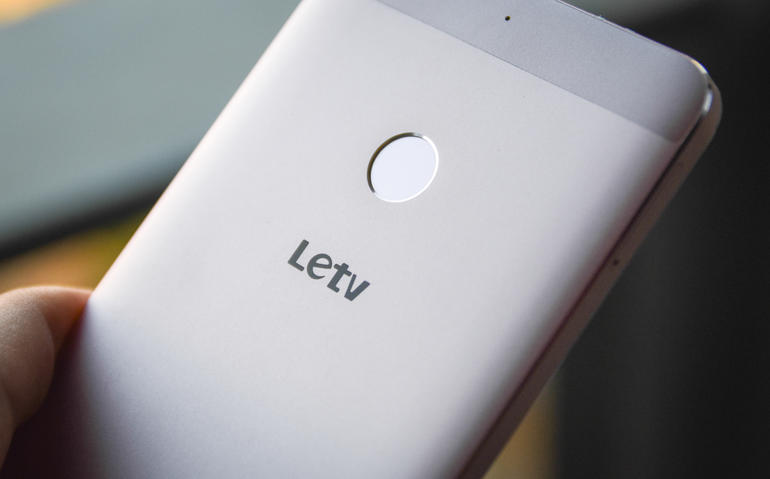
LeTV rebranded itself as LeEco to reflect its new direction forward. The company held an event yesterday in India where it spoke about its new brand, which involves an open ‘ecosystem’ with a connected world. To do this, LeEco is diversifying itself. The company that started with television and content (hence the original name) has moved on to other venues like smart cycles, internet-linked electric cars, and smartphones.
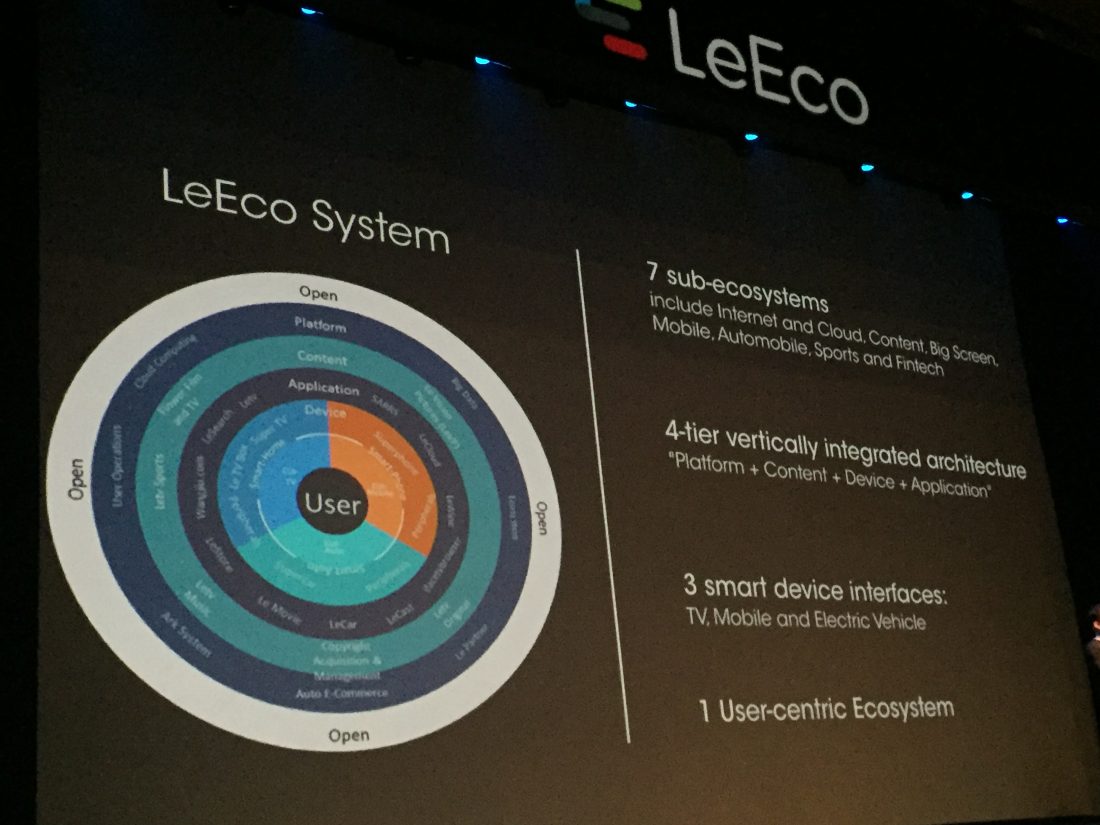
LeEco’s Ecosystem
Yesterday, LeEco launched three new smartphones in India – Le Max, Le 1s and Le Max Sapphire. The first half of the event, however, was used to talk about the brand’s new ideology. The company’s move towards a comprehensive ecosystem incorporate’s four aspects – Culture, Technology, Internet, and Platform. The idea is to have a broad, connected reach. LeEco has already begun this by launching smart accessories, online content, TV, mobile, and electric vehicle by partnering with Faraday Future.
Flash Sale: Can it Deliver the Goods?
Indeed, LeEco wants to be everywhere. But the question is whether the company can deliver. In India, after launching the smartphones yesterday, the company stated that it will hold its first flash sale on Flipkart on the 2nd of February. There are some reasons why customers in India may feel a little hesitant in going with LeEco’s new offerings.
Firstly, one needs to give props to the company in terms of pricing, especially for the Le 1s which is priced at a very impressive Rs 10,999. The company could have easily priced it a few notches higher given the device’s specs and premium look. Now, the Le 1s looks to give devices like the Lenovo K4 Note a run for its money. But will it?
Lenovo has established a good base in India and is one of the more trusted names. The company also held a flash sale recently on Tuesday and Wednesday for the K4 Note. The company also stated that it sold 10,000 units in less than a second. Registrations, however, shot up to 4 lakh. The uncertainty is how much of its K4 Note units Lenovo managed to deliver. Certainly there must have been a lot of disappointed fans.
LeEco sold over 4 million smartphones last year making it the fastest selling newcomer in the market. It beat the likes of Xiaomi, Meizu and OnePlus on that front. For comparison sake, Xiaomi took a year to sell 400,000 units while Meizu sold 600,000 units.
LeEco’s flash sale will put to test just how well its ‘superphones’ will be received in India. The company’s refusal in providing a figure when asked how many units it plans on selling is not a good sign as it does lead one to question if the company is prepared for the Indian market at all.
No Physical Stores Will be a Hindrance
Moreover, without brick and mortar, it’s hard to imagine how LeEco will sustain in the Indian market. On that note as well the company refused to answer when asked when it plans to open up physical stores in India.
Even today, physical stores remain key to sales of smartphones. Companies cannot rely solely on e-commerce sites like Flipkart and Amazon for sustainment. Granted, LeEco is still early in its entry into a myriad of businesses, but the company does have enough financial backing for brick and mortar.
On a number of occasions at yesterday’s event, LeEco did not shy away from taking jabs at Apple. The company not only compared its Le Max to the iPhone 6s, but also criticised Apple’s closed ecosystem. However, one has to wonder that in naming Apple over and over again, isn’t LeEco establishing the Cupertino giant’s dominance?
When it comes to demand and supply, Apple has delivered on units in surplus. LeEco has a tough job ahead if it wants to entry the top three brand in the country as it claimed yesterday. Given its track record in China, LeEco has done exceedingly well. However, without a proper manufacturing base in India it may see some hiccups. While the company begins to establish itself in the country, it needs to be careful on how much it can deliver initially. A disappointing flash sale will in effect damage the company’s image before it even gets started.
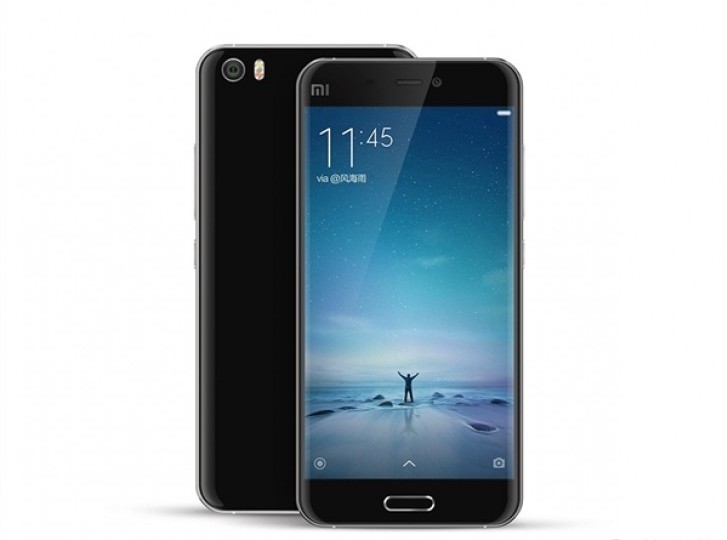
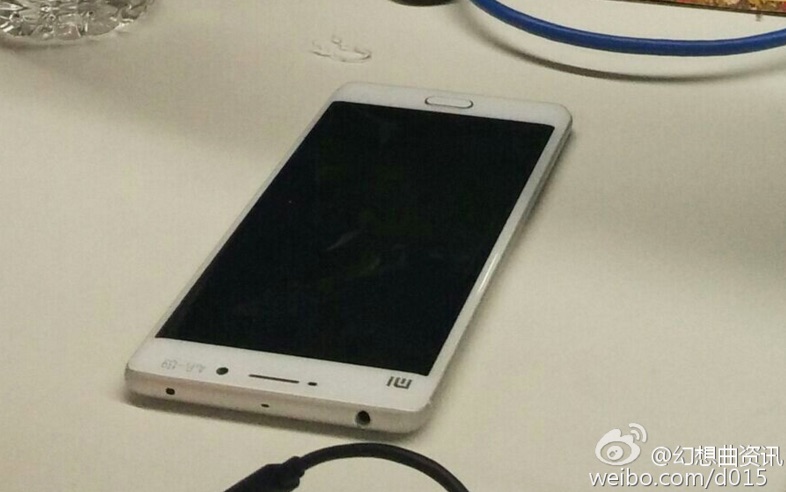
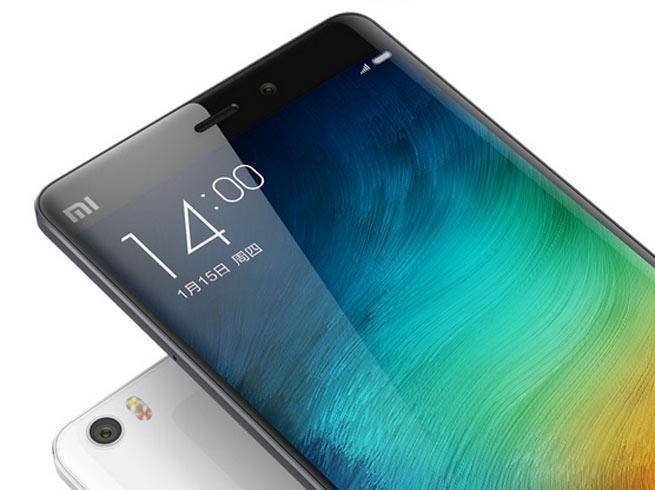
Xiaomi is exactly a month away from unveiling its newest flagship smartphone, but leaks and rumours over the past few weeks have let little to the imagination. The specifications are all but confirmed and some images and renders of the phone have also told us what the Mi 5 is going to look like. And just because fans cannot have enough of leaked photos, there’s one more that shows the device in its glorious white body.
This new photo shared by Weibo has the Mi 5 lying on its back showing the white frontal glimpse with its 5.2-inch screen and a home button which is likely to house a fingerprint scanner. The image is in line with previous leaks of the handset. The glass top is surrounded by a metal frame, and the headphone jack is placed on top.
Xiaomi has made some obvious changes to the Mi 5 compared to its predecessor. The home button is present now and the device sports a curved look moving away from the box-like design of the Mi 4. Other specs that are hardly a secret now include a Snapdragon 820 chipset with 4GB of RAM. The storage is 16GB, though a 64GB option is very likely. The device will run MIUI 7 (based on Android 5.1).
On the camera front, the Mi 5 is set to sport a 16MP camera on the back with dual-LED flash and an 8MP selfie camera. The device is complete with a 3,600mAh battery. The Mi 5 is also a dual-SIM handset, both 4G LTE-enabled.
Pricing of the Mi 5 will be revealed at the launch later in February. Rumours have suggested that the Mi 5 will cost more than its predecessors given the next-gen specs involved. We’ll know more when the device s unveiled on the 21st of February at MWC.
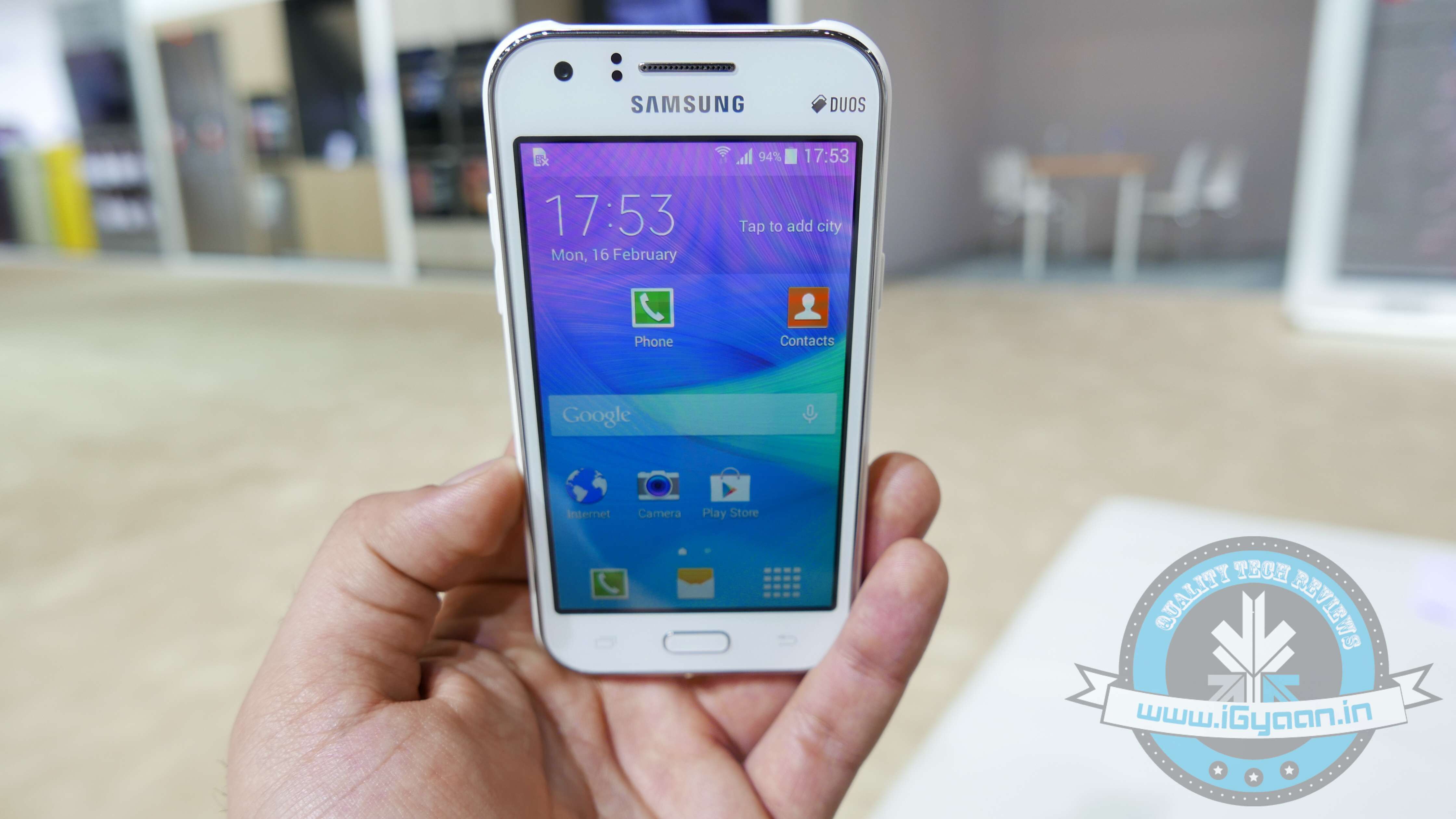
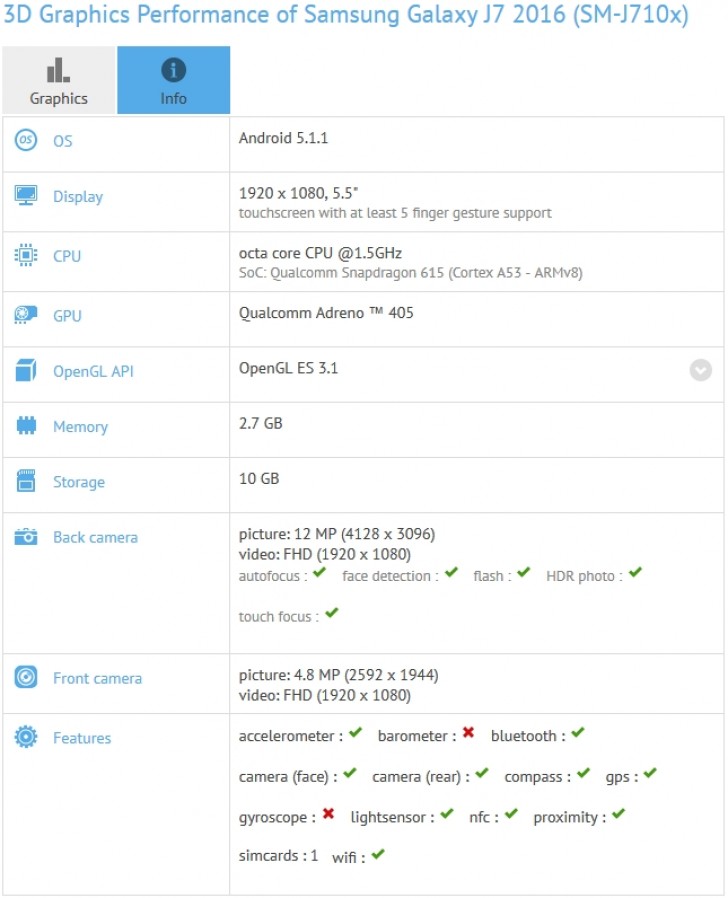
Samsung has been really keeping busy updating its J-series lineup. We’ve already seen the J1 go on sale in Dubai and the J5’s specs listed on GFXBench. Now the Galaxy J7 has been spotted on GFXBench benchmark listing revealing key specs of the upcoming mid-range device.
The 5.5-inch device comes with a Full HD display this time around with 1920×1080 pixel resolution. Samsung has updated its RAM from 1.5GB RAM to 3GB while the processor and GPU remain the same at Snapdragon 615 and Adreno 405, respectively.
The camera is the same, at least on paper. The primary shooter is at 13MP while the front is at 5MP. The J7 successor will run on Android 5.1 Lollipop and is likely to be launched in February along with the J5 at the Samsung Forum that will be held in Kuala Lumpur, Malaysia from the 4th.
As is the case with the J5, pricing will be key here. We know that Samsung wants to push out devices that fill each and every price range, especially the budget to mid-range categories. Samsung will have to price the updated J series around the same price tag as its predecessors, which means the Galaxy J7 is likely to cost around Rs 15,000 when it hits the Indian market.
We all know that 5G is the next big thing. We are also aware that the speeds 5G promises will be massive. While many countries still try to have an established 4G network, including India, Australia is one country which wants to stay ahead of the pack. According to Vodafone, Australia will likely have 5G mobile network by 2020.
The development of the fifth-generation mobile network has invited a number of eager investors. After all, the next-gen network promises supremely fast speeds and will be the guiding factor for everything from ‘Internet of Things’ to driverless cars.
Vodafone’s Australian chief Benoit Hanssen believes Australia will be among the first countries to have 5G network by 2020. “Australia adopted the smartphone enthusiastically — smartphone penetration is one of the highest in the world,” he said. “There is a readiness to adopt new things, and you have a population that can largely afford to adopt new things. We do think that as 5G comes out, Australia will be there.”
Indeed, Australia has embraced 4G greatly with almost 70% of Vodafone customers on 4G phones. Hanssen expects the figure to cross 90% this year. 5G is all set to break speed records if the tests have anything to show for it. In 2015, British scientists claimed they broke speed records during tests of 5G data connections, reaching one terabit per second. According to the BBC, with such a speed, it “would be theoretically possible to download a file 100 times the size of a feature film in about three seconds.”
Spectrums have and continue to be the main reason behind the delay of not only 5G but 4G as well. In fact, many countries still face a lack of 3G connectivity. The release of spectrum is being negotiated globally. We wonder how long it takes before we can even begin talking about 5G in India, which is still being introduced to 4G network slowly.
Tin Mok, Asia Pacific CEO, took the stage at LeEco’s (formerly known as LeTV) official event today where the company launched Le Max with the tag-line”Go Big, Go Bold”, and Le 1s, along with revealing the new logo for the company. LeEco established over 1 million fans Facebook fans in barely 63 days. While the Le Max boasts of big specs inside a big frame, the Le 1s is aimed at the mid-range market.
LeEco Logo
LeMax:
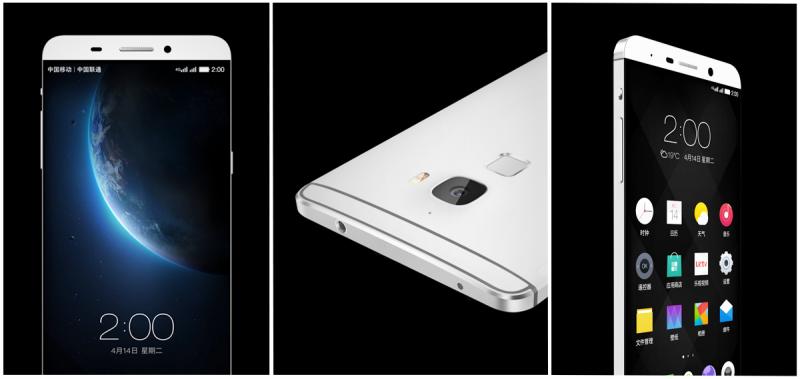
The Le Max has dominant hand-settings which cater to the user’s preferred hand -left or right. The UI is faster, convenient and has one-step access. The Le Max features a 6.3-inch screen with 2K display and sports a metal body design with slim bezels. The device is powered by a Qualcomm 64-bit 2GHz octa-core Snapdragon 810 SoC coupled with 4GB of RAM. It is available in 64GB and 128GB storage variants.
On the camera front, the Le Max comes with 21-megapixel and runs on Android 5.1 with custom EUI running on top. The device comes equipped with multiple desktops – Application Desktop, LeView Desktop, Live Desktop -different screens for the phone that makes different applications, live streaming of events and multimedia available to the user conveniently and smoothly.
LeEco has also tied up with Yupp TV, which offers over 250 channels across 12 languages that can be accessed through the smartphone. The company has further partnered with Eros International to make Bollywood films available to users. Users wouldn’t have to look for content or download multiple apps -the content would be simply available along with a year’s premium subscription of Eros to consumers.
With an AnTuTu score of 83851, Le Max beats Samsung Galaxy S6 and HTC One A9. World’s first bezel-less ID, full floating glass design,0.8mm display border and no heating issues are some of its other highlights.
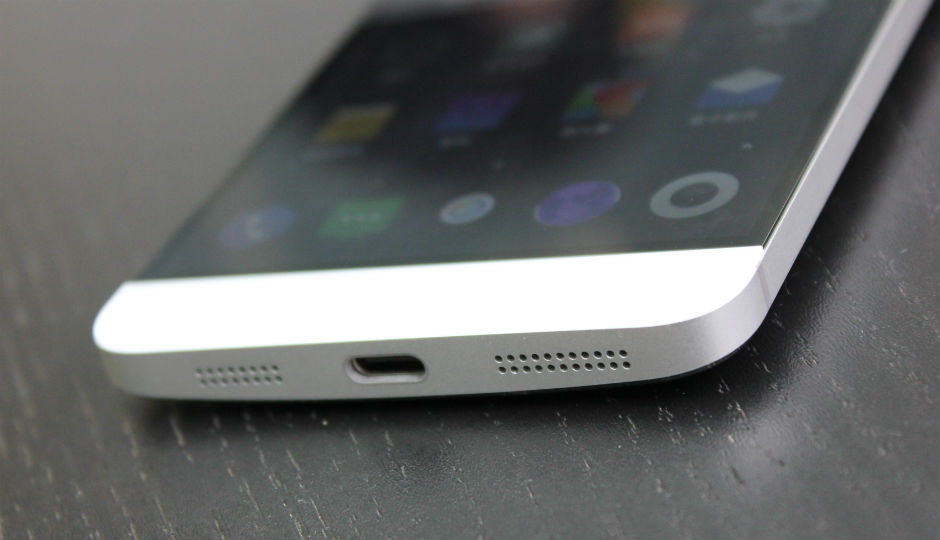
Additionally, the Le Max includes Smart PA-SPK box speakers, full-metal unibody, and is available in two colours -Gold with 128 GB and Silver with 64 GB. The phone further has a Type-C USB port and a hypersensitive fingerprint sensor
Le 1s:
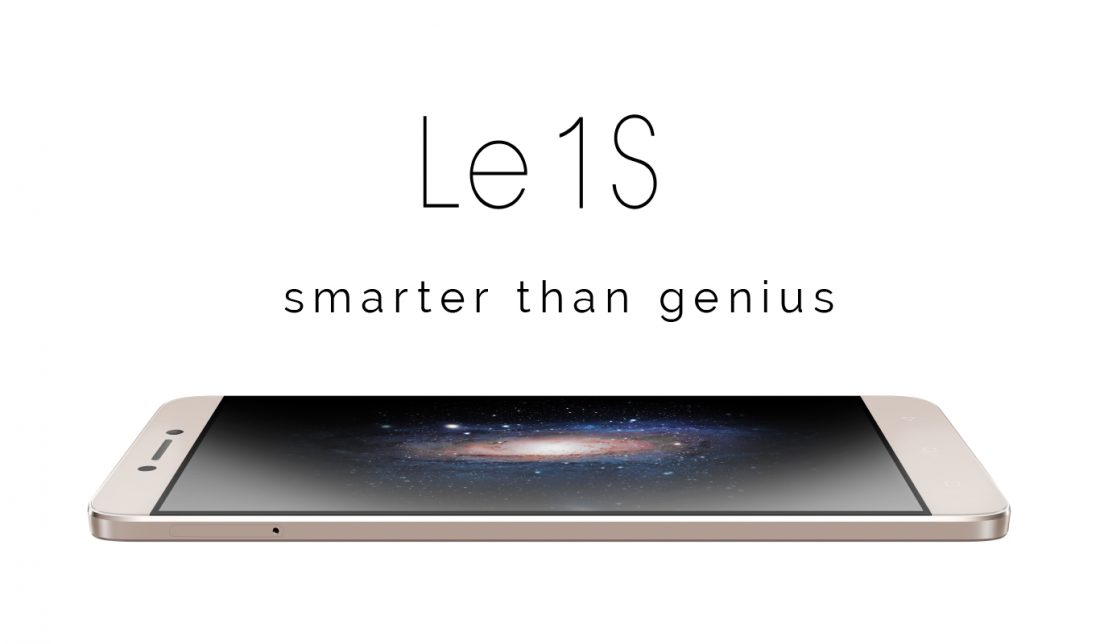
The Le 1s sports a 5.5-inch Full HD display and is powered by a MediaTek’s Helio X10 processor. It features a 13MP rear camera and a 5MP front camera. The smartphone will run on Android 5.1 with custom EUI on top. It is a Dual-SIM device with an AnTuTu score of 55844, beating HTC One M9.It has a type-C USB port which ensures 3.5 hours of usage in 5 minutes of charging, along with a double chamber, symmetrical design, and super-slim, full-metal body with 7.5 mm of thickness. The finger-print scanner of the device called LeTouch, is mirror-surfaced with 99.3% accuracy and .15 seconds flash recognization.
Find below the specs of Le Max and Le 1s.
Specs
Le Max
Le 1S
Le Display
6.33-inch, Gorilla Glass 3, 2K Sharp display
5.5-inch Full HD display
Resolution
2560 x 1440 resolution (464ppi)
1920 X 1080 (403 ppi)
Processor
64 bit octa-core, Qualcomm Snapdragon 810
2.2 GHz MediaTek’s Helio X10
GPU
Adreno 430
VR G6200
RAM
4 GB
3 GB
Storage
64GB/ 128GB
32 GB
Rear Camera
21 MP OIS, Sony Imx 230 sensor, 6P lens, 6 layers, 2K resolution, Dual 14 bit ISP image processor, HDR more vivid than standard HDR, Dual tone flash
13 MP, High-Definition, f2.0 aperture, ISOCELL technology, PDAF, 4K video
LeEco also launched what it calls its “ultimate flagship”, the Le Max Sapphire today. The device is pink in colour and has a sapphire crystal display. It’s priced at Rs. 69,999 for the 128 GB variant.
The devices will be available on Flipkart with 10% cash-back for Axis Bank users as part of the opening day deal. The registrations for the device start today, till 11 am on 2nd Feb with the first round of flash sales for Le 1s on 2n February, and for Le Max on 16th February. The company also offers free home pick-up and drop-off services should the consumer need any.
Samsung is all set to host its annual two-day SEA Forum starting from the 4th of February in Kuala Lumpur, Malaysia. The Forum will see the Korean giant launch some new products across various categories from smartphones to televisions to home appliances. The products showcased at the Forum are India-bound, which means that their arrival in India will be shortly expected after.
Last year at the Forum which was held in Bankok, Thailand, Samsung had unveiled a number of 4G-enabed smartphones like the Galaxy J1 along with Galaxy A7 smartphone and Galaxy Tab Active.
Although the products have been kept under wraps, we expect to see the new Galaxy J5 and A8 smartphones to be launched for the Indian market. The new J5 successor that was spotted on GFXBench just today is likely to sport a 5.2-inch screen with 720p resolution, a 12 or 13 MP (most likely 13MP) rear camera with LED flash, a 5 MP front, 2GB of RAM, and 16GB of built-in storage. The device is powered by Qualcomm’s Snapdragon 410 chipset, which comes with a 1.2 GHz quad-core Cortex-A53 CPU, and will run Android 5.1.1 Lollipop.
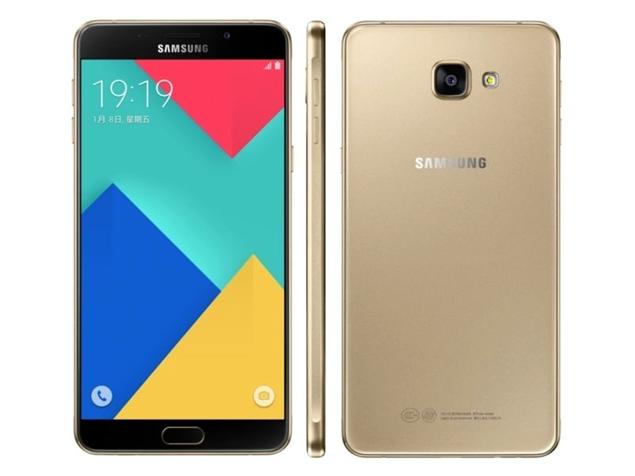
Meanwhile, the massive new Galaxy A9 that was launched in China last month is also likely to be launched for the Indian market at the Samsung Forum. The 6-inch device sports a Full HD AMOLED display and a metal frame. Powering the device is a Snapdragon 652 (earlier named 620) chipset with 3 GB of RAM and 32 GB of internal storage.
The new handset also features a fingerprint scanner embedded in its home button, and will run on Android 5.1.1 Lollipop. The device features a 13 MP primary camera with a wide f/1.9 aperture and optical image stabilisation, and an 8 MP front. The Galaxy A9 also packs a massive 4,000mAh battery with QuickCharge support.
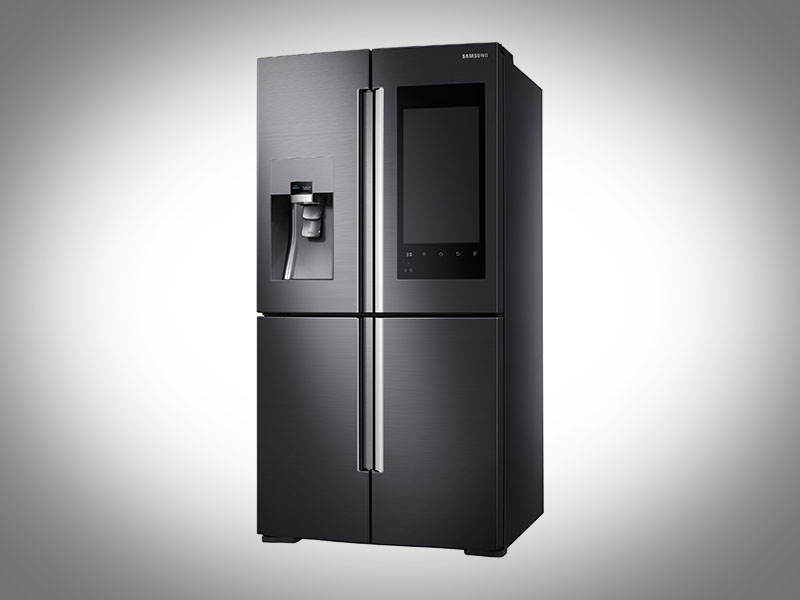
While these are the likely phone launches expected at the Forum, Samsung may also give an early sneak peek at the upcoming S7 flagship smartphone. Furthermore, the Forum will also see some products that were unveiled at CES 2016 such as the KS9500 series SUHD TV – available in 65-,77-, and 88-inch sizes – that come with the thinnest bezels you’ve ever seen and a smart fridge that comes with a giant 21-inch touchscreen display. The smart fridge is part of Samsung’s ‘Family Hub’ lineup of home appliances.
iGyaan will be on the ground at the Samsung Forum and will bring you all the latest launches that are set to take place.
Samsung unveiled the Gear S2 at IFA Berlin last year. The smartwatch has been launched slowly in select countries for the past few months, and will now come to India this week. Samsung India has sent out media invites for the launch event on the 21st of January.
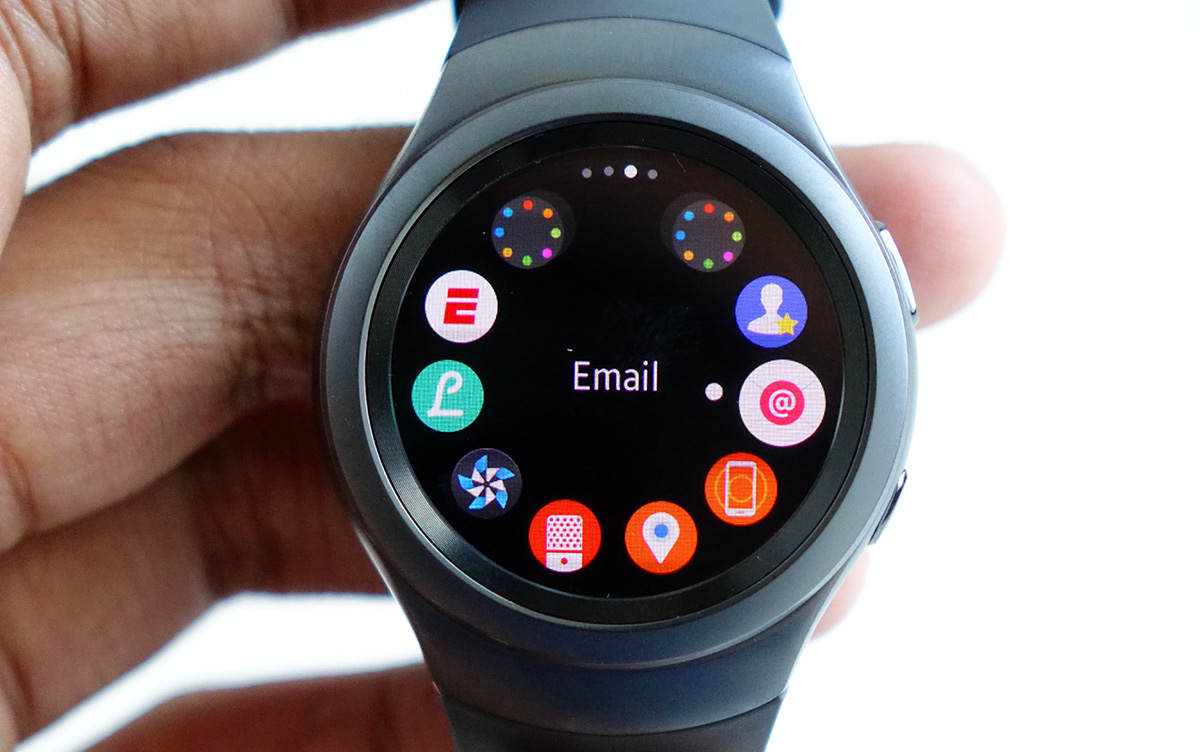
The new smartwatch comes with a 1.2-inch screen with a 360x360resolution (302ppi). To power the device, Samsung has used 1GHz dual-core processor and provided the option of 3G Connectivity. The Gear S2 runs on the company’s very own Tizen OS and uses a rotating bezel, along with the Home and Back buttons, for navigation. Samsung has also added NFC for mobile payments.
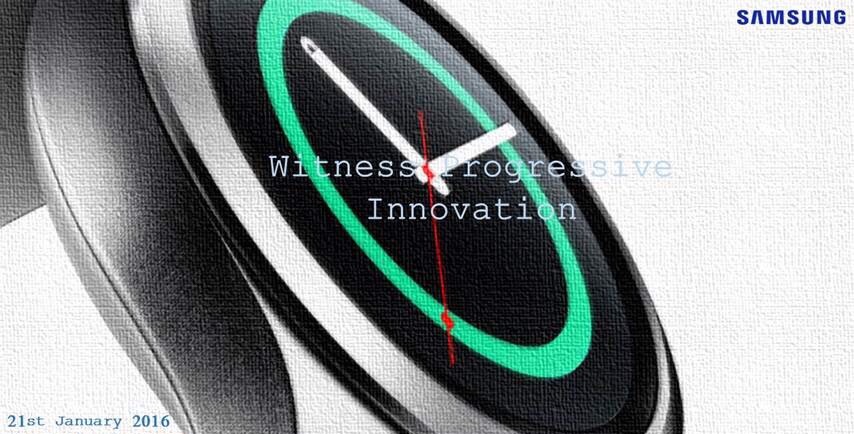
The Samsung Gear S2 Reflects Samsung’s Most Progressive Innovation. It Is The Perfect Complement For Any Occasion, Easily Taking You From Day To Night, From Work To Workout
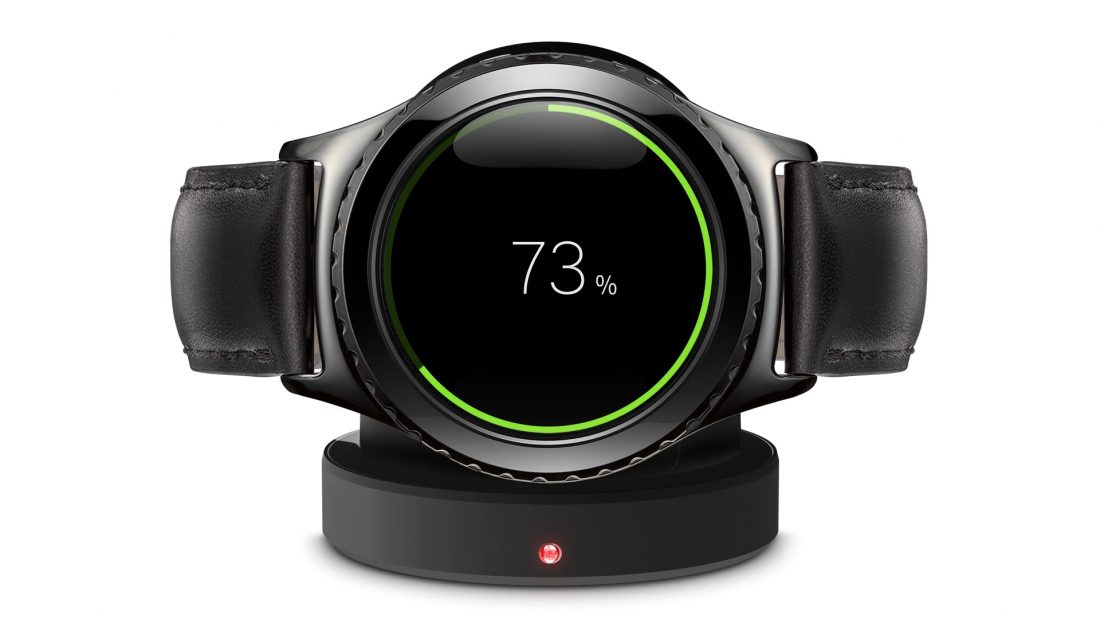
Perhaps, the highlight of the device would be the fact that the company claims it lasts upto 2-3 days on a single charge. Since a wearable is an extra ‘smart’ device that you need to carry around, a long-lasting battery is a necessity. One of the exciting announcements is that the smartwatch has been announced in two variants – Gear S2 and Gear S2 Classic. Other than the design, the only major difference between the two is their size. The Classic has been built smaller and lighter than the Gear S2. For its timeless design, we’re leaning towards the Classic which comes with a black dial and a leather band.
Furthermore, The Gear S2 will be iOS compatible later this year. As of now, the wearables can only work with an Android device.
The event will also see the launch of the Gear VR headset. The Oculus-powered virtual reality headset is compatible with a number of Samsung smartphones including the Galaxy S6, Galaxy S6 Edge, Galaxy S6 Edge+ and the Galaxy Note 5.
Specs
Samsung Gear S2
Display
1.2-inch, Circular Super AMOLED, 360×360, 302ppi
Processor
Dual-core 1.0 GHz
OS
Tizen-based wearable platform
Storage Memory
4GB Internal Memory
RAM
512MB
Connectivity
Wi-Fi: 802.11 b/g/n, Bluetooth® 4.1, NFC
Battery
250mAh Li-ion
Misc
IP68 Certified Dust and Water Resistant, Wireless Charging
Sources close to iGyaan have suggested that the much-anticipated Galaxy S7 flagship smartphones will only come in ‘edge’ form. This means that you might not see a flat S7 device at all.
This latest rumour brings in line with what past renders of the S7 have revealed. The 5.1 Galaxy S7 will likely come in the form of last year’s Galaxy Note 5 where the sides curve at the back. Meanwhile, the 5.5-inch S7 Edge will have curved edges at the front and so will the 5.7-inch S7 Edge+. The video of the render shows the front design of the S7 having narrower side bezels, 2.5D glass covering the display and the Home Button.
The move to curved-only smartphones makes sense as Samsung won widespread praise for its design language last year. The Galaxy S7 Edge, Edge+ and Note 5 were among Samsung’s best-looking devices in 2015.
Meanwhile, the specs of the device remain unchanged from past rumors. It is already confirmed that the flagship device will sport Qualcomm’s latest Snapdragon 820 chipset. Other likely specs include 4 GB of RAM, 64 GB internal storage, Adreno 530 GPU. The device will run of Android 6.0 Marshmallow (no surprises there).
On the camera front, Samsung is looking to downgrade to 12 MP camera and focus more on improving low-light imaging and wider dynamic range for the upcoming flagship. To do this, Samsung is taking help of the new BRITECELL setup. AnTuTu listing also confirms that the device will sport a 12 MP rear sensor and a 5 MP front. Looks like Samsung is sticking to quality rather than quantity here.
Looks like Samsung is really keen on its budget to mid-range devices, as has been the case for a while now. The Korean giant has been heavily pushing out its ‘J’ and ‘A’ series in the past few weeks with the J1 recently being outed. Now it seems the new Galaxy J5 mid-range smartphone will be out soon too, if the latest benchmarks have anything to say about it.
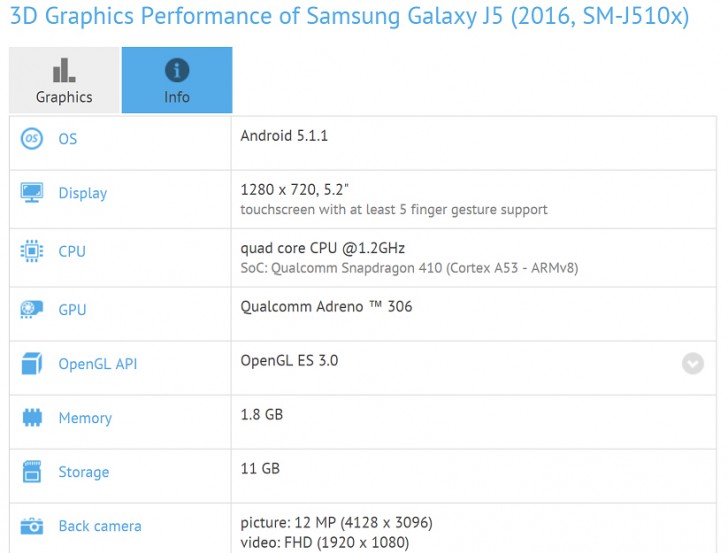
A benchmark listing posted by GFXBench has been discovered that suggests some key specs of the alleged J5 smartphone.
The device is shown to sport a 5.2-inch screen 720p resolution, a 12 or 13 MP (most likely 13MP) rear camera with LED flash, a 5 MP front, 2GB of RAM, and 16GB of built-in storage. The device is powered by Qualcomm’s Snapdragon 410 chipset, which comes with a 1.2 GHz quad-core Cortex-A53 CPU. It runs Android 5.1.1 Lollipop.
According to the listing, the new J5 will come with a slightly bigger screen and memory compared to the previous J5. Nothing has been revealed on the battery front, but its likely to be the same the its predecessor.
Now, pricing will be key to the success of the J5 and since Samsung is launching a slew of devices in the budget to mid-range category, it is important that the J5 be competitively priced. One would expect Samsung to price this slightly updated J5 successor around the same as the previous version, which is Rs. 12,000. We’ll know more when we get closer to the launch of the Galaxy J5.
WhatsApp, the $19 billion messaging service is dropping its $1 annual fee. Yes, the messaging service giant wants to reach out to the entire human population now. Founder Jan Koum explained that although the $1 fee isn’t much and there are millions who use the messaging service – that made the traditional SMS obsolete – there are still many who aren’t using WhatsApp, especially those without access to card payments.
The change takes effect from today, and will be a week or two until it reaches everywhere across all versions of the app. This news, however, has raised a lot of concerns among people. The main question was how WhatsApp will earn now that it’s lost its revenue stream. Naturally, the speculations lead towards advertisements.
But before you begin to panic, WhatsApp has stated that advertisements are not coming, claiming that “we will test tools that allow you to use WhatsApp to communicate with businesses and organizations that you want to hear from.” WhatsApp is likely to slowly take over other functions of your phone (it already has voice calling for one) in a bid to make itself more relevant and practical for users. We’ll just have to wait and see what WhatsApp plans for its future.
The original Moto 360 was met with a lot of hype, and quite rightly so as it was the device that kicked off the Android Wear trend. While the first iteration was met with a lot of praise, finding a lot of things to love about it and a few faults as well, the second generation Moto 360 builds on its predecessor and improves where it needed to.
Overview
The Moto 360 2nd Gen was unveiled at IFA Berlin last year and was launched in India early September. The smartwatch comes with new design language and customization options including Moto Maker, which, however, is not available in India yet.
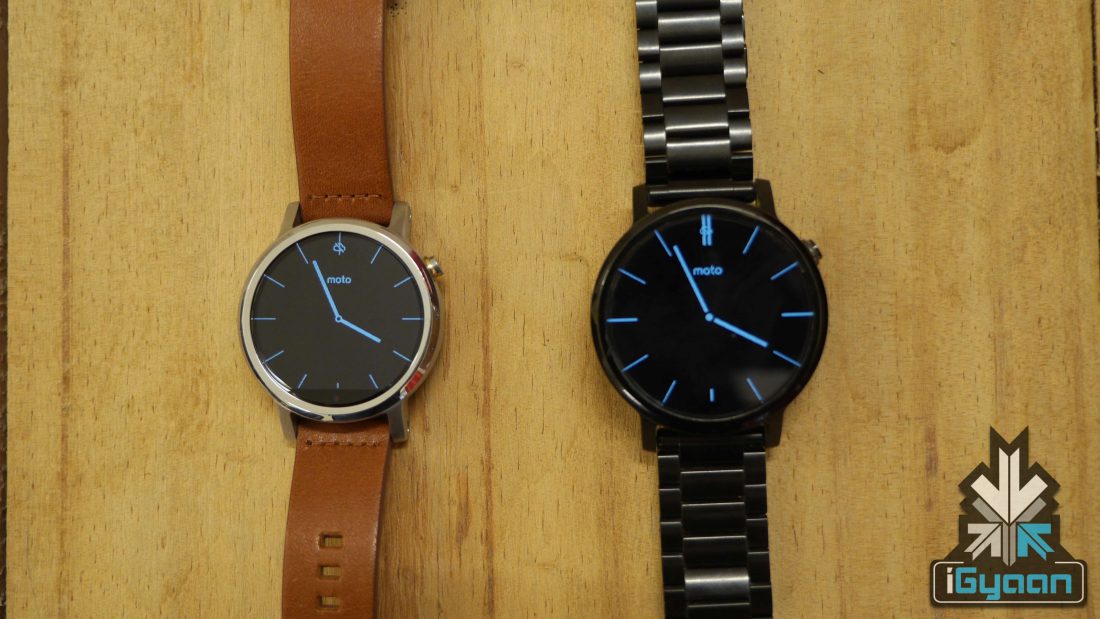
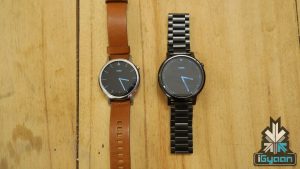
42mm (left), 46mm (right)
The Moto 360 2nd Gen starts at a price of Rs 19,999 for the 42 mm variant and Rs 23, 999 for the 46 mm option. The smartwatch is available on Flipkart and Amazon.
Build Quality and Design
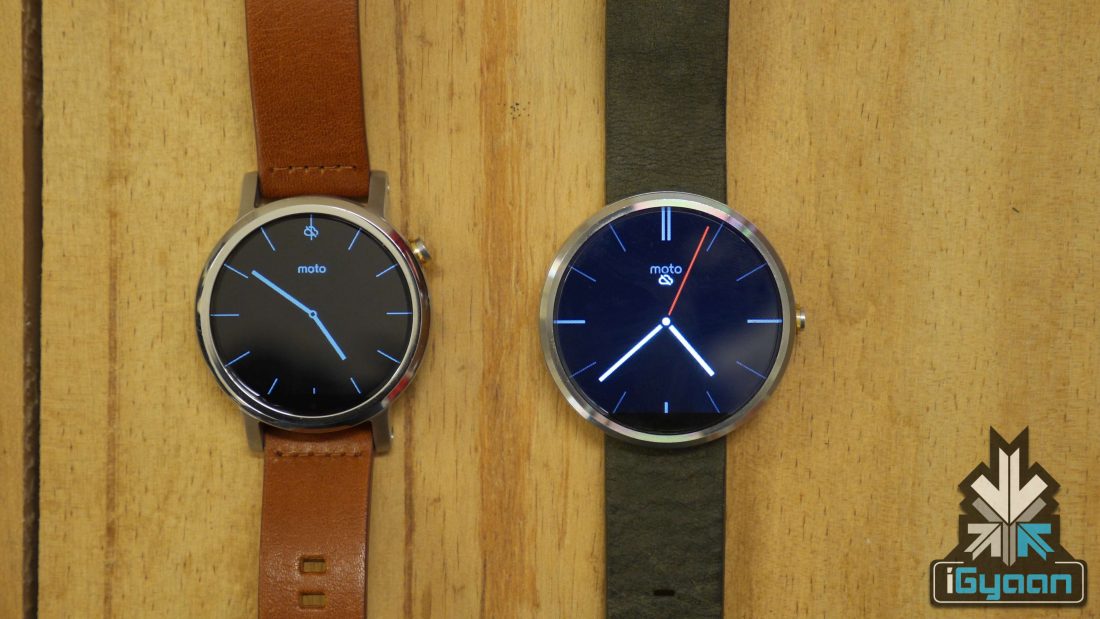
Moto 360 2nd Gen (Left) Moto 360 1st Gen (Right)
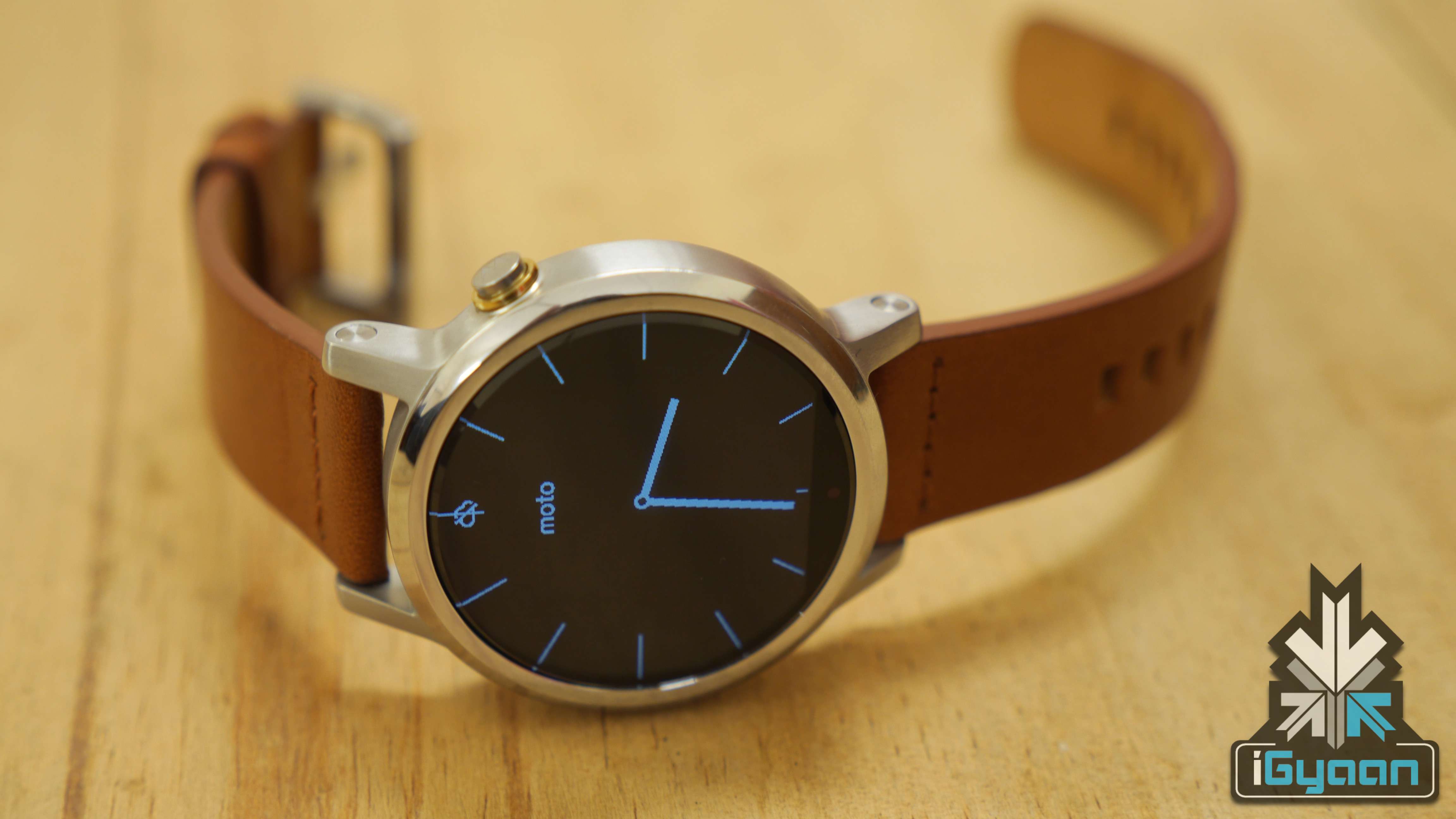
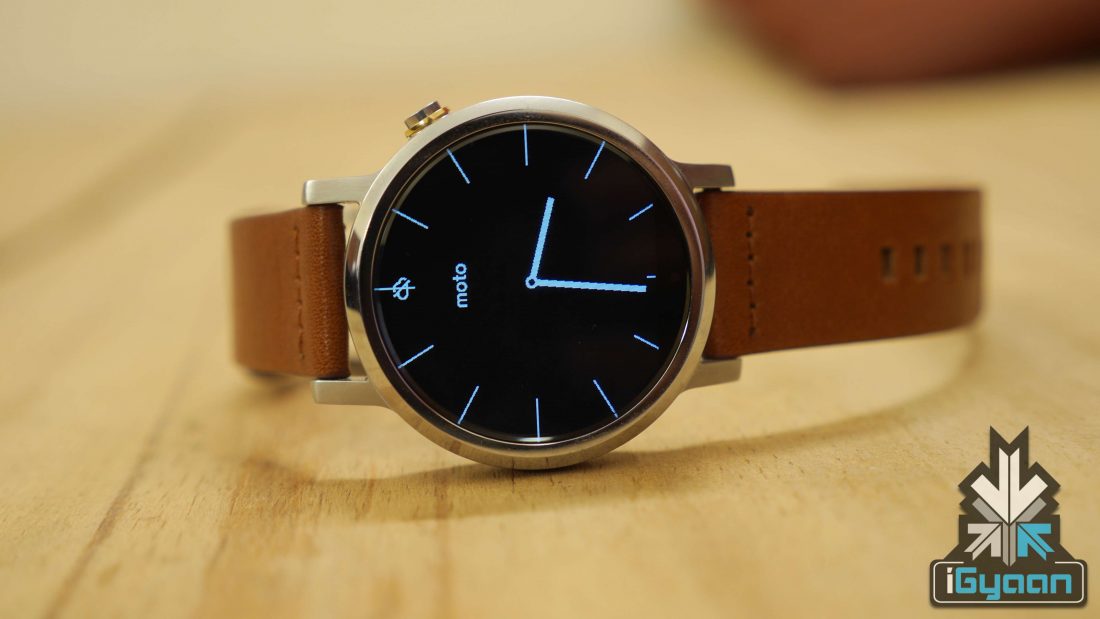
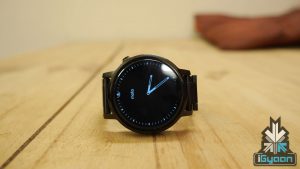
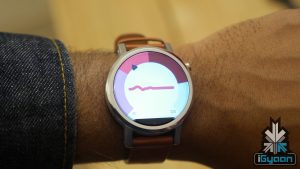
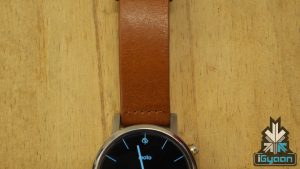
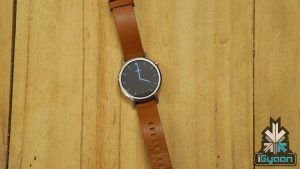
The Moto 360 2nd Gen’s new design language is pretty great. The smooth metallic edge is complemented with thin, refined aluminium bezels. The watch has a firm, strong build and the added nubs give it a better shape and rigidity and gives the device a more watch-like feel to it. The nubs also make changing the straps easier and the lugs are pretty simple to unclasp the band as well. The crown has shifted up a bit to the 2 o’clock position and the top sports the ‘M’ logo.
The Moto 360 2nd Gen is available in three different sizes – a 42 mm male and female version and a male-only 46 mm model. The difference between the male and female version is that the latter attaches itself to a thinner 16 mm strap while the former is compatible with a 20 mm strap only. The 46 mm variant is compatible with a strap that measures up to 22 mm. While the size of the straps differ, the models are all 11.4mm thick, which feels just right without looking too bulky.
The button moves to the 2 o’clock position
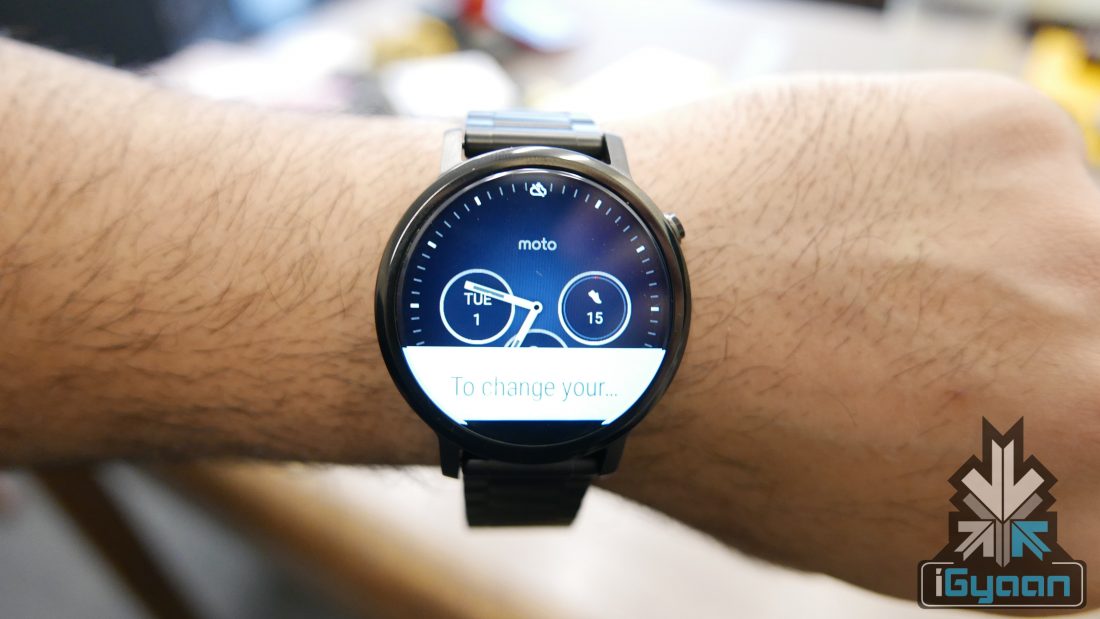
Size isn’t the only point of variation the Moto 360 offers; it comes with a variety of bands to pick from – metal, leather and silicon. However, the silicon version will not be arriving in India any time soon. The smartwatch also comes with gold, rose gold and silver cases and bands. The leather on the 42 mm variant looks elegant on both men and women, while a metallic strap for the 46 mm model looks great on larger wrists.
Display
The 42 mm and 46 mm variants have a 1.37 inch and 1.56 inch LCD display, respectively, and both come with Gorilla Glass 3 protection. The 46 mm version comes with a 360 x 360 pixel resolution and 233ppi, while the 42 mm version has a display resolution of 360 x 325 and 263ppi.
The Moto 360 has received a lot of polarising opinions regarding the display. The popular opinion of it being the first round smartwatch without actually having a fully rounded display stays with the 2nd Gen as well. This is because the screen has a flat-tire like band on the bottom that houses the sensors.
Though many felt the band a little distracting, Motorola has decided to stick with it, and it has come to become something of a defining trait for a Moto smartwatch. After a while with the Moto 360, you tend to grow used to the little band and it really doesn’t feel like an issue. The band also allows Motorola to keep the bezels thin, which is what adds to the look of the device.
The display is quite bright but the LCD screen lacks the vibrancy of an AMOLED display. The light sensor which helps to dim and brighten the screen allows just the right amount of brightness under both light and dark conditions without hurting the eyes. Outdoor visibility is questionable. There’s a ot of glare on the display under sunlight, but you’ll be able to see it just fine when facing the watch directly to yourself.
Hardware and Performance
The Moto 360 Gen 2 is powered by a quad-core Qualcomm Snapdragon 400 processor, an Adreno 305 GPU and comes with a 512 MB of RAM space with a 4GB internal storage on board. Connectivity options include Bluetooth and Wi-Fi. The watch also supports a GPS connectivity, however, it only comes with the Sport range (which unfortunately isn’t available in India yet).
One of the concerns people had with the first iteration was that the device came with a slower OMAP 3 chip, but the second generation rocks a quad-core SD400 processor, and needless to say, there are some differences when using the device. The interface on the 2nd Gen is a lot snappier with very little lag.
Specs
Moto 360 2nd Gen
Display
Men and Women 42mm: 1.37-inch 263ppi (360×325)
Men 46mm: 1.56-inch 233ppi (360×330)
Corning Gorilla Glass 3, backlit LCD
Watch Case Dimensions
Mens:
46mm diameter by 11.4mm high
42mm diameter by 11.4mm highWomens:
42mm diameter by 11.4mm high
Processor
Qualcomm Snapdragon 400 with 1.2 GHz quad-core CPU (APQ 8026)
Adreno 305 with 450MHz GPU
Performance of the Moto 360 2nd Gen is pretty smooth, however, it isn’t the smoothest smartwatch out there. The Moto 360 falls just short of the Apple Watch and Samsung’s Gear S2, but given the price of the Moto 360, we can’t be greedy.
Battery life is good too and an improvement over the first Moto 360, but that’s not saying too much. One of the main problems with smartwatches has been the battery, or the lack therof. Luckily, the Wi-Fi feature helps conserve battery life just a little more.
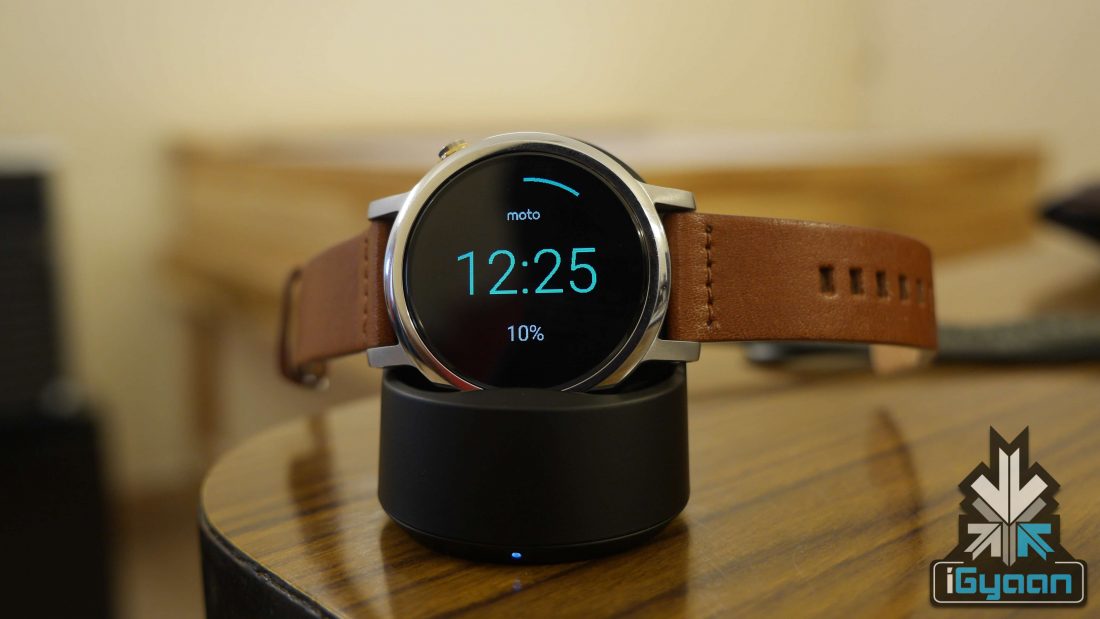
With the Ambient Mode that leaves the display on and dim continuously turned on, the smartwatch lasts a full day. Consequently, with the Ambient Mode turned off, the smartwatch can go on for a day and a half (for the 42mm 300mAh variant) on a single charge. The wireless charging is zippy too, powering up the Moto 360 to about 50% in under an hour.
42mm: 300mAh – Up to 36 hours of use with Ambient Mode off and up to 9 hours with Ambient Mode on (both on basic daily usage)
46mm: 400mAh – Close to 2 days with Ambient Mode off and 11 hours with Ambient Mode on (both on basic daily usage)
Features
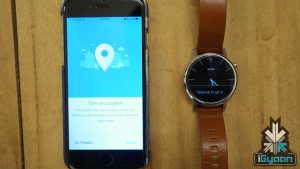
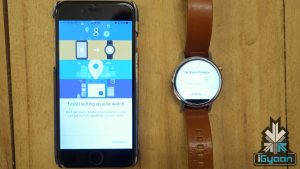
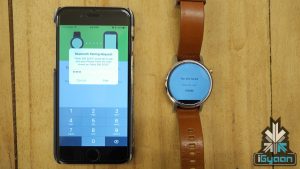
The new Moto 360 is compatible with Android devices as well as iOS due to Android Wear’s move into the Apple Store. This gives the Moto 360 an edge over the Apple Watch as the latter is pricier and works only with iOS. The pairing with iOS is pretty seamless and the watch displays your phone’s or tablet’s notification and messages to which you can voice reply. You need only download the Android Wear app on your iOS device and reset your Moto 360 to begin pairing.
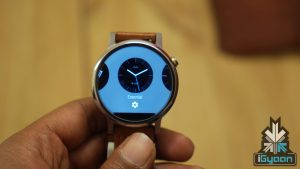
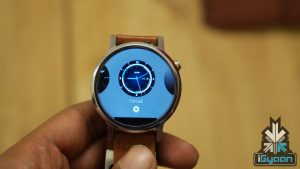
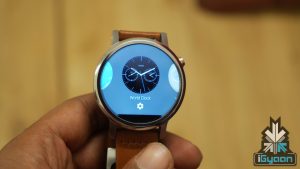
The Moto 360 has a unique feature called Live Dial, which allows its users to set dials on their home screens. Other than a bunch of options provided by Motorola, users can also use their own pictures as the watch-face. There are a number of dials available and you can use your paired smartphone or tablet (including iOS) to set the faces for your watch.
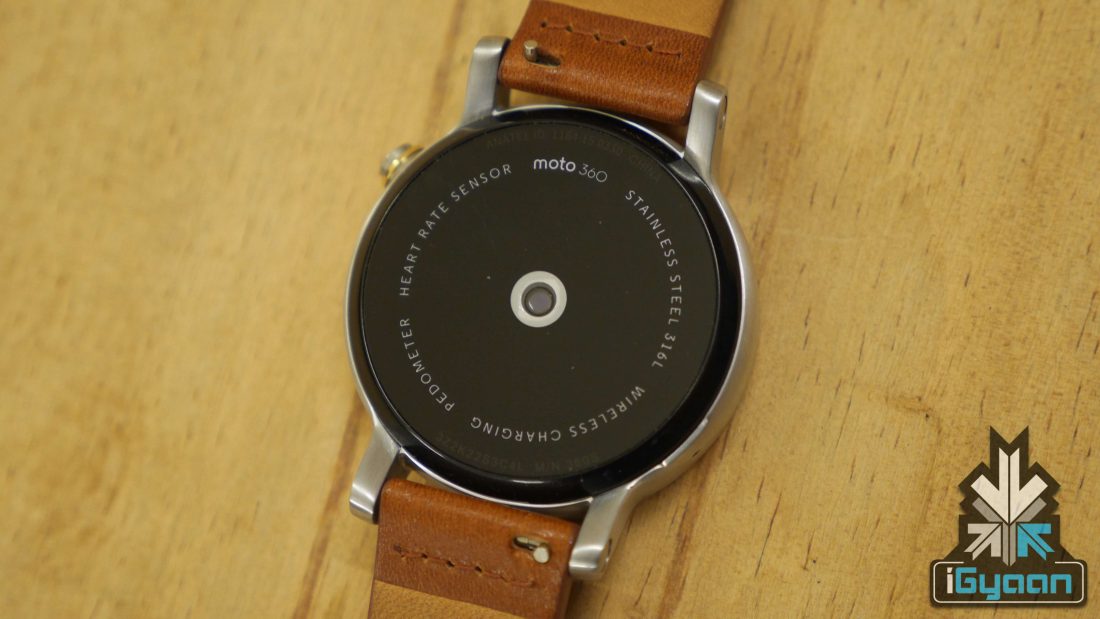
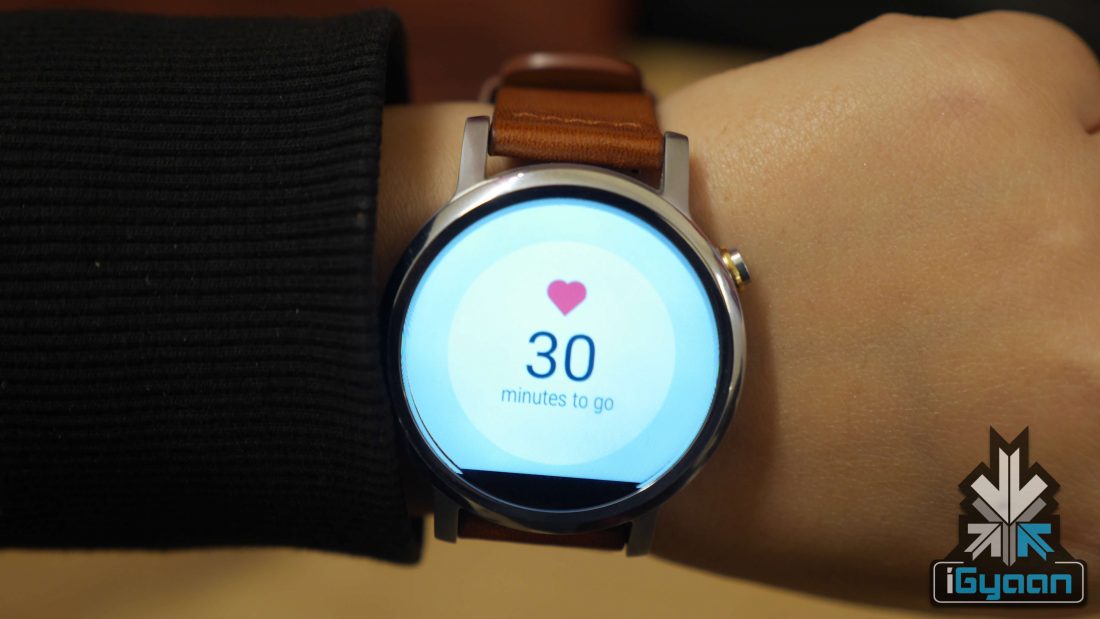
The smartwatch also supports the Moto Body software, that keeps a tab on calories burnt and bpm stats with the help of an optical heart rate monitor. It is packed in with a 400 mAh and 300 mAh battery for the 46mm and 42mm versions respectively. Both variants will come with a charging dock station.
Additionally, the watch is rated at IP67 which means it can be soaked in 1 m (3.3 ft) of water for half an hour. With a leather strap, however, we stress caution and would advise keeping the smartwatch away from water at all costs.
Conclusion
The Moto 360 2nd Gen is a great Android Wear device and a starting price of Rs 19,999 keeps it in the affordable range. The fact that it is iOS compatible makes the watch a strong competitor for the pricier Apple Watch. Changing the straps is easier and the display is sharper. However, there are some cheaper smartwatches out there like the Asus Zenwatch 2, which comes with an AMOLED display and Sony Smartwatch 3. But for those who want a smartwatch that looks like a watch, then the Moto 360 2nd Gen is worth spending a few extra bucks on. indeed, it is the most elegant looking rounded smartwatch currently in the market.
The Moto 360 2nd Gen does feel more like a watch this time around with a solid build thanks to the added nubs, and the customization options here are quite extensive. Furthermore, the upgraded processor makes the Moto 360 pretty snappy to work with. There aren’t too many noteworthy apps here but there’s enough to make it smartwatch-worthy. The design is a big win and it is worth considering just for that. Another noteworthy point is that the Wi-Fi option here will help conserve battery life and you won’t have to leave Bluetooth on all day.
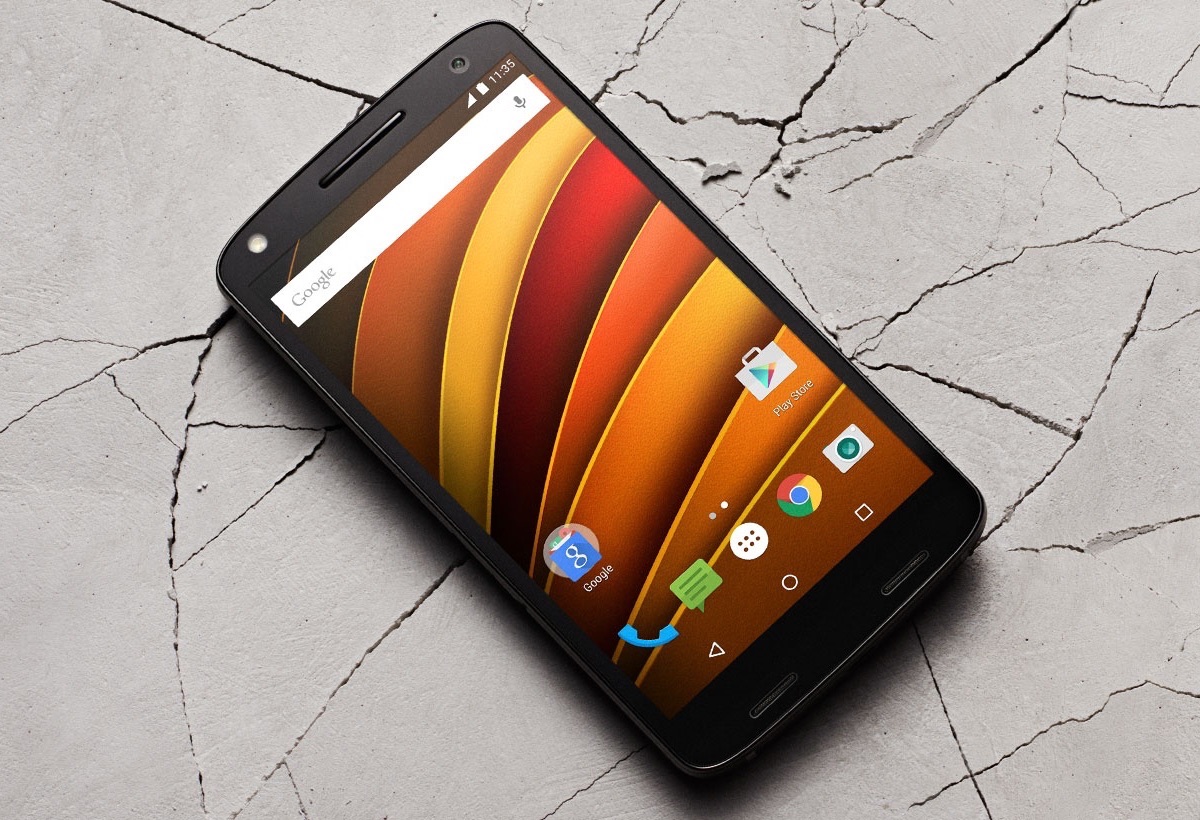
Motorola India has just launched a teaser for its upcoming Moto X Force smartphone. The device’s major highlight is its shatter-proof display which is gloriously demoed in this teaser while taking a jibe at some other well known smartphones out there including the iPhone.
The teaser shows people dropping iPhones, Samsung devices and other devices in slow motion, capturing the many different ways in which the displays can shatter. At the end comes the Moto X Force which is dropped and comes out clean, without a single scratch to the display or dent on the sides.
Motorola claims to have integrated a ‘Moto Shattershield’ technology in the display of Moto Force which, it says, is the first shatterproof screen in a phone ever. The company feels confident enough to affirm the screen would stay intact for up to four years, owing to the multiple layers of different materials used in making it capable of absorbing shock and providing protection against cracking. The phone also boasts of two touchscreen layers, which make sure that the smartphone can be used even if one of the layers is cracked.
On the specs front, Moto X Force packs a 5.4 inch Quad HD display with a resolution of 2560×1440 pixels. It is powered by Qualcomm Snapdragon 810 octa-core chipset along with 3 GB of RAM. The two internal storage options of 32 GB and 64 GB are expandable up to 2 TB with the help of a microSD card.
The Moto X Force is set to launch in India by the end of January. Follow this space for more.
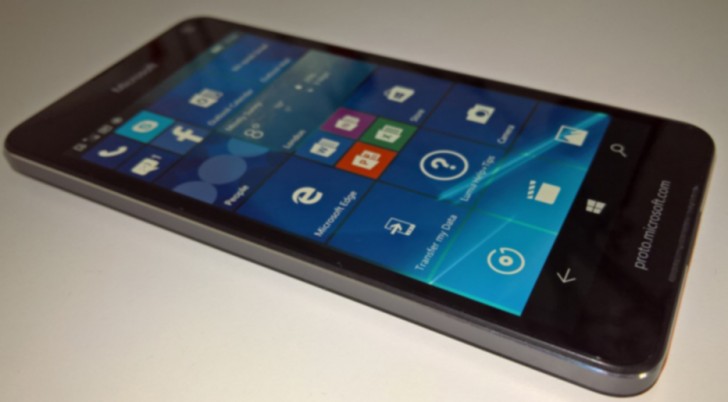
The official announcement of the Lumia 650 budget smartphone is just around the corner. Reports suggest that Microsoft is planning to unveil the device on the 1st of February. But that’s not all the rumours are suggesting. Word is that the Lumia 650 might be the only Lumia device from Microsoft this year.
This news contradicts earlier reports that Microsoft will also launch the Lumia 750 and 850. While some believe that the two devices are still on the cards, there are many who believe that the launch has been cancelled citing the reason that Microsoft wants to focus more on its Surface phone. Microsoft is planning to launch a Surface phone that will sport Qualcomm’s Snapdragon 820 chipset later this year.
The 5-inch 720p display Lumia 650 is likely to come bearing the Snapdragon 210 chipset clocking at 1.1GHz. A 2,000mAh battery pack in the 650 is small, especially when compared to the Lumia 640 (2,500mAh) and the Lumia 550 (2,100mAh).
Furthermore, it is the single-SIM variant that has been cleared by FCC with the model number RM-1152 suggesting the device will first launch in the United States. Microsoft will also offer a dual-SIM variant for the device.
From what the unconfirmed specs tell us, the Lumia 650 lacks both juice and power but does well with the exterior design, and a pricing of under Rs. 10,000 (similar to the Lumia 550) will be needed for this device to tempt the masses.
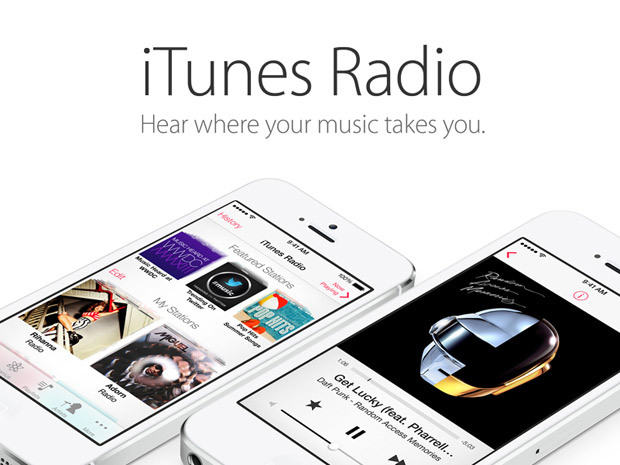
Apple’s iTunes Radio will no longer be a free streaming service. The company will add the ad-supported streaming service to Apple Music beginning January 29. Apple Music is a paid music streaming service that began last year. After the date, Beats 1, which launched alongside Apple Music, will be the only free music streaming service offered by the Cupertino company.
Apple launched iTunes Radio in 2013 in the United States and Australia. The streaming service lets you create custom stations based on genres or specific songs, much like Pandora and other internet radio services. The service is ad-supported and does not allow on-demand access to music.
Apple sent out emails to customers regarding its new change and also confirmed the same to BuzzFeed. iTunes Radio has already been a part of Apple Music since the latter’s inception, but users were still able to access iTunes Radio streams for free. After the 29th, Beats 1, Apple’s curated live 24/7 radio station, will be the only free music streaming option available.
The news follows and confirms Apple’s decision to discontinue its iAD App Network, the company’s mobile ads product.
Gun violence in America is an issue that cannot be brushed under the rug. Last year, gun violence resulted in at least a 1,000 injuries and deaths, and about 400 deaths were caused due to mass shootings alone. An incident last April shocked the world to no end when a three year old boy shot a baby (Braylon Robinson) dead using a gun the boy found lying in the house in Cleveland, Ohio.
Such horrific stories have made politicians stand up and take notice, turning towards technology for help. President Barack Obama asked during his Jan. 5 gun control address from the White House that, “if we can set it up so you can’t unlock your phone unless you’ve got the right fingerprint, why can’t we do the same thing for our guns?” The proposition was reasonable indeed, and this is exactly what ‘smart gun technology’ is all about.
The United States President has called for three called for three federal agencies – the Department of Defence, the Justice Department, and the Department of Homeland Security – to speed up research in smart gun technology with the aim of preventing the “accidental discharge or unauthorised use of firearms.”
The technology has been around since the 90s. Digitally equipped firearms were designed to work for the authorized owner only. Smart guns typically employ fingerprint scanners, or a radio-frequency-identification device (RFID), such as a ring or bracelet that sends a signal to unlock the weapon. Like modern smartphones, smart guns are being developed that use biometrics to unlock.
One such device, the Identilock, created by Detroit-based engineer and National Rifle Association (NRA) member Omer Kiyani, takes the form of a black box that fastens on to the end of a handgun. The Identitylock works by preventing the trigger to move unless the device recognizes the user’s fingerprint when they place their fingertip against the scanner on the side of the device. Once the device recognizes the fingerprint, the Identitilock falls to the ground allowing the user to fire the gun.
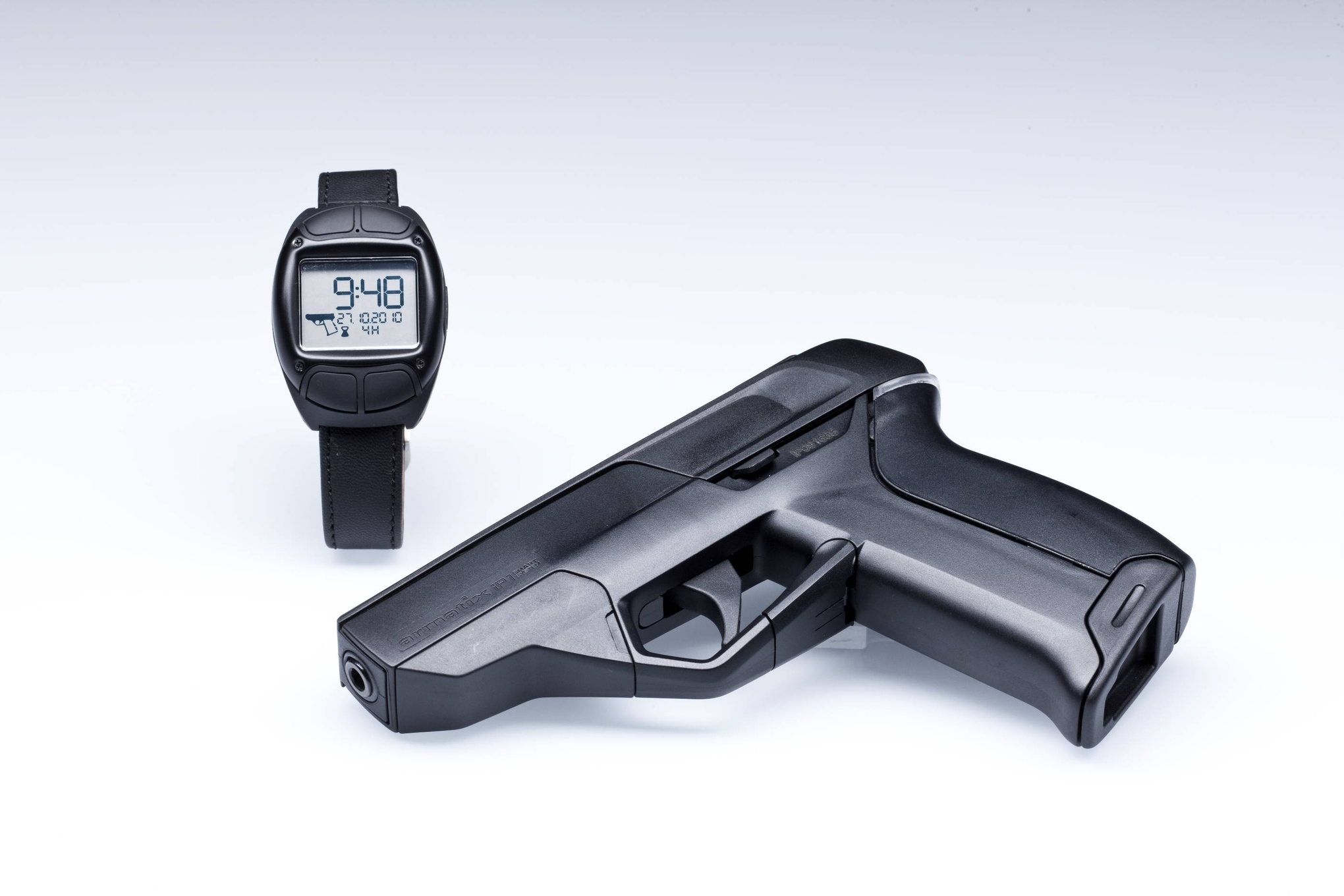
Armatix is another company that has worked on a smart gun, iP1 that requires the user to wear a companion watch into which a pin number is entered. The gun will refuse to fire if it is taken more than 10-inches away from the watch.
https://www.youtube.com/watch?v=XHHT1PuM3K8
Smart guns aren’t likely to completely stop deliberate mass shootings, like the racially motivated shooting at a South Carolina church last year where nine people were killed. However, smart guns can avoid incidents like the above mentioned Braylon Robinson shooting.
Smart gun technology has also met with a lot of criticism. The opposition comes due to the unreliability of technology and the security concerns that such gins can be hacked. Moreover, the fact that fingerprint scanners take a couple of seconds before authorizing the user can be fatal in a situation where the user needs to act under duress. Nevertheless, the need for a solution is at hand and perhaps technology is the only way out. We’ll just have to wait and see how far this goes to curb gun violence in America and other countries with liberal gun laws.




 LeEco has also tied up with Yupp TV, which offers over 250 channels across 12 languages that can be accessed through the smartphone. The company has further partnered with Eros International to make Bollywood films available to users. Users wouldn’t have to look for content or download multiple apps -the content would be simply available along with a year’s premium subscription of Eros to consumers.