Author: Vipul Vij

  • Xiaomi Mi Mix 2S: Everything We Know So Far

    Xiaomi Mi Mix 2S: Everything We Know So Far

    Xiaomi is expected to launch the Mi Mix 2S at MWC 2018. A few weeks ago, the Mi Mix 2S looked like a fragment of someone’s imagination. Especially with the weird design and how the “notch” was being handled in the renders. However, the past couple of weeks have proved that the Mi Mix 2S is definitely real and could be launched very soon. While it was predicted to be launched before MWC, there has been no indication from the company and the MWC now seems like the ideal event for its launch.

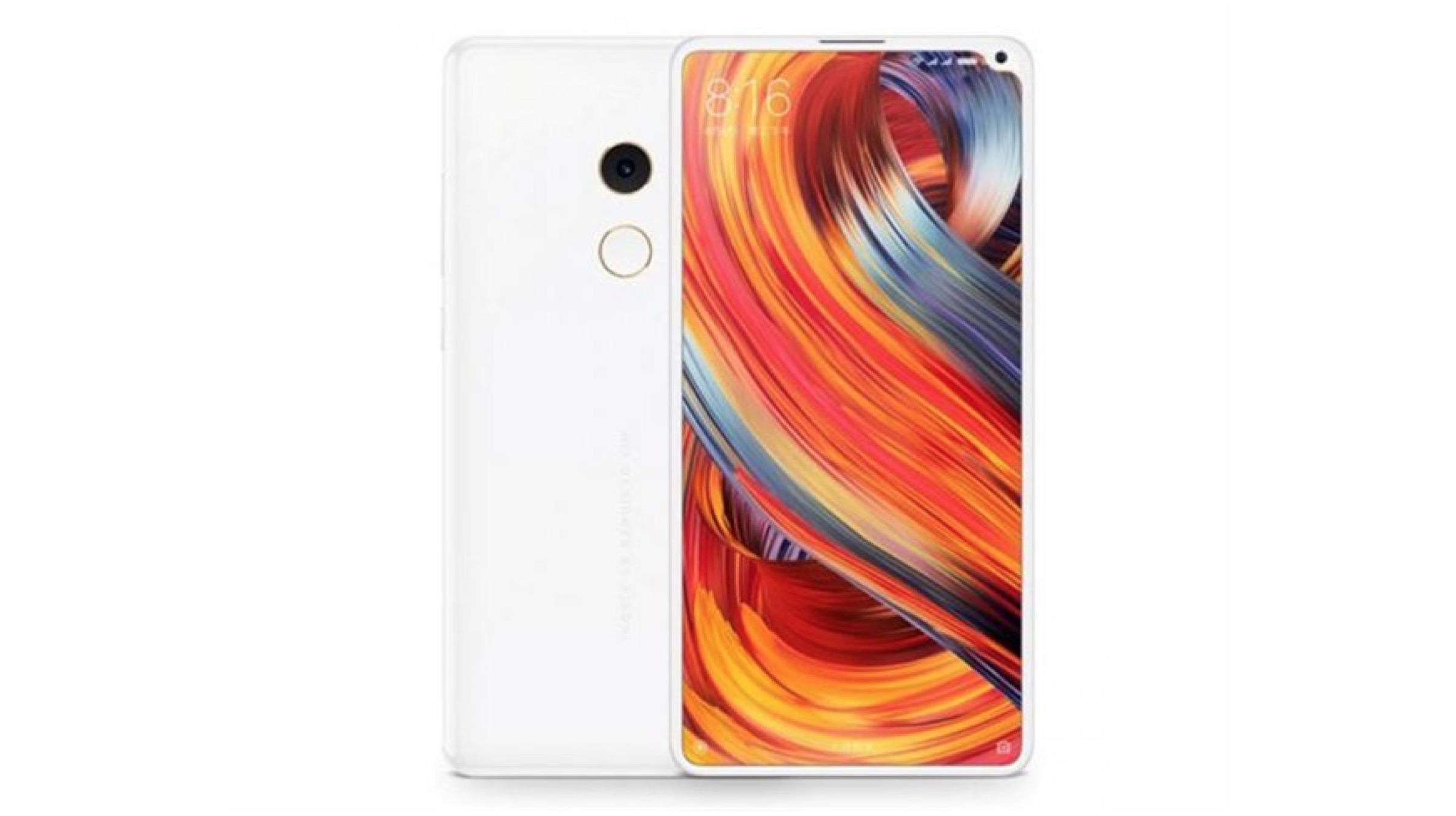
    The Mi Mix 2S seems more than just a revision of the Mi Mix 2. It will have a new design, an upgraded chipset and possibly, an in-display fingerprint sensor. So, with a few days to go for its launch, what do we know about the device so far?

    Price

    One of the mysterious aspects of the device is its price. So far, there has been no information leaked about the pricing of the phone. However, considering Xiaomi’s competitive pricing for all its devices, the Mi Mix 2S could be the cheapest smartphone running on Snapdragon 845 after MWC 2018. Devices like the Galaxy S9 and Sony Xperia XZ2 Pro will be priced much higher. The Mi Mix 2S is expected to be priced slightly higher than Mi Mix 2.
    Mi Mix 2S
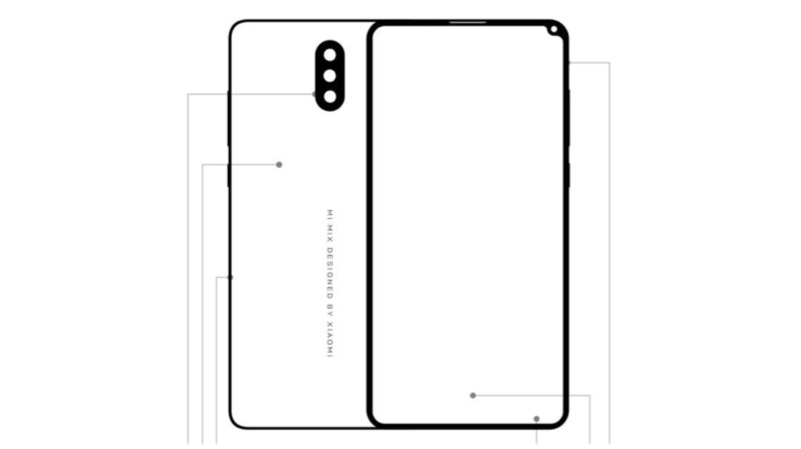
    Mi Mix 2S Design Sketch
    Display

    As bezels get thinner, the average size of smartphone displays has become bigger. In 2016, 5.5 inch displays were the norm, however, tall aspect ratios mean most devices come with a 6 inch display. That is expected to be the case with the Mi Mix 2S as well. The device will have a 6 inch display with a 2160 x 1080 px resolution. However, due to that notch on the top right corner, it might have an unusual resolution.

    Under The Hood

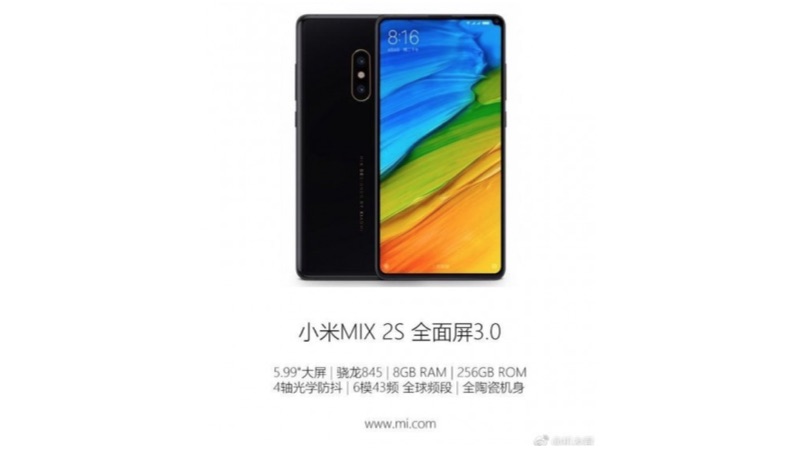
    The Mi Mix 2S was heavily touted to be the first ever Android device running on the Snapdragon 845 chipset. However, that won’t be the case but, it will be one of the first few devices on the market. Recently, an official banner ad of the Mi Mix 2S was leaked, and it revealed that the device will have 8GB of RAM and 256GB storage. In typical Xiaomi fashion, the storage won’t be expandable. This will be an upgrade over the Mi Mix 2, which has 6GB of RAM and 128GB storage in India.
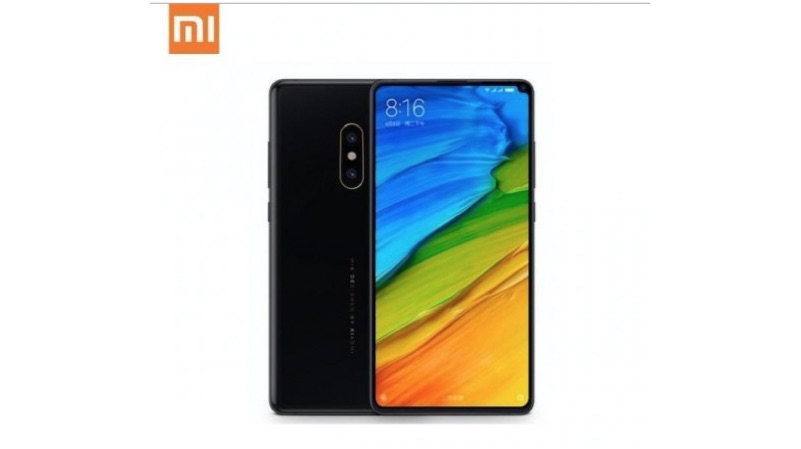
    The fingerprint sensor is largely expected to be placed on the back, however, the banner ad did not show a fingerprint sensor. To assume that the Mi Mix 2S could have an in-display fingerprint sensor might not be stretching it. The Mi Mix 2 did not have a headphone jack, and similarly, the Mi Mix 2S won’t have a headphone jack as well. Powering the device will be a 3400 mAh battery with support for QuickCharge 4.0+.

    OS

    So far, only the Xiaomi Mi A1 runs Android 8 Oreo. All other Xiaomi phones even the Mi Mix 2 runs Android 7 with MIUI 9 on top. There have been reports that claim the Mi Mix 2S will run Android 8 Oreo out of the box. This does make sense, and maybe after the launch of its 2018 flagship device, the company will start rolling out Android Oreo update for other devices as well.

    Mi Mix 2S
    2016 Mi Mix

    The Mi Mix 2S will run MIUI 9 on top of Android 8 Oreo and will be one of the first in line to receive the MIUI X update. The trend of Face Unlock means the Mi Mix 2S might have a software implemented facial recognition, similar to the OnePlus 5T.

    Camera

    The smartphone cameras have gained importance over the years. Nowadays, camera performance can make or break a device. The Google Pixel and Pixel XL launched in 2016 did not have all the flagship features. However, they did have the best smartphone camera at that point, which papered over their other shortcomings. Xiaomi would want to launch a flagship device with great camera capabilities.

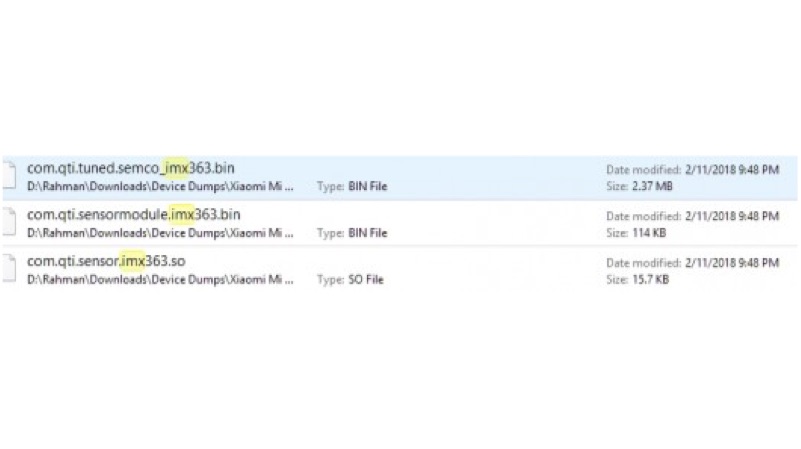
    The Mi Mix 2S is expected to have a dual-camera setup on the back, a first for the Mix series. Leaks suggest that Xiaomi will use a Sony IMX363 sensor.

  • Google Has Made It Harder To Steal Images From Google Images

    Google Has Made It Harder To Steal Images From Google Images

    Google has updated its Google Image search which might have huge repercussions. The company took to Twitter to announce that it has removed the “view image” button from image search. Therefore, the company has made it difficult for people to save copyrighted images directly. The update might seem small but, it is a huge change in the grand scheme of things.

    What Has Changed?

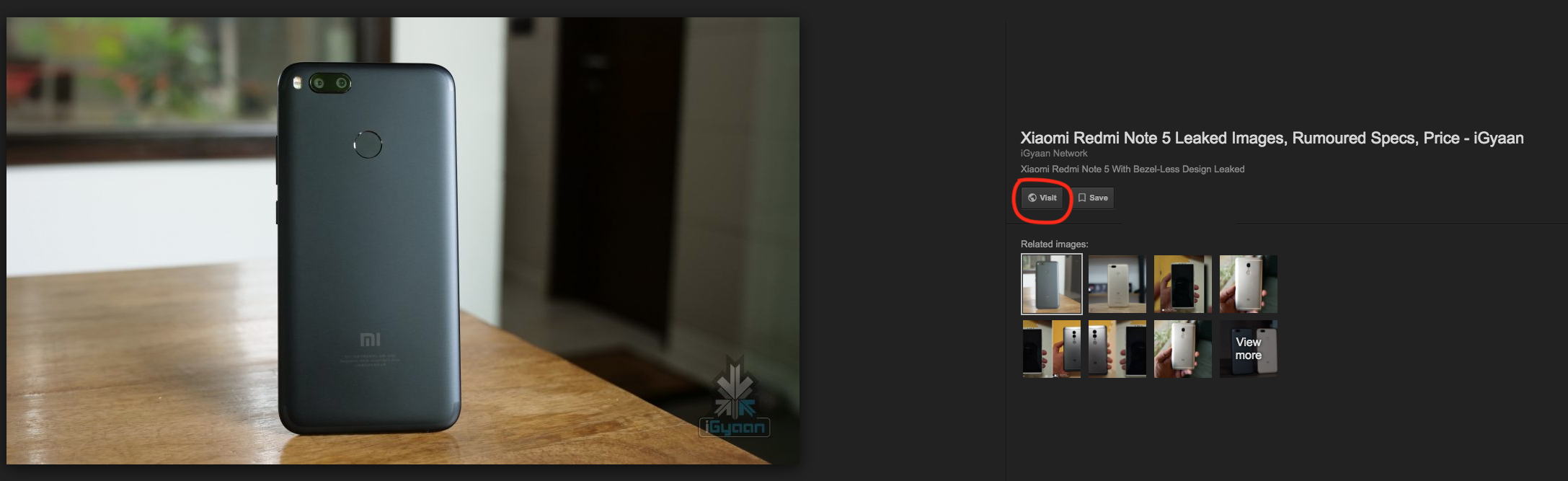
    The company has essentially eliminated the “view image” button. This button was once the direct link to a high-resolution version of the image. This was a huge concern for photographers, publishers and stock image sites for obvious reasons. As this button essentially allowed users to access the original version of the image without visiting the source site.

    Now, users will be able to visit the source site “visit” button. This means that in order to steal an image, the user will have to go to a source site which means an additional step. The timing of the move is worth noting here. In early-February, Getty Images announced a licensing partnership with Google.

    Google

    Back in 2016, Getty Images filed a complaint against Google. It accused the company of anti-competitive practices within Google Images. It said that Google was “distorting search results in favour of its own services.” Therefore, users did not have an incentive to visit source stock websites likes Getty to download the original image.

    Getting rid of the “view” button is definitely a significant move. However, whether this will curb copyright infringement or not is yet to be seen.

  • Images Of Huawei P11 Lite With iPhone X-Like Leaked

    Images Of Huawei P11 Lite With iPhone X-Like Leaked

    Huawei will be launching a smartphone at MWC 2018. After some speculation that the company would skip the event, it confirmed its presence. However, it also confirmed a launch event for March 27. At MWC 2018, the company is expected to launch the Huawei P11/P20 Lite while the March 27 event will see the unveiling of the Huawei P20 and P20 Plus.

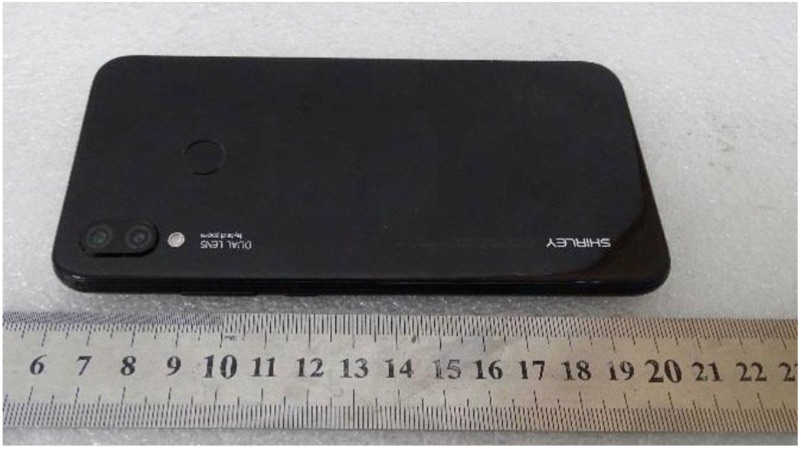
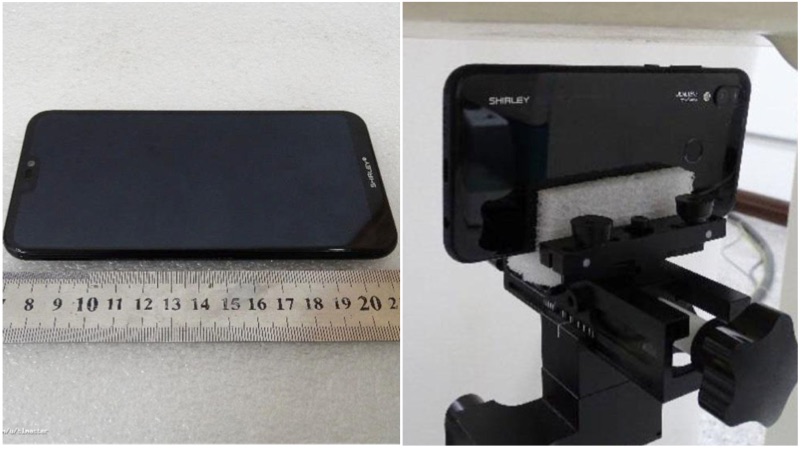
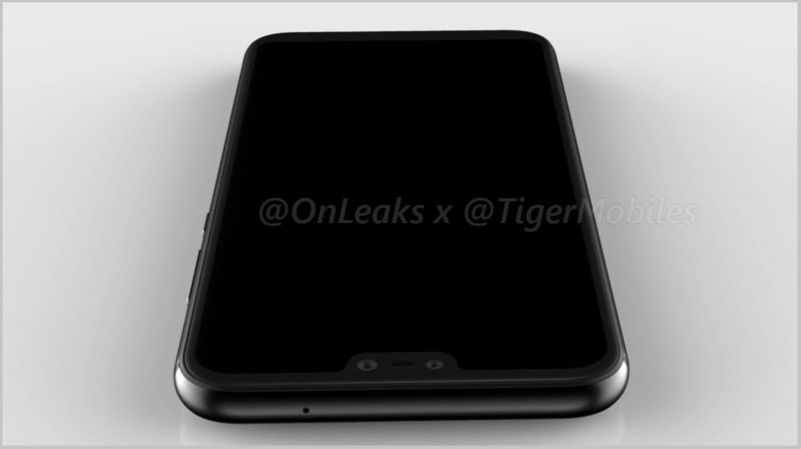
    A few days ago, renders of the Huawei P11/P20 Lite were leaked by a popular tipster on Twitter. And now, live images of the device have been leaked by FCC. The leaked images confirm what has been rumoured for a while now. The Huawei P11/P20 Lite will have a lot of similarities with the Apple iPhone X.

    On the front, it will have an iPhone X-style notch that will house the earpiece and front-camera. On the back, Huawei P11/P20 Lite will have a vertically placed dual-camera setup. The position of the camera module is uncannily similar to the iPhone X. It even protrudes a bit, just like the iPhone X. The LED flash is placed below the cameras, while it is placed between the two cameras on the iPhone X.

    The fingerprint sensor will be placed on the back. Therefore, we might have to wait until the end of the year for a Huawei phone with Clear ID. The device also appears to have an all-glass build with an aluminium frame.

    Expected Specifications

    With bezels getting thinner, the standard size of a smartphone has increased from 5.5 inches to 6 inches. The Huawei P11 Lite is expected to have a 6 inch display with a 2880 x 1440 px resolution. Just like the Mate 10, Huawei could use an OLED panel as well. As seen in the renders, the corners are curved which means an OLED panel is expected on the Huawei P11 Lite as well.

    Under the hood, it will have the HiSilicon Kirin 970 chipset along with 6GB or 8GB of RAM. The fingerprint sensor will be placed on the back of the phone. While the smartphone is expected to be thin, it is expected to house a big battery that will support SuperCharge

    The MWC 2018 event isn’t too far away. Hence, we are expected to see frequent leaks of devices that are expected to be launched in the coming days.

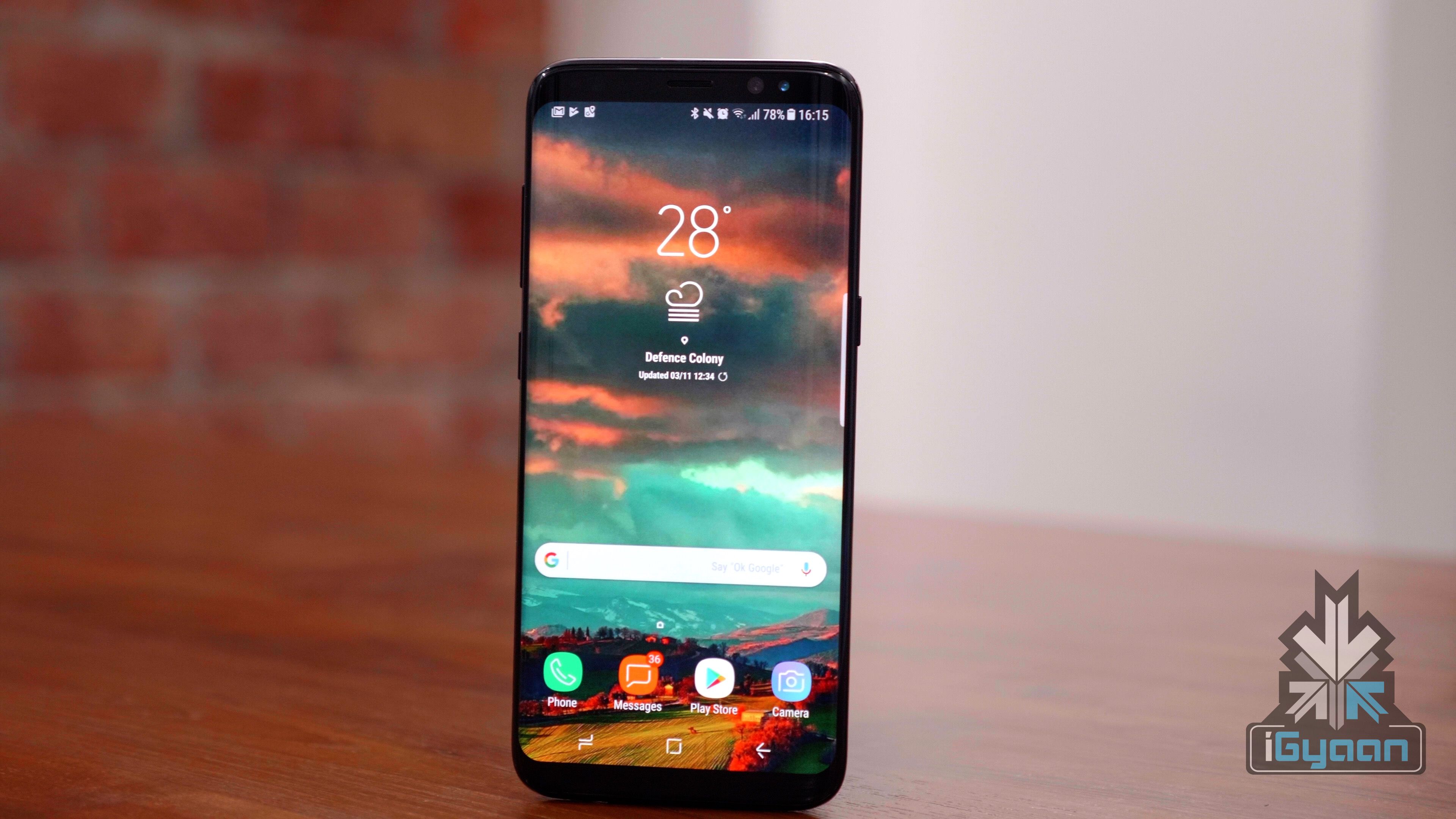
  • Samsung Galaxy S8 Android 8 Oreo Update Suspended

    Samsung Galaxy S8 Android 8 Oreo Update Suspended

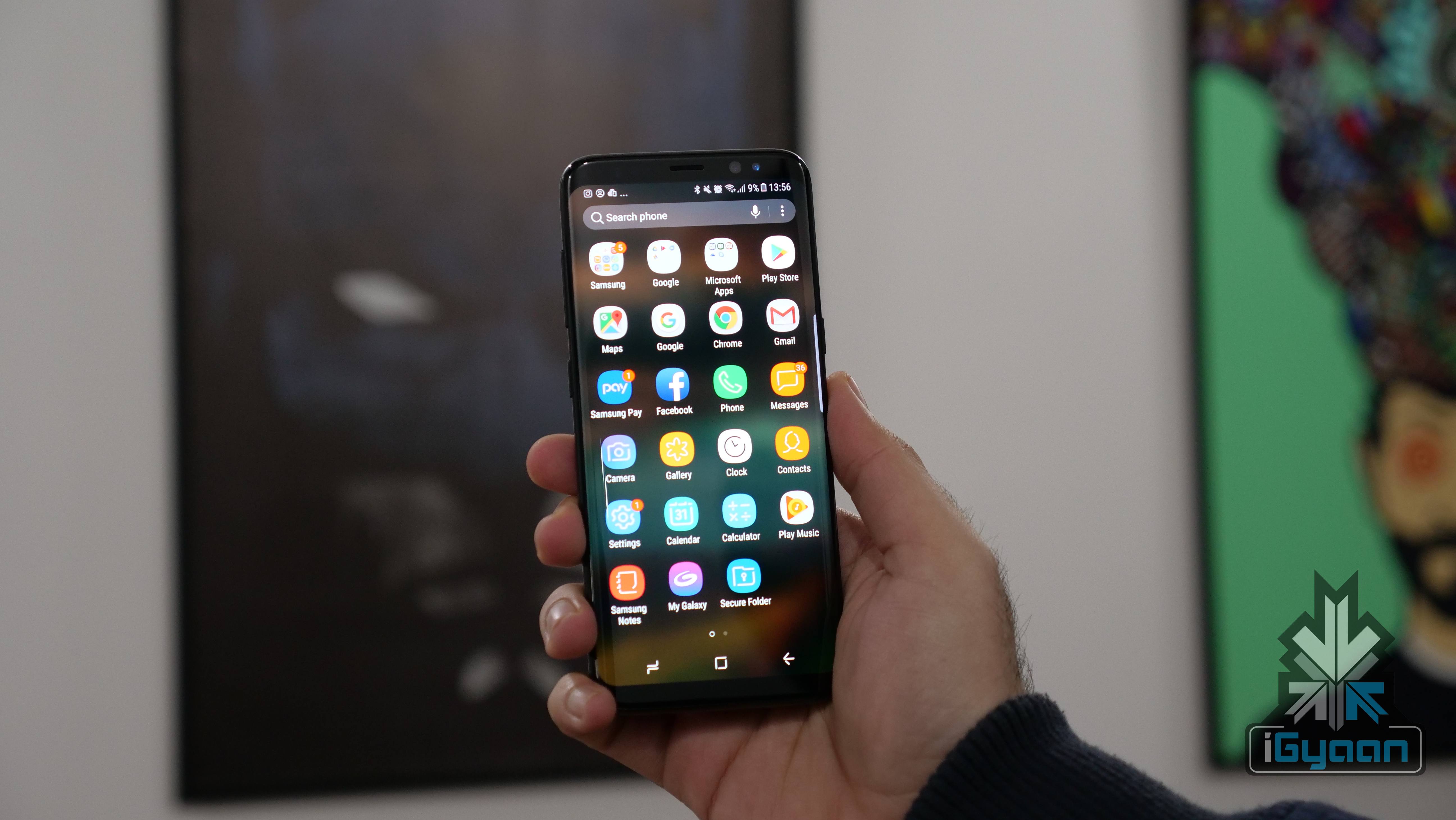
    Android 8 Oreo, much like iOS 11, seems to be a troubled software update of 2017. Officially launched back in August, OEMs were slow to roll out updates but, at least some devices were being updated. Samsung recently started rolling out the Android 8 Oreo update to its 2017 flagship, the Galaxy S8 and S8+. This rollout began after an extensive Beta program was carried out.

    8 Oreo
    Experience UI Based On Android 7 Nougat

    However, the company had to suspend the new software update rollout. This isn’t the first time an OEM had to suspend the Android 8 Oreo update. Smartphone makers like Xiaomi, OnePlus also halted updates to their devices. Samsung has come out and clarified its stance on the matter:

    Following a limited number of cases where Galaxy S8 and S8+ devices have rebooted unexpectedly with the Android 8.0 Oreo, we have temporarily stopped the rollout of the update. We are investigating the issue internally to ensure that the impact to the affected devices is minimized and the rollout of the update can resume as quickly as possible.

    When the year began, Xiaomi had to suspend the Android 8 Oreo update to its Mi A1 devices. Many users complained about issues pertaining to an unresponsive camera and dialer app. Similarly, OnePlus had to suspend the rollout for the OnePlus 5T.

    There is no confirmation from the company as to when the rollout will resume. The downloaded files will be deleted if you haven’t installed the update yet.

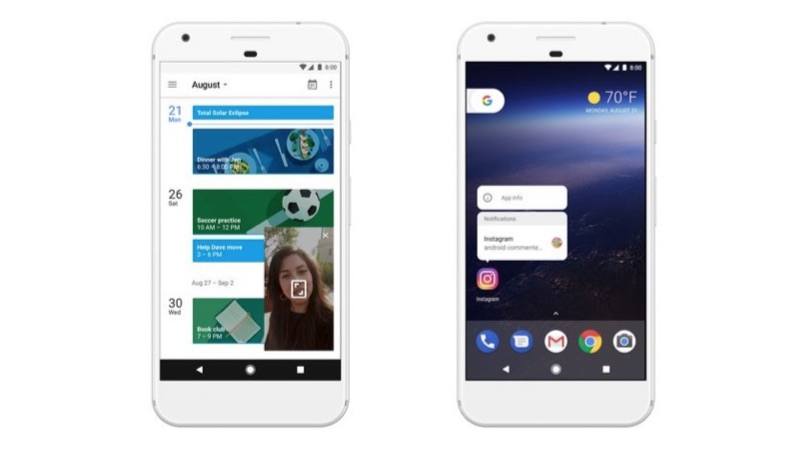
    Some Android 8.0 Oreo features:

    User Interface

    Users can now organise notifications into custom channels and modify the alerts for the entire channel. An autofill framework in the operating system makes the repeated filling of forms easy for the user. This can range from sign up information to a new service, or credit card information to make a payment. The feature will prevent frustration and repetitiveness by allowing users to quickly fill in a form. Users will have to opt-in for the Autofill framework, after which new and existing applications can make use of the feature.


    Picture-In-Picture Mode and New Notifications

    A new picture-in-picture feature allows users to continue operating the device without interruptions for things like watching a video. Another interesting change in the UI this time around is Adaptive Icons. The supported shapes are Circle, Squircle, Rounded Square and Square.

    Behind The Screen

    A cache budget is allocated to every application. When the system is low on resources, the applications that exceed the cache budget the most will be the first to have their cached files deleted. Developers can also set custom triggers to update the content when it is stale or outdated, even without a specific request from the user. There are also background execution limits, which ensures that applications running in the background don’t use up a lot of system resources.

    Media playback should be significantly improved for users, as now there is fine-grained control to scrub to a particular frame in a video. Applications can also now mix multiple audio and video tracks at once, for streaming purposes.

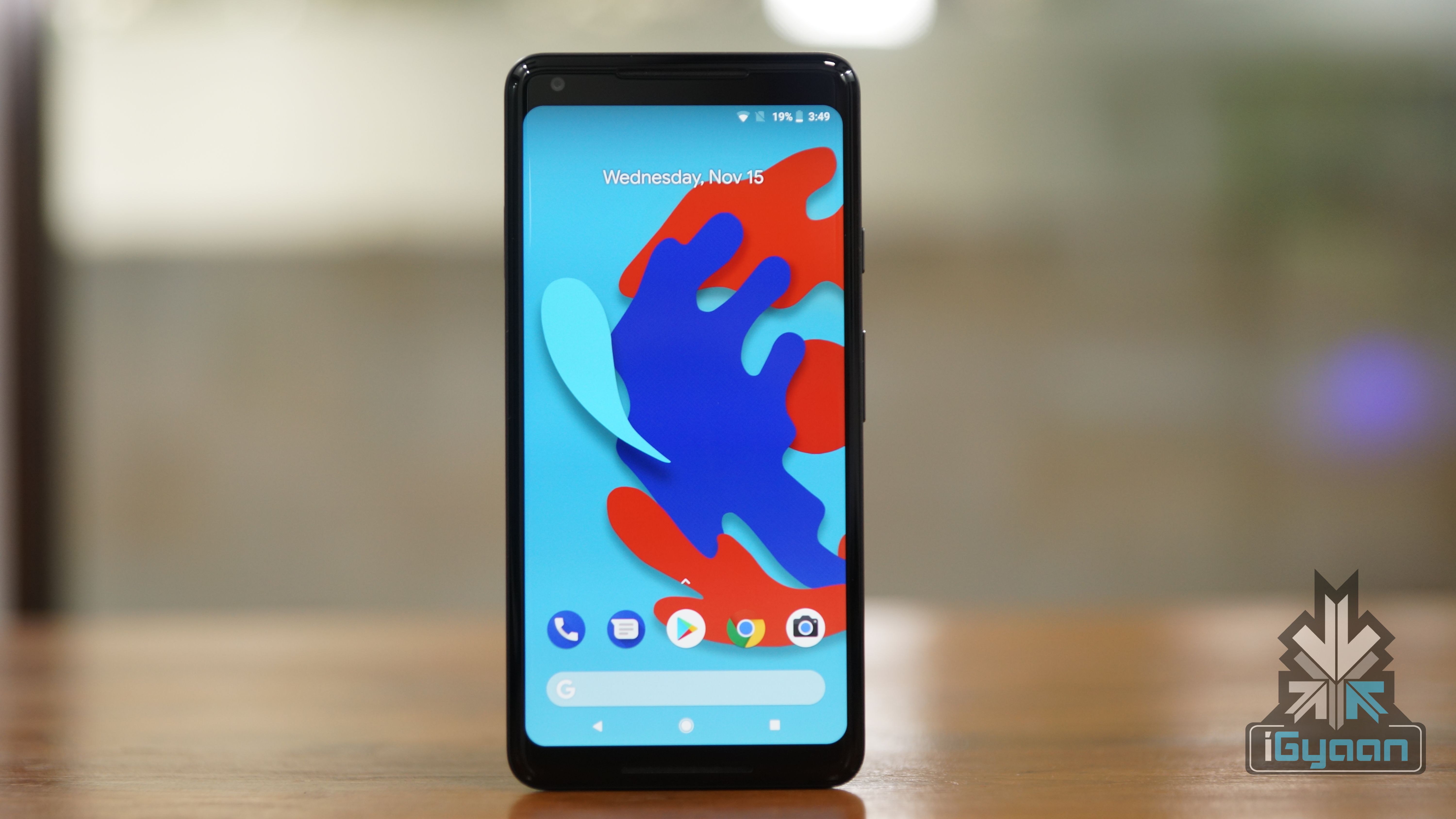
    Pixel 2 XL Runs Android 8 Oreo

    A smart sharing feature allows the operating system to guess the context of a photo, and pick the best application to hand the image over to. The more you use your phone, the more your smartphone will learn about your behaviour and act accordingly. A smart copy feature enables similar functionality but for text, where the smartphone recognises if the text copied is an address, a phone number or name of an entity, and suggest opening a relevant app.


  • Xiaomi Mi Mix 2S Will Run Android 8 Oreo And Have A 3400 mAh Battery

    Xiaomi Mi Mix 2S Will Run Android 8 Oreo And Have A 3400 mAh Battery

    The certainty of Xiaomi launching the Mi Mix 2S is increasing every second. Every passing day, a new leak reveals more information about the Mi Mix 2S. A little over a month ago, the Mi Mix 2S felt like a fragment of someone’s imagination and now, it is one of the most anticipated devices of MWC 2018.

    Xiaomi won’t launch the Mi 7 right now, which means that the Mi Mix 2S will be launched at MWC 2018. A new leak has revealed further information about the upcoming device. The Mi Mix 2S will be the first device in the Mi Mix series to sport a dual-camera setup. Moreover, Xiaomi will use the Sony IMX363 sensor. Powering the device will be a 3400 mAh battery which should support QuickCharge 4.0+ technology.
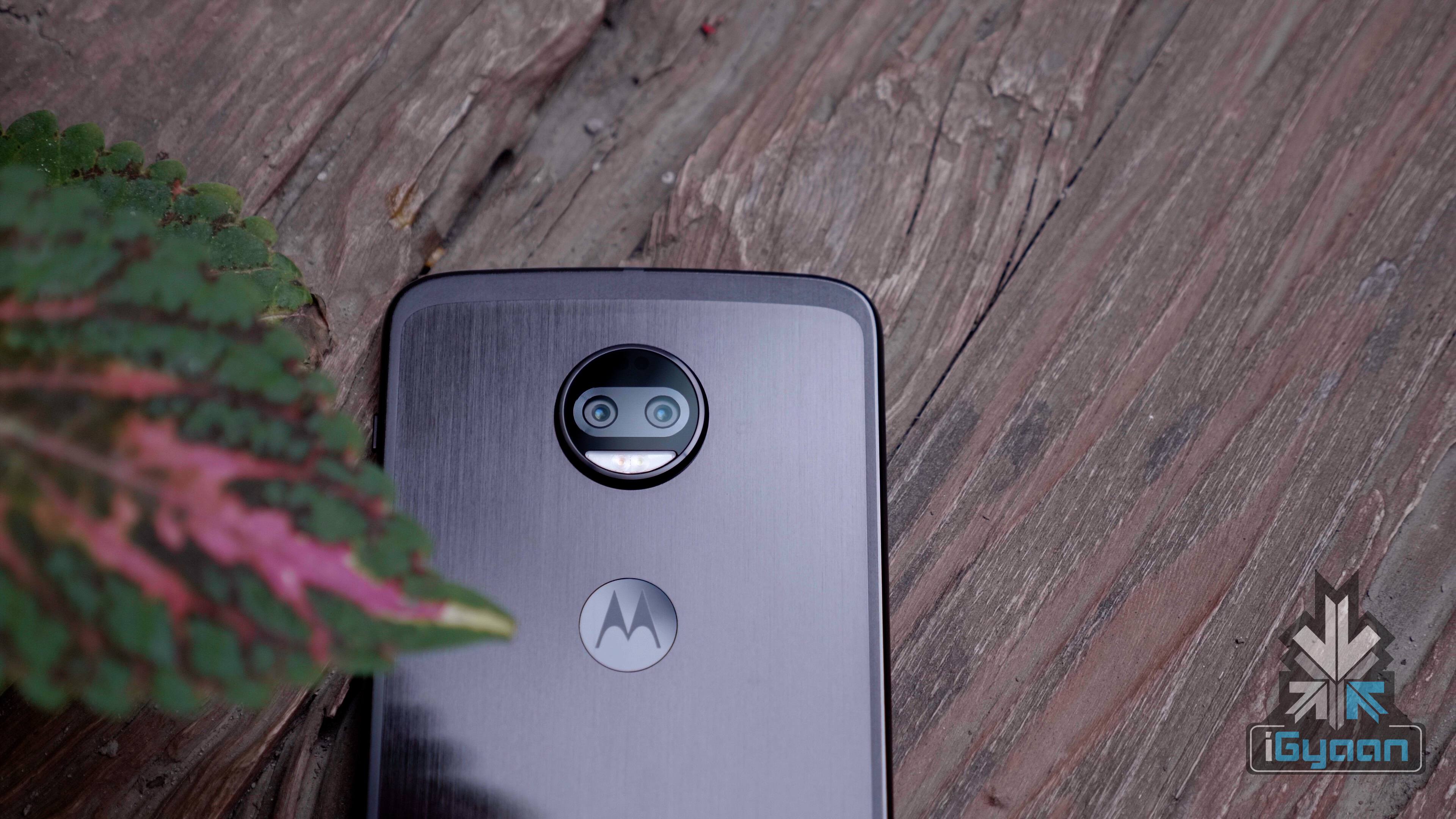
    A few days ago, an official-looking banner ad for the Mi Mix 2s was leaked. It revealed further specifications of the Mi Mix 2s which are very believable.

    Mi Mix 2s

    Xiaomi Mi Mix 2s Expectations

    The back of the Mi Mix 2S is expected to be the same as the Mi Mix 2. It will be made of ceramic which means it’ll be a fingerprint magnet. However, that is a price you have to pay for a device that looks as premium as the Mi Mix 2S. The significant change will be in the camera department. This time around, the Mi Mix 2S will have a dual-camera setup, which could be similar to the one found on the Mi A1, albeit of better quality.

    On the front is where Xiaomi will look to one-up the much-famed Samsung Galaxy S9 and S9+. The leaked image confirms that the smartphone will have a different take on the notch. The bezels all around the display will be uniform but, the top right corner will protrude a bit and that will house the front-facing camera.

    Apart from the design, the image reveals some specifications of the device. It will be powered by the Qualcomm Snapdragon 845 chipset coupled with 8GB of RAM and 256GB onboard storage.

    What’s missing in the render is a fingerprint sensor. This means that Xiaomi could be the second company to launch a smartphone with an in-display fingerprint sensor. This would also mean that Xiaomi will use an OLED panel for the upcoming device as opposed to the IPS LCD panel used on the Mi Mix 2.
    Mi Mix 2s
    Mi Mix 2s Renders
    Conclusion

    As we all know, the Samsung Galaxy S9 and S9+ won’t look very different from their predecessors. This means that design-wise, Samsung won’t have much to show, and that is where the Mi Mix 2S could excel. A lot of smartphone makers will skip MWC because of the popularity of the Galaxy S devices but, Xiaomi could grab a lot of eyeballs with the launch of this smartphone. That being said, this could very well be the Mi 7. Xiaomi will have to move on from the 16:9 aspect ratio for its flagship Mi series. This means that this could be the Mi 7, just like the Mi6 X was the Redmi Note 5 Pro.


  • Moto Z2 Force Vs OnePlus 5T Vs Xiaomi Mi Mix 2

    Moto Z2 Force Vs OnePlus 5T Vs Xiaomi Mi Mix 2

    Motorola has finally launched its flagship smartphone, the Moto Z2 Force in India. It is priced at Rs. 34,999 which took everyone by surprise. It was globally launched for US$ 720 (Rs. 47,000 approx.) which means that it is considerably cheaper than its global price. The pricing makes sense for Motorola as the Z2 Force runs on the Snapdragon 835 chipset, which will soon be outdated.

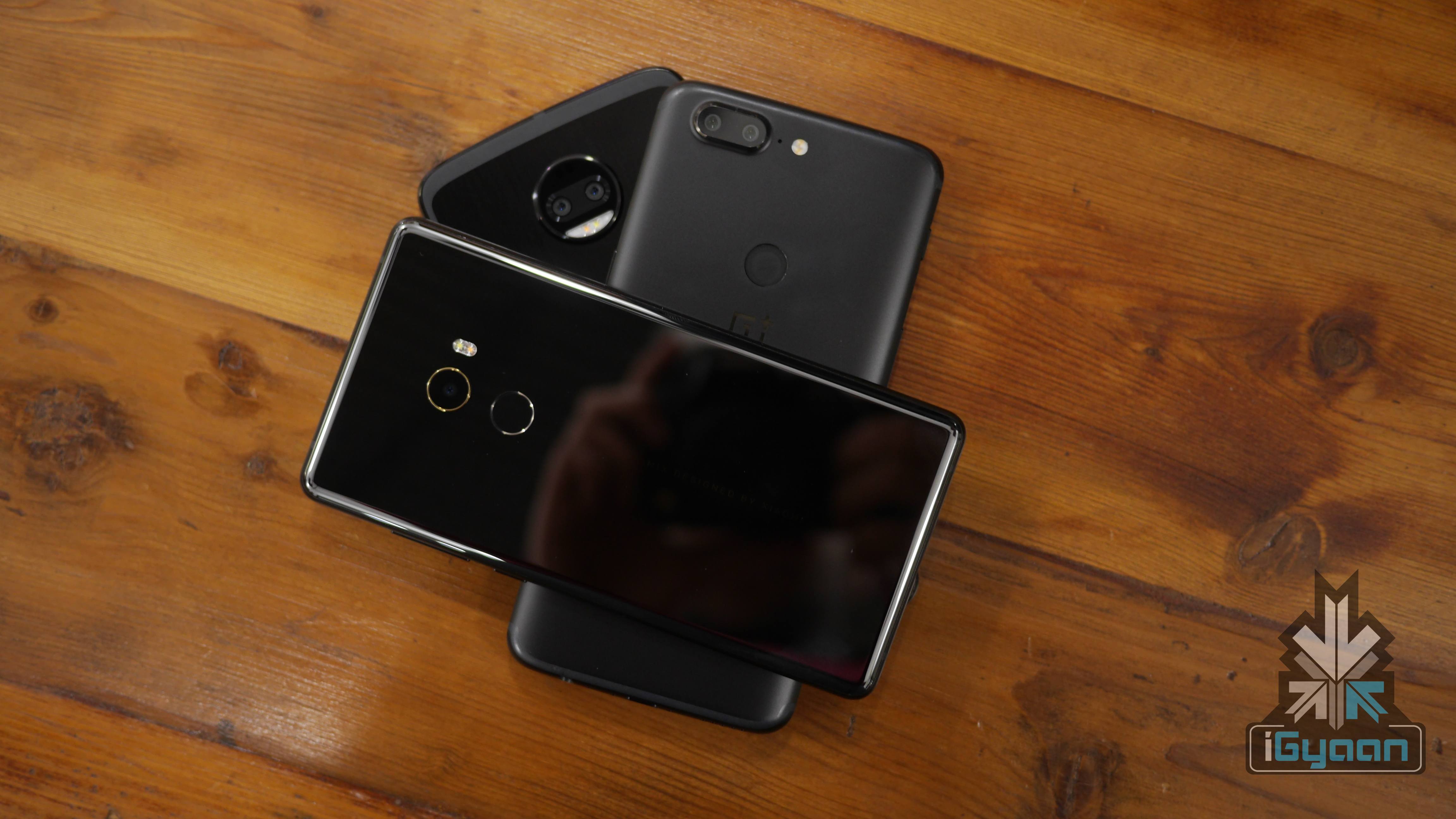
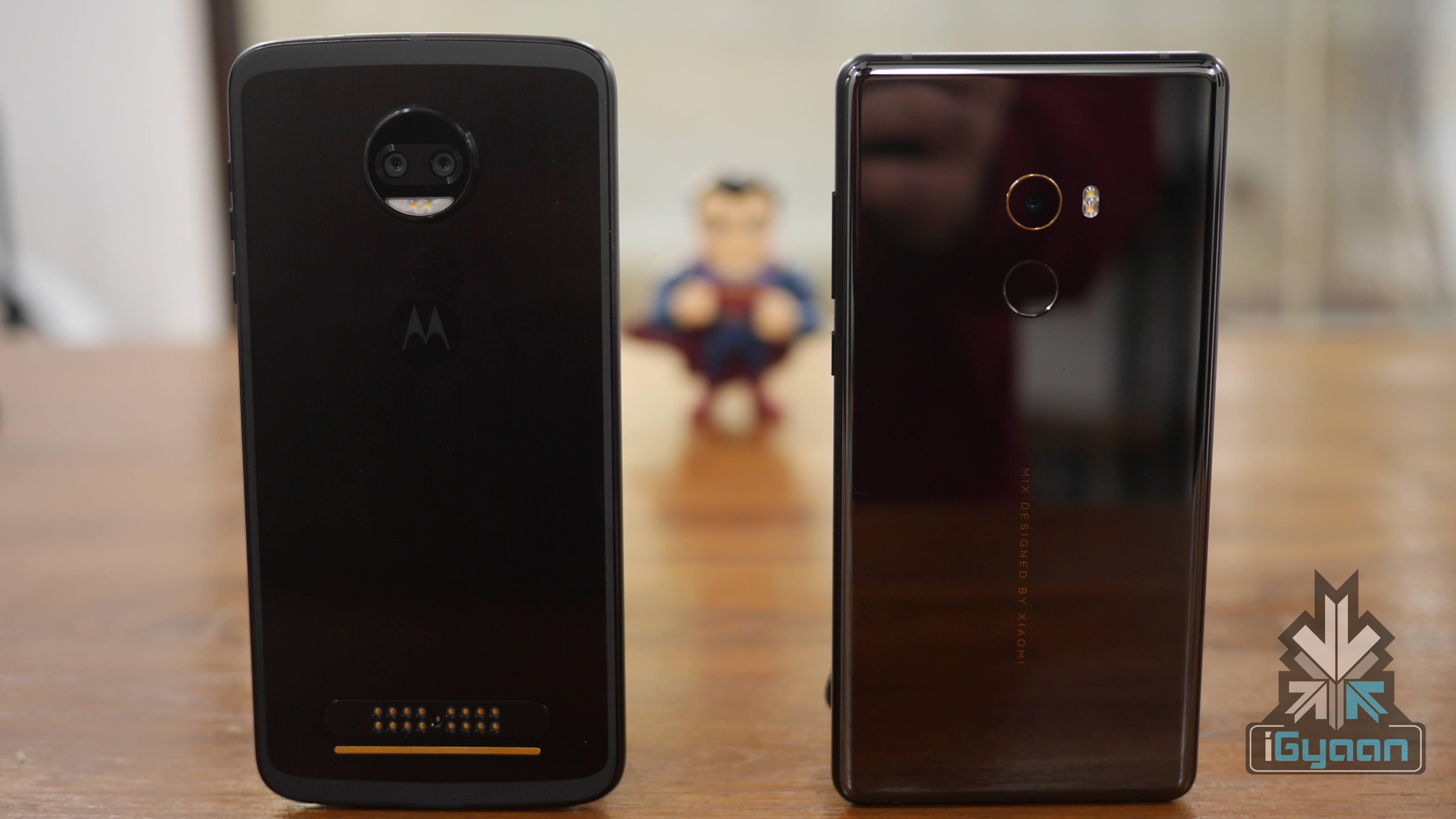
    At such a price, the Moto Z2 Force will go head-to-head with the likes of Xiaomi Mi Mix 2 and OnePlus 5T. The OnePlus 5T, in particular, has been very successful in the Indian market. The Moto Z2 Force matches with the OnePlus 5T in almost every aspect and then does a bit more. The Moto Z2 Force, apart from being shatterproof, also has modular capabilities. This is something that is missing in the OnePlus 5T and the Mi Mix 2.

    Moto Z2 Force

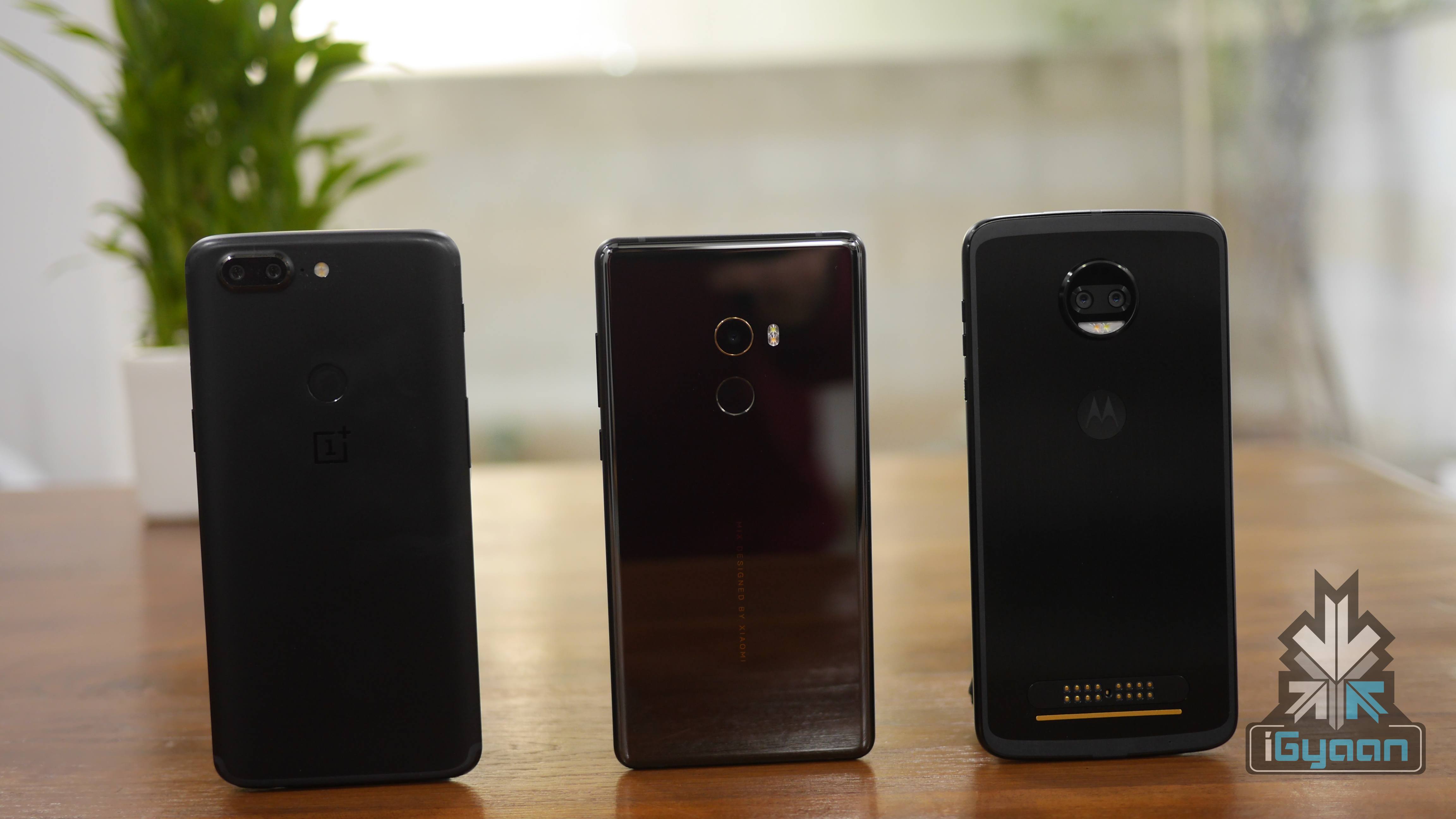
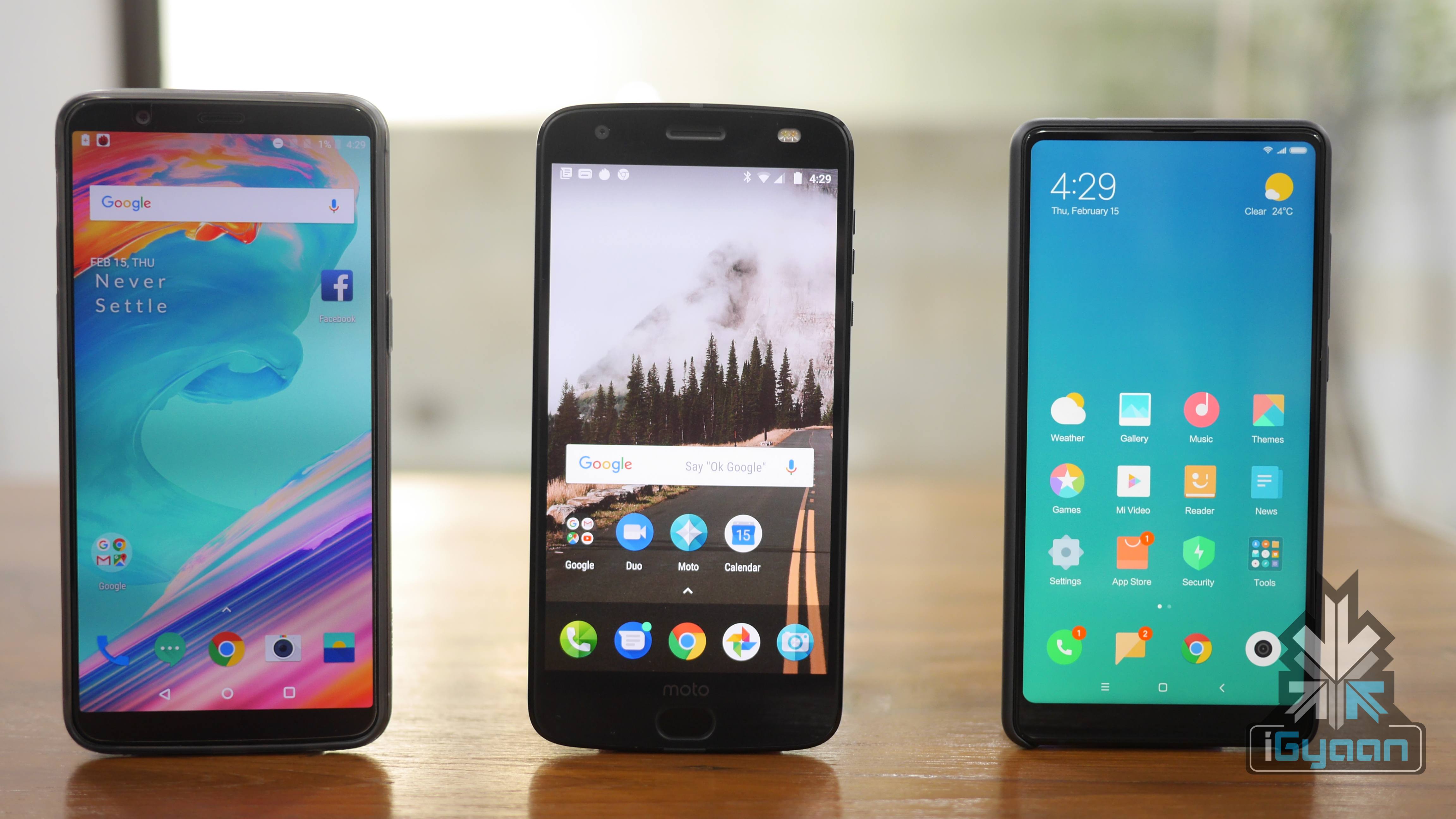
    Where the Moto Z2 Force might fall behind the design department, it makes it up in functionality. That being said, the Moto Z2 Force still has a stunning design despite the 16:9 aspect ratio.Being a mid-2017 flagship, the Moto Z2 Force has bigger bezels and a 16:9 aspect ratio while the other two devices sport a modern design. The OnePlus 5T and Mi Mix 2 have thin bezels and an 18:9 aspect ratio.

    Under the hood, all the three smartphones run on the same Qualcomm Snapdragon 835 chipset. The base model of the OnePlus 5T, priced at Rs. 32999, has 6GB of RAM and 64GB storage. The Mi Mix 2 is also priced at Rs. 32999 and offers the same RAM with 128GB storage. The Moto Z2 Force also has 6GB RAM and 64GB storage. However, it is the only one to offer expandable storage up to 2TB. That can be a dealmaker for people whose primary media consumption happens through a smartphone. The flexibility of storage matters a great deal for a few.

    The Mot Z2 Force also runs Android 8 Oreo out of the box while the Mi Mix 2 is still stuck at Android 7 Nougat. The OnePlus 5T recently received an update to Android 8 Oreo as well. The Moto Z2 Force and OnePlus 5T run close to stock Android OS while the Mi Mix 2 comes with MIUI 9 on top. As we have said it in the past, preference for stock OS or custom skin is very subjective.

    The OnePlus 5T retains the 3.5mm headphone jack while the Mi Mix 2 and Z2 Force both don’t have a headphone jack. This, again, can be a huge deal for a few consumers. The Moto Z2 Force is also the most durable smartphone thanks to its shattershield display. Due to the plastic coating on top, the Moto Z2 Force will be able to survive a few drops where the other two might crumble.

    Specifications
    Specs Moto Z2 Force OnePlus 5T Xiaomi Mi Mix 2
    Price Rs. 34,999 Starting at Rs. 32999 Rs. 32999
    Display 5.5 inch
    P-OLED
    6 inch
    Optic AMOLED
    5.99 inch
    IPS LCD
    Resolution 2560 x 1440 px
    534ppi
    2160 x 1080 px
    401ppi
    2160 x 1080 px
    403ppi
    Battery 2750 mAh
    TurboCharge
    3300 mAh
    DashCharge
    3400 mAh
    QuickCharge
    Chipset Qualcomm Snapdragon 835 Qualcomm Snapdragon 835 Qualcomm Snapdragon 835
    RAM 6GB 6GB
    8GB
    6GB
    Storage 64GB
    Expandable up to 2TB
    64GB/128GB
    Not expandable
    128GB
    Not expandable
    Primary Camera 12MP RGB+12MP Monochrome
    f/2.0
    16MP+20MP
    f/1.7
    12MP
    f/2.0
    Primary Camera Video 4K @ 30fps 4K @ 30fps 4K @ 30fps
    Secondary Camera 5MP
    LED Flash
    f/2.2
    16MP
    f/2.0
    EIS
    5MP
    f/2.0
    Add-Ons Fingerprint Sensor
    Moto Mods Support
    Fingerprint Sensor
    Face Unlock
    Fingerprint Sensor
  • Unboxing The Moto Z2 Force

    Unboxing The Moto Z2 Force

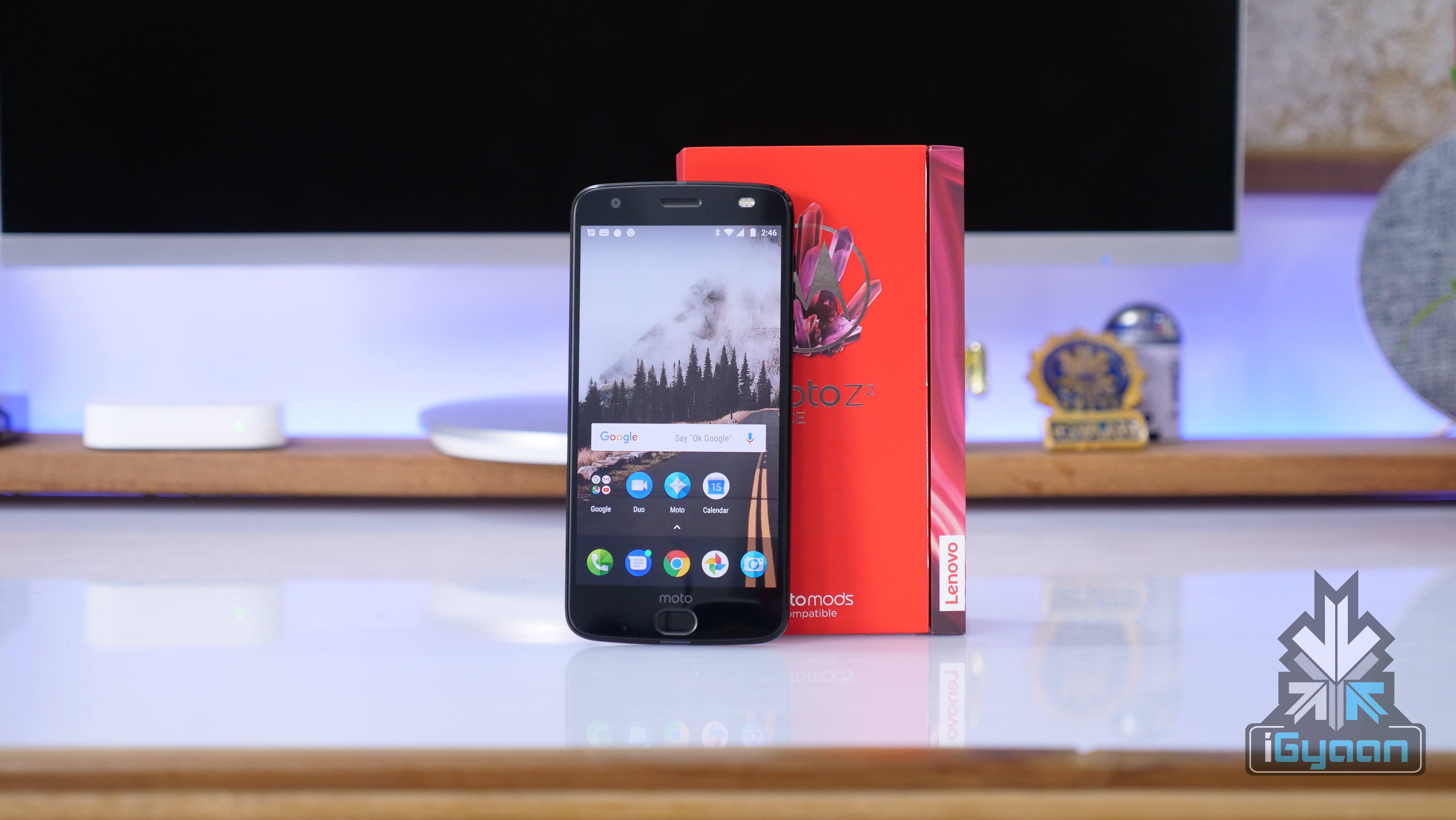
    Lenovo-owned Motorola has launched the Moto Z2 Force in India. It is priced at Rs. 34,999 in India and will go on sale at midnight via Flipkart and Moto Hub stores. Motorola has launched the device in India, almost six months after its global launch. Although the Moto Z2 Force is competitively priced, it won’t be long before the OnePlus 6 is launched at a similar price and Snapdragon 845 chipset.

    Let’s unbox the Moto Z2 Force and see what we get inside:

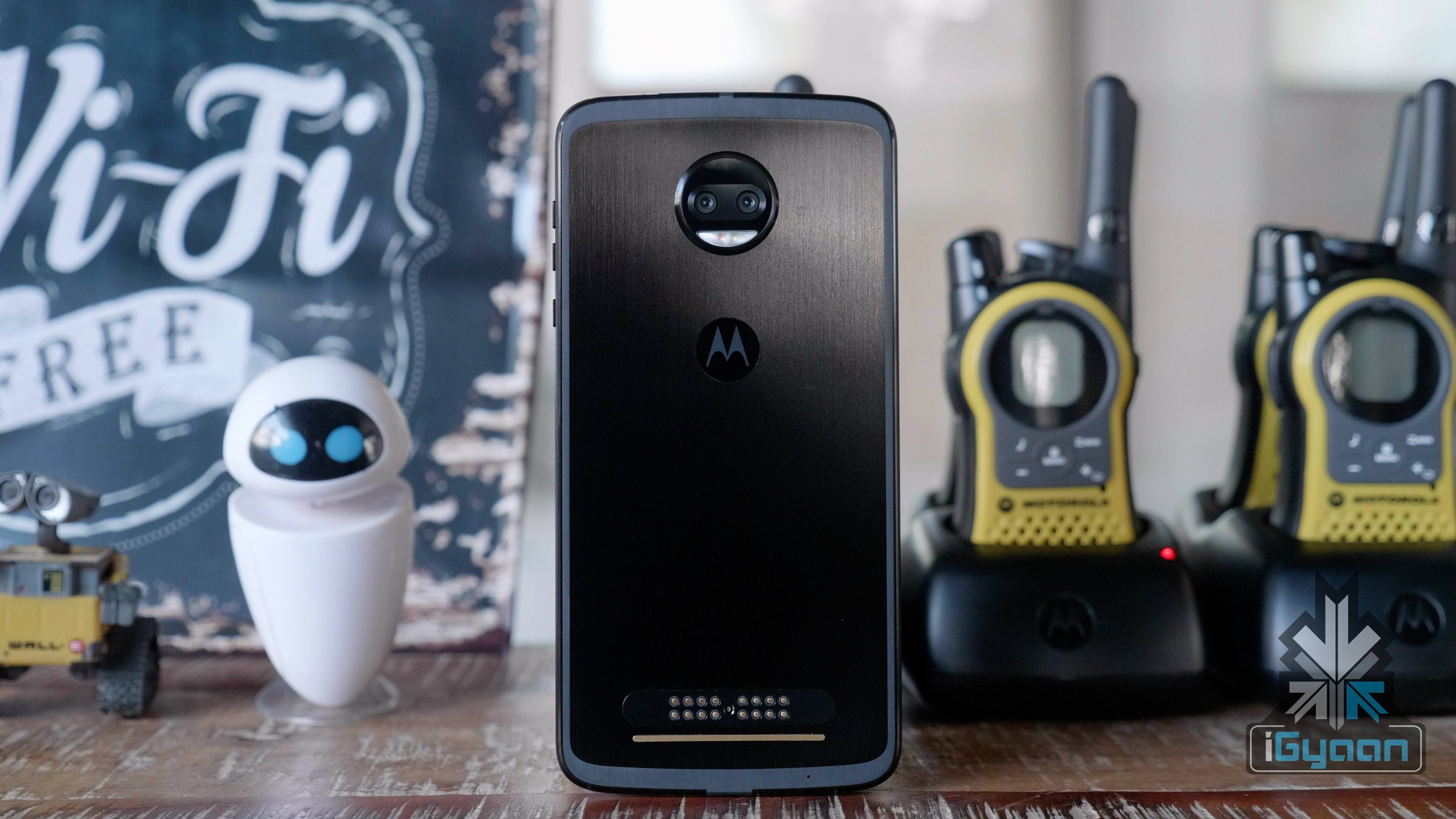
    Moto Z2 Force

    • Moto Z2 Force
    • Documentations
    • Sim Ejector Tool
    • Earphones
    • Type C to 3.5mm dongle
    • USB Type C Cable
    • TurboCharge Wall Charger
    First Impressions

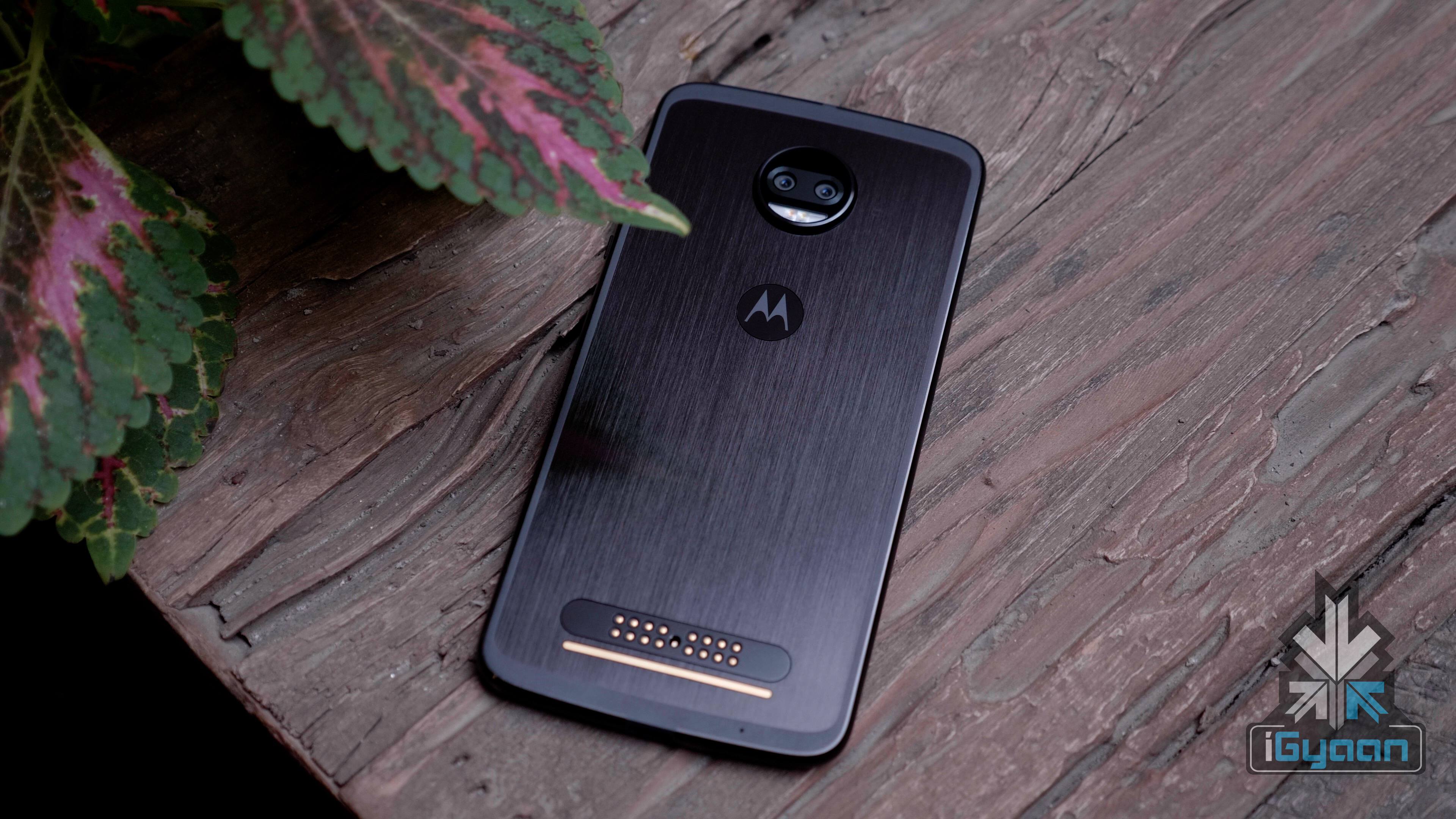
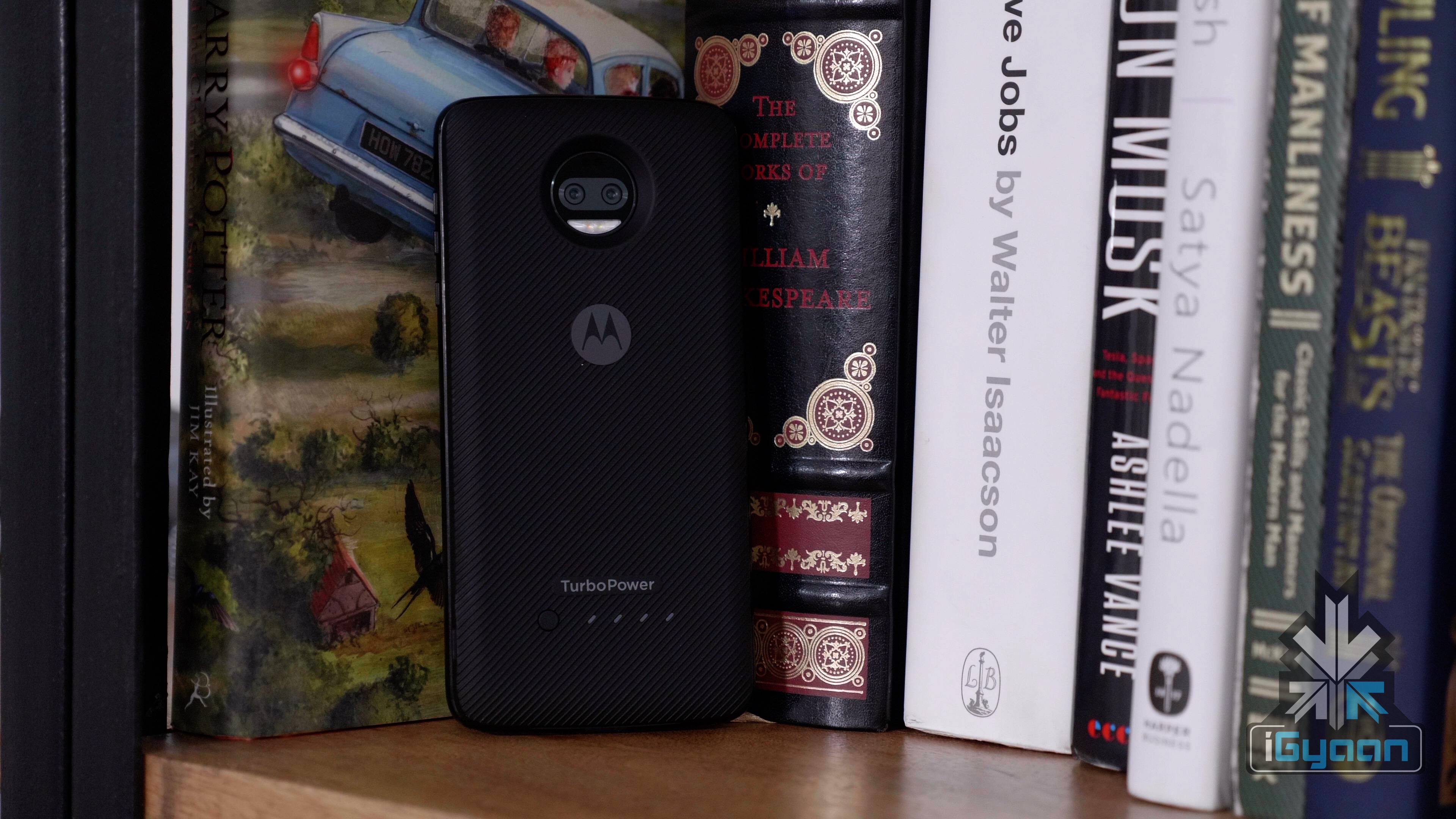
    To maintain the device’s compatibility with Moto Mods, the Z2 Force doesn’t look too different from its predecessor. It is thinner for sure and has a very sturdy build. This time around, Moto has implemented s dual-camera setup on the back which has become a norm. At a price of Rs. 34999, along with the TurboPower Mod, the Moto Z2 Force is a great alternative to the OnePlus 5T.

    Moto Z2 Force
    Moto Z2 Force With TurboPower Mod
    Moto Z2 Force Specifications

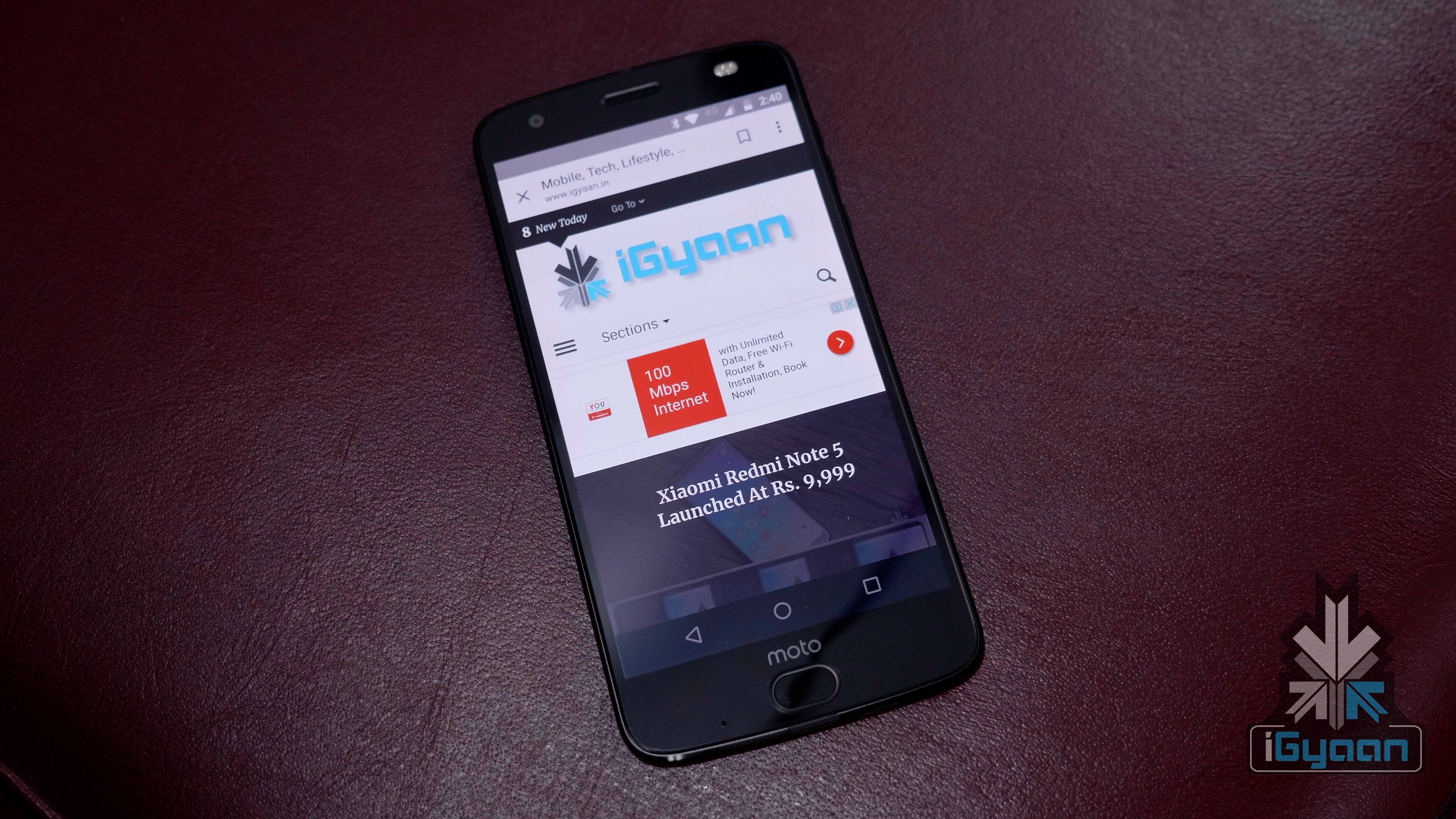
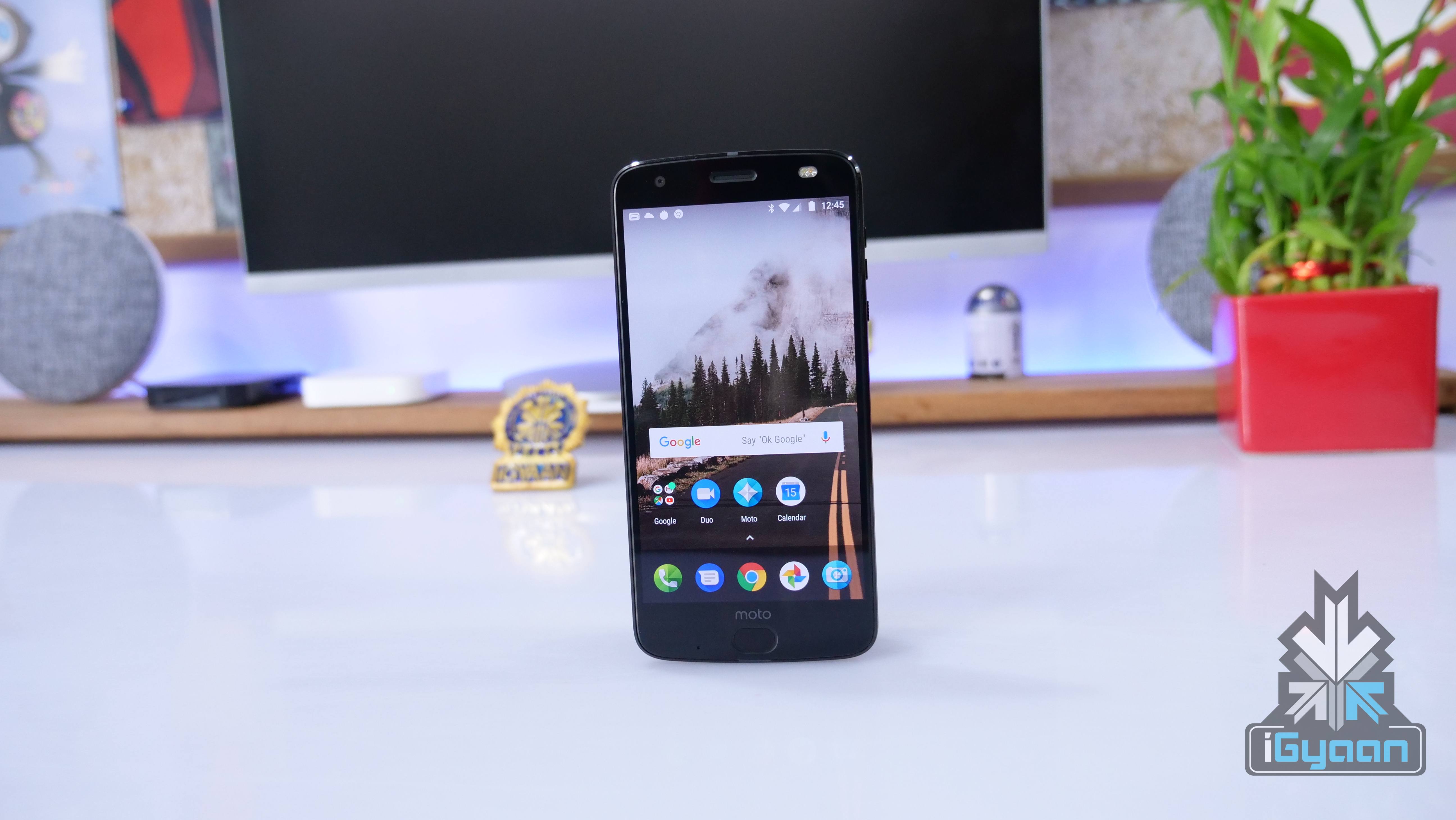
    The Moto Z2 Force has a 5.5 inch P-OLED display with a 2560 x 1440 px resolution. The Z2 Force does not have Corning Gorilla Glass on top, instead has a plastic shattershield coating on top. This means that the Z2 Force will survive drops more than a regular device with Corning Gorilla Glass. However, thanks to the presence of a plastic coating, it would be more susceptible to smaller scratches.

    Moto Z2 Force
    Moto Z2 Force
    Under the hood, the device has the Qualcomm Snapdragon 835 chipset along with 6GB of RAM and 64GB of onboard storage. The storage is expandable up to 2TB via a microSD card. The fingerprint sensor is placed on the front of the smartphone as it retains the size and design of a ‘Moto Z’ device. As a result, the Z2 Force is compatible with Moto Mods.

    Probably, a possible let down could be the missing of the 3.5mm headphone jack. However, it will come with a dongle inside the box to still use your beloved wired headphones.

    Another modern element, which has now truly become a norm is in the camera department. The Z2 Force, like many flagship phones, has a dual 12MP camera setup on the back with an f/2.0 aperture. One of them has an RGB sensor while the other one has a monochrome sensor. The smartphone records 4K videos at 30fps. On the front of the device is a 5MP camera with a dual-tone LED flash.
    Moto Z2 Force
    Moto Z2 Force

    [embedyt] https://www.youtube.com/watch?v=vdrhrkUMFMg[/embedyt]

  • Moto Z2 Force Launched In India At Rs. 34,999

    Moto Z2 Force Launched In India At Rs. 34,999

    Lenovo-owned Motorola has launched its 2017 flagship device, the Moto Z2 Force in India. The device is priced at Rs. 34,999 and will go on sale at midnight. It will be available via Flipkart and Moto Hub stores for purchase. To sweeten the deal, Motorola has included its Turbo Mod along with the device.

    The Moto Z2 Force is without a doubt, a late entrant in the India market. It was globally launched back in July 2017 and has taken a lot of time to hit the Indian shores. At a price of Rs. 34,999, the Moto Z2 Force falls in the territory dominated by the OnePlus 5T. The 8GB RAM variant of the OnePlus 5T is priced at Rs. 37,999. Moreover, a Snapdragon 845 device is not expected anytime soon in this price category.

    The Moto Z2 Force, like all the other Moto Z devices, has modular capabilities. Motorola has introduced quite a few interesting Mods in the recent past, like the GamePad or an instant printer.

    Moto Z2 Force
    Moto Z2 Force With TurboPower Mod
    Moto Z2 Force Specifications

    The Moto Z2 Force has a 5.5 inch P-OLED display with a 2560 x 1440 px resolution. The Moto Z2 Force does not have Corning Gorilla Glass on top, instead has a plastic shattershield coating on top. This means that the Moto Z2 Force will survive drops more than a regular device with Corning Gorilla Glass. However, thanks to the presence of a plastic coating, it would be more susceptible to smaller scratches.

    Moto Z2 Force
    Moto Z2 Force
    Under the hood, the device has the Qualcomm Snapdragon 835 chipset along with 6GB of RAM and 64GB of onboard storage. The storage is expandable up to 2TB via a microSD card. The fingerprint sensor is placed on the front of the smartphone as it retains the size and design of a ‘Moto Z’ device. As a result, the Moto Z2 Force is compatible with Moto Mods.

    Probably, a possible let down could be the missing of the 3.5mm headphone jack. However, it will come with a dongle inside the box to still use your beloved wired headphones.

    Another modern element, which has now truly become a norm is in the camera department. The Moto Z2 Force, like many flagship phones, has a dual 12MP camera setup on the back with an f/2.0 aperture. One of them has an RGB sensor while the other one has a monochrome sensor. The smartphone records 4K videos at 30fps. On the front of the device is a 5MP camera with a dual-tone LED flash.
    Moto Z2 Force
    Moto Z2 Force
    Conclusion

    The Moto Z2 Force is probably a great prospect for people who prefer Moto devices. The addition of a TurboPower mod makes it a very good deal right now hence, we expect the device to do well in India. However, there are a host of budget premium devices like the OnePlus 6 expected to launch in mid-2018. Due to the possible launch of such devices, the Moto Z2 Force might face a steep battle to be a success in India.

    Buy the Moto Z2 Force here
  • Nokia 7 Plus, Nokia 1 Images Leaked

    Nokia 7 Plus, Nokia 1 Images Leaked

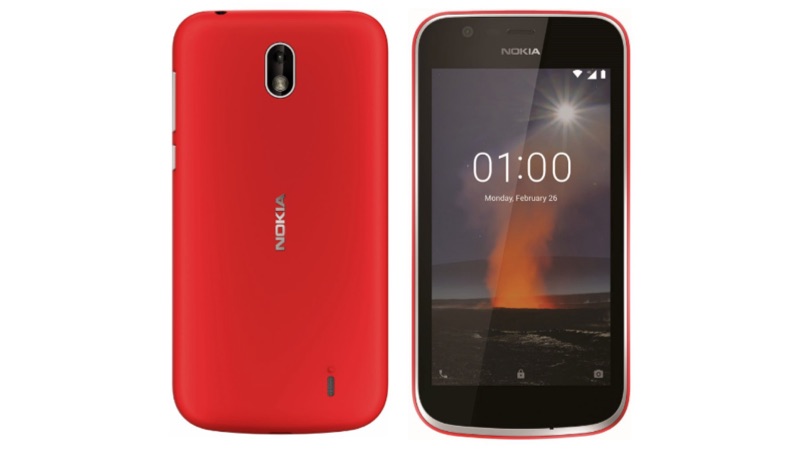
    HMD Global is set for an eventful MWC 2018. The company will be announcing a few new smartphones along with the Penta-lens Nokia 10 concept. Expected to make their debuts are the Nokia 1 and Nokia 7 Plus. The Nokia 1 could be the first Android Go device and the Nokia 7 Plus will be a follow up to the recently launched Nokia 7.

    Nokia 1
    Nokia 1

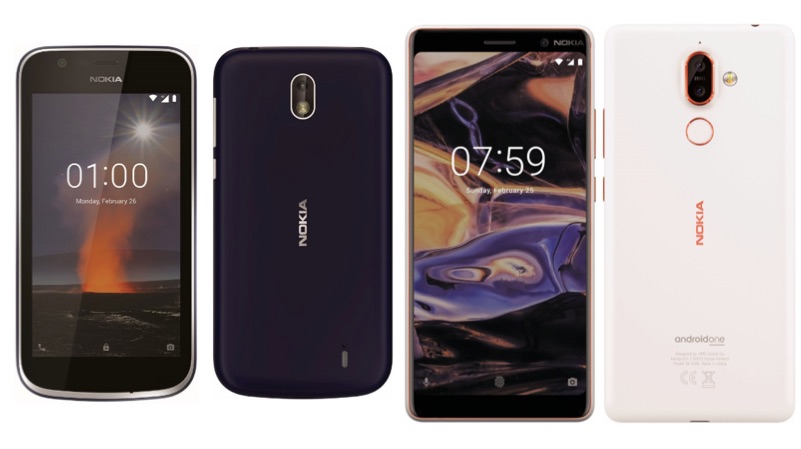
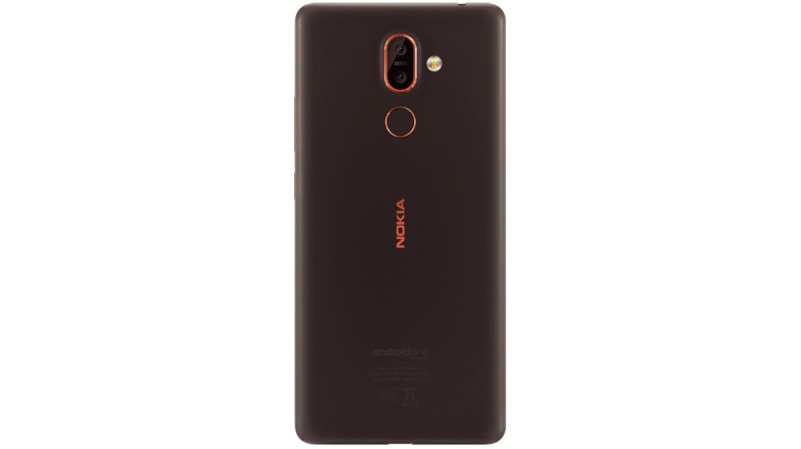
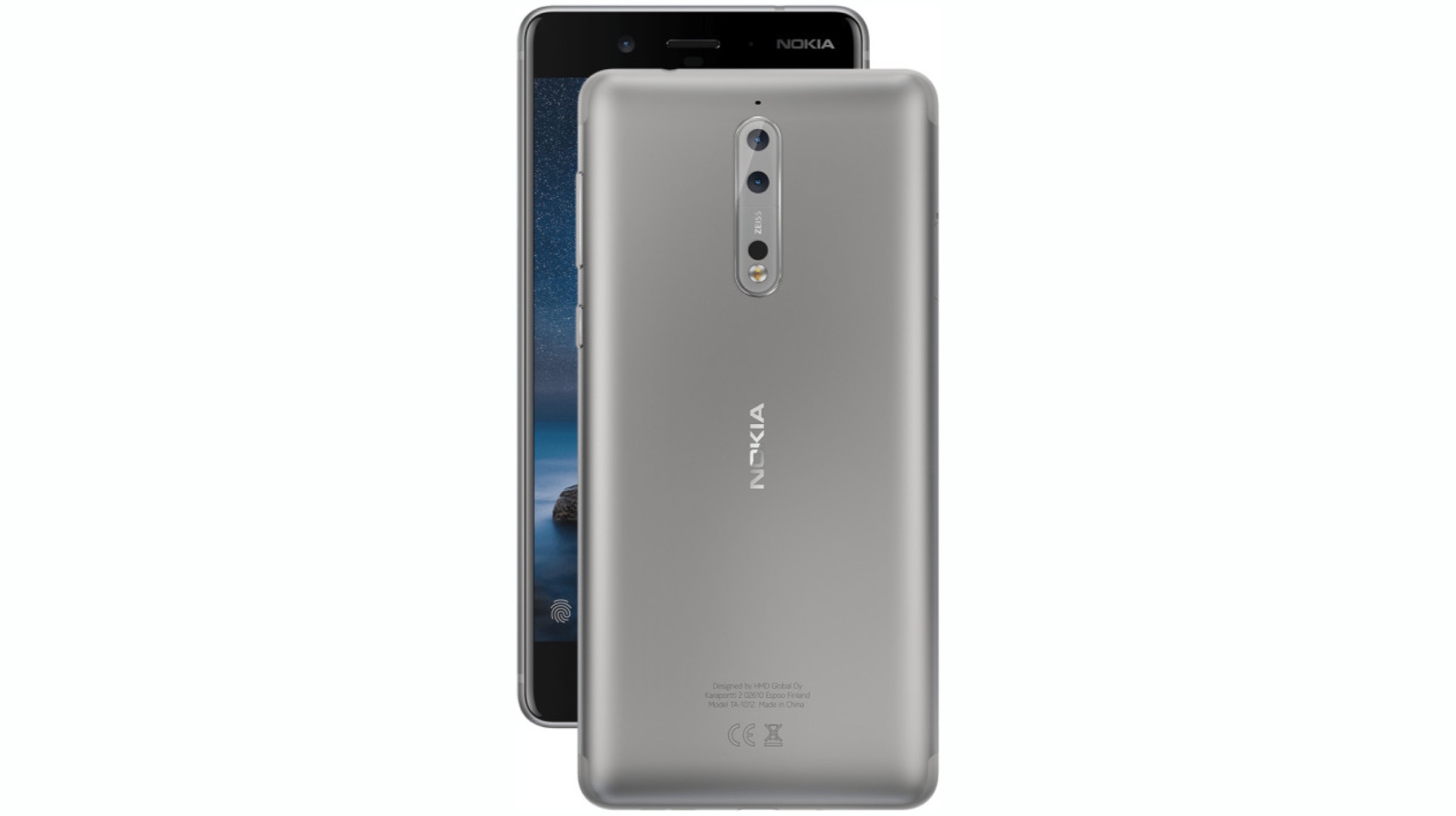
    While there has been a few Nokia 7 Plus leaks, images of the Nokia 1 have also been finally revealed. A popular tipster on Twitter shared the renders of the Nokia 1 and Nokia 7 Plus. The design of the Nokia 7 Plus looks particularly impressive while the Nokia 1 seems like an ideal entry-level device. The Nokia 7 Plus will have an 18:9 aspect ratio along with thin top and bottom bezels. The Nokia 1, on the other hand, looks quite simple but, it will be an entry-level smartphone.

    Nokia 7 Plus will also have colour accents similar to the Nokia 6 (2018). The white colour variant will have orange accents on the back camera and the fingerprint sensor rim. The design is expected to be hugely popular, at least in China after the Nokia 7 was a hit. Another revelation is that the Nokia 7 Plus will be an Android One device, which means stock Android OS and timely software updates. Nokia, to its credit, has been pushing out timely updates so far.
    Nokia 1
    Nokia 7 Plus
    Expectations

    The Nokia 1, being an Android Go device, will have entry-level specifications. It is expected to have up to 1GB of RAM, 8GB of internal storage and a Snapdragon or MediaTek chipset. It will run Android 8.1 Oreo out of the box.

    The Nokia 7 Plus, however, is expected to have updated specifications over the Nokia 7. It will have a will have a 6 inch display with an 18:9 aspect ratio hence, the “Plus” moniker. The fingerprint sensor will be placed on the back, just like the Nokia 7 although, the device had a 16:9 aspect ratio and thick bezels.

    Nokia 1
    Nokia 7 Plus Live Images

    Under the hood, the Nokia 7 Plus is expected to have the Snapdragon 660 chipset. That could be coupled with up to 6GB of RAM and 64GB of onboard storage.

    With MWC 2018 just around the corner, the anticipation has increased. HMD Global will also announce the global availability of these devices. Looking at India’s feature phone market, it could be one of the first countries to get the Nokia 1.

  • From Xiaomi Redmi Note 4 To Redmi Note 5 : What Has Changed?

    From Xiaomi Redmi Note 4 To Redmi Note 5 : What Has Changed?

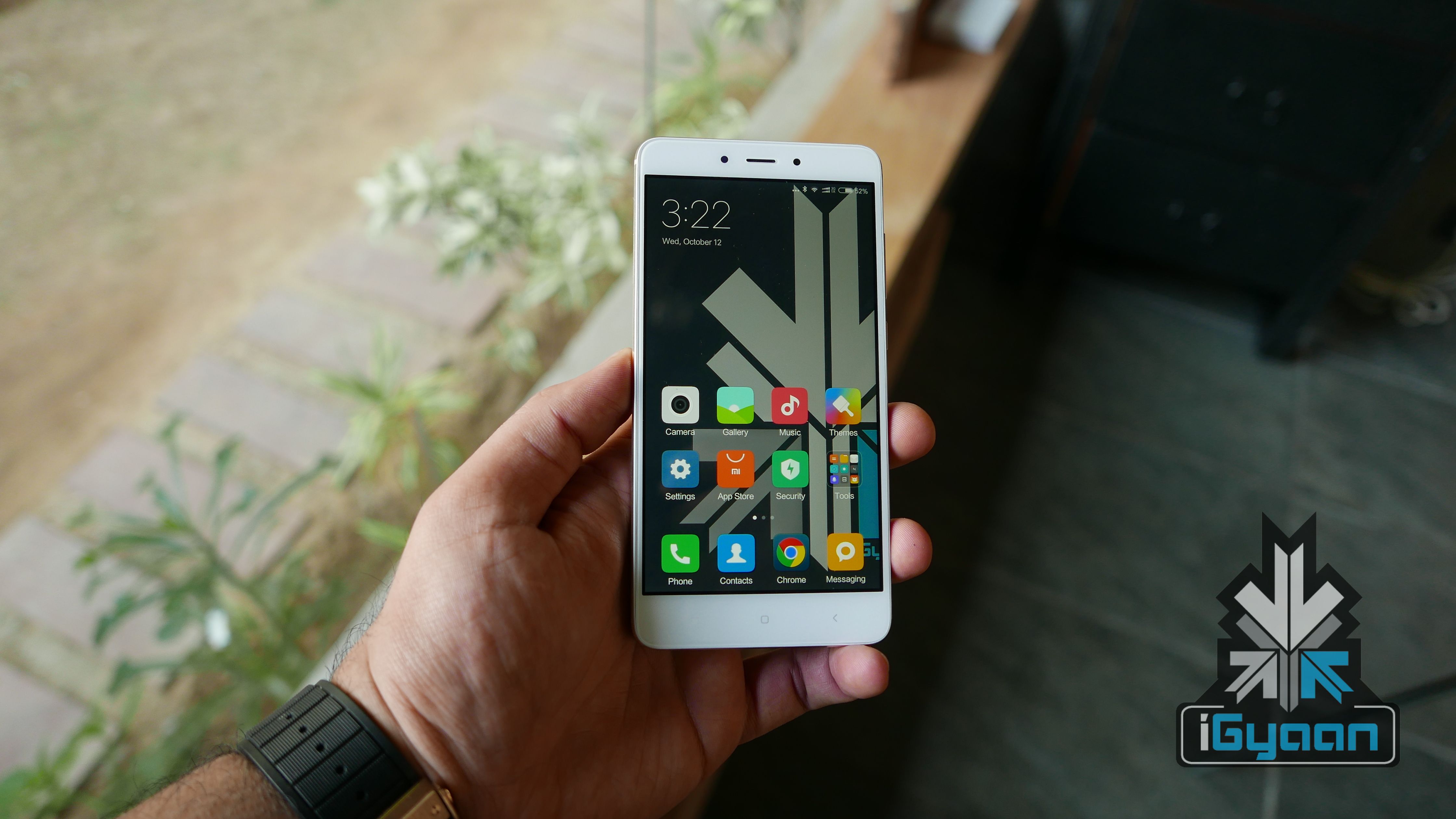
    Xiaomi has launched the Redmi Note 5 in India at a starting price of Rs. 9,999. The device will finally go on sale on the 22nd of February in India. The Redmi Note 5 has huge shoes to fill in, considering the Redmi Note 4 is the bestselling smartphone by Xiaomi.

    Redmi Note 5
    Xiaomi Redmi Note 4

    A few weeks ago, a news from China claimed that Xiaomi won’t launch a Redmi Note 5 in China and instead rename the Redmi 5 Plus as Redmi Note 5 for the Indian market. While many were sceptical about this move, it felt more plausible at that time. Now, it is official that the Redmi 5 Plus is indeed the Redmi Note 5. So, what has changed between the two generations?

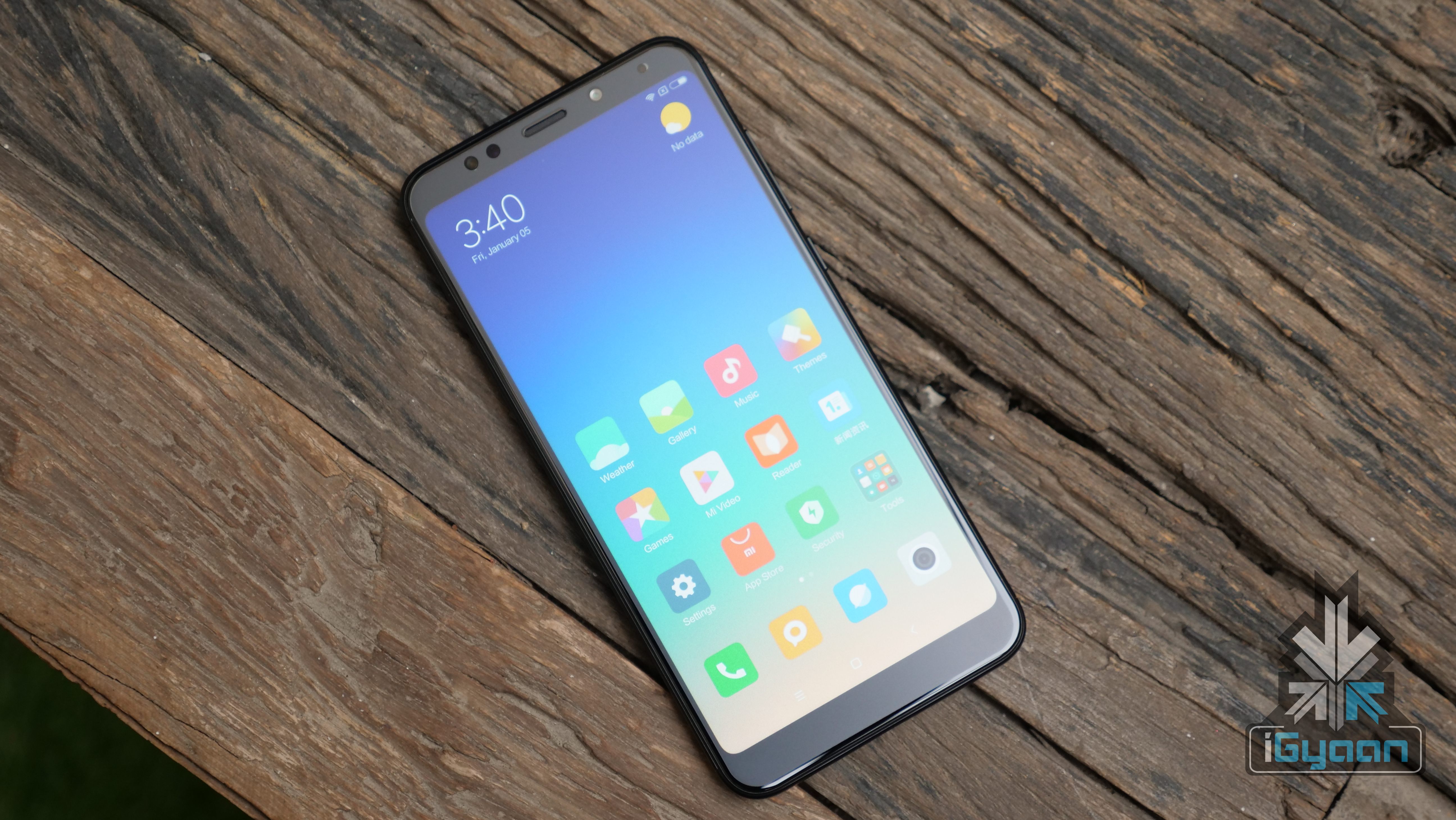
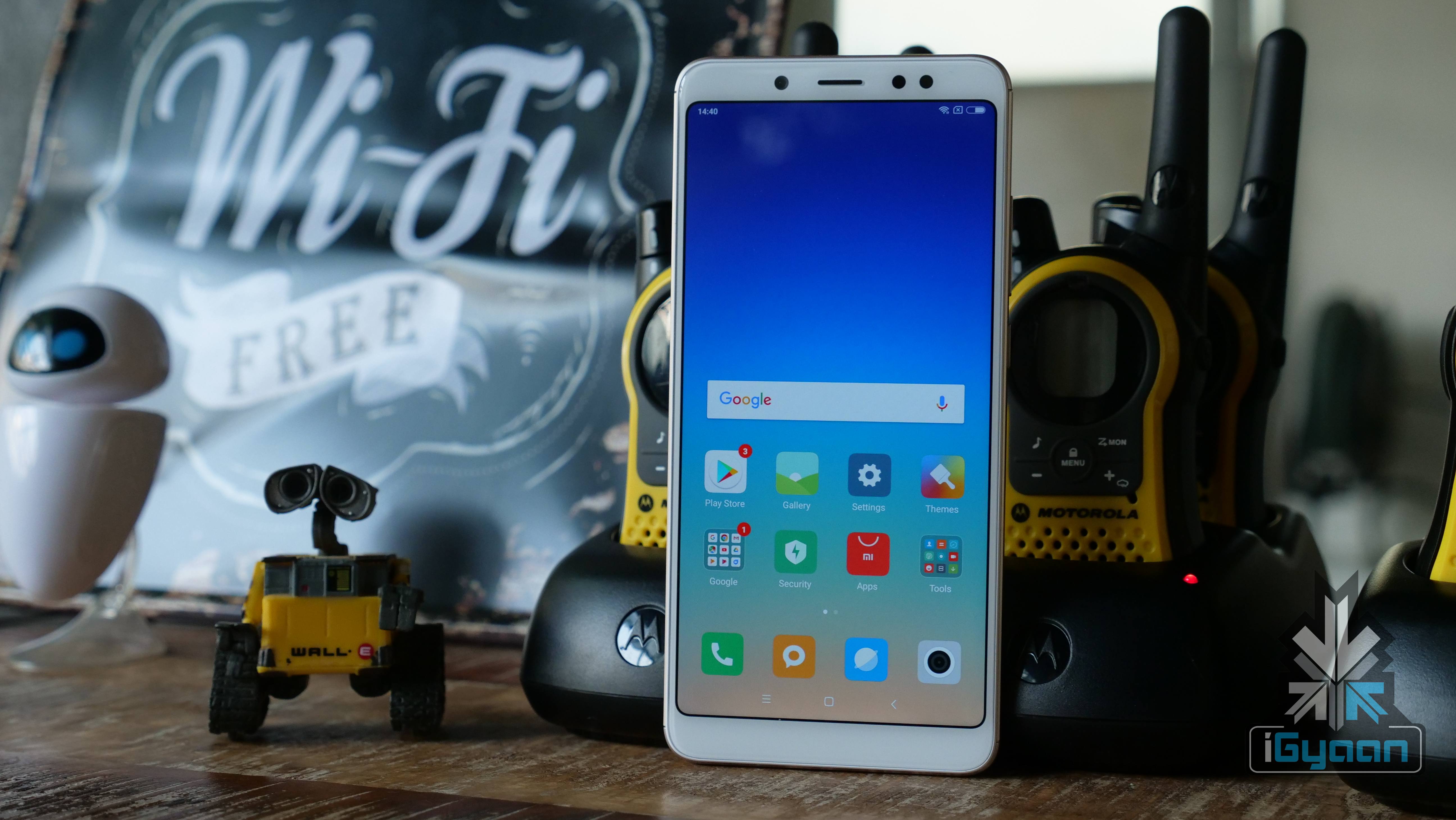
    The first thing you notice when you hold the new Note 5 is the display and its 18:9 aspect ratio. The smartphone industry has moved on from the 16:9 aspect ratio and it made sense for Xiaomi to launch a modern looking device in 2018. The Redmi Note 5 provides that with its relatively thinner bezels. The Redmi Note 5 is not a bezel-less device by any means and the Gold colour makes the presence of the bezels more prominent, thanks to the white colour.

    Redmi Note 5
    Redmi Note 5

    Having said that, the Redmi Note 5, in terms of design, is a definite upgrade over the Redmi Note 4. It is still built very sturdily with an aluminium unibody design.

    Under the hood, the Redmi Note 5 has the same the Qualcomm Snapdragon 625 chipset as the Redmi Note 4. The company claims that the Snapdragon 625 is one of the best budget chipsets and that is one of the reasons the Note 5 has maintained the chipset. When you look at flagship devices, a 2018 flagship phone launching with the Snapdragon 835 would not make sense because the Snapdragon 845 exists. Similarly, the Note 5 should have had a better chipset, like the Redmi Note 5 Pro has the Snapdragon 636 chipset.

    This move might stop a lot of Redmi Note 4 owners from upgrading in 2018. Since, the Redmi Note 4 continues to perform great and its succesor won’t really provide anything better. A lot of customers usually look for hardware upgrade rather than design changes, especially in the budget category. Probably, Redmi Note 4 users could get tempted to update to the Note 5 Pro considering it has a newer and better chipset under the hood.

    Redmi Note 5
    Redmi Note 4

    The Redmi Note 4’s biggest issue was its camera performance. Xiaomi claims that the Redmi Note 5 has much better camera performance than the Redmi Note 4. It has a 12MP primary camera with an f/2.2 aperture. On paper, these aren’t the most flattering numbers but, it performs better than the Redmi Note 4. But again, is that worthy enough for a generational upgrade?

    The Xiaomi Redmi Note 4 had a great battery performance thanks to the Snapdragon 625 chipset and the 4000 mAh battery. In a world where companies are making smartphones slimmer by reducing battery sizes, Xiaomi has done something else. The Redmi Note 5 has the same combination of the Snapdragon 625 chipset and a 4000 mAh battery. But, it also has a bigger display which means that the battery performance might be affected slightly.

    At a price of Rs. 9999, this smartphone is a great prospect for some with a Redmi Note 3 or older phone. However, people who own a Redmi Note 4 would be hard pressed not to take out their wallets for the Redmi Note 5. What are your thoughts? let us know in the comments.

    Buy The Redmi Note 5 here


  • Nokia 8 Starts Receiving Android 8.1 Oreo Update

    Nokia 8 Starts Receiving Android 8.1 Oreo Update

    HMD Global launched the Nokia 8 in India in September 2017. At the time of the launch, the company promised an update to Android 8 Oreo soon as the device was running Android 7 Nougat out of the box.

    The company has now confirmed that the Nokia 8 has started receiving an update to Android 8.1 Oreo via OTA. Chief Product Manager at HMD Global, Hujo Sarvikas took to Twitter to share the news.

    As per the official changelog, the Android 8.1 Oreo update for the Nokia 8 includes battery saving navigation buttons, a revamped power menu, new settings menu, and Bluetooth battery percentage. Also included are various core Android features such as Neural Networks API, Autofill framework updates, and a SharedMemory API. Along with these changes, there will obviously be enhanced performance and necessary bug fixes.

    The Nokia 8 recently received a permanent price cut and is now available in India at a price of Rs. 28,999.

    Nokia 8 Specifications

    The Nokia 8 has a 5.3 inch 2560 x 1440 px display and 2.5D Corning Gorilla Glass 5 for protection.

    [amazon_link asins=’B072LNNSQQ’ template=’ProductAd’ store=’igyaan-21′ marketplace=’IN’ link_id=’a44a6421-1173-11e8-894b-43f3c8f10cbe’]

    Under the hood is the Qualcomm Snapdragon 835 chipset and a 2.45GHz octa-core processor, the Adreno 540 GPU, 4GB of RAM and 64GB of onboard storage which is expandable via microSD card. The smartphone has an aluminium unibody design and an IP54 rating for splash resistance. The fingerprint sensor is housed inside a physical home button which sits between two navigation touch capacitive buttons below the screen.

    Powering the device is a 3090mAh battery with QuickCharge 3.0 support via USB Type-C port. It runs stock Android 7.1.1 OS and the company has promised monthly security updates and yearly Android updates.

    The Nokia 8 is the first Nokia Android device to feature Carl Zeiss optics. The Nokia 8 boasts a Zeiss powered dual camera setup at the rear – a primary 13MP RGB (colour) sensor with optical image stabilisation paired with a 13MP secondary monochrome (black and white) sensor and an f/2.0 aperture. The dual-camera setup is capable of recording videos in 4K at 30 FPS and has a portrait mode for bokeh effect. On the front is a 13MP camera with an f/2.0 aperture which can also record 4K videos at 30FPS.

  • Xiaomi Redmi Note 5 Pro

    Xiaomi Redmi Note 5 Pro

    Xiaomi has launched a ‘Pro’ version of the Redmi Note 5 in India at a launch event in Delhi. The Redmi Note 5 Pro will go on sale in India at a starting price of Rs. via Flipkart. The Redmi Note 5 Pro has better hardware and the company claims that the camera performance of the Redmi Note 5 Pro is its highlight. For context, the Redmi Note 5 is priced at Rs 10999.

    From the front, the Redmi Note 5 Pro looks very similar to the Redmi Note 5. It has the same display and 18:9 aspect ratio like the Redmi Note 5. Once you flip the device is when you see the difference. In a move that will garner a lot of eyeballs, Xiaomi has gone for a vertically placed dual-camera setup which is positioned uncannily similar to the iPhone X. Even the LED flash is placed between the two sensors, like the iPhone X.

    [section label=”Latest News”]

    Latest News

    [loop included_tags=”40211,39981″ loading=”paged” layout=”f” postsperpage=”6″ disable_ads=”true” disable_excerpt=”true”]

    [section label=”Videos”]

    Videos

    [embedyt] https://www.youtube.com/watch?v=0aFnAF63j2o[/embedyt]

  • Xiaomi Mi LED Smart TV 4 Launched In India At Rs. 39,999

    Xiaomi Mi LED Smart TV 4 Launched In India At Rs. 39,999

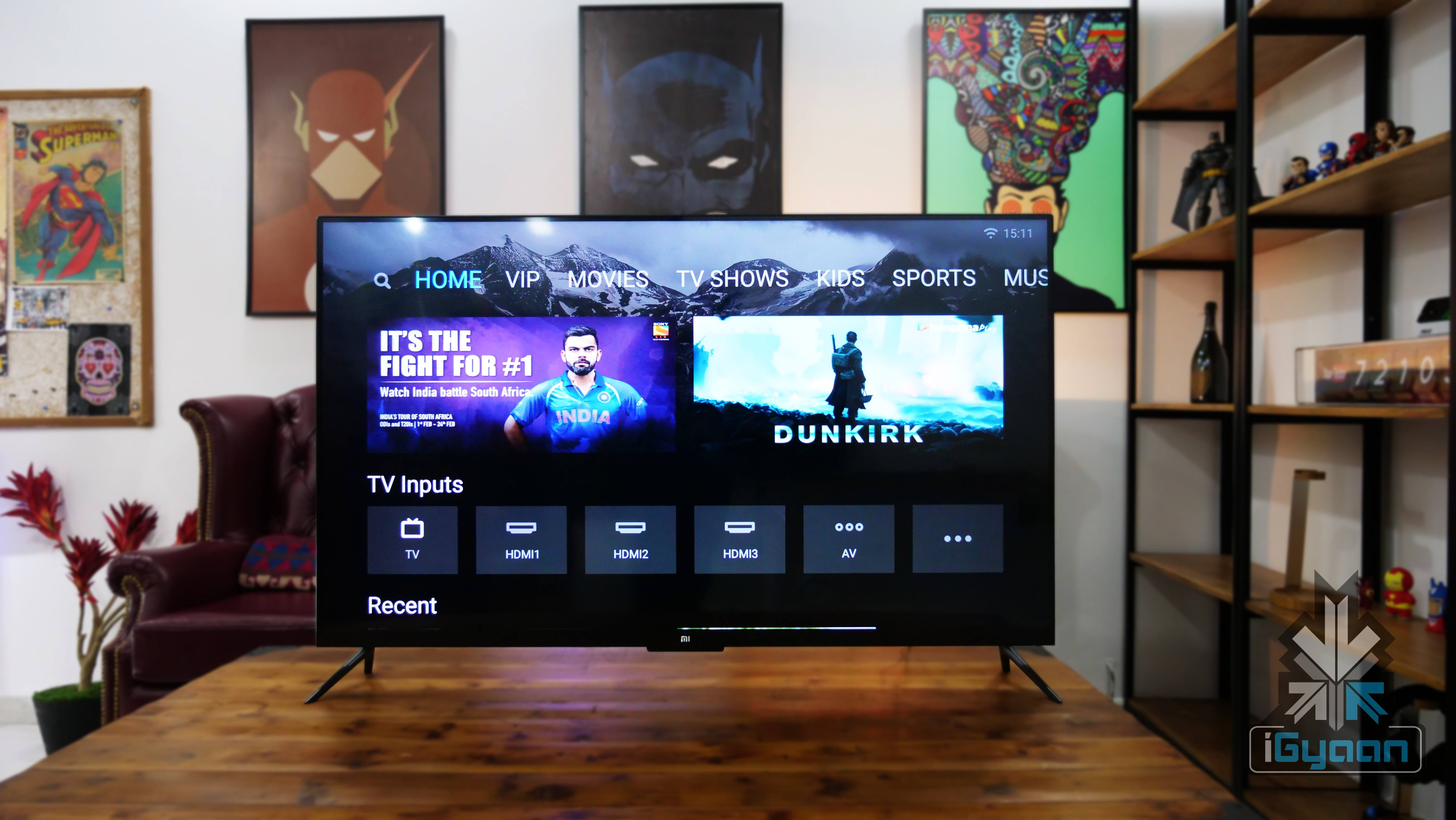
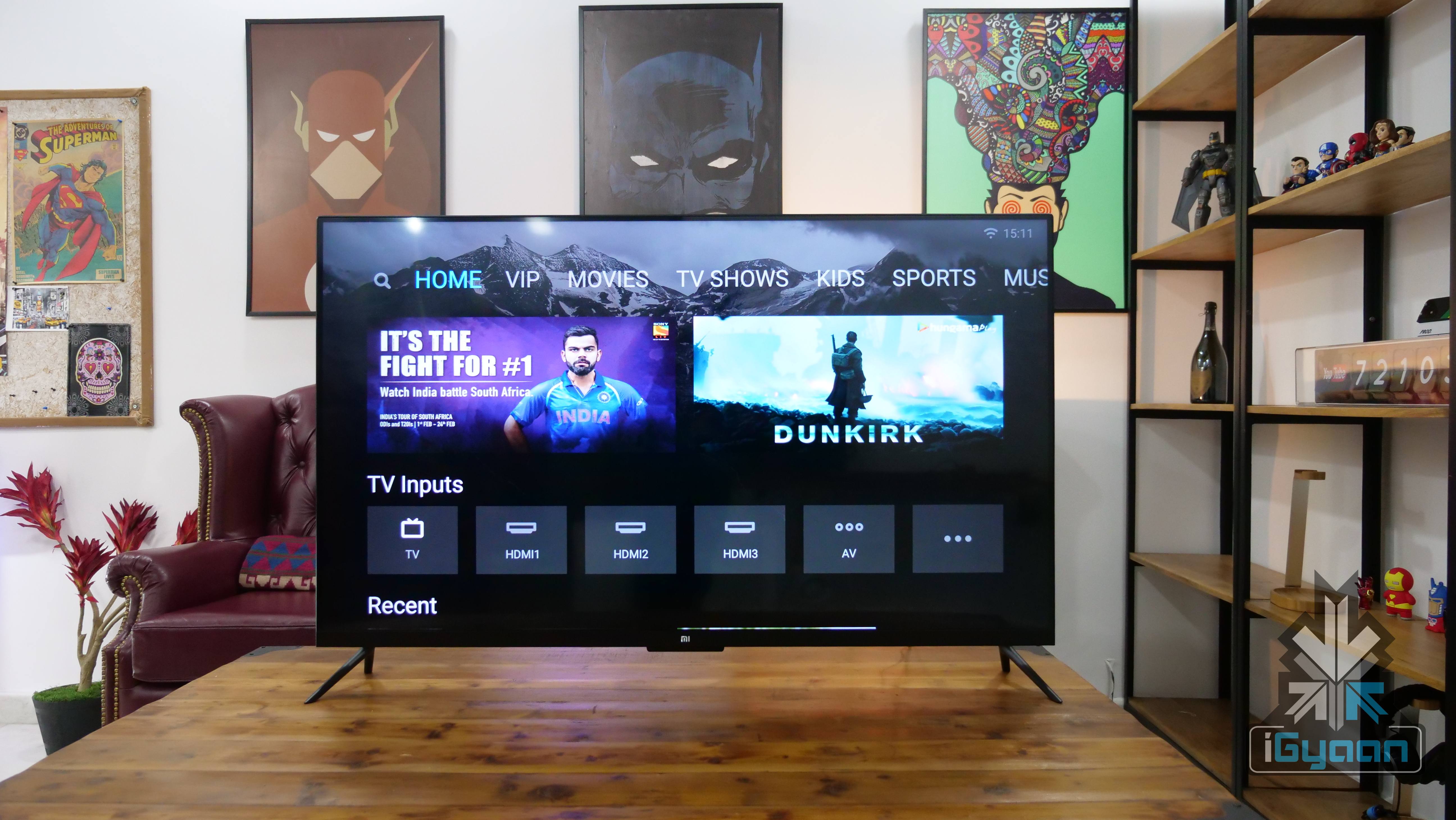
    Along with two smartphones, Xiaomi has launched its first ever smart TV in India. The Xiaomi Mi LED Smart TV 4 will go on sale in India at a price of Rs. 39,999 on the 22nd of February.

    Overview

    The 55 inch Xiaomi Mi TV 4 comes with a 4K UHD display with a 3840 x 2160 resolution and a 178-degree viewing angle. The TV has a refresh rate of 60Hz and it also offers support for HDR10+ HLG. The device has a “frameless design” and also comes with Dolby Atmos audio technology.

    Interestingly, the trend of AI and machine learning is bleeding into the television industry as well, it seems. The Xiaomi Mi LED Smart TV comes with AI support and can make recommendations. It has a UI called PatchWall and is based on Android OS which allows for content curation based on recommendations. The TV also has speech recognition and voice control, but, since it is only available in China as of now, it doesn’t work with the English language.

    Under the hood, the Mi LED Smart TV is powered by a 64-bit Amlogic L962 chipset with four 1.5GHz Cortex-A53 cores along with 2GB of RAM and 8GB of onboard storage. As for connectivity, the Xiaomi Mi TV 4 has Wi-Fi ac, Bluetooth 4.2, three HDMI ports, two USB ports, AV in, Ethernet port, and S/PDIF audio output. There is also the new Xiaomi remote for controlling the TV which has infrared as well Bluetooth connectivity options.

    [embedyt] https://www.youtube.com/watch?v=s0q4V3wwPIs[/embedyt]
  • Xiaomi Redmi Note 5

    Xiaomi Redmi Note 5

    After months of rumours and leaked, Xiaomi has launched the follow up to the Redmi Note 4. The company has launched the Xiaomi Redmi Note 5 in India at a starting price of Rs. 9999. It was speculated that Xiaomi will drop the “Note” moniker altogether and launch the Redmi 5 Plus in India. That speculation has turned out to be true as the Redmi 5 Plus has been renamed Redmi Note 5 for the Indian market.

    The device will have a lot of expectations from fans after the success of the Redmi Note 4. By the company’s own admission, the Redmi Note 4 is the most successful Xiaomi phone in India. That is no mean feat considering the popularity of Xiaomi smartphones in India. However, launching the Redmi 5 Plus as the Redmi Note 5 in India might be a surprise for many.

    Buy it here

    [section label=”Latest News”]

    Latest News

    [loop included_tags=”40092,39981″ loading=”paged” layout=”f” postsperpage=”6″ disable_ads=”true” disable_excerpt=”true”]

    [section label=”Videos”]

  • Xiaomi Redmi Note 5 Vs Honor 9 Lite

    Xiaomi Redmi Note 5 Vs Honor 9 Lite

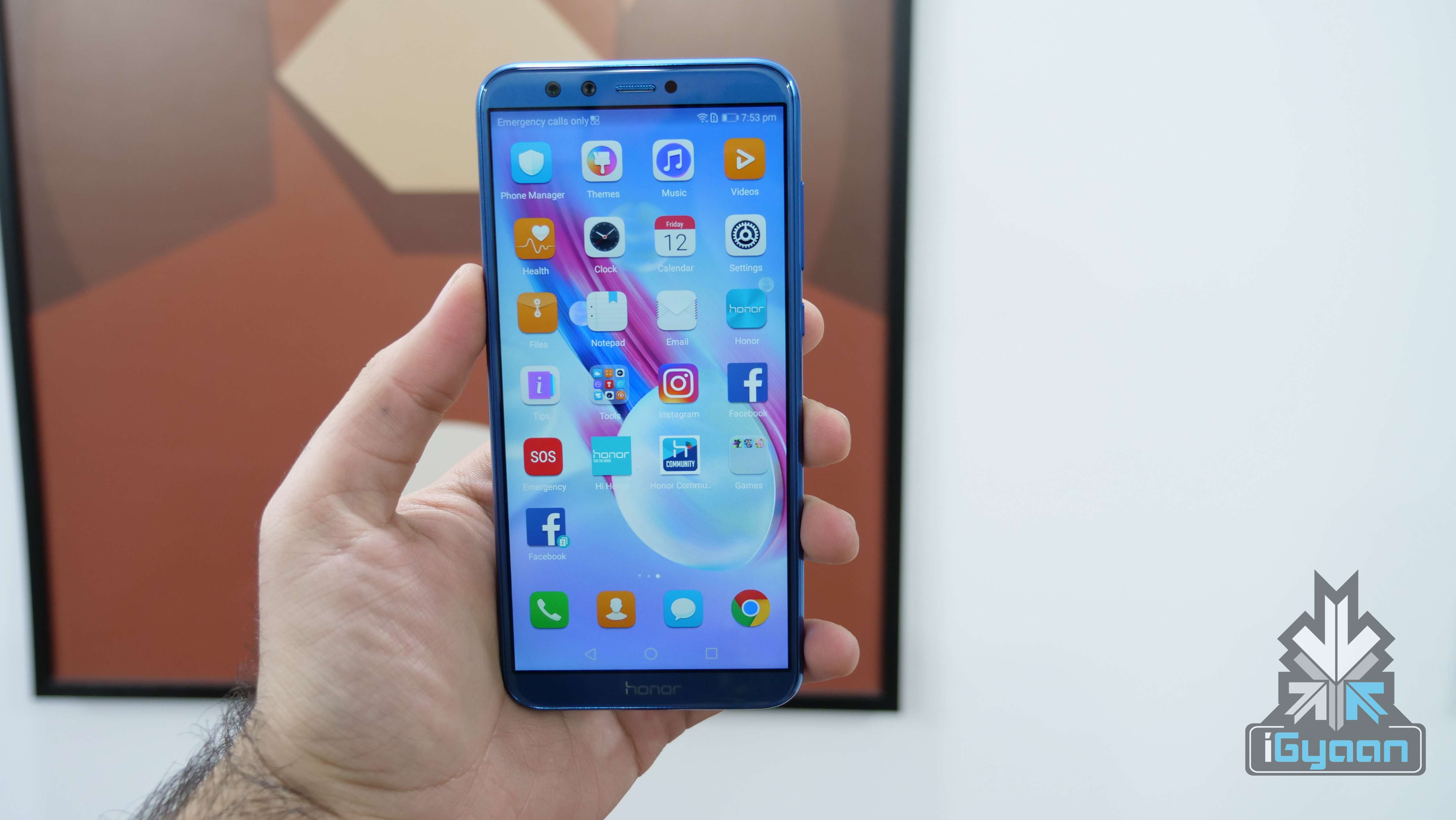
    Xiaomi has launched the Redmi Note 5 in India at a starting price of Rs. 9,999 with a new design but, the same chipset. At this price, the Redmi Note 5 competes directly with the recently launched Honor 9 Lite. Both the smartphones have an 18:9 aspect ratio and very capable respective chipsets.

    Redmi 5
    Redmi Note 5

    The Xiaomi Redmi Note 5 is basically the Redmi 5 Plus which was launched in December in China. The design is much more modern than the previous generation and it comes in four different colour variants. The Honor 9 Lite has much thinner bezels but, also a smaller screen size. The Honor 9 Lite has an all-glass build which gives it a much more premium look when compared to the aluminium unibody design of the Redmi Note 5.

    With a very similar pricing and more or less similar design language, which device comes out on top? Let’s find out!

    Specifications Xiaomi Redmi Note 5 Honor 9 Lite
    Price Rs. 9999
    Rs. 10999
    Rs. 10999
    Rs. 14999
    Display 5.99 inch IPS LCD
    18:9 Aspect Ratio
    5.65 inch IPS LCD
    18:9 Aspect Ratio
    Resolution 2160 x 1080 px
    403ppi
    2160 x 1080 px
    428ppi
    Battery 4000 mAh 3000 mAh
    Chipset Qualcomm Snapdragon 625 HiSilicon Kirin 659
    RAM 3GB
    4GB
    3GB
    4GB
    Storage 32GB
    64GB
    Expandable up to 256GB
    32GB
    64GB
    Expandable up to 256GB
    Primary Camera 12MP
    f/2.2
    13MP
    2MP (depth sensor)
    Primary Camera Video 1920 x 1080 px @ 30fps 1920 x 1080 px @ 30fps
    Secondary Camera 5MP
    LED
    13MP
    2MP (depth sensor)
    Add-ons Fingerprint Sensor Fingerprint Sensor
    Face Unlock (update scheduled)
iGyaan Network
Privacy Overview

This website uses cookies so that we can provide you with the best user experience possible. Cookie information is stored in your browser and performs functions such as recognising you when you return to our website and helping our team to understand which sections of the website you find most interesting and useful.