Category: Government, Law and Policy

  • Government Blocks Google Street View in India

    Government Blocks Google Street View in India

    The Indian Government has halted plans from Google to put Indian cities, tourists spots, hills, and rivers in an application in which one can explore through 360-degree, panoramic and street-level images.

    According to the security agencies and home ministry, these pictures can be used for planning of terrorist attacks that might ultimately lead to events like those in 2008 that took place in Mumbai.

    Street view, which was earlier just launched as a test in the US is now showcasing 360-degree panoramic views to include locations on all seven continents, covering 65 plus countries and has travelled seven million plus miles.

    Google street view 2

    Google has often run into trouble with their Maps platform, in countries that take privacy, including many in the EU. In Germany, homeowners can log into street view and blur their homes.

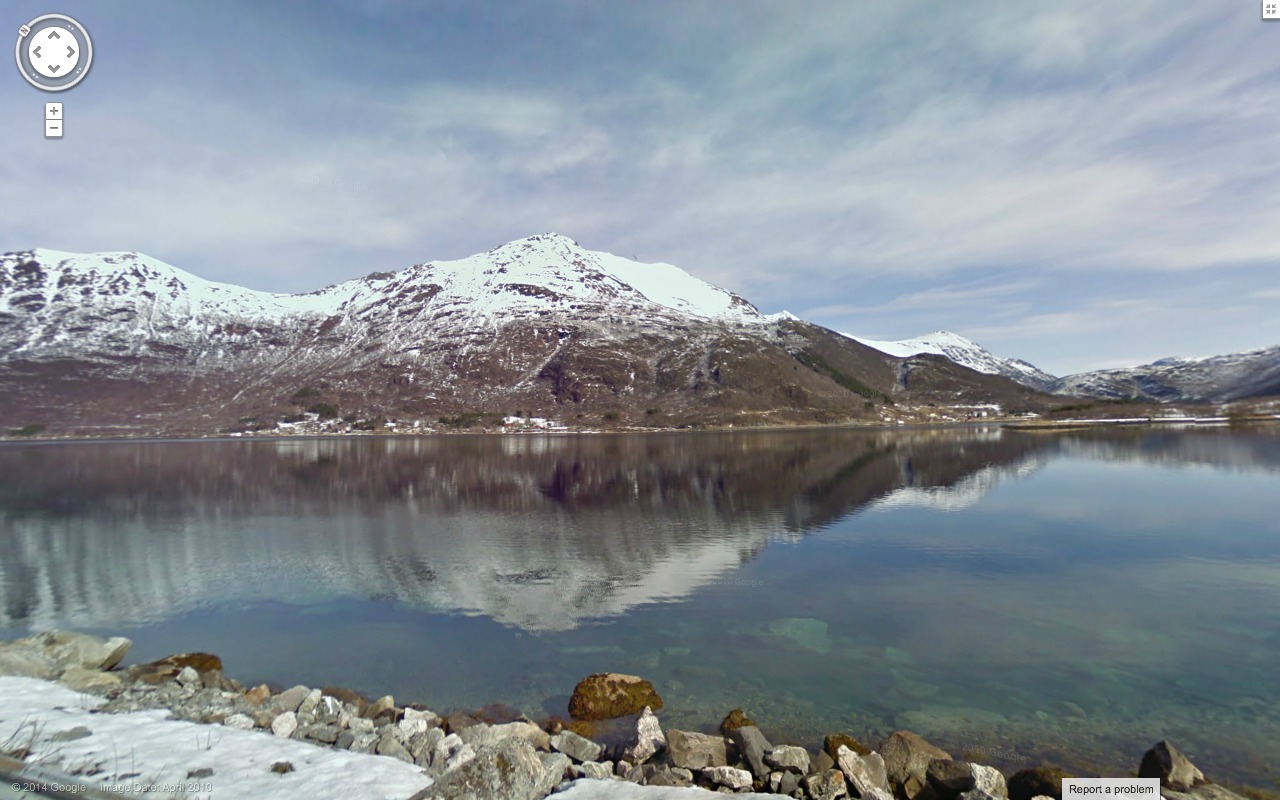
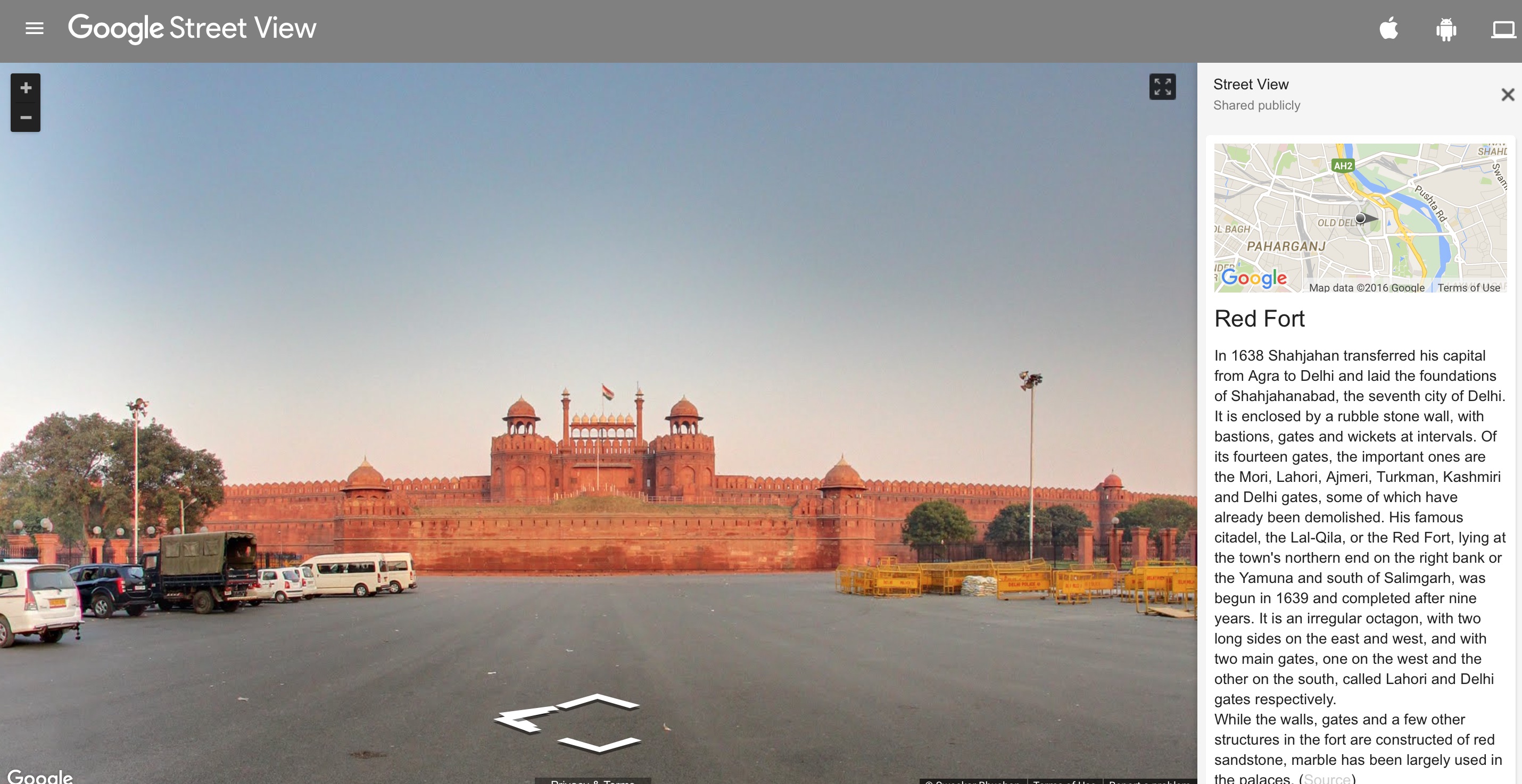
    Google with the Archaeological Survey of India has already added their street view to the Taj Mahal, Red Fort, Qutub Minar, Varanasi river bank, Nalanda University, Mysore Palace, Thanjavur Temple, Chinnaswamy Stadium besides others in partnership with the Archaeological Society of India.

    red fort street view

    But now, the Government of India has blocked Google from going ahead with Street View due to fear of potential terrorist attacks. However, if the fear of terrorism holds back progress, then terrorism at a certain level has already been achieved.

    [poll id=44]


  • Nokia is talking to Indian Telecom Operators for 5G Networks

    Nokia is talking to Indian Telecom Operators for 5G Networks

    Even though 4G networks in India have not been a real success, thanks to poor deployment and connectivity and also due to high charges, Nokia is in talks with various telecom companies to provide 5G networks in India.

    While major telecos are still investing into 4G technology trying to get it up to speed with other countries, with respect to network and infrastructure.

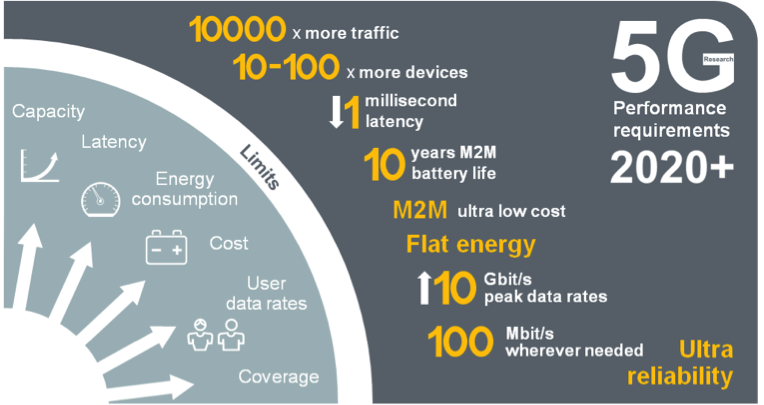
    5G technology is leaps and bounds ahead of current gen networks and, many countries are already investing heavily in the technology. With 5G users can attain 100 megabit per second speed and the infrastructure can handle 1000 times more data traffic.

    5g ultra-reliabilty

    India is expected to initiate 5G by 2020 and Nokia equipment will play a major role in providing this technology across the country.

    It will be used for purposes beyond voice and data communications carried by people today. It will has less than 1 millisecond latency that will be used by machines for quick action like for to stop in case it identifies any obstacle, surgery from remote location etc.Discussion about spectrum (at global level) in which 5G will operate will finish by 2019. Commercial 5G deployment will start in 2020. Then you will see 100 mbps guaranteed speed everywhere : Nokia Networks Head of Mobile Broadband Milivoj Vela

    For India 700 Mhz and 2.6 Ghz are currently employed for Mobile Telephony,  Wi-fi generally uses between 2.4 Ghz to 5.9 Ghz.  With 5G networks telepresence ill get a huge boost. Although with the poor state of network in the country many users are waiting for options like Reliance JIO that promise to offer up better connectivity and cheaper pricing.

  • Top 10 Most Polluted Cites in India

    Top 10 Most Polluted Cites in India

    There is no denying that India is top on the list of polluted countries in the world. In-Fact 13 of the Top 20 polluted cities in the world come from India according to a report published by World Health Organization( WHO) in 2014.

    Many claim that the reason for the pollution is the large population that is only second to China. To measure the levels of pollution PM10 and PM25 counts are used, PM10 is suspended particulate matter 10 micrometers or less in diameter; PM2.5 is suspended particulate matter 2.5 microns or less in diameter. Safe levels numbers kept by health organizations are PM10: Safe 40 µg/m3 over a period of a year and for PM2.5: Safe 25 µg/m3 over a period of a year.

    Here is the list of Top 10 cities, any guesses for Number One?

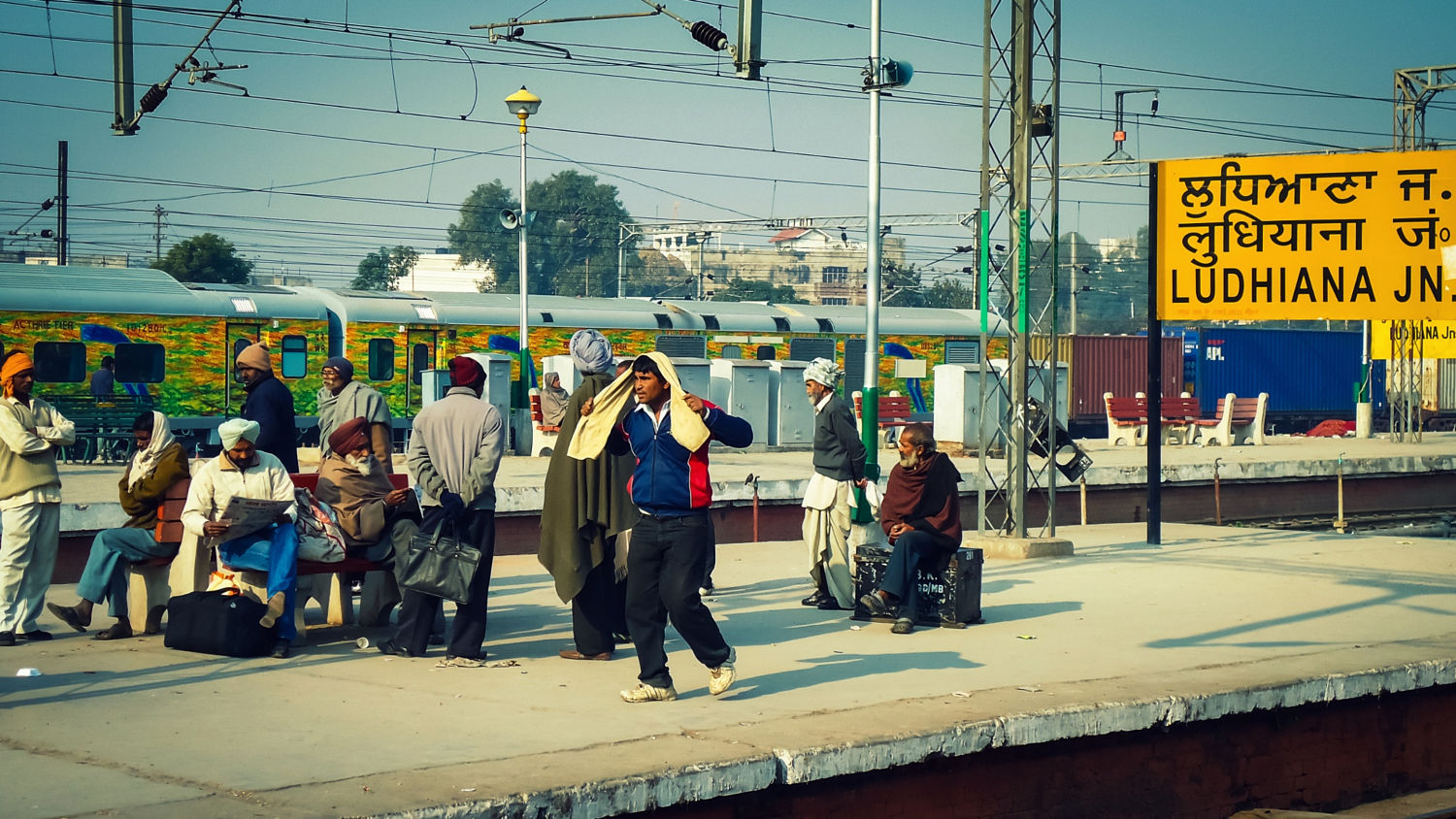
    10. Ludhiana

    ludhiana

    While a relatively small city, Ludhiana is seeing massive development and a large influx of traffic.

    • PM10 : 207 µg/m3
    • PM 2.5 : 91 µg/m3

    The Pollution levels are almost four times the permissible levels for a healthy life.


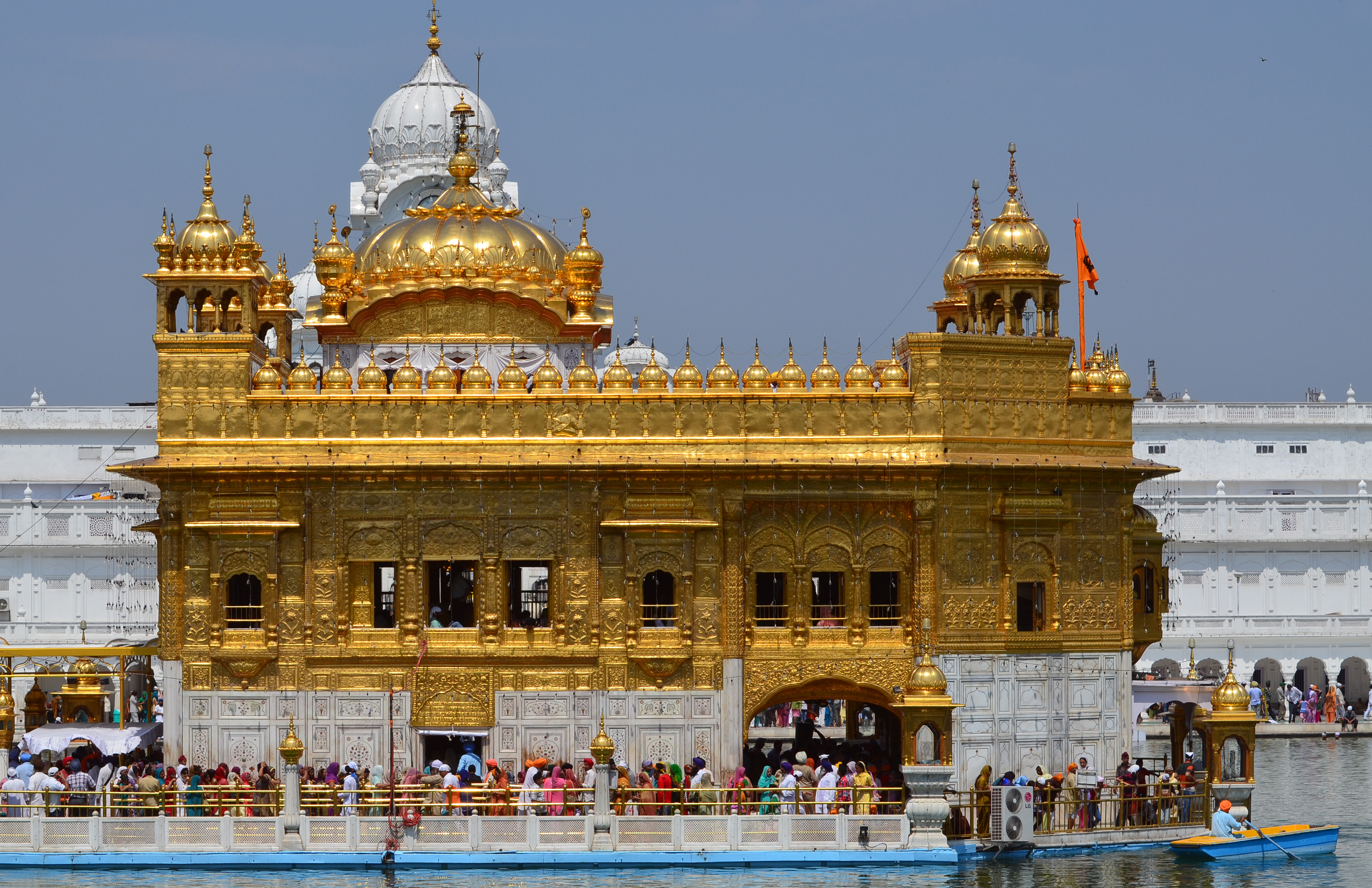
    9. Amritsar

    The_Golden_Temple

    Another small city of Punjab and the home of the Golden Temple, Amritsar hits the list at number nine. While the food there is amazing and the people happy, the pollution levels are off the charts. Only a little more than Ludhiana but much above the safe permissible limits.

    • PM10 : 210 µg/m3
    • PM 2.5: 92 µg/m3

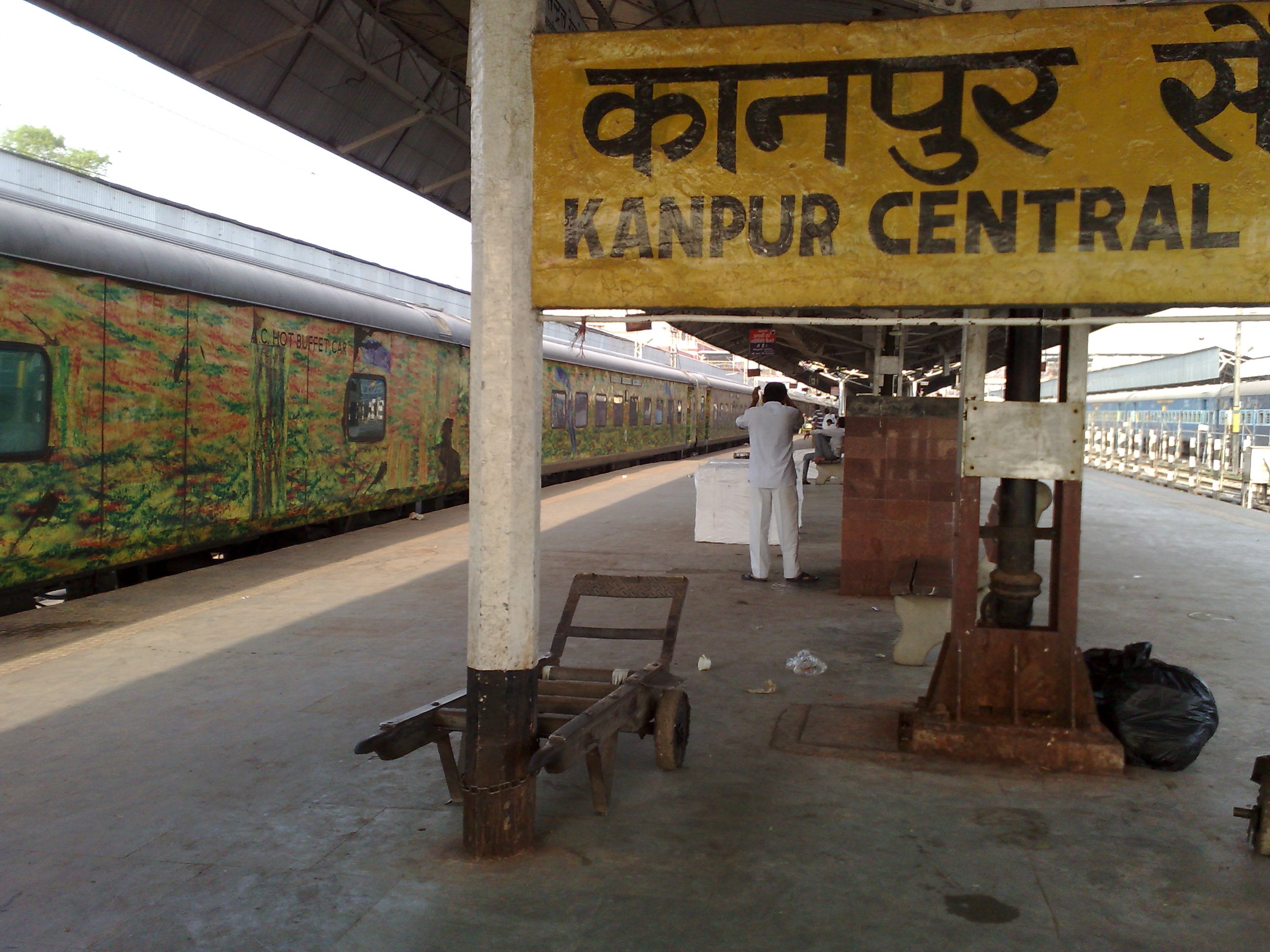
    8. Kanpur

    kanpur

    A city with a population crossing 40 lac or 4 million residents Kanpur hits the list at number 8. with a

    • PM10 : 212 µg/m3
    • PM2.5 : 93µg/m3

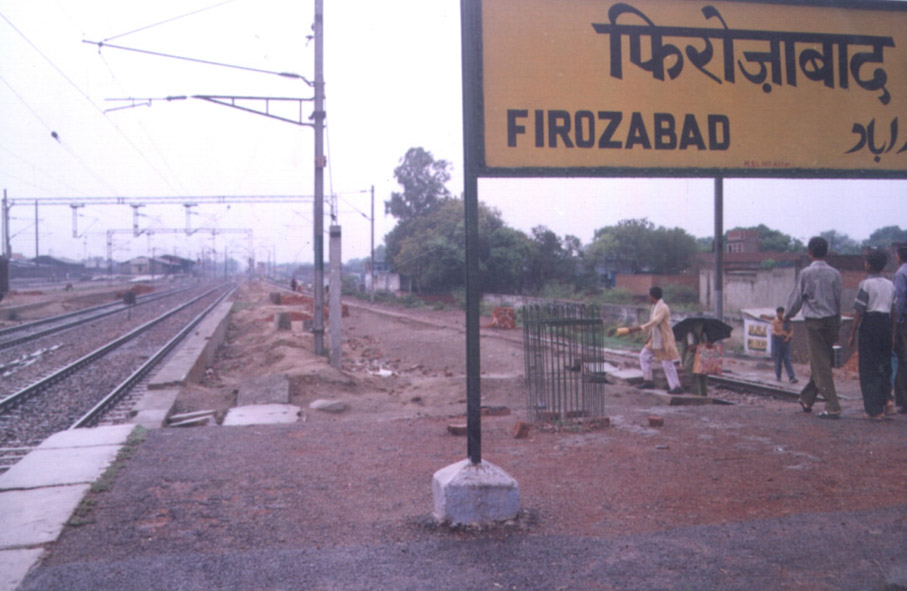
    7. Firozabad

    fzdstation

    Firozabad is located in north central India, in western Uttar Pradesh , 40 km from Agra and around 240 km away from Delhi. Firozabad has a large industry with a high pollution output which gets the blame for the degradation of the Taj Mahal’s white marble.

    • PM10 : 219 µg/m3
    • PM2.5 : 96 µg/m3

    6. Lucknow

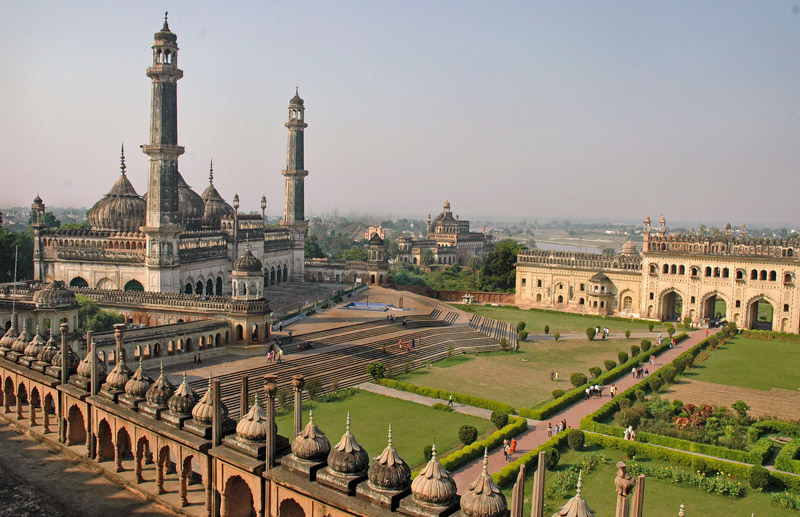
    lucknow-bara-imambara

    Lucknow is the largest city in Uttar Pradesh and the second largest in India after Delhi. Home of the Royals of the Mughal Empire also known as Nawabs of Awadh is no longer safe for Royalty or any inhabitation of any kind.

    • PM10 : 219 µg/m3
    • PM2.5 : 96 µg/m3

    5. Ahmedabad

    ahmedabad
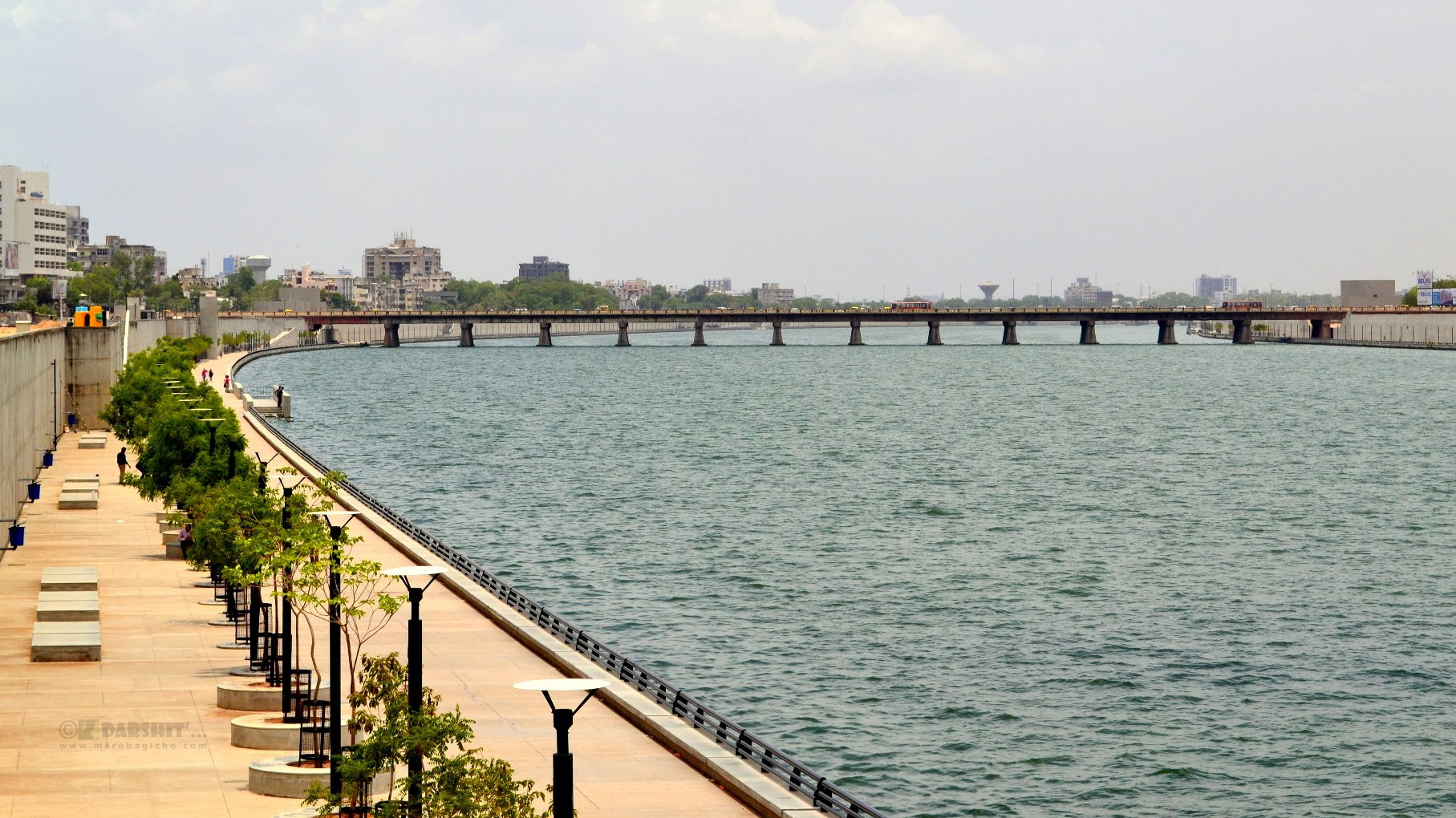
    Ahmedabad River Front

    The pride of the Prime Minister of India and the former capital of the State of Gujrat, Ahmedabad has a population of  6.3 million and an extended population of 7.2 million. While the PM10 count is well under control at 67 µg/m3, still above the permissible level, the PM2.5 is extremely high and toxic for humans.

    • PM10 : 67 µg/m3
    • PM2.5 : 100 µg/m3

    4. Raipur

    nagar-ghadi
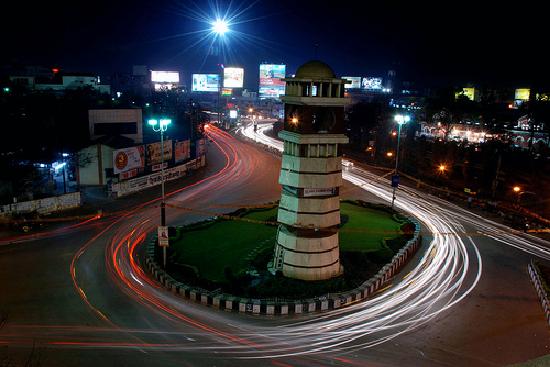
    Clock tower in Raipur

    Here is where the list goes shockingly out of proportion, Raipur the capital of Chhattisgarh is losing the battle with PM10 count and not only is it extremely high it is so bad that if you were to explain this with an image, you would use the following: death_crossbones_skull_dead-512

    • PM10 : 304 µg/m3
    • PM2.5 : 135 µg/m3

    3. Gwalior

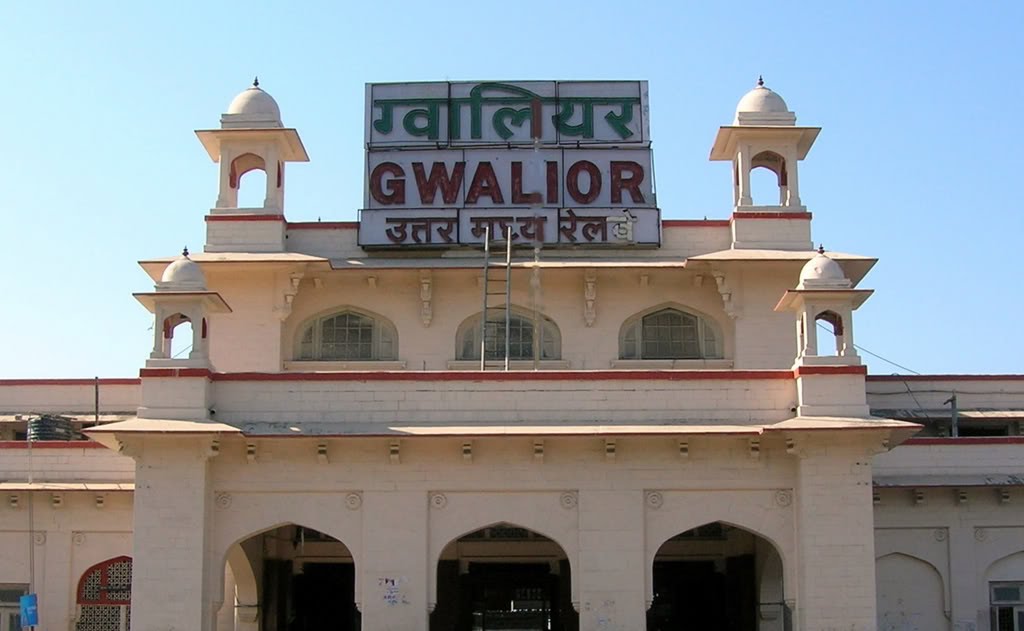
    Gwalior-railway-station

    Coming it at a cool number 3 the City of Gwalior is located 319 kilometers south of Delhi in the heart of Madhya Pradesh. The 2014 WHO report calls Gwalior the third most polluted city in the world, only because the top two are also from India.

    • PM10 : 329 µg/m3
    • PM2.5 : 144 µg/m3

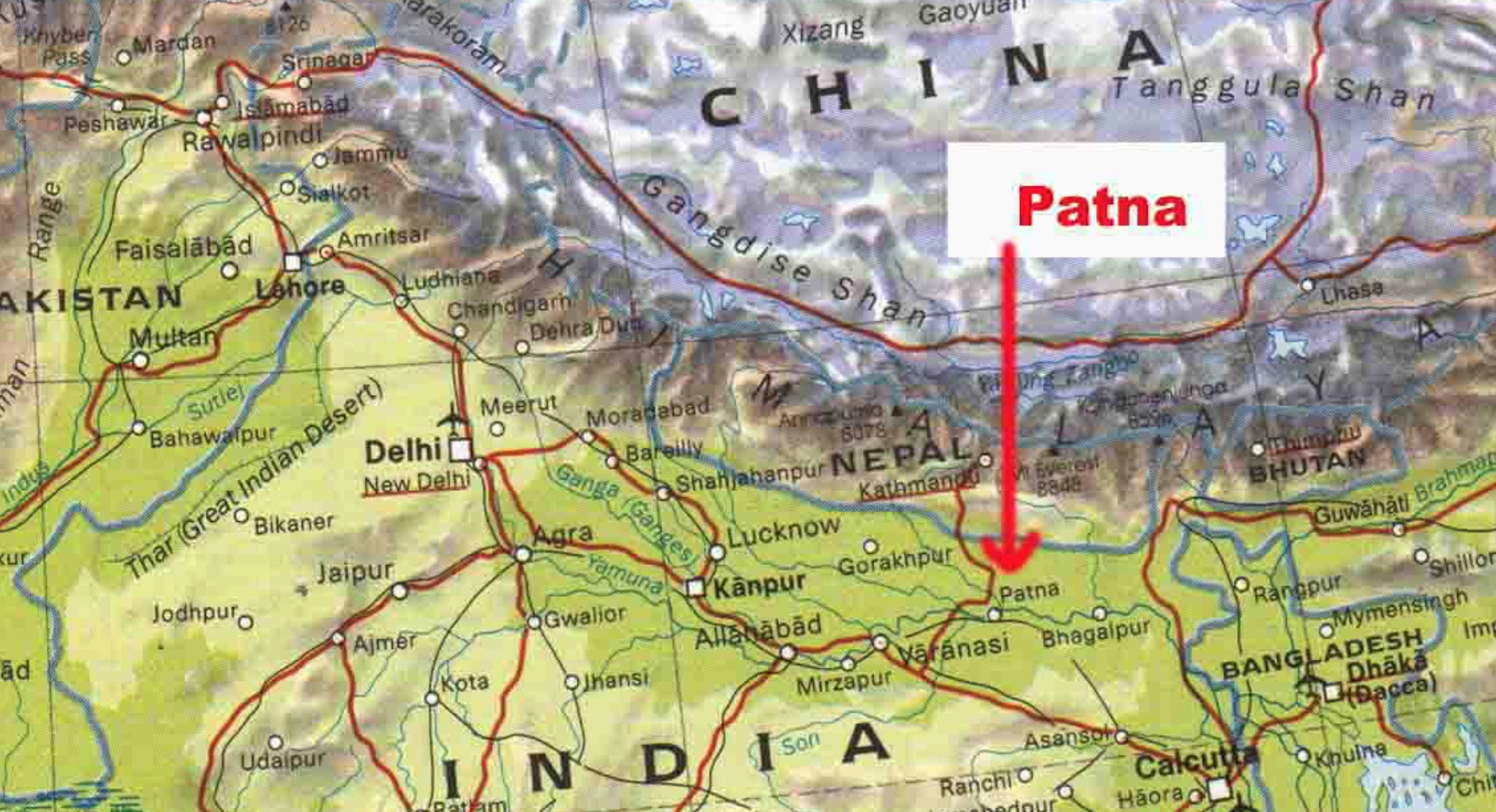
    2. Patna

    patna

    The state capital of Bihar, Patna is the second most polluted city in the world and also the second most polluted city in India. One of the oldest continuously inhabited places in the world. Patna was founded in 490 BCE by the king of Magadha, little did he know the levels of pollution it would reach.

    • PM10 : 164 µg/m3
    • PM2.5 : 149 µg/m3
    1. Delhi

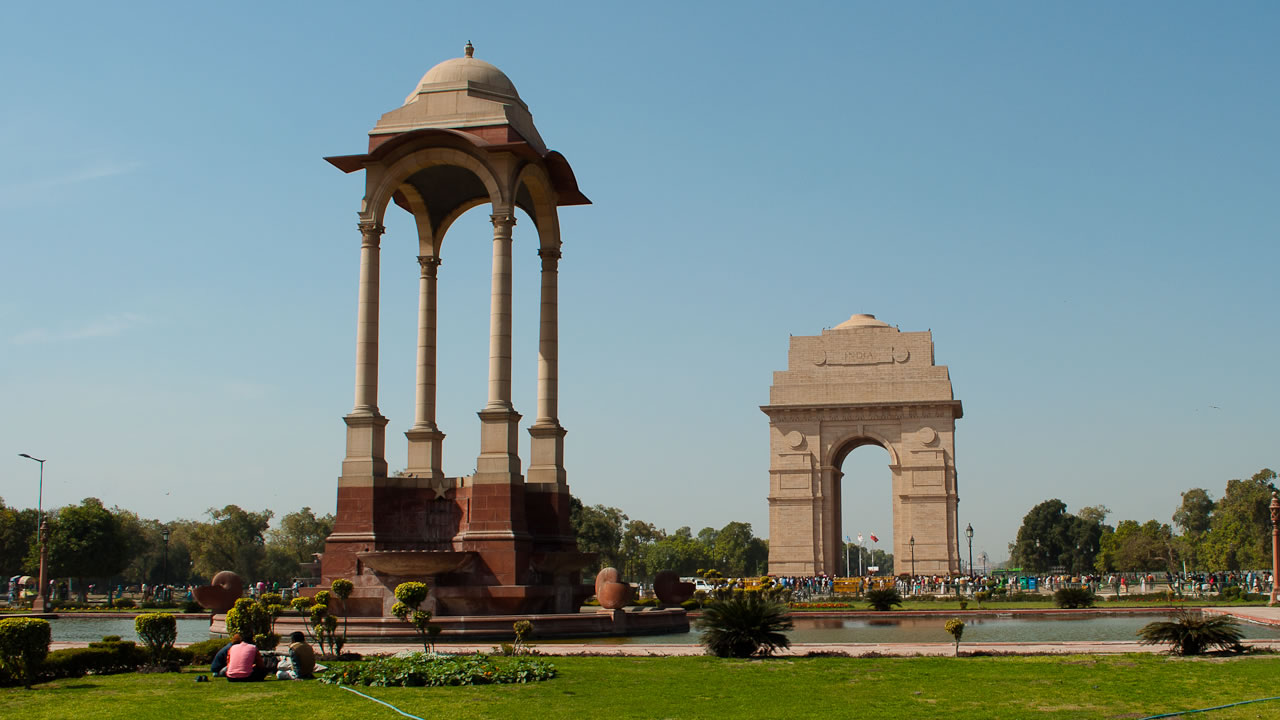
    delhi india gate

    You guessed it; the odd-even traffic laws will be little or no relief for Delhi, which is the capital of India and also the largest city in the country. In the 2011 census, Delhi’s population crossed 16 million inhabitants or around 1.6 crore people. A large number of vehicles and traffic is attributed as the primary cause of the city’s toxic levels of air pollution. No signs can signify the levels of damage this does to the human body.

    • PM10 : 286 µg/m3
    • PM2.5 : 153 µg/m3

    Remember the safe limits of PM10:  40 µg/m3 and for PM2.5: 25 µg/m3 over a period of a year. The worst part about this situation is that the last collected numbers are from the 2014 report, which means that the current levels are expected to be much higher. The state or local authorities have taken no significant preventive measures or steps to control the rising levels of pollution.

    While Delhi tries the Odd-Even formula, it may be too little too late.

  • Delhi Metro to Provide Free Wi-Fi in All Trains and Stations

    Delhi Metro to Provide Free Wi-Fi in All Trains and Stations

    DMRC or Delhi Metro Rail Corporation is working on launching free Wi-Fi for all its passengers at all 187 stations and 250 + Km of track on its 222 trains. The service will be free to passengers and will be rolled out by the end of 2016.

    Delhi Metro Network is amongst the largest Metro Networks in the world with ridership touching 3.5 Million in a day. With lines launching in 2016 which will also interconnect existing lines, daily ridership is expected to increase dramatically.

    The current model is set to provide seamless connectivity via the Metro app or a Third party app which will also track your location and tell you wat station you are on or if your stop has arrived.

    Earlier this year DMRC had also announced smart-tags which could be managed using their app to be reloaded and used to access train stations. The DMRC is trying to catch up with the modern world. Hopefully, their execution is as exciting as these launch announcements.

  • India has the Poorest Internet in Asia Pacific

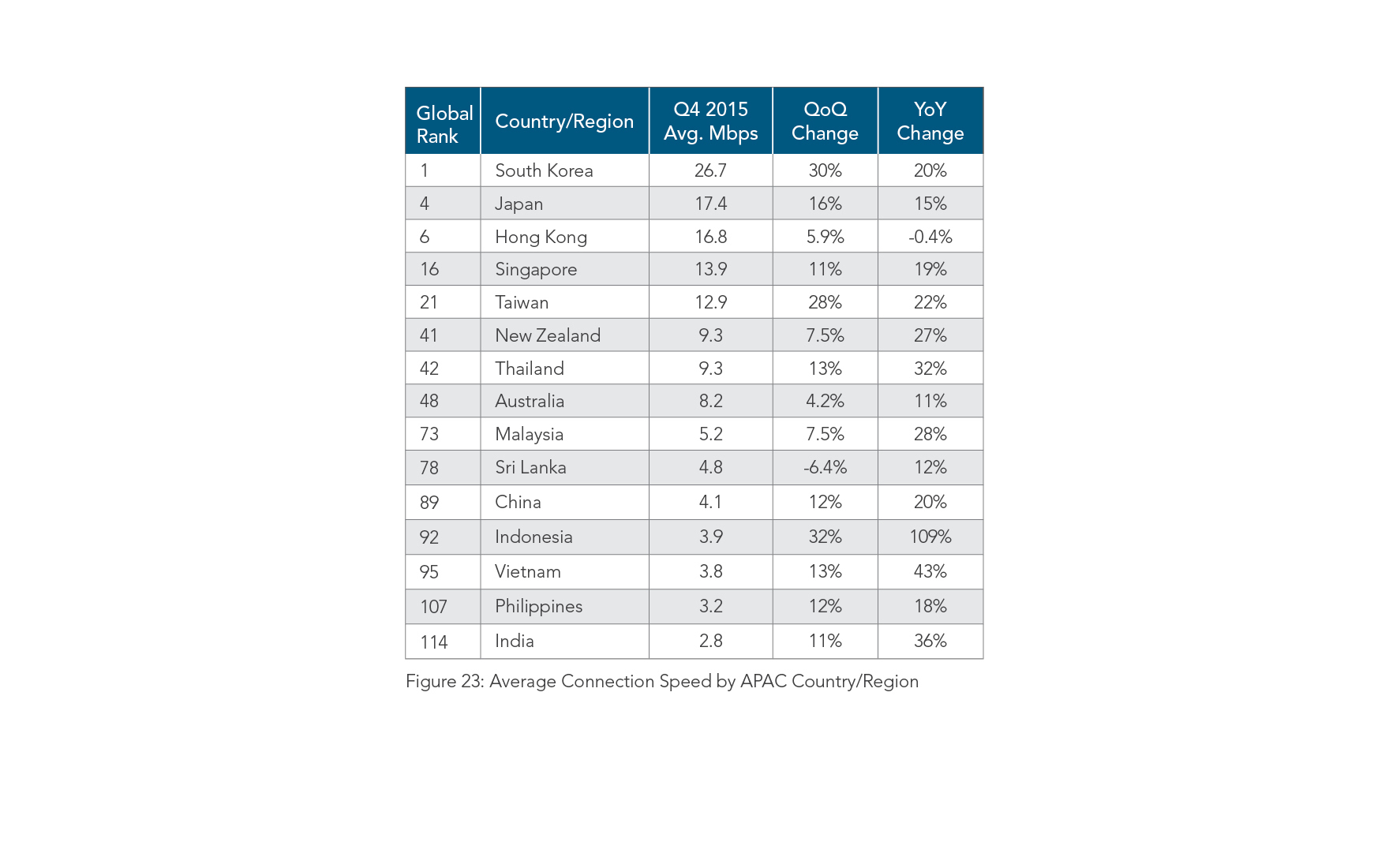
    In December 2015 the global average internet speed increased to 5.6 Mbps, an increase of 23 % year on year. India however, looks at the picture differently.

    Internet speed

    Akamai released a State of the Internet Report which states:

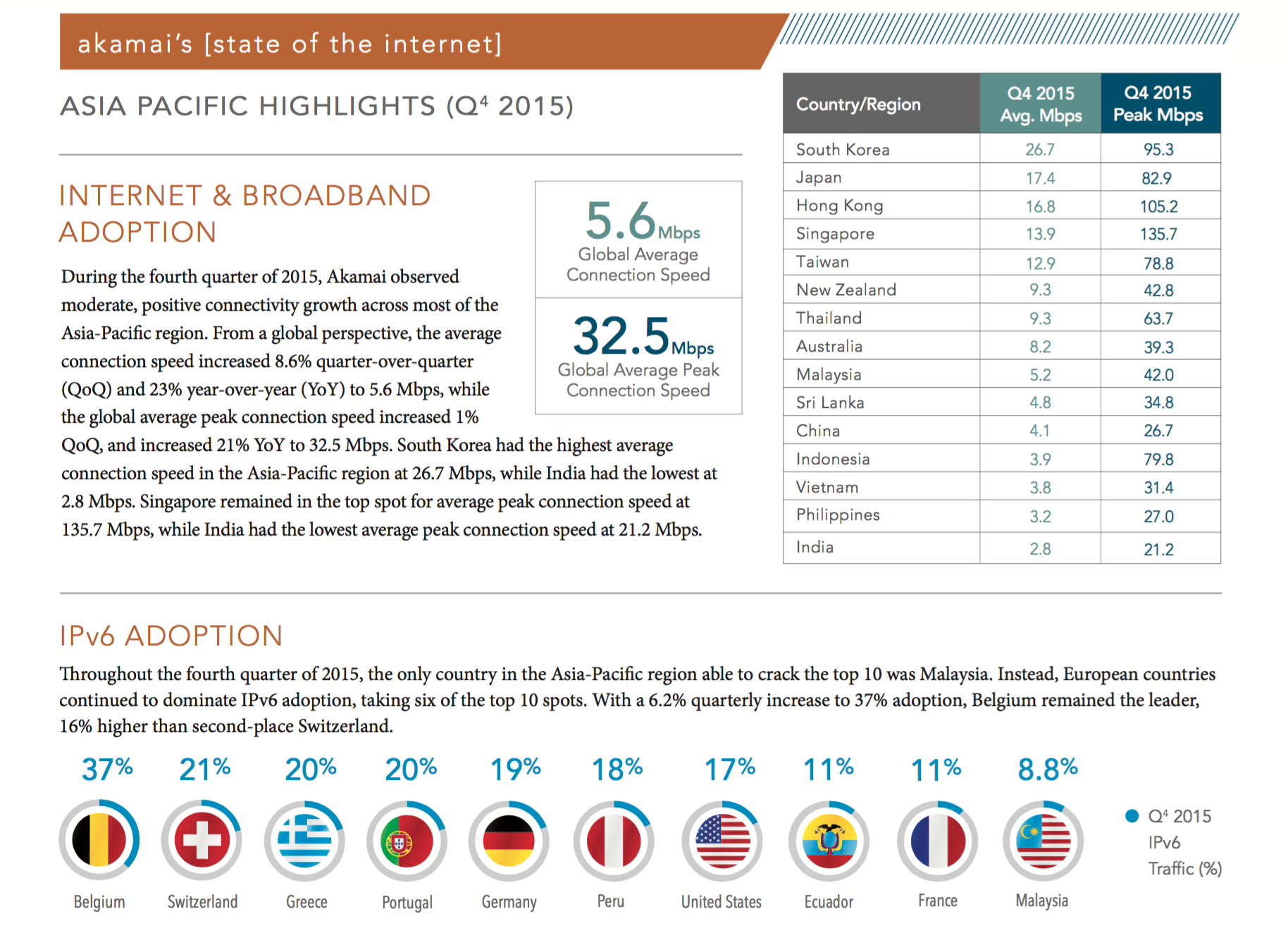
    From a global perspective, the average connection speed increased 8.6 percent quarter-over-quarter (QoQ) and 23 percent year-over-year (YoY) to 5.6 Mbps, while the global average peak connection speed increased 1 percent QoQ, and increased 21 percent YoY to 32.5 Mbps,

    South Korea tops the rank in APAC, with an average of 26.7 Mbps, India on the other hand has an average of 2.8 Mbps. South Korea (95.3 Mbps) and Macao (83.1 Mbps) show 10% and 13% growth year on year respectively.

    State of Internet Report 2015

    The report also pointed out that 43 countries/regions saw IPv4 address counts grow 10 percent or more in the quarter ended December 2015 while 13 saw counts decline 10 percent or more compared with the July-September quarter of 2015. You can read the full report in the source link below.

    Source


  • India’s Cochin Airport Has 100% Free Electricity Via a Massive Solar Project

    India’s Cochin Airport Has 100% Free Electricity Via a Massive Solar Project

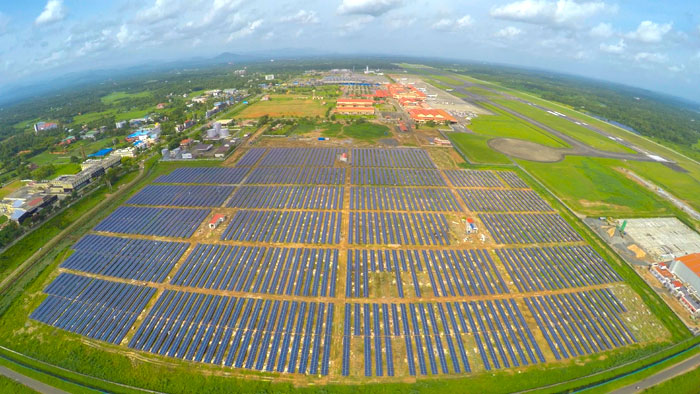
    Cochin Airport in India became the world’s first airport to become completely self-reliant as far as electricity is concerned.

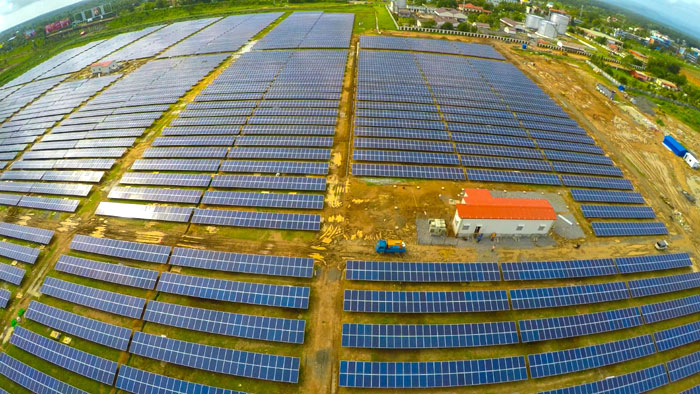
    The project, worth $10 Million, began in 2013 and was completed in 2015, it comprises of 46,150 solar panels laid on 45 acres of land near the airport’s cargo complex. Cochin airport’s solar power plant produces 50,000 to 60,000 units of electricity per day to for consumption by all facilities at the International airport.

    When we had realized that the power bill is on the higher side, we contemplated possibilities. Then the idea of tapping the green power came in. We consume around 48,000 unit (KWh) a day. So if we can produce the same, that too by strictly adhering to the green and sustainable development model of infrastructure development that we always follow, that would transcend a message to the world. Now this has become the world’s first airport fully operates on solar power ” -Said Mr.V.J.Kurian IAS, Managing Director, Cochin International Airport Ltd.

    This plant will produce 18 million units of clean power an annual power equivalent for 10,000 homes for one year. Over the next 25 years, this green energy project will avoid carbon dioxide emissions from coal-fired power plants by more than 3 lakh metric tons, which is equivalent to planting 3 million trees or not driving 750 miles.

    cochin solar feild

    Initially Kolkata-based M/s Vikram Solar Pvt. Ltd. was responsible for the 400 polycrystalline modules of an output of 250Wp and five Refu-sol 20kW capacity string inverters were used in this plant as a trial. After completion, the airport has so far saved more than 550 Metric Tonnes of CO2 emission.

    This solar project in itself is an incredible feat, and the fact that the whole airport is self-sustainable for at least the next 25 years makes it even more impressive

    Source

  • Apple vs FBI: DOJ Threatens to Force Apple into Turning Over iOS Source Code

    Apple vs FBI: DOJ Threatens to Force Apple into Turning Over iOS Source Code

    The United States Department of Justice has decided to tighten the noose on Apple, and in its latest Communications has in harsh words revealed to Apple that it will force Apple to comply with the government body’s directives.

    The feds have threatened Apple that if the Cupertino-based tech giant does not accept the FBI’s request to help it unlock the San Bernardino terrorism case suspect, Syed Farook’s phone, then the feds will with all their might force Apple to give up the entire source code of the iOS and the “private electronic signature” that is required for access to the code.With these, the FBI can essentially build its own Govt.OS and unlock the Apple iPhone 5c that was used by deceased terrorist Syed Farook.

    Apple store 1

    This epic battle between the FBI and Apple is becoming more ugly by the day as only yesterday; Apple accused the DOJ of getting desperate, explaining why the government’s rhetoric bar has been raised in the last couple of days. Apple for its part has also been in attack mode as in-house attorney Bruce Sewell called the government’s filing a smear job.

    Apple will go head to head against the government in court on the 22nd of this month after which there will be more clarity about the direction where things would move ahead in this particular case.

  • Russia Working On “Nuclear Powered Engine” for Fast Travel to Mars

    Russia Working On “Nuclear Powered Engine” for Fast Travel to Mars

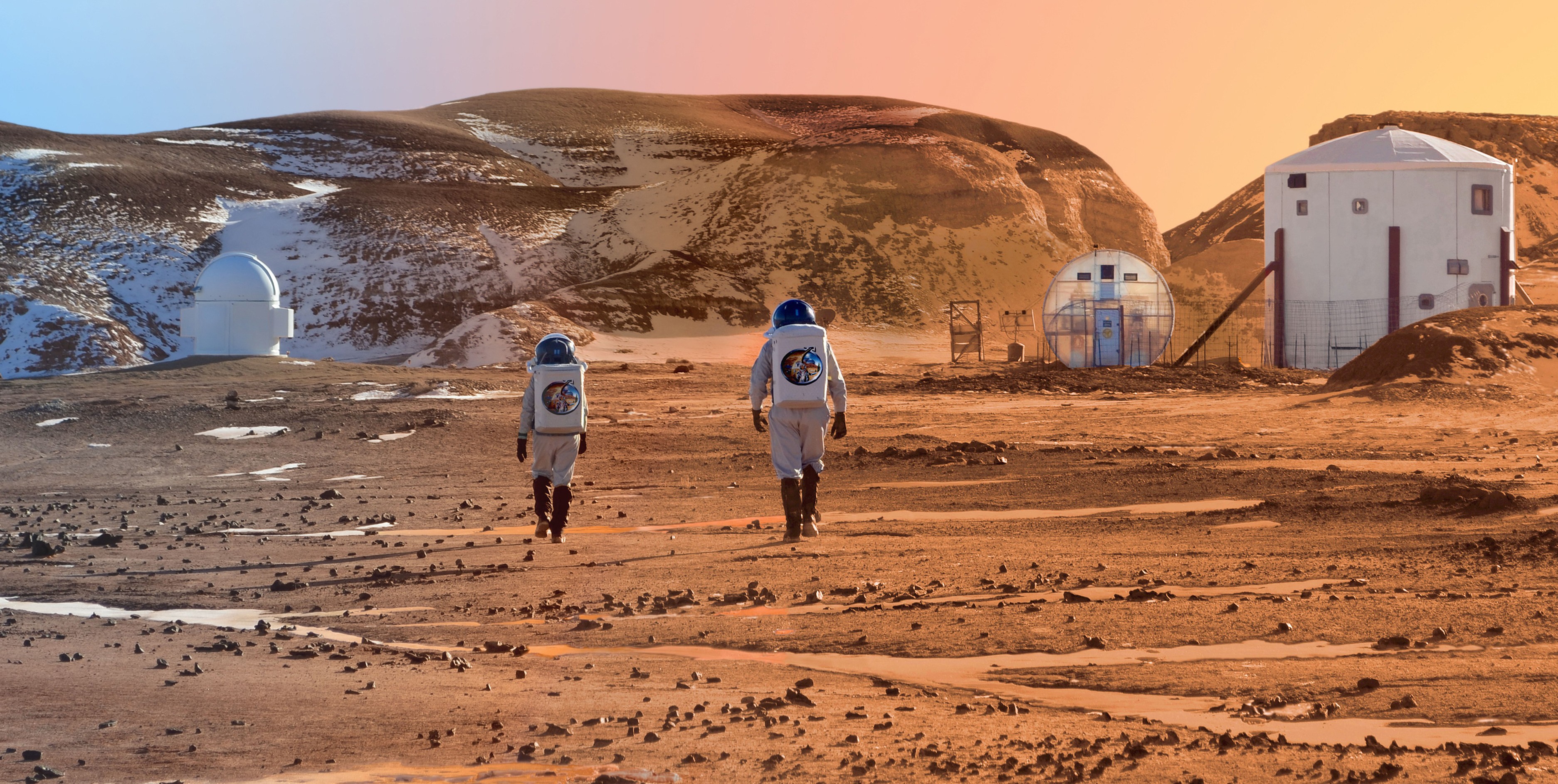
    Mars, for long has remained a planet which has captivated the imagination of the human race. For some reason, we have always maintained an obsession with the red planet making it become almost an enigma for us. Much of it is down to the fact that for all our technological advancements, we haven’t yet deciphered a fuel efficient and quick way to reach Mars, but all of it is about to change.

    Mars


    Russia is reportedly working on a super-fast spaceship which will take Astronauts to Mars in 45 days, as compared to what is 18 months using the current generation rocket propulsion technology. Talking about this, head of Russia’s state nuclear body Rosatom, Sergey Kirienko said,

    ” A nuclear power unit makes it possible to reach Mars in a matter of one to one and a half months, providing the capability for maneuvering and acceleration. Today’s engines can only reach Mars in a year and a half, without the possibility the of return.”

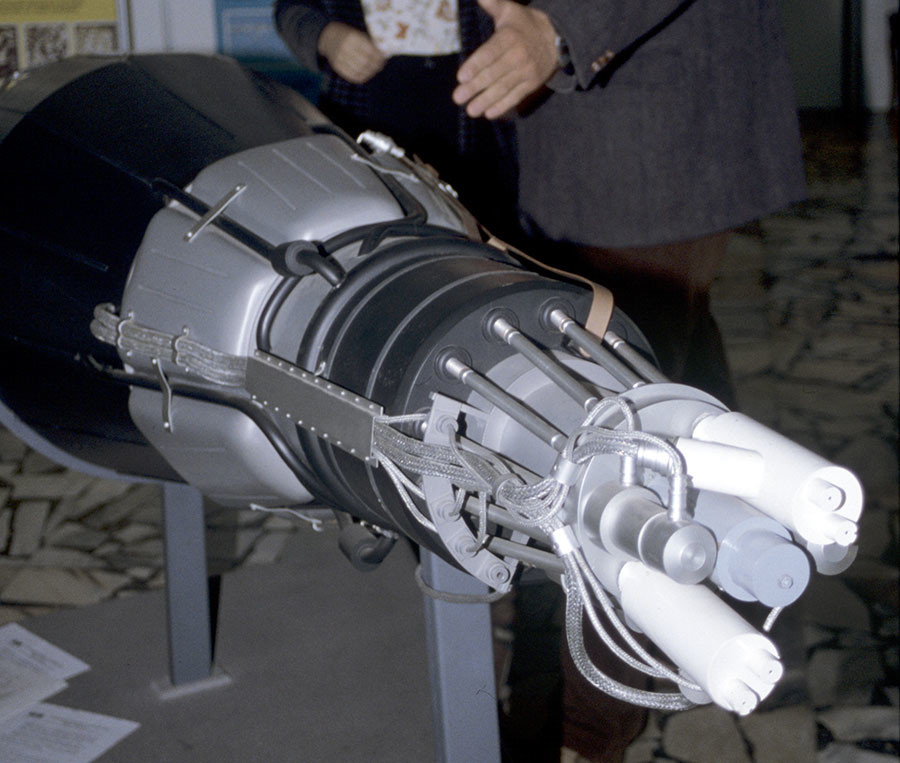
    topaz space reactor

    According to reports, a prototype nuclear drive could start testing by 2018. Traditional rocket engines are believed to have reached the limit of their potential and can’t be used for deep space exploration. The nuclear engine project was first launched in 2010 and by 2012, an engineering design had been created. The project’s budget is estimated at 20 billion rubles (about $US274 million). This is highly economical also in comparison to traditional rocket engines whose cost goes into 10s of Billions of US Dollars.

    Needless to say that a “Nuclear powered” spaceship comes with its obvious set of risks. As with rockets, many do not manage to cross the earth’s atmosphere, and some even blow up at the site of launch. Keeping that in mind, having a nuclear-powered spaceship blow up in the atmosphere leading to radioactive debris falling from the air onto areas of our planet does sound like a dangerous idea. In 1978, a nuclear-powered Soviet satellite crashed in northern Canada, spewing radioactive waste over nearly 50,000 square miles. But having said that, we’re sure the Russians will have some failsafe in place for a mishap like this, or at least we hope they would.


  • India Gets First Smart Self Cleaning Toilets

    India Gets First Smart Self Cleaning Toilets

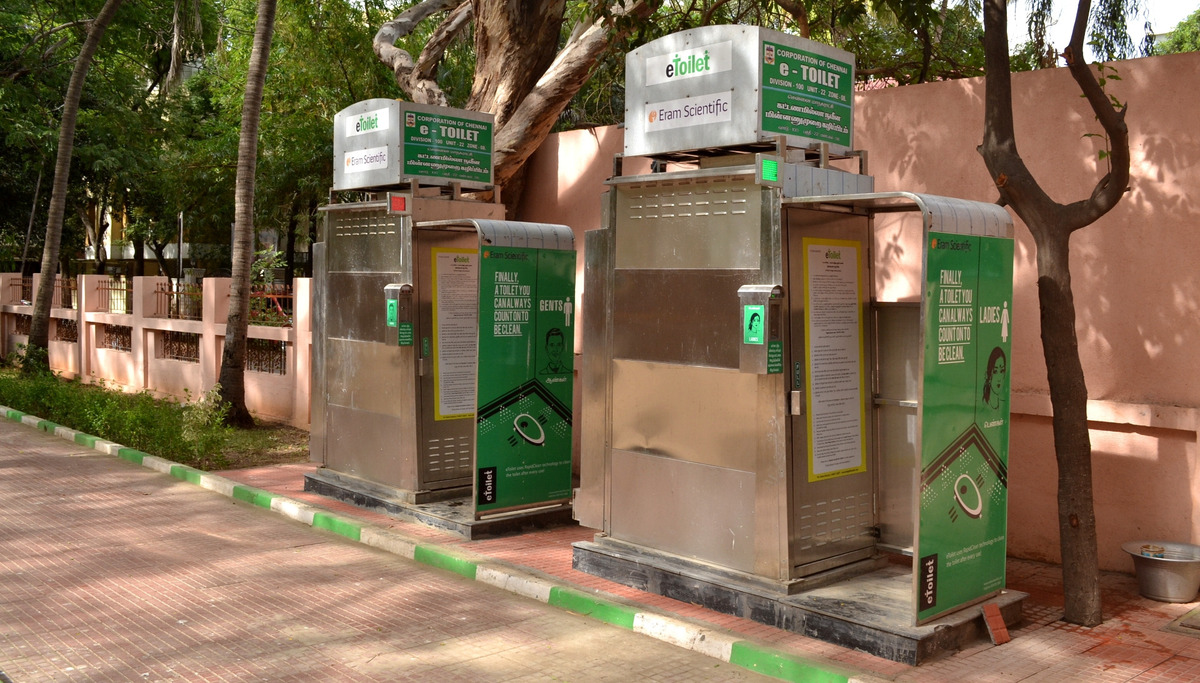
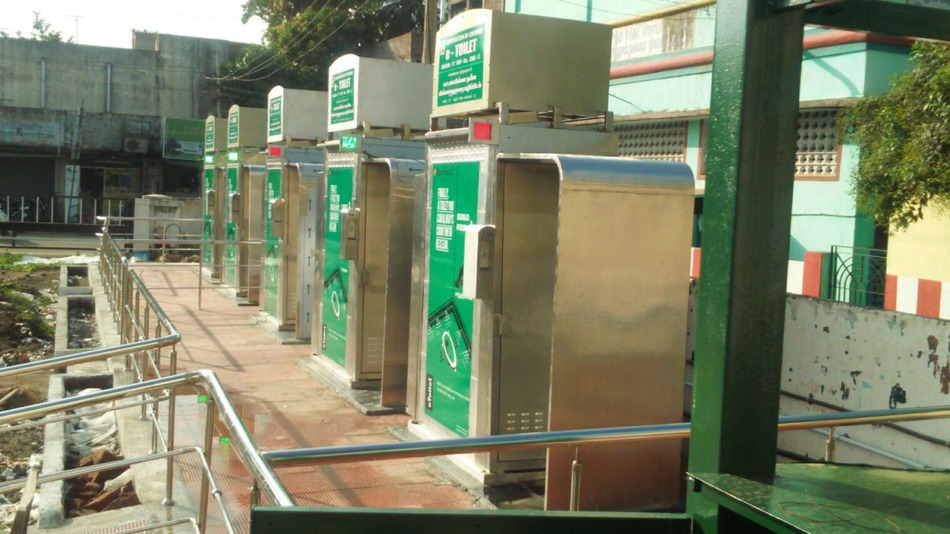
    In what is a first for the country, 183 self-cleaning public eToilets have been installed in the city of Chennai. These toilets which are spread out through the city of Chennai can be located through mobiles using an Android app which not only tells you the location but also gives the user functionality to rate them, offer feedback and even suggest new places where they should be installed. Making the service truly connected, officials from the Greater Chennai Corporation use another app to remotely monitor hygiene levels, usage figures, and water availability at each toilet.

    Adambakkam-Bus-Depot

    These toilets are fully automatic, and the toilet cleans itself before entry and after use. They come equipped with sensors for exhaust fan and light. The toilets flush with only 1.5 litres of water after 3 minutes of use, and with 4.5 litres if the usage period is longer. It also washes the floor automatically after five or ten rounds.

    To top things off, these toilets are eco-friendly and waste treatment is carried out using anaerobic biodegradation. One of its models, the e-Lite 14, is powered by solar panels to eliminate the use of electricity.

    Cost of these toilets are a bit on the upper side, at approximately Rs 4,50,000, but these could very well be great solutions to our cities sanitation and hygiene problems.

  • Apple vs FBI : Federal Court Rules in Favour of Privacy

    Apple vs FBI : Federal Court Rules in Favour of Privacy

    This are heating up in Apple’s fight with the FBI. On the eve of a Congressional hearing about the Department of Justice’s fight with Apple over unlocking San Bernardino terror suspect’s iPhone, a court in Brooklyn in a separate case has rejected an FBI request to order Apple to unlock  the phone of a drug dealer.

    The Department of Justice of the United States had first sought access to the phone in the Brooklyn case in October, months before a court in California ordered Apple to help authorities gain access to the phone of a terror suspect.

    Apple store 1

    In stark contradiction to the San Bernardino terror case, Judge James Orenstein has ruled that “he did not have the legal authority to order Apple to disable the security of an iPhone that was seized during a drug investigation”

    Although the judge in the San Bernardino case, will not be bound by Orenstein’s decision, analysts expect it to be influential. In both cases, the government relies on the All Writs Act.

    Orenstein in his ruling indirectly gave support to the key arguments Apple is making in its other, higher-profile fight with the government. He hinted, the All Writs Act (AWA) can’t be used to order a technology company to manipulate its products. He further said. “The implications of the government’s position are so far-reaching – both in terms of what it would allow today and what it implies about Congressional intent in 1789 – as to produce impermissibly absurd results,”


  • Union Budget 2016 : Major Tech Related Announcements and Reactions

    Union Budget 2016 : Major Tech Related Announcements and Reactions

    The Union Budget for 2016-2017 has been tabled in the parliament, and reactions are now pouring in thick and fast from across all quarters. The day saw the tech industry react favourably to the slew of announcements by the Finance Minister which will look to spur technological developments in the country in the coming years.

    Emphasising on the importance of technology, a key aspect which will drive forward PM Modi’s Digital India initiative, Arun Jaitley in the lower house said “technology would be used in all aspects, starting from tax and markets to data mining and more with the help of better IT systems”

    finance_ministry

    Here are the major announcements made by the Finance Minister which were tech related and would impact the consumer markets, and us in the coming days.

    • The FM announced two new schemes — national digital literacy mission and digital Saksharta Abhiyan, both aimed at improving digital literacy in the rural and urban areas of the country.
    • National Digital Literacy Mission Scheme aimed at rural areas of the Internet, which aims at making the Indian citizens connected with Internet.
    • The FM announced that the government plans to cover about 6 crore houses in rural areas in the next three years and provide digital devices like computers, tablet PCs and smartphones, and Internet usage
    • FM Jaitley announced cabinet’s approval of the Start Up India campaign. To encourage entrepreneurs, Jaitley has announced a range of tax benefits, including 100 percent tax deduction for three out of five years.
    • Proposal to reduce excise duty on inputs, parts and components, subparts for manufacture of charger/adapter, battery and wired headsets/speakers of mobile phone from 12.5% to nil.

    The day saw major names from the industry come out and react to these announcements that could have a major impact on the industry over the coming fiscal. Here’s a round up of what the biggest names from the industry had to say.

    Debjani Ghosh, Vice President, Sales and Marketing Group and Managing Director for South Asia at Intel on Union budget 2016, said in a statement

    “The budget is strongly focused on bridging the divide between the ‘haves’ and ‘have not’s’, and good work by the Government in identifying the right priorities for focus under the 9 pillars called out by the FM. This budget, unlike any other, has not treated technology in isolation but integrated the effective use of technology across all the strategic imperatives in keeping with the intent of a Digital India.

    Vinu Cheriyan, CFO & Director Operations at Sennheiser Electronics India Pvt Ltd had this to say,

    “It is heartening to see our accelerated to 7.6% and the CPI inflation has come down to 5.4%.  It is also quite encouraging to see that fiscal discipline has been given priority at today’s budget while focusing on the GDP growth” He further added  “The budget didn’t mention much about the electronic segment at all, we need to go through the fine print to delve deeper into it.It is great to see that both corporates and salaried employees are relieved in the budget as there is an improved cash flow for the middle class due to various tax reliefs”

    Talking about the impact of the budget on the burgeoning mobile phone industry, Mr. Rajesh Agarwal, Co-Founder, Micromax Informatics Limited, said,

    ” Make in India continues to be an important agenda for the government as the new manufacturing companies are going to reap benefits in the segment. We have been one of the first companies in India to stress in local manufacturing, and it is great to see increase emphasis by the government yet again. The proposal on reduction in excise duty  on inputs, parts and components, subparts for manufacture of charger/adapter, battery and wired headsets/speakers of mobile phone, being exempted from 12.5%  to nil is a welcome move and will eventually promote the manufacturing of these components domestically..


  • Samsung’s Appeal Destroys Apple’s $120M Win in Patent Dispute

    Samsung’s Appeal Destroys Apple’s $120M Win in Patent Dispute

    In what will come as bitter defeat for Apple, by the hands of the South Korean tech giant, Samsung, which earlier today saw the US Court of Appeals overturn the 2014 verdict of a California federal court that held Samsung guilty of infringing on Apple’s smartphone patents and directed the former to pay $120 million in damages.

    samsung-vs-apple-iphone-5-642x394

    The U.S. Court of Appeals for the Federal Circuit in Washington, D.C., said Samsung Electronics Co Ltd did not infringe Apple’s “quick links” patent, and that two other patents covering the iPhone’s slide-to-unlock and auto-correct features were also invalid. Adding insult to the misery the court also said Apple was liable for infringing one of Samsung’s patents.

    Samsung reacted to the statement with a spokeswoman stating: “Today’s decision is a win for consumer choice and puts competition back where it belongs – in the marketplace, not in the courtroom.” Apple spokesperson unsurprisingly declined to comment.

    The particular verdict comes just days after Apple in a separate case asked the US Supreme Court not to take up the South Korean company’s appeal. That case has so far seen Samsung agreeing to pay Apple $548 million to settle it.


  • Union Budget 2016 : What to Expect

    Union Budget 2016 : What to Expect

    With the Union Budget 2016 hardly days away, the nation’s eyes are on the Finance Minister Arun Jaitley’s suitcase which holds in itself the blueprint of the plan which will not only affect big Multi National firms and small startup companies but each and everyone of us.

    From IT firms, automobile manufacturers to mobile phone makers, everyone has their wish lists set that will help them grow in this vibrant and growing market that India is right now, but what about the average tech-loving citizen that you and me represent? Let’s take a look at what the budget holds for tech addicts like you and me.

    Allocation of resources for improving existing telecom and Broadband Infrastructure
    telecom

    We might have access to fancy 4G phones, and expensive computers in our country, but what good is it if there isn’t a proper infrastructure at the service providers end to run these devices the way they should? But the government wants to change all that with the upcoming Union Budget 2016.

    Call drops, and slow broadband connections could soon become a thing of the past with the government looking to substantially invest in improving the infrastructure in the coming year. The Telecom ministry has a proposal to allocate Rs.7,350 crore to Universal Obligation Fund which focuses on increasing infrastructure across the country.

    Push for Startups and Entrepreneurs
    Sign at the entrance of Startup city, Washington

    With the push by the government towards the ‘Start Up India, Stand Up India’ initiative, we may see more tax breaks, concessions and budget allocation towards developing the infrastructure and skills to encourage entrepreneurship in the country.

    According to analysts, the Government is likely to raise the Service Tax exemption bar for Small & Medium Businesses. The service tax limit is expected to be raised to Rs 25 lakh from the current Rs 10 lakh. The moves will mark a significant advance in ease of doing business and pave the way for the growth of young entrepreneurs and startups across the nation.

    Apart from this, Startups could also enjoy benefits in the form of exemption from paying income tax for the first three years and a massive 80% rebate on filing a patent application.

    Hike in VAT and Sales Tax

    Feature1

    With the shadow of the Goods and Service Tax(GST) which will subsume all other indirect taxes under it looming large over the economy, the government with the new budget will look towards a new round of tax hikes to bring all indirect taxes such as VAT and Sales Tax as close to the 17.5% rate of GST.

    Though this move is good for fiscal consolidation, and will most likely not last for over a year, this increase in the tax rate could make products such as mobiles, laptops, cameras etc significantly more expensive and as a result, hamper consumer demand.

    Subsidy to See Cars/Mobiles Get more Affordable
    MAKE-IN-INDIA

    With the government pushing for its pet project, the ” Make in India” Campaign, a number of new companies are expected to start rolling out mobile phones, automobiles and other consumer durables which will cost significantly less because of tax exemptions they will enjoy under the Make in India program. The companies are expected to trickle down the benefit that they enjoy from the governments end to help provide products to the end consumer at more affordable price points.

    Subsidy on smartphones budget smartphones can also be expected which will further help the government in connecting the far reaches of the country to the big cities. As it stands, Tier 2 and 3 cities in the country thrive on these devices and increasing smartphone reach through such tax reductions will only help the whole growing smartphone ecosystem in the country.


    Union Budget 2016

    What to Expect

    Telecom and Broadband Infrastructure Proposal to allocate Rs.7,350 crore to Universal Obligation Fund to improve infrastructure.
    Startups and Entrepreneurs Service tax limit expected to be raised to Rs 25 lakh.

    Exemption from paying income tax for the first three years.

    Massive 80% rebate on filing a patent application

    VAT & Sales Tax Major Hike in taxes from their respective rates closer to the 17.5% of GST. To affect prices of mobile phones, cars, and consumer goods directly.
    Tax exemption on Manufacturing Subsidy on products to increase under the “Make in India” program. Will see Cars/Mobiles Get more Affordable in the coming year.


  • Apple vs FBI : Bill Gates Ditches Apple in the iPhone Encryption Case

    Apple vs FBI : Bill Gates Ditches Apple in the iPhone Encryption Case

    As the plot thickens in this complex saga of privacy vs security, Apple has seen a lot of big names put their weight behind its argument but today in a change of trends, one of the biggest names that the tech industry has ever seen has come out surprisingly in open support of the FBI.

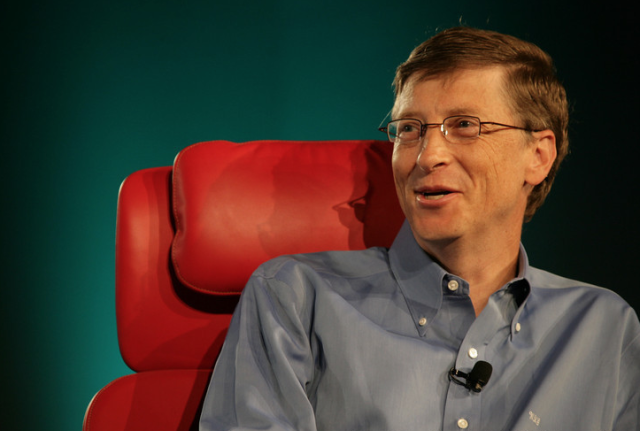
    Microsoft co-founder and billionaire philanthropist Bill Gates has backed the Federal Bureau of Investigation in its legal battle against Apple over encryption in an iPhone used by one of the shooters in December’s San Bernardino attacks.

    screen-shot-2015-01-28-at-10-06-36-am

    In an interview with the Financial Times, Gates dismissed the notion that Aple’s CEO Tim Cook is propagating that granting the FBI access would set a legal precedent for future cases such as this one. Bill Gates argued that the FBI is “not asking for some general thing, and is asking for a particular case.”

    Adding to this, the Co-Founder of Microsoft goes on,

    “It is no different than [the question of] should anybody ever have been able to tell the phone company to get information, should anybody be able to get at bank records. Let’s say the bank had tied a ribbon round the disk drive and said ‘don’t make me cut this ribbon, because you’ll make me cut it many times.’”

    As it stands, Microsoft communications chief Frank X. Shaw declined to comment on Bill Gates’ comments which sees him alienating himself from other Silicon Valley top executives, such as Facebook Inc chief Mark Zuckerberg, Twitter Inc founder Jack Dorsey and Google head Sundar Pichai, who have all backed Cook’s decision, the newspaper added.

    .

  • US Dept of Justice Files Motion Forcing Apple to Hack into iPhones

    US Dept of Justice Files Motion Forcing Apple to Hack into iPhones

    Things are getting ugly between the FBI, and Apple. In latest developments in this ongoing saga, the Department of Justice has gotten itself involved and has filed a motion asking Apple to comply with the FBI order.

    Over the last few days, the courts ordered Apple to create a special version of the iOS to access a work iPhone 5c of one of the suspected terrorists involved in the San Bernardino shooting. What ensued then was Apple bringing the debate to the public discourse when its CEO, Tim Cook, wrote a strongly worded open letter to its customers worldwide in which it insinuated that it will not comply with the court’s orders as it will be detrimental to the privacy of each and everyone using the iPhone 5c.

    snooping

    This motion filed against Apple shouldn’t come as a surprise after what the Obama government has already said on the issue. The government earlier revealed that it is in the favour of FBI’s argument, and considers rooting out terrorism a priority over the privacy of millions around the globe.

    The Department of Justice filing which could have grave implications for all of us read,

     “Apple left the government with no option other than to apply to this Court for the Order issued on February 16, 2016. The Order requires Apple to assist the FBI with respect to this single iPhone used by Farook by providing the FBI with the opportunity to determine the passcode. The Order does not, as Apple’s public statement alleges, require Apple to create or provide a ‘back door’ to every iPhone; it does not provide ‘hackers and criminals’ access to iPhones; it does not require Apple to ‘hack [its] own users’ or to ‘decrypt’ its own phones; it does not give the government ‘the power to reach into anyone’s device’ without a warrant or court authorization; and it does not compromise the security of personal information.”


iGyaan Network
Privacy Overview

This website uses cookies so that we can provide you with the best user experience possible. Cookie information is stored in your browser and performs functions such as recognising you when you return to our website and helping our team to understand which sections of the website you find most interesting and useful.