Tag: infringement

  • Qualcomm Demands US$ 31 Million In Damages From Apple

    Qualcomm Demands US$ 31 Million In Damages From Apple

    Qualcomm and Apple are known for battling out a number of suits in courts, and the latest trial between the two companies was held in San Deigo over infringement of three different patents by Apple. As per reports, Qualcomm has demanded the trillion dollar technology company, Apple to pay a sum of US$ 31 Million in damages for the same. 

    The Hearing
    Apple’s leading witness for the case, former engineer Arjuno Siva was supposed to testify in the court on March 7. However, as per reports, he was unable to reach the destination, and the Qualcomm’s defence defense was accused of witness tampering by the Apple counsel. Moreover, the company called its former employee a “tainted witness” when he failed to turn up for the hearing.
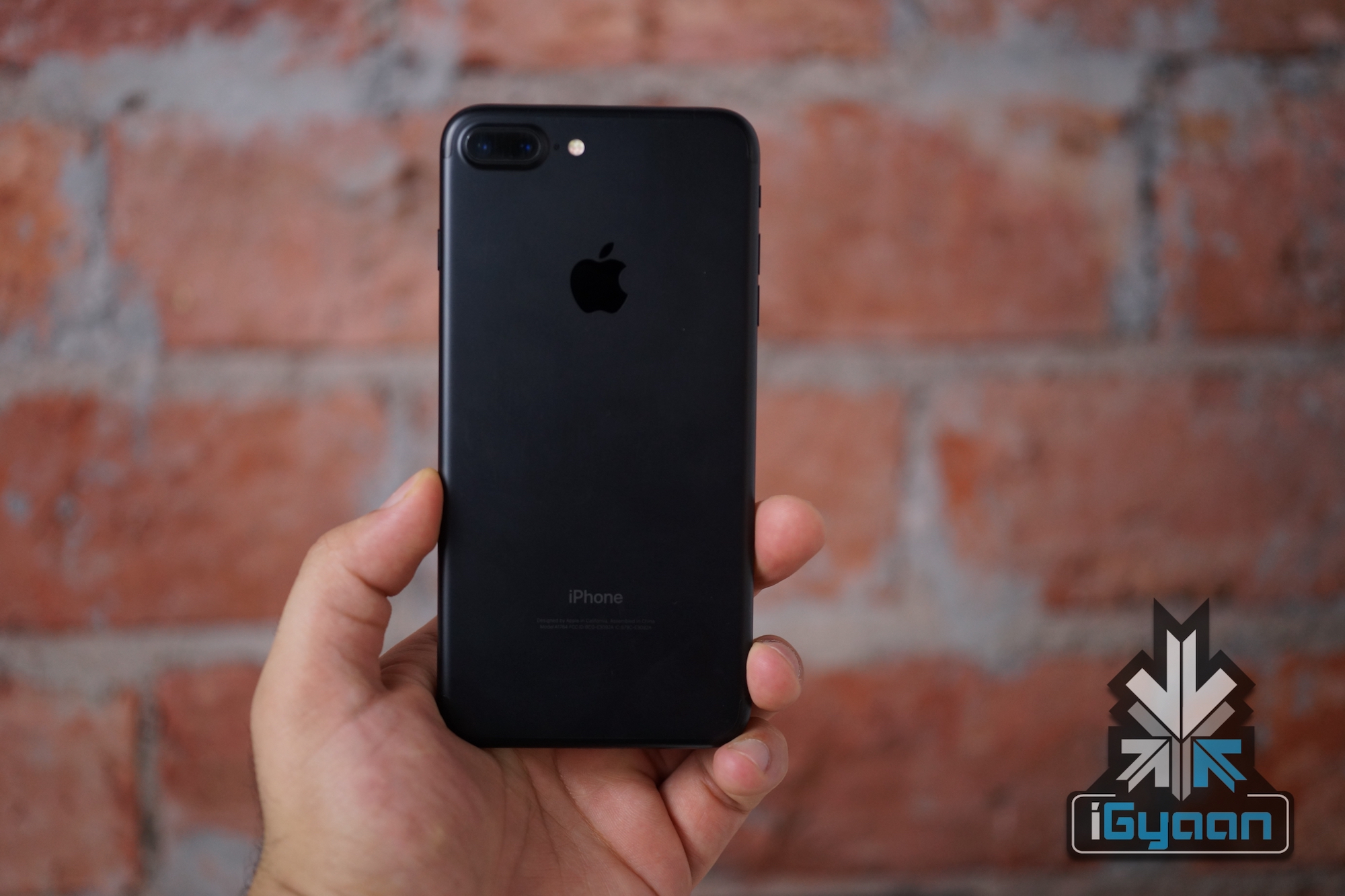
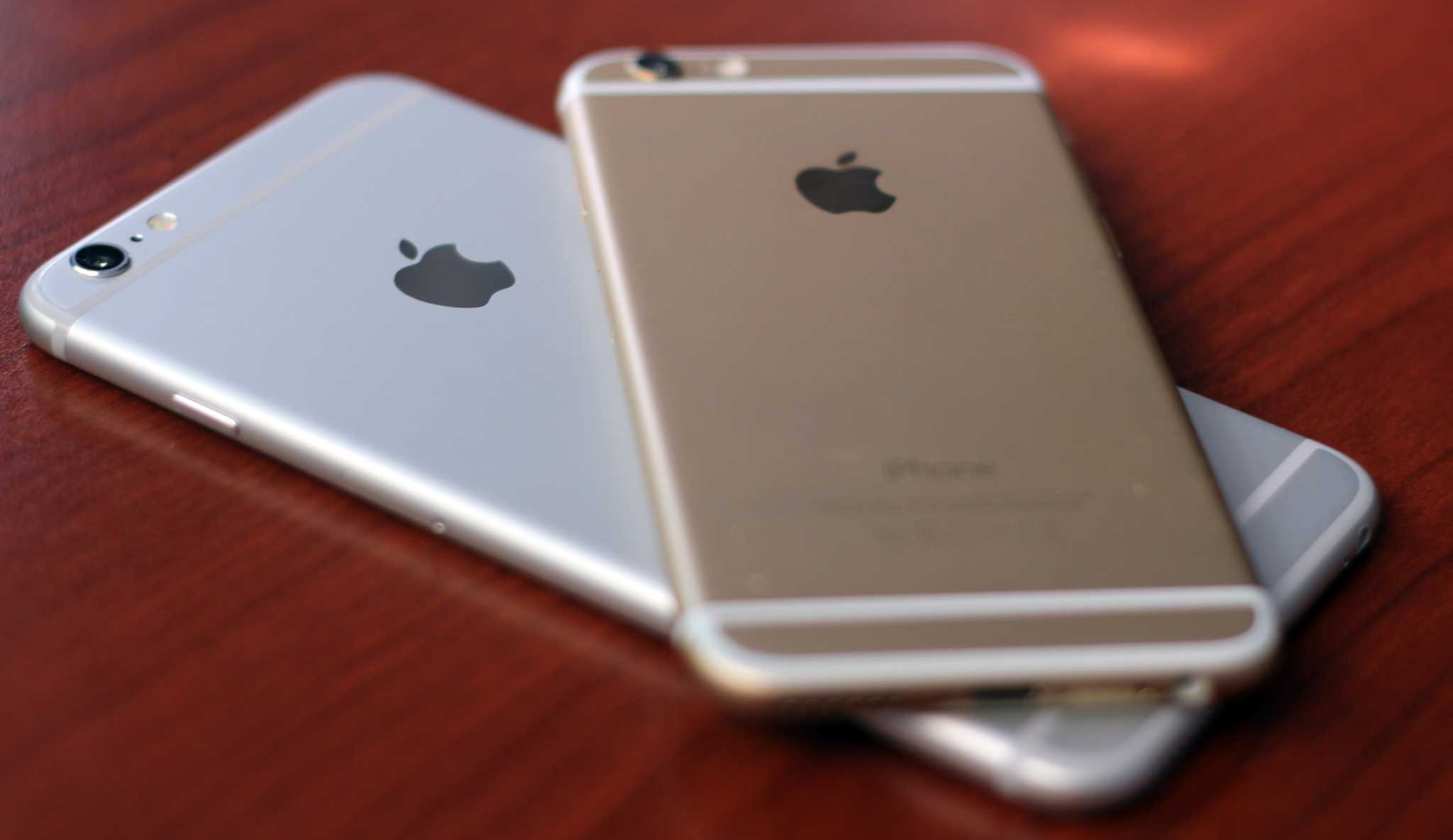
    In a turn of events, the ex-Apple employee has hired a new attorney, leading to Apple’s confirmation that the testimony will take place during the next hearing after all. Furthermore, information has come to light that the damages are for iPhones sold July 2017 onwards, which were kitted with Intel Chips. Later in the year 2017, Apple replaced Qualcomm with Intel as its exclusive components supplier. As per reports, in the year 2016, Apple was also using Intel modems in some iPhone variants instead of Qualcomm modems. The devices included the iPhone 7 and 7 Plus.

    About The Patents

    Hence, Qualcomm is seeking US$ 31 Million in damages from Apple, which roughly breaks down to US$1.40 per iPhone sold. The infringed patents are as follows:

    • one that handles the CPU and modem connection to download applications.
    • one that helps the iPhone to connect to the Internet immediately after it is turned on.
    • one that focuses on battery life and the processor.

    Also Read: Intel And Qualcomm Will Offer 5G Modems For Computers

    Notably, the biggest lawsuit between the companies will be settled in April 2019, in which Apple has accused Qualcomm of indulging in anti-trust practices and illegally withholding US$ 1 Billion worth of rebates from Apple.
     

  • Apple Wins Lawsuit Against Samsung, 9 Samsung Devices Banned from Sale

    Apple Wins Lawsuit Against Samsung, 9 Samsung Devices Banned from Sale

    Say hello to yet another courtroom drama between Samsung and Apple. As always, the bone of contention was patent infringement where Apple accused Samsung of having stolen features like word recommendations and unlock gestures.

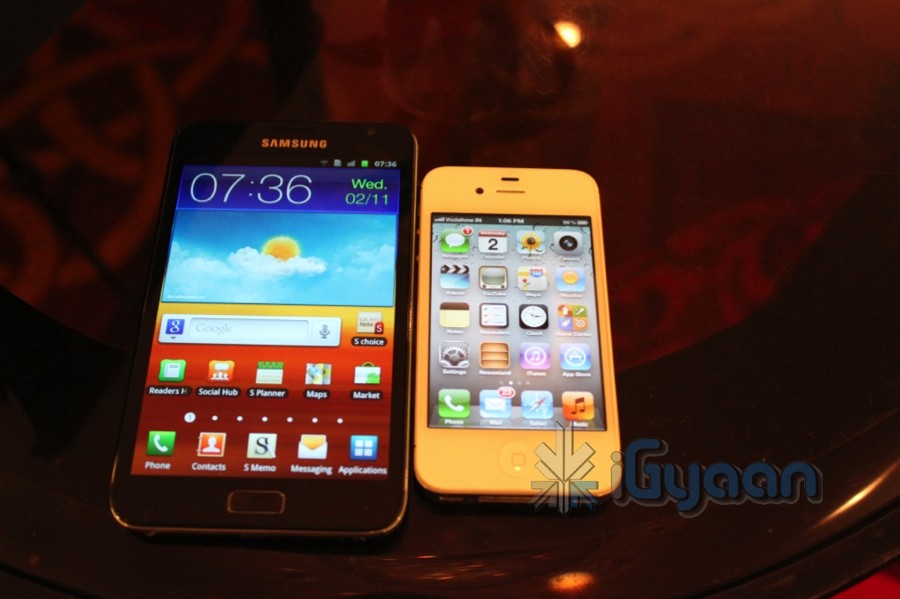
    Judge Lucy Koh of the Northern California District San Jose court agreed with Apple leading to banning of Samsung’s flagship devices from 2012. The list of devices now banned from sale in the US includes Samsung Admire, Galaxy Nexus, Galaxy Note, Galaxy Note II, Galaxy S II, Galaxy S II Epic 4G Touch, Galaxy S II Skyrocket, Galaxy S III and Samsung Stratosphere.Samsung vs Apple

    The lawsuit had been stretched over a period of three years before the final verdict was passed. This means there has been three new generations of smartphones since the first violation of patents. Other than many sellers making some extra dough by selling these banned Samsung devices for a higher-than-normal price on eBay, one wonders what else this verdict could lead to. While Samsung may not feel too amused at this point, this is a blow it will definitely recover from without much effort.

    Besides, it wouldn’t be too long before Samsung’s gets a chance to even out the two scores once the two companies find themselves pitted against each other again in another courtroom scenario. Hold your breath until then.

  • Samsung Drags Apple to Supreme Court Over Patent Lawsuit

    Samsung Drags Apple to Supreme Court Over Patent Lawsuit

    Looks like the two tech-giants have taken it upon themselves to take care of the drama front of the tech world. As lawsuits and courtroom scenes between Samsung and Apple continue to persist, here’s the latest update.

    Samsung had agreed to pay Apple $548 million this month after negotiating an initial penalty of $1 billion over a patent copyright infringement lawsuit. While many saw this as a stroke of luck for Samsung to be able to pay only half the amount of the initial fine, Samsung clearly disagrees.Samsung Apple Legal Trouble

    The company requested the verdict to be over-turned by the Supreme Court by filing a motion with the highest court in the United States. Samsung believes the previous jury was not given enough material to understand the patent thoroughly.

    Since the cases in the American Supreme Court are chosen by the justices, there is no surety that Samsung will get a chance to fight it out with Apple there. But if it does indeed land up there, both companies will be required to make 30 minute long oral-arguments each, along with file briefs. Time to bring out the popcorn and sit-back, folks. Team Samsung or Apple?

  • Apple To Pay $234 Million For Patent Infringement

    Apple To Pay $234 Million For Patent Infringement

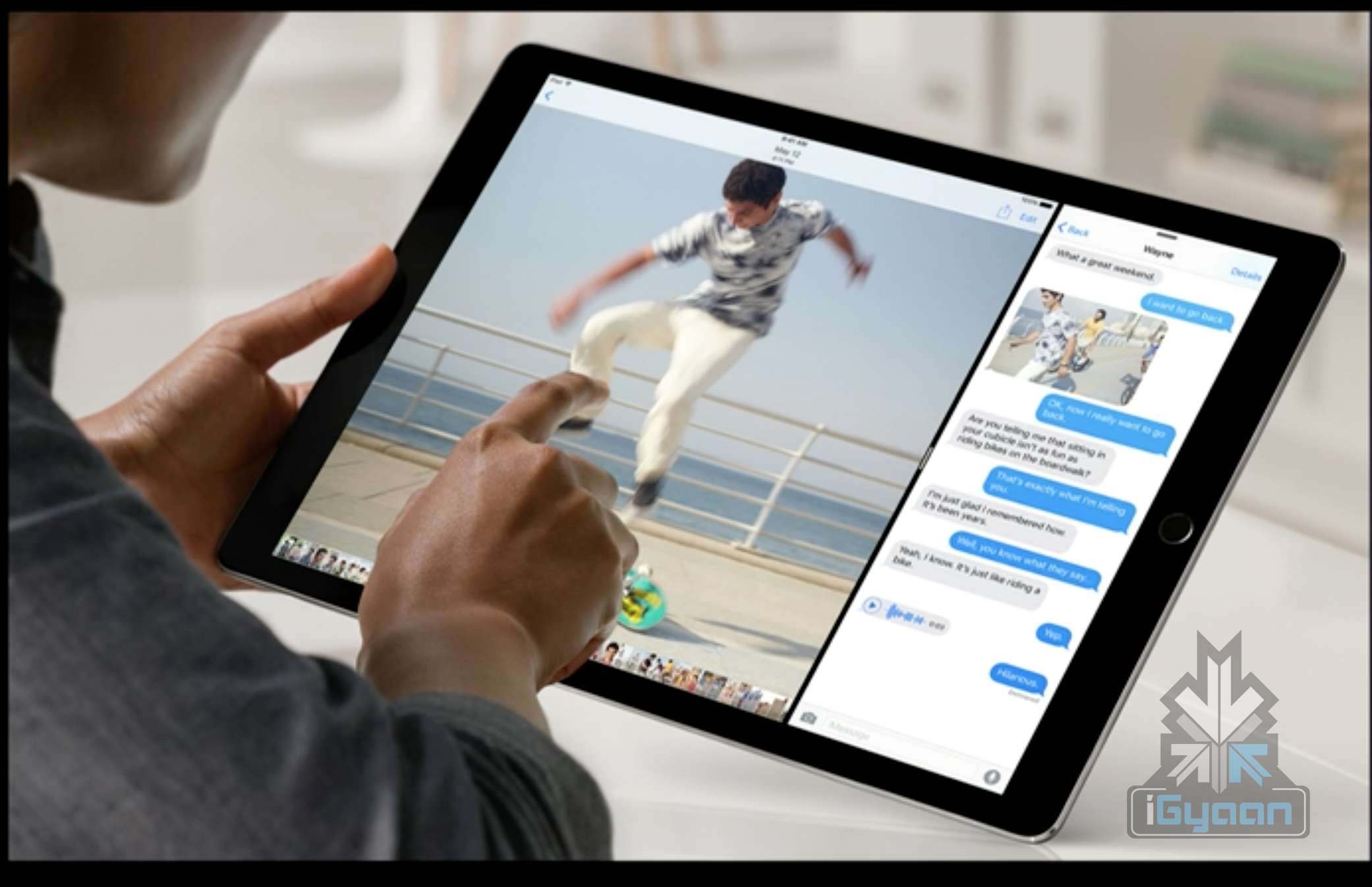
    A US jury has passed its verdict and it’s definitely not going to please Apple. The tech giant has been ordered to pay Wisconsin Alumni Research Foundation (WARF) a sum of over $234 million as penalty for patent infringement. WARF is in-charge of all the patent licensing of the University of Wisconsin-Madison.Apple iPad Pro 4

    The jury had previously reached a decision that Apple had used a patented microchip technology in its iPads and iPhones to which Apple had appealed. After about three hours of deliberation, the amount was set at over a hundred million dollars less than what the University had demanded of Apple. We did a story on this lawsuit which you can read here.Samsung Apple Legal Trouble

    Though Apple is at least free of one lawsuit, more legal trouble awaits the company courtesy of WARF again which is suing the company on the same lines for using patented technology in its latest iPhones -6s and 6s Plus. However, legal trouble is not a territory unknown to Apple which has been waging copyright, infringement and patent related battles with other tech giants as well, Samsung being one of them. Such penalties are not likely to be more than a puny amount for a company which reported its annual revenue for 2014 to be around $182 billion.

  • Google To Face Hefty Fine For SimpleAir Push Notification Patent Infringement

    Google To Face Hefty Fine For SimpleAir Push Notification Patent Infringement

    SimpleAir is seeking $125M in damages from Google after a jury found that push notification services in Android infringe on a SimpleAir patent, the company said Tuesday.

    The accused services are the Google Cloud Messaging (GCM) and Android Cloud to Device Messaging (C2DM) services. The services are used by Google to process and send instant notifications for Android applications, such as Facebook, Twitter, and Gmail.

    It’s worth noting that Google isn’t the first company to run into trouble with SimpleAir. Microsoft, Apple and even Blackberry all have licensing agreements with the company, after all. 

    Because the jury did not agree on how much to award in damages, a limited second trial will be held to determine the amount. SimpleAir said in a press release that it will seek US$125 million, though it did not specify how it had calculated the amount.

    [modal heading=”Press Release” text=”Press Release” size=”btn-medium”]Federal Jury Finds Google Infringed SimpleAir Patent January 21, 2014 03:45 PM Eastern Standard Time MARSHALL, Texas–(BUSINESS WIRE)–SimpleAir announced today that a federal jury returned a verdict that SimpleAir’s U.S. Patent No. 7,035,914 is infringed by Google. The verdict was reached on Saturday, January 18, 2014, following a week-long trial presided over by the Honorable Rodney Gilstrap, U.S. District Judge for the Eastern District of Texas. “We are grateful for the jury’s hard work in this case and pleased with their verdict” SimpleAir had alleged that Google’s push notification services for the Android smartphones and tablets infringed five claims of the ‘914 patent. The jury agreed unanimously on all counts of infringement and also found unanimously that each claim was valid. The validity of the patent had previously been confirmed by the U.S. Patent and Trademark Office during a Reexamination proceeding that concluded in February 2013. The accused services are the Google Cloud Messaging (GCM) and Android Cloud to Device Messaging (C2DM) services. The services are used by Google to process and send instant notifications for Android applications, such as Facebook, Twitter, and Gmail. The jury was unable to reach a unanimous decision on the amount of damages to award for Google’s infringement. The damages issue will be decided by a separate jury in a limited second trial. SimpleAir will seek damages in excess of $125 million for Google’s infringement in the damages retrial. “We are grateful for the jury’s hard work in this case and pleased with their verdict,” said John Payne, who is the lead inventor and majority owner of SimpleAir. “There was a lot of information presented to the jury and they did an exceptional job figuring out what mattered and what didn’t. We look forward to addressing the issue of damages in the second trial and hope the jury in that trial will be as dedicated as this one was.” SimpleAir is an inventor-owned technology licensing company. The company holds eight issued U.S. Patents and several pending patent applications in the areas of wireless content delivery, mobile applications, and push notifications. SimpleAir has licensed its inventions to many leading technology companies. SimpleAir is represented by Greg Dovel, Jeff Eichmann, and Simon Franzini of Dovel & Luner LLP and by Calvin Capshaw, Elizabeth DeRieux, and Jeff Rambin of Capshaw DeRieux LLP.[/modal]

  • Apple Pays for Swiss Railway Clock Design

    Apple Pays for Swiss Railway Clock Design

    Apple may be willing to spend millions in court over some copyright fights, but it has learned the lessons of history and has decided not to mess with the Swiss.

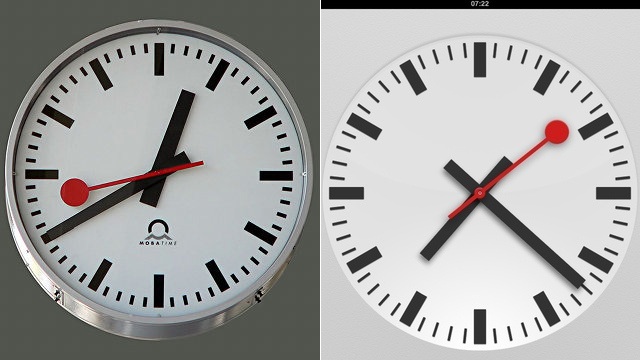
    Last month, Switzerland’s railway operator SBB took Cupertino to task for stealing the design of its clock for iOS 6’s Clock app. Now the world’s favorite fondleslab manufacturer has agreed to pay up and license the design from SBB, rather than risk the wrath of the Swiss railways.

    The iPad Clock app, according to an SBB spokesperson, was “an unauthorized use by apple,” and thus they needed to work out a “legal and financial” resolution to the issue in order to prevent copyright infringement.  However, SBB later admitted that it was “rather proud that a brand as important as Apple is using our design,” to clarify that they weren’t simply taking money for the use of the design.  SBB already does in fact license the clock’s design to other companies, including the watchmaker Mondaine, so it can be assumed that Apple did pay to use the design.

    According to SBB, the railway clock, which was originally designed by Hans Hilfike in 1944 has become “a symbol of innovation and reliability.”

  • Apple wins $1 billion in Samsung patent case

    Apple wins $1 billion in Samsung patent case

    Apple Inc scored a sweeping legal victory over Samsung on Friday as a U.S. jury found the Korean company had copied critical features of the hugely popular iPhone and iPad and awarded the U.S. company $1.05 billion in damages.

    The verdict — which came after less than three days of jury deliberations — could lead to an outright ban on sales of key Samsung products and will likely solidify Apple’s dominance of the exploding mobile computing market.

    The US lawsuit was one of several cases around the world between California-based Apple and South Korean Samsung over technology rights and innovation in the fast-growing mobile computing sector.

    Apple sued Samsung in April 2011, and Samsung countersued. The companies have also sued each other in Britain, Australia and South Korea. The California case was the first to go to a US jury.

    Apple sought $2.75 billion for its claims that Samsung infringed four design patents and three software patents. Samsung demanded as much as $421.8 million in royalties for claims that Apple infringed five patents.

    For the ’381 patent, which covers the “bounce-back” feature in document scrolling, all applicable Samsung products were found to be infringing for Samsung Electronics Ltd, Samsung Electronics America, and Samsung Telecommunications America, with the exception of the Galaxy Tab under Samsung Telecommunications America. This is a total of 21 smartphones and tablets including the Samsung Nexus S 4G, Galaxy s II (AT&T and i9100), Galaxy Tab, and Galaxy Tab 10.1.

    One bit of good news for Samsung: The jurors found that the Galaxy Tab 10.1 tablet did not infringe on any physical iPad design patents, as Apple had claimed.

  • RIM hit with $147.2 million verdict in wireless patent lawsuit

    RIM hit with $147.2 million verdict in wireless patent lawsuit

    Whoops! Something went wrong!

    Research in Motion Ltd has been directed by a northern California jury directed to pay $147.2 million in patent litigation over a remote management system for wireless devices.

    Mformation, a maker of mobile-device management software, sued RIM in 2008, alleging infringement of two patents. The company claimed it disclosed details of the technology to RIM during licensing discussions. After refusing to take a license, the BlackBerry maker modified its software to include the patented systems, Mformation said in its complaint.

    Amar Thakur, an attorney for Mformation, said the jury directed RIM to pay an $8 royalty for every BlackBerry device connected to RIM’s enterprise server software, which brings the total award to $147.2 million. The verdict only covers U.S. sales through trial, Thakur said, and not future or foreign damages.

    RIM’s stock has tumbled more than 70 percent in the past year as its customers abandoned the BlackBerry following the increasing popularity of its rivals Apple’s iPhone and other devices using Google Inc’s Android software. RIM last month posted its first and unexpected operating loss in eight years.

  • Apple loses patent war with HTC

    Apple loses patent war with HTC

    Taiwan’s HTC on Wednesday won a London court ruling against US tech giant Apple over a series of patent infringement claims linked to technology used in its mobile devices.

    London’s High Court said in a ruling carried on its website that HTC’s devices did not infringe four Apple technology patents.

    Along with the slide-to-unlock mechanism, HTC challenged Apple’s patents on the iPhone’s “multi-touch” system. Both are prize features in the American company’s portfolio, according to intellectual property experts. The other patents in the case related to the way the iPhone manages photographs, and the use of different character sets in text messaging.

    A HTC spokesman welcomed the London court’s ruling, which said parts of the slide-to-unlock patented were too “obvious” or foreshadowed by earlier patents.

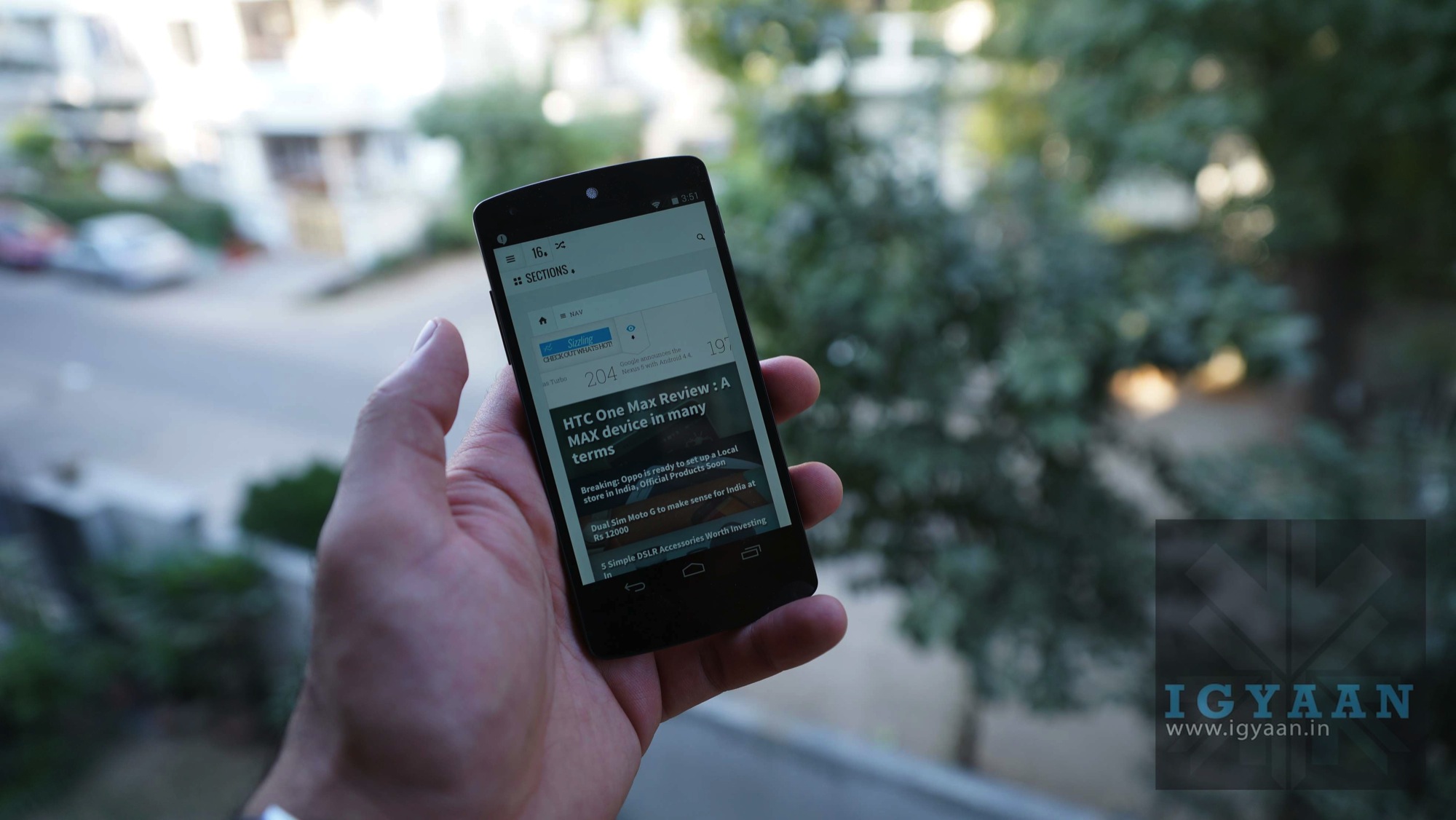
  • Nexus 7 infringes our patents : Nokia

    Nexus 7 infringes our patents : Nokia

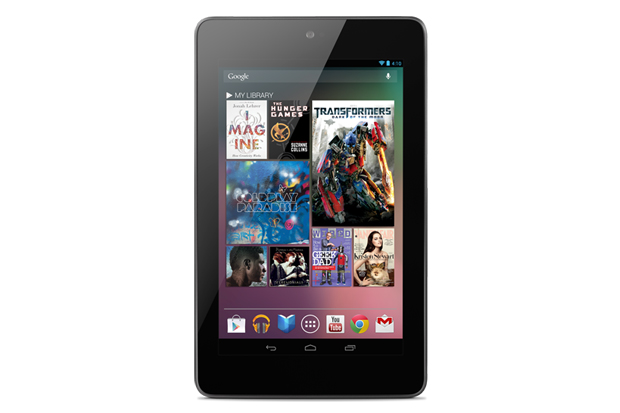
    Whoops! Something went wrong!Google’s Nexus 7 is fast, slick, and cheap, but Nokia claims it also infringes some of its patents in the process.

    Nokia has announced that the tablet infringes a number of its patents connected with the IEEE 802.11 Wi-Fi standard. In fact, most mobile device manufacturers license the patents from Nokia; currently, neither Google nor Asus is on the list of licensees.

    A Nokia spokesperson told The Inquirer that “companies who are not yet licensed under our standard essential patents should simply approach us and sign up for a license.” Hence, Google and Asus can almost certainly approach them to get their paperwork in order—if they think they need to.

    Asus replied by saying “at the moment, Asus will not be providing any response/comment related.” 

  • U.S judge dismisses Apple vs Motorola patent suit

    U.S judge dismisses Apple vs Motorola patent suit

    Whoops! Something went wrong!

    A U.S. judge on Friday ruled that Apple Inc. cannot pursue an injunction against Google’s Motorola Mobility unit, effectively ending a key case for the iPhone maker in the smartphone patent wars.

    Judge Richard Posner, of the U.S. District Court for Northern Illinois in Chicago, has also dismissed a counterclaim that Apple was infringing on Motorola’s patent in iPhones. Posner ruled out any damages for either company and said, that neither party is entitled to an injunction as the parties have failed to present enough evidence to create triable issues. In the ruling filed, Posner also said neither side could refile their claims.

    [quote]During the legal proceedings, the judge also pointed to serious problems with the U.S. patent system and questioned the worth of many software patents, saying, Reuters reported, You can’t just assume that because someone has a patent, he has some deep moral right to exclude everyone else[/quote].


  • Apple vs Samsung settles down as parties drop several claims

    Apple vs Samsung settles down as parties drop several claims

    Both Apple and Samsung have dropped several claims from the case against one another, after Judge Lucy Koh informed them to do so. Apple has reduced its case to one claim from each of its asserted utility patents, its four iPhone and one iPad design patents, and its trade dress claims for those two devices. While Samsung has dropped their cases to 15 altogether from a a total of 75 and completely deleted two claims.

    Both parties can later re-assert the removed claims in another lawsuit if they choose to do so.

    The case date for the hearing is on July 30th, after which a real outcome may finally be achieved.

    [Apple filing]

    [Samsung filing]

  • Request for preliminary ban on Galaxy Tab 10.1N and Galaxy Nexus Denied to Apple in German Court

    Request for preliminary ban on Galaxy Tab 10.1N and Galaxy Nexus Denied to Apple in German Court

    German Court has denied the Preliminary ban on the Galaxy Tab 10.1 and Galaxy Nexus, as requested by Apple on the basis of Touchscreen copyright infringement. The court declared the patent invalid due to the market presence of the same technology before the patent was granted. The court in Dusseldorf  has yet to give its final decision on the ban of Galaxy Tab 10.1N, which may finally give us the expectancy of the said Tab.

    [Bloomberg]

  • HTC takes aim, sues Apple using x-Motorola Patents

    HTC takes aim, sues Apple using x-Motorola Patents

    In the wonderful world of manufacturer patent-wars, a new twist has developed today. HTC has sued Apple using newly obtained firepower: nine patents picked up from Google last week. Theses patents have travelled from Palm – to Motorola – Google (who has bought Motorola) , Google transferred these patents to HTC last week, to power the HTC vs Apple suit.

    HTC CFO had earlier said that HTC was trying to figure out and resolve problems with Apple. Looks like the sit down with Apple’s nasty lawyers didn’t work out for the Taiwanese Giant.

  • German Court Removes Ban on Galaxy Tab 10.1 Sales in EU

    German Court Removes Ban on Galaxy Tab 10.1 Sales in EU

    The courts have gone in favor of Samsung and the  Düsseldorf regional court in Germany announced on Tuesday that it is partially lifting its original injunction that banned Samsung from selling its Galaxy Tab 10.1 tablet in all of the European Union excluding the Netherlands.

    According to sources , an Official from the court said:

    It is unclear if The Court has the ability or the power to ban the sales outside of Germany in the first place

    Apple also recently banned the sale of the Galaxy Tab in Australia recently, yet Samsung is all set to appeal the ban on the 25th of Aug. The sale of the Galaxy Tab 10.1 will go undeterred in India. The bans could also be a possible reason for the name change of the tablets in India : the Galaxy 750 is the rebranded Galaxy tab 10.1 ( to avoid Apple’s radar?).

    It also looks fruitless for Apple to file an injunction in India, since the Legal proceedings itself will take months and by then Samsung will be all sold out.

iGyaan Network
Privacy Overview

This website uses cookies so that we can provide you with the best user experience possible. Cookie information is stored in your browser and performs functions such as recognising you when you return to our website and helping our team to understand which sections of the website you find most interesting and useful.