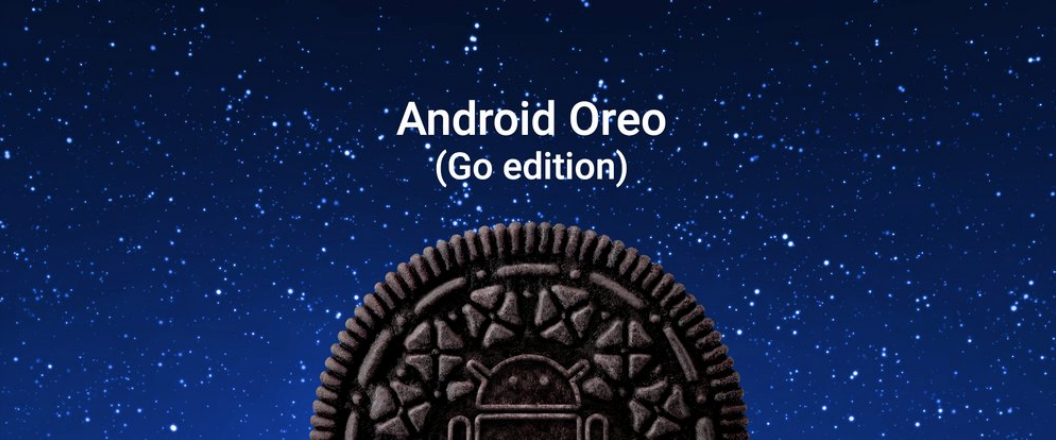
Google recently announced the Android Go Oreo edition. A new variant of Android 8.1 Oreo OS optimised for smartphones with 1GB of RAM or less. Two of the most prominent chipmakers in the smartphone industry, MediaTek and Qualcomm have now voiced their support for Android Go.
MediaTek, in a statement, said that it will be an SoC partner for bringing Android Go Oreo edition to smartphone makers and will offer support on Android devices with 512MB to 1GB of RAM.
MediaTek Inc. today announced that it is a System-on-Chip (SoC) partner for providing Google’s Android™ Oreo (Go edition) software to smartphone makers, and after a deep collaboration with Google, MediaTek’s MT6739, MT6737, and MT6580 SoCs, among others, now have board support packages available to run Android Oreo (Go edition).
Qualcomm has also announced that it will be working closely with Google to offer an optimised experience on smartphones with a memory of 1GB or less.
We are excited to implement Android Oreo (Go edition) within the Qualcomm Snapdragon mobile platform family as it will enable consumers around the world to experience a more robust operating system for lower cost smartphones.
This allows greater consumer flexibility as mobile users in emerging regions such as India, Southeast Asia and Africa gain access to a wider variety of Android smartphones with a more modern operating system.
Google has claimed that Android Go’s Oreo edition will be a variant of Android Oreo that a manufacturer can just set by ticking off a configuration flag. What this basically does is that it sets up the phone to use the “Go” versions of a handful of Google apps such as the main Google app, Google Assistant, Google Maps, Gmail, and others. Google claims that the smaller apps and slimmer OS can as much as halve the amount of storage that’s taken up by default on a new phone running default OS.
India is expected to be one of the first few countries to get Android Go Oreo edition thanks to its large budget smartphone segment.
Google has launched a version of Android 8.0 Oreo which is best suited for Android phones with 1GB of RAM or less.
At the Google I/O event in May 2017, Google promised to launch a custom version of Android tailor-made for lower-end devices. On the 5th of December, Android Go (Oreo edition) was officially launched and made available to smartphone manufacturers and developers.
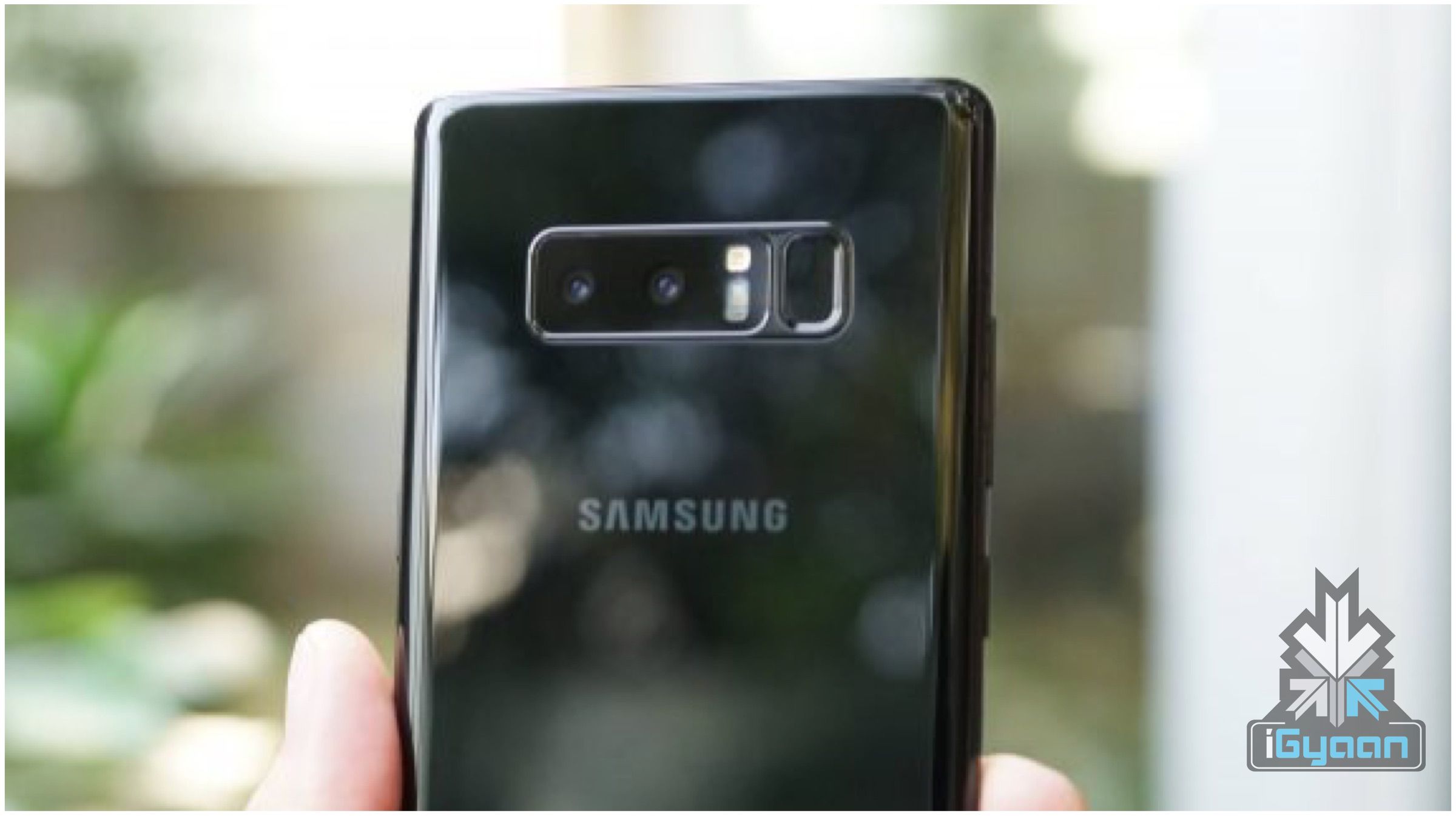
As Google said, the idea behind Android Go is to create a version of Android software which is designed to run better on phones with either 512MB or 1GB of RAM. In the world of OnePlus 5T with its 8GB of RAM or Galaxy Note8’s 6GB RAM, it is easy to forget that there are lower-end smartphones currently available in the market which have 1GB of RAM or less.
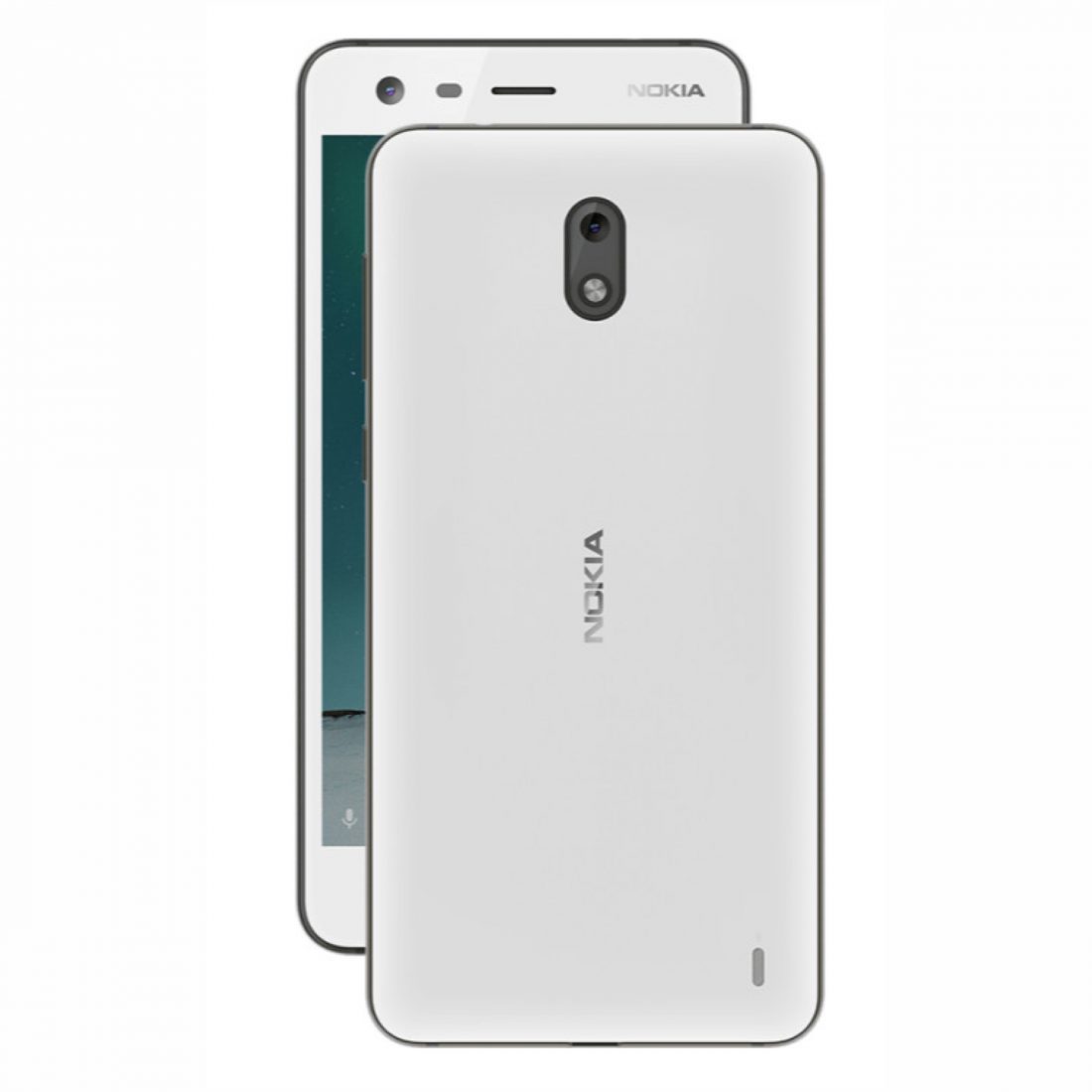
Recently, the Nokia 2 launched in India at a price of Rs. 6999 with 1GB of RAM and running Android 7.1 Nougat. Android Go’s launch means that HMD Global will be able to push out an Android 8.0 Oreo update for the Nokia 2 faster since the build is already optimised for phones with such specifications.
Nokia 2
Google has claimed that Android Go’s Oreo edition will be a variant of Android Oreo that a manufacturer can just set by ticking off a configuration flag. What this basically does is that it sets up the phone to use the “Go” versions of a handful of Google apps such as the main Google app, Google Assistant, Google Maps, Gmail, and others. Google claims that the smaller apps and slimmer OS can as much as halve the amount of storage that’s taken up by default on a new phone running default OS.
Google will also introduce a few other data saving features on Android Go. For example, in Chrome, everything will get run through a Google server that reduces file sizes before it gets delivered to the user’s phone. The new Datally app will also be pre-installed to keep a track of cellular data.
Considering India’s budget smartphone segment, it might be one of the first few countries to receive Android Go.
Android released the developer preview of Android 8.1 Oreo on the 25th of October and has now announced that the official update will start seeding on the 5th of December. Google has kept its promise to release Android 8.1 to the public by the end of the year.
The Android 8.1 will roll out to the Pixel 2, Pixel 2 XL, Pixel, Pixel XL, Pixel C, Nexus 6P, and Nexus 5X starting today.
The second developer preview was released last week, which included the much-awaited developer access to the Visual Core image processing chip inside the Pixel 2 and Pixel 2 XL feature. Because of this access, camera app developers will be able to improve their apps to take full advantage of the hardware found on Google’s new smartphones.
The update also fixes the infamous hamburger and beer emoji found on the Google keyboard app. So, if a consumer was offended by the previous emojis, then they can breathe a sigh of relief.
One of the main new updates in Android 8.1 Oreo is in its back-end processing. The new feature would automatically flag apps as “inactive” and deprioritise the generation of cache files for that app. The phone will only consider an app as “inactive” if it hasn’t been recently used in the foreground and the app package isn’t being used by another app package in the background.
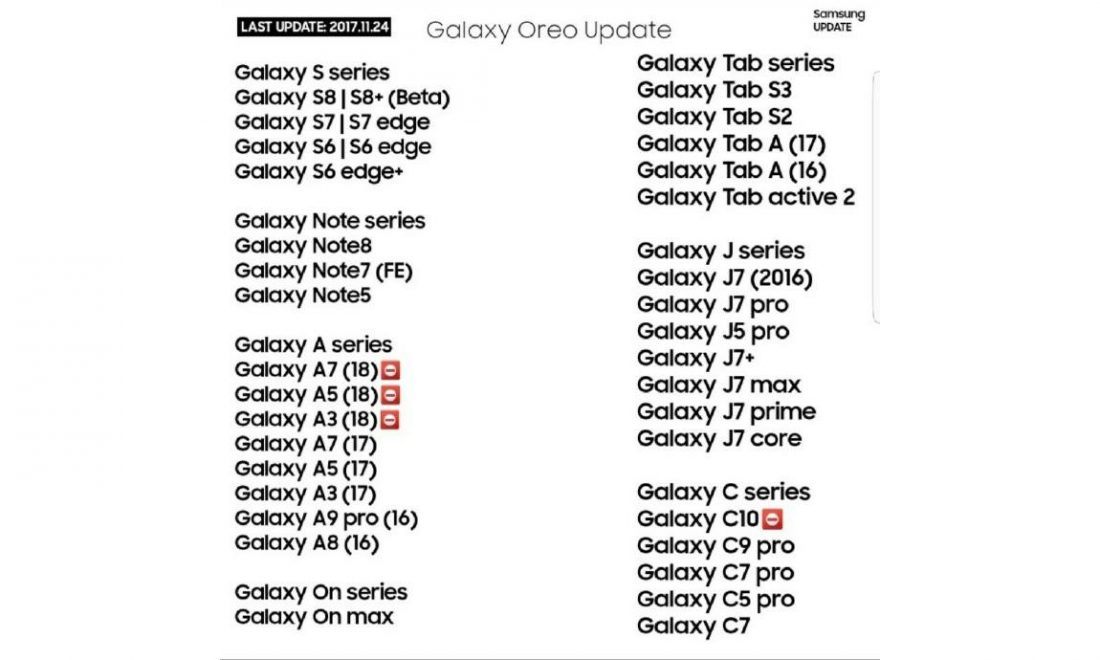
Android 8.0 Oreo was launched back in August and the adoption rate of the newest Android OS has been abysmal, to say the least. Samsung, however, appears to have great plans for updating a slew of its smartphones to the latest Android 8.0 Oreo in the coming months.
In the image leaked above, you can see all the phones and tablets from Samsung that will receive the Android 8.0 Oreo update. Android phones have a notorious history of not being updated to the latest software if they are more than a year old. That is one of the reasons why Android adoption rate for the latest OS is so low as compared to iOS. In this list, however, devices such as Galaxy A8 (2016), Galaxy A9 Pro (2016), Galaxy J7 (2016), Galaxy Tab A (2016) and Galaxy C7 were all released back in 2016 and Samsung has plans of updating them to Android 8.0 Oreo.
Even the Galaxy S6 and S6 Edge, the flagship phones from 2015 will receive the new update. This move from Samsung will definitely be appreciated by the brand loyalists and people who are planning to buy a Samsung mid-ranger in the coming months. It will ensure consumers that their phones will be supported even when newer variants of their phones are launched.
It is worth noting that the list also includes unannounced 2018 A-series smartphones, which, as per many leaks, will be running Android 7.1 Nougat out of the box.
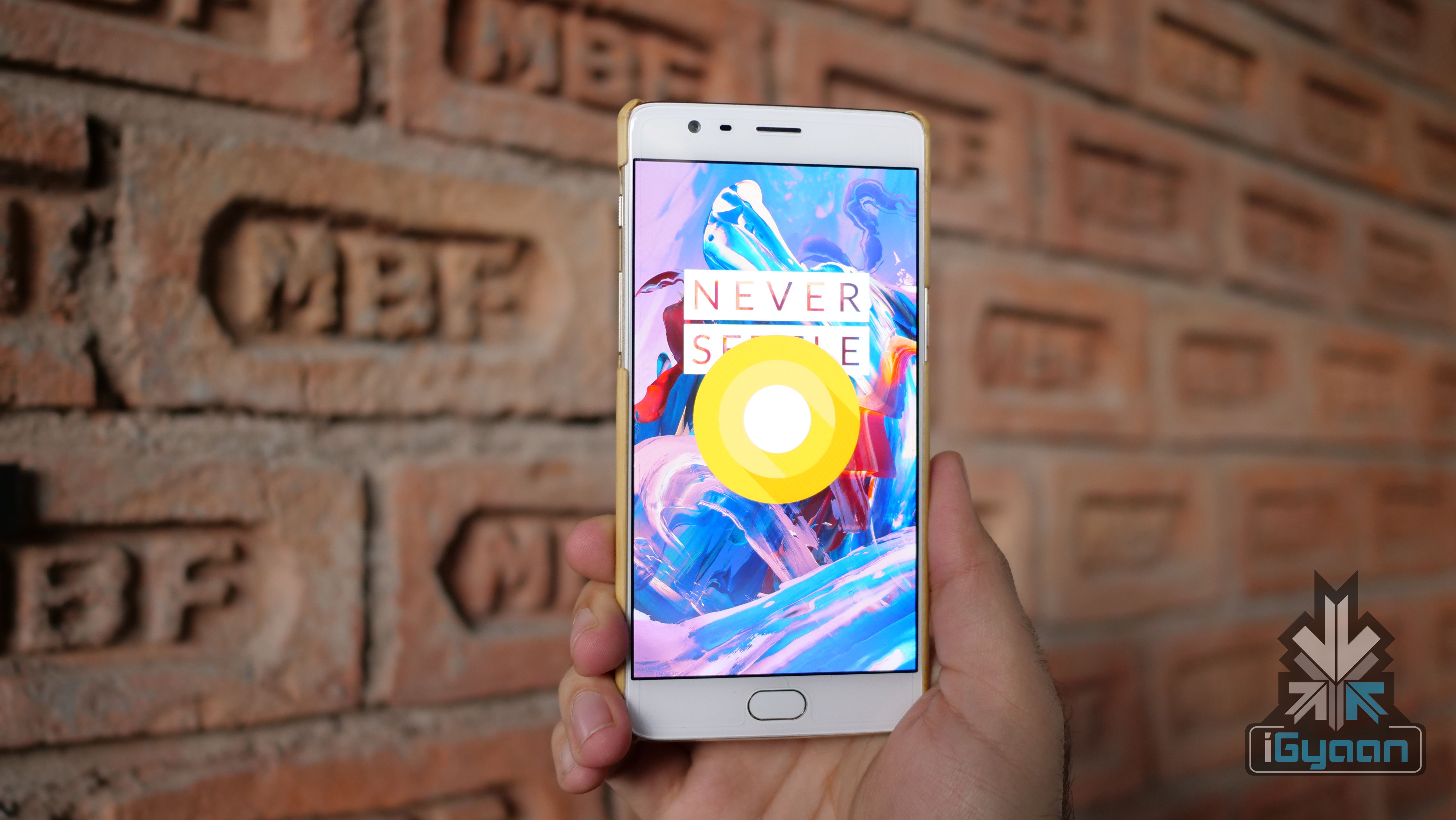
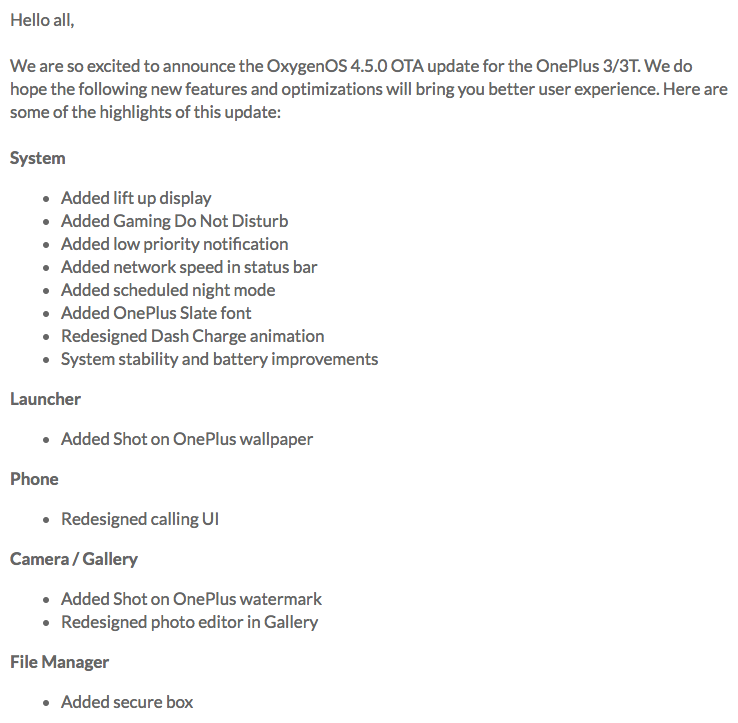
We are pushing out the incremental roll-out of OxygenOS 5.0, our first official Android O OTA update for the OnePlus 3 and 3T.
With the new update, the OnePlus 3 and 3T will get long awaited Android 8.0 Oreo features such as notifications dots and picture-in-picture mode and a few new Oxygen OS features. Other additions are ‘parallel apps’, auto-fill, smart text selection and more.
In the OnePlus launcher, there are new features like notification dots and a new app folder design. OnePlus has also added the option to upload photos directly to Shot on OnePlus. The company has further cleared that the OTA update is ‘incremental’ which means that only a small percentage of users will get the update right away. The blog post continues to state that a broader roll-out of the new software update will begin in some days.
The news is bittersweet for OnePlus 3 and OnePlus 3T users. Yes, these users will be the first to get Android 8.0 Oreo on a OnePlus device but, as the company had announced earlier, this is the last major software upgrade for the OnePlus 3 and OnePlus 3T. OnePlus is known for dropping support for its year-old flagships and this case doesn’t seem any different.
The OnePlus 5 and OnePlus 5Tare expected to get the Android 8.0 Oreo update some time in early 2018 as the beta testing on the two phones will start in early-December.
Even though we’ve almost reached the end of 2017, there is a constant flux of high-end phones launching week in and week out. We recently saw three high profile Android phones launching in November itself, the Razer Phone, HTC U11+ (a mid range variant called the HTC U11 Life was launched as well) and the OnePlus 5T. Excluding the HTC U11+, the OnePlus 5T and the Razer Phone have the best specifications you can ask for in an Android phone. Snapdragon 835, up to 8GB of RAM and umpteen amount of storage.
But, these two phones have one thing in common which should not be acceptable in November of 2017. Both the devices run on an Android OS version which is more than a year old. Android 8.0 Oreo was launched back in August and it has been three months since it was made available for all these big smartphone companies to adopt and install in its new phones.
When the OnePlus 5T was launched, the Chinese smartphone maker said it is due to the intensive testing programme that it has not yet introduced Android 8.0 Oreo in the latest OnePlus 5T. Razer gave a similar reason and said it will push out an update soon enough. But, is soon enough good enough? You’re paying close US $700 for the Razer Phone and the higher end OnePlus 5T has a price tag of US $549, at this price, a consumer at least deserved whatever the latest software is in the market.
Yes, at the price these two phones have the best specifications in the market and the performance will be amazing enough to ignore what Android OS version these phones are running.
But, won’t the latest and greatest Android OS match better with the latest and greatest chipset? With Android 8.0 Oreo, Google introduced faster boot speeds, tighter security and those notification dots along with a lot of under the hood improvements. That should amount to something more than just, “it looks great, it will work great as well.” That is usually our defence for phones running older Android OS versions.
An average consumer barely even notices what OS version their phone is running. But, it matters, because the latest version of any operating system means that it performs better than the previous one and will be better for the longevity of your phone.
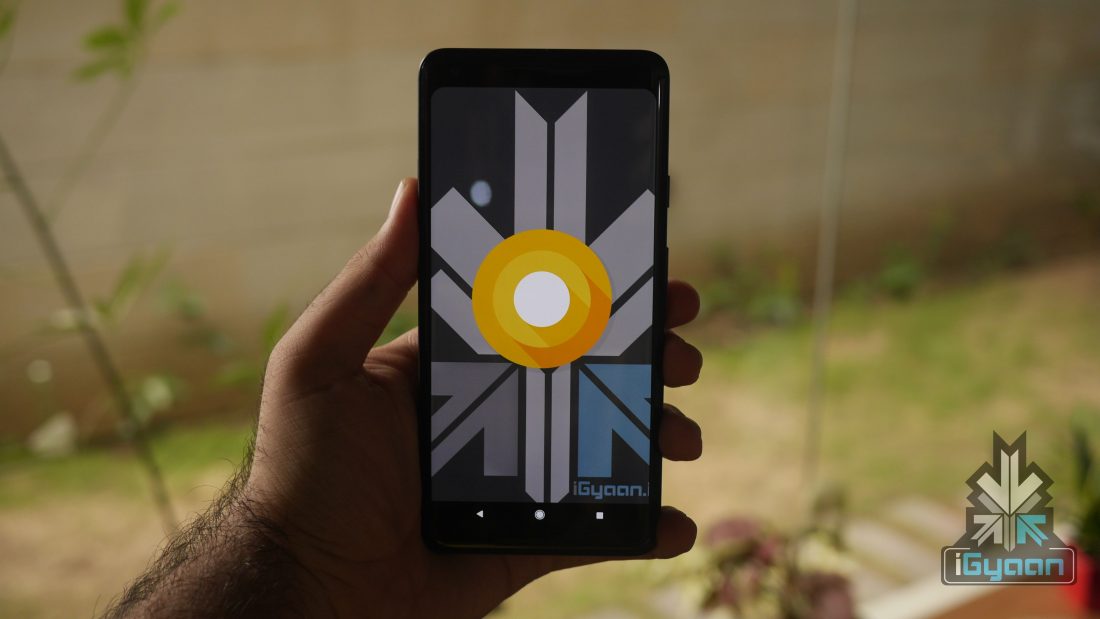
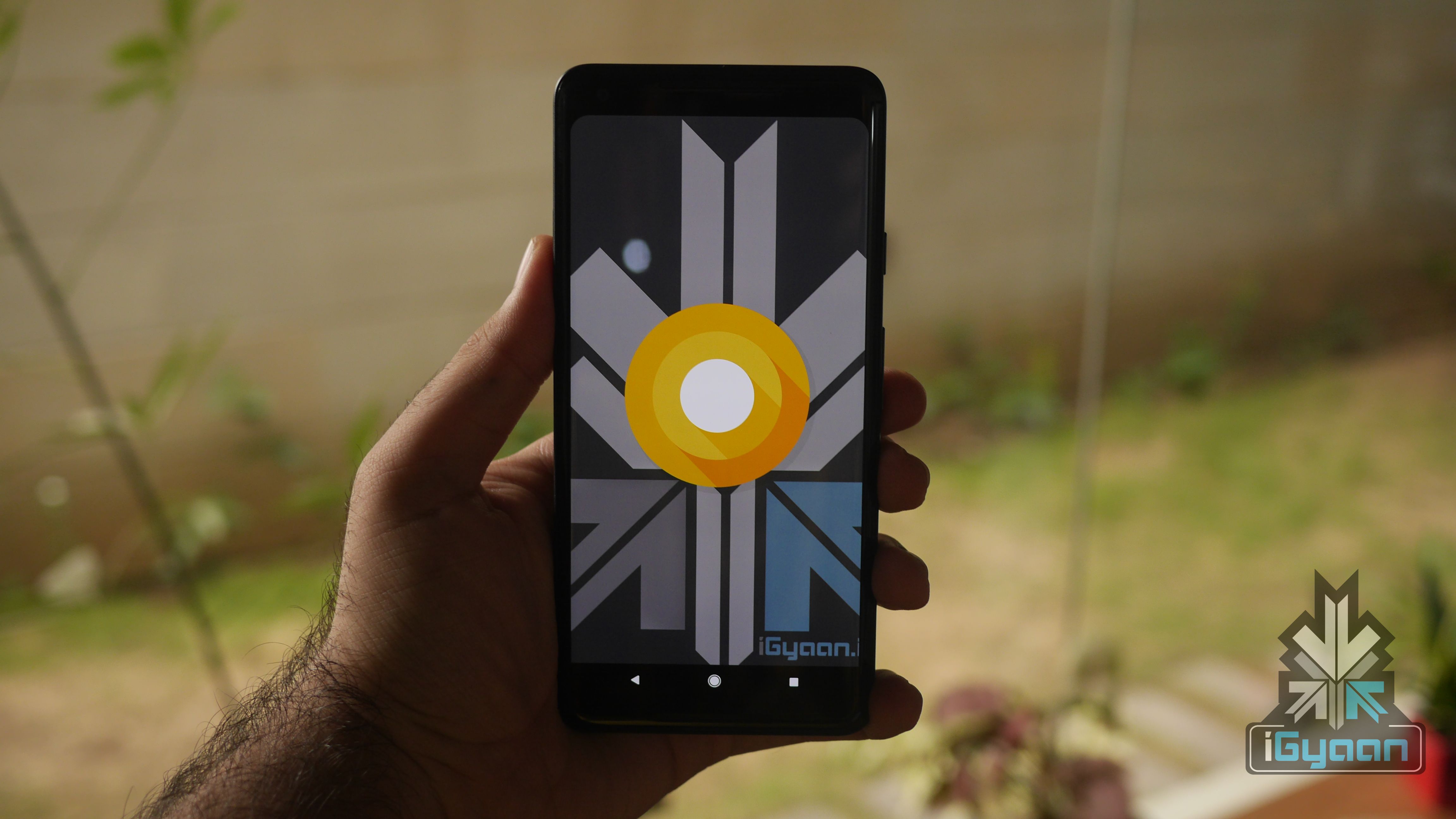
Android 8.0 Oreo On Pixel 2 XL
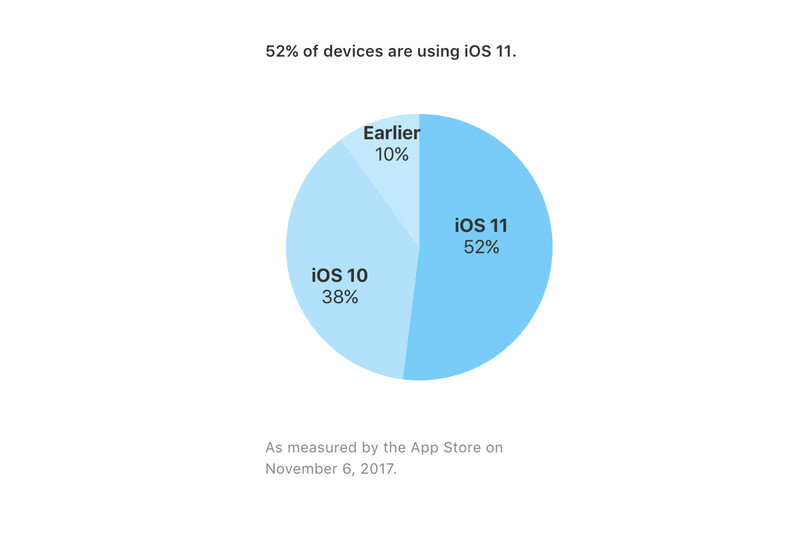
Android 8.0 Oreo is currently available in only 0.3% Android phones, while iOS 11, which was launched in September is present in over 50% of iOS devices. For further context, here is the Android OS and the percentage of Android phones running it:
Android KitKat (13.8%) – 2013,
Lollipop (27.2%) – 2014,
Marshmallow (30.9%) – 2015
Nougat (20.6%) – 2016
Android Lollipop, launched back in 2014 is more prevalent than Android Nougat that was launched in 2016. This tells you the story of Android’s adoption rate, especially when compared to iOS 11. Even iOS 10, which was launched in 2016 is available in 38% of the iOS devices currently out in the market.
It is hard to believe that companies like Razer and OnePlus would bring out their marquee phones with dated software because of lack of effort. It may be because the difference between Android Nougat and Android Oreo from the look of it, isn’t much. An average consumer would not make out the difference unless the consumer is coming from KitKat or Gingerbread. Fragmentation of Android devices is also a reason why so many smartphones currently never see a major software upgrade through their lifecycle.
Google’s Android One resurgence shows that the company wants more people to adopt to the latest OS and not wait for other OEMs to make a skin based on the latest Android OS and then push it out to consumers. Whether the Android One project will be a success is yet to be seen and how the adoption rate will change for Android 8.0 Oreo.
Storage space on smartphones which do not support microSD card has always been an issue. The Google Pixel from 2016 had 16GB of storage on its base model and it was a premium phone. This year, Google bumped it up to 64GB albeit, no storage expansion option. To tackle with this issue, Google will introduce a new smart feature in Android 8.1 Oreo which will reduce the size of inactive apps.
The latest commit in Android’s AOSP framework mentions a new feature that would automatically flag apps as “inactive” and deprioritises the generation of cache files for that app. The phone will only consider an app as “inactive” if it hasn’t been recently used in the foreground and the app package isn’t being used by another app package in the background.
These apps marked as “inactive” won’t have cache files generated for them, thus reducing storage space.
While the feature is a welcome addition to growing smart things Android phones can do, we might have to wait a while till we see this getting implemented in more smartphones other than the Pixels and the Nexuses. As reported earlier, only 0.2% Android smartphones run Android 8.0 Oreo right now, hence seeing Android 8.1 Oreo in a wide range of phones might be some time away. Also, OEMs will have to enable their smartphones to take advantage of this feature.
Lenovo K8 series owners will be happy to hear that Lenovo has officially announce update plans for the devices to receive Android 8.0 Oreo update. The excitement ends there as the timeline for these updates is a long time away.
The timeline has been announced by Lenovo, and the K8 series is expected to get the update June-July 2018 during which time Google should be announcing Android 9.0.
The K8 will be the first of the series to get Android Oreo according to the company’s post, which will roll out in June of 2018, while the K8 Note and K8 Plus are slated for an update in July of 2018.
The Lenovo K8 Note was launched in August for a price of Rs. 13999 while the K8 and K8 plus saw subsequent launches. The K8 Plus remains a flipkart exclusive while the other two handsets are on sale on Amazon.in
While most companies are pushing updates in a timely manner, and Xiaomi has set an end of the year timeline for their Mi A1 and Mi Mix 2, The company is yet to roll out any updates to the Mi Mix original which is still on MiUI 8.
The Update will be available as an OTA update to devices and will be rolled out across eligible Lenovo K8 / plus/ note devices at the same time.
When Android 8.0 Oreo was officially announced, OnePlus was one of the first few smartphone makers to announce its imminent availability to it smartphone portfolio. Now, OnePlus has rolled out the Open Beta build based on Android 8.0 for the OnePlus 3 and OnePlus 3T devices, signalling a full-blown release isn’t too far away. OnePlus wrote:
We are very excited to announce that we are ready to put out the first Open Beta build based on Android 8.0 for the OnePlus 3 and OnePlus 3T devices.
The company also pointed out the issues pertaining to the beta build:
Known issues:
Fingerprint actions may be slower than you are used to.
Shortcut to access Google Photos is unavailable
Some stability issues with NFC and bluetooth Performance and compatibility of 3rd party apps will continue to be optimised
Back in August, OnePlus subsequently announced that Android 8.0 Oreo will be OnePlus 3 and 3T’s last major software upgrade. This news didn’t go down too well for the owners of the two phones as they were launched recently in 2016 only. But, OnePlus continued its pattern of dropping support to its previous generation flagship phone and concentrate on the new and upcoming flagship smartphone.
This news comes days after the company was exposed to be collecting personal data of its users. While the company has come out and said that users can disable this function, it has still left a blemish on the perception of OnePlus.
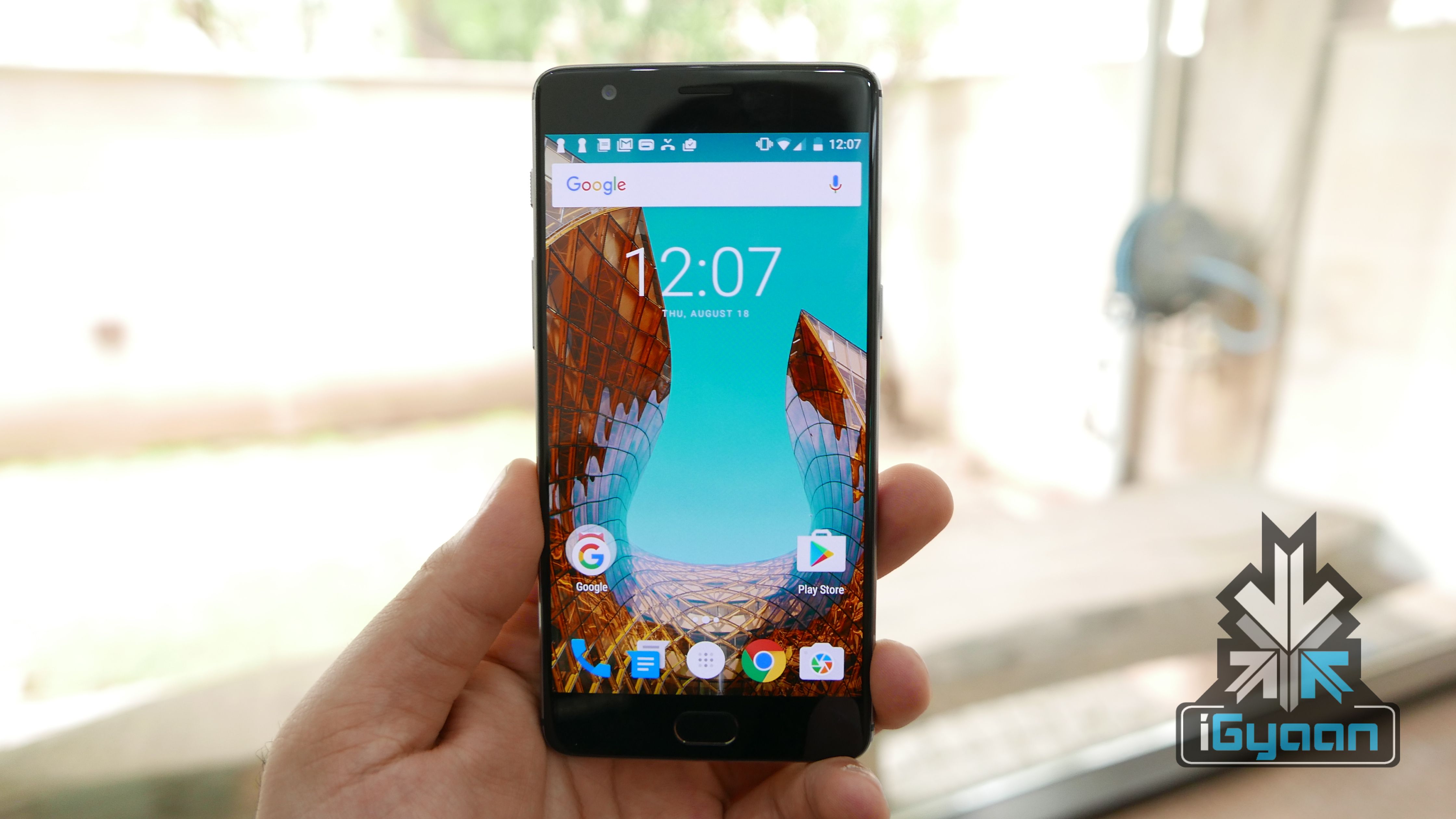
OnePlus is known to drop support for its previous year flagships and concentrate solely on its new and shiny flagship of the year. The company did it with the OnePlus 2 when OnePlus 3 and 3t came to the fore. The support for the OnePlus 3 and 3T hasn’t died out yet, and a new update brings in a lot of features to the OnePlus 3/3T from the OnePlus 5.
The new update is 1.5GB in size and brings features like “lift up display,” Gaming Do Not Disturb, low priority notifications, and OnePlus’ Slate font. These features were restricted to the OnePlus 5 only but, have finally trickled down to the 2016 flagship devices. The most interesting features that the update brings, like the “lift up display” and gaming do not disturb mode can be activated from the settings app.
The low priority notifications toggle is exactly what it sounds like. The low priority apps don’t trigger sounds, don’t peek, and don’t set the LED to start blinking. These notifications also won’t appear on the lock screen or the status bar. The ‘lift up display” allows you to glance at your phone’s lock screen by simply lifting it up, without double tapping the screen or pressing the lock/unlock button. Gaming Do Not Disturb mode can be turned on to mute all the notifications when you are gaming on your phone.
The new Slate font introduced in the OnePlus 3 and 3T was first font is already available in OnePlus 5. The company has also brought the secure box to the File Manager app. There are some other minor UI redesigns like a redesigned calling UI in the Phone app, an improved photo editor in the Gallery, the ability to add a ‘Shot on OnePlus’ watermark, and the addition of ‘Shot on OnePlus’ wallpapers. However, the security patch level still remains at August.
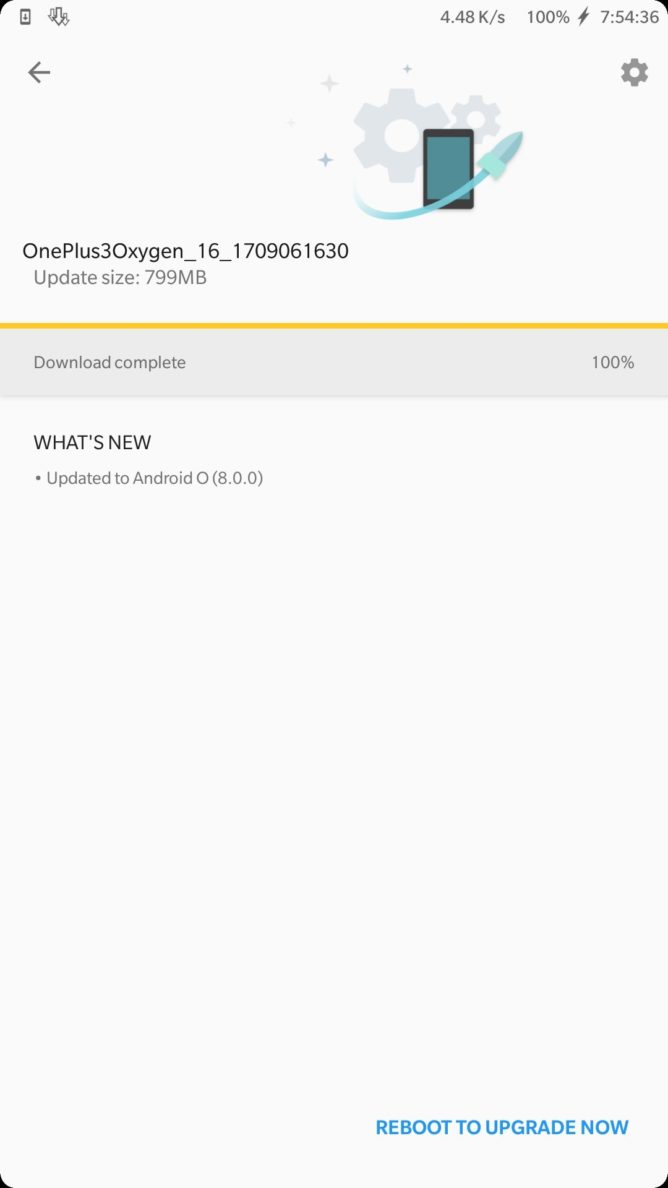
OnePlus has started rolling out an 800 MB heavy software update for OnePlus 3 closed beta group which updates the phone to Android 8.0 Oreo.
The update as of now is very unstable with many functions like the NFC, WiFi, Bluetooth, and hotspot fairly unstable. OnePlus is trying to roll out a stable update in mid-September. The OnePlus 3T and OnePlus 5 closed beta groups will also start getting this update soon.
OnePlus had earlier announced that an update to Android 8.0 Oreo will be the last major software update for OnePlys 3 and 3T but, the devices will get regular security patches for a longer period. Only the OnePlus 5 as of now, will be updated to next year’s Android P. This news didn’t go down well OnePlus enthusiasts who had just bought either of the devices.
Android 8.0 Oreo was officially announced last month with a lot of upgrades and a few new features. Highlights of new features in Android 8.0 Oreo
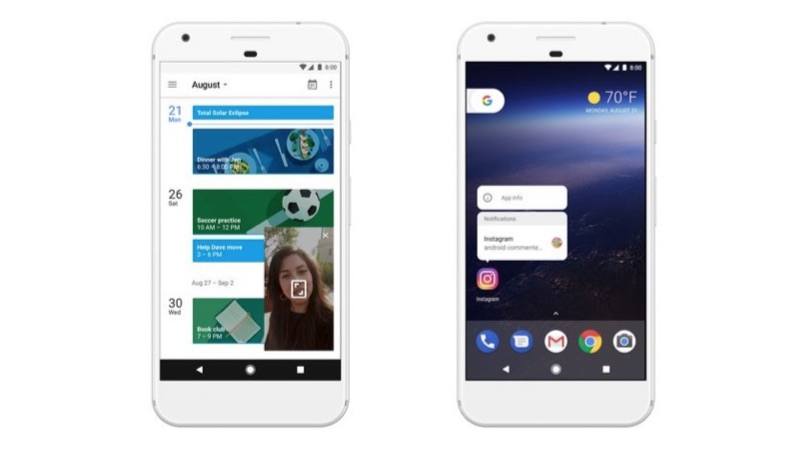
A new picture-in-picture feature allows users to continue operating the device without interruptions for things like watching a video.
Users can now organise notifications into custom channels and modify the alerts for the entire channel.
An auto fill framework in the operating system makes the repeated filling of forms easy for the user.
Original Equipment Manufacturers (OEM) can specify a look and feel for the UI by choosing between various icon shapes by using Adaptive Icons
A smart sharing feature allows the operating system to guess the context of a photo, and pick the best application to hand the image over to.
There are also background execution limits, which ensures that applications running in the background don’t use up a lot of system resources.
OnePlus is notorious for shutting down support on its 1-year-old phones and has continued to do so with its 3 and 3T variants. This new update means that a full-fledged roll out of Android 8.0 Oreo is not too far and the users might get an update by October, which will be fairly quick considering the Google Pixel 2 and Pixel XL 2 will launch in early-October running Android 8.0.
Google officially launched its latest Android OS, 8.0 Oreo during an event that ‘eclipsed’ the Solar Eclipse on August 21. Developers have had access to a preview version of Google’s latest mobile operating system since mid-March, with updated versions releasing in May, June, and July.
The new OS comes with a lot of new features and under the hood upgrades for better user experience. Highlights of new features in Android 8.0 Oreo
A new picture-in-picture feature allows users to continue operating the device without interruptions for things like watching a video.
Users can now organise notifications into custom channels and modify the alerts for the entire channel.
An auto fill framework in the operating system makes the repeated filling of forms easy for the user.
Original Equipment Manufacturers (OEM) can specify a look and feel for the UI by choosing between various icon shapes by using Adaptive Icons
Smart sharing feature allows the operating system to guess the context of a photo, and pick the best application to hand the image over to.
There are also background execution limits, which ensures that applications running in the background don’t use up a lot of system resources.
A lot of you must be wondering whether your Android device will be updated to 8.0 Oreo or not. Let’s find out
Google Devices
This is a no-brainer. If you own the Nexus 5X, 6P or the Google Pixel or the Pixel XL, an Android O update isn’t far away. Google Pixel 2 and Pixel XL 2 will be the first devices running Android 8.0 Oreo when they’re launched and an update to the Nexus devices and previous gen Pixel smartphones will follow soon.
Samsung
Samsung launched the Galaxy Note 8 running Android 7.1.1 Nougat and promised an update to Android Oreo in the coming months. This suggests that the Samsung Galaxy S8 and S8+ may also receive an update before the mid-2018 launch of the Galaxy S9. Samsung’s mid-range devices may also receive an Android Oreo update but later next year.
HTC
HTC has officially announced that the HTC 10, U Ultra and the new flagship U11 will receive the Android Oreo update in the coming months.
OnePlus
Carl Pei has announced that Oneplus 5, 3T and 3will all receive Android 8.0 Oreo update. However, it was also announced that this update will be the last Android OS update for last year’s OnePlus 3 and 3T.
Motorola
Moto Z2 Force, Z2 Play, G5S, G5S Plus, G5 and G5 Plus are all in line to receive an upgrade to Android 8.0 Oreo keeping up with Lenovo-owned Motorola’s promise.
Lenovo
Lenovo recently dropped its custom VibePure UI for pure Android skin and promised that the K8 Note and other K Note devices will receive the Android Oreo update. The timeline though is not confirmed.
LG
LG is on the verge of launching its late 2017 flagship, the LG V30 on August 31. The phone will most likely run Android 7.1 Nougat and will be updated to Android Oreo later on. Along with the LG V30, LG G6, LG V20, and V10 might also receive the update in the coming months.
Google officially launched the next generation of its Android OS, 8.0 Oreo during the first Solar Eclipse in the USA since 1917. Developers have had access to a preview version of Google’s latest mobile operating system since mid-March, with updated versions releasing in May, June, and July. Rumours of the new version being named Oatmeal Cookie were put to rest when Google launched Android 8.0 Oreo through a live stream.
So, what has changed from Android 7.0 Nougat to 8.0 Oreo? Let’s take a look
User Interface
Users can now organise notifications into custom channels and modify the alerts for the entire channel. This can be specifying the sounds if the notification triggers a vibration, and if the notification is allowed to override the do not disturb setting. An autofill framework in the operating system makes the repeated filling of forms easy for the user. This can range from sign up information to a new service, or credit card information to make a payment. The feature will prevent frustration and repetitiveness by allowing users to quickly fill in a form. Users will have to opt-in for the Autofill framework, after which new and existing applications can make use of the feature.
Picture-In-Picture Mode and New Notifications
A new picture-in-picture feature allows users to continue operating the device without interruptions for things like watching a video. Another interesting change in the UI this time around is Adaptive Icons. Original Equipment Manufacturers (OEM) can specify a look and feel for the UI by choosing between various icon shapes. Different shapes can be used on some models. The feat is achieved by applying masks over a base layer. The supported shapes are Circle, Squircle, Rounded Square and Square. Adaptive icons can be created using Android Studio.
Behind The Screen
Each application is now allocated a cache budget. When the system is low on resources, the applications that exceed the cache budget the most will be the first to have their cached files deleted. Content refreshing is now a more streamline experienced. Also, there is now an easier way for applications to check if they are displaying the latest content on the screen. Developers can also set custom triggers to update the content when it is stale or outdated, even without a specific request from the user. There are also background execution limits, which ensures that applications running in the background don’t use up a lot of system resources.
Media playback should be significantly improved for users, as now there is fine-grained control to scrub to a particular frame in a video. Applications can also now mix multiple audio and video tracks at once, for streaming purposes. This can be useful in gameplay videos where users can capture the screen, themselves through the front-facing camera, the audio from a game, and any commentary from the user.
A smart sharing feature allows the operating system to guess the context of a photo, and pick the best application to hand the image over to. For example, if you click a selfie, social networking applications are pulled up but, if you click a photo of a receipt, expense tracking applications will open up. The more you use your phone, the more your smartphone will learn about your behaviour and act accordingly. A smart copy feature enables similar functionality but for text, where the smartphone recognises if the text copied is an address, a phone number or name of an entity, and suggest opening a relevant app. For example, if you copy a phone number, a floating bar will suggest opening up the Dialer app or the Contacts app.
Connectivity
Android 8.0 Oreo has support for Wi-Fi Aware, an energy-efficient way by which supported hardware can discover and chat with each other without a Wi-Fi hotspot or an internet connection. There is also a support for the new Bluetooth Low-Energy (BLE) 5.0 standard.
It is expected that the first smartphone to run Android 8.0 Oreo will be the new Pixel 2 and Pixel XL 2 while the Pixel and Pixel XL will get an update soon after the launch.
Expected devices to receive Android 8.0 Oreo update
Nexus
Nexus 5X
Nexus 6P
Samsung
Samsung will push out the Android 8.0 update when it launches the Samsung Galaxy S9 next year. Devices expected to receive the update are-
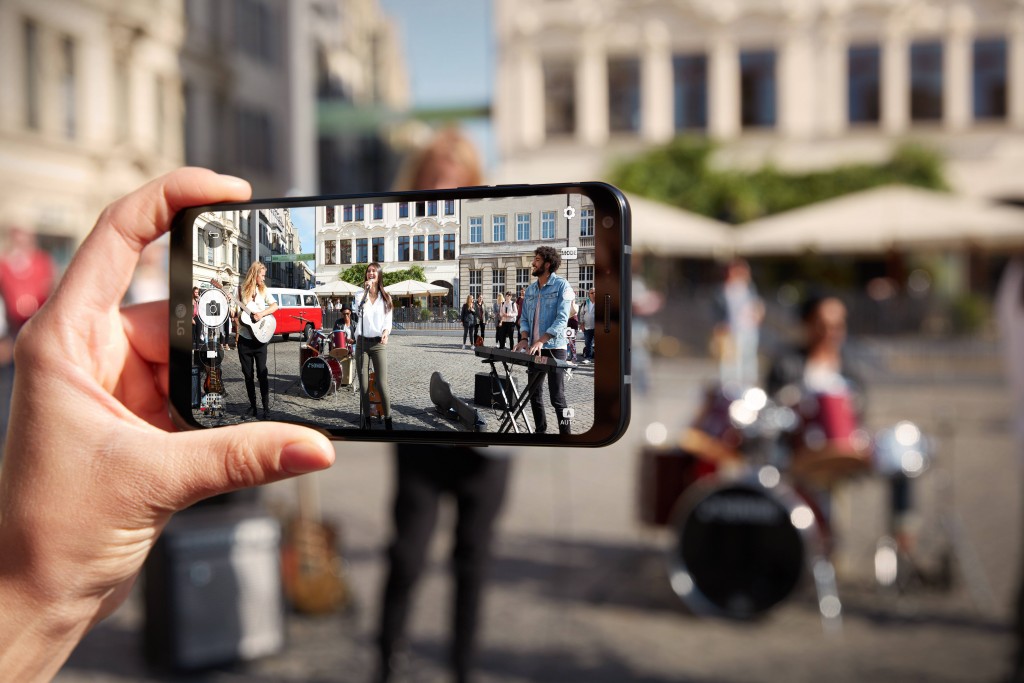
2017 has so far been the year of the “bezel-less” smartphone, starting early with the LG G6 and the Samsung Galaxy S8 and S8+ then the likes of the iPhone 8 and the Essential phone. These smartphones however, also usually come with a hefty price tag. There are a lot of smartphones that sport a “bezel-less” display and won’t cost you a fortune.
LG Q6
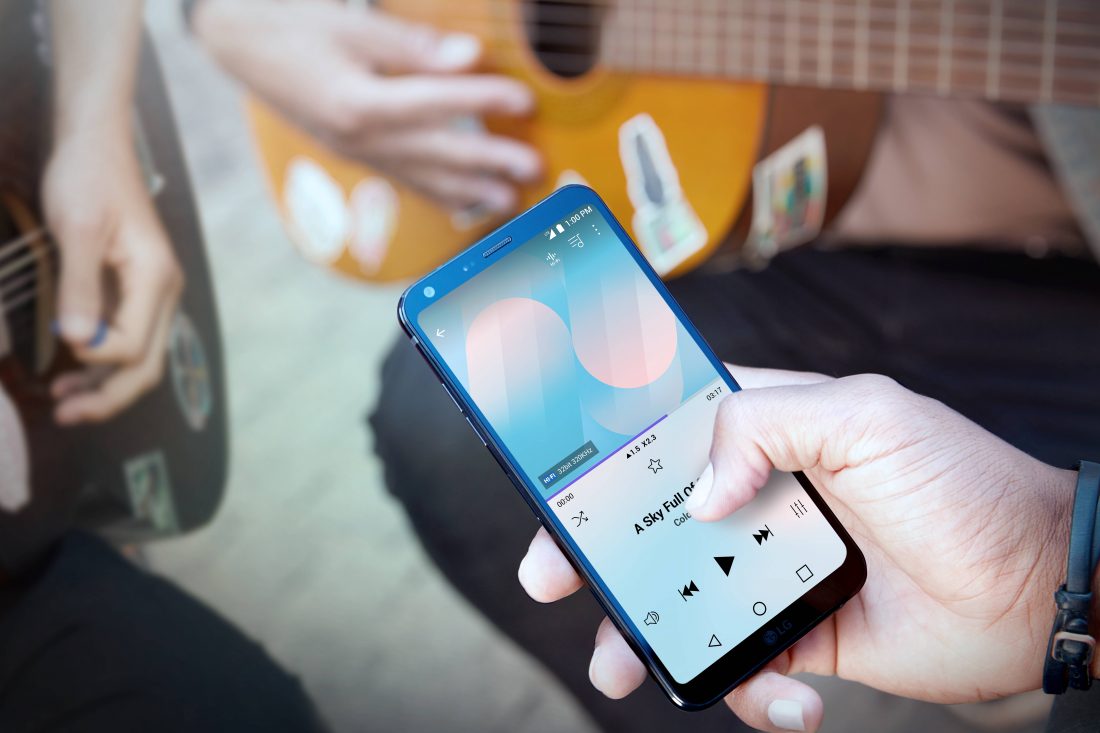
The LG Q6 was recently launched in India for a price of Rs 14,990. It sports a 5.5 inch 2160 x 1080 px IPS LCD display with a pixel density of 442ppi and a 78% screen-to-body ratio. The device is powered by a 3,000mAh non-removable battery and runs Android 7.1.1 Nougat with LG’s custom skin on top of it. The LG Q6 packs the Qualcomm Snapdragon 435 chipset with a 1.4GHz octa-core processor and Adreno 505 GPU along with 3GB RAM and 32GB onboard storage which is expandable via microSD card up to 2TB.
It features a single 13MP rear-facing camera with a single LED flash and on the front is a wide angle 5MP sensor. The rear camera records video at 1920 x 1080 px at 30 FPS. LG also claims that the Q6 has US Military Standard-810G Certification which means that it can survive quite a few drops.
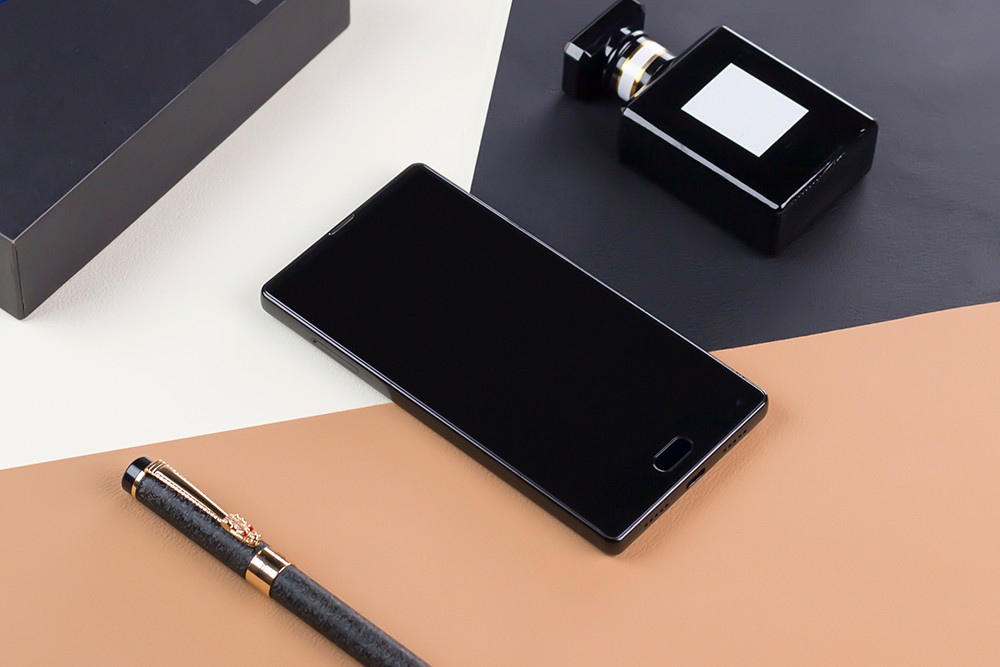
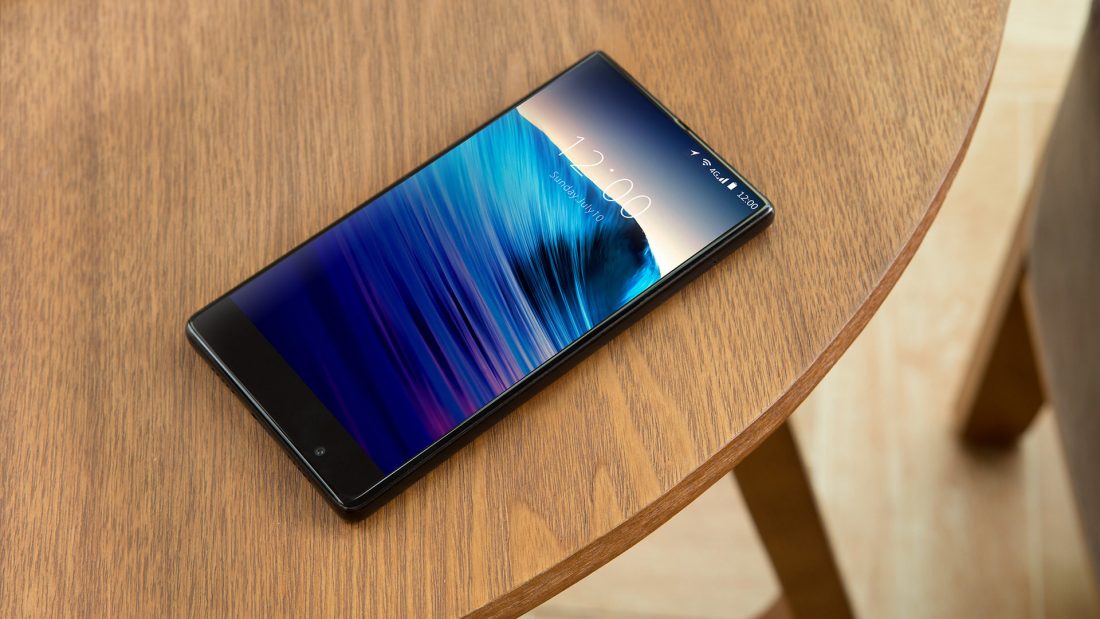
Doogee Mix
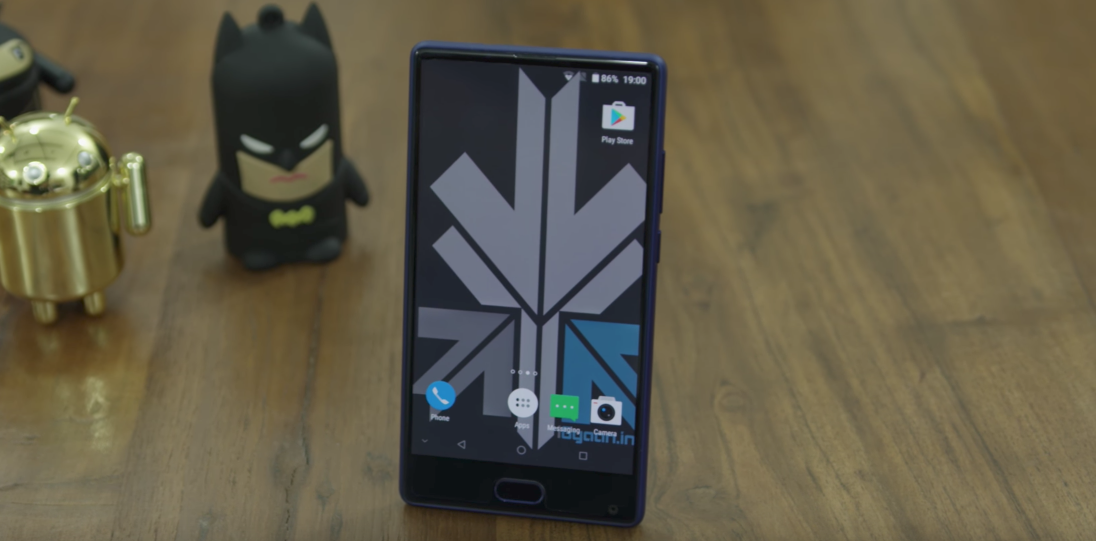
The Doogee Mix costs US $180 (Rs 11,500 approx.) and sports a 5.5 inch 1920 x 1080 px IPS LCD display. The device has minimal bezels on the top, left and right side of the display but the bottom bezel is huge in order to accommodate the fingerprint sensor and the 5MP front camera. The device is powered by a 3,380 mAh battery and runs on Android 7.0 Nougat. the MediaTek MT6757CD Helio P25 chipset along with 6GB RAM and 128GB onboard storage complete the innards. The smartphone also features a 16MP + 8MP dual-camera setup at the back capable of depth effect mode and video recording in 4K at 30 FPS.
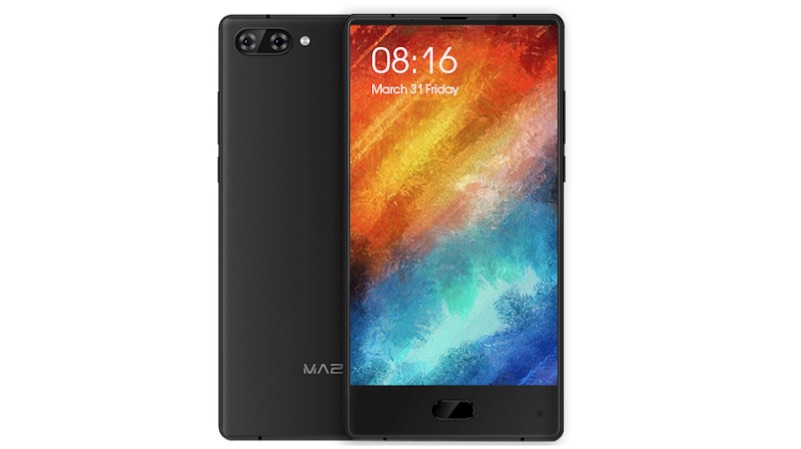
Maze Alpha
The Maze Alpha has a design similar to the Doogee Mix, with a huge bottom chin and ultra-thin bezels on the two sides and top of the device. The phone has a 6 inch 1920 x 1080 px display with an 83% screen-to-body ratio and Corning Gorilla Glass 4 for protection. The smartphone costs $224 (Rs 14,300 approx.) which is slightly more than the Doogee Mix and at par with the LG Q6. The Maze Alpha packs a 4,000 mAh battery and supports Quick Charge through the USB Type C port. Just like the Doogee Mix, it runs on the MediaTek MT6757CD Helio P25 chipset along but, with 4GB RAM and 64GB onboard storage which is expandable via microSD card up to 256GB. The back of the device features a 13Mp + 5MP dual-camera setup with Samsung S5K3L8 sensor and an f/2.2 aperture the front has a 5MP camera.
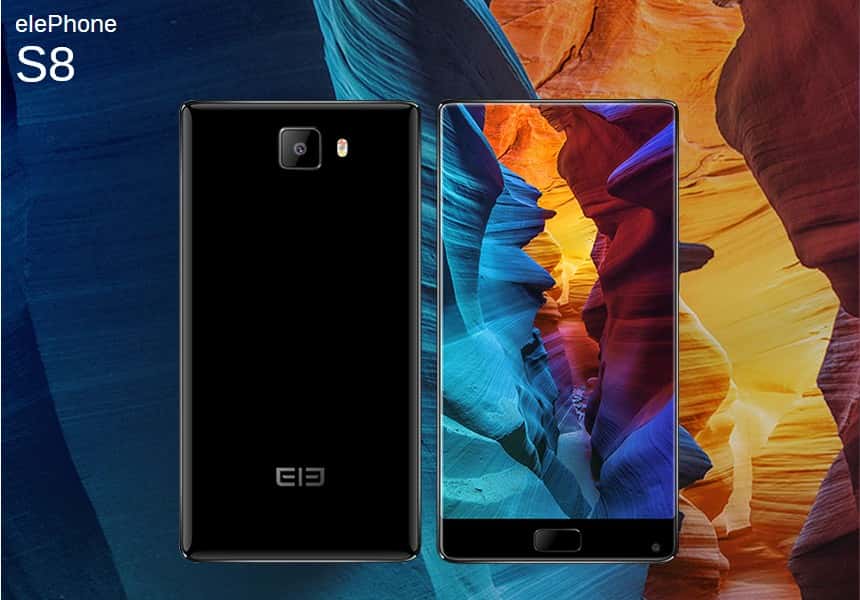
The Elephone S8 sports a 6 inch 1920 x 1080 px IPS LCD display. The bezel-less display is restricted to the top, left and right sides as the large bottom chin houses the fingerprint sensor and the front camera. The device is powered by a 3,300mAh battery and runs on Android 7.0 Nougat. Under the hood is the MediaTek Helio X20 chipset along with 4GB RAM and 128GB onboard storage which is expandable via microSD card. In terms of optics, the device features a 21MP rear-facing camera and a 13MP front-facing camera.
Next in line is the Bluboo S1 with an impressive 90% screen-to-body ratio and costs around $200 (RS 12,800 approx.). It sports a 5.5 inch 1920 x 1080 display with Corning Gorilla Glass 4 for protection. Running Android 7.0 and powered by a 3,500mAh battery, the Bluboo S1 packs the MediaTek Helio P25 chipset. The device also has 4GB RAM and 64GB onboard storage which is expandable via microSD card up to 256GB. For the cameras, it features a 13MP + 3MP dual camera setup at the back and a 5MP front-facing camera which is placed below the display.
Our next pick in the budget friendly bezel-less smartphones category is the UMDIGI Crystal which starts at US $109 (Rs 7,000 approx.). The device sports a 5.5 inch 1920 x 1080 px display with Corning Gorilla Glass 4. The smartphone features a 3,300 mAh battery and runs on Android 7.0 Nougat. The UMDIGI Crystal is powered by the MediaTek MTK6750T chipset and comes in two variants – one with 2GB RAM/16GB storage and the other with 4GB RAM/64GB storage. In terms of the cameras, it features a 13MP + 5MP dual-camera setup at the back and a 5MP front-facing camera which is located below the screen. The fingerprint sensor is located at the back just below the dual cameras.
Ulefone Future
The last one our list is the Ulefone Crystal which costs about $260 (Rs 16,000 approx.) and sports a 5.5 inch 1920 x 1080 px display along with Corning Gorilla Glass 3 on top. The ‘Future’ runs on the not-so-futuristic Android 6.0 Marshmallow and running all of it under the hood is a 3,090 mAh battery. The device is powered by the MediaTek MT6755 chipset along with 4GB RAM and 32GB onboard storage which is expandable via microSD card up to 128GB.Another not-so-futuristic feature is the single camera 16MP sensor at the back with an f/2.0 aperture and dual-tone LED flash. On the front is a 5MP camera. The fingerprint sensor is mounted on the right edge of the phone just under the lock button.
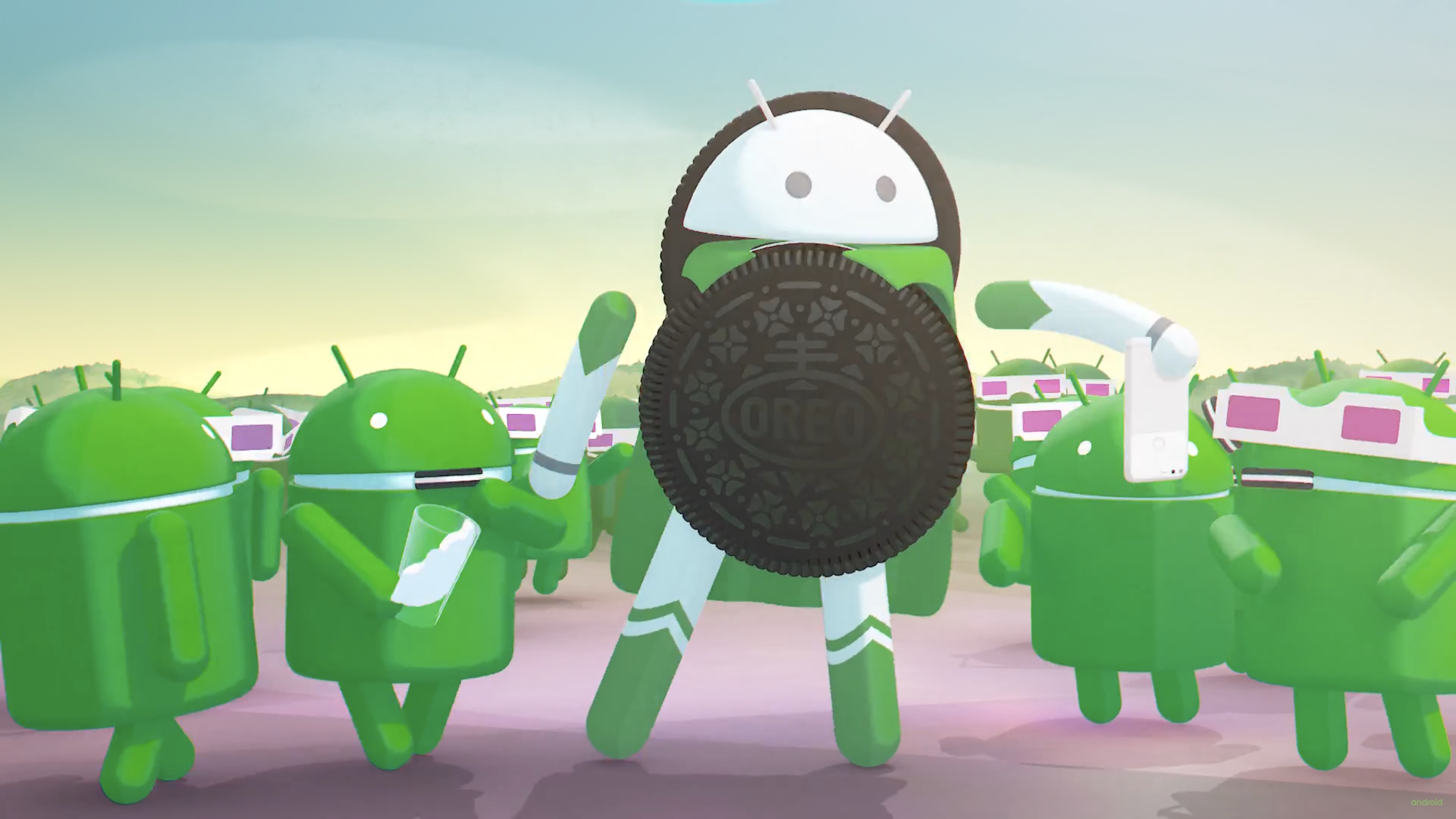
After a lot of speculation surrounding the official name for the next Android OS, it seems that Google itself may have just spilled the (jelly) beans on the name of Android O, and it’s not Oatmeal Cookie, it’s Oreo.
Google put out a teaser on Google+ to promote the August 21 event where the Android O and its official name will be unveiled. The teaser video for the launch reveal was named ‘GoogleOreo_Teaser_0817_noDroids (1).mp4‘. If that doesn’t confirm the name, we don’t know what will.
But, in an attempt to right the wrong, Google took down the teaser and uploaded it again with the name ‘OctopusTeaser.mp4′, which just reassured what we have all been speculating. Google’s decision to go with Oreo makes sense since the famous cookies are known worldwide.
Android 8.0 brings new features such as Notification Dots, Autofill, Smart text selection and Picture-In-Picture. Google has also said to improve the security and increased the booting speed in the new OS. Notification Dots show the notification of an app after a long press.
A small notification bar pops up at the top right corner of the app and shows the notification of the particular app. The Autofill feature helps in filling forms inside an app. Smart Selection feature is a machine learning based features that select only important text to be copied. Android O also comes with a multitude of back-end improvements such as better battery management algorithms, app optimisations, audio enhancements like improved Bluetooth audio and more.
As is with every Google launch event, it will be live streamed to the world and there is a lot of mention of the ‘eclipse’ on the launch website. The website and the teaser s in-line with the rumours that Google is planning a spectacle this time around rather than “hey. this is the official name of Android 8.0.” The reveal event is scheduled for 21 August in New York, which coincides with the Solar Eclipse and from the looks of it, Google will take full advantage of it.