Category: Business

  • 10 Super Useful Apps to Help Manage a Startup

    10 Super Useful Apps to Help Manage a Startup

    As apps become more prevalent and powerful, entrepreneurs and small business owners are relying on these savvy tools to help their businesses grow and run more smoothly. Some of the apps in this arsenal will help you get a lot done with minimal personnel, since things are just starting out and human resources may be limited at this point.

    We are listing top 10 apps to get you organized, connected, visible and will likely contribute to your start-up’s success.

    1. Slack

    slackSlack provides you with real-time messaging, archiving and integrations to other tools, such as Google Docs and Trello. This means less internal email communication and keeping things quick and on the go. Using Slack would mean no one will miss out on anything, and everyone is clear on what’s happening on each project. The app comes with a feature which allows you to be notified when certain terms or words are used by the team, meaning you are always on top of the urgent things.

    2. Zendesk

    Zendesk

    If your business targets for excellent customer service then Zendesk is one app that’ll help you take over the entrepreneurial world. It is vital to understand what your customers need and like everything in this world, each person has a varied requirement. In such a scenario, you need to keep a check where you are standing in comparison to all your competitors. Zendesk helps you do all this and much more.

    3. Salesforce Sales Cloud

    salesforce_cloudsSalesforce is the industry standard for CRM, and it’s a great starting point for your new business. Salesforce effectively primes your customer-interfacing business channels for sales. What’s more, due to its wild popularity, Salesforce Sales Cloud is also among the most compatible apps on the market.

    4. SurveyPocket

    surveypocket-SurveyPocket helps you put together mobile-friendly surveys. It helps get to know your target customers better than by surveying them – before you invest time, money, and effort in the wrong endeavours. SurveyPockets lets you get feedback from your audience, and it’s an app that is especially capable of mobile surveying.

    5. ZohoDocs

    ad1-1B-wall2

    In the course of running your new business, you’re going to generate tons of documents day one onward. Zoho Docs help you safely dump proprietary, sensitive documents that you can’t afford to lose, as well as accounting and tax reporting-related documents that you’ll need to store for years.  Zoho Docs is a great place to start with online file storage that adds user access control to an otherwise intuitive set of features.

    6. SureDone

    suredone

    It one of most relied upon online selling solutions. It allows you to easily sell from your e-Commerce website, as well as from marketplaces like eBay, Amazon, and Google Shopping. If your startup plans to offer any type of products, SureDone is the perfect choice to help you reach the widest market possible, easily.

    7. HootSuite

    hootsuite

    HootSuite is a social networking app that reduces the time it takes to manage your startup’s social media presence. Twitter, Facebook, and LinkedIn are requisites at this point. HootSuite not only lets you automate posting and sharing, but it tracks brand mentions and inquiries and reports them to you, all from a convenient dashboard.

    8. Expensfy

    ExpensfyExpensify, an app that keeps track of business expenses and mileage, while letting users scan and upload receipts. Users can even sort file receipts by trip and submit expense reports to employers with the click of a button. Founded by David Barrett, the app has exploded to almost 1 million users and processes over $2 million in expenses daily.

    9. TrackMaven

    trackmaven-1

    TrackMaven streamlines your ability to monitor data on your competition, without going through the hassle of consulting multiple sources. Filter the marketing activity you want alerts for and erase all the extra white noise.

    10. TimeStation
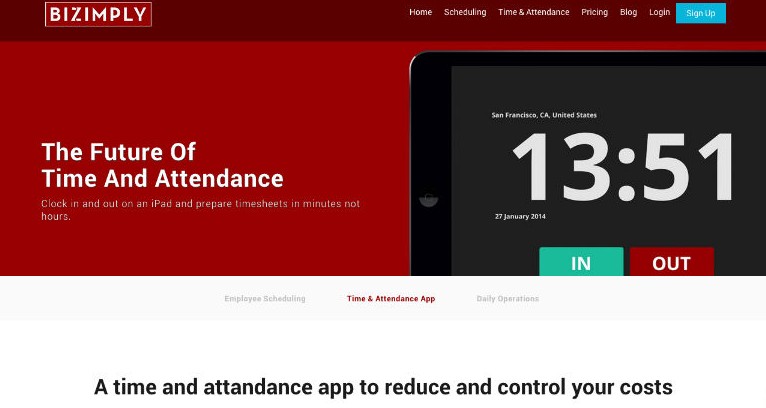
    Timestation is an app extention of popular employee managment website called Bizimply. It turns your iOS device into a cloud-based time and attendance system. Using our Fast-Scan technology, employees can punch In and Out in less than a second. The best thing is that TimeStation runs in the cloud, so there’s no software or servers to maintain. Managers can see who’s in and run time and attendance reports anytime, anywhere. TimeStation is the perfect solution for small and medium businesses looking to track time and attendance without the usual costs and overhead of traditional systems.
  • WhatsApp Will Soon Allow You To Make Purchases And Download Apps

    WhatsApp Will Soon Allow You To Make Purchases And Download Apps

    When Facebook acquired WhatsApp for $19 billion last year, we weren’t sure how the social media giant would make use of the messaging app. However, at the F8 conference 2015, Facebook announced a new Business for Messenger initiative, through which the company might be able to make some profit. According to this initiative, Business for its Messenger app will give users the choice to install apps and make purchases with the Facebook Messenger app itself.

    The company said that they would include some of the features of Facebook Messenger and experiment with it on WhatsApp, to promote business to consumer communications that could be paid up by marketers.

    [quote text_size=”small” author=”David Wehner” author_title=”Facebook’s Chief Financial Officer”]

    We think that enabling that [business to consumer] messaging has an excellent business potential for us. As we learn those things, I think there are going to be opportunities to bring some of those things to WhatsApp, but that’s more longer-term than the near-term.

    [/quote]

    Facebook CEO, Mark Zuckerberg says that once WhatsApp reaches 1 billion users, will business through the messaging app is meaningful. For now, WhatsApp has got around 800 million users. After the $22 billion acquisition by Facebook, WhatsApp Chief Jan Koum said that the messaging app will be ad-free.

    Currently, Facebook is working with more business partners and will soon begin Business for its Messenger app.

  • Indian Mobile Market Plunges for the First Time in 20 Years

    Indian Mobile Market Plunges for the First Time in 20 Years

    India’s mobile market has developed over the past few years. Every global firm is eyeing to set up a manufacturing plant in the country, and many Chinese firms have already taken progressive steps in this direction. Amid all these advancements, the recent report have raised concern over the future of mobiles in the country. According to research firm CyberMedia Research, the mobile phone sales in India has shrinked consecutively for the second time in Q1 2015.

    phone sale

    The statistics released by the firm clearly speaks of the dropped sales in Q1 2015 (January – March) and in the last quarter of 2014 (October – December). In the first quarter of this year, the mobile phone sales in total dropped 14.5% that is, from 62 million to 53 million. Out of this, feature phones sale rolled down to 34 million, while that of smartphones remained 20 million.

    phone sale india

    The Lead Analyst at CyberMedia Faisal Kawoosa spoke on the same –

    With major announcements of new handsets and with the entry of some new brands happening in a big way in Q4 2014, there wasn’t really something very exciting in the market for customers that could push up sales in Q1 2015. At the same time, a change in duty structure and the longer continuation of Chinese new year festivities which generally conclude by mid-February each year, affected the supply chain and inventories

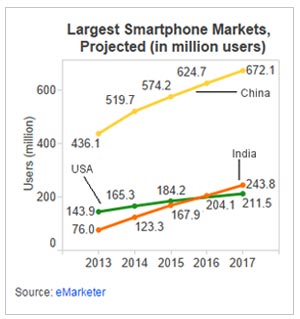
    India is one of the tremendously booming electronic markets in the world. In 2014, the nation emerged as the fastest growing smartphone market in Asia-Pacific, and was speculated to overtake the US as the second-largest smartphone market across the globe after China.

    The slow down of mobile sales in India reportedly depends on a number of factors like unexciting phones, increased tax, mounting competition and the extended Chinese new year festivities. The smartphone brands need to think of innovative device structures that stand out of the pack; immediately enticing the customers to buy one. LG’s G Flex series is one such example of innovation and style, which makes it ahead of the league. The increased tax is another area which is pulling smartphone vendors to offer devices at cheaper rates. Oppo, Xiaomi, and a few more manufacturers have found a solution to this, but there are many more who are yet to find an answer.

  • Xiaomi Launches Internet Finance Unit to Compete with Alibaba and Tencent

    Xiaomi Launches Internet Finance Unit to Compete with Alibaba and Tencent

    The widely popular Chinese electronics manufacturer Xioami is making headway into the finance sector with the launch of a new product service. Termed as ‘Huoqi Bao’, the newly launched personal finance service will offer deposit rates higher than the traditional Chinese banks. The recently inaugurated financial unit by Xiaomi pits it against the big players in the online finance arena like Alibaba, Tencent and Baidu.

    The China’s Apple has collaborated with a fund management company called E Fund Management that, as per Xiaomi, will expand into offering personal lending and security brokerage in the near future. The Huoqi Bao service will be accessible via an app bundled with Xiaomi’s operating system.

    Xiaomi Co-Founder Hong Feng said in a statement –

    We’re aiming to build a smart platform to help financial partners find high quality clients, while helping our users earn money and borrow money.

    China’s two biggest internet companies, Tencent and Alibaba, have established themselves in such a short span of time. Xiaomi aims to follow the footprints of the firms and provide investors with higher growth rates and cash-on-demand service. As per Reuters report, the world’s third largest smartphone brand has recently “generated annualized returns on deposits of 4.5 percent.”

    Alibaba’s financial arm Yu’E Bao was reported to have assets of worth 578 billion yuan ($93 billion) by end 2014. The E Fund Management is not exclusive to Xiaomi only and will also provide services to the Tencent’s Licaitong.

  • BlackBerry Will Not Manufacture Sub-$200 Phones: Company’s India Head

    BlackBerry Will Not Manufacture Sub-$200 Phones: Company’s India Head

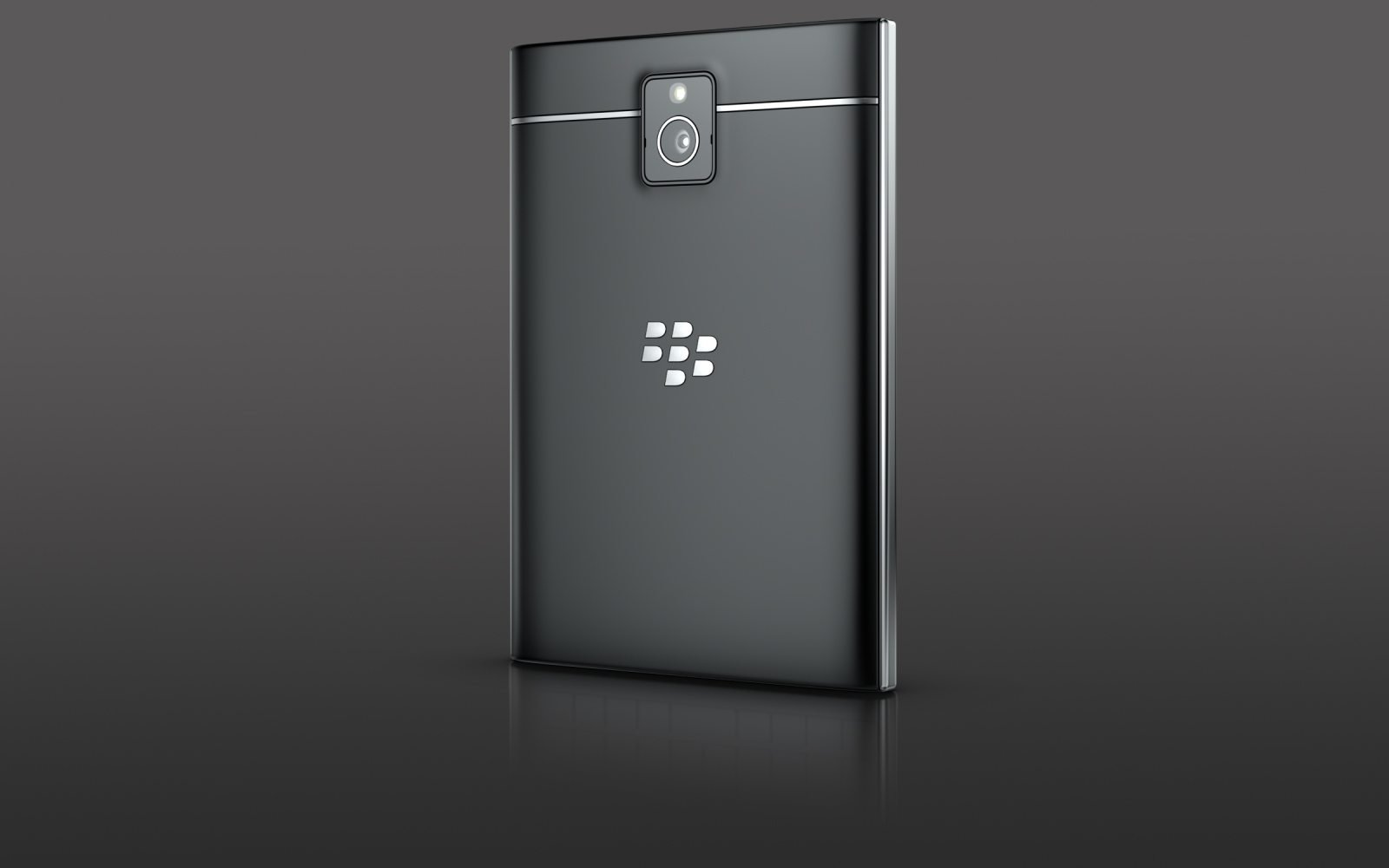
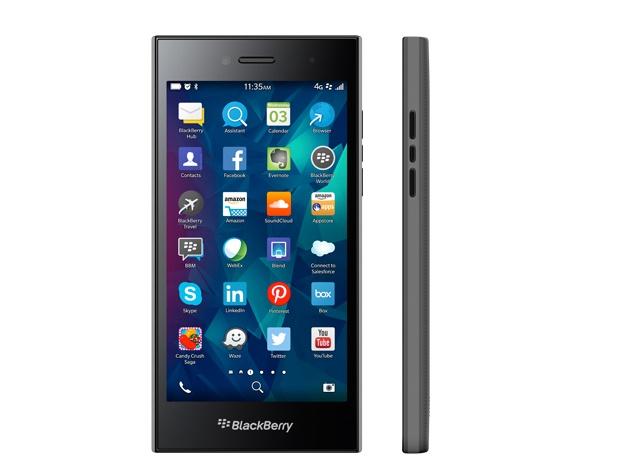
    Lately, BlackBerry has been witnessing a revenue dip in its smartphone segment. It recently released Leap and Classic,  to catch up with the present smartphone market, but the Canadian firm’s future success is uncertain. Hence, BlackBerry has chosen to restrict the yearly rollout of its models and focus on enterprise business for maximum profits.

    BlackBerry India Managing Director Sunil Lalvani said they will roll out the company’s key handsets, but for a niche segment. “The focus going ahead is the enterprise business, which today contributes a significant portion to the company’s revenues,” commented Lalvani. He further stated that they will not manufacture sub-$200 phones in future like other smartphone manufacturers are doing these days.

    blackberry leap

    BlackBerry’s market share in the Q4 last year explains the actual position of the company. According to research firm IDC, the market share of BlackBerry was 0.4% in last quarter 2014 (October-December), which was 8.1% during the same period in 2011.

    Lalvani comments on the firm’s goal for the coming years were –

    Going ahead the focus will be on increasing the bottom line and not the top line. So, in aligning ourselves to this view, we will not sell a huge number of handsets and hardware to boost our revenue figures but concentrate our effort on our high-margin enterprise and software services, which will drive profits.

    A couple of days back, an innovative idea was introduced by the smartphone maker that will sort the problem of managing multiple SIM cards. BlackBerry proposed a Virtual SIM card for the Indian users which gives the benefit of nine SIM cards in one. Talks are on with regulatory authorities and telecom operators to launch the Virtual SIM in India, and it has also partnered with Idea Cellular for its services. The same is expected to arrive by year-end.

  • Alibaba Eyes Micromax For Investment And Entry Into India

    Alibaba Eyes Micromax For Investment And Entry Into India

    Asia’s largest e-commerce name Alibaba is keen on entering the Indian market. With all the buzz around the online space, a new pro-investment Prime Minister and the booming Mobile phone market in India, Alibaba has found a secret route to enter.

    Sources claim that Chinese search and e-comm giant Alibaba will invest heavily in Micromax, acquiring upto 20 % stake in the Indian bred company. A deal that would cost the company over  $ 1.2 Billion, would allow the chinese giant easy access into the market which is tough to get into for new companies.

    Alibaba has also been in the news recently for investing in brands like Ouya, Meizu and Snapchat. Micromax is one of the largest mobile phone manufacturer in the domestic market. With its constant damage to Samsung’s position in India, and the new brand “YU” taking on the likes of Xiaomi and OnePlus in the local markets, Micromax makes for a good investment option.

    Micromax’s new brand YU is apparently set to launch a new product in India on the 12th of May to provide a more premium outlook, taking on flagship killers. The company was also recently in the news for the sad breakup of OnePlus and Cyanogen .

    The investment, however, focuses on Micromax devices and their wide spread reach. Alibaba plans to deploy services like Alipay, the company’s new payment platform. Ant Financial Services Group, which owns Alipay, is China’s largest payment service provider and is controlled by Alibaba’s executive chairman and founder Jack Ma.

  • Samsung to Provide Chipset and Displays for Apple’s Upcoming Products

    Samsung to Provide Chipset and Displays for Apple’s Upcoming Products

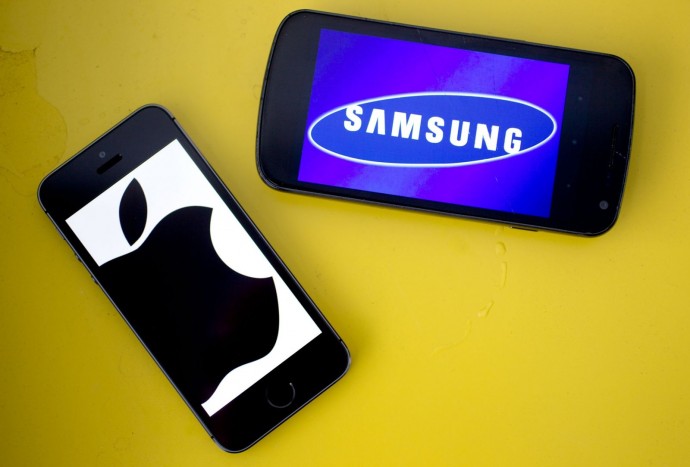
    It looks like the world’s biggest rivals in the tech world will soon be announcing major collaborations. According to the grapevine, Samsung will be manufacturing Apple’s core chip for the next iPhone as well as displays for other Apple products. This unexpected alliance was formed when Apple Chief Executive agreed to tone down the battle of patent suits against Samsung, thereby leading to this association.

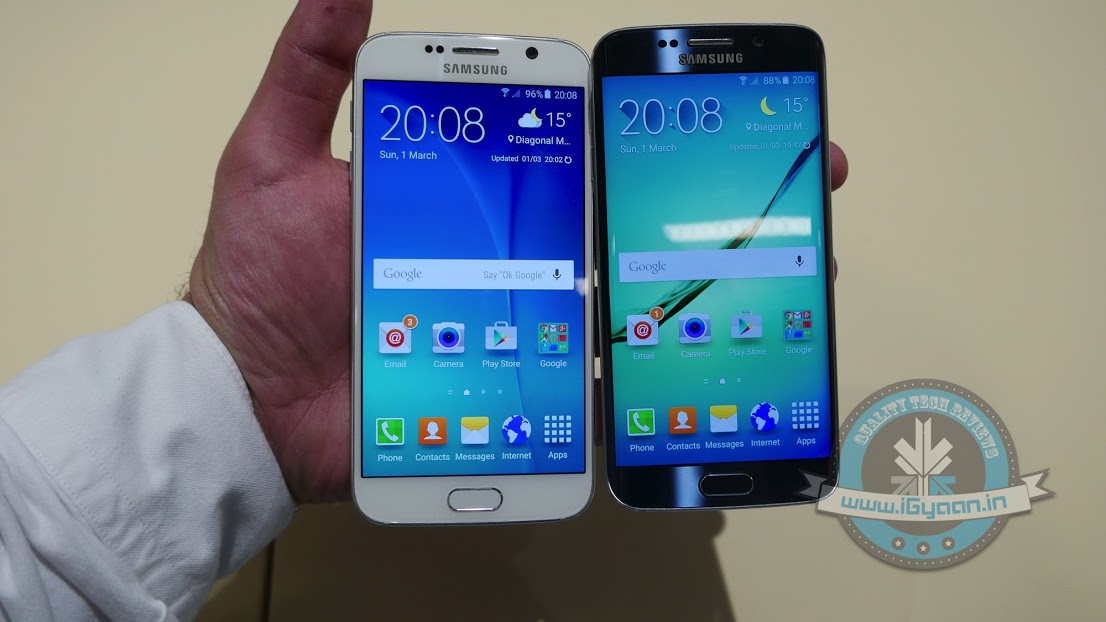
    Samsung will be budgeting $14 billion dollars for setting up new plants and equipment for manufacturing Apple’s newest device parts. Samsung had used the latest SoC for their flagship Galaxy S6 and Galaxy S6 Edge. The chip uses 14nm technology whose standards are matched by Exynos 7420, Samsung’s home made processor. The 14Nm chip is more powerful than the 16Nm chips that are standardly used in the company’s handsets.

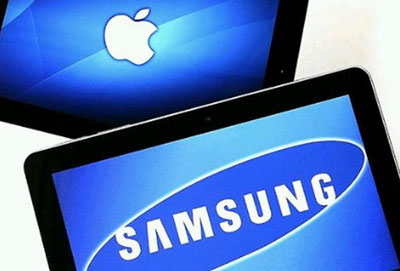
    Samsung-AppleBut from this partnership, Apple’s former partners like Taiwan Semiconductor Manufacturing Company (TSMC) and Sandisk may get a significant blow. TSMC used to manufacture chips for all the previous models of the iPhone and SanDisk was given the responsibility of memory chips for iPhone, iPad and Mac.
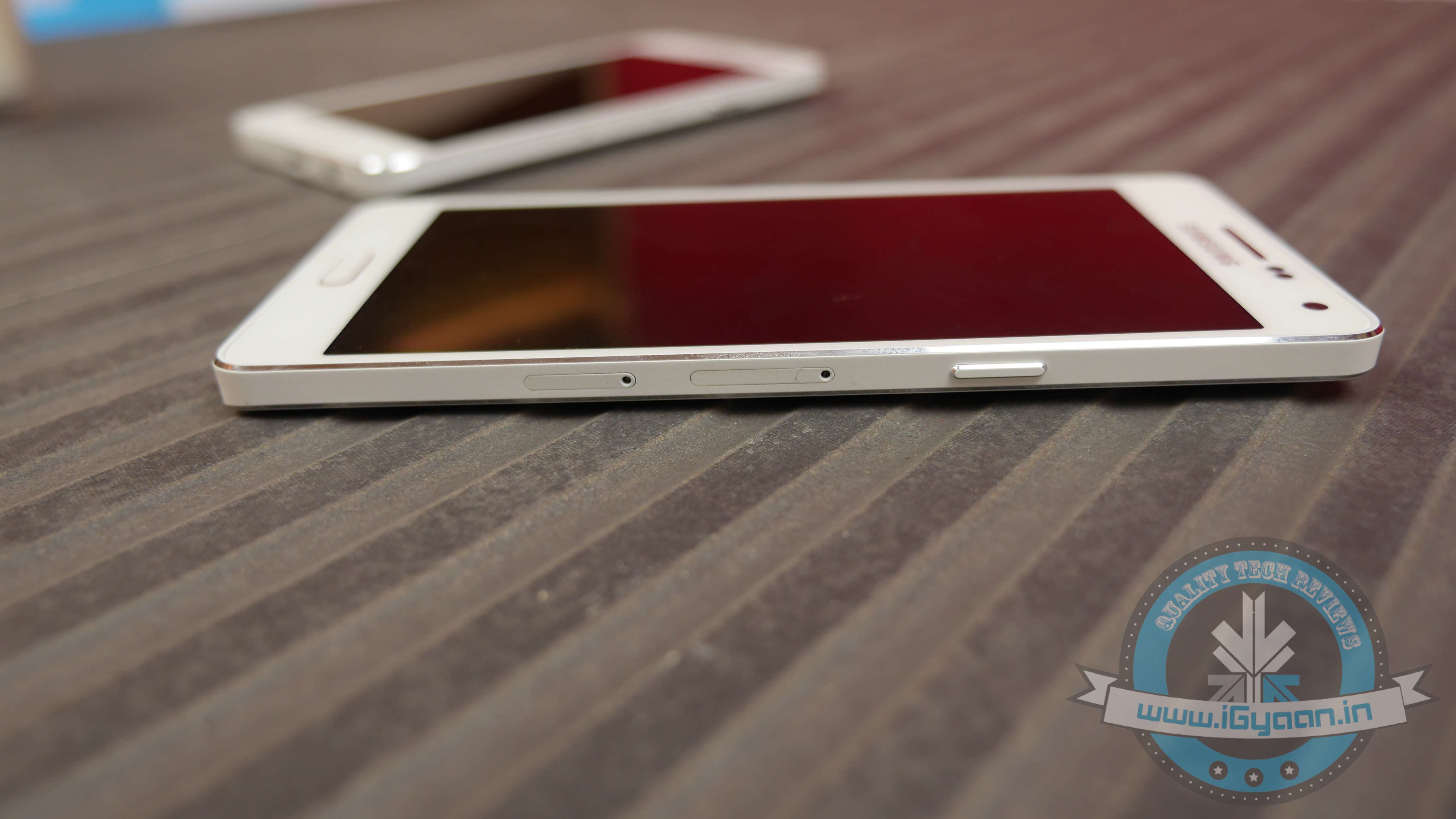

    There are no official confirmations from both the tech power houses, but if true, we may soon see something very different from this alliance. Although Samsung is manufacturing Apple’s new chipset, the Korean company will continue to make its own smartphones.

  • Counterpoint : Samsung Stays Steady on Top in India; Micromax Faces a Steep Decline

    Counterpoint : Samsung Stays Steady on Top in India; Micromax Faces a Steep Decline

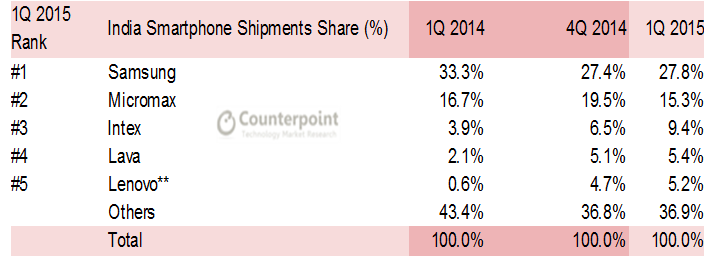
    According to the Q1 2015 reports by Counterpoint Technology Market Research, Samsung remained the the lead as India’s  champion in terms of growth and market share. The company has recently faced absurd challenges, in Asia particularly, but its condition improved enough to win over the Indian market from Apple and Micromax.

    Reports of the Q1 2015 showed Samsung India grew 2.1% over the last year. Samsung led the overall mobile phone market and the smartphone segment during the quarter with market shares of 18.2% and 27.8% respectively. This figure is still below the 33% growth from the previous year. But, with a sale of 82.4 million handsets within the first three months of the quarter, Samsung captured 24.5% of the market share.

    According to the report, Samsung has used its distribution prowess to sell-in during the quarter as it executed aggressive smartphone launches during the quarter including the Tizen-based Z1.

    India Smartphone shipment counterpoint

    One of the reasons why Samsung boomed is that the Korean company launched its flagship Galaxy S6 and Galaxy S6 Edge at the end of the quarter in April.

    Micromax ended their quarter with 15.3% market share that served as a decline on the yearly basis as well as on sequential basis. Although, it still managed to secure the second place, the report commented that Micromax’s new brand Yureka with the launch of its first Cyanogen powered LTE smartphone Yu started off well, but will need more models across different price brackets to match the scale of Xiaomi and Motorola.

  • Microsoft Might Set Up a Smartphone Manufacturing Unit in India

    Microsoft Might Set Up a Smartphone Manufacturing Unit in India

    The smartphone landscape in India is rapidly flourishing. Previously Xiaomi expressed its view to build a manufacturing unit in the country and now, Microsoft is mulling over the same thought. The US-based firm Microsoft is pondering over establishing a local manufacturing unit in India after the government’s decree on import. The company says that post the Indian government’s rigorous take on international organizations, it would be expensive to bring phones to the country.

    Corporate Vice-President at Microsoft Mobile Device Sales, Chris Weber reiterated the same, “We’re evaluating local manufacturing in terms of what our local footprint is. There are some new regulations and tax duties, etc., about local manufacturing and certainly we’re looking at them to make sure that we remain competitive.” He further mentioned that the evaluation is underway for all nations including India.

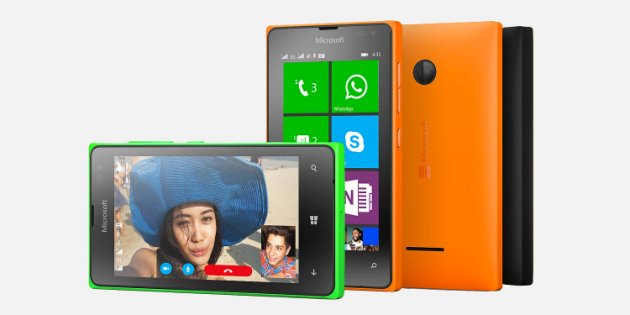
    Lumia 435

    Microsoft got a boost in the smartphone business with the buyout of Nokia’s device business for $7.5 billion last year. The firm has a foothold in the market, but to stay ahead of its competitors like Samsung, Xioami, Micromax and more, Microsoft needs to offer phones at an unbeatable price point.

    As an Indian origin firm, Micromax has added benefits. It can retail its handsets at comparatively lower prices as the Indian government has relieved the home-grown companies from many taxes to give them a push. On the other hand, the current budget puts excessive load on foreign tech companies since it has made import even more pricey. It has led global companies to consider establishing a manufacturing unit in India.

    Weber said that Microsoft will update its 4G devices portfolio in India and make a comeback in the premium smartphone market this year. The hardware and software beast now has several budget and mid-range smartphones in its portfolio. Seeing people’s inclination to high-end devices like Galaxy S6 and iPhone 6 Plus, Microsoft is planning to throw its top-notch devices in the marketplace and enter the premium smartphone battle.

    The American multinational technology firm is presently rebranding the brick-and-motor stores of Nokia all over the world. The rebranding will be held in two categories – Microsoft Priority Resellers and Microsoft Mobile Sellers. The former one will keep all the company products, and the latter will be an experience store.

  • Samsung Reports Major Drop in First-Quarter Profits

    Samsung Reports Major Drop in First-Quarter Profits

    The latest flagships by Samsung Electronics, Galaxy S6 and S6 Edge, were supposed to bring the company back on track. The company has been rapidly losing ground to other smartphone manufacturers like Apple, OnePlus, and Xiaomi. The escalating demand for its flagships speaks of Samsung’s decent performance this time around, but the latest announcement says otherwise.

    Samsung, who has been relying on the buoyant sales of the high-end devices, recorded significant slide in profit for the sixth consecutive time. It is the sixth consecutive quarter-on-quarter (QOQ) drop reported by Samsung. The company today declared that Q1 2015 net profit was 4.63 trillion won ($4.35 billion). This was lower than the 7.49 trillion won gained the previous year. The company also mentioned that the quarterly revenue tripped by 11 percent to 47.12 trillion won, while the operating profit increased to 5.98 trillion won.

    The latest statistics is higher than the previous quarter and less than half of what was reported in Q1 2014.

    Samsung Galaxy S6 and S6 Edge 0
    Samsung is banking on the Galaxy S6 and S6 Edge to help boost its numbers.

    Samsung’s latest S series was outdone by Apple’s iPhone 6 and its bigger sibling. According to numbers, people preferred the bigger iPhones over the curvy Galaxy S6 Edge. Alongside, Samsung has been unable to cope up with the supply demands of Samsung S6 Edge, which is likely to have an adverse effect on its business.

    Apple has again become the world’s most valuable company and disclosed the iPhones sales of the first quarter. According to Apple, a total of 61 million iPhones were retailed in Q1 this year and the maximum numbers were sold in China.

    Samsung expects a better sales figure in the second quarter, and said that the Galaxy S6 and S6 Edge will boost the numbers up in the next couple of months. OLED and LCD panel sales are further anticipated to lift the overall sales. The Consumer Electronics (CE) Division also sees an improved sale of air conditioners and the flagship SUHD TV.

    With many premium products in its kitty, Samsung expects to recover its revenue figures in the next quarter. However, it wouldn’t be that easy as many tech start-ups, as well as established companies, have secured a niche in almost every segment. Xiaomi has become a customer favourite and Apple fans are rapidly multiplying all over the world. It would be interesting to see what tactics Samsung adopts to catch up with these present titans.

  • Google’s New Marketplace Invites Sellers to Trade Their Patents

    Google aims to get a hold of your exclusive set of rights. The search internet giant announced the same on Monday by stating its plan to establish an online marketplace. The common place will offer talented minds sell their patents to them.

    The online meeting spot for Google and patent holders is known as Patent Purchase Promotion and it is an “experimental marketplace for patents that’s simple, easy to use, and fast.”

    Allen Lo, the Patent Deputy Counsel of Google mentioned in a blog post –

    We invite you to sell us your patents. Today we’re announcing the Patent Purchase Promotion as an experiment to remove friction from the patent market.

    The blog post adds that a streamlined portal will be open for patent holders from May 8, 2015 through May 22, 2015, where willing sellers can set a price of their product. On the last date, the submission will close and submitters with valuable patents will be contacted by June 26, 2015. The deal is anticipated to close by late August.

    The move will help improve their patent landscape. Also, it will provide better benefits to the original patent owner.

    Get more information on Patent Purchase Promotion here.

  • Xiaomi’s Q1 Earnings May Not be as Good as You Think

    Xiaomi’s Q1 Earnings May Not be as Good as You Think

    Lately, Xiaomi has been in the news for all the good reasons. They’re constantly announcing high-speced affordable smartphones and earnings that are constantly on a rise. But seems like the good days of the company may be over played. The Chinese equipment manufacturer that took over Apple’s sales on its home ground a while back, is now witnessing a steep decline in its revenue.

    Ben Bajarin from the market research firm Creative Strategies revealed the quarterly sales of Xiaomi. The figure shown below depicts a decline in the Q1 2015 from the last quarter of 2014.

    According to the statement by Ben Bajarin, Xiaomi sold a total of 100 million handsets, which is less than its previous records. One of the major reasons for lesser business for the Chinese tech giant is the supply shortage. The flash sale model adopted by the company has worked both in its favour and against. When the company’s supply does not meet the demand, interested buyers begin looking for other options.

    There is a possibility that the latest Mi phone may help recover the revenue. The new Xiaomi Mi 4i consists of the Mi 4 parts, which are easily available in the market. Their supply chain is expected to achieve an overall boost by this, consequently helping Xiaomi build its sales numbers. Let’s hope Xiaomi pays heed to these figures, and increases its units in the future.

  • Xiaomi Flaunts 3 Lakh Mi 4i Registrations; No Word on the Number of Units Up for Sale

    Xiaomi Flaunts 3 Lakh Mi 4i Registrations; No Word on the Number of Units Up for Sale

    When Xiaomi took the veil off its latest, affordable smartphone Mi 4i in India, it was speculated to have record sales. Going by the presumption, the device has garnered huge registrations for the flash sale to be held on April 30. The handset reported over 3 lakh applications in a mere four days period.

    Xiaomi India Head Manu Jain confirmed the same via Twitter –

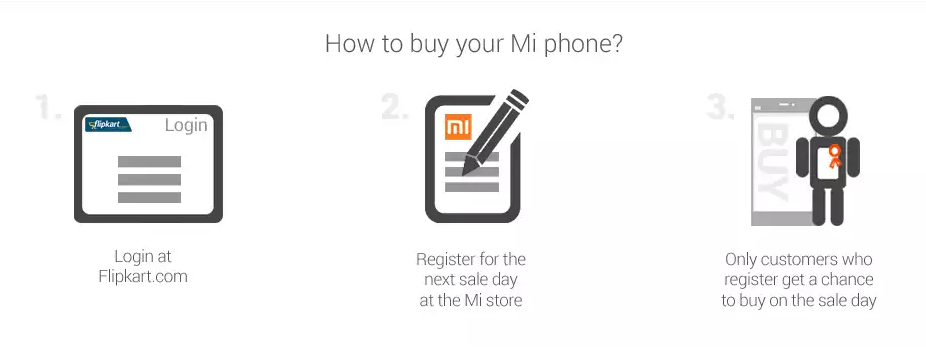
    At the launch event held on April 23, the Chinese electronics firm mentioned that users need to register on the e-commerce website Flipkart to participate in the sale. The registration process is done simply via a three step process.

    Xiaomi hasn’t mentioned the number of devices going up for sale and users need to be online before the sale time (April 30, 2 pm) to grab the product. In the past, we have seen Xiaomi pushing 40,000-50,000 units of devices. Therefore, this time it is expected to release units close to the earlier figures. Those who haven’t registered yet can do it here.

    mi 4i registration

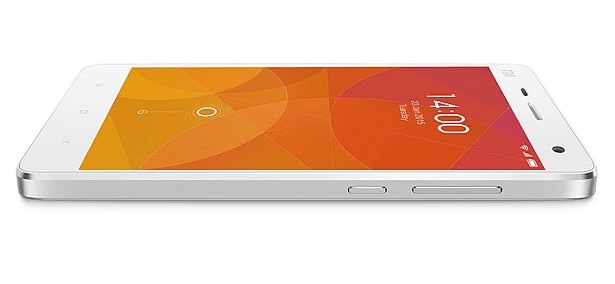
    Recalling the specifications, Xiaomi Mi 4i has a 5-inch Full HD OGS IPS display with 441ppi pixel density. The processor powering the phone is a 64-bit octa-core Cortex-A53; the four cores clocked at 1.7 GHz and the other four at 1.1 GHz. It features 2GB of RAM and 16GB of non-expandable storage space. The Mi 4i runs on Android 5.0 Lollipop with the company’s MIUI 6 on top.

    Optics includes a 13MP rear and a 5MP shooter. The dual-SIM device is powered by a 3120mAh battery. Connectivity options include microUSB 2.0, Bluetooth 4.0 and Wi-Fi. Priced at Rs. 12,999, the handset will be available in white, blue, orange, yellow and pink colour options.

  • Apple CEO Speaks Up About iPad’s Disappointing Sales Figures

    Apple CEO Speaks Up About iPad’s Disappointing Sales Figures

    The recently released statistics by Apple establishes the fact that the iPhone is the most popular smartphone in the international markets. The world’s most valuable company made public the three months earnings of this year’s second quarter, which speaks of 61 million iPhones being sold. This leap is incredible as this is the second biggest quarter for the iPhone. Apple managed to sell as much as 43 million iPhones last year in Q2 2014.

    The CEO of the company Tim Cook spoke about the achievement –

    We are thrilled by the continued strength of iPhone, Mac and the App Store, which drove our best March quarter results ever. We’re seeing a higher rate of people switching to iPhone than we’ve experienced in previous cycles, and we’re off to an exciting start to the June quarter with the launch of Apple Watch.

    Apple set a record in China by surpassing the overall sales of US. For the first time in the history of iPhone, China contributed $160 million with the iPhone sale, whereas it remained $120 million in its home market Europe. The increase of 71% put Apple’s revenue in the Asian country to $16.8 billion, a major chunk mostly attributed to festivities around the Chinese New Year.

    apple earning

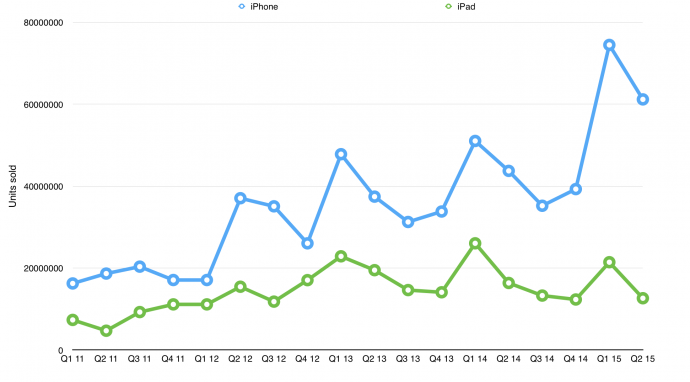
    However as iPhones, Macs, and the App Store has gained numbers, iPad are continuously fading in the background every passing year. Once again, the iPad sale shrunk this year and closed at 12.6 million. The newest iPads to hit the market this year were the iPad Air 2 and iPad Mini 3.

    For the lackluster sales of iPad, Tim Cook says –

    We have never worried about that, it is what it is, and at some point it will straighten out.

    Meanwhile, there are many estimates by analysts about the Apple Watch sales, but the company hasn’t come out with an official announcement. Seeing the present report, Apple is likely to take a leap from $46 billion to $48 billion in revenue in Q3 this year.

  • China Overtakes US in iPhone Sales, As Apple Earnings up 33%

    China Overtakes US in iPhone Sales, As Apple Earnings up 33%

    For the first time in the history of the iPhone, China sales of the Apple iPhone have overtaken the US sales. The increase of 71% put Apple’s revenue in the asian country to $16.8 Billion, a major chunk mostly doe to the festivities around the Chinese New Year.

    The Apple iPhone 6 and iPhone 6 Plus have been the most popular handsets from the company since the launch of the iPhone back in 2007. The last quarter results broke all records pegging the worldwide success of the handsets.

    [quote text_size=”small” author=”Tim Cook” author_title=”CEO- Apple inc.”]

    The large middle class growth has fueled the high purchase volumes of the handset in China

    [/quote]

    End of March 2015 Apple’s cash totaled $193.5 billion, up from $178 billion at the end of December, that is more than the total of the next top 15 companies in the Standard & Poor’s 500 list.

    Apple has increased its dividend to 11%, In all, Apple pledged to return $200 billion to shareholders through buybacks and dividends by March 2017. Overall revenue rose to $58.01 billion in the second quarter ended March 28, from $45.65 billion a year earlier. That beat Wall Street’s expected revenue of $56 billion.

    Apple’s latest hardware product, the Apple Watch, started shipping Friday. So far, availability is limited for the new device with Apple’s website estimating that new orders won’t be delivered until June.


iGyaan Network
Privacy Overview

This website uses cookies so that we can provide you with the best user experience possible. Cookie information is stored in your browser and performs functions such as recognising you when you return to our website and helping our team to understand which sections of the website you find most interesting and useful.