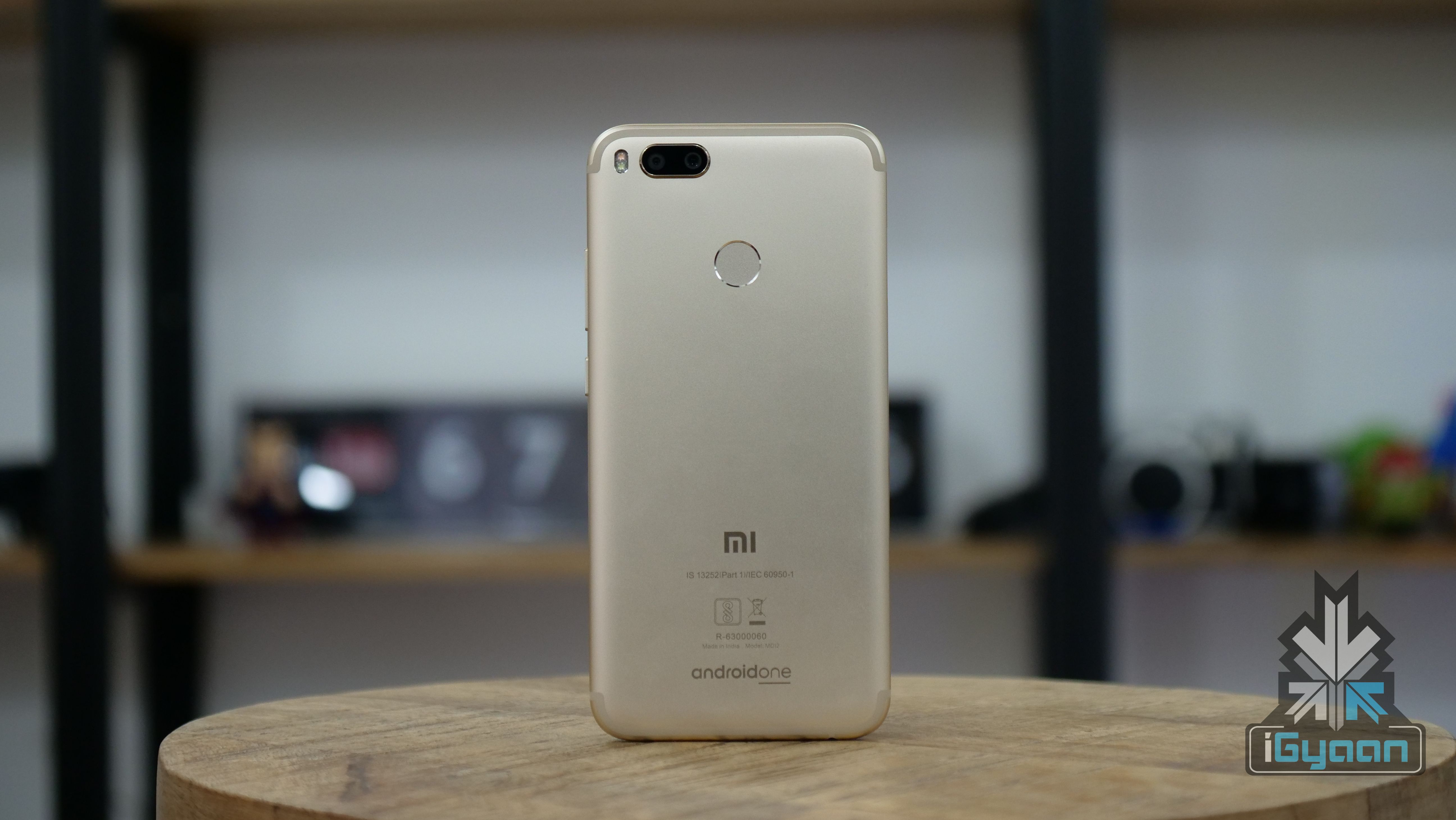
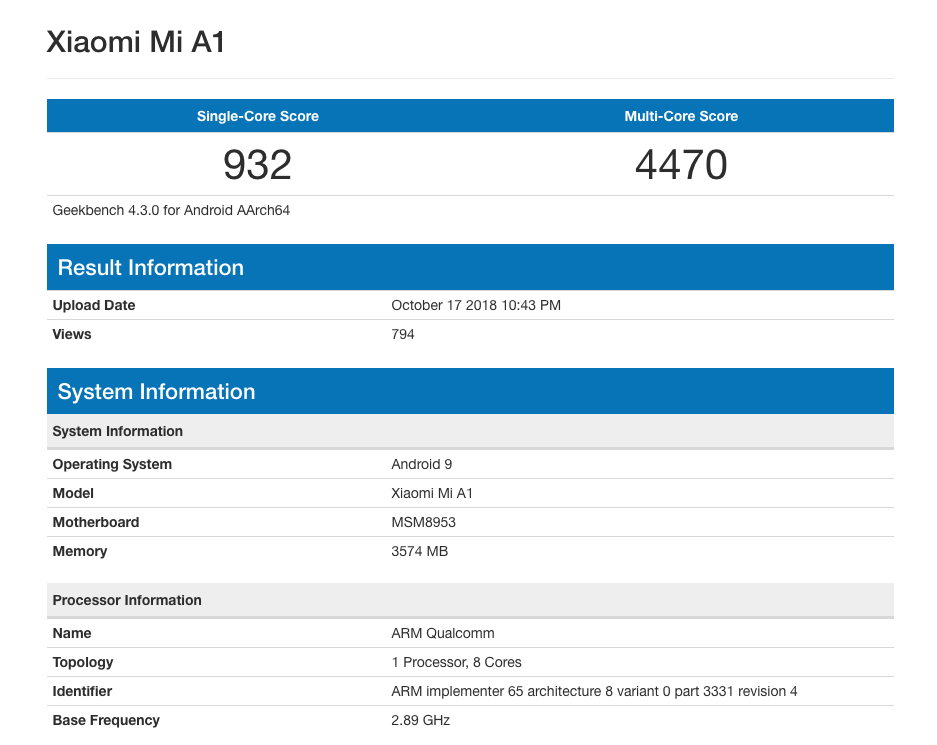
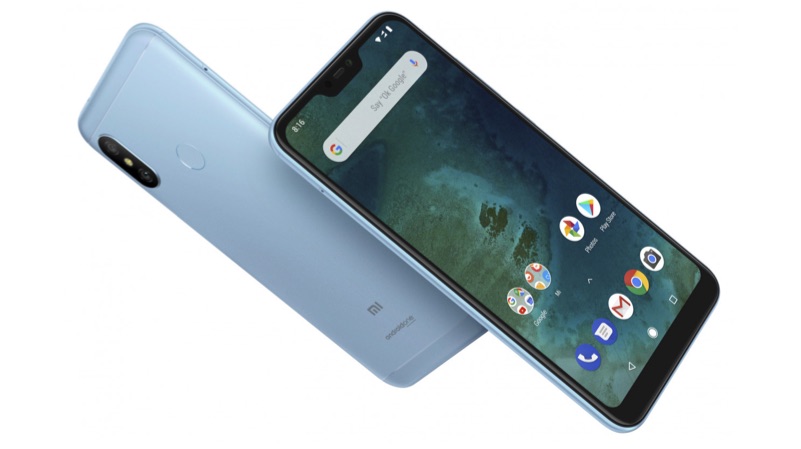
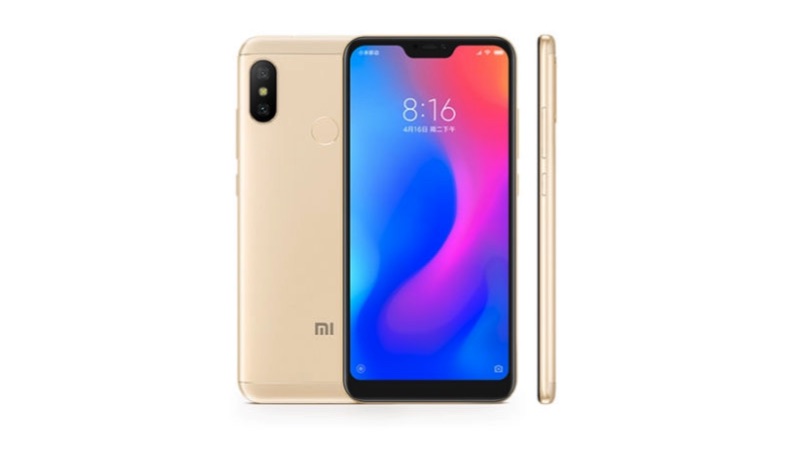
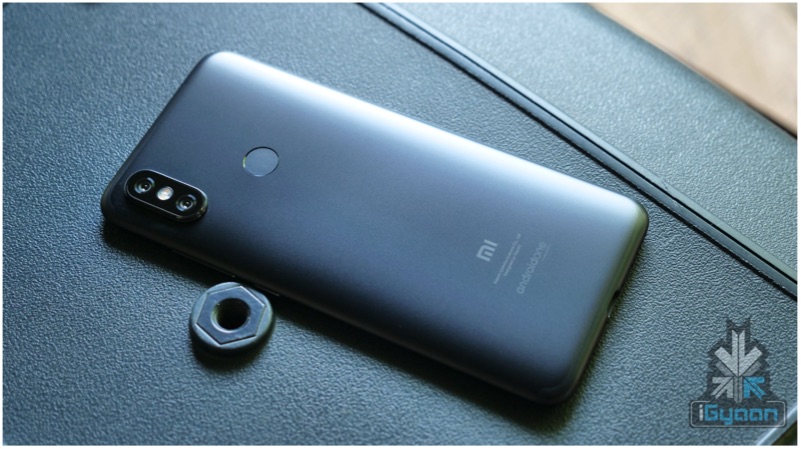
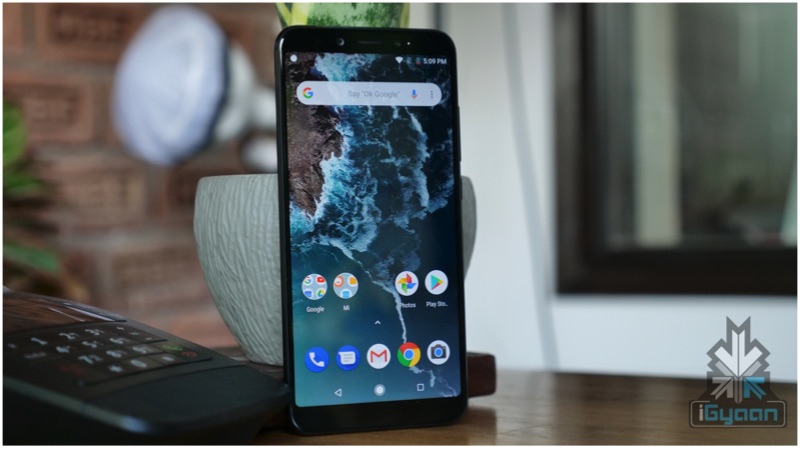
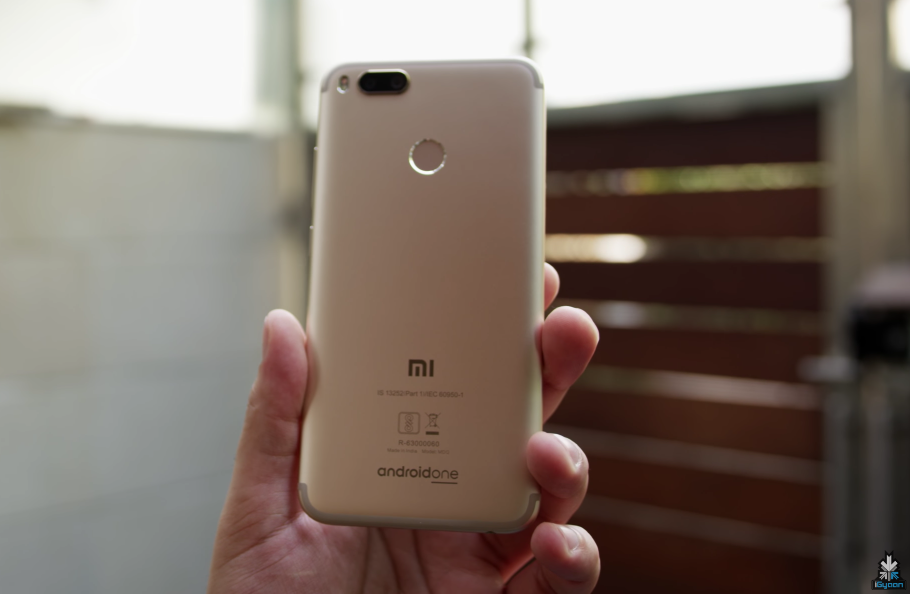
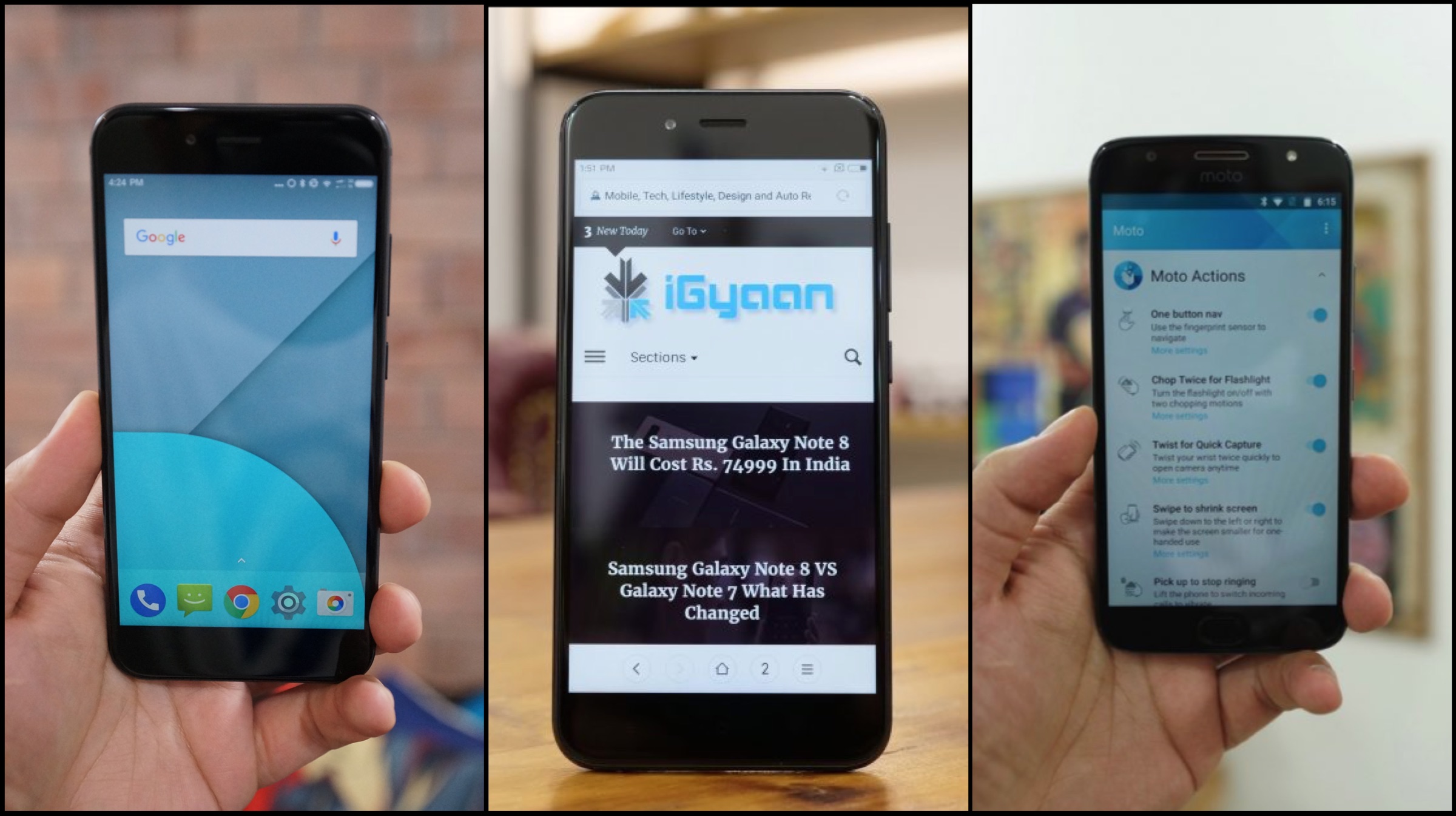
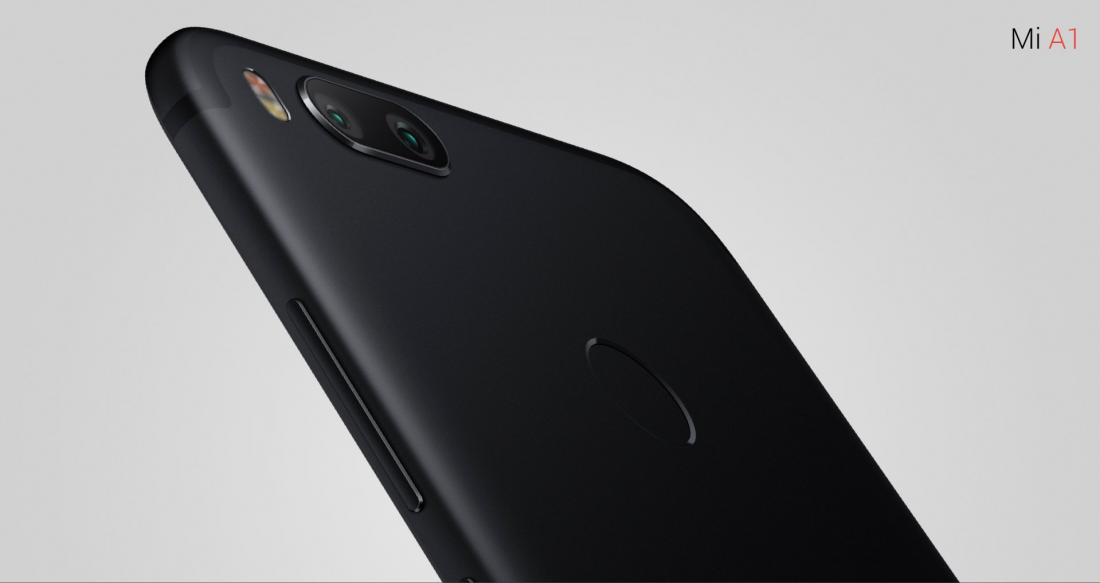
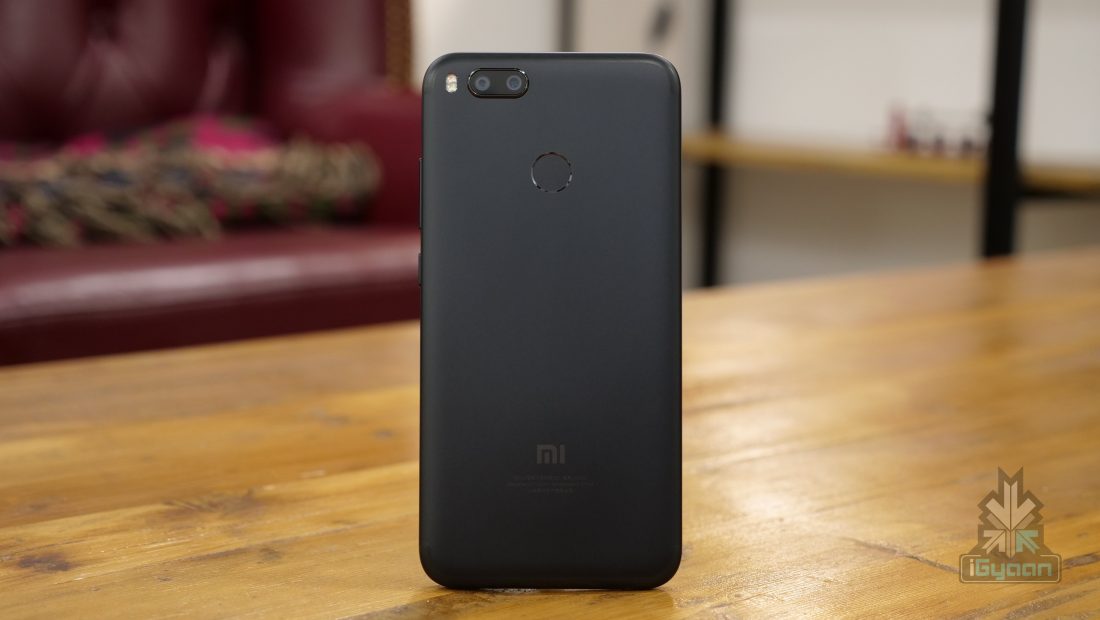
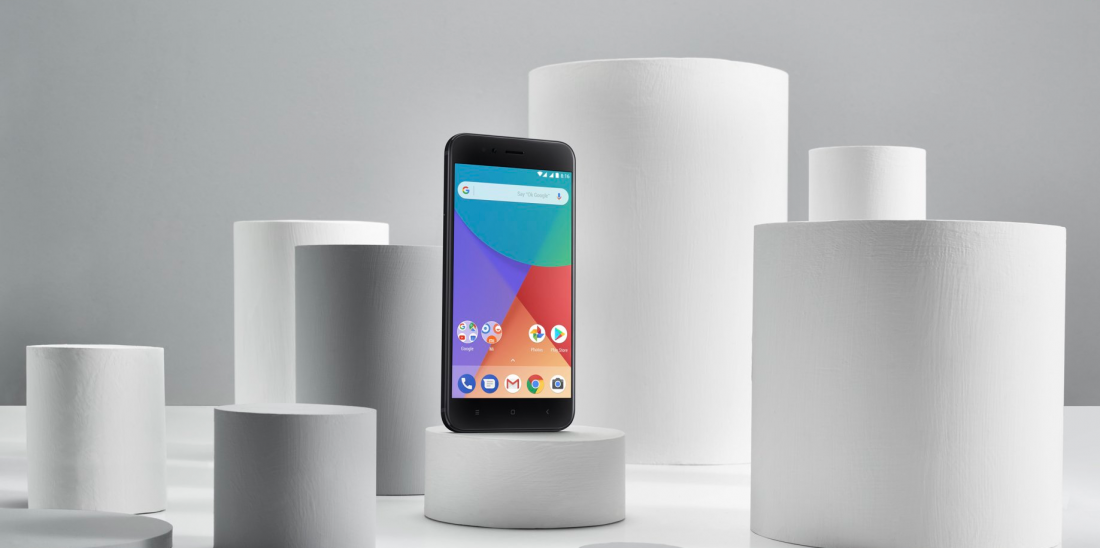
Xiaomi’s stock Android phone Mi A1 is due for an update and it seems like the date is not too far away. As of now, the Mi Mix 2S is the only model in Xiaomi’s phone line up that has received the Android 9 update. The Mi A1 running an Android 9 Pie has been spotted on the GeekBench database. It is also noteworthy that the recently launched Mi A2, which also runs on Android One, features Android Oreo.
The model that passed through GeekBench featuring the Android 9 Pie update has a Single Core score of 932 and a Multi Core score of 4470. Uploaded on October 17, the score seems to be slightly higher than the ones running older Android versions. Xiaomi is however yet to release any official statement on the update. Speculations are rife that the update may arrive in a few week’s time. The Android Pie brings with it several new features and User Interface changes. Some of the best features of Android Pie include full-screen gestures, Gesture navigation, Restyled recent apps interface, Improved text selection interface and redesigned notification drop down.
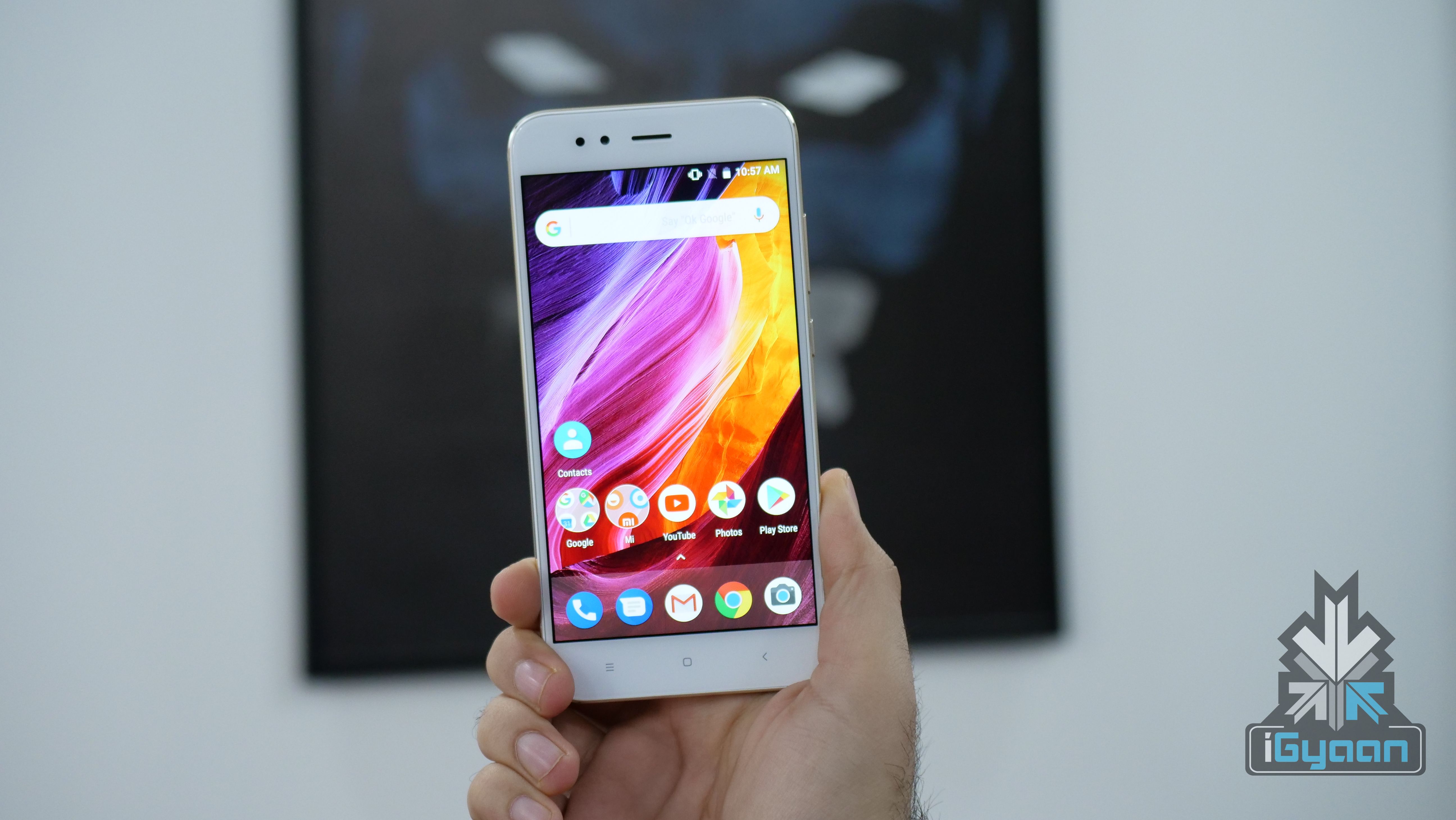
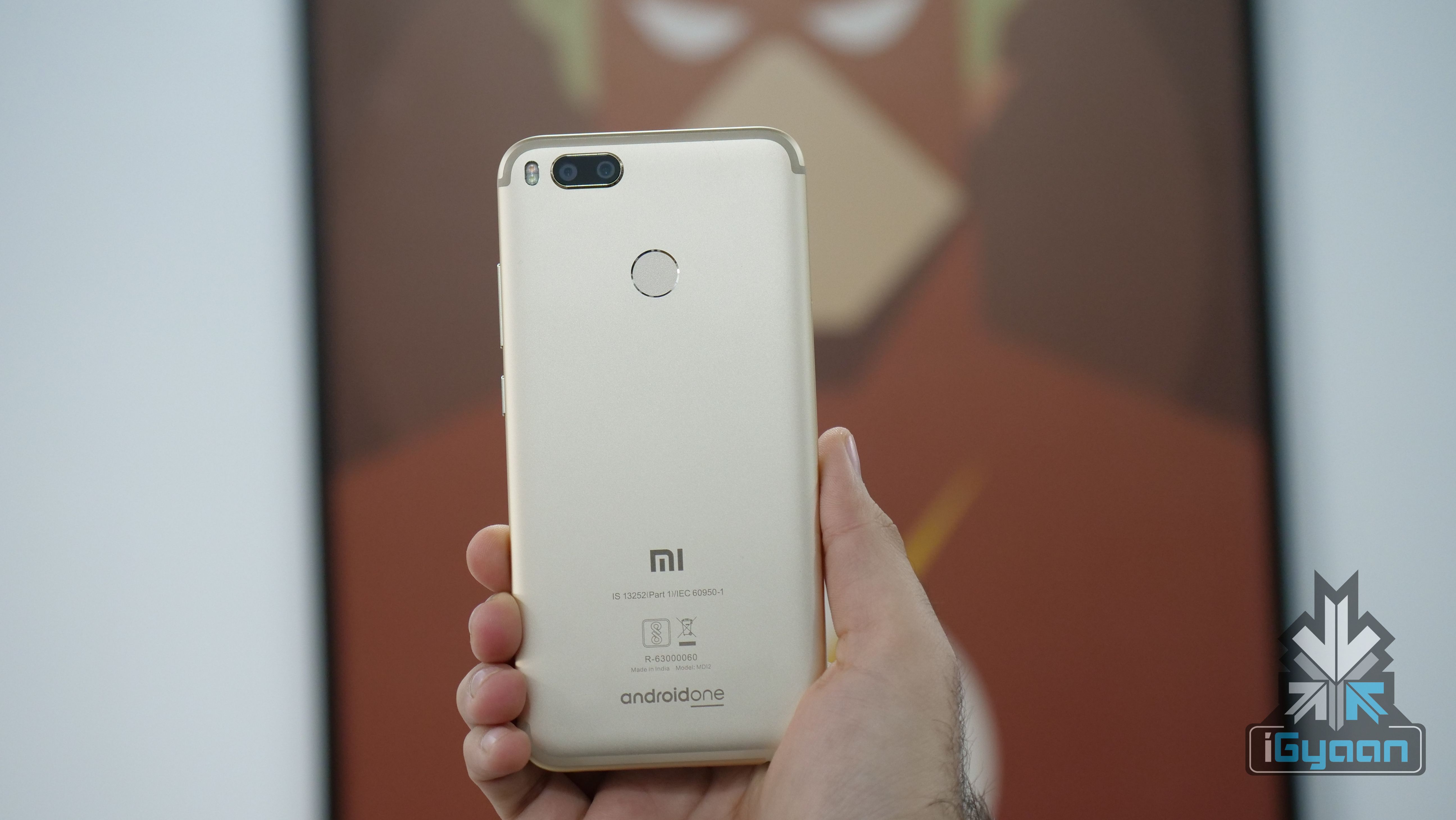
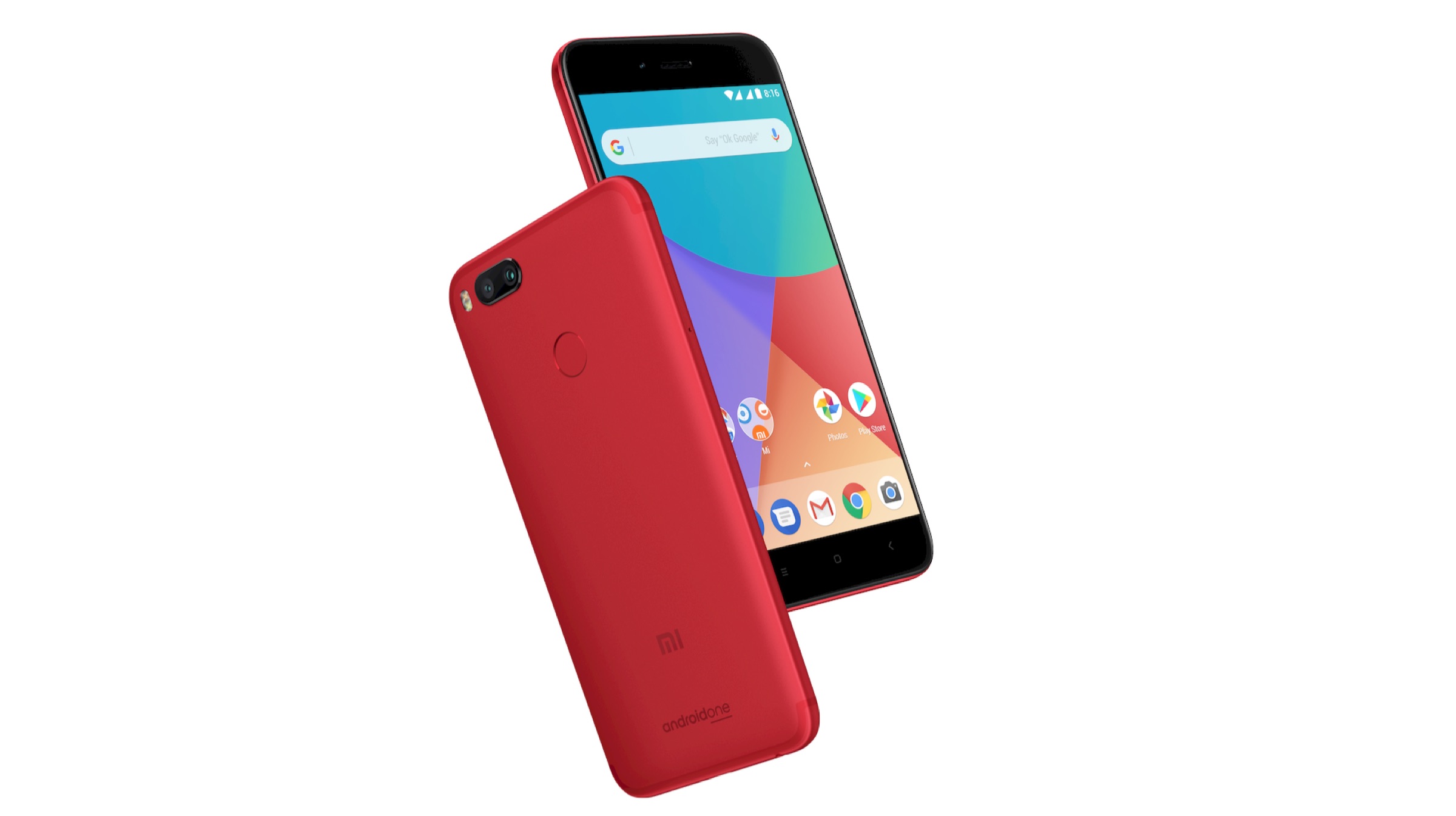
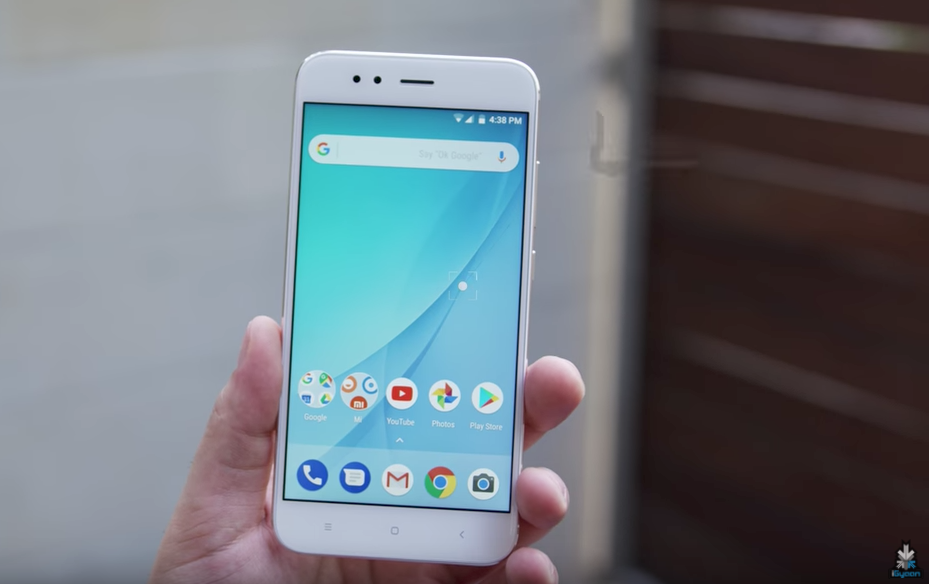
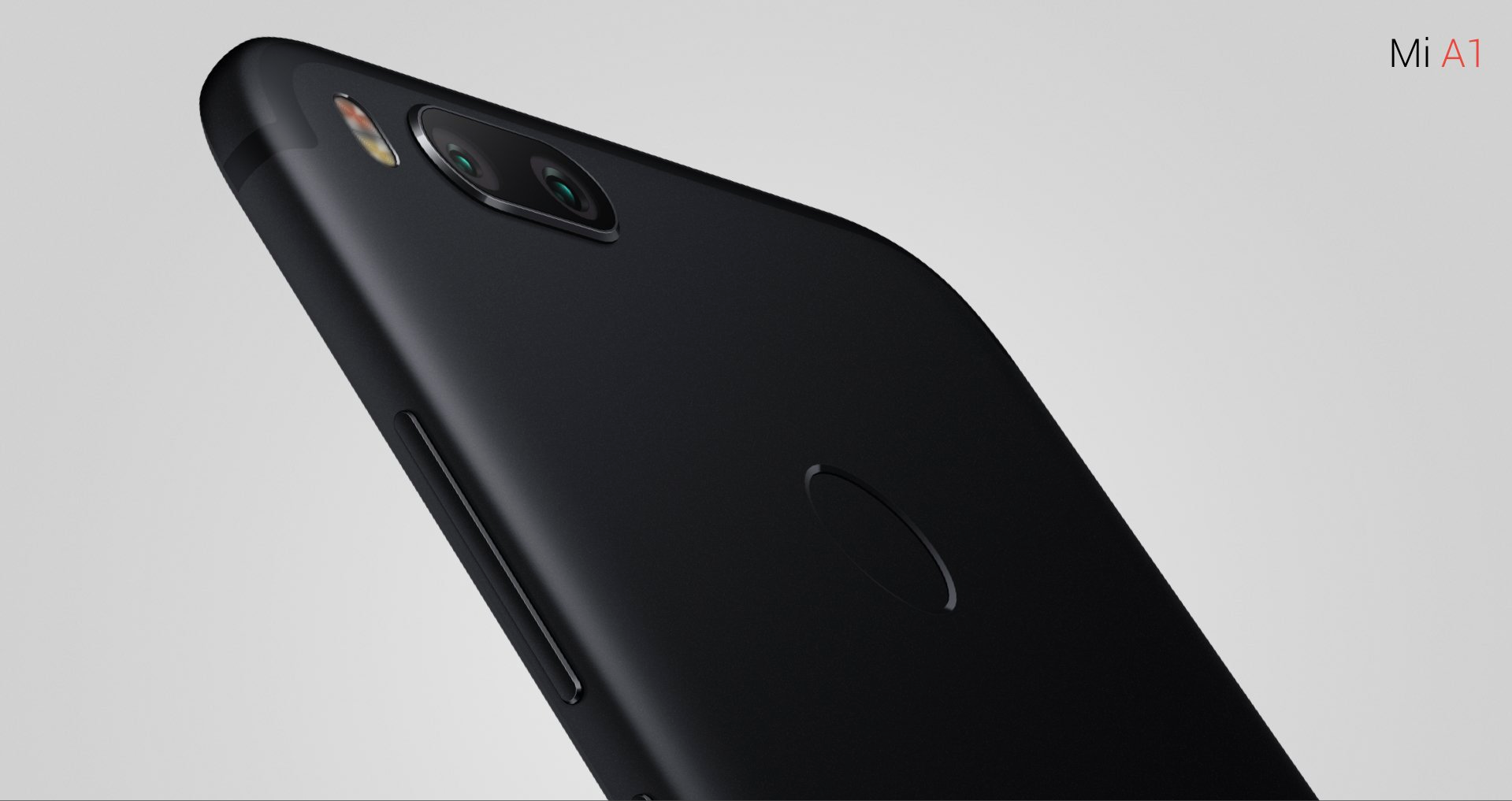
The Mi A1 features 4 GB RAM coupled with 64 GB ROM which is expandable upto 128 GB. It also has a 5.5 inch Full HD display and two 12 MP primary cameras with a 5 MP front camera. The phone also features a 3,080 mAh Li-polymer Battery and is powered by the Qualcomm Snapdragon 625 64 bit Octa Core 2 GHz Processor. The Mi A1 also has a 3.5mm jack, IR Blaster, fingerprint sensor, USB Type C and all the standard features. The phone features Android Nougat 7.1.2 with Android Oreo update immediately available out of the box. It is available in Black, Gold, Rose Gold, and the Special Edition Red colour options. The Mi A1 is available for a price of Rs 13,999 on the official Mi website.
When Xiaomi launched the Mi A1 back in September 2017, it also revealed the company’s sales figure for the month. Moreover, the Mi A1 was also the company’s first Android One device. The was also the company’s first smartphone in the Mi A series. Xiaomi claimed that it had sold close to 10 million devices in the month of September alone, making the Mi A1 one of the most bought smartphones of the year. Now, in the month of July 2018, the company has launched the Xiaomi Mi A2 and A2 Lite. While not much has changed from the Mi A1 to the Mi A2, there are still a few things that the company has decided to differently with the latter. The smartphone has launched on 24th July globally in Madrid, Spain.
The only similarity which both the Mi A1 and the Mi A2 share is that both of them are Android One devices, other than that, the company has introduced a lot of changes. The Xiaomi Mi A2 has a front glass design and an aluminum body. The display on the Mi A2 is a 5.99-inch panel with an aspect ratio of 18:9 and a resolution of 2160 x 1080 px. This display is an IPS LCD panel. Whereas, the Mi A1 has a 1920 x 1080 px IPS LCD panel.
Mi A2 Lite
Powering the Xiaomi Mi A2 is a Qualcomm Snapdragon 660 chipset with the Adreno 512 GPU. Whereas, the Mi A1 had the Snapdragon 625 with the Adreno 506 GPU.
The camera setup on the Mi A2 consists of a total of three sensors. The primary camera has a 12 MP sensor with a f/1.75 aperture and another 20 MP sensor with a f/1.75 aperture. Secondary camera of the device is a 20MP sensor with front-facing LED flash and a f/2.2 aperture. While the Mi A1 had a primary dual-camera with two 12MP sensors.
Mi A2 Camera
What Xiaomi could have also done differently is add a fast charging capability to the Mi A2 since the chipset supports Qualcomm Quick Charge 4 technology. There are three storage variants of the Xiaomi Mi A2, a 4GB RAM and 32GB storage, 4GB RAM and 64GB storage, and a 6GB RAM and 128GB storage variant.
Why The Mi A2 Lite?
Even though the Mi A1 did really well, especially in the Indian market, many complained that the smartphone was slightly on the expensive side. To address this issue, Xiaomi has launched announced the Mi A2 Lite. The smartphone is advertised as the “entry-level Android One king”. Entry-level, because, the price of the Mi A2 could be under the Rs. 15,000 price bracket.
MI A2
While there is no word about whether this device will be launched in India, but we can expect it to arrive in India under another alias.
The display on the Mi A2 Lite is a 5.84-inch panel with an aspect ratio of 19:9 and a resolution of 2280 x 1080 px. The Mi A2 Lite sports a notch-display. Both the Xiaomi Mi A2 and A2 Lite have an IPS LCD panel. The Mi A2 Lite is powered by the Snapdragon 625 with the Adreno 506 GPU. This chipset also featured in the Mi A1.
Pricing And Availability
The Mi A2 starts at a price of €249 (Rs. 20,071.20 approx) for the 32GB variant, with the 64GB costing around €279 (Rs. 22,500.42 approx), and the 128GB variant around €349 (Rs. 28,145.69 approx). While the Mi A2 Lite will start at €179 (Rs. 14,434.23 approx). The Mi A2 will go on sale in Spain starting 10th August, in France on 27th July, and in Italy and India on 8h August. While the Mi A2 will be available in India, the Mi A2 Lite will be sold in countries other than India.
Xiaomi celebrated its first Android One anniversary with the launch of the Xiaomi Mi A2 and A2 Lite. The company has also emphasized the AI capabilities of both the smartphones through the launch. While you have to wait for our full review of the Mi A2, we already have an unboxing video ready for the smartphone. Take a look.
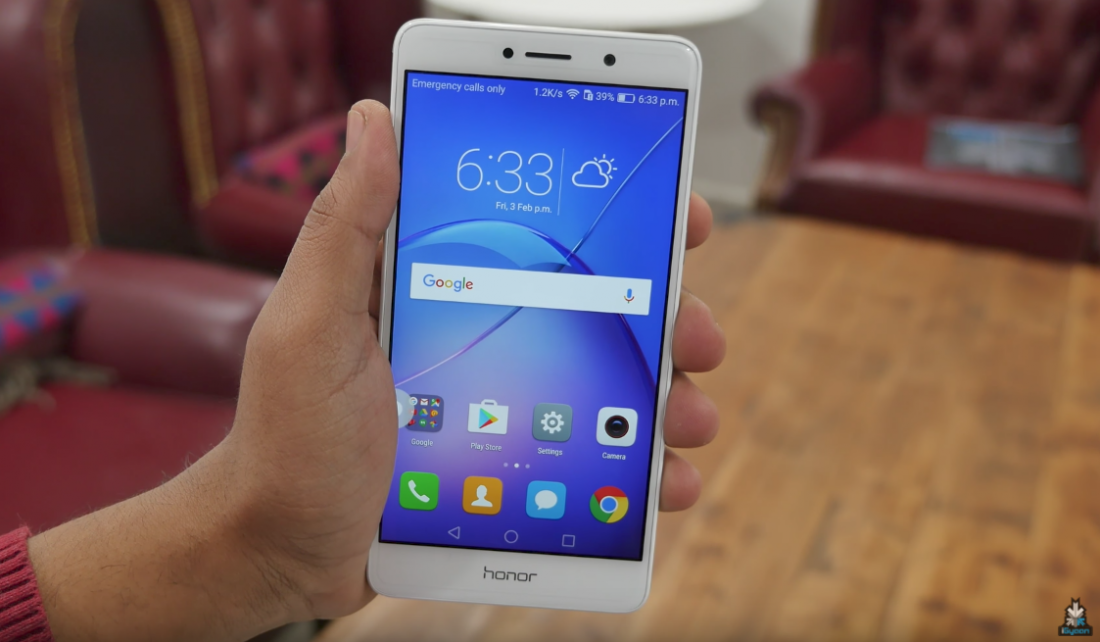
Huawei Honor launched the Honor 7X in India at a starting price of Rs. 12999. Up until then, that price segment was dominated by the likes of the Xiaomi Mi A1 and Moto G5s Plus, both of which offered similar specifications and software experience.
Before the Honor 7X was launched in India, the Xiaomi Mi A1 was soaring high at a price tag of Rs. 14999 which was cheaper than the Moto G5s Plus, however, a few days after the Honor 7X was launched, the price of the Mi A1 decreased. In order to keep a level playing field, Xiaomi reduced the price of the Honor 7X to Rs. 13999 and right now, it is available for Rs. 12999 on Flipkart. With the price tag no longer a factor, let’s see which phone comes out on top.
Design
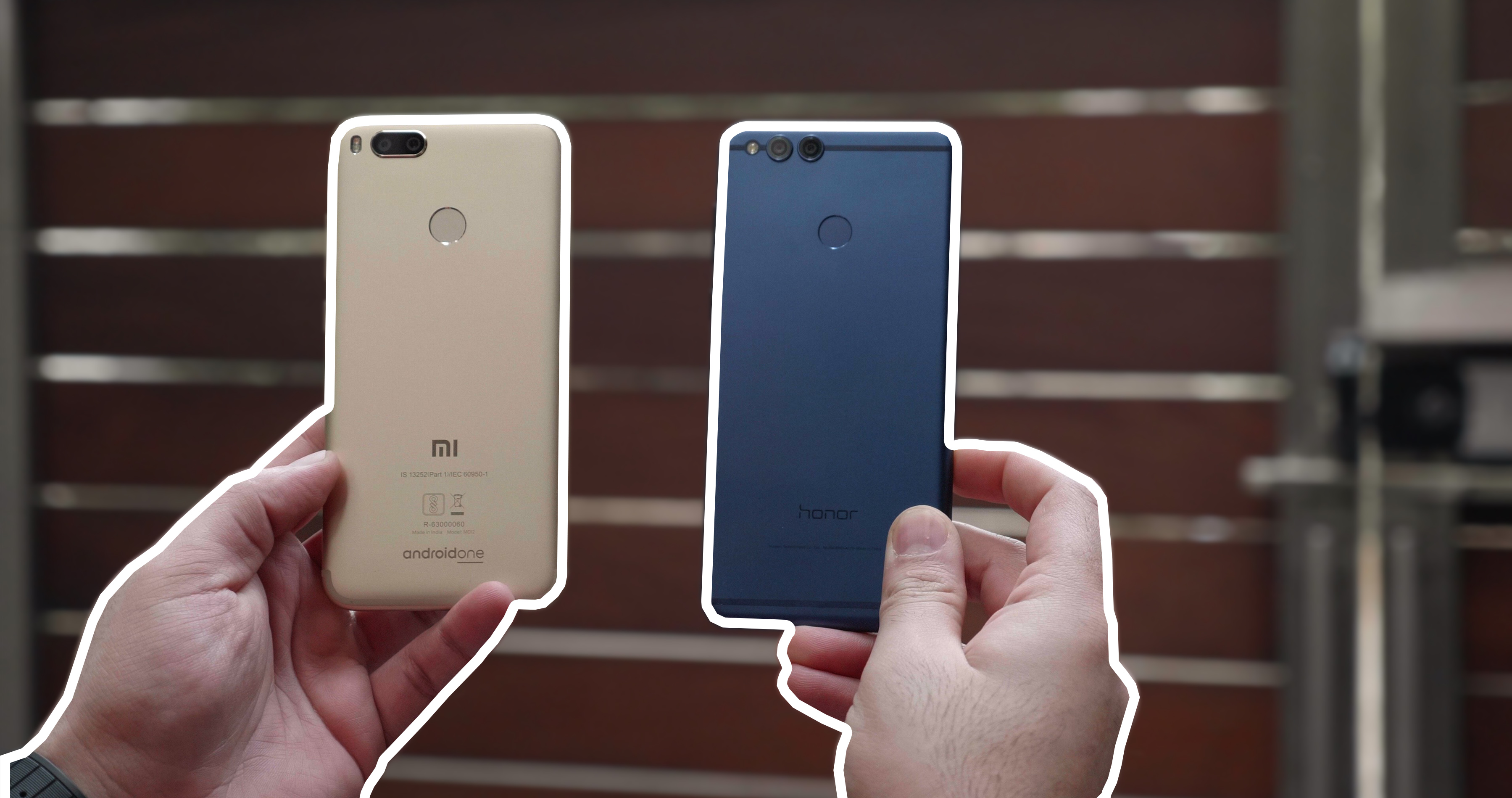
Hands down, the Honor 7X wins in the design department. The Xiaomi Mi A1 is not a bad looking phone but, when kept next to each other, the Mi A1 looks dated. The Honor 7X has a modern design with thin bezels and even though the company could’ve used the bottom bezel to house a fingerprint sensor instead of its branding, the Honor 7X looks sleek and more pleasing to the eye than the Xiaomi Mi A1.
Display
The Honor 7X has a 5.93-inch LTPS IPS LCD display with a 2160 x 1080 px resolution and 407ppi. The Xiaomi Mi A1, on the other hand, has a 5.5 inch LTPS IPS LCD display with a 1920 x 1080 px resolution and 403ppi. Despite a taller display, the Honor 7X has a slightly high pixel count than the Xiaomi Mi A1. In terms of display, the Honor 7X wins the battle again thanks to its 18:9 aspect ratio which comes in handy while multi-tasking and content consumption in general. The Xiaomi Mi A1 has the 2016 standard 5.5-inch display which cannot seem to hold up against the Honor 7X.
Software
After photos and sound, software is the most subjective aspect of a smartphone. Just like some people prefer bass-heavy sound over a flat soundstage, some people prefer the bells and whistles of a custom skin over stock Android OS. There is no denying that the Xiaomi Mi A1 will always be ahead when it comes to software updates but, EMUI on the Honor 7X has come a long way since its inception as well. Both the phones offer a different software experience for different sets of people.
Performance
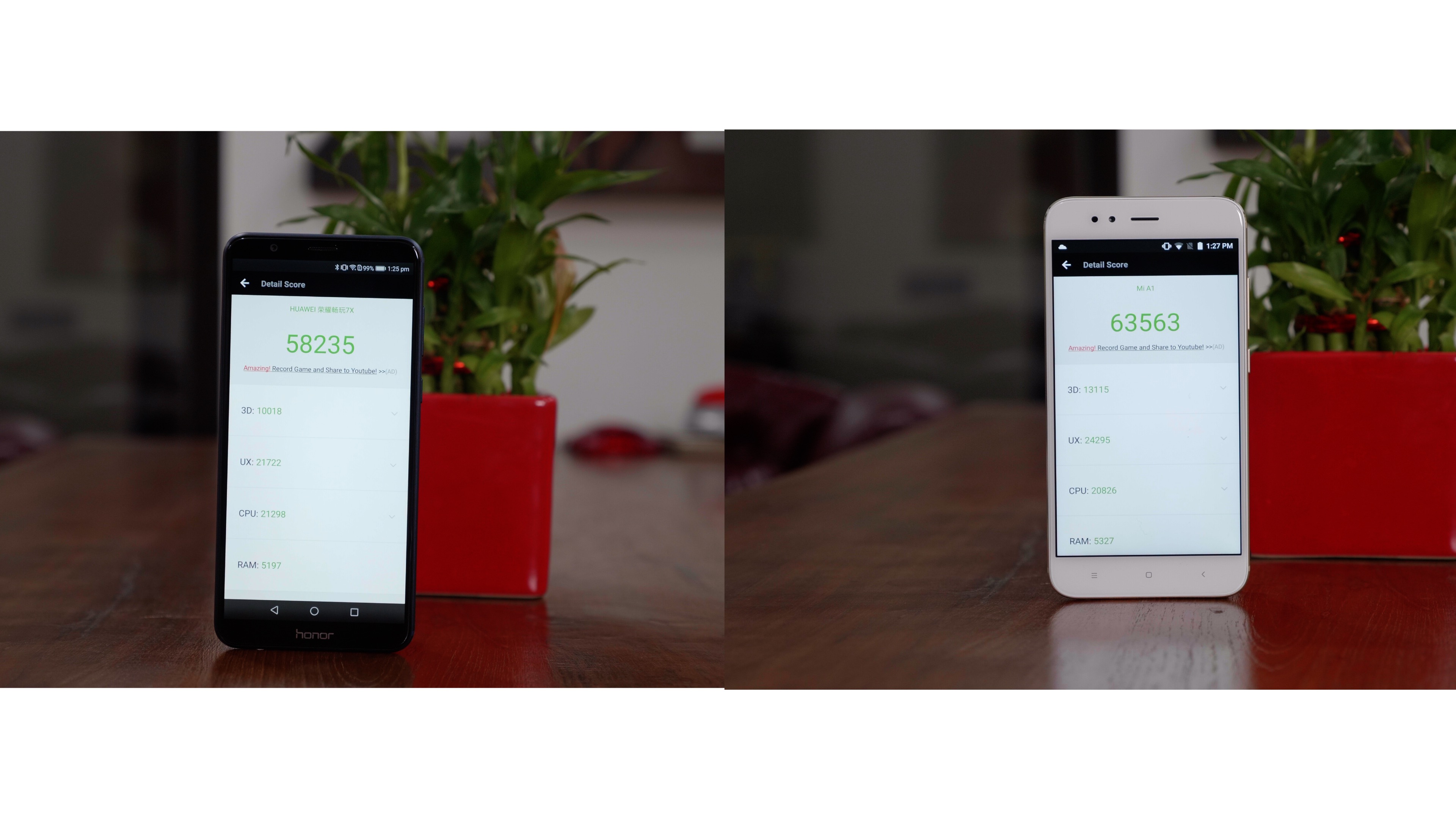
The Xiaomi Mi A1 has the Qualcomm Snapdragon 625 chipset, 4GB of RAM and 64GB of onboard storage which can be expanded up to 128GB via microSD card. The Honor 7X is powered by the HiSilicon Kirin 659 chipset, 4GB of RAM and 32GB of storage (for the Rs. 12,999 variant) which can also be expanded up to 256GB via microSD card. Just as you would expect, bot the devices handle day-to-day tasks with ease although the 18:9 display makes normal usage much more fun on the Honor 7X. During gaming again, the display of the Honor 7X comes into play as it enhances the user experience while the Xiaomi Mi A1’s experience is adequate but, nothing to ride home about.
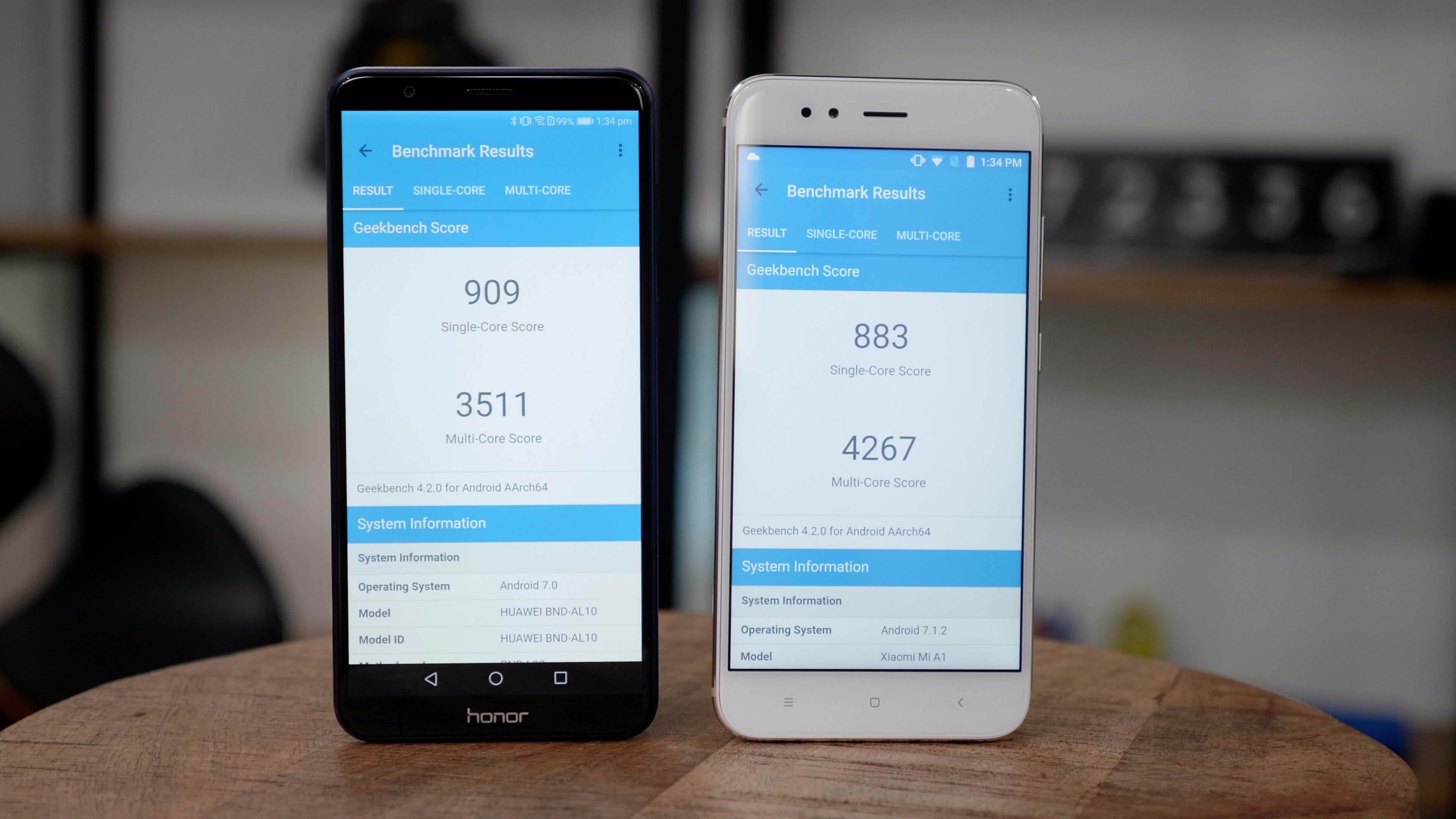
Benchmark scores tell a similar story. In Geekbench, the Xiaomi Mi A1 scores 883 in single-core and 4267 in multi-core set. The Honor 7X on the other hand scores 909 in single-core and 3511 in multi-core tests.
Camera
Photos are extremely subjective and the same case is in this comparison as well. Watch our full comparison for photo samples and decide for yourself. Here are a few sample shots from both, the Xiaomi Mi A1 and Honor 7X.
Honor 7X
Honor 7X
Honor 7X
Honor 7X
Xiaomi Mi A1
Xiaomi Mi A1
Xiaomi Mi A1
Xiaomi Mi A1
While specifications on paper might not tell the whole story, the two phones are a solid option in the price category. The Mi A1 has a dated design but stock Android OS while the Honor 7X has a modern design, thin bezels but a heavily skinned custom OS.
Specifications
Honor 7X
Xiaomi Mi A1
Price
[amazon_link asins=’B0784BZ5VY’ template=’ProductAd’ store=’igyaan-21′ marketplace=’IN’ link_id=’d3211805-ec8b-11e7-b2e3-2fce9ec0930c’] Starting At Rs.12999
Rs. 13999
Display
5.93-inch
LTPS IPS LCD
5.5-inch
LTPS IPS LCD
Resolution
2160 X 1080 px
407ppi
1920 x 1080 px
403ppi
Battery
3340 mAh
3080 mAh
OS
Android 7.1 Nougat
EMUI
Android 8.0 Oreo (Beta)
Stock Android OS
Chipset
HiSilicon Kirin 659
Qualcomm Snapdragon 625
GPU
Mali-T830 MP2
Adreno 506
RAM
4GB
4GB
Storage
32GB/64GB (Expandable up to 256GB)
64GB (Expandable up to 128GB)
Primary Camera
16MP + 2MP depth sensor
12MP (f/2.2) + 12MP (f/2.6) telephoto lens
Primary Video
1080P @ 30fps
4K @ 30fps
Secondary Camera
8MP
5MP
Add-ons
Fingerprint Sensor
Tall display and bezel-less design
Xiaomi launched the Mi A1 in India back in August at a price of Rs. 14999. Thanks to Android One program, the Xiaomi Mi A1 has a stock Android OS and will be supported by Google for the next couple of years with major software upgrades. At the time of its launch, Xiaomi promised that the Android 8.0 Oreo update will be seeded out to all Mi A1 phones by the end of the year. The company appears to on track to deliver on that promise as it has already seeded the third beta Android 8.0 Oreo update for the Xiaomi Mi A1.
A report claims that with the new Android 8.0 Oreo update, the Xiaomi Mi A1 charges much quicker than it used to while running Android 7.1 Nougat. The report, however, conceded that the user charged the phone with a OnePlus charger and the phone went from zero to a hundred percent in 92 minutes while earlier it used to take over two hours.
The absence of fast-charging despite having a USB-C port was a definite let down and Xiaomi appears to be making amends with the new software update. The report also notes that Oreo has made app loading much quicker and animations are much smoother now as well.
The Xiaomi Mi A1 will end the year as one of the best budget smartphones of 2017 and even in the early parts of 2018, apart from the tough competition posed by the Honor 7X, there won’t be many competitors in this category. The Xiaomi Mi A1 is now available at a price of Rs. 13999 after it received a permanent price cut.
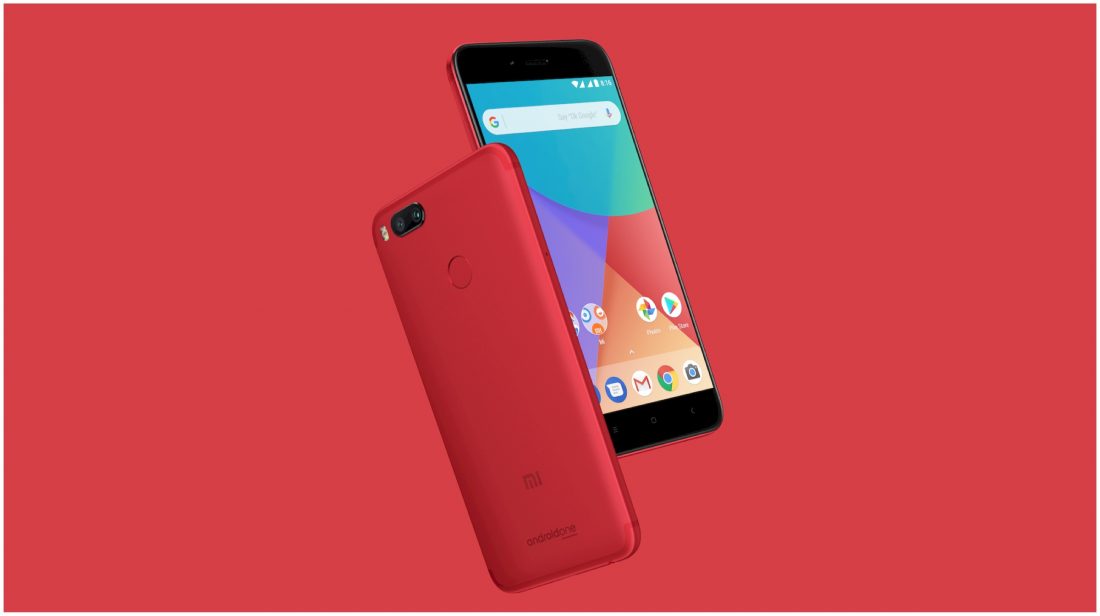
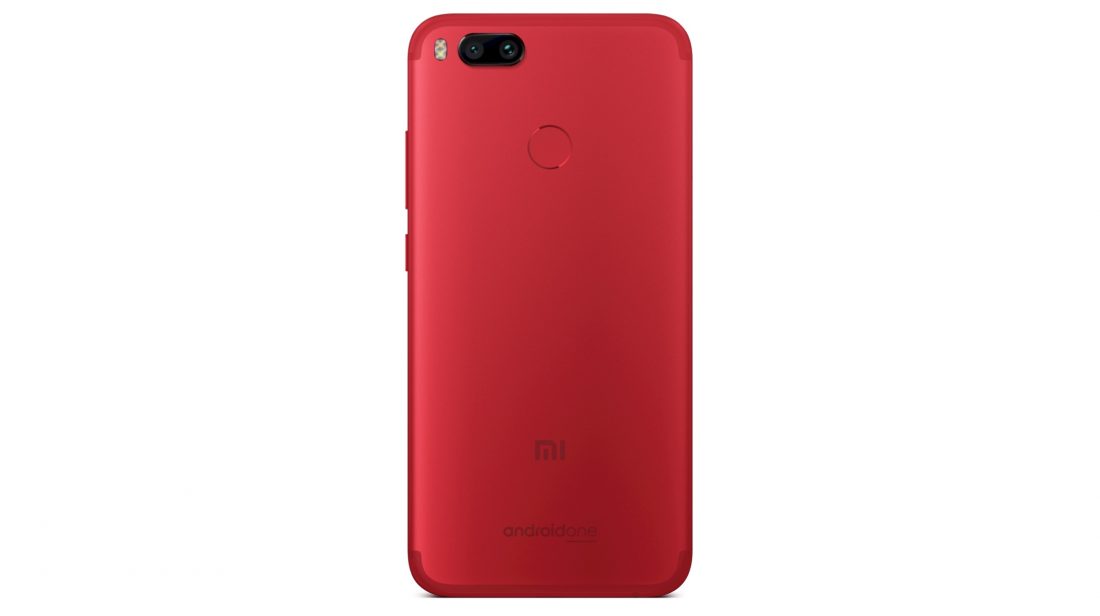
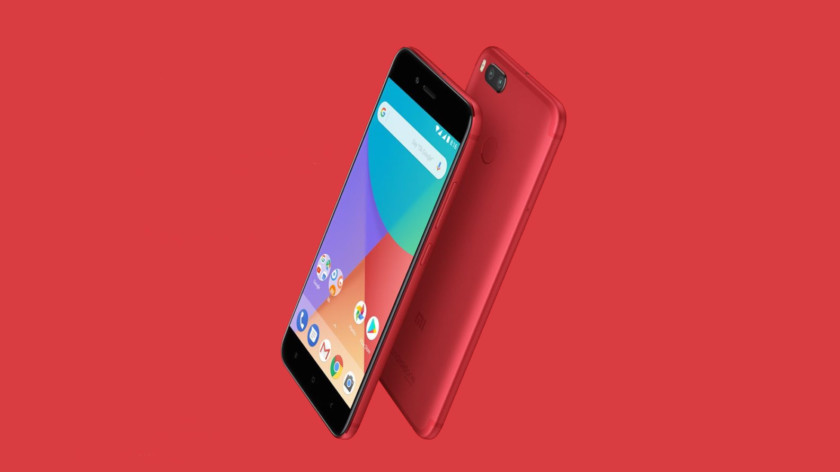
To compete with the competition of the Honor 7X, Xiaomi recently launched a limited edition red colour variant of the Xiaomi Mi A1 as well, to offer something different than the usual pink, gold and black phones that smartphone makers launch.
Xiaomi has launched its limited edition Red colour variant of the Xiaomi Mi A1 in India at a price of Rs. 13999. Xiaomi recently launched the Red edition of the Mi A1 in Indonesia a few days back. The device in India will go on sale in India via Flipkart, mi.com and Mi Home stores from the 20th of December. The Xiaomi Mi A1 is already available in India in Gold, Black and Rose Gold colour variants.
The smartphone recently received a permanent price cut and is available at a price of Rs. 13999. Seeing its popularity in India, Xiaomi has launched the red colour variant as well especially since other OEMs have launched phones in colours other than the usual black, gold and pink. The new Honor 7X is priced at Rs. 12999 and comes in a blue colour variant which definitely makes it stand out from the crowd.
As far as specifications go, it has a 5.5 inch IPS LCD display with a 1920 x 1080 px resolution.
The interesting bit about this phone lies in its software and camera department. It is the first ever Xiaomi phone to run stock Android OS thanks to Android One program. It also has a dual-camera setup at the back.
One of the best mid-range smartphones of 2017, the Xiaomi Mi A1 has been launched in a new red colour variant but, it is not available in India yet. The new red colour variant is only available in Indonesia as of now for a price of IDR 3,099,000 which roughly translates to US $215 or Rs. 14,600. Reportedly, it will be available in limited numbers.
The Xiaomi Mi A1 is available in Gold, Black and Rose Gold colour variants in India. Seeing its popularity in India, it will be interesting to see if Xiaomi decides to launch the red colour variant as well especially since other OEMs have launched phones in colours other than the usual black, gold and pink. The new Honor 7X is priced at Rs. 12999 and comes in a blue colour variant which definitely makes it stand out from the crowd.
All is not gloomy for the Xiaomi Mi A1 users and aspirants, iGyaan reported that Android 8.0 Oreo beta version for Mi A1 had started seeding which means that the official update to Android 8 Oreo is not far away.
As far as specifications go, it has a 5.5 inch IPS LCD display with a 1920 x 1080 px resolution.
Gold colour variant of Mi A1 available in India
The interesting bit about this phone lies in its software and camera department. It is the first ever Xiaomi phone to run stock Android OS thanks to Android One program. It also has a dual-camera setup at the back.
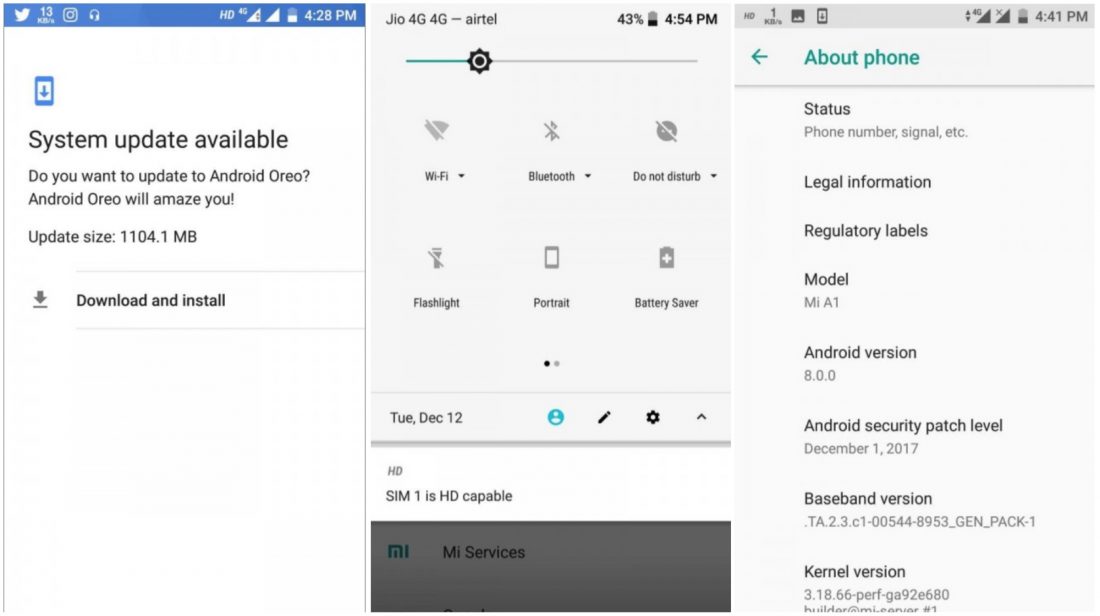
Last week, it was reported that Xiaomi was looking for beta testers for Android 8.0 Oreo on the Xiaomi Mi A1. Now, the Android 8.0 Oreo beta update has started seeding to the beta testers and should be available to everyone by the end of 2017, as promised by the company.
The update is 1104.1 MB in size and right now is only available for beta testers. During the launch of the Xiaomi Mi A1, the company promised an update to Android 8.0 Oreo by the end of 2017, and it appears that the company might deliver on the promise.
The smartphone has a 5.5 inch 1920 x 1080 px LTPS display with Corning Gorilla Glass on top for protection along with an aluminium unibody build.
The Xiaomi Mi A1 has the Qualcomm Snapdragon 625 chipset, 8x ARM Cortex A53 2.0GHz 64-bit processor, 4GB RAM and 64GB of onboard storage which is expandable via microSD card. Handling the graphics under the hood is the Adreno 505 GPU. The pyrolytic graphite sheet will help in heat management as well, Xiaomi claims. The Xiaomi Mi A1 has an IR blaster to control appliances in your home or office. The fingerprint sensor sits at the back of the device below the camera. Xiaomi has also included a dedicated headphone amplifier for better music listening experience.
Powering the device is a 3080 mAh battery and 2A charging through the Type C port.
Even though the phone has stock Android 7.1.2 Nougat, Xiaomi has retained a few apps, such as the Mi camera app since the Google Camera app doesn’t support dual-camera functions right now.
The smartphone features dual sensors at the back, a 12MP telephoto lens with an f/2.2 aperture (26mm) and 12MP wide-angle lens with an f/2.6 aperture (50mm) setup with 1.25-micron pixel size. The telephoto lens allows the user to take bokeh effect shots with blurred background and a 2X optical lossless zoom. For landscape shots, Xiaomi has introduced a wide angle lens while on the front is a 5MP camera.
Xiaomi launched the Mi A1 back in August at a price of Rs. 14999. Now, one of the best budget camera phones, the Mi A1 has received a permanent price cut of Rs. 1000 and will now retail for Rs. 13999.
The Xiaomi Mi A1 offers something different than the rest of the Xiaomi phones available in India or the global market. It has stock Android OS thanks to the Android One program which means that the Mi A1 will receive Android 8.0 Oreo and Android P updates faster than other OEM phones in the same price bracket. This gives the Mi A1 a slight advantage over its closest competitor, the Moto G5s Plus which also has similar specifications and price. The price cut may also be attributed to the competition from other smartphones such as the Honor 7X which also offers a dual-camera setup and is priced at Rs 12999.
Even though there has been no announcement for Android 8.0 Oreo update for the Xiaomi Mi A1, it is expected to be rolled out by the end of January 2018.
The smartphone has a 5.5 inch 1920 x 1080 px LTPS display with Corning Gorilla Glass on top for protection along with an aluminium unibody build.
The Xiaomi Mi A1 has the Qualcomm Snapdragon 625 chipset, 8x ARM Cortex A53 2.0GHz 64-bit processor, 4GB RAM and 64GB of onboard storage which is expandable via microSD card. Handling the graphics under the hood is the Adreno 505 GPU. The pyrolytic graphite sheet will help in heat management as well, Xiaomi claims. The Xiaomi Mi A1 has an IR blaster to control appliances in your home or office. The fingerprint sensor sits at the back of the device below the camera. Xiaomi has also included a dedicated headphone amplifier for better music listening experience.
Powering the device is a 3080 mAh battery and 2A charging through the Type C port.
Even though the phone has stock Android 7.1.2 Nougat, Xiaomi has retained a few apps, such as the Mi camera app since the Google Camera app doesn’t support dual-camera functions right now.
The smartphone features dual sensors at the back, a 12MP telephoto lens with an f/2.2 aperture (26mm) and 12MP wide-angle lens with an f/2.6 aperture (50mm) setup with 1.25-micron pixel size. The telephoto lens allows the user to take bokeh effect shots with blurred background and a 2X optical lossless zoom. For landscape shots, Xiaomi has introduced a wide angle lens while on the front is a 5MP camera.
At a price of Rs. 13999, there is a lot going on for the Xiaomi Mi A1 and with the holidays coming up, this might be the ideal smartphone for you to upgrade to.
Dual cameras, a trend that started in 2016 in flagship phones trickled down to budget smartphones in 2017. From the iPhone 7 Plus in 2016 to Lenovo K8 Plus in 2017, the trend of dual-camera smartphones is here to stay and has become a norm for a top-performing budget Android device. In a sea of budget smartphones with identical specifications and price, which dual-camera phone should you buy this holiday season? iGyaan brings you its pick for the best budget dual-camera phones you can buy right now:
Xiaomi Mi A1
One of the best budget phones to be launched in 2017, the Mi A1 combines Xiaomi’s hardware and Google’s stock Android OS in this perfectly priced budget phone.
The smartphone has a 5.5 inch 1920 x 1080 px display with Corning Gorilla Glass on top for protection and metal unibody build.
The phone has the Qualcomm Snapdragon 625 chipset, 2.0GHz octa-core processor, 4GB RAM and 64GB of onboard storage which is expandable via microSD card. Handling the graphics under the hood is the Adreno 505 GPU. The pyrolytic graphite sheet will help in heat management as well, Xiaomi claims. The Xiaomi Mi A1 has an IR blaster to control appliances in your home or office. Powering the device is a 3,080 mAh battery and fast charging through the Type C port
The fingerprint sensor sits at the back of the device below the camera. Xiaomi has also included a dedicated headphone amplifier for better music listening experience.
The Mi A1 runs pure Android 7.1.2 Nougat OS and thanks to Android One program, the Mi A1 will get software to Android 8.0 Oreo and Android P as well.
It’s worth noting that despite the stock Android OS, Xiaomi has still introduced a few apps of its own like the Mi Camera app, since Google’s app doesn’t support dual-camera right now. Other apps like the Mi Remote and the Mi Store are also present in the Xiaomi Mi A1.
In terms of optics, the smartphone features a 12MP dual-camera setup with 1.25-micron pixel size. Out of the two cameras at the back, the primary one is equipped with a telephoto lens and the secondary camera has a wide-angle lens. The telephoto lens allows the user to take bokeh effect shots with blurred background and a 2X optical lossless zoom. For landscape shots, Xiaomi has introduced a wide angle lens while on the front is a 5MP camera.
Moto G5s Plus
Successor to one of the best budget camera smartphones the Moto G5 Plus, Moto G5s Plus was launched close to the Xiaomi Mi A1 and carries an identical price tag as well.
The Moto G5S Plus has a 5.5 inch 1920 x 1080 px display with Corning Gorilla Glass 3 on top for protection.
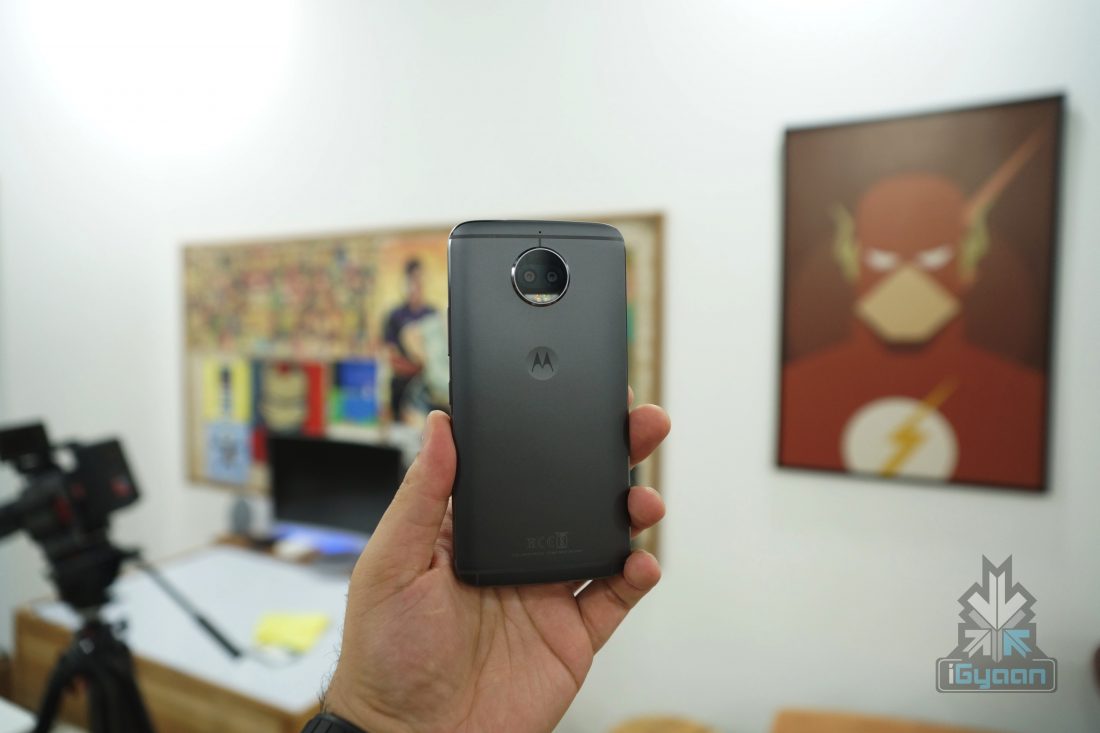
The smartphone has the Qualcomm 625 chipset, an octa-core processor clocked at 2.0 GHz with 4GB RAM and 64GB of onboard storage which can be expanded up to 128GB via a microSD card. The fingerprint sensor is housed inside the home button which sits below the display. The device is powered by a 3,000 mAh battery with included turbo charge capabilities.
The Moto G5S Plus runs Android 7.1.1 Nougat with little customisation done by the manufacturer resulting in stock Android OS experience.
The Moto G5S Plus features rear-mounted 13MP dual-cameras with an f/2.0 aperture. The dual camera captures Bokeh, and selective focus shots, along with other capabilities of background replacement and exposure management. On the front is a wide angle 8MP camera with a single LED flash and a panoramic mode. The rear cameras capture videos in 4K at 30 FPS and the front camera records videos in 1080P at 30 FPS. According to Motorola, additional features such as Night Display and Quick Reply enhance the software experience. The implementation of the dual-camera setup on the Moto G5S Plus is different than that on the Mi A1.
Lenovo K8 Note
The Lenovo K8 Note features a 5.5-inch 1920 x 1080 px display with a pixel density of 441ppi and a Corning Gorilla Glass with oleophobic coating for scratch and smudge resistance.
The K8 Note is also splash resistant due to its P2i coating, although the resistance might decrease with time due to wear and tear of the nano coating. The fingerprint sensor sits at the back of the device under the cameras.
The Lenovo K8 Note is run on a MediaTek MT 6797D Helio X23 a Tri-cluster, 64-bit chipset with a 2.3 GHz high-performing deca-core processor and the Mali T-880 MP4 GPU. The device has either a 3GB or 4GB RAM and 32GB or 64GB onboard storage which is expandable via a microSD card.
The Lenovo K8 Note has a 13M Pure cell sensor mated with a 5MP Samsung BSI sensor dual camera setup and dual LED flash at the back. The phone is capable of depth mode effects along with 1920 x 1080 px Video capture. A 13MP camera with LED flash and an f/2.0 aperture sits on the front of the device above the display. The camera UI will also feature a stock Android layout with no customisation offered by Lenovo apart from the depth mode.
Honor 9i
The Honor 9i has a 5.9-inch 2160 x 1080px display with an 18:9 aspect ratio.
It also has Huawei’s in-house octa-core Kirin 659 chipset, octa-core 2.36 GHz processor, along with 4 GB of RAM and 64 GB onboard storage. Powering the device is a 3340 mAh battery which charges via a micro USB port.
The device runs Android 7.0 Nougat out of the box with Huawei’s EMUI 5.1 skin on top
This is the only smartphone on this list which has four cameras. The rear of the phone contains a 16 MP main sensor and a 2 MP secondary sensor, while the front has a 13 MP camera and another 2 MP secondary sensor. A fingerprint sensor is placed at the back of the phone since the phone has thin bezels and no physical button at the front of the phone.
Dual cameras, a trend that started in 2016 in flagship phones trickled down to budget smartphones in 2017. From the iPhone 7 Plus in 2016 to Lenovo K8 Plus in 2017, the trend of dual-camera smartphones is here to stay and has become a norm for a top-performing budget Android device. In a sea of budget smartphones with identical specifications and price, which dual-camera phone should you buy this holiday season? iGyaan brings you its pick for the best budget dual-camera phones you can buy right now:
Xiaomi Mi A1
One of the best budget phones to be launched in 2017, the Mi A1 combines Xiaomi’s hardware and Google’s stock Android OS in this perfectly priced budget phone.
The smartphone has a 5.5 inch 1920 x 1080 px display with Corning Gorilla Glass on top for protection and metal unibody build.
The phone has the Qualcomm Snapdragon 625 chipset, 2.0GHz octa-core processor, 4GB RAM and 64GB of onboard storage which is expandable via microSD card. Handling the graphics under the hood is the Adreno 505 GPU. The pyrolytic graphite sheet will help in heat management as well, Xiaomi claims. The Xiaomi Mi A1 has an IR blaster to control appliances in your home or office. Powering the device is a 3,080 mAh battery and fast charging through the Type C port
The fingerprint sensor sits at the back of the device below the camera. Xiaomi has also included a dedicated headphone amplifier for better music listening experience.
The Mi A1 runs pure Android 7.1.2 Nougat OS and thanks to Android One program, the Mi A1 will get software to Android 8.0 Oreo and Android P as well.
It’s worth noting that despite the stock Android OS, Xiaomi has still introduced a few apps of its own like the Mi Camera app, since Google’s app doesn’t support dual-camera right now. Other apps like the Mi Remote and the Mi Store are also present in the Xiaomi Mi A1.
In terms of optics, the smartphone features a 12MP dual-camera setup with 1.25-micron pixel size. Out of the two cameras at the back, the primary one is equipped with a telephoto lens and the secondary camera has a wide-angle lens. The telephoto lens allows the user to take bokeh effect shots with blurred background and a 2X optical lossless zoom. For landscape shots, Xiaomi has introduced a wide angle lens while on the front is a 5MP camera.
Moto G5s Plus
Successor to one of the best budget camera smartphones the Moto G5 Plus, Moto G5s Plus was launched close to the Xiaomi Mi A1 and carries an identical price tag as well.
The Moto G5S Plus has a 5.5 inch 1920 x 1080 px display with Corning Gorilla Glass 3 on top for protection.
The smartphone has the Qualcomm 625 chipset, an octa-core processor clocked at 2.0 GHz with 4GB RAM and 64GB of onboard storage which can be expanded up to 128GB via a microSD card. The fingerprint sensor is housed inside the home button which sits below the display. The device is powered by a 3,000 mAh battery with included turbo charge capabilities.
The Moto G5S Plus runs Android 7.1.1 Nougat with little customisation done by the manufacturer resulting in stock Android OS experience.
The Moto G5S Plus features rear-mounted 13MP dual-cameras with an f/2.0 aperture. The dual camera captures Bokeh, and selective focus shots, along with other capabilities of background replacement and exposure management. On the front is a wide angle 8MP camera with a single LED flash and a panoramic mode. The rear cameras capture videos in 4K at 30 FPS and the front camera records videos in 1080P at 30 FPS. According to Motorola, additional features such as Night Display and Quick Reply enhance the software experience. The implementation of the dual-camera setup on the Moto G5S Plus is different than that on the Mi A1.
Lenovo K8 Note
The Lenovo K8 Note features a 5.5-inch 1920 x 1080 px display with a pixel density of 441ppi and a Corning Gorilla Glass with oleophobic coating for scratch and smudge resistance.
The K8 Note is also splash resistant due to its P2i coating, although the resistance might decrease with time due to wear and tear of the nano coating. The fingerprint sensor sits at the back of the device under the cameras.
The Lenovo K8 Note is run on a MediaTek MT 6797D Helio X23 a Tri-cluster, 64-bit chipset with a 2.3 GHz high-performing deca-core processor and the Mali T-880 MP4 GPU. The device has either a 3GB or 4GB RAM and 32GB or 64GB onboard storage which is expandable via a microSD card.
The Lenovo K8 Note has a 13M Pure cell sensor mated with a 5MP Samsung BSI sensor dual camera setup and dual LED flash at the back. The phone is capable of depth mode effects along with 1920 x 1080 px Video capture. A 13MP camera with LED flash and an f/2.0 aperture sits on the front of the device above the display. The camera UI will also feature a stock Android layout with no customisation offered by Lenovo apart from the depth mode.
Honor 9i
The Honor 9i has a 5.9-inch 2160 x 1080px display with an 18:9 aspect ratio.
It also has Huawei’s in-house octa-core Kirin 659 chipset, octa-core 2.36 GHz processor, along with 4 GB of RAM and 64 GB onboard storage. Powering the device is a 3340 mAh battery which charges via a micro USB port.
The device runs Android 7.0 Nougat out of the box with Huawei’s EMUI 5.1 skin on top
This is the only smartphone on this list which has four cameras. The rear of the phone contains a 16 MP main sensor and a 2 MP secondary sensor, while the front has a 13 MP camera and another 2 MP secondary sensor. A fingerprint sensor is placed at the back of the phone since the phone has thin bezels and no physical button at the front of the phone.
India recently became the second largest smartphone market in the world, only behind China. For years, the mid-range smartphone market has had a plethora of phones offering top of the line performance at an affordable price. 2017 saw dual-camera phones entering the sub-20K segment while other phones continued to deliver the best in class performance with very little compromises. Let’s take a look at the top smartphones between Rs 10,000 to Rs 20,000 that you can buy right now.
Xiaomi Redmi Note 4
Priced the cheapest in this list, the Xiaomi Redmi Note 4 is by no means the cheapest in terms of specifications and performance. The Redmi Note 4 has a 5.5 inch IPS LCD display with a 1920 x 1080 px resolution. Powering the device is a massive 4100 mAh battery and it runs Android 6.0 Marshmallow out of the box. Under the hood, the smartphone has a the Qualcomm Snapdragon 625 chipset, up to 4GB of RAM and 64GB of onboard storage which can be expanded via microSD card. It has a rear mounted 13MP camera with an f/2.0 aperture and records 1920 x 1080 px videos at 30fps. The front of the smartphone has a 5MP camera with an f/2.0 aperture which records 1280 x 720 px videos at 30fps.
Lenovo K8 Note
Another smartphone with a dual camera setup at the back, the Lenovo K8 Note is priced slightly higher than the Redmi Note 4 and offers stock Android OS and a guaranteed update to Android 8.0 Oreo. The Lenovo K8 Note packs the Helio X23 chipset with a 2.3GHz high-performing deca-core processor and the Mali T-880 MP4 GPU. The device has two variants – 3GB RAM with 32GB onboard storage and 4GB RAM with 64GB onboard storage which is expandable up to 128GB via a microSD card and features USB OTG support for added storage options. The phone features a 5.5-inch 1920 x 1080 px display with a pixel density of 441ppi and a Corning Gorilla Glass with oleophobic coating for scratch resistance. The smartphone is powered by a 4,000mAh battery with turbo charge.
The Lenovo K8 Note has a 13MP Pure cell sensor mated with a 5MP Samsung BSI sensor dual camera setup and dual LED flash at the back. The phone is capable of depth mode effects along with 1920 x 1080 px Video capture. A 13MP camera with LED flash and an f/2.0 aperture sits on the front of the device above the display.
Xiaomi Mi A1
Stock Android OS with Xiaomi’s hardware and a confirmed upgrade to Android 8.0 Oreo and Android P for Rs 14999. This seemed surreal up until August when Xiaomi launched the Android One Xiaomi Mi A1 in India with a best-in-segment dual-camera setup at the back. The smartphone has a 5.5 inch 1920 x 1080 px LTPS display with Corning Gorilla Glass on top for protection and aluminium unibody build. Powering the device is a 3080 mAh battery and 2A charging through the Type C port. The Mi A1 runs pure Android 7.1.2 Nougat OS. Even though the phone has stock Android OS, Xiaomi has retained a few apps, such as the Mi camera app since the Google app doesn’t support dual-camera functions right now. The phone has the Qualcomm Snapdragon 625 chipset, 8x ARM Cortex A53 2.0GHz 64-bit processor, 4GB RAM and 64GB of onboard storage which is expandable via microSD card. Handling the graphics under the hood is the Adreno 505 GPU. The fingerprint sensor sits at the back of the device below the camera. Xiaomi has also included a dedicated headphone amplifier for better music listening experience.
The Xiaomi Mi A1 features dual sensors – 12MP with an f/2.2 aperture (26mm) and 12MP with an f/2.6 aperture (50mm) setup with 1.25-micron pixel size. Out of the two cameras at the back, the primary one is equipped with a telephoto lens and the secondary camera has a wide-angle lens. The telephoto lens allows the user to take bokeh effect shots with blurred background and a 2X optical lossless zoom. For landscape shots, Xiaomi has introduced a wide angle lens while on the front is a 5MP camera.
Moto G5s Plus
Motorola followed up the highly successful Moto G5 Plus with the Moto G5s Plus. With stock Android OS and dual-cameras at the back, it really is a toss-up between the G5s Plus and the Mi A1. The Moto G5S Plus has a 5.5 inch 1920 x 1080 px display with Corning Gorilla Glass 3 on top for protection. The device is powered by a 3,000 mAh battery with included turbo charge capabilities. The Moto G5S Plus runs Android 7.1.1 Nougat with little customisation done by the manufacturer resulting in stock Android OS experience. The smartphone has the Qualcomm 625 chipset, an octa-core processor clocked at 2.0 GHz with 4GB RAM and 64GB of onboard storage which can be expanded up to 128GB via a microSD card. The fingerprint sensor is housed inside the home button which sits below the display.
The Moto G5S Plus features rear-mounted 13MP dual-cameras with an f/2.0 aperture. The dual camera captures Bokeh, and selective focus shots, along with other capabilities of background replacement and exposure management. On the front is a wide angle 8MP camera with a single LED flash and a panoramic mode. The rear cameras capture videos in 4K at 30 FPS and the front camera records videos in 1080P at 30 FPS. According to Motorola, additional features such as Night Display and Quick Reply enhance the software experience.
Apple iPhone SE
The Apple iPhone SE was launched in India in March 2016, which should automatically make it a no-go. But, the good thing about an iPhone is the support it gets from Apple. The recently launched iOS 11 was made available to a phone as old as the iPhone 5s, which proves that the software of the iPhone SE will be up-to-date for another 2 years at least. If you miss the good old days of smartphones that were truly usable with one hand, then the iPhone SE is the way to go. The iPhone SE has a 4-inch 1136 x 640 px Retina display. Powering the device is Apple’s A9 chipset which can also be found in the iPhone 6s and iPhone 6s Plus. The iPhoen SE has a 12MP rear mounted camera with an f/2.2 aperture and a front facing 1.2MP camera with an f/2.4 aperture. The rear mounted 12Mp camera is capable of recording 3840 x 2160 px videos at 30fps while the front facing camera records 1920 x 1080 px videos at 30fps.
Flipkart is offering some great deals on smartphones and tech accessories during its Big Billion Days sale. We look at the top deals for smartphones available right now.
Samsung Galaxy S7
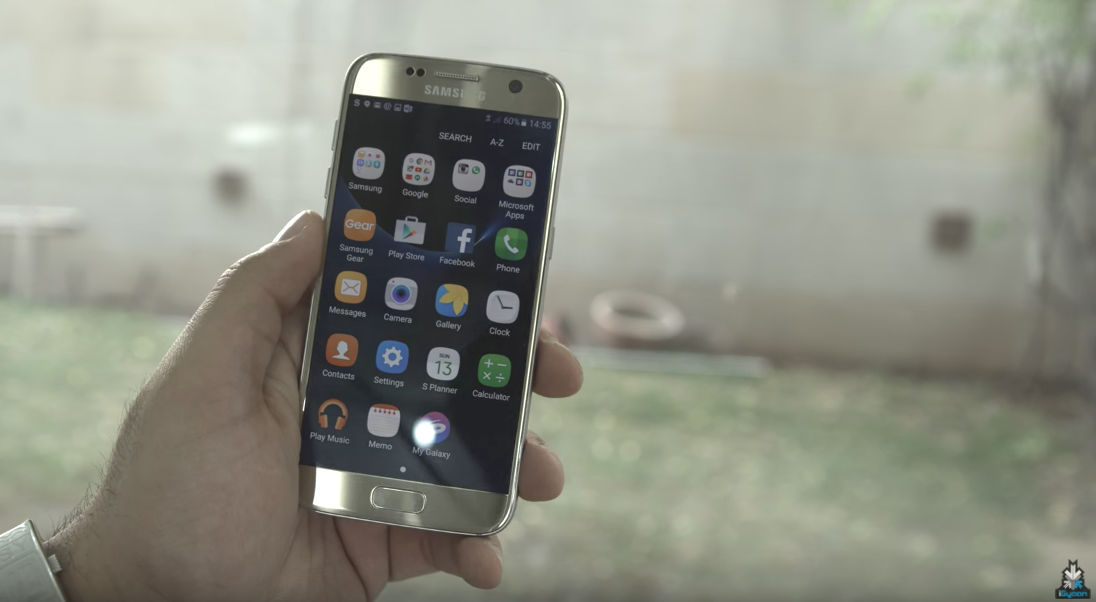
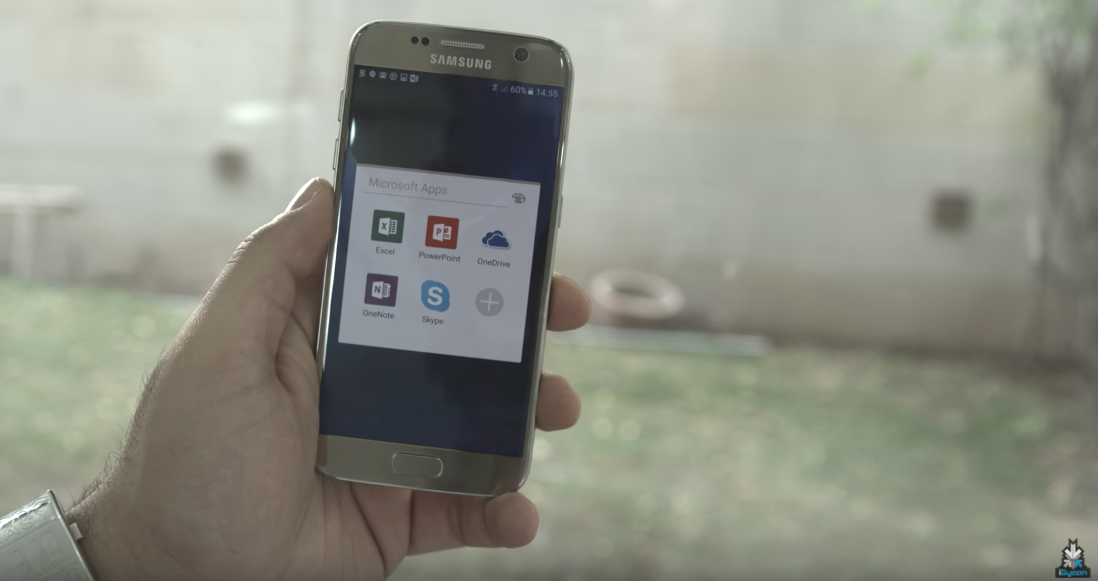
Samsung’s 2016 flagship smartphone, the Galaxy S7 has a 5.1 inch 2560 x 1440 px display. In the day and age of big phablet-type flagships, the 5.1-inch compact form factor might be ideal for people looking for a smaller phone but with top-end specifications. Under the hood, the Galaxy S7 has the Exynos 8890 chipset, 4GB RAM and 64GB onboard storage which can be expanded up to 256GB via microSD card. The Galaxy S7 has a 12MP dual-pixel camera at the back and a dual pixel 5MP camera at the front.
Huawei P9
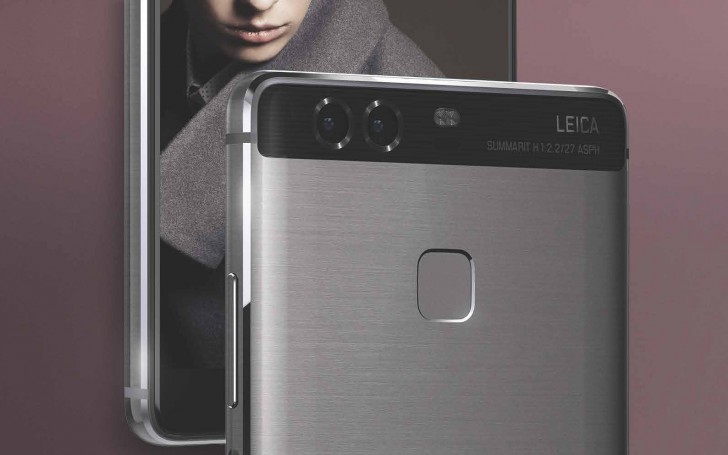
The Huawei P9 has a 5.2-inch display and 1080p resolution. The P9 runs on the Kirin 955 chipset with an octa-core CPU set at 2.5GHz for the quad-Cortex-A72 cluster and 1.8GHz for the quad-Cortex-A53. The P9 has a 3000 mAh battery and is equipped with a USB type C charging port. The Huawei P9 has dual 12 MP rear-facing cameras with an f/2.2 aperture, 27 mm, Leica optics, and phase detection autofocus. On the front is an 8MP camera with an f/2.4 aperture.
Lenovo K8 Plus
The Lenovo K8 Plushas two variants, a 3GB RAM, and a 4GB RAM variant and both of them are on sale right now. The Lenovo K8 Plus has a 5.2 inch 1920 x 1080 px IPS LCD display with three touch capacitive navigation buttons below. Powering the device is a 4,000 mAh battery and it runs stock Android 7.1.1 Nougat. Under the hood, the smartphone has the MediaTek Helio P25 chipset, a 2.6 GHz octa-core processor, Mali T880 GPU, 3GB/4GB RAM with 32GB onboard storage which is expandable up to 128GB via microSD card. It has a primary 13MP Pure cell sensor mated with a 5MP Samsung BSI sensor dual camera with an f/2.0 aperture and dual LED flash. On the front is an 8MP wide angle lens with an f/2.0 and an LED flash.
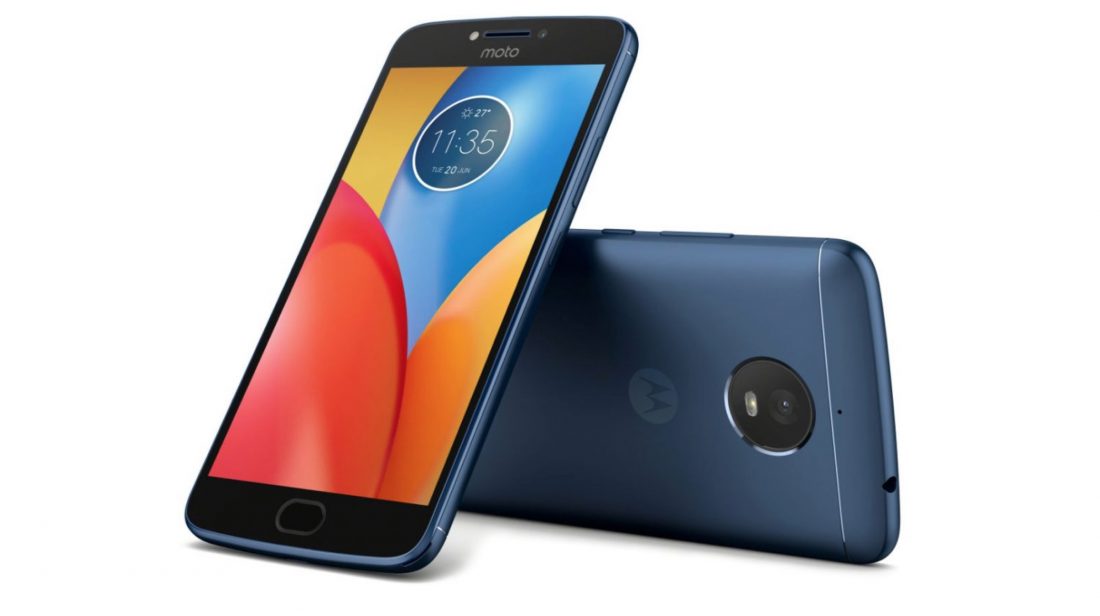
Moto E4 Plus
Motorola announced that the new Oxford Blue colour variant of the Moto E4 Plus will be available on Flipkart exclusively during the Big Billion Days sale. The Motorola Moto E4 Plus is powered by 1.4GHz quad-core MediaTek MTK6737M processor and has 3GB of RAM with 32GB of internal storage along with microSD card expansion. The Moto E4 plus has a 5.5 inch 1280 x 720px IPS LCD display along with Corning Gorilla Glass 3 and an oleophobic coating.The phone also runs Android 7.1.1 out of the box and should be updated to the next generation Android by the company, as the UI is mostly stock with some Moto features including the Moto display, some gestures and One-Key Navigation. The front also has a fingerprint sensor along wit a notification LED light.
For optics, the front has a 5 MP camera with a front flash while the main camera is a 13 MP with an f/2.0 aperture. The battery on the E4 Plus is a massive 5000 mAh battery.
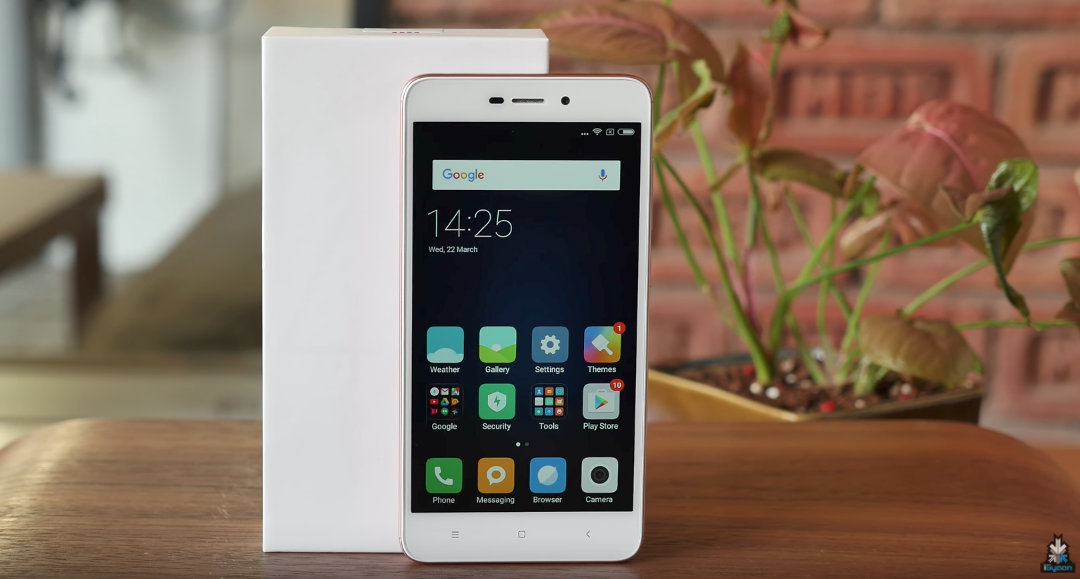
Xiaomi Redmi 4A
The Xiaomi Redmi 4A is a budget device ideal for people who want performance and battery life without shelling out too much cash. The device has a 5 inch 1280 x 720 px display. The budget smartphone from Xiaomi runs on the Qualcomm’s 64-bit Snapdragon 425 chipset with a quad-core processor and Adreno 308 GPU. The rear camera on the Redmi 4A has a 13MP sensor with auto-focus and LED flash, the front-facing camera, on the other hand, has a 5MP sensor. The device is powered by a 3120 mAh battery.
Honor 8 Pro
Competitively priced, great performance, big battery, and a dual-camera setup, the Honor 8 Pro was launched as a competitor of the OnePlus 5. The Honor 8 Pro has 5.7 inch 2560 x 1440 px display which is ideal for media consumption via VR. The Honor 8 Pro has 128 GB of storage along with 6GB of RAM. The Honor 8 Pro runs on the Kirin 960 chipset which is an octa-core chip – four high-performance Cortex A73 cores clocked at 2.4GHz and four low-power Cortex A53 cores clocked at 1.8Ghz. The phone also has a large 4000 mAh battery and fast charge capabilities, with long battery modes built into Honor’s user interface. The camera setup consists of two cameras, 12+12 MP shooters, where one is a monochrome camera while the other is RGB. The front camera is an 8 MP shooter with an f/2.0 aperture.
Honor 6X
The Honor 6X is a budget offering by Huwaei’s sub0-brand, Honor. The phone has a 5.5 inch 1920 x 1080 px display. The Honor 6X has a HiSilicon Kirin 655 chipset, octa core processor, 3GB RAM and 32GB onboard storage which can be expanded 256GB via microSD card. On the camera front, the smartphone sports a dual 12MP+2MP camera setup and an 8MP front-facing camera. The device is powered by a 3340 mAh battery.
Xiaomi Mi A1
The Mi A1 combines Xiaomi’s hardware and Android One’s stock OS experience at a budget price. The smartphone has a 5.5 inch 1920 x 1080 px LTPS display with Corning Gorilla Glass on top for protection and aluminum unibody build. Powering the device is a 3080 mAh battery and 2A charging through the Type C port. The phone has the Qualcomm Snapdragon 625 chipset, 8x ARM Cortex A53 2.0GHz 64-bit processor, 4GB RAM and 64GB of onboard storage which is expandable via microSD card. In terms of optics, the smartphone features dual sensors – 12MP with an f/2.2 aperture (26mm) and 12MP with an f/2.6 aperture (50mm) setup with 1.25-micron pixel size. Out of the two cameras at the back, the primary one is equipped with a telephoto lens and the secondary camera has a wide-angle lens. On the front is a 5MP camera.
Xiaomi Mi A1 was launched in India on September 5th at a price of Rs 14999. Two USPs of the device are the dual-camera setup and stock Android OS. The Mi A1 is the first Xiaomi smartphone to feature stock Android OS in association with Google’s Android One program. The company has also confirmed that the device will receive Android 8.0 Oreo update before the end of 2017.
The smartphone has a 5.5 inch 1920 x 1080 px LTPS display with Corning Gorilla Glass on top for protection and aluminum unibody build. Powering the device is a 3080 mAh battery and 2A charging through the Type C port. The Mi A1 runs pure Android 7.1.2 Nougat OS. Even though the phone has stock Android OS, Xiaomi has retained a few apps, such as the Mi camera app since the Google app doesn’t support dual-camera functions right now. The phone has the Qualcomm Snapdragon 625 chipset, 8x ARM Cortex A53 2.0GHz 64-bit processor, 4GB RAM and 64GB of onboard storage which is expandable via microSD card. Handling the graphics under the hood is the Adreno 505 GPU. The fingerprint sensor sits at the back of the device below the camera. Xiaomi has also included a dedicated headphone amplifier for better music listening experience.
In terms of optics, the smartphone features dual sensors – 12MP with an f/2.2 aperture (26mm) and 12MP with an f/2.6 aperture (50mm) setup with 1.25-micron pixel size. Out of the two cameras at the back, the primary one is equipped with a telephoto lens and the secondary camera has a wide-angle lens. The telephoto lens allows the user to take bokeh effect shots with blurred background and a 2X optical lossless zoom. For landscape shots, Xiaomi has introduced a wide angle lens while on the front is a 5MP camera.
Xiaomi launched the new Mi A1 in India on September 5 at a price of Rs 14,999 with dual cameras and stock Android OS. For the longest time, the Mi 5X was touted to be the first dual-camera phone by Xiaomi to launch in India but, instead, we got an Android One device.
The Mi A1, at Rs 14,999 will compete with the likes of the Moto G5S Plus which also offers stock Android OS and dual-cameras. The Mi 5X and Mi A1 share the same design language, much like any 0ther Xioami Mi phone, and a dual-camera setup. The Mi A1 is the first phone from Xiaomi to feature stock Android OS and it is in association with Google’s Android One program. This means faster OS updates to Android 8.0 Oreo and Android P next year. The Mi5X, on the other hand, runs the MIUI 8 on top of Android 7.1 Nougat and going by Xiaomi’s track record, may not receive an update to Android 8.0 Oreo, atlas not for a few months. The Moto G5S Plus runs Android 7.1.1 Nougat and the company has confirmed update to Android 8.0 Oreo by the end of the year.
Hardware wise these phones sit on a pretty similar platform, same chipset, RAM, storage, and similar display and battery size.
Xiaomi Mi A1
Xiaomi Mi A1
The Xiaomi Mi A1 is priced at Rs 14,999 for the Indian market and will be available from September 12 on Flipkart, mi.com, Mi Home stores and partner retail outlets. It will be available in Black, Gold, and Rose Gold colour variants. The smartphone has a 5.5 inch 1920 x 1080 px display with Corning Gorilla Glass on top for protection and metal unibody build. Powering the device is a 3,080 mAh battery and fast charging through the Type C port. The Mi A1 runs pure Android 7.1.2 Nougat OS. The phone has the Qualcomm Snapdragon 625 chipset, 2.0GHz octa-core processor, 4GB RAM and 64GB of onboard storage which is expandable via microSD card. Handling the graphics under the hood is the Adreno 505 GPU. The pyrolytic graphite sheet will help in heat management as well, Xiaomi claims. The Xiaomi Mi A1 has an IR blaster to control appliances in your home or office. The fingerprint sensor sits at the back of the device below the camera. Xiaomi has also included a dedicated headphone amplifier for better music listening experience.
It’s worth noting that despite the stock Android OS, Xiaomi has still introduced a few apps of its own like the Mi Camera app, since Google’s app doesn’t support dual-camera right now. Other apps like the Mi Remote and the Mi Store are also present in the Xiaomi Mi A1.
In terms of optics, the smartphone features a 12MP dual-camera setup with 1.25-micron pixel size. Out of the two cameras at the back, the primary one is equipped with a telephoto lens and the secondary camera has a wide-angle lens. The telephoto lens allows the user to take bokeh effect shots with blurred background and a 2X optical lossless zoom. For landscape shots, Xiaomi has introduced a wide angle lens while on the front is a 5MP camera.
The Xiaomi Mi 5X was launched in China in July as a mid-ranger with dual-cameras, much like the Mi A1 for the Indian market. The smartphone from Xiaomi has a 5.5-inch 1920 x 1080 px IPS LCD display. Unlike a lot of smartphones from 2017, the Mi 5X has a considerable amount of bezels around the display. The smartphone is powered by a 3,080 mAh battery with fast charging capabilities through the USB Type C port, although, the included charger does not provide a fast charge. The Mi 5X has the Qualcomm Snapdragon 625 chipset, 2.0 GHz octa-core processor, 4GB RAM and 64GB onboard storage which is expandable via microSD card up to 128GB. The Mi 5X runs Android 7.1.1 based on MiUi 8.5.
The phone has 12MP dual-cameras with the secondary camera equipped with a telephoto lens for 2X lossless optical zoom. The camera app has a portrait mode very similar to the one on iPhone 7 Plus with features that include a portrait mode, blurring out the background. The dual-cameras are also capable of recording 4K videos at 30 FPS and 720P videos 120 FPS. On the front is a 5MP camera that records 1080P videos at 30 FPS.
The Moto G5S Plus has a 5.5 inch 1920 x 1080 px display with Corning Gorilla Glass 3 on top for protection. The device is powered by a 3,000 mAh battery with included turbo charge capabilities. The Moto G5S Plus runs Android 7.1.1 Nougat with little customisation done by the manufacturer resulting in stock Android OS experience. The smartphone has the Qualcomm 625 chipset, an octa-core processor clocked at 2.0 GHz with 4GB RAM and 64GB of onboard storage which can be expanded up to 128GB via a microSD card. The fingerprint sensor is housed inside the home button which sits below the display.
The Moto G5S Plus features rear-mounted 13MP dual-cameras with an f/2.0 aperture. The dual camera captures Bokeh, and selective focus shots, along with other capabilities of background replacement and exposure management. On the front is a wide angle 8MP camera with a single LED flash and a panoramic mode. The rear cameras capture videos in 4K at 30 FPS and the front camera records videos in 1080P at 30 FPS. According to Motorola, additional features such as Night Display and Quick Reply enhance the software experience. The implementation of the dual-camera setup on the Moto G5S Plus is different than that on the Mi A1 and the Mi 5X.
Specifications
Mi A1
Mi 5X
Moto G5S Plus
Price
Rs 14,999
Rs 18,000 Approx
Rs 15,999
Display
5.5 inch
5.5 inch
5.5 inch
Display Resolution
1920 x 1080 px
1920 x 1080 px
1920 x 1080 px
Protection
Corning Gorilla Glass
–
Corning Gorilla Glass 3
Dimensions
155.40 x 75.80 x 7.30 mm
155.40 x 75.80 x 7.30 mm
153 x 76.2 x 7.8 mm
Weight
165 grams
165 grams
168 grams
Chipset
Qualcomm Snapdragon 625
Qualcomm Snapdragon 625
Qualcomm Snapdragon 625
Processor
2.0GHz octa-core
2.0GHz octa-core
2.0GHz octa-core
RAM
4GB
4GB
4GB
Storage
64GB, expandable via microSD card up to 128GB
64GB, expandable via microSD card up to 128GB
64GB, expandable via microSD card up to 128GB
Rear Camera
2 x 12 MP
26mm, f/2.2
50mm, f/2.6
2 x 12 MP
26mm, f/2.2
50mm, f/2.6
13MP dual-camera with an f/2.0 aperture
Features
Bokeh effect
Depth of field shots
Wide angle landscape shots
2X lossless optical zoom
The Xiaomi Mi A1 is the Mi 5X with stock Android OS and stacks up well against the Moto G5S Plus, at least on spec sheet. The Mi A1 will be a little cheaper than the Moto G5S Plus but, how the two phones compete in the real life is yet to be seen. Stay tuned on iGyaan for more coverage of the Xiaomi Mi A1 and a possible comparison!
Xiaomi has announced the new Mi A1 at an event in New Delhi at a price of Rs 14,999. The phone will be available in Black, Gold and Rose Gold colour variants. The Mi A1 will be the first Xiaomi smartphone to feature stock Android OS in association with Google’s Android One program. The company has also confirmed that the device will receive Android 8.0 Oreo update before the end of 2017 and will be in line to receive to Android P update next year.
The smartphone has a 5.5 inch 1920 x 1080 px LTPS display with Corning Gorilla Glass on top for protection and aluminum unibody build. Powering the device is a 3080 mAh battery and 2A charging through the Type C port. The Mi A1 runs pure Android 7.1.2 Nougat OS. Even though the phone has stock Android OS, Xiaomi has retained a few apps, such as the Mi camera app since the Google app doesn’t support dual-camera functions right now. The phone has the Qualcomm Snapdragon 625 chipset, 8x ARM Cortex A53 2.0GHz 64-bit processor, 4GB RAM and 64GB of onboard storage which is expandable via microSD card. Handling the graphics under the hood is the Adreno 505 GPU. The pyrolytic graphite sheet will help in heat management as well, Xiaomi claims. The Xiaomi Mi A1 has an IR blaster to control appliances in your home or office. The fingerprint sensor sits at the back of the device below the camera. Xiaomi has also included a dedicated headphone amplifier for better music listening experience.
In terms of optics, the smartphone features dual sensors – 12MP with an f/2.2 aperture (26mm) and 12MP with an f/2.6 aperture (50mm) setup with 1.25-micron pixel size. Out of the two cameras at the back, the primary one is equipped with a telephoto lens and the secondary camera has a wide-angle lens. The telephoto lens allows the user to take bokeh effect shots with blurred background and a 2X optical lossless zoom. For landscape shots, Xiaomi has introduced a wide angle lens while on the front is a 5MP camera.
The Xiaomi Mi A1 is priced at Rs 14,999 for the 4GB RAM and 64GB onboard storage variant and will be available on Flipkart, mi.com, Mi Home stores and offline partner stores. The smartphone will go on sale from September 12 at Noon online and offline. Xiaomi has teamed up with Airtel to give up to 300GB of 4G data to new and existing Airtel customers on the purchase of the Xiaomi Mi A1.